
When you describe a room, choose a color, or write an email, the word light can mean different things. A room may have plenty of sunlight. A bag may weigh very little. A blue shirt may have a pale shade. Each meaning has its own opposite, so choosing the right word matters.
The most common answer to the phrase opposite of light is dark when light means brightness. However, heavy is the opposite when light describes weight, while dark, deep, or rich may work when you describe certain colors.
The best word depends on the sentence. Calling a heavy suitcase dark changes its meaning, and calling a dark room heavy does not describe its lack of brightness. Context helps you select a word that says exactly what you mean.
This guide explains the word’s different meanings, its origin, more than 30 useful alternatives, and the differences between close synonyms. You will also find examples for essays, resumes, emails, texts, and everyday conversations, along with common mistakes and answers to frequent questions.
Find more synonyms in Opposite of Easy Best Words and Examples 2026.
What Is the Opposite of Light
The opposite of light changes with the meaning of the word. In most everyday sentences about brightness, the answer is dark. When light means low in weight, the correct opposite is heavy. When it describes a pale color, a darker or deeper shade may be the best choice.
| Meaning of light | Common opposite | Example |
|---|---|---|
| Brightness | Dark | The hallway was dark after sunset. |
| Weight | Heavy | The empty box was light, but the full box was heavy. |
| Color shade | Dark | She chose a dark green jacket instead of a light green one. |
| Amount of work | Demanding or heavy | The first shift was light, but the next shift was demanding. |
| Food or a meal | Rich or filling | We had a light lunch and a heavy dinner. |
| Sleep | Deep or sound | He is a light sleeper, but his brother is a deep sleeper. |
| Touch or pressure | Firm or strong | Use a light touch on the keys rather than firm pressure. |
| Mood or tone | Gloomy or serious | The playful story ended on a serious note. |
These are context based opposites rather than a single fixed list. Some words fit only certain phrases. For example, deep sleep is a common expression, while heavy sleep is not the usual choice in everyday English.
Where the Word Light Comes From
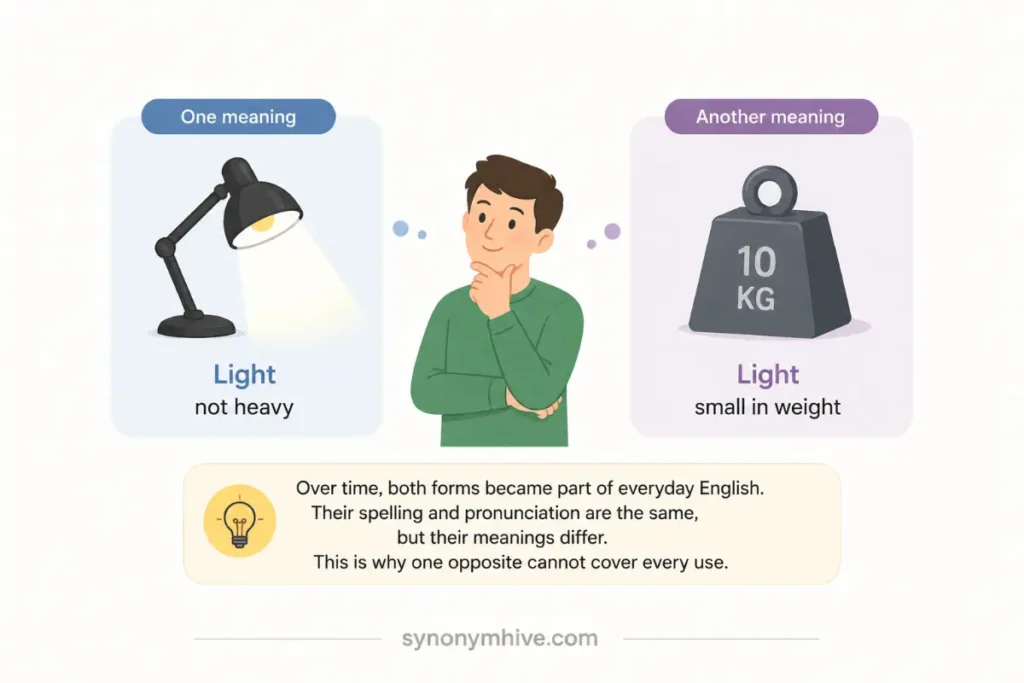
The English word light has a long history. The word for brightness comes from Old English lēoht, which is related to similar words in other Germanic languages. The word for low weight has a separate history, linked to an old English word meaning easy or not burdensome.
Over time, both forms became part of everyday English. Their spelling and pronunciation are the same, but their meanings differ. This is why one opposite cannot cover every use.
The brightness meaning refers to the presence of visible illumination. A bright room has enough light to see clearly, while a dark room has little illumination. In a figurative sense, light can also suggest hope, understanding, or happiness. Its opposite may then be gloom, confusion, or sadness.
The weight meaning describes how much something weighs or how easy it is to lift or carry. A light backpack is easy to carry. A heavy backpack puts more strain on the person carrying it.
Color uses add another layer. Light blue has a pale appearance, while dark blue has a deeper appearance. In this case, light and dark describe shade, not the actual amount of illumination in a room.
Understanding these meanings helps you choose a more exact opposite instead of relying on the same familiar word every time.
What Are the Best Words to Use Instead of Light
The best replacement depends on what you want to describe. Use dark for a lack of brightness, heavy for weight, deep for some colors, and demanding for a workload that takes effort.
The table below groups useful alternatives by style and setting. The categories are practical rather than strict grammar rules. A word that sounds natural in conversation may also work in writing, but formal reports often need more precise wording.
Simple words for everyday use
| Word | Meaning | Tone | Example |
|---|---|---|---|
| Dark | Having little light | Neutral | The kitchen was dark before sunrise. |
| Heavy | Weighing a lot | Neutral | This package is heavier than it looks. |
| Deep | Strong or dark in color | Neutral | He painted the wall deep blue. |
| Thick | Dense or difficult to see through | Neutral | Thick curtains blocked the sunlight. |
| Dim | Not brightly lit | Neutral | A dim lamp stood beside the bed. |
| Dull | Lacking brightness or vividness | Neutral | The paint looked dull under the old lights. |
| Strong | Forceful or intense | Neutral | The machine needed strong pressure to move the part. |
Everyday words for more precise meaning
| Word | Meaning | Tone | Example |
|---|---|---|---|
| Shadowy | Filled with shadows | Descriptive | We walked through a shadowy passage. |
| Gloomy | Dark or low in mood | Descriptive | The cloudy sky made the afternoon gloomy. |
| Murky | Dark, cloudy, or hard to see through | Descriptive | The water looked murky after the storm. |
| Weighty | Heavy or serious | Neutral to formal | She carried a weighty box upstairs. |
| Burdensome | Difficult to carry or manage | Formal | The extra paperwork became burdensome. |
| Dense | Closely packed or thick | Neutral | Dense clouds covered the hills. |
| Saturated | Strong or full in color | Technical or descriptive | The designer used a saturated red. |
| Somber | Serious, dark, or subdued | Formal | The room had a somber gray finish. |
Formal words for academic and professional writing
| Word | Meaning | Tone | Example |
|---|---|---|---|
| Unilluminated | Not lit | Technical | The unilluminated stairwell needed a safety light. |
| Obscure | Difficult to see or understand | Formal | The thick fog obscured the road. |
| Opaque | Not allowing light to pass through | Technical | The opaque screen blocked the view. |
| Substantial | Considerable in size or weight | Formal | The equipment was substantial and difficult to move. |
| Cumbersome | Awkward or difficult to carry or use | Formal | The old device was cumbersome to transport. |
| Demanding | Requiring considerable effort | Professional | The project became more demanding in its final stage. |
| Intense | Strong in degree or effect | Neutral to formal | The artist selected an intense shade of blue. |
| Somber | Muted, serious, or dark | Formal | The report used a somber visual style. |
Slang and casual expressions
Slang depends on the group and situation. Some expressions are playful, while others can sound blunt or exaggerated. They usually suit texts and casual conversation better than academic or professional writing.
| Word or phrase | Meaning | Tone | Example |
|---|---|---|---|
| Pitch black | Completely dark | Casual | The garage was pitch black. |
| Jet black | Extremely black in color | Casual | He bought a jet black cap. |
| A ton | A very large amount or weight | Informal | This bag weighs a ton. |
| Super heavy | Much heavier than expected | Casual | That box is super heavy. |
| Dark as night | Very dark | Conversational | The room was dark as night. |
| A real workout | Difficult to lift or carry | Playful | Carrying those groceries was a real workout. |
| Moody | Dark or subdued in style | Casual or descriptive | The café has a moody look after sunset. |
Not every word in these tables is a direct dictionary opposite. Some describe a result, a degree, or a related quality. For example, opaque describes a material that blocks light, while dark describes a place or object with little brightness. Choose the word that matches the meaning in your sentence.

Which Words Describe a Mild or Strong Opposite
Some words describe a small change, while others suggest an extreme difference. Picking the right strength makes your writing more accurate.
Mild differences
Use these words when an object has less brightness or a color looks less vivid, but it is not completely dark.
- Dim. A dim room has limited brightness, but you may still see objects clearly.
- Dull. A dull color lacks vividness. It may look faded rather than dark.
- Muted. A muted shade has a softer appearance than a bold or vivid one.
- Shaded. A shaded place receives less direct light, often because something blocks the sun.
- Deep. A deep color looks stronger or darker than a pale shade.
Example: The designer replaced the light yellow background with a muted gold shade. The change made the page calmer without making it look dark.
Moderate differences
These words describe a clear lack of brightness or a noticeable increase in weight.
- Dark. Use it for a room, street, sky, or object with little light.
- Shadowy. Use it for a place where shadows cover parts of the scene.
- Murky. Use it when something is dark and difficult to see through, such as cloudy water.
- Heavy. Use it when an object has considerable weight or a task requires effort.
- Cumbersome. Use it when an object is awkward to carry, handle, or use.
Example: The light suitcase was easy to lift, but the heavier case needed two hands.
Strong differences
Use these words when you need to describe an extreme lack of brightness or a large amount of weight.
- Pitch black. This means extremely dark, with almost no visible light.
- Blackout dark. This informal phrase suggests darkness caused by a loss of lighting.
- Jet black. This describes a very deep black color rather than a dark room.
- Massive. This can describe something very large or substantial, but it does not always mean heavy.
- Weighty. This means heavy in a physical sense or serious in an abstract sense.
Example: The tunnel was pitch black, and the workers had to carry massive equipment through it.
Choose a strong word only when the situation supports it. Pitch black is too dramatic for a room with a single dim lamp, and massive may describe size rather than actual weight.
How Does the Opposite Change by Part of Speech
The word light can work as a noun, adjective, or verb. Its opposite changes with the grammatical role and the meaning.
Light as a noun
As a noun, light usually means illumination. The opposite is darkness.
- The light from the window brightened the room.
- Darkness covered the street after the power failed.
- The photographer used a lamp to reduce the shadows.
Light can also mean a source of illumination, such as a lamp or traffic signal. In that case, darkness is the opposite condition, not a direct replacement for the object itself.
Light as an adjective
As an adjective, light can describe brightness, weight, color, flavor, or workload.
| Use | Opposite | Example |
|---|---|---|
| Brightness | Dark | The room is dark. |
| Weight | Heavy | The suitcase is heavy. |
| Color | Dark or deep | She wore a dark blue dress. |
| Meal | Heavy or rich | We ate a heavy dinner. |
| Workload | Heavy or demanding | Friday was a demanding workday. |
| Sleep | Deep or sound | He had a deep sleep. |
| Touch | Firm or strong | Apply firm pressure to the surface. |
The adjective needs context. A light jacket might be thin and easy to wear, but a dark jacket refers to its color. Heavy does not always mean the opposite of light when color is the topic.
Light as a verb
As a verb, light can mean to set something burning or to provide illumination. The best opposite depends on the action.
- Extinguish means to put out a flame. The firefighter extinguished the candle.
- Douse means to put out a fire or soak something with liquid. They doused the small fire with water.
- Darken means to make something darker. Thick clouds darkened the sky.
- Dim means to reduce the brightness of a light. She dimmed the lamp before bed.
These verbs are not interchangeable. You extinguish a candle, but you dim a lamp when you want less light rather than no light at all.
What Is the Difference Between Light and Dark
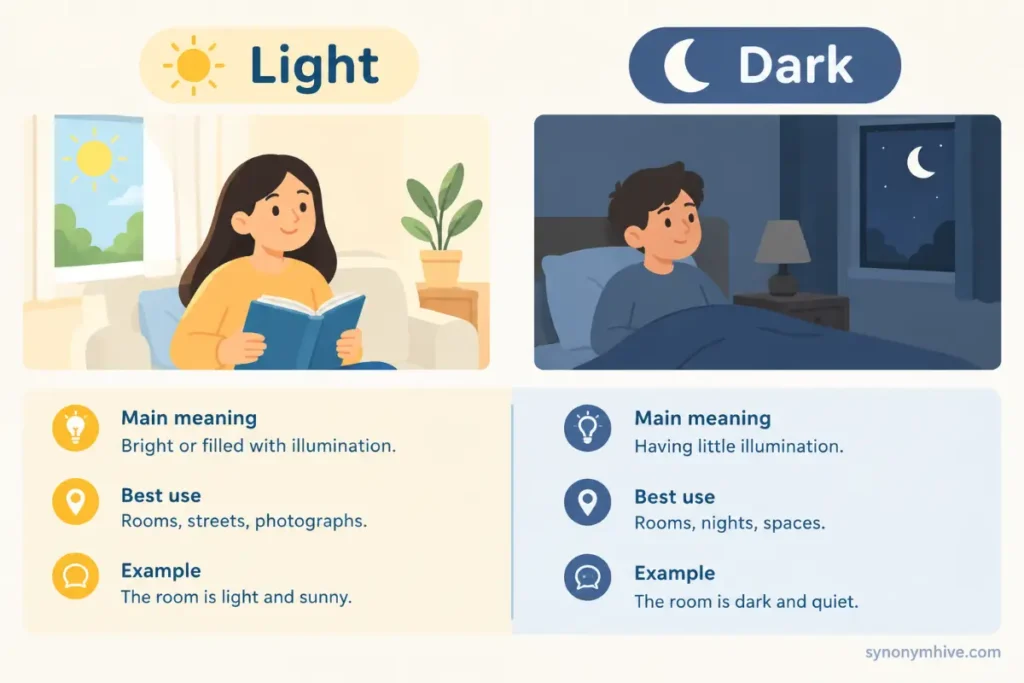
Light and dark are opposites when the subject is brightness or shade. Yet each word covers several related ideas.
| Word | Main meaning | Best use | Example |
|---|---|---|---|
| Light | Bright or filled with illumination | Rooms, streets, photographs | The room is light and sunny. |
| Dark | Having little illumination | Rooms, nights, spaces | The room is dark and quiet. |
| Dim | Low in brightness | Lamps and weak lighting | The hallway light is dim. |
| Shadowy | Covered by shadows | Places and scenes | A shadowy figure stood near the gate. |
| Murky | Dark and difficult to see through | Water, air, unclear conditions | Murky water hid the stones below. |
| Gloomy | Dark or low in mood | Weather, rooms, atmosphere | The sky looked gloomy before the rain. |
Dark is the safest general choice when describing a lack of brightness. Dim is more precise when some light remains. Murky suggests poor visibility, and gloomy can describe a mood as well as a physical setting.
Consider these sentences.
- The room was dark, so I turned on the ceiling light.
- The lamp was dim, so I replaced its bulb.
- The pond looked murky after the heavy rain.
- The office seemed gloomy on the cloudy morning.
Each sentence gives the reader a different picture. Replacing every word with dark would remove useful detail.
What Is the Difference Between Light and Heavy
Light and heavy describe weight, but they can also refer to effort, meals, workload, and other qualities. Heavy is the most direct opposite when light means easy to lift or carry.
| Expression | Meaning | Example |
|---|---|---|
| Light bag | Easy to lift or carry | My light bag fits under the seat. |
| Heavy bag | Weighs a lot | The heavy bag strained my shoulder. |
| Light workload | A small amount of work | I have a light workload today. |
| Heavy workload | A large or demanding amount of work | The team has a heavy workload this month. |
| Light meal | Not very filling or rich | I had a light meal before the meeting. |
| Heavy meal | Filling or rich food | A heavy meal made me sleepy. |
A heavy task is not necessarily physically heavy. It may require time, focus, or emotional effort. Likewise, a light workload usually means there is less work to do, not that the work weighs less.
In professional writing, use a more exact word when the meaning matters. A resume might describe a demanding schedule, a large project, or a substantial workload instead of calling the work heavy. These choices tell readers more about the situation.
You may also like Opposite of Kind Best Words for Every Situation.
Is Dark the Opposite of Light in Every Situation
No. Dark works best when light describes brightness or shade. Heavy is the usual opposite when light describes weight, and other words may fit sleep, meals, pressure, or workload.
A simple way to choose is to replace light with its meaning before selecting an opposite.
- If light means bright, try dark.
- If light means low in weight, try heavy.
- If light means pale, try dark or deep.
- If light means not filling, try rich or filling.
- If light means a small amount of work, try demanding or heavy.
- If light means a gentle touch, try firm or strong.
This quick check helps you avoid a word that is technically familiar but wrong for the sentence. The most useful opposite is the one that preserves your intended meaning.
What Is the Best Opposite of Light for Each Situation
The right word depends on your audience and purpose. A casual text can use simple language, while an essay or work email may need a more exact term. Here are practical choices for common writing situations.
What word should you use on a resume
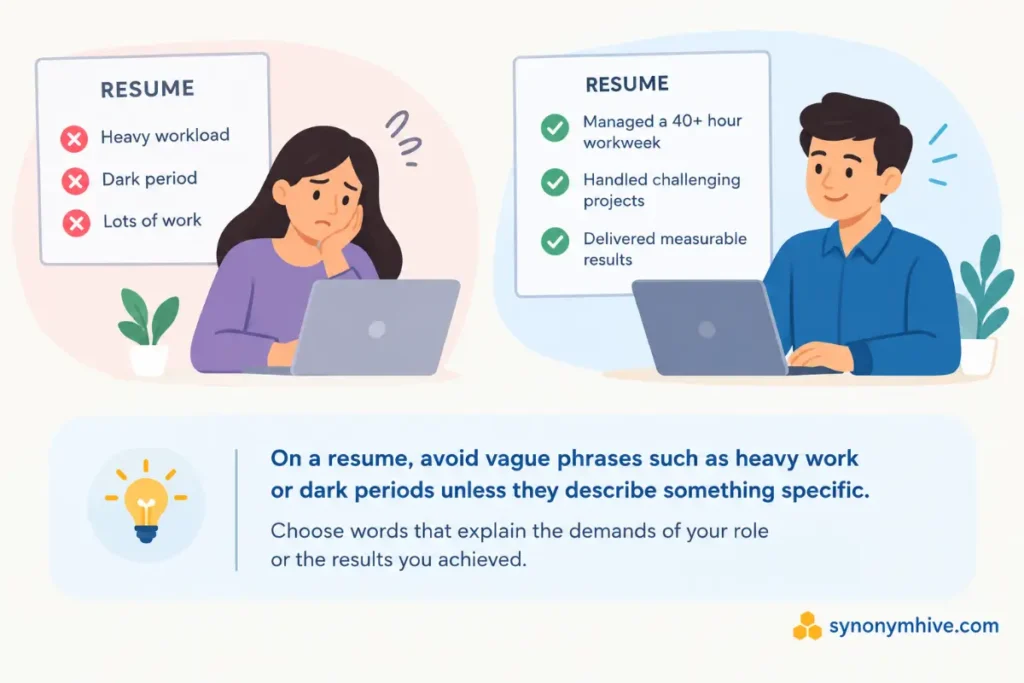
On a resume, avoid vague phrases such as heavy work or dark periods unless they describe something specific. Choose words that explain the demands of your role or the results you achieved.
Use demanding, substantial, complex, or intensive to describe work that required time, effort, or skill. Use heavy when it clearly refers to workload or physical weight.
Examples.
- Managed a demanding schedule while meeting weekly deadlines.
- Completed a substantial project that required coordination across three teams.
- Handled a heavy workload during the annual reporting period.
- Operated large equipment that required careful handling.
These phrases give an employer useful information. They also sound more precise than saying a job was not light.
What word works best in an essay
In an essay, choose words that fit the subject and keep your meaning clear. Dark works for a lack of light or a serious mood. Heavy can describe weight, a difficult workload, or a serious topic. Deep often works for colors and strong feelings.
Examples.
- The dark streets reflected the fear that had spread through the town.
- The author uses a gloomy setting to create suspense.
- The research team faced a demanding task.
- The painter used deep blue to create contrast with the pale background.
For academic writing, avoid slang such as super heavy or dark as night unless you are discussing informal speech or writing in a creative style.
What should you write in a text message
Texts often sound best when they use familiar words. Choose dark for a room, heavy for a bag, and pitch black for extreme darkness.
Examples.
- The room is too dark. Can you turn on the light?
- This box is so heavy.
- The road was pitch black last night.
- I picked a darker shade for the background.
Casual expressions can add personality, but make sure the other person understands the intended meaning. A ton is an informal way to describe something very heavy, not a precise measurement in everyday conversation.
What word fits best in an email
Work emails should be clear and direct. Use demanding for a task that requires effort, substantial for a large amount, and dim or dark when discussing lighting.
Examples.
- The current workload is substantial, so I suggest moving the deadline.
- The storage room is too dark for staff to read the labels safely.
- We may need a stronger lamp because the existing light is dim.
- The package is heavier than the listed shipping weight suggests.
When the email concerns a problem, describe the issue rather than relying on a vague opposite. Saying that a room is poorly lit tells a facilities team more than saying it is not light.
What word sounds natural in conversation
Everyday speech usually calls for short, familiar words. Dark and heavy work in most casual situations, while pitch black adds emphasis.
Examples.
- It gets dark early in winter.
- That suitcase is heavier than mine.
- The basement is pitch black.
- The food was too rich for lunch.
- This week’s schedule is pretty demanding.
In spoken English, context often makes the meaning clear. Still, use the more exact term when a misunderstanding could affect safety, cost, or plans.
How Do You Use the Opposite of Light in Real Sentences
These examples show how the right word changes across home life, school, work, travel, design, and conversation.
- At home. The living room was dark after the curtains were closed, so we switched on a lamp.
- While traveling. My backpack became heavy after I packed my laptop, charger, and water bottle.
- At school. The teacher asked us to compare a light shade of green with a deep green shade.
- At work. The final stage of the project was demanding because the team had to check every detail.
- In a shop. I chose a dark coat because the pale one showed stains more easily.
- During a power cut. The hallway was pitch black until someone found a flashlight.
- In a restaurant. I ordered a light lunch because I planned to eat a filling dinner later.
- In a bedroom. My brother is a deep sleeper, but I wake up at the smallest sound.
- In photography. The photographer adjusted the exposure because the background looked too dark.
- In interior design. The designer replaced the pale gray wall with a deeper charcoal shade.
- While exercising. The gym bag felt heavy after I added my shoes and water bottle.
- In a garden. Dense branches shaded the path and made it darker in the afternoon.
- In a classroom. The dim projector made the small text difficult to read.
- During a repair. The mechanic used firm pressure to loosen the stuck part.
- In a report. The team described the extra workload as substantial rather than simply calling it heavy.
Notice that the best word does more than reverse the meaning of light. It explains the specific quality that matters in each situation.
Common Mistakes When Choosing an Opposite
A familiar word can still be the wrong choice. Avoid these common errors when writing or speaking.
Using dark for every meaning
Dark is the standard opposite of light when discussing brightness or shade, but it does not describe low weight.
Incorrect: This dark suitcase is easy to lift because it weighs very little.
Better: This light suitcase is easy to lift because it weighs very little.
The suitcase may be dark in color, but its weight is light. Both descriptions can be true at once.
Using heavy when you mean dark
A heavy room is not a natural way to describe a room without much light. You might say a room has a heavy atmosphere when it feels serious or oppressive, but that is a figurative meaning.
Incorrect: The room was heavy, so I switched on the lamp.
Better: The room was dark, so I switched on the lamp.
Treating dim and dark as exact matches
Dim means low in brightness. Dark suggests little or no light. A dim room may still be easy to see in, while a very dark room may be difficult to move through safely.
Choose dim when some illumination remains and dark when the lack of light is the main point.
Confusing deep with dark
Deep often describes a strong or rich color, such as deep blue or deep red. Dark describes a low level of brightness or a shade that is closer to black. The words overlap, but they do not always mean the same thing.
For example, a deep red can look rich and vivid without looking nearly black.
Using formal words in casual messages
Words such as unilluminated and cumbersome may sound stiff in a quick text. A simple phrase such as not lit or hard to carry may be clearer.
Match the word to the setting. Formal vocabulary is useful when it improves precision, not when it makes an easy sentence harder to read.
Assuming every opposite has one perfect match
Language depends on context. Light meal can contrast with a heavy or rich meal, while light sleep contrasts more naturally with deep sleep. The word heavy does not fit every use of light.
Before choosing a replacement, identify the meaning you want to reverse.
What Are the Antonyms of Light
Antonyms are words with opposite or contrasting meanings. The main antonyms of light include dark and heavy, but several others fit specific uses.
| Word | Main contrast | Example |
|---|---|---|
| Dark | Bright | The room turned dark at sunset. |
| Heavy | Low in weight | The heavy suitcase needed a cart. |
| Deep | Pale in color | She selected a deep shade of green. |
| Rich | Light or plain in flavor | The sauce was rich and creamy. |
| Demanding | Easy or undemanding | The assignment was demanding. |
| Firm | Gentle or slight in pressure | Use firm pressure on the handle. |
| Deep | Light in sleep | He is a deep sleeper. |
| Gloomy | Bright or cheerful in mood | The gloomy weather lasted all day. |
Some of these are opposites only in a particular setting. Rich is a useful contrast for a light meal, but it is not the opposite of a bright room. Demanding contrasts with an easy task, while heavy contrasts with an object that weighs little.
Quick Tips for Choosing the Right Word
Use these simple checks when you need a suitable opposite.
- Check the meaning first. Decide if light refers to brightness, weight, color, food, sleep, or effort.
- Choose the clearest word. Dark and heavy work in many ordinary sentences because readers understand them quickly.
- Use precise alternatives when needed. Dim, murky, deep, and demanding give more detail than a general word.
- Think about the reader. Use familiar words in texts and conversation. Choose more exact language in reports and essays.
- Check the whole sentence. Read the sentence with your chosen word. If the meaning changes in an unintended way, try another term.
- Avoid exaggerated language. Pitch black describes extreme darkness, not every room with low lighting.
- Do not confuse color with illumination. A dark blue shirt can sit in a brightly lit room.
- Use a dictionary for unusual cases. Some phrases have established opposites that may not be obvious from the individual words.
Learn more useful word alternatives in Opposite of Brave Best Words for Every Situation 2026.
Conclusion
The best opposite of light is the word that matches the meaning you want to express. Dark is the clearest choice for brightness and shade, while heavy works for weight and demanding often suits a difficult workload. Other words, such as dim, deep, murky, and gloomy, add detail when the situation calls for it.
Think about the object or idea first, then choose a word that describes its exact quality. A dark room needs more light, a heavy bag may need two hands, and a demanding task may need more time. These distinctions help your writing sound natural and make your message easier to understand. With a little attention to context, you can choose an accurate word for essays, emails, conversations, and everyday descriptions.
Frequently Asked Questions
What is the opposite of light?
The most common opposite of light is dark when the word describes brightness. If light means low in weight, the opposite is heavy.
Is dark always the opposite of light?
No. Dark contrasts with light when discussing brightness or color, while heavy is the usual opposite for weight. The sentence determines the best choice.
What is the opposite of light in color?
Dark is the most common answer for color, while deep can describe a strong, rich shade. For example, light blue contrasts with dark blue or deep blue.
What is the opposite of light weight?
Heavy is the direct opposite of light when describing weight. You can also use weighty or cumbersome when you need to describe something substantial or awkward to carry.
What’s another way to say dark?
You can use dim, gloomy, shadowy, murky, or pitch black, depending on the situation. Dim describes weak lighting, while pitch black describes extreme darkness.
What is a formal word for dark?
Unilluminated, obscure, and somber can work in formal writing, but they have different meanings. Use unilluminated for a place without lighting, obscure when something is hard to see or understand, and somber for a dark or serious tone.
What is the opposite of light in a sentence about food?
Heavy or rich often contrasts with light when describing a meal. A light lunch is usually less filling than a heavy dinner.