

When you’re writing an essay, sending a text, or describing someone in a story, choosing the right word for a lack of intelligence can be tricky. You might think of words such as foolish, unwise, ignorant, or clueless. They all relate to being less than smart in some way, but they don’t mean exactly the same thing.
The opposite of smart is usually stupid or unintelligent, depending on the tone and situation. However, words such as foolish and unwise often describe a poor decision rather than a person’s intelligence. That difference matters when you want your writing to sound accurate and fair.
The opposite of smart can mean lacking intelligence, showing poor judgment, or making an unwise choice. The best word depends on the person, action, and context you want to describe.
This guide explains the meaning and origin of the word smart, compares more than 30 alternatives, and shows how each word works in everyday speech, essays, resumes, texts, and professional emails. You’ll also find examples, close word comparisons, common mistakes, and practical tips for choosing the most accurate term.
Find more synonyms in Opposite of Hard Best Words for Every Situation.
What Is the Opposite of Smart?
The most common opposites of smart are stupid and unintelligent. Both can describe someone who lacks the ability to understand, learn, or solve problems easily. However, stupid often sounds insulting, while unintelligent is more formal and direct.
Other words describe different aspects of being less than smart. Foolish and unwise usually focus on decisions. Clueless describes someone who does not understand what’s happening. Ignorant means lacking knowledge about a subject, and it does not automatically mean someone has low intelligence.
Here are a few simple examples.
- A smart student solves a problem by using logic. A student who struggles to understand the same problem may need more practice or a different explanation.
- A smart decision considers the risks. A foolish decision ignores clear warning signs.
- A knowledgeable employee understands the rules. An uninformed employee may make a mistake because nobody explained them.
These examples show why the best word depends on what you mean. Someone can be intelligent but make a foolish choice. A person can also lack knowledge about a topic and still be highly intelligent.
What Does Smart Mean in Plain English?
Smart commonly means intelligent, quick to learn, or good at solving problems. A smart person may understand difficult ideas, notice patterns, think logically, or find useful solutions.
The word also has other meanings. A smart outfit looks neat and stylish. A smart response may show good judgment. In technology, a smart device can use digital systems to perform useful tasks.
Because smart has several meanings, its opposite changes with the sentence.
| Meaning of smart | Possible opposite | Example |
|---|---|---|
| Intelligent | Unintelligent | The test measured skills that required intelligent reasoning. |
| Showing good judgment | Foolish | Ignoring the warning was a foolish choice. |
| Neat or stylish | Sloppy | He wore a sloppy outfit to the formal event. |
| Quick to understand | Slow to catch on | She was slow to catch on to the new process. |
| Clever or skillful | Inept | The inept response failed to solve the problem. |
For most questions about intelligence, stupid or unintelligent will be the closest match. For a decision, foolish or unwise may communicate the idea more clearly.
Is Stupid the Same as Unintelligent?
Stupid and unintelligent overlap, but their tone differs. Stupid is common in casual conversation and can sound harsh or insulting when used to describe a person. Unintelligent is more formal, though it can still sound judgmental.
Compare these examples.
- That was a stupid mistake.
- The report did not demonstrate strong reasoning skills.
The first sentence is blunt and emotional. The second is more measured and focuses on performance. In school or professional writing, describing the specific mistake is often more useful than labeling someone.
Use stupid carefully when you want to criticize a choice or action. Choose unintelligent only when intelligence itself is relevant and you have a reasonable basis for the description. In many situations, a more precise term such as careless, uninformed, or unwise is better.
Where Did the Word Smart Come From?
The history of smart helps explain why it can refer to intelligence, appearance, quickness, and good judgment.
The word comes from Old English roots connected with pain, sharpness, or causing a sharp sensation. Related forms developed meanings associated with being quick, vigorous, or sharp in thought. Over time, smart gained its familiar sense of being mentally quick and capable.
Today, English uses smart in several ways. A smart answer may show quick thinking. A smart investment may show good judgment. The intended meaning depends on the words around it.
The word stupid has a different history. It comes through Latin and French from a Latin term meaning stunned or dulled. Its modern meaning describes a lack of intelligence or judgment, but it often carries a strong negative tone.
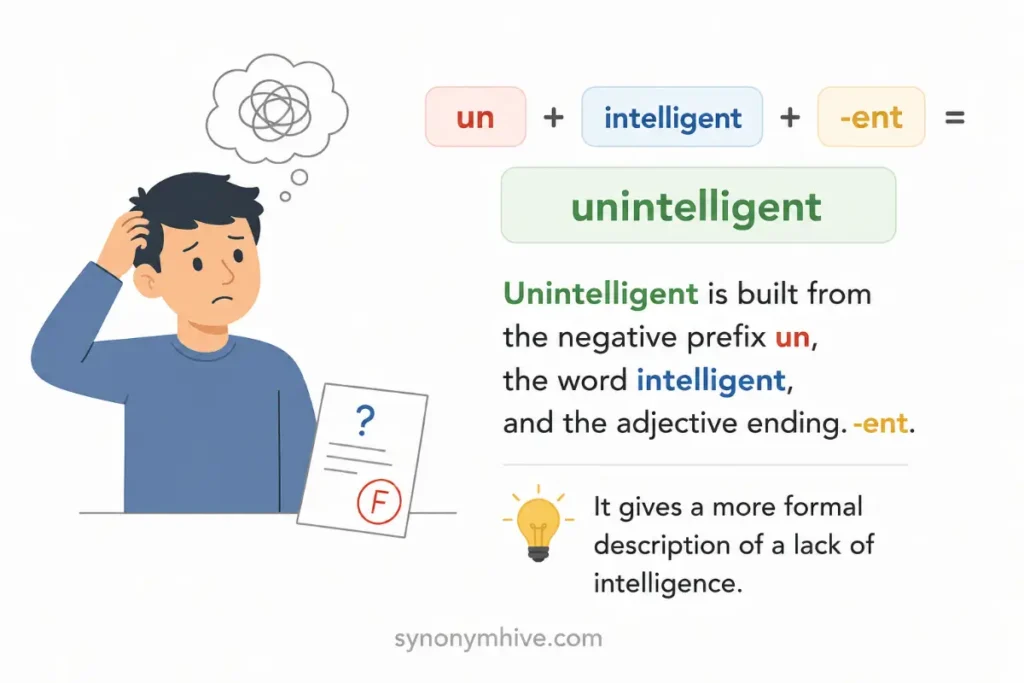
Unintelligent is built from the negative prefix un, the word intelligent, and the adjective ending. It gives a more formal description of a lack of intelligence.
Foolish has a long history in English and describes behavior that lacks good sense or judgment. Unlike unintelligent, it often focuses on what someone does rather than what the person can understand.
Why Smart Has More Than One Opposite
Words rarely have one perfect opposite for every situation. The meaning of smart changes with context, so its antonym changes too.
If smart means intelligent, use unintelligent or, in casual speech, stupid. If smart means well judged, use unwise or foolish.
This distinction makes writing clearer. Instead of choosing a strong word just because it sounds like an opposite, identify the exact meaning you want to reverse.
For example, calling a risky investment stupid may sound insulting. Calling it unwise explains the problem more clearly because the focus is on the decision and its risks.
What Does Smart Mean in Different Situations?
Smart can describe mental ability, practical skill, or sound judgment. These meanings often overlap, but they are not identical.
A person may have strong academic skills but poor practical judgment. Another person may not do well on tests but solve everyday problems with creativity and care. Someone can also be new to a subject and need more information without lacking intelligence.
For that reason, words such as ignorant, inexperienced, careless, and foolish should not be treated as direct synonyms for stupid. Each one points to a different issue.
Good word choice begins with a simple question: Are you describing a person’s ability, the knowledge they have, the decision they made, or the result of their action? Once you know that, selecting an accurate word becomes much easier.
Opposite of Smart Best Words and Examples
When you’re writing an essay, sending a text, or describing someone in a story, choosing the right word for a lack of intelligence can be tricky. You might think of words such as foolish, unwise, ignorant, or clueless. They all relate to being less than smart in some way, but they don’t mean exactly the same thing.
The opposite of smart is usually stupid or unintelligent, depending on the tone and situation. However, words such as foolish and unwise often describe a poor decision rather than a person’s intelligence. That difference matters when you want your writing to sound accurate and fair.
The opposite of smart can mean lacking intelligence, showing poor judgment, or making an unwise choice. The best word depends on the person, action, and context you want to describe.
This guide explains the meaning and origin of the word smart, compares more than 30 alternatives, and shows how each word works in everyday speech, essays, resumes, texts, and professional emails. You’ll also find examples, close word comparisons, common mistakes, and practical tips for choosing the most accurate term.
What Is the Opposite of Smart?
The most common opposites of smart are stupid and unintelligent. Both can describe someone who lacks the ability to understand, learn, or solve problems easily. However, stupid often sounds insulting, while unintelligent is more formal and direct.
Other words describe different aspects of being less than smart. Foolish and unwise usually focus on decisions. Clueless describes someone who does not understand what’s happening. Ignorant means lacking knowledge about a subject, and it does not automatically mean someone has low intelligence.
Here are a few simple examples.
- A smart student solves a problem by using logic. A student who struggles to understand the same problem may need more practice or a different explanation.
- A smart decision considers the risks. A foolish decision ignores clear warning signs.
- A knowledgeable employee understands the rules. An uninformed employee may make a mistake because nobody explained them.
These examples show why the best word depends on what you mean. Someone can be intelligent but make a foolish choice. A person can also lack knowledge about a topic and still be highly intelligent.
What Does Smart Mean in Plain English?
Smart commonly means intelligent, quick to learn, or good at solving problems. A smart person may understand difficult ideas, notice patterns, think logically, or find useful solutions.
The word also has other meanings. A smart outfit looks neat and stylish. A smart response may show good judgment. In technology, a smart device can use digital systems to perform useful tasks.
Because smart has several meanings, its opposite changes with the sentence.
| Meaning of smart | Possible opposite | Example |
|---|---|---|
| Intelligent | Unintelligent | The test measured skills that required intelligent reasoning. |
| Showing good judgment | Foolish | Ignoring the warning was a foolish choice. |
| Neat or stylish | Sloppy | He wore a sloppy outfit to the formal event. |
| Quick to understand | Slow to catch on | She was slow to catch on to the new process. |
| Clever or skillful | Inept | The inept response failed to solve the problem. |
For most questions about intelligence, stupid or unintelligent will be the closest match. For a decision, foolish or unwise may communicate the idea more clearly.
Is Stupid the Same as Unintelligent?
Stupid and unintelligent overlap, but their tone differs. Stupid is common in casual conversation and can sound harsh or insulting when used to describe a person. Unintelligent is more formal, though it can still sound judgmental.
Compare these examples.
- That was a stupid mistake.
- The report did not demonstrate strong reasoning skills.
The first sentence is blunt and emotional. The second is more measured and focuses on performance. In school or professional writing, describing the specific mistake is often more useful than labeling someone.
Use stupid carefully when you want to criticize a choice or action. Choose unintelligent only when intelligence itself is relevant and you have a reasonable basis for the description. In many situations, a more precise term such as careless, uninformed, or unwise is better.
Where Did the Word Smart Come From?
The history of smart helps explain why it can refer to intelligence, appearance, quickness, and good judgment.
The word comes from Old English roots connected with pain, sharpness, or causing a sharp sensation. Related forms developed meanings associated with being quick, vigorous, or sharp in thought. Over time, smart gained its familiar sense of being mentally quick and capable.
Today, English uses smart in several ways. A smart answer may show quick thinking. A smart investment may show good judgment. The intended meaning depends on the words around it.
The word stupid has a different history. It comes through Latin and French from a Latin term meaning stunned or dulled. Its modern meaning describes a lack of intelligence or judgment, but it often carries a strong negative tone.
Unintelligent is built from the negative prefix un, the word intelligent, and the adjective ending. It gives a more formal description of a lack of intelligence.
Foolish has a long history in English and describes behavior that lacks good sense or judgment. Unlike unintelligent, it often focuses on what someone does rather than what the person can understand.
Why Smart Has More Than One Opposite
Words rarely have one perfect opposite for every situation. The meaning of smart changes with context, so its antonym changes too.
If smart means intelligent, use unintelligent or, in casual speech, stupid. If smart means well judged, use unwise or foolish.
This distinction makes writing clearer. Instead of choosing a strong word just because it sounds like an opposite, identify the exact meaning you want to reverse.
For example, calling a risky investment stupid may sound insulting. Calling it unwise explains the problem more clearly because the focus is on the decision and its risks.
What Does Smart Mean in Different Situations?
Smart can describe mental ability, practical skill, or sound judgment. These meanings often overlap, but they are not identical.
A person may have strong academic skills but poor practical judgment. Another person may not do well on tests but solve everyday problems with creativity and care. Someone can also be new to a subject and need more information without lacking intelligence.
For that reason, words such as ignorant, inexperienced, careless, and foolish should not be treated as direct synonyms for stupid. Each one points to a different issue.
Good word choice begins with a simple question: Are you describing a person’s ability, the knowledge they have, the decision they made, or the result of their action? Once you know that, selecting an accurate word becomes much easier.
What Is the Best Word for Smart in Different Situations?
The right alternative depends on your audience and purpose. A school essay needs accurate language, a work email needs a professional tone, and a casual text may call for a simpler expression.
What Word Should You Use in a Resume?
A resume should focus on skills, results, and work performance. Avoid describing yourself or another person as stupid, dumb, or unintelligent. These labels rarely help an employer understand what happened.
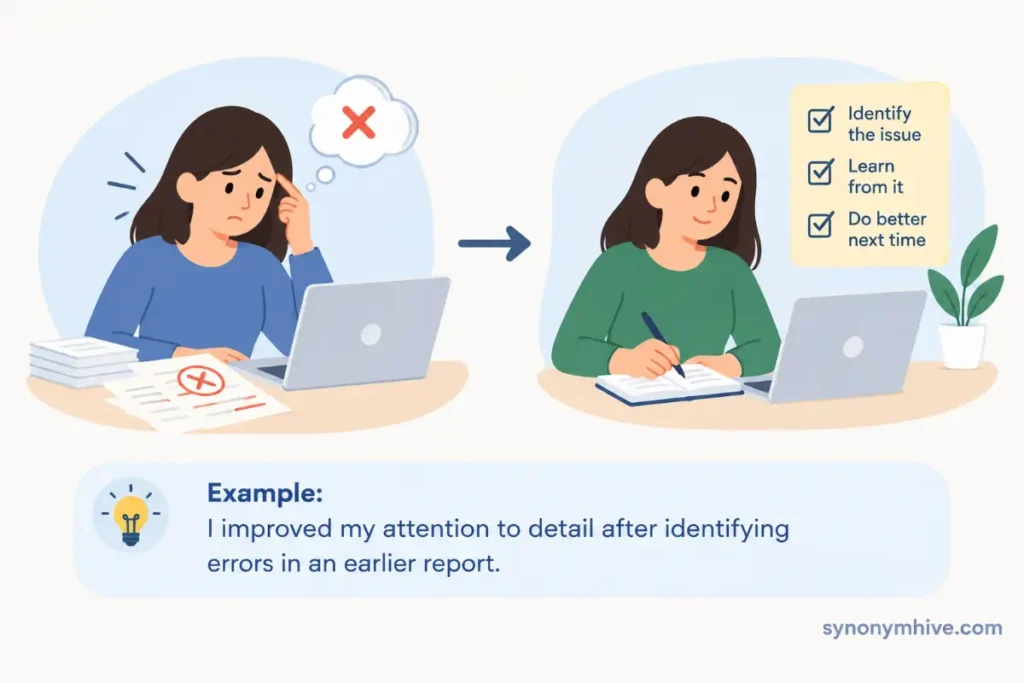
If you made a mistake at work, describe the problem and what you learned from it. If you’re writing about a team member, focus on a specific skill gap or performance issue.
Example sentence: I improved my attention to detail after identifying errors in an earlier report.
For professional feedback, terms such as inexperienced, unprepared, or lacking technical knowledge can be more useful than a broad label. They identify an area for improvement without making an unsupported claim about someone’s intelligence.
Example sentence: The employee needed additional training to complete the technical tasks accurately.
What Word Works Best in an Essay?
For an essay, choose a word that explains the problem clearly. Foolish and unwise work well for poor decisions. Illogical describes reasoning that does not make sense, while uninformed describes a view based on missing facts.
Example sentence: The character’s foolish decision creates problems that could have been avoided with careful planning.
If you are analyzing a historical event, avoid calling people stupid simply because their choices seem wrong today. They may have faced different information, beliefs, or limits at the time.
Example sentence: The policy was shortsighted because its authors failed to consider the long term effects.
A strong essay supports each judgment with evidence. Explain what a character, leader, or group did and why the decision was flawed. That approach creates a more convincing argument than relying on insults.
What Word Sounds Natural in a Text Message?
In casual messages, people commonly use words such as dumb, silly, foolish, and clueless. These terms can sound natural among friends, but their impact depends on the relationship and the situation.
Example sentence: That was a silly way to spend your last twenty dollars.
If you want to criticize a choice without insulting the person, focus on the action.
Example sentence: That decision wasn’t very wise, especially with rent due next week.
Be careful with words such as stupid and dumb when someone is already upset. A message that seems funny to the sender may sound hurtful to the reader. When the goal is to solve a problem, clear and respectful wording usually works better.
Which Word Is Best for a Work Email?
Professional emails should describe facts, risks, and actions rather than attack someone’s intelligence. Words such as uninformed, unwise, inaccurate, and illogical can help explain a problem when they fit the evidence.
Example sentence: The recommendation appears unwise because it does not account for the additional costs.
If the issue concerns missing information, use uninformed or incomplete rather than stupid. If the problem is a calculation error, say that the calculation was incorrect.
Example sentence: The estimate was inaccurate because it left out two major expenses.
This style keeps the conversation focused on a solution. It also gives the recipient a clear understanding of what needs to change.
What Word Sounds Best in Everyday Conversation?
Foolish, silly, clueless, and unwise are useful in everyday speech. Foolish often describes a bad decision, silly can soften a criticism, and clueless suggests a lack of understanding about a particular situation.
Example sentence: I was clueless about the parking rules, so I checked the signs before leaving my car.
If someone makes a risky choice, you might say it was unwise. If the choice creates a problem that could easily have been avoided, foolish may fit better.
Choose words that explain the situation without making a personal attack. This is especially useful when you want to give advice or point out a mistake without hurting a friendship.
What Are Some Real Examples of the Opposite of Smart?
The following examples show how different words work in real situations. Each sentence focuses on a specific action, knowledge gap, or reasoning problem.
- At school. A student submits an essay without reading the assignment instructions. The student was careless because a quick review could have prevented the mistake.
- At work. An employee agrees to a deadline without checking how much time the project needs. The decision was unwise because it ignored a practical limit.
- With money. Someone spends the money needed for rent on an expensive item. The purchase was foolish because it put an essential expense at risk.
- Online. A buyer believes a stranger who promises a large return for a small payment. The buyer may be gullible because the offer contains warning signs.
- During a debate. A speaker makes a claim that contradicts the evidence presented earlier. The argument is illogical because its conclusion does not follow from the facts.
- In a friendship. A person believes every rumor without checking the source. That response may be naive because it assumes the information is trustworthy without enough evidence.
- In a meeting. A manager approves a plan without reading its cost estimate. The choice is shortsighted because it ignores a major factor that could affect the outcome.
- While driving. A driver ignores a clear road warning and enters a closed area. The action is reckless because it creates avoidable danger.
- At home. Someone tries to repair an electrical problem without understanding the safety risks. The decision is unwise and potentially dangerous.
- In a classroom. A student has never studied a topic and gives an incorrect answer. The student may be uninformed, but that does not prove a lack of intelligence.
- In a team project. A worker repeatedly fails to follow required procedures despite receiving clear instructions and support. The performance may show a skill gap or a need for further training.
- During a purchase. A customer buys a product without comparing prices or checking its condition. The decision may be careless if a quick check would have revealed a better option.
These examples show that a precise word explains more than a broad insult. A person may lack information, make a poor decision, overlook a detail, or need more experience. Those are different problems, and each calls for a different description.
Explore another synonym guide: Opposite of Confident Best Words for Every Situation.
What Is the Difference Between Stupid and Foolish?
Stupid and foolish are sometimes used in similar ways, but they place emphasis on different ideas. Stupid can describe a lack of intelligence or a mistake, while foolish usually focuses on poor judgment.
| Point of comparison | Stupid | Foolish |
|---|---|---|
| Main meaning | Lacking intelligence or showing very poor judgment | Acting without good sense |
| Typical tone | Blunt and potentially insulting | Critical but often less personal |
| Common use | Insults, casual criticism, strong reactions | Decisions, actions, and choices |
| Example | That was a stupid mistake. | It was foolish to ignore the warning. |
A person can make a foolish decision while being highly intelligent. For example, an experienced investor may understand the market but still take an unnecessary risk. Calling the decision foolish describes the poor judgment without claiming that the person lacks intelligence.
Stupid can sound much harsher when directed at someone. In careful writing, explain the specific error instead of using the word as a label.
What Is the Difference Between Ignorant and Unintelligent?
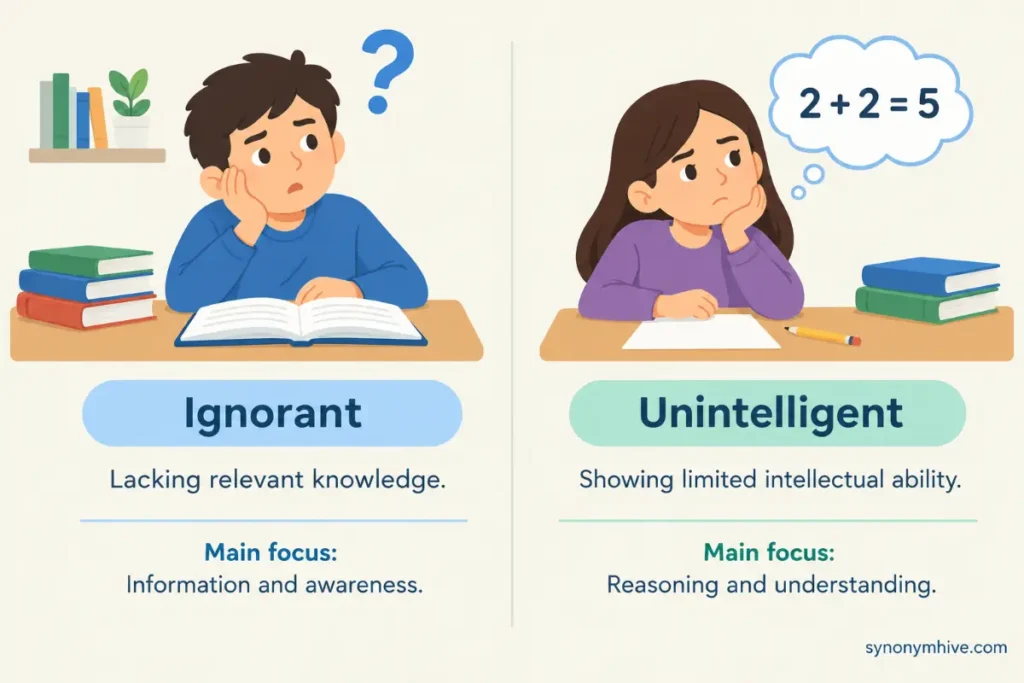
Ignorant and unintelligent do not mean the same thing. Ignorant means lacking knowledge or awareness about a subject. Unintelligent refers to a lack of intellectual ability.
| Point of comparison | Ignorant | Unintelligent |
|---|---|---|
| Main meaning | Lacking relevant knowledge | Showing limited intellectual ability |
| Main focus | Information and awareness | Reasoning and understanding |
| Can education help? | Often, yes | Education can improve knowledge and skills, but the word refers to a broader ability |
| Example | He was ignorant of the local law. | The assessment examined several reasoning skills. |
Someone may be ignorant of a topic simply because they have never learned about it. A scientist can know little about a particular law, a student can be unfamiliar with a historical event, and a new employee can lack knowledge of company procedures.
None of these situations proves that the person is unintelligent. If missing information explains the problem, use ignorant or uninformed carefully and describe the subject. This is more accurate than treating a knowledge gap as proof of low intelligence.
What Are the Common Mistakes When Choosing an Opposite of Smart?
Choosing a word that is too strong or too vague can weaken your writing. Keep these common mistakes in mind.
Using Stupid for Every Mistake
A mistake does not automatically show low intelligence. Someone may be tired, distracted, inexperienced, or working with incomplete information.
Instead of saying, “She was stupid with the figures,” consider saying, “She made a careless calculation error.” The second sentence explains what happened and gives the reader a clearer picture.
Confusing Ignorance With Low Intelligence
A person who does not know a fact may simply lack the relevant information. Ignorance can often be corrected through learning, research, or experience.
Use uninformed when the person lacks important facts. Use unintelligent only when intellectual ability is genuinely relevant to the discussion and the description is supported by evidence.
Calling Every Bad Decision Irrational
Irrational suggests that a decision does not follow sound reasoning. A choice can have disadvantages and still make sense to someone who has different priorities or limited options.
Before calling a decision irrational, consider the information available to the person at the time. Unwise or shortsighted may be more accurate if the decision simply failed to account for a risk.
Treating Inexperience as Incompetence
Inexperience means someone has not had much practice or exposure. Incompetence suggests that the person lacks the ability to perform a task adequately.
A new employee may need training before completing a job independently. That does not automatically make the employee incompetent. Describe the actual performance and the support required.
Using Slang in Formal Writing
Words such as dumb, boneheaded, and airheaded may work in casual conversation, but they can sound unprofessional in an essay, report, or work email.
For formal writing, consider unwise, uninformed, illogical, or careless. Choose the term that describes the actual issue rather than the term that sounds most dramatic.
Making a Broad Judgment About a Person
One poor decision does not define someone’s intelligence. A person may make a foolish choice in one situation and show excellent judgment in another.
Focus on the action, the evidence, and the result. If a pattern of poor performance exists, describe that pattern rather than relying on a personal insult.
What Are the Antonyms of Smart in a Quick List?
The most useful antonyms depend on which meaning of smart you want to express.
- Stupid.
- Unintelligent.
- Foolish.
- Unwise.
- Silly.
- Ignorant.
- Clueless.
- Illogical.
- Irrational.
- Careless.
- Naive.
- Gullible.
- Shortsighted.
- Inept.
- Incompetent.
- Uninformed.
- Imprudent.
- Unsound.
Stupid and unintelligent are common choices when you mean a lack of intelligence. Foolish and unwise are better for poor decisions. Ignorant and uninformed describe missing knowledge, while illogical refers to faulty reasoning.
If smart means neat or stylish, the opposite may be sloppy or untidy instead. Always check the sentence before choosing an antonym.
How Can You Choose the Right Word?
Use these practical steps to make your word choice more accurate.
- Identify the problem. Decide if you’re describing intelligence, knowledge, judgment, attention, or skill.
- Match the tone to the audience. Casual speech may allow blunt words, but professional writing usually needs neutral language.
- Check the strength of the word. Use mild terms for small errors and stronger terms only for serious or repeated problems.
- Avoid guessing intent. A person who overlooks a detail may be careless, but that does not prove they intended to make a mistake.
- Describe the evidence. Explain what happened and why the reasoning or decision failed.
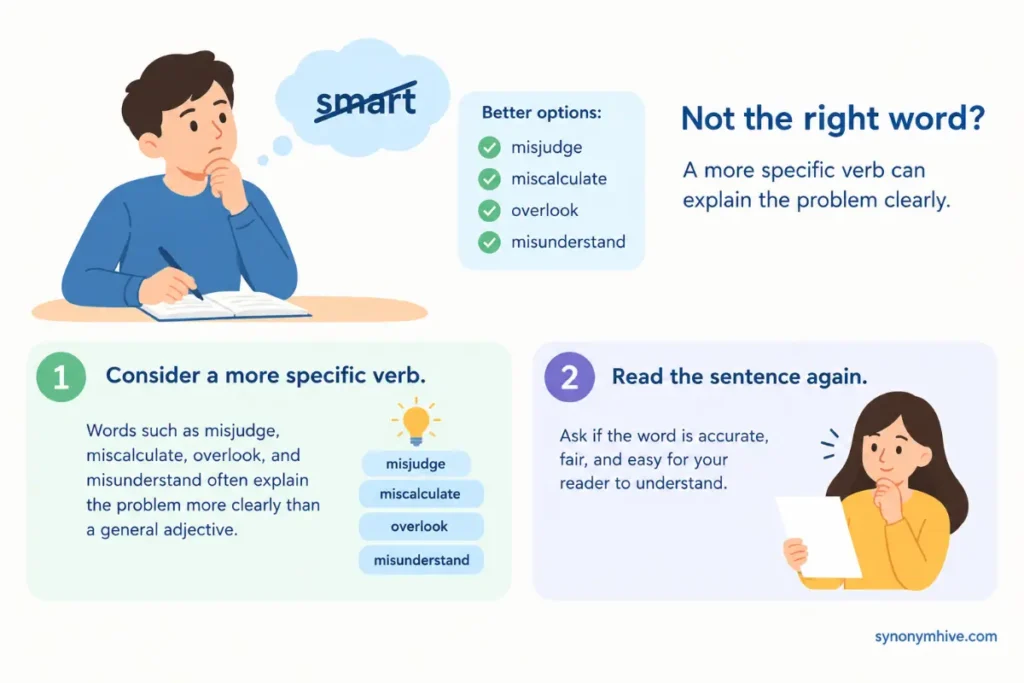
- Consider a more specific verb. Words such as misjudge, miscalculate, overlook, and misunderstand often explain the problem more clearly than a general adjective.
- Read the sentence again. Ask if the word is accurate, fair, and easy for your reader to understand.
For example, “The proposal was stupid” gives little information. “The proposal was unwise because it ignored the projected costs” explains the weakness and supports the criticism.
Learn more useful word alternatives in Opposite of Open: Best Words for Every Situation.
Conclusion
The best word to use for the opposite of smart depends on what you want to describe. Stupid and unintelligent relate to intelligence, while foolish and unwise focus on poor judgment. Ignorant and uninformed describe missing knowledge, and illogical points to reasoning that does not hold up. These distinctions help you communicate clearly without using a word that is too harsh or inaccurate.
Before choosing an antonym, consider the action, the available information, and the result. A specific description often works better than a personal label, especially in essays, resumes, and workplace communication. You can make your writing stronger by naming the exact problem and explaining why it matters. The goal is not to find the harshest word. It is to find the word that tells the truth as clearly as possible.
Frequently Asked Questions
What is the opposite of smart in one word?
Stupid is a common one word opposite of smart, while unintelligent is a more formal option. Foolish is often better when you mean a poor decision rather than a lack of intelligence.
What is a polite word for stupid?
Unwise, mistaken, uninformed, or careless may be more polite, depending on the situation. These words explain a specific problem without making a broad judgment about someone’s intelligence.
Is ignorant the same as unintelligent?
No. Ignorant means lacking knowledge about a subject, while unintelligent refers to intellectual ability. A person can be highly intelligent and still lack information about a topic.
What’s another way to say someone made a stupid decision?
You can say the person made an unwise, foolish, shortsighted, or imprudent decision. The best choice depends on whether the decision involved poor judgment, ignored risks, or a lack of planning.
What is the opposite of smart in an essay?
Unintelligent can describe a lack of intelligence, while foolish or unwise can describe poor judgment. In an essay, explain the evidence behind your word choice so the point remains clear and fair.
Is foolish stronger than silly?
Yes, foolish often sounds more critical because it suggests poor judgment. Silly can describe a harmless mistake, playful behavior, or something that lacks seriousness.
What is the opposite of smart when talking about clothes?
Sloppy or untidy can be the opposite of smart when smart means neat and stylish. The words stupid and unintelligent do not fit this meaning of smart.