
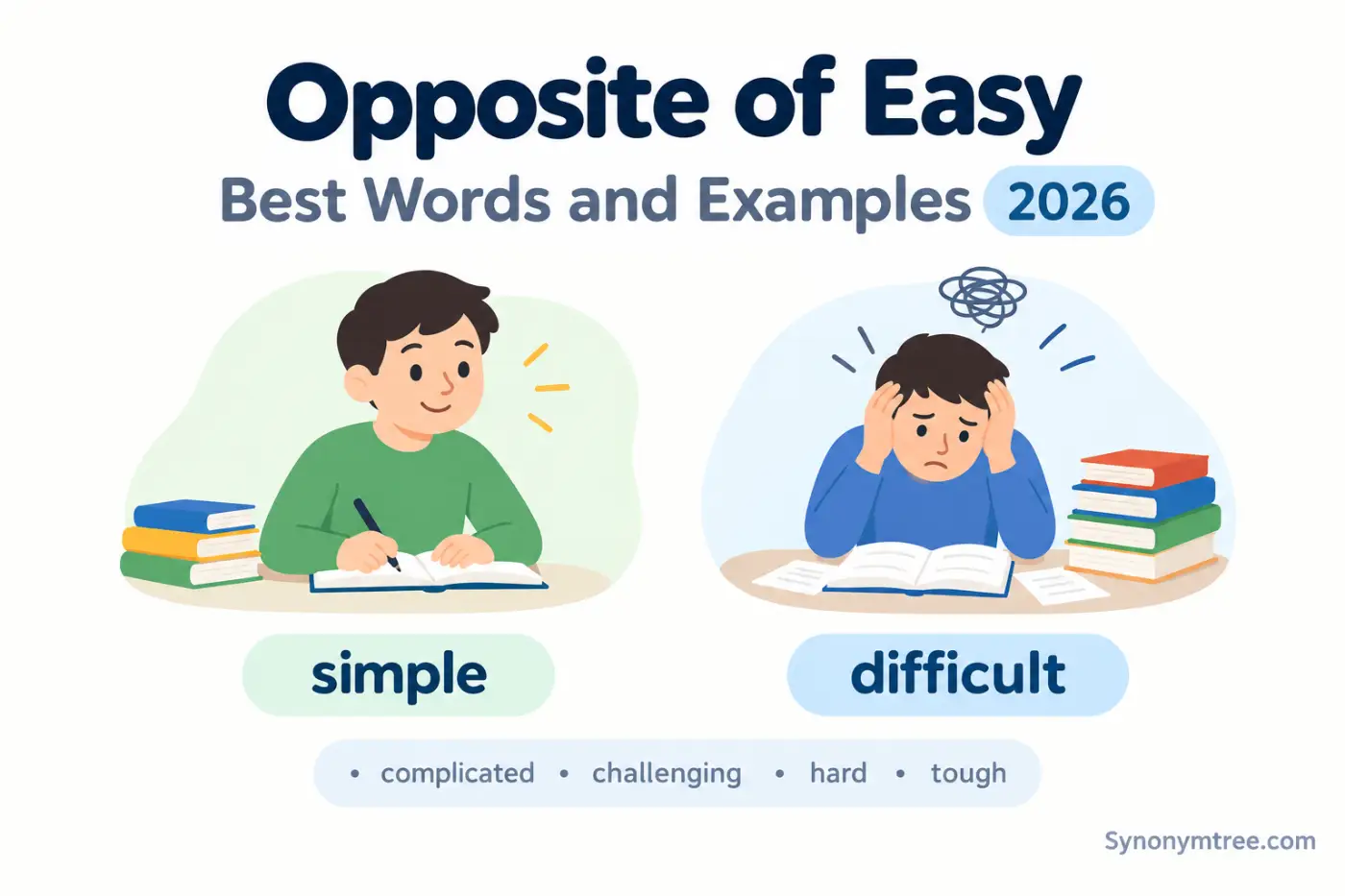
Writing an email, finishing a school assignment, or describing a task on your resume can make you stop and search for a better word than hard. You might need to explain that a project took extra effort, a test required careful thought, or a new skill was difficult to learn. The right word helps readers understand the kind of challenge you mean. The most common opposite of easy is difficult. Hard is another everyday choice. However, these words do not cover every situation. A complicated task has many parts, a demanding job requires sustained effort, and a challenging problem tests your skills or knowledge.
The opposite of easy is usually difficult or hard. These words describe something that takes effort, skill, time, or careful thought to complete.
Choosing a more precise word can make your writing clearer and more natural. This guide explains the meaning and origin of easy, compares more than 30 alternatives, and shows how to use them in resumes, essays, emails, texts, and everyday conversations. You will also learn the differences between close synonyms, common mistakes to avoid, and how to choose a word that fits the situation.
Looking for another word? See Opposite of Loud The Best Words to Use.
What Is the Opposite of Easy in Plain English?
The simplest answer is difficult. When something is difficult, it takes more effort, knowledge, time, or skill than usual. Hard has a similar meaning and often sounds more natural in casual speech.
For example, a difficult exam tests what you have learned. A hard workout pushes your physical limits. A complicated form may be difficult to complete because it contains many steps, while a demanding job may require long hours and steady attention.
The best alternative depends on the source of the difficulty. If a task takes a lot of effort, demanding may fit. If it has too many parts or rules, complicated may be more accurate.
What Does Easy Mean?
Easy is an adjective that describes something that requires little effort, skill, time, or difficulty. It can refer to a task, decision, experience, process, or activity.
An easy question takes little thought to answer. An easy recipe has simple steps.
The word can also describe a relaxed manner or comfortable situation. An easy conversation flows naturally, while an easygoing person tends to remain calm and relaxed. These meanings matter because the opposite is not always difficult.
For example, the opposite of an easygoing person might be tense or strict, depending on the intended meaning. The opposite of an easy question, however, would usually be a difficult question.
What Is the Origin of the Word Easy?
The word easy entered English through Old French, from a word related to Latin adjacens, meaning lying near or close by. Over time, its meaning developed toward something that causes little trouble or effort.
Today, easy applies to many kinds of experiences. It can describe physical work, mental tasks, social situations, instructions, choices, and processes. Its broad meaning explains why English has so many possible opposites.
Difficult comes through French from Latin roots connected with difficulty and trouble. Hard comes from Old English and has long described something firm, demanding, or not easily done. Although these words overlap, their histories and uses have helped give them slightly different tones in modern English.
In everyday writing, difficult often sounds a little more formal than hard. Both are common and correct. Other choices, such as demanding, complex, strenuous, or challenging, help explain exactly what makes something difficult.

What Words Can You Use Instead of Difficult?
English offers many alternatives to difficult. Some are simple and familiar, while others work better in formal writing or casual conversation. The tables below group these words by tone and meaning so you can choose one that fits your sentence.
Simple Words for Everyday Use
These words are common, easy to understand, and suitable for most general writing.
| Word | Meaning | Tone | Example |
|---|---|---|---|
| Hard | Requiring effort or skill | Neutral and casual | The final question was hard. |
| Tough | Difficult to handle or complete | Casual | We had a tough week at work. |
| Tricky | Difficult because it involves a hidden problem or detail | Casual | The last step is tricky. |
| Rough | Difficult or unpleasant to experience | Casual | It was a rough day at school. |
| Awkward | Difficult to manage or handle smoothly | Neutral | The awkward opening made the task harder. |
| Demanding | Requiring much effort or attention | Neutral | Caring for a newborn can be demanding. |
| Challenging | Testing a person’s ability or skill | Positive or neutral | Learning a new language is challenging. |
| Testing | Putting someone’s skill, patience, or strength under pressure | Neutral | The long trip was testing for everyone. |
Hard is the most direct everyday alternative to easy. Tough often suggests that a situation takes persistence. Tricky points to a detail that can cause mistakes, while demanding emphasizes the amount of effort required.
Everyday Alternatives With More Specific Meanings
These words help explain why a task or experience is not easy.
| Word | Meaning | Tone | Example |
|---|---|---|---|
| Complicated | Having many parts or steps that are hard to understand | Neutral | The instructions were complicated. |
| Confusing | Difficult to understand or follow | Neutral | The confusing directions led us to the wrong street. |
| Frustrating | Causing annoyance because progress is difficult | Emotional | The slow website was frustrating to use. |
| Exhausting | Using up a great deal of energy | Strong | The long hike was exhausting. |
| Strenuous | Requiring significant physical or mental effort | Neutral to formal | Moving the furniture was strenuous work. |
| Demanding | Requiring sustained effort or attention | Neutral | Her new role is demanding. |
| Unpleasant | Causing discomfort or dislike | Neutral | The repair was an unpleasant task. |
| Challenging | Requiring ability, effort, or persistence | Neutral or positive | The puzzle was challenging but fair. |
A confusing task may become easy once the instructions are clear. An exhausting activity can be simple to understand but tiring to perform. These distinctions make the words more useful than a basic list of synonyms.
Formal Words for Essays and Professional Writing
Formal alternatives are helpful when you need to describe a problem, explain a result, or assess the level of effort required.
| Word | Meaning | Tone | Example |
|---|---|---|---|
| Difficult | Requiring effort or skill | Formal and neutral | The researchers faced a difficult question. |
| Arduous | Requiring long, tiring effort | Formal | The team completed an arduous review. |
| Laborious | Requiring much time and effort | Formal | The laborious process delayed the report. |
| Complex | Involving many connected parts or ideas | Formal | The issue has a complex set of causes. |
| Intricate | Containing many small or detailed parts | Formal | The machine has an intricate design. |
| Demanding | Requiring considerable work or attention | Formal and neutral | The position is demanding. |
| Formidable | Difficult to deal with because of its size, strength, or complexity | Formal | The company faced a formidable challenge. |
| Problematic | Creating problems or raising concerns | Formal | The proposed method proved problematic. |
| Daunting | Seeming difficult enough to cause worry | Formal and neutral | The large assignment looked daunting. |
| Onerous | Involving an unpleasant or excessive burden | Formal | The onerous rules slowed the process. |
Use arduous for work that is long and tiring. Laborious emphasizes the time and effort involved. Complex focuses on connected parts or ideas, while intricate suggests many fine details. Daunting describes how intimidating a task seems before or during an attempt.
Slang and Informal Alternatives
Informal words can make everyday speech more expressive. They are useful in texts, friendly conversations, and casual storytelling, but they may sound out of place in academic or professional writing.
| Word | Meaning | Tone | Example |
|---|---|---|---|
| A pain | Annoying or difficult to deal with | Informal | Filling out those forms was a pain. |
| A hassle | Something that causes trouble or extra work | Informal | Getting the printer to work is a hassle. |
| A beast | Something extremely demanding or hard to handle | Slang | That final workout was a beast. |
| Brutal | Extremely hard or unpleasant | Informal and strong | The exam was brutal. |
| Killer | Extremely demanding or impressive in difficulty | Slang | We had a killer deadline. |
| No joke | Serious or harder than expected | Informal | That hike was no joke. |
| A nightmare | An experience that is very difficult or unpleasant | Informal and strong | The booking process was a nightmare. |
| Hairy | Risky, tense, or difficult to manage | Informal | The last part of the drive got hairy. |
Slang often adds emotion, not just meaning. Calling an exam brutal tells the reader that it felt extremely hard. Saying a form was a hassle suggests annoyance and extra work. In a formal report, difficult or burdensome would usually be a better choice.
Which Words Describe Difficulty From Mild to Extreme?
Not every difficult task is equally hard. A small challenge may need a little extra attention, while a demanding project can require weeks of steady work. Choosing a word that matches the level of difficulty helps readers understand the situation.
Mild Difficulty
Use these words when a task is manageable but still requires some thought or care.
- Tricky describes something that can cause mistakes because of a small detail or hidden problem.
- Awkward describes something that is hard to handle smoothly.
- Confusing describes something that is not clear or easy to understand.
- Challenging describes something that tests your ability or knowledge.
- Testing describes an experience that puts patience, skill, or strength under pressure.
For example, a tricky question may have one detail that changes the answer. An awkward conversation may require careful wording. A challenging class may take extra study time, but students can still succeed with practice.
These words do not suggest that a task is impossible. They simply explain why it needs more attention than usual.
Moderate Difficulty
These alternatives suggest that a task needs a noticeable amount of work, thought, or patience.
- Hard is a general term for something that takes effort.
- Tough often suggests that persistence is needed.
- Demanding describes something that requires ongoing effort or attention.
- Complicated describes a task with many steps or rules.
- Frustrating describes a task that causes annoyance or slows progress.
- Laborious describes work that takes a lot of time and effort.
A complicated tax form may be difficult because it contains many details. A demanding job may require constant attention. A laborious task may be easy to understand but take hours to finish.
Severe Difficulty
Use these words when the task requires exceptional effort or creates a major challenge.
- Arduous describes work that is long and tiring.
- Strenuous emphasizes physical or mental effort.
- Onerous describes a heavy or unpleasant burden.
- Daunting describes something that seems intimidating or overwhelming.
- Formidable describes a challenge that appears powerful or hard to overcome.
- Brutal is an informal term for an extremely difficult or unpleasant experience.
An arduous journey may take days of effort. A strenuous workout pushes the body hard. A daunting assignment may seem overwhelming at first, while a formidable opponent may be difficult to defeat.
Use severe terms carefully. Calling a routine meeting brutal can sound dramatic unless the meeting was unusually stressful or demanding.
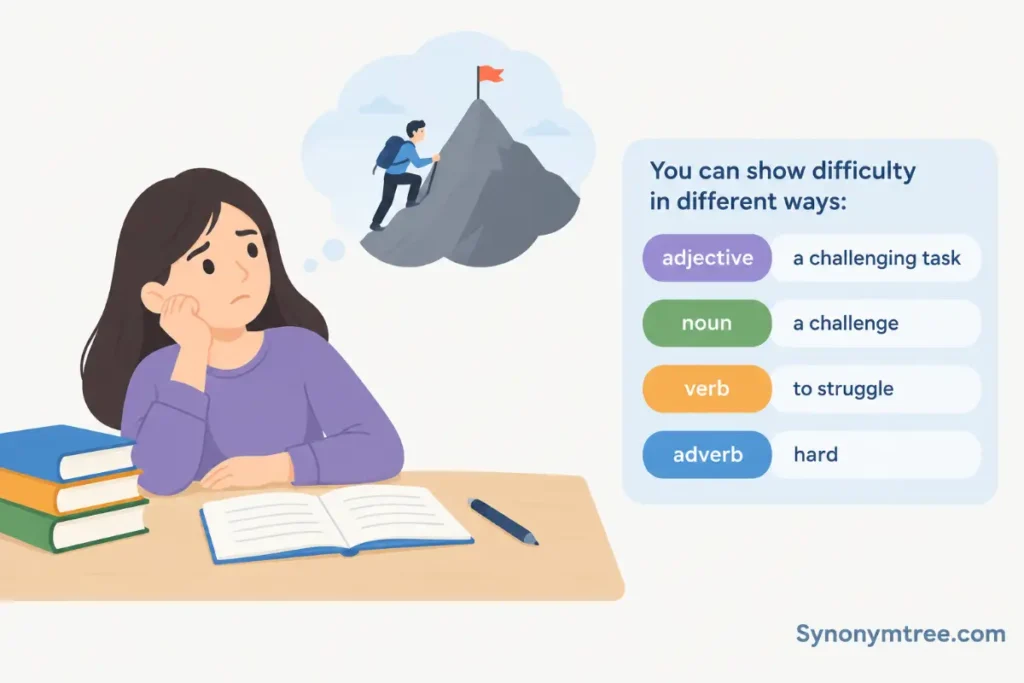
Which Opposite of Easy Works by Part of Speech?
Easy is an adjective, so the most direct opposites are also adjectives. However, you can express difficulty with nouns, verbs, and adverbs when the sentence calls for a different structure.
Adjectives That Describe Difficult Tasks
Adjectives describe the task, person, process, or experience.
Common choices include difficult, hard, challenging, demanding, complicated, confusing, arduous, strenuous, daunting, and laborious.
Examples include the following.
- The difficult assignment required careful research.
- The demanding schedule left little time for breaks.
- The complicated process involved several approval stages.
- The arduous climb tested the hikers’ endurance.
- The confusing directions made the route harder to follow.
The adjective should describe the main problem. Use confusing when the issue is understanding, demanding when the issue is effort, and arduous when the work is long and tiring.
Nouns That Name Difficulty
Nouns allow you to discuss the challenge itself instead of describing an object or activity.
| Noun | Meaning | Example |
|---|---|---|
| Difficulty | A problem or condition that requires effort | We had difficulty finding the correct entrance. |
| Challenge | A task that tests ability or determination | The new role presented a major challenge. |
| Struggle | A difficult effort to achieve something | She faced a struggle while learning to read music. |
| Obstacle | Something that blocks progress | A lack of funding became the main obstacle. |
| Burden | A responsibility or problem that is hard to carry | The extra paperwork became a burden. |
| Complication | A detail or problem that makes a situation harder | A delay created another complication. |
| Hardship | A serious condition that causes suffering or difficulty | The family endured financial hardship. |
Difficulty is the broadest option. A challenge can be positive because it gives someone a chance to grow. An obstacle blocks progress, while a burden suggests an unwanted responsibility. Hardship usually refers to serious problems in life rather than a small task.
Verbs That Show Something Becoming Difficult
Verbs describe actions or changes. They can show that a task becomes harder, that someone struggles, or that a process creates problems.
| Verb | Meaning | Example |
|---|---|---|
| Complicate | To make something harder to understand or manage | The extra rule complicated the application. |
| Hinder | To slow or block progress | Poor lighting hindered the repair work. |
| Struggle | To make a hard effort or have trouble | He struggled to understand the new software. |
| Strain | To place pressure on a person or system | The extra workload strained the team. |
| Burden | To place a heavy responsibility on someone | The new rule burdened small businesses. |
| Overwhelm | To make someone feel unable to manage the amount of work | The large number of tasks overwhelmed the new employee. |
These verbs express different kinds of difficulty. Complicate adds problems or extra steps. Hinder blocks progress. Overwhelm suggests that the amount of work or pressure is too much to manage comfortably.
Adverbs That Explain How Difficult Work Happens
Adverbs describe how someone performs an action. They can help explain the effort involved.
| Adverb | Meaning | Example |
|---|---|---|
| Laboriously | With slow and tiring effort | The crew laboriously moved the heavy equipment. |
| Reluctantly | With hesitation or unwillingness | He reluctantly agreed to repeat the test. |
| Painfully | With great difficulty or discomfort | She painfully worked through the confusing instructions. |
| Strenuously | With great effort | The team strenuously defended its decision. |
| Uneasily | With worry or discomfort | He answered the difficult question uneasily. |
Not all these adverbs mean difficult by themselves. Reluctantly describes unwillingness, while uneasily describes discomfort or worry. Use them when those details matter to the sentence.
Do American and British Speakers Use Different Words for Difficult?
American and British English share most common terms for difficulty. Difficult, hard, tough, tricky, complicated, demanding, and challenging are natural in both varieties.
Differences are more likely to involve informal expressions, local habits, and the situation in which a word is used.
Common American English Choices
American speakers often use hard, tough, tricky, and a hassle in everyday conversation.
Examples include these sentences.
- That math problem was tough.
- The online form was a hassle.
- The last part of the test was tricky.
- Moving to a new city can be hard.
These expressions are widely understood, but a hassle is casual. It describes an annoying problem or extra work rather than difficulty in every possible sense.
Common British English Choices
British speakers also use hard, tough, difficult, and tricky. Informal phrases such as a bit of a struggle can describe a task that takes more effort than expected.
For example, someone might say, The first week was a bit of a struggle, when describing an adjustment to a new job or school.
This phrase is not limited to Britain. American speakers use it too. The main point is that regional language preferences are flexible, and there is no strict rule that assigns one general synonym to only one country.
How Should You Choose a Word for an International Audience?
Use widely understood terms when writing for readers from different English speaking regions.
Difficult, hard, challenging, complicated, and demanding are safe choices for most international audiences. Slang such as a beast or hairy can confuse readers who are unfamiliar with the expression.
If clarity matters more than personality, choose the word that directly explains the problem. If you are writing dialogue or a casual message, an informal expression may sound more natural.
What Is the Best Word for Difficult in a Resume?
Resume writing requires a balance between honesty and confidence. If a project was hard, explain the specific challenge instead of making your skills sound limited. Words such as demanding, complex, and challenging can describe the work without suggesting that you lacked ability.
Which Words Work Best for a Resume?
Choose a word that explains the work, responsibility, or problem.
| Situation | Useful word | Example sentence |
|---|---|---|
| A project required sustained effort | Demanding | I managed a demanding project and delivered the final report on schedule. |
| A task involved many connected parts | Complex | I coordinated a complex project across three departments. |
| A deadline required extra effort | Challenging | I met a challenging deadline while maintaining quality standards. |
| A process had too many steps | Complicated | I simplified a complicated approval process for the sales team. |
| A problem required a new solution | Difficult | I resolved a difficult customer issue through careful communication. |
| A workload tested your ability | Intensive | I completed an intensive training program while meeting daily targets. |
These examples focus on what you achieved. That is more useful than simply calling a project hard.
How Can You Describe a Difficult Work Experience?
Explain the problem, the action you took, and the result.
Instead of writing, The project was very hard, try this.
I managed a demanding project by setting clear milestones and reviewing progress each week.
Instead of writing, The process was complicated, try this.
I simplified a complicated reporting process and helped the team complete monthly reports faster.
Instead of writing, I had a difficult customer, try this.
I resolved a challenging customer complaint by listening carefully and offering a practical solution.
The goal is to show how you handled the situation. A difficult experience can demonstrate planning, problem solving, patience, and communication skills.
What Is the Best Word for Difficult in an Essay?
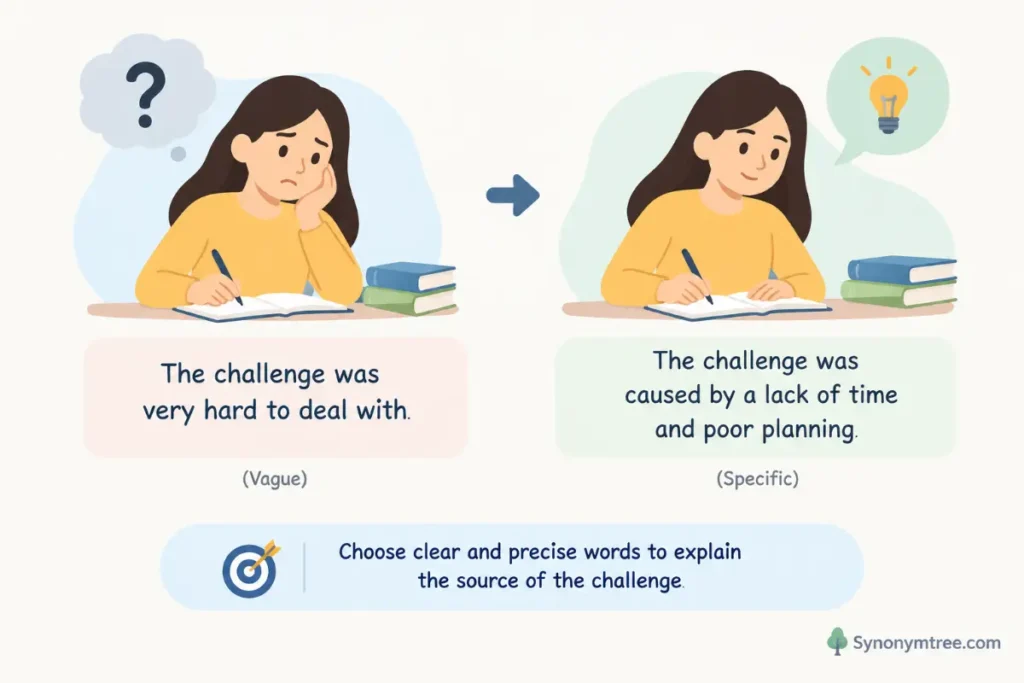
In an essay, choose language that explains the source of the challenge. A precise word makes your argument easier to follow and prevents vague descriptions.
When Should You Use Difficult?
Use difficult when a task, question, or situation requires considerable effort or skill.
Example: The experiment was difficult because it required accurate measurements at several stages.
This word works well when you want a clear, general description without adding extra judgment.
When Should You Use Complex?
Use complex when a subject contains many connected parts, causes, or relationships.
Example: The causes of poverty are complex and cannot be explained by one factor alone.
Complex does not always mean extremely hard. A complex system may become easier to understand with a clear explanation, even though its parts remain connected in many ways.
When Should You Use Arduous?
Use arduous when an activity requires long, tiring effort.
Example: The arduous journey across the mountains required careful planning and physical endurance.
This word is more formal than hard. It works well in descriptive writing, historical accounts, and essays about work that demands sustained effort.
When Should You Use Challenging?
Use challenging when a task tests ability, knowledge, or determination. The word can sound positive because the task may offer a chance to learn or improve.
Example: The challenging assignment encouraged students to compare different explanations and support their conclusions with evidence.
This term is useful when you want to acknowledge difficulty without making the task sound unpleasant or impossible.
What Should You Say Instead of Easy in a Text Message?
Text messages usually work best with short, familiar words. Hard, tough, tricky, and a hassle sound natural in casual conversations.
Examples for Everyday Texts
- That exam was harder than I expected.
- Getting tickets turned out to be a hassle.
- The last question was tricky.
- Learning the new game was tough at first.
- The directions were confusing, so I took the wrong turn.
- That hike was brutal, but the view was worth it.
Each sentence gives a slightly different impression. Harder than expected shows surprise. A hassle expresses annoyance. Tricky suggests a detail that requires care, while brutal describes an experience that felt extremely demanding.
If you are texting a teacher, manager, or someone you do not know well, a neutral term such as difficult may be more suitable. Informal expressions can sound friendly with people you know, but they may appear too casual in serious conversations.
Looking for another word? See Opposite of Smart Best Words and Examples.
What Is the Best Word for Difficult in an Email?
Emails often need a clear and respectful tone. If you are discussing a problem, describe the work or situation rather than blaming someone.
Examples for Professional Emails
- The current process is complicated and needs a clearer set of instructions.
- The deadline will be challenging, so I recommend setting priorities today.
- We encountered a difficult issue during testing and are reviewing possible solutions.
- The task requires intensive review before we can approve the final version.
- The current schedule is demanding, but the team is making steady progress.
These examples state the problem without exaggerating it. They also give the reader useful information about what needs to happen next.
When you need help, be specific. Instead of saying, This is too hard, you might write, I need clarification on the final two steps before I can complete the task. That sentence identifies the obstacle and makes it easier for someone to respond.
How Can You Describe Something Difficult When Speaking?
Spoken language depends on the audience and setting. In a casual conversation, hard and tough are usually enough. During a presentation, interview, or formal discussion, difficult, demanding, or complex may sound more appropriate.
Examples for Natural Speech
- The first few weeks were tough, but I learned a lot.
- That question is difficult to answer without more information.
- The repair was more complicated than we expected.
- Training for the race was demanding.
- The decision was challenging because both options had drawbacks.
- The final stage was exhausting, but we finished the job.
You can also describe the reason for the difficulty. Saying, The task was hard because we had limited time, gives more information than saying, The task was hard.
In conversation, this extra detail helps the listener understand your experience. It also keeps the description fair. A difficult task may be manageable with more time, clearer instructions, or better tools.
What Is the Difference Between Difficult and Challenging?
Difficult and challenging often overlap, but they can create different impressions.
| Word | Main meaning | Typical impression | Example |
|---|---|---|---|
| Difficult | Requires effort, skill, or thought | Neutral and direct | The test was difficult. |
| Challenging | Tests ability or determination | Often constructive or positive | The test was challenging and helped me improve. |
Difficult is the more neutral choice. It tells readers that something requires effort without suggesting that the experience is valuable or enjoyable.
Challenging often presents the task as an opportunity to use or develop skills. It can still describe an unpleasant situation, but it frequently carries a more constructive tone.
For example, a difficult customer interaction may require patience and careful communication. A challenging assignment may push a student to learn a new method. Neither word guarantees a positive outcome, so the surrounding sentence still matters.
What Is the Difference Between Complicated and Complex?
Complicated and complex both describe situations with many parts, but they are not always interchangeable.
| Word | Main meaning | Best use | Example |
|---|---|---|---|
| Complicated | Hard to understand or manage because of many steps or details | Instructions, forms, procedures | The application process is complicated. |
| Complex | Made up of connected parts or factors | Systems, ideas, relationships, problems | The issue has complex social and economic causes. |
Complicated often emphasizes the trouble someone faces while understanding or completing something. A complicated form may contain confusing instructions and unnecessary steps.
Complex focuses more on how parts connect. A complex scientific problem may be difficult because many factors affect one another, even when the explanation is clear.
The distinction is not absolute. A process can be both complicated and complex. Still, complicated is often a better choice for a procedure that is hard to follow, while complex suits a subject with many connected elements.
What Common Mistakes Should You Avoid When Choosing a Word?
A synonym may look correct in a list but sound wrong in a sentence. Watch for these common mistakes when choosing the opposite of easy.
Using Hard When You Mean Confusing
Hard and confusing describe different problems. A task can be hard because it requires effort, while a confusing task is difficult to understand.
For example, lifting a heavy box is hard, but the instructions for assembling a desk may be confusing. You can understand the instructions perfectly and still find the work physically demanding.
Choose confusing when clarity is the problem. Choose hard when effort is the main issue.
Using Complicated for Every Difficult Task
Complicated suggests that something has many details, steps, or parts that make it harder to manage. It does not describe every type of difficulty.
A long run can be exhausting without being complicated. A difficult conversation may involve strong emotions rather than many steps. An arduous journey may require endurance more than detailed reasoning.
Name the source of the problem instead of using complicated as a general replacement.
Using Formal Words in Casual Conversations
Words such as onerous, arduous, and formidable can sound stiff in a quick text message.
For example, saying, Completing that short form was onerous, may sound overly formal to a friend. Saying, That form was a hassle, sounds more natural in casual conversation.
Formal vocabulary is useful when it adds precision. It is less useful when a simple word communicates the same idea.
Using Slang in Academic or Professional Writing
Expressions such as brutal, a beast, and a nightmare can show strong emotion, but they are often too informal for a report or essay.
Instead of writing, The training session was a nightmare, use, The training session was exhausting and poorly organized, if that is what you mean.
Specific language gives readers more information and makes your writing easier to assess.
Treating Challenging as Always Positive
Challenging can sound encouraging, but it does not always describe a good experience. A challenging deadline may create pressure, and a challenging personal situation may be upsetting.
Look at the surrounding sentence. If you want to emphasize the effort required, demanding may fit better. If you want to describe stress or annoyance, frustrating may be more accurate.
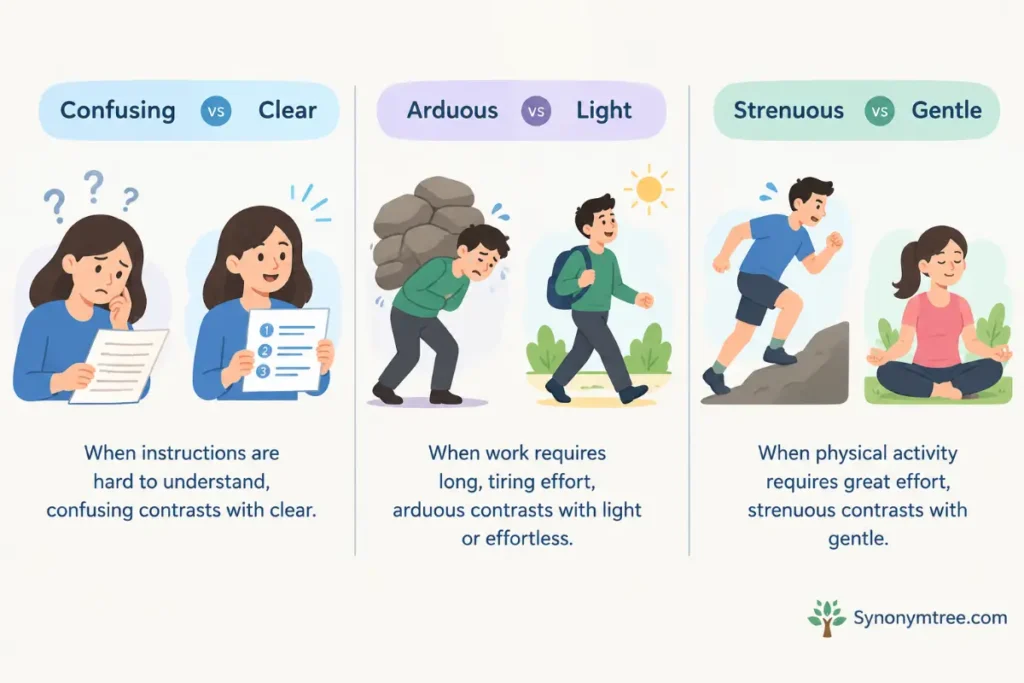
What Are the Antonyms of Easy Besides Difficult?
Difficult and hard are the most common opposites of easy, but other words fit specific contexts.
- Complicated contrasts with simple when a task has many difficult steps.
- Demanding contrasts with effortless when an activity requires sustained work.
- Confusing contrasts with clear when instructions are hard to understand.
- Arduous contrasts with light or effortless when work requires long, tiring effort.
- Strenuous contrasts with gentle when physical activity requires great effort.
- Daunting contrasts with reassuring or manageable when a task seems intimidating.
- Frustrating contrasts with satisfying when a process causes annoyance instead of a positive result.
These words are contextual alternatives, not exact opposites in every sentence. The best choice depends on the meaning of easy in the original sentence.
How Can You Choose the Right Word Quickly?
Use these practical tips to make your writing clear and accurate.
- Identify the source of the difficulty. Decide if the problem involves effort, understanding, time, physical strain, or emotional pressure.
- Use difficult for a neutral description. It works in most settings and does not add unnecessary emotion.
- Choose a specific alternative when it adds meaning. Use confusing for unclear instructions, demanding for ongoing effort, and arduous for long, tiring work.
- Match your tone to your reader. Casual texts may suit tough or a hassle, while essays and reports often need difficult, complex, or insufficient.
- Avoid making a task sound worse than it is. Words such as brutal and nightmare suggest a high level of frustration or discomfort.
- Give a reason when possible. The sentence The process was difficult because the instructions were unclear explains more than The process was difficult.
- Read the sentence aloud. A word should sound natural in context and express the meaning you intend.
A useful test is to replace easy with its opposite and then ask what makes the task harder. That detail will often point you toward the most accurate word.
Check out more vocabulary ideas in Opposite of Hard Best Words for Every Situation.
Conclusion
Difficult and hard are the most common answers when you need the opposite of easy. Both work in everyday conversation, but other words can give readers a clearer picture of the problem. Use complicated for a process with many steps, demanding for work that requires steady effort, confusing for unclear information, and arduous for long and tiring tasks. In formal writing, precise language can make an argument or report easier to understand. In casual messages, simple words usually sound more natural. Focus on the reason a task requires extra effort, then choose the word that explains it best. With a little attention to meaning and tone, you can make your writing clearer without making it sound complicated.
Frequently Asked Questions
What is the most common opposite of easy?
The most common opposite of easy is difficult. Hard is another widely used choice, especially in everyday speech.
What is a formal word for hard?
Arduous, demanding, laborious, and strenuous can work as formal alternatives to hard. Arduous describes long, tiring effort, while strenuous often emphasizes physical or mental exertion.
What is the opposite of easy in a resume?
In a resume, demanding, challenging, or complex can describe work that required effort or skill. Focus on the task and the result instead of making your abilities sound limited.
What’s another way to say difficult?
Other ways to say difficult include hard, tough, challenging, complicated, demanding, and arduous. Choose the word that best describes the source of the difficulty.
Is complicated the same as difficult?
No, complicated usually means that something has many parts or steps that are hard to manage or understand. Difficult is broader and can describe anything that requires considerable effort or skill.
What is the opposite of easy to understand?
Confusing, unclear, and complicated can describe something that is not easy to understand. Confusing is especially useful when information or instructions are hard to follow.
Can challenging be a positive word?
Yes, challenging can describe a task that tests your skills and helps you improve. It acknowledges difficulty without necessarily suggesting that the experience is unpleasant.