
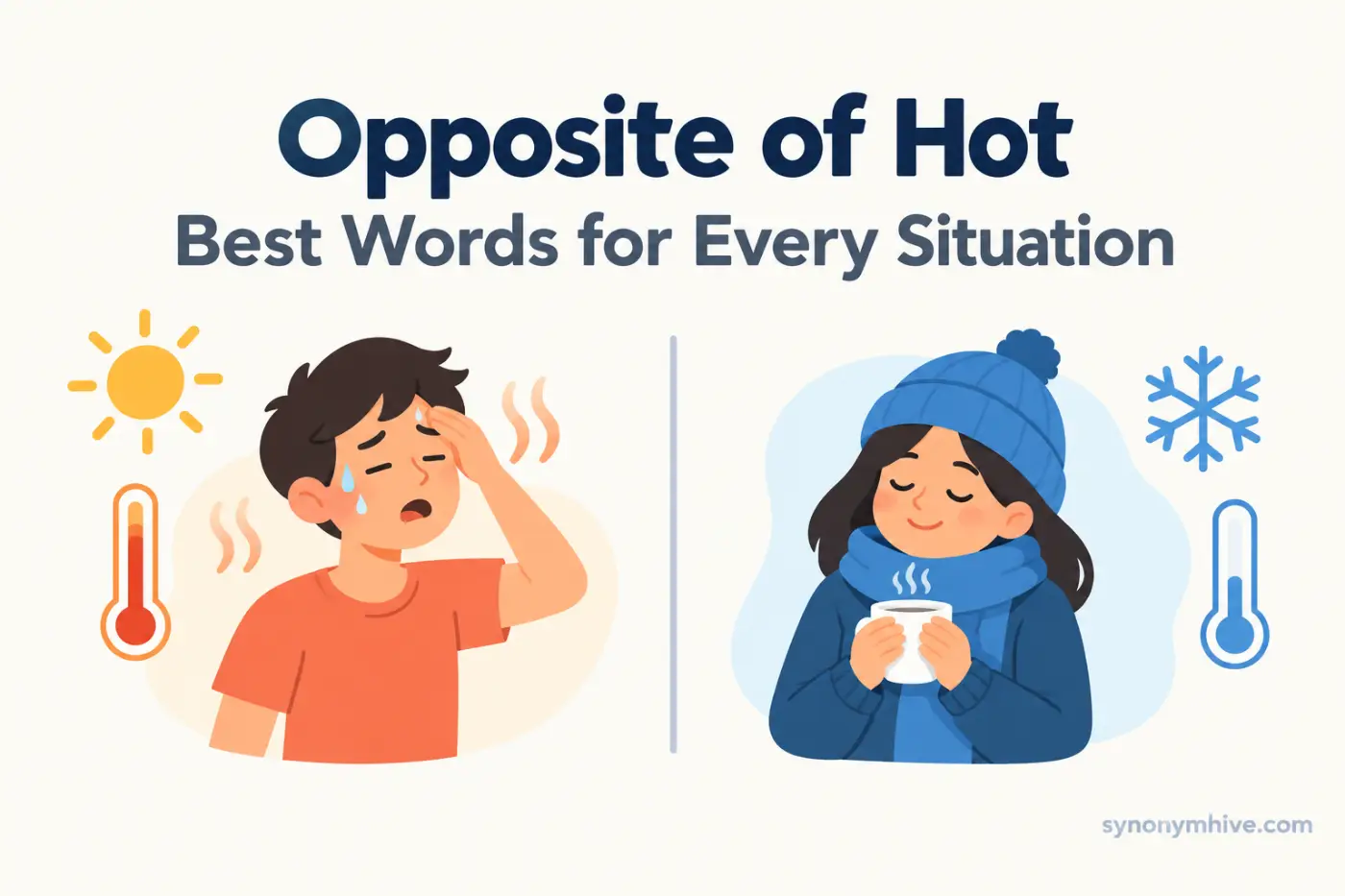
You are writing a text about the weather, describing a cup of coffee, or explaining a spicy meal. You reach for the word hot, but you need its opposite. The right choice may be cold, cool, chilly, mild, or freezing, depending on what you want to say.
The most common opposite of hot is cold. However, hot has several meanings. It can describe temperature, spicy food, popular trends, attractive people, or a situation that needs quick attention. Each meaning calls for a different word.
Quick answer: The opposite of hot is usually cold when talking about temperature. Depending on the context, other opposites include cool, chilly, mild, unpopular, unattractive, or inactive.
Choosing the right word makes your writing more accurate and natural. For example, cool water is not necessarily freezing, and mild salsa is not the same as cold salsa. The words may seem related, but each one gives the reader a different picture.
This guide explains the meaning and origin of hot, compares more than 30 alternatives, and shows how to choose the best word for weather reports, essays, resumes, emails, texts, food descriptions, and everyday conversations.
You may also like Opposite of Confident Best Words for Every Situation.
What Is the Opposite of Hot?
The opposite of hot is usually cold when hot describes temperature. Cold means having a low temperature, while hot means having a high temperature.
For example, hot tea may be uncomfortable to drink right after it is poured. Cold tea has a low temperature and may be refreshing on a warm day.
The exact opposite can change with the situation. Consider these common uses.
- Weather. A hot afternoon may become cool in the evening.
- Food. Hot soup can become cold as it sits on the table.
- Spicy flavor. Hot salsa may have a strong chili pepper flavor, while mild salsa has little heat.
- Popularity. A hot new trend may later become unpopular or unfashionable.
- Appearance. In casual slang, hot can mean attractive. Its opposite might be unattractive, though that word can sound blunt.
- Activity. A hot lead in an investigation is promising. A cold lead has produced little progress.
- Technology. A hot device or component may be physically warm, while a cool one has a lower temperature.
These meanings are not interchangeable. Cold describes temperature, while mild describes a low level of spice. Unpopular describes public opinion, and inactive describes a lack of activity.
Before choosing a word, ask what hot means in your sentence. That simple step helps you select an accurate opposite instead of using cold for every situation.
Is Cold Always the Best Opposite of Hot?
No. Cold is the most direct antonym when the subject is temperature, but it may not fit other meanings.
A hot curry is usually described as mild when it has little chili heat. A hot song that no one likes anymore may be unpopular or out of fashion.
The right choice depends on the quality you want to reverse. If hot describes physical warmth, use a temperature word. If it describes spice, use a flavor word.
What Does Hot Mean?
Hot usually means having a high temperature or producing a strong feeling of heat. It can also describe food with a spicy flavor, something popular, a person considered attractive, or a situation that is urgent or risky.
Here are the main meanings.
- High temperature. Hot water, hot weather, and hot metal have a high temperature.
- Spicy flavor. Hot peppers and hot sauce create a burning or sharp sensation in the mouth.
- Popularity. A hot product or trend attracts a lot of attention.
- Physical attractiveness. In informal speech, hot can describe someone considered attractive.
- Urgency. A hot issue or hot lead may need immediate attention.
- Danger or risk. A hot surface can burn someone, and a hot area may be dangerous.
- Strong performance. A player who is hot may be performing especially well.
- Fresh information. Hot news may be new, exciting, or widely discussed.
These meanings explain why hot appears in so many everyday expressions. The word can describe a physical sensation, a flavor, a person’s appearance, or the level of public interest in an idea.
Its opposite changes along with the meaning. Cold works for temperature. Mild works for spice. Unpopular can describe a trend that has lost its appeal. A player who is not performing well might be described as struggling rather than cold, depending on the sport and situation.
Where Did the Word Hot Come From?
The English word hot comes from Old English hāt, which referred to something having a high temperature or producing heat. Related forms appear in other Germanic languages.
Over time, English speakers expanded the word beyond physical temperature. Hot came to describe spicy food, strong emotions, attractive people, popular trends, and urgent situations. Many of these uses rely on the idea of heat as something intense, noticeable, or powerful.
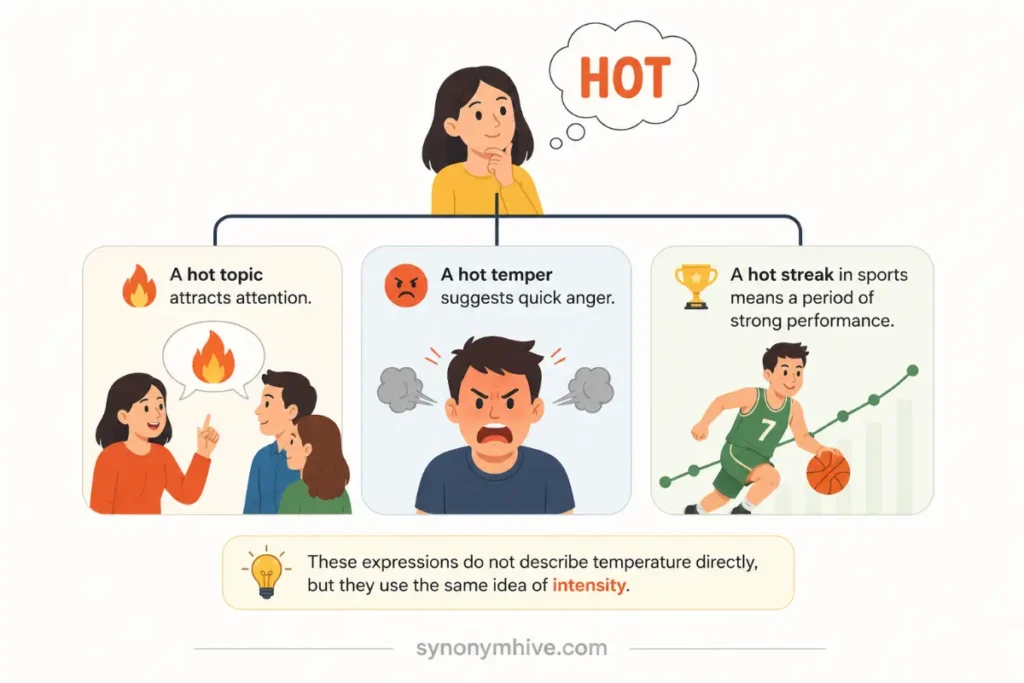
For example, a hot topic attracts attention, while a hot temper suggests quick anger. A hot streak in sports means a period of strong performance. These expressions do not describe temperature directly, but they use the same idea of intensity.
The history of the word helps explain why no single antonym fits every use. Cold is a natural opposite for physical heat. Mild works for spice, while unpopular or out of fashion can describe a trend that has lost its appeal.
What Is the Difference Between Hot and Cold?
Hot and cold are direct opposites when they describe temperature. Hot refers to a high temperature, while cold refers to a low one.
| Word | Meaning | Example |
|---|---|---|
| Hot | Having a high temperature | The coffee is too hot to drink. |
| Cold | Having a low temperature | The water is cold after sitting in the fridge. |
| Warm | Comfortably or moderately hot | The towel feels warm. |
| Cool | Slightly cold or pleasantly low in temperature | The room feels cool. |
| Chilly | Uncomfortably cold, often in the air | A chilly wind blew through the park. |
| Freezing | Extremely cold or at the point of freezing | The road was icy in freezing weather. |
| Scalding | Hot enough to burn with liquid or steam | The scalding water damaged the plant. |
| Lukewarm | Only slightly warm | The tea became lukewarm. |
Cold and freezing are not the same. Cold is broad, while freezing suggests extreme cold or a temperature at which water turns to ice under normal conditions. Chilly often describes weather that feels uncomfortably cool, while cool can sound pleasant.
Scalding is a strong word for dangerously hot liquids or steam. Lukewarm describes something that has lost much of its heat but is not cold.
Use these distinctions to describe the situation accurately. If a drink is only a little warm, calling it freezing would be incorrect. If a metal pan can burn someone, hot may not communicate the danger as clearly as scalding or dangerously hot.
What Are the Best Synonyms for the Opposite of Hot?
The best word depends on whether hot describes temperature, food, popularity, or another quality. The following tables group useful alternatives by tone and everyday use.
Simple Words for the Opposite of Hot
| Word | Meaning | Tone | Example |
|---|---|---|---|
| Cold | Having a low temperature | Neutral | The milk is cold. |
| Cool | Slightly cold or pleasantly low in temperature | Neutral | A cool breeze entered the room. |
| Chilly | Uncomfortably cool | Everyday | It was chilly outside this morning. |
| Freezing | Extremely cold | Strong | The lake looked frozen in the freezing air. |
| Mild | Not strong in heat or spice | Neutral | The curry has a mild flavor. |
| Lukewarm | Only slightly warm | Neutral | The bathwater was lukewarm. |
| Icy | Extremely cold or covered with ice | Strong | An icy wind hit the coast. |
Cold is the most common direct opposite of hot. Cool often describes a more comfortable temperature, while chilly suggests discomfort. Freezing and icy are stronger terms that help readers imagine intense cold.
Mild belongs in a different category when describing food. Mild salsa has little chili heat, but it can still be served hot in temperature. That is why context matters.
Everyday Words for the Opposite of Hot
| Word | Meaning | Tone | Example |
|---|---|---|---|
| Fresh | Cool or newly prepared in a suitable context | Positive | Fresh water helped us cool down. |
| Crisp | Cool and fresh, especially in weather | Positive | We enjoyed a crisp autumn morning. |
| Brisk | Cool and invigorating | Positive | A brisk wind swept across the field. |
| Temperate | Moderate rather than extreme in temperature | Neutral | The island has a temperate climate. |
| Pleasant | Comfortable rather than too hot | Positive | The evening was pleasant and cool. |
| Unheated | Not warmed by a heating source | Neutral | The room remained unheated overnight. |
| Refrigerated | Kept cold in a refrigerator | Practical | Serve the refrigerated drink chilled. |
These words describe different kinds of cool conditions. Crisp and brisk often suggest refreshing weather. Temperate refers to moderate conditions rather than extreme heat or cold. Unheated and refrigerated explain how something is kept, so they are not exact antonyms in every sentence.
Fresh can also describe food that is newly prepared or recently collected, rather than its temperature. Use it as an alternative only when it fits the meaning.
Formal Words for the Opposite of Hot
| Word | Meaning | Tone | Example |
|---|---|---|---|
| Cold | Having a low temperature | Formal or neutral | The sample must remain cold during transport. |
| Chilled | Cooled to a low temperature | Formal or practical | Keep the chilled medicine in its approved storage conditions. |
| Refrigerated | Cooled in a refrigerator | Technical or practical | The product must be refrigerated after opening. |
| Subzero | Below zero on a stated temperature scale | Technical | Subzero conditions affected the equipment. |
| Frigid | Extremely cold | Formal and strong | Frigid air moved across the valley. |
| Tepid | Lukewarm or only slightly warm | Formal | The water was tepid by the time we arrived. |
| Temperate | Moderate in temperature | Formal | The region has a temperate climate. |
Formal terms are useful in reports, instructions, scientific writing, and descriptive essays. Frigid emphasizes severe cold, while subzero gives a more exact temperature relationship when the scale is understood.
Tepid is similar to lukewarm, but it can sometimes suggest a lack of enthusiasm when used figuratively. Temperate usually describes a climate or conditions that avoid extremes rather than something that is actively cold.
Informal and Slang Words for the Opposite of Hot
| Word | Meaning | Tone | Example |
|---|---|---|---|
| Cool | Pleasantly low in temperature or fashionable, depending on context | Casual | The room is cool now. |
| Chilly | A little too cold | Casual | It got chilly after sunset. |
| Not spicy | Having little chili heat | Casual | I ordered the sauce that is not spicy. |
| Mild | Having little heat from spices | Everyday | This version is mild enough for the kids. |
| Uncool | Not fashionable or socially approved | Informal | That joke was considered uncool. |
| Old news | No longer new or exciting | Informal | That trend is old news now. |
| Out of style | No longer fashionable | Everyday | Those shoes are out of style. |
Cool has two different uses in everyday English. It can describe a low temperature, or it can mean fashionable, impressive, or socially acceptable. In the second meaning, its opposite may be uncool rather than hot.
Old news works when a subject is no longer new or exciting. Out of style fits fashion and trends. Neither is a direct opposite of hot in the physical sense.
Which Opposite of Hot Works Best by Intensity?
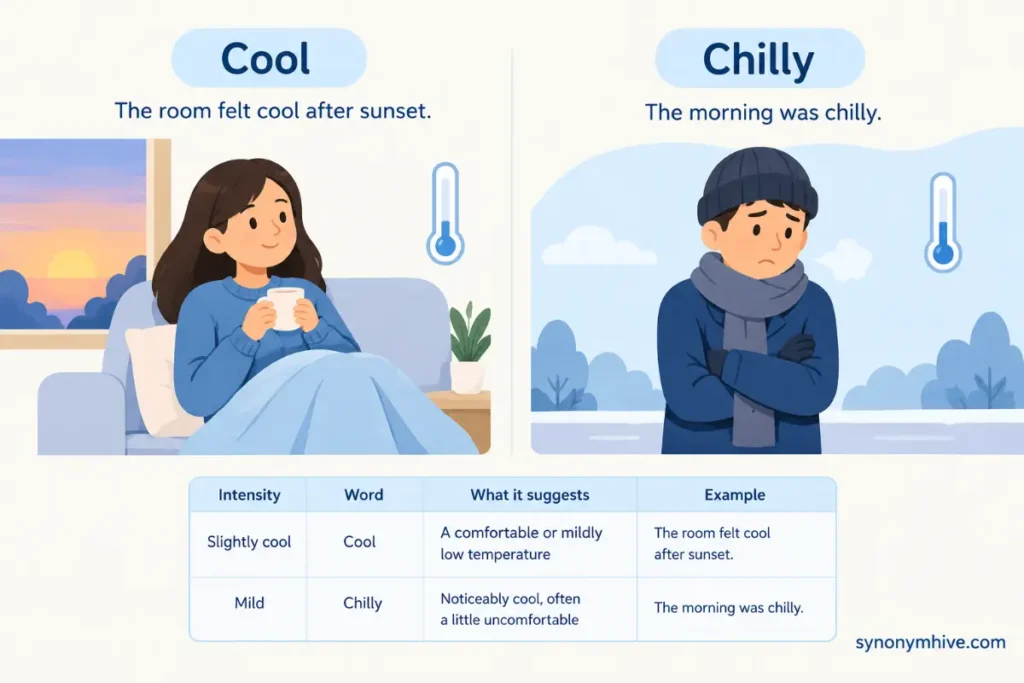
Some words describe a small drop in temperature, while others suggest severe cold. Choosing a word based on intensity helps readers understand the conditions more clearly.
| Intensity | Word | What it suggests | Example |
|---|---|---|---|
| Slightly cool | Cool | A comfortable or mildly low temperature | The room felt cool after sunset. |
| Mild | Chilly | Noticeably cool, often a little uncomfortable | The morning was chilly. |
| Moderate | Cold | A low temperature | The water felt cold. |
| Strong | Very cold | A much lower temperature than comfortable | The hikers faced very cold weather. |
| Very strong | Freezing | Extreme cold or a temperature near the freezing point | It was freezing outside. |
| Severe | Frigid | Intensely cold conditions | Frigid air entered through the open window. |
| Dangerous | Icy or dangerously cold | Conditions that may create a safety risk | Icy roads made driving difficult. |
The scale is a general guide, not a scientific measurement. What feels chilly to one person may feel cold to someone else. Humidity, wind, clothing, and personal comfort can all affect how a temperature feels.
What Is a Mild Opposite of Hot?
Cool is a good choice when you mean a small or comfortable reduction in temperature. It usually sounds less severe than cold.
For example, the air conditioner made the office cool rather than cold. The room remained comfortable without feeling too chilly.
Mild also works when describing weather that is neither very hot nor very cold. A mild winter may have comfortable temperatures, while a mild sauce contains little chili heat.
What Is a Strong Opposite of Hot?
Freezing, frigid, and icy are strong choices when describing very cold conditions. Each word adds a different detail.
Freezing often describes extreme cold in everyday conversation. Frigid sounds more formal and emphasizes intense cold. Icy can describe a surface covered with ice, a very cold sensation, or conditions that create a slipping hazard.
For example, freezing weather may make people uncomfortable, while icy roads create a specific danger for drivers. Choose the word that explains the main concern.
How Does Part of Speech Change the Opposite of Hot?
Hot is an adjective. It describes a noun, such as hot water, hot weather, or a hot meal. Its opposite is often another adjective, such as cold, cool, or mild.
However, some sentences need a noun or a verb instead. Choosing the correct form keeps your sentence grammatical.
| Part of speech | Word related to hot | Opposite or related form | Example |
|---|---|---|---|
| Adjective | Hot | Cold | The cold water refreshed us. |
| Noun | Heat | Cold | The sudden cold surprised everyone. |
| Noun | Hotness | Coolness, in a temperature context | The coolness of the room was welcome. |
| Verb | Heat | Cool | Let the soup cool before serving. |
| Adjective | Spicy | Mild | We ordered a mild curry. |
| Adverb | Hotly | Calmly, in some figurative contexts | They discussed the issue calmly. |
| Adjective | Popular or trendy | Unpopular or unfashionable | The once popular style is now unfashionable. |
Not every word has a perfect grammatical opposite. Hotly can mean passionately or intensely, as in a hotly debated issue. In that sentence, coldly may suggest an unemotional manner, but calmly may be more natural if you mean a discussion without anger.
Similarly, the noun heat can refer to temperature, public pressure, or intense competition. The correct opposite depends on the meaning. Cold can describe temperature, while relief from pressure or a decline in intensity may better express the opposite of figurative heat.
Is Cold the Opposite of Heat?
Yes, cold is commonly used as the opposite of heat in everyday language. In scientific contexts, however, heat refers to energy transferred because of a temperature difference, while cold describes a lower temperature or the sensation of being cold.
For everyday writing, you can say the heat faded as the evening cooled. In a science assignment, use precise terms that explain temperature and energy correctly.
What Is the Opposite of Heating?
Cooling is the usual opposite of heating when describing a process. Heating raises temperature, while cooling lowers it.
For example, the machine uses heating to warm the room and cooling to lower its temperature. These forms are useful when explaining appliances, food preparation, and industrial processes.
What Is the Difference Between Hot and Warm?
Hot and warm both describe temperature, but hot usually suggests a higher temperature. Warm often describes a comfortable level of heat.
| Hot | Warm |
|---|---|
| Often suggests a high temperature. | Usually suggests moderate or comfortable heat. |
| Can imply discomfort or danger. | Often has a pleasant meaning. |
| Common in warnings about liquids and surfaces. | Common in descriptions of weather, clothing, and rooms. |
| Example: The pan is too hot to touch. | Example: The blanket kept me warm. |
Warm is not the direct opposite of hot. It is usually a milder level of heat. If the room is hot, saying it is warm suggests that the temperature has become more comfortable, not that it has become cold.
This distinction matters in safety instructions. A warm surface may be comfortable to touch, but a hot surface can cause burns. Use clear warnings when a high temperature creates a real risk.
What Is the Difference Between Cool and Cold?
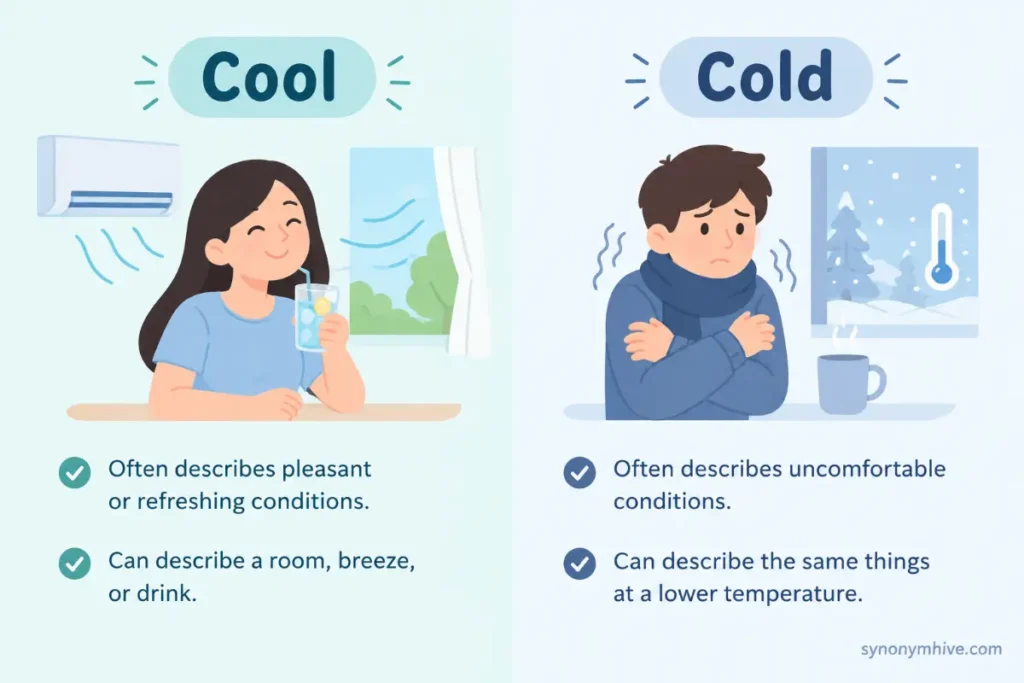
Cool and cold both describe lower temperatures, but cool often sounds more comfortable. Cold usually suggests a lower temperature or a stronger sensation.
| Cool | Cold |
|---|---|
| Often describes pleasant or refreshing conditions. | Often describes uncomfortable conditions. |
| Can describe a room, breeze, or drink. | Can describe the same things at a lower temperature. |
| Also means fashionable or impressive in slang. | Can suggest emotional distance in figurative use. |
| Example: The evening air was cool. | Example: The wind made the evening cold. |
The difference is not fixed. A cool room may still be uncomfortable to someone who prefers warmer conditions. A cold drink can be pleasant on a hot day. The surrounding situation determines how the words sound.
Cool also has meanings that cold does not share. If someone says your idea is cool, they probably mean it is appealing or impressive. In that context, cold would change the meaning rather than serve as a direct antonym.
What Is the Difference Between Cold and Freezing?
Cold is a broad term for a low temperature. Freezing is stronger and often describes extremely cold conditions or a temperature near the point at which water turns to ice.
| Cold | Freezing |
|---|---|
| Describes a wide range of low temperatures. | Usually emphasizes extreme cold. |
| Can describe water, weather, food, or a room. | Often used for severe weather or very cold objects. |
| Example: The water is cold. | Example: The water is freezing. |
In ordinary conversation, people may call something freezing even when its temperature is above the freezing point of water. The word can be an expression of how cold something feels.
For scientific or technical writing, include an actual temperature when accuracy matters. For everyday descriptions, freezing communicates a stronger sensation than cold.
Looking for another word? See Opposite of Kind Best Words for Every Situation.
How Does American English Differ From British English?
American and British English share the main temperature words, including hot, cold, cool, chilly, freezing, and warm. The biggest differences often appear in informal expressions and the way people describe weather.
In the United States, people commonly say it is chilly, cold, or freezing outside. They may also say they are cooling off after spending time in the sun.
In British English, skint means having very little money, but it is not a temperature word. For temperature, British speakers also use chilly and freezing. Regional preferences can vary, so no single expression belongs exclusively to one country.
Here are a few useful distinctions.
- Cool. Common in both countries for pleasant or slightly low temperatures.
- Chilly. Common in both countries for weather that feels uncomfortably cool.
- Freezing. Common in both countries for very cold conditions, including informal exaggeration.
- Mild. Common in both countries for weather that is not extreme.
- Nippy. Informal in both places, though it may be more familiar to some British speakers. It means noticeably chilly.
For a broad American audience, cold, cool, chilly, and freezing are safe, familiar choices. If your readers are in a specific region, local expressions may make the writing sound more natural.
Which Opposite of Hot Works Best in a Resume?
A resume rarely needs a temperature antonym unless you are applying for a job that involves cooking, food storage, refrigeration, or equipment safety. In most professional contexts, hot may refer to a trend, skill, opportunity, or active lead.
If you mean a skill is no longer in demand, write outdated or less in demand. If you mean a lead is no longer promising, use inactive or unproductive.
Example: My research helped the sales team identify inactive leads and focus on stronger opportunities.
If you are describing food handling or equipment, use precise temperature terms.
Example: Followed procedures for keeping refrigerated products at safe temperatures.
The main rule is to describe the condition that matters to the employer. A clear phrase is more useful than forcing an opposite into a sentence where it does not belong.
Which Opposite of Hot Works Best in an Essay?
For an essay about weather or temperature, cold is the simplest choice. Use cool, chilly, freezing, or frigid to add a more specific meaning.
Example: The hot afternoon gave way to a cool evening breeze.
In a food essay, mild is often a better opposite when hot means spicy. In a discussion about popularity, use unpopular, unfashionable, or no longer trendy.
Example: The once popular style became unfashionable as new designs appeared.
Academic writing benefits from precise language. Instead of saying the weather was not hot, explain that temperatures remained cool throughout the morning. Instead of calling a dish not hot, state that it had a mild flavor.
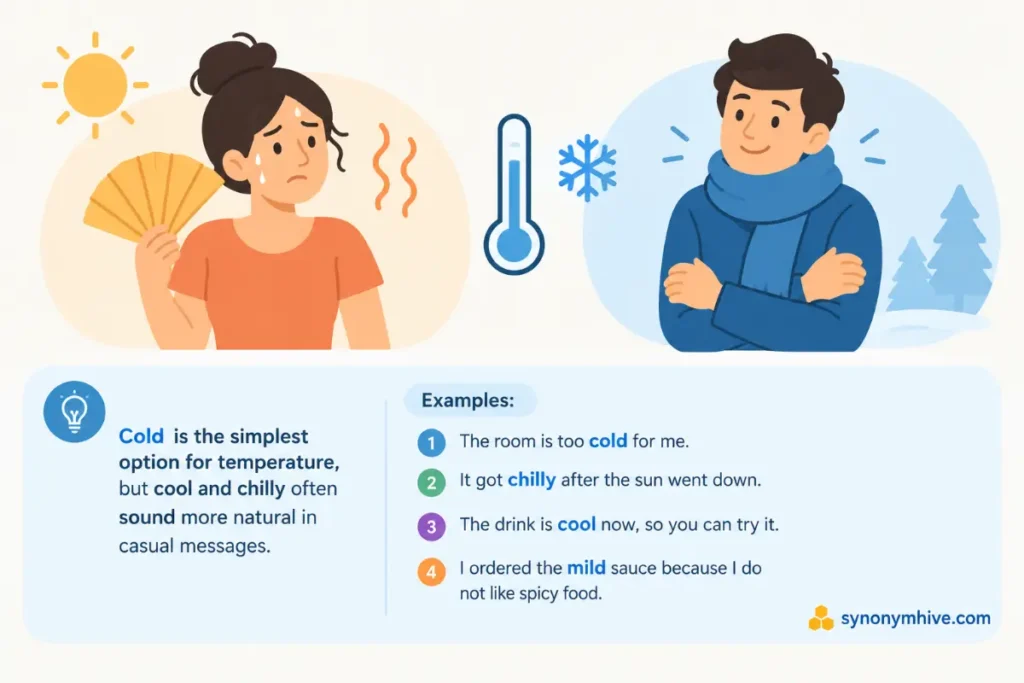
Which Opposite of Hot Works Best in Texting?
Cold is the simplest option for temperature, but cool and chilly often sound more natural in casual messages.
Examples include the following.
- The room is too cold for me.
- It got chilly after the sun went down.
- The drink is cool now, so you can try it.
- I ordered the mild sauce because I do not like spicy food.
If you are talking about popularity, choose words that match the intended meaning. A trend that is no longer popular may be old news or out of style.
Example: That trend is old news now, and everyone has moved on.
Slang works best when your reader understands it. Use plain words if you are unsure how a phrase will sound to the other person.
Which Opposite of Hot Works Best in an Email?
In a professional email, cold, cool, mild, and refrigerated can describe physical conditions. Use the word that provides the necessary detail.
Example: Please store the samples in a refrigerated area until collection.
If hot means urgent, popular, or promising, the right alternative may be less urgent, less popular, or inactive. Avoid choosing cold just because it is the usual temperature opposite.
Example: The earlier lead is now inactive, so the team will focus on current prospects.
Clear wording helps colleagues understand the situation without guessing. In work emails, explain the change and its effect rather than relying on a vague adjective.
Which Opposite of Hot Works Best When Speaking?
In everyday speech, cold is the safest direct opposite of hot. Cool sounds gentler, chilly suggests discomfort, and freezing adds emphasis.
For food, mild is often the natural choice when you mean less spicy. For fashion or trends, unfashionable or out of style may fit better.
Example: The soup is still hot, so give it a few minutes to cool.
Example: That style is no longer popular.
These choices sound natural because they match the meaning instead of following a one word rule. When in doubt, say exactly what you mean. That is usually clearer than reaching for a dramatic synonym.
What Are Some Real Examples of the Opposite of Hot?
These original examples show how different words work in common situations.
- Weather report. A cool breeze lowered the temperature after sunset.
- Morning commute. It was chilly outside, so I wore a jacket.
- Winter travel. The hikers prepared for freezing temperatures in the mountains.
- Coffee shop. My coffee became cold while I waited for my friend.
- Cooking. We chose a mild sauce because the children do not enjoy spicy food.
- Food safety. The restaurant kept the ingredients refrigerated until preparation.
- Office comfort. The meeting room felt cool after the air conditioner was adjusted.
- Fashion. The bright jacket went out of style after the trend faded.
- Music. The song was once popular, but it is now old news among younger listeners.
- Sports. The player cooled off after a strong first half and struggled to score.
- Gardening. The plants grew better during the cool part of the season.
- Science class. The water cooled as heat moved into the surrounding air.
- Home repair. The heater stopped working, leaving the bedroom cold overnight.
- Restaurant order. I asked for mild salsa instead of the hot version.
- Work discussion. The issue was no longer urgent, so the team moved it to the next meeting.
- Travel planning. We chose a temperate destination to avoid extreme summer heat.
Each sentence uses a word that matches its specific meaning. These examples also show that cold is not always the right answer. Mild, cool, inactive, and out of style can be more accurate in the right context.
What Mistakes Should You Avoid When Choosing an Opposite?
The most common mistake is assuming that cold works in every sentence containing hot. It is a direct opposite for temperature, but not for every figurative or descriptive meaning.
Mistake One Using Cold for Spicy Food
Incorrect: This curry is cold because it is not hot.
Better: This curry is mild because it is not spicy.
The first sentence describes temperature. The second describes flavor. A curry can be hot in temperature and mild in spice at the same time.
Mistake Two Confusing Cool With Freezing
Cool usually suggests a slightly low or comfortable temperature. Freezing suggests much more intense cold.
Incorrect: The room was freezing when the air conditioner made it comfortable.
Better: The room was cool after the air conditioner lowered the temperature.
Use freezing when the conditions are genuinely very cold or when you are using the word as casual emphasis.
Mistake Three Using Unpopular for Temperature
Unpopular describes something that people do not like or support. It does not describe a low temperature.
Incorrect: The water became unpopular after sitting in the fridge.
Better: The water became cold after sitting in the fridge.
If you mean a trend has lost public interest, however, unpopular may be the right choice.
Mistake Four Treating Mild and Bland as Identical
Mild means low in heat or intensity. Bland usually means lacking strong flavor or interest.
A mild curry can still have a rich taste from herbs, garlic, or other ingredients. A bland curry may lack flavor altogether.
Choose mild when you mean less spicy. Choose bland when you mean the food tastes dull or needs more flavor.
Mistake Five Ignoring Figurative Meaning
A hot topic is not necessarily warm to the touch. It may be an issue attracting attention or causing debate.
Incorrect: The topic became cold after the discussion ended.
Better: The topic lost public interest after the discussion ended.
Cold can be used figuratively in some situations, but it may not express the intended meaning clearly. Use phrases such as lost interest, no longer urgent, or inactive when they explain the change more accurately.
What Are the Antonyms of Hot Besides Cold?
The main antonyms depend on the meaning of hot.
| Meaning of hot | Useful opposite |
|---|---|
| High temperature | Cold |
| Comfortable heat | Cool |
| Spicy flavor | Mild |
| Very popular | Unpopular |
| Fashionable | Unfashionable |
| Urgent | Nonurgent or less urgent |
| Active or promising lead | Inactive or unproductive |
| Intense performance | Struggling or off form |
| Strong heat in a product | Low temperature or cooled |
| Strongly heated debate | Calm or less heated |
Some of these words are contextual opposites rather than strict dictionary antonyms. For example, a player who is not hot may be struggling, but that does not mean the player is always performing poorly. The right phrase depends on the situation.
How Can You Choose the Right Opposite of Hot?
Use these practical tips to choose a word that fits your sentence.
- Identify the meaning. Decide if hot refers to temperature, spice, popularity, attractiveness, urgency, or performance.
- Match the intensity. Use cool for a mild drop in temperature and freezing for severe cold.
- Consider the audience. Plain words such as cold and mild work in most settings. Slang may suit a text but not a formal report.
- Use precise language. Refrigerated describes storage, while cold describes temperature. They are related but not identical.
- Check the sentence. Read the full sentence and make sure the opposite preserves its meaning.
- Avoid exaggeration. Do not use freezing for ordinary cool weather unless you are speaking casually for emphasis.
- Use the right food term. Mild means less spicy, while bland means lacking flavor.
- Think about figurative meanings. A hot trend may become unfashionable, while a hot lead may become inactive.
A quick test can help. Ask yourself what kind of heat you mean. If it is physical heat, choose a temperature word. If it is chili heat, choose a flavor word.
Discover related words in Opposite of Love Best Words and Examples 2026.
Conclusion
The opposite of hot depends on the meaning of the word in your sentence. Cold is the most common choice for temperature, while cool and chilly describe less intense cold. Freezing and frigid suggest stronger conditions. For spicy food, mild is often more accurate, and for trends or popular ideas, words such as unpopular and unfashionable may fit.
When choosing the opposite of hot, focus on the quality you want to describe rather than searching for one word that works everywhere. Consider your audience and the level of intensity you need. A short text may call for a familiar word, while a report may need a more precise term. Once you identify the intended meaning, you can choose a word that sounds natural and communicates your point clearly.
Frequently Asked Questions
What is the opposite of hot in one word?
Cold is the most common one word opposite of hot when describing temperature. For spicy food, mild is often a better choice.
Is cool the opposite of hot?
Cool can be the opposite of hot when describing temperature, especially when you mean a comfortable or slightly low temperature. Cold usually suggests a stronger drop in temperature.
What is the opposite of hot when talking about food?
Mild is usually the opposite of hot when hot means spicy. Cold is the opposite when hot refers to the food’s temperature.
What’s another way to say something is not hot?
You can say cold, cool, chilly, or lukewarm when describing temperature. If you are talking about spicy food, say mild or not spicy.
What is the opposite of hot weather?
Cold weather is the direct opposite of hot weather. Cool, chilly, and freezing offer more detail about how low the temperature feels.
What is the opposite of hot in slang?
The opposite depends on the slang meaning. If hot means fashionable or attractive, you might use uncool or unfashionable for a trend, though unattractive can sound blunt when describing a person.
Is mild the same as cold?
No. Mild usually describes low spice or moderate conditions, while cold describes a low temperature. A dish can be mild and hot at the same time.