

The opposite of full depends on what you mean. If your glass has no water left, it is empty. If a room has plenty of space, it is spacious. Choosing the right word helps you explain the exact situation without confusing your reader.
The most common opposite of full is empty. Use empty when a container has nothing inside it or when a place has no people or objects. Other useful words include vacant, available, incomplete, hungry, and unoccupied. Each word fits a different meaning of full, so the best choice depends on the sentence.
The opposite of full is usually empty, meaning that something contains nothing or has no one inside it. In other contexts, words such as vacant, available, incomplete, or hungry express the intended contrast more accurately.
This guide explains the meaning and origin of full, gives you a large synonym and antonym list, and compares words that people often confuse. You will also find examples for essays, resumes, emails, everyday conversations, and texts, along with practical tips for choosing the clearest word.
Looking for another word? See Opposite of Beautiful Best Words and Examples 2026.
What Is the Opposite of Full?
The most common antonym of full is empty. However, English uses full in several ways, and each meaning can have a different opposite.
| Meaning of full | Best opposite | Example |
|---|---|---|
| A container holds as much as it can. | Empty | The bottle is empty. |
| A room has no available space. | Spacious or unoccupied | The room is unoccupied. |
| A place has no more seats available. | Available | Two seats are available. |
| A schedule has many activities. | Free or open | My afternoon is free. |
| A report contains all the required details. | Incomplete | The report is incomplete. |
| A person has eaten enough. | Hungry | I am hungry again. |
| A sound has a rich, deep quality. | Thin or weak | The recording sounds thin. |
| A color looks strong and rich. | Pale or muted | The wall has a pale blue color. |
| A group has reached its maximum size. | Underfilled or small | The class has only six students. |
| A person has a rounded body shape. | Slim or lean | The runner has a lean build. |
The first row covers the most familiar use. The other rows show why you should consider the sentence before selecting an antonym. Empty works for a water bottle, but it does not work naturally for a person who has finished a meal. In that case, hungry expresses the opposite condition.
Where Does the Word Full Come From?
The word full has a long history in English. It comes from Old English full, which meant filled, complete, or having as much as something could hold. Related forms appear in several Germanic languages, showing that the idea of fullness has been part of the language for centuries.
Today, full can describe much more than the amount of liquid in a glass. It can refer to quantity, space, time, completeness, sound, color, food, and even emotions.
Consider these examples.
- The glass is full. It contains as much liquid as it can hold.
- The parking lot is full. No spaces remain available.
- My calendar is full. I have many plans or commitments.
- The report is full of useful facts. It contains many facts.
- I am full. I have eaten enough food.
- The singer has a full voice. The voice sounds rich and powerful.
The same word carries a related idea in each example. Something has reached a high level, contains a lot, or has everything expected of it. Its opposite changes with the meaning.
What Does Full Mean in Plain English?
Full usually means that something contains as much as it can hold, has no room left, or contains all the expected parts.
For example, a full cup holds liquid up to its capacity. A full bus has no seats left for new passengers. A full report contains the information readers need.
The word can also describe a person who has eaten enough, a rich sound, or a complete amount of information. These meanings explain why one antonym cannot fit every sentence.
Why Does Full Have Several Opposites?
English words often carry several related meanings. Full is a good example because it describes both physical quantity and abstract conditions.
A container can be full of water. A calendar can be full of appointments. A person can have a full understanding of a subject. Although the word stays the same, each sentence points to a different idea.
That difference matters when you choose the opposite of full. Empty works well for a container, free works well for a schedule, and incomplete works well for a report that lacks important details.
The most useful approach is simple. Identify what full describes, then choose the word that expresses the opposite condition.
What Are the Best Synonyms for Full and Its Opposites?
The following table groups common words by tone and use. It includes words that directly oppose full in certain contexts, along with related terms that help you describe a lack of space, quantity, availability, or completeness.
Some words in the table are not interchangeable. For instance, vacant usually describes an empty property or position, while incomplete describes something that lacks required parts. Use the example sentences to see how each word works.
Simple Words for Everyday Use
| Word | Meaning | Tone | Example |
|---|---|---|---|
| Empty | Containing nothing | Neutral | The jar is empty. |
| Blank | Having no writing or marks | Neutral | Please sign the blank form. |
| Bare | Having little or nothing on a surface | Neutral | The room had bare walls. |
| Clear | Free of objects or obstacles | Neutral | Keep the doorway clear. |
| Free | Not occupied or busy | Everyday | I am free after lunch. |
| Open | Available for use or entry | Everyday | The seat beside me is open. |
| Spare | Extra and available | Everyday | Do you have a spare chair? |
| Unused | Not currently in use | Neutral | We turned the unused room into an office. |
These words work well in casual speech and basic writing. Empty is usually the clearest choice for a container with nothing inside it. Blank describes a surface or document with no content. Clear suggests that a place has no objects blocking it, while free and open often describe availability.
Everyday Words for Specific Situations
| Word | Meaning | Tone | Example |
|---|---|---|---|
| Vacant | Not occupied by a person or group | Neutral | The apartment is vacant. |
| Unoccupied | Not being used or lived in | Neutral | The meeting room is unoccupied. |
| Available | Ready for someone to use or take | Neutral | Three appointments are available. |
| Unfilled | Not filled or assigned | Neutral | One position remains unfilled. |
| Unused | Not used at present | Neutral | The unused desk sits near the window. |
| Spacious | Offering plenty of room | Positive | Their new kitchen is spacious. |
| Roomy | Having plenty of space | Casual | This car has a roomy back seat. |
| Uncrowded | Not containing too many people | Neutral | The beach was uncrowded in the morning. |
These choices often describe places, seats, rooms, jobs, and appointments. Vacant and unoccupied are useful when no one uses a place. Available is better when someone can book, select, or use something. Spacious and roomy describe places that offer plenty of space rather than places that contain nothing.
Formal Words for Essays and Professional Writing
| Word | Meaning | Tone | Example |
|---|---|---|---|
| Incomplete | Missing some required parts | Formal | The application remains incomplete. |
| Deficient | Lacking something needed or expected | Formal | The proposal was deficient in evidence. |
| Insufficient | Not enough for a purpose | Formal | The team had insufficient funding. |
| Unoccupied | Not occupied or in use | Formal | The building remained unoccupied. |
| Unavailable | Not accessible or ready for use | Formal | The specialist is unavailable today. |
| Limited | Restricted in amount or scope | Neutral | We have limited resources. |
| Sparse | Thinly spread or containing little | Formal | The report offered sparse details. |
| Scant | Barely enough or very small in amount | Formal | The team had scant evidence. |
These terms work well in reports, essays, business emails, and academic writing. Incomplete focuses on missing parts. Insufficient focuses on an amount that does not meet a need. Sparse and scant suggest a small amount of something, such as information, evidence, or resources.
Choose the word that describes the actual problem. A report can be incomplete because it lacks a required section. Its evidence can be insufficient because it does not support the conclusion. Those meanings overlap, but they are not identical.
Casual Words and Slang
| Word | Meaning | Tone | Example |
|---|---|---|---|
| Empty | Having nothing inside | Everyday | My snack box is empty. |
| Dead | Having no activity or life | Casual | The chat was dead last night. |
| Quiet | Having little noise or activity | Casual | The café is quiet this morning. |
| Chill | Relaxed or not busy | Casual | My weekend is pretty chill. |
| Open | Free or available | Casual | Are you open on Friday? |
| Free | Not busy or committed | Casual | I am free tonight. |
| Bare | Having very little | Casual | The fridge is looking bare. |
| Low | Having a small amount | Casual | My phone battery is low. |
Casual words can make a conversation sound natural, but context matters. Dead can describe a quiet group chat or a place with no activity. Chill describes a relaxed schedule, not a container with nothing inside. Low describes a small amount, such as a low battery or low supply.
Avoid using slang in a formal report unless the tone calls for it. In a work email, available or unoccupied will usually sound clearer than chill or dead.

Which Opposites of Full Show Different Levels of Emptiness?
Not every opposite carries the same strength. Empty often means nothing remains inside. Bare can mean that very little remains. Sparse suggests that things appear in small numbers or sit far apart. Incomplete means that something still lacks required parts.
Use this scale to choose a word that matches the situation.
| Level or condition | Word | What it suggests | Example |
|---|---|---|---|
| A small amount remains | Low | The amount has dropped | The water level is low. |
| Very little is present | Sparse | Items or details appear in small numbers | The notes are sparse. |
| Little remains on a surface | Bare | A surface lacks its usual contents | The shelves are bare. |
| Nothing is inside | Empty | No contents remain | The box is empty. |
| No one occupies a place | Vacant | A room, home, or position has no occupant | The house is vacant. |
| A required part is missing | Incomplete | Something needs more work | The form is incomplete. |
| The amount does not meet a need | Insufficient | There is not enough | The evidence is insufficient. |
| A place has plenty of room | Spacious | The area offers open space | The hall is spacious. |
When Should You Use Empty Instead of Bare?
Use empty when something contains nothing. Use bare when a surface or place has very little on it or lacks its usual covering.
For example, an empty cupboard contains no items. A bare cupboard might contain only one or two items, or its shelves might have no lining or covering. The exact meaning depends on the sentence.
When Is Sparse Better Than Empty?
Sparse works when some things remain, but they appear in small numbers or are spread far apart. An empty page has no writing. A page with sparse notes has a few words or ideas.
The distinction is useful in academic and professional writing. Sparse data means the data set contains few observations. Empty data may mean that no observations exist at all.
When Does Incomplete Fit Better Than Empty?
Incomplete describes something that has not reached the expected level of completion. An incomplete essay contains some writing, but it lacks a required part. An empty document has no content.
This word is especially useful for forms, reports, assignments, applications, and plans. It tells the reader that the work needs more content rather than suggesting that nothing exists.
What Is the Opposite of Full by Part of Speech?
Full usually works as an adjective, but it can appear in several expressions and grammatical patterns. The best opposite depends on the role the word plays in the sentence.
Opposite of Full as an Adjective
An adjective describes a person, place, object, or condition. In this role, full commonly means filled, complete, occupied, or rich.
Examples include:
- The bottle is full. The bottle is empty.
- The bus is full. The bus has no available seats.
- The report is full. The report is complete.
- The schedule is full. The schedule is packed.
- The room is full. The room is crowded.
The first example uses empty as a direct opposite. The others require a little more care. A full bus is often crowded, but a bus with available seats is not necessarily empty. A full report may be complete, while an incomplete report lacks required details.
Opposite of Fill as a Verb
Fill is the verb related to full. It means to put something into a space or container, or to make something complete.
Common opposites include empty, drain, clear, and remove. The right verb depends on the action.
- Fill the glass with water. Empty the glass.
- Fill the bathtub. Drain the bathtub.
- Fill the room with chairs. Clear the room of chairs.
- Fill the form with details. Leave the form blank.
- Fill the position. Leave the position vacant.
Notice that empty and drain describe different actions. You can empty a container by removing its contents. You drain it when you let liquid flow out. Clear focuses on removing objects from a place, while leave blank means to add no writing or information.
Opposite of Full in Common Expressions
Some expressions use full in a figurative way. Their opposites often require a phrase instead of one word.
| Expression with full | Natural opposite | Example |
|---|---|---|
| Full of hope | Without hope or discouraged | She felt discouraged after the setback. |
| Full of energy | Tired or low on energy | I am tired after the long trip. |
| Full of details | Brief or lacking detail | The summary is brief. |
| Full schedule | Free schedule or open time | My Friday afternoon is free. |
| Full capacity | Reduced capacity or spare capacity | The venue is operating below capacity. |
| Full attention | Distracted attention | He listened with little attention. |
A literal word for word replacement may sound awkward. Focus on the intended meaning of the entire phrase, then write the natural opposite.
Which Word Should You Use Instead of Full in Different Situations?
The best word depends on your audience and purpose. A resume needs precise professional language. A text message can use casual wording. An essay often benefits from a clear, specific antonym rather than a general word such as empty.
What Is the Best Opposite of Full for a Resume?
Use available, unoccupied, open, or incomplete based on the point you need to make. These words can describe your schedule, a role, a resource, or a document.
Example sentences.
- I am available to start work on Monday.
- The team identified an open position in the sales department.
- I completed the missing sections of an incomplete report.
- We found an unoccupied office for the new employee.
For a resume, avoid describing your workload as empty unless that detail matters. Instead, explain your availability or the work you can take on. For example, I am available to manage new client accounts sounds more useful than My schedule is empty.
What Is the Best Opposite of Full for an Essay?
Use incomplete, insufficient, sparse, limited, or empty according to the subject. These words help you explain missing information, low quantities, or a lack of evidence.
Example sentences.
- The study provides insufficient evidence to support the claim.
- The first draft remains incomplete because it lacks a conclusion.
- The report contains sparse details about the survey.
- The sample size was limited.
- The empty table shows that no participants submitted results.
Academic writing benefits from accuracy. An empty table contains no entries. An incomplete table may contain some entries but still lack required information. Insufficient evidence means the available proof does not support a strong conclusion.
What Is the Best Opposite of Full for Texting?
Use empty, free, open, quiet, or dead when the meaning fits. These words sound natural in casual messages.
Example messages.
- My water bottle is empty.
- Are you free after school?
- Is the seat next to you open?
- The group chat has been dead all day.
- The café is quiet right now.
The best choice depends on what you want to say. If you mean that you have no plans, say that you are free. If you mean that a container has no contents, say that it is empty.
What Is the Best Opposite of Full for an Email?
Use available, vacant, unoccupied, incomplete, or insufficient in professional messages. These words give readers a clear idea of the situation.
Example sentences.
- Two appointment slots are available this afternoon.
- The meeting room remains unoccupied until noon.
- Your application is incomplete because it needs a signature.
- We have insufficient stock to fulfill the order.
- The position is still vacant.
A professional email should explain the next step whenever possible. Instead of saying the file is not full, say the file is incomplete and identify the missing information.
What Is the Best Opposite of Full in Everyday Speaking?
Use empty for containers, free for schedules, vacant for places, and hungry for the feeling after your body needs food.
Example sentences.
- The milk carton is empty.
- I am free this evening.
- The hotel room is vacant.
- I am hungry again.
- The parking lot is almost empty.
These choices sound natural because they match common situations. If you are talking about a meal, hungry is usually more accurate than empty. If you are talking about your calendar, free is more natural than vacant.
Looking for another word? See Opposite of Open: Best Words for Every Situation.
What Are Some Examples of the Opposite of Full in Real Life?
These examples show how the right word changes with the situation. Each sentence uses a familiar context so you can apply the words in your own writing and speech.
Home and Daily Life
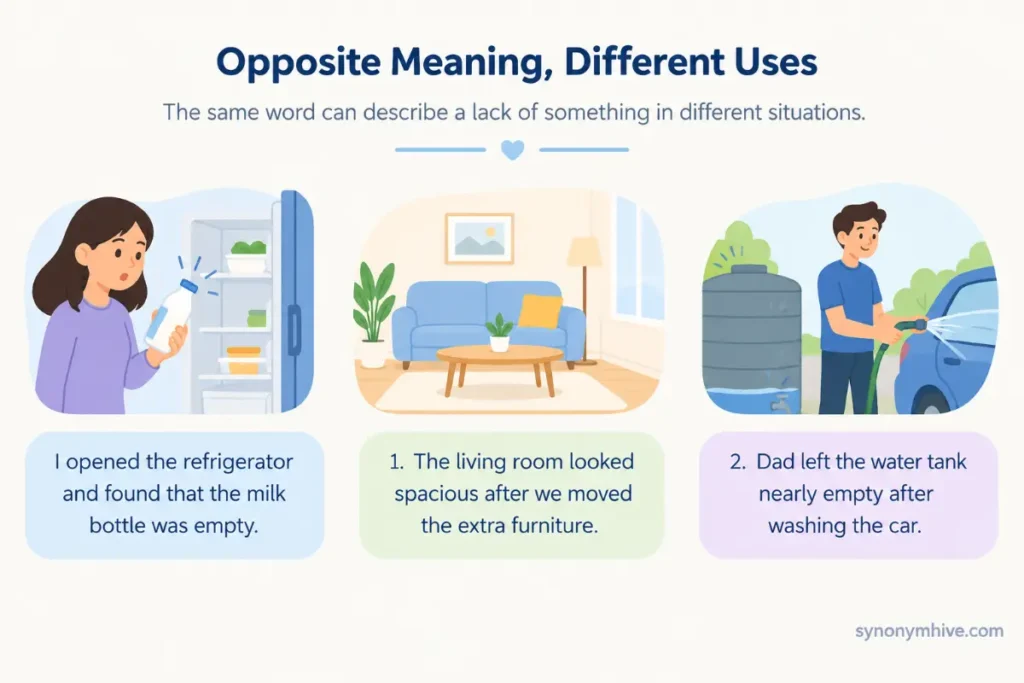
- I opened the refrigerator and found that the milk bottle was empty.
- The living room looked spacious after we moved the extra furniture.
- Dad left the water tank nearly empty after washing the car.
- The kitchen shelves looked bare after the family finished dinner.
- We found an unused cupboard for the new dishes.
School and Learning
- My teacher returned an incomplete essay because I forgot the final paragraph.
- The student left several blank spaces on the worksheet.
- Our class collected insufficient data to finish the experiment.
- The library was quiet during the early morning.
- The notebook contained sparse notes from the lecture.
Work and Business
- The manager said two positions were available on the support team.
- Our report was incomplete because we had not added the latest sales figures.
- The company had limited supplies during the busy season.
- I am available for a short meeting after lunch.
- The conference room remained unoccupied until the afternoon session.
Travel and Public Places
- We found an empty seat near the window.
- The train was crowded, but the next carriage had several available seats.
- The parking garage was almost empty before sunrise.
- The hotel had a vacant room for one night.
- The beach looked uncrowded on a weekday morning.
Food and Feelings
- After two slices of pizza, I felt full and did not want more food.
- Two hours later, I was hungry again.
- The soup bowl was empty after dinner.
- The singer used a thin voice during the quiet passage.
- The room felt spacious and calm after we removed the boxes.
These sentences demonstrate a useful rule. Do not choose a word simply because a dictionary lists it as an antonym. Choose the word that describes the exact condition in your sentence.
What Is the Difference Between Empty and Vacant?
Empty and vacant can both suggest that something has no contents or occupants, but they usually describe different things.
| Feature | Empty | Vacant |
|---|---|---|
| Main meaning | Having nothing inside or very little remaining | Not occupied or assigned |
| Common uses | Bottles, boxes, rooms, seats, shelves | Apartments, rooms for rent, jobs, seats |
| Tone | Everyday and direct | Neutral or slightly formal |
| Example | The bottle is empty. | The apartment is vacant. |
Use empty when you want to emphasize the lack of contents. Use vacant when you want to emphasize that no person occupies a place or holds a position.
For example, an apartment may be vacant even if it contains furniture. The word tells you that nobody lives there at present. An empty apartment suggests that it contains no furniture or other items, although everyday usage can vary.
What Is the Difference Between Incomplete and Insufficient?
Incomplete and insufficient both suggest a lack, but they describe different problems.
| Feature | Incomplete | Insufficient |
|---|---|---|
| Main meaning | Missing one or more required parts | Not enough for a specific need |
| Common uses | Forms, essays, reports, applications | Evidence, time, money, supplies |
| Main question | Is something missing? | Is there enough? |
| Example | The application is incomplete. | The evidence is insufficient. |
An incomplete report may contain plenty of information but still lack a required section. An insufficient amount of evidence may contain all the expected types of information but still fail to support a conclusion.
Use incomplete when the work needs additional parts. Use insufficient when the amount or quality does not meet a need.
What Are Common Mistakes When Choosing an Opposite of Full?
A common mistake is to treat every antonym as an exact replacement. English words carry different shades of meaning, so the wrong choice can change the message.
Using Empty for Every Situation
Empty is the most familiar opposite of full, but it does not fit every use.
Incorrect: I am empty after dinner.
Better: I am full after dinner.
If you want to describe the opposite condition, say I am hungry. Empty usually describes a container or place, although people sometimes use it figuratively to describe emotions or experiences.
Using Vacant for Containers
Vacant usually describes a place, room, property, or position that no one occupies. It does not normally describe a bottle or jar.
Incorrect: The bottle is vacant.
Better: The bottle is empty.
Confusing Empty With Incomplete
Empty means something has no contents. Incomplete means something lacks required parts.
Incorrect: The essay is empty because it lacks a conclusion.
Better: The essay is incomplete because it lacks a conclusion.
An essay with no writing is empty. An essay with several paragraphs but no conclusion is incomplete.
Confusing Free With Empty
Free often describes time, availability, or something that costs nothing. Empty describes a lack of contents.
Incorrect: My bottle is free.
Better: My bottle is empty.
However, My afternoon is free is correct when you mean you have no plans. Always check what the adjective describes.
Choosing Formal Words for Casual Situations
Words such as deficient and insufficient can sound stiff in everyday conversation. You can use simpler alternatives when the situation is informal.
Formal: We have insufficient time to complete the task.
Everyday: We do not have enough time to finish.
Both sentences communicate the same basic idea. The second sounds more natural in a casual conversation.
What Are the Antonyms of Full?
The main antonyms of full include empty, vacant, unoccupied, incomplete, available, free, hungry, sparse, and insufficient. Each word fits a particular meaning.
| Antonym | Best use |
|---|---|
| Empty | Containers and places with no contents |
| Vacant | Properties, rooms, and positions without occupants |
| Unoccupied | Rooms, seats, or spaces not in use |
| Incomplete | Work or documents missing required parts |
| Available | Resources, appointments, or options ready for use |
| Free | Time without commitments |
| Hungry | A person who needs food |
| Sparse | Information or items present in small numbers |
| Insufficient | An amount that does not meet a need |
| Spacious | A place that offers plenty of room |
| Blank | A page or form without writing |
| Unfilled | A role or space that has not been filled |
The word you choose should match the meaning of full in your sentence. For a container, empty is usually best. For a schedule, free or available often works better.
How Can You Choose the Right Opposite of Full?
Use these quick tips to make your choice.
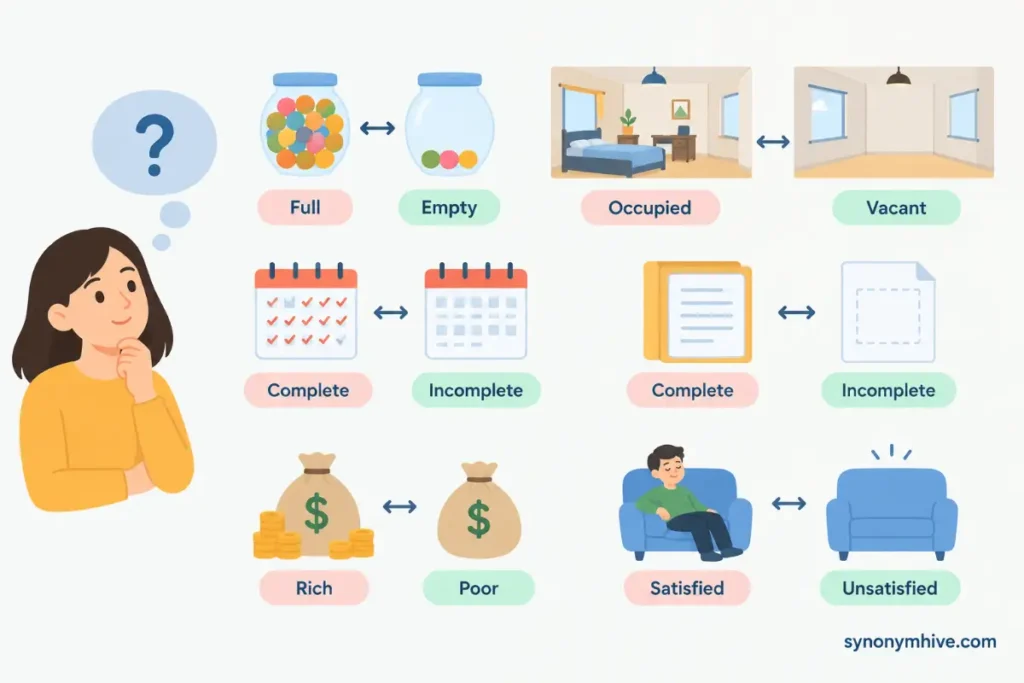
- Identify the subject. Decide if you are describing a container, person, room, schedule, document, or amount of something.
- Find the intended meaning. Ask if full means filled, occupied, complete, busy, satisfied, or rich in quality.
- Choose the direct opposite. Use empty for contents, vacant for occupancy, free for time, and incomplete for missing parts.
- Check the tone. Choose simple words for casual messages and precise words for formal writing.
- Read the sentence aloud. If the word sounds unnatural, try a more specific alternative.
- Check the result. Make sure the new word communicates the opposite condition you intended.
For example, consider the sentence My schedule is full. You could replace full with open or free if you mean you have no commitments. You would not normally use empty because people do not describe a schedule as an empty object in ordinary conversation.
The same principle applies to the opposite of full in a school assignment, work email, or everyday discussion. The sentence provides the context that helps you choose the best word.
Find more synonyms in Opposite of Confident Best Words for Every Situation.
Conclusion
Choosing the right antonym makes your writing clearer and helps readers understand exactly what you mean. Empty is the most common answer when something contains nothing, but it is not the best choice for every situation. Vacant describes a place or position without an occupant. Available and free describe options or time that people can use. Incomplete points to missing parts, while insufficient means that an amount does not meet a need.
When you search for the opposite of full, start by identifying what full describes in your sentence. Then select the word that expresses the opposite condition in natural English. This small step can improve an essay, a work email, a resume, or an everyday conversation. With practice, you will choose words that sound more precise and fit your message without adding extra explanation.
Frequently Asked Questions
What is the opposite of full in one word?
The most common opposite is empty. Use it when a container or space has no contents, but choose a more specific word for schedules, documents, or people.
What is another way to say full?
You can use filled, packed, occupied, complete, crowded, or satisfied, depending on the meaning. For example, a packed room has many people, while a complete report contains all its required parts.
Is vacant the same as empty?
No. Vacant usually means that nobody occupies a place or position, while empty usually means that something contains nothing. A furnished apartment can be vacant without being empty.
What is the opposite of a full schedule?
The opposite of a full schedule is a free or open schedule. These phrases mean that someone has time available and few or no commitments during the period discussed.
What is the opposite of full in a sentence?
The best word depends on the sentence. For example, The glass is full becomes The glass is empty, while My schedule is full becomes My schedule is free.
What is the opposite of full for a person after eating?
The opposite is hungry. Full means that a person has eaten enough and does not need more food at that moment, while hungry means the person wants or needs food.
What is the opposite of full in formal writing?
Incomplete, insufficient, vacant, and unoccupied can work in formal writing. Choose incomplete for missing parts, insufficient for an amount that falls short, and vacant or unoccupied for places without occupants.