
Imagine writing an email and describing a room as loud. That word gives readers a clear picture, but it may not express the exact point you want to make. Perhaps the room was peaceful, the music was soft, or the conversation stayed low. Choosing the right opposite of loud can make your writing more precise.
The best replacement depends on what you mean. Quiet works in most everyday situations. Silent suggests a complete lack of sound. Soft describes a low volume, while peaceful focuses on a calm setting. Each word carries a slightly different meaning.
The opposite of loud is usually quiet. Other useful choices include silent, soft, muted, low, hushed, peaceful, and subdued. The right word depends on the sound, setting, and tone you want to describe.
This guide explains the meaning and history of these words, compares more than 30 alternatives, and groups them by intensity and use. You’ll also find examples for resumes, essays, emails, texts, and everyday conversations.
Find similar expressions in Opposite of Hot Best Words for Every Situation.
What Is the Opposite of Loud?
The most common opposite of loud is quiet. It describes a sound or environment with little noise or a low volume. For example, a quiet room has less noise than a loud room.
However, quiet is not the only useful choice. English has several words that describe different kinds of low sound or a lack of noise.
| Word | Basic meaning | Example |
|---|---|---|
| Quiet | Making little noise | The library was quiet. |
| Silent | Making no sound | The classroom became silent. |
| Soft | Low in volume | She spoke in a soft voice. |
| Low | Not high in volume | Keep the music low. |
| Hushed | Very quiet, often deliberately | The crowd grew hushed. |
| Muted | Reduced in volume or strength | A muted sound came from the next room. |
| Peaceful | Calm and free from disturbance | We enjoyed a peaceful evening. |
| Subdued | Quiet and restrained | The audience gave a subdued response. |
Is Quiet Always the Best Opposite?
Quiet is the safest general choice, but it doesn’t fit every sentence.
For example, a quiet person may speak very little. A silent person does not speak or make a sound at that moment. A soft voice has a low volume, but people can still hear it clearly.
Think about the exact meaning you want to express before choosing a replacement. This small change can make a sentence clearer and more natural.
Where Did the Word Loud Come From?
The word loud has a long history in English. It comes from the Old English word hlūd, which meant making a strong sound or producing a great noise. Its meaning has stayed close to that idea over time.
Today, loud describes sounds that have a high volume or strong impact on the ear. A loud alarm, a loud engine, and loud music all produce sounds that are easy to hear.
The word also has meanings beyond physical sound. People use it to describe bright colors, strong opinions, bold clothing, and noticeable behavior.
For example, a loud outfit may attract attention because of its bright colors. A loud personality may stand out because someone speaks with great confidence or acts in a very noticeable way.
What Does Loud Mean in Everyday English?
Loud usually means producing or making a strong sound. It can also mean attracting attention through bold or noticeable qualities.
Here are common uses.
- Sound: The children made a loud noise in the hallway.
- Speech: He spoke in a loud voice during the meeting.
- Music: The band played loud music at the concert.
- Color: She wore a loud shirt with bright patterns.
- Behavior: His loud personality filled the room.
This range matters because the best opposite changes with the meaning. Quiet and silent work well for sound. Subtle or understated may work better when you describe clothing or style.
What Are the Main Words That Mean the Opposite of Loud?
The following words cover everyday speech, formal writing, sound levels, and casual conversations. Some describe low volume, while others focus on silence, calmness, or restraint.
Simple Words
These are easy to understand and work well in everyday English.
| Word | Meaning | Tone | Example |
|---|---|---|---|
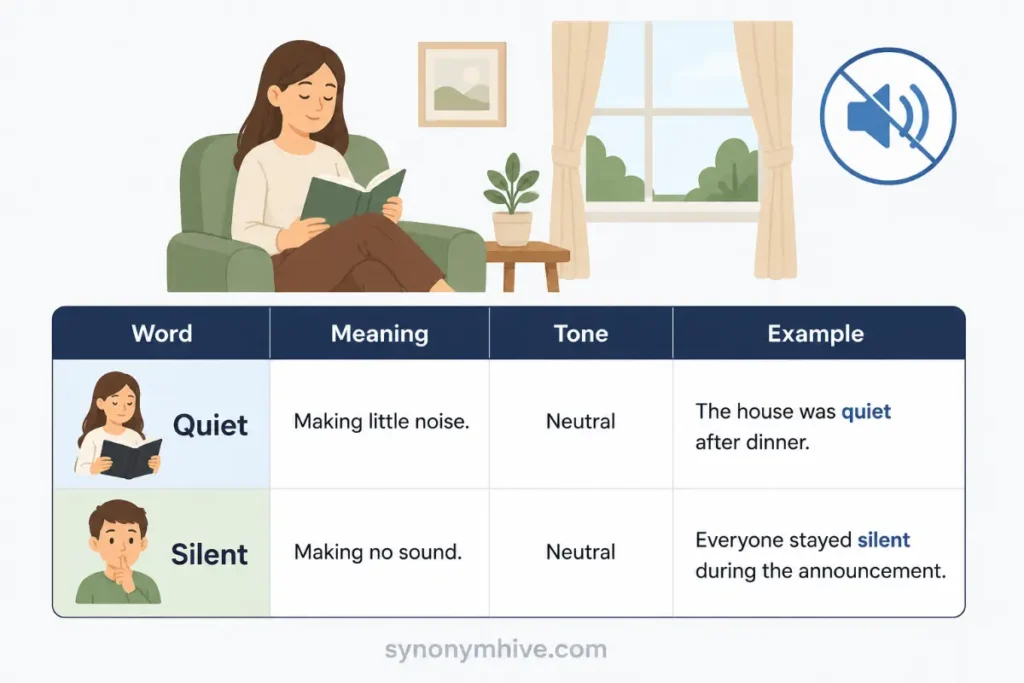
| Quiet | Making little noise | Neutral | The house was quiet after dinner. |
| Silent | Making no sound | Neutral | Everyone stayed silent during the announcement. |
| Soft | Low in volume | Neutral | The radio played soft music. |
| Low | Not high in volume | Neutral | Please keep your voice low. |
| Calm | Free from noise or excitement | Positive | The room felt calm after the meeting. |
| Still | Quiet and without movement | Neutral | The forest was still before sunrise. |
| Peaceful | Calm and free from disturbance | Positive | We spent a peaceful afternoon at home. |
| Gentle | Mild rather than harsh or forceful | Positive | A gentle sound came from the garden. |
Everyday Words
These choices add more detail and help describe specific sounds or situations.
| Word | Meaning | Tone | Example |
|---|---|---|---|
| Hushed | Very quiet, often on purpose | Neutral | The audience grew hushed before the show. |
| Muted | Reduced in sound or strength | Neutral | A muted voice came through the door. |
| Faint | Very weak or difficult to hear | Neutral | We heard a faint sound outside. |
| Muffled | Made less clear by something blocking the sound | Neutral | A muffled voice came from upstairs. |
| Subdued | Quiet and restrained | Neutral | The team gave a subdued celebration. |
| Gentle | Soft and not harsh | Positive | Gentle music played in the background. |
| Whispered | Spoken in a very low voice | Neutral | She whispered the answer to her friend. |
| Low-key | Quiet, simple, and not attention-seeking | Casual | They planned a low-key birthday dinner. |
Formal Words
These terms suit reports, essays, professional communication, and careful descriptions.
| Word | Meaning | Tone | Example |
|---|---|---|---|
| Inaudible | Too quiet to be heard | Formal | The recording contained an inaudible response. |
| Soundless | Without sound | Formal | The film opened with a soundless scene. |
| Noiseless | Producing no noticeable noise | Formal | The machine moved in a noiseless manner. |
| Restrained | Controlled and not excessive | Formal | The speaker used a restrained tone. |
| Understated | Quiet, simple, and not showy | Formal | The design had an understated style. |
| Tranquil | Peaceful and calm | Formal | The garden offered a tranquil setting. |
| Serene | Calm and undisturbed | Formal | A serene atmosphere filled the room. |
| Soft-spoken | Speaking gently and quietly | Formal | The soft-spoken manager answered each question. |
Slang and Casual Words
These expressions work in relaxed conversations, texts, and informal writing. Some describe a person or event rather than sound itself.
| Word | Meaning | Tone | Example |
|---|---|---|---|
| Chill | Calm and relaxed | Slang | The party stayed chill all night. |
| Low-key | Not loud, flashy, or attention-seeking | Casual | We had a low-key weekend. |
| Laid-back | Relaxed and easygoing | Casual | He’s a laid-back speaker. |
| Mellow | Calm, soft, or relaxed | Casual | The café played mellow music. |
| Under the radar | Not attracting much attention | Informal | They kept the celebration under the radar. |
| Quiet as a mouse | Extremely quiet | Idiom | The children were quiet as mice during the film. |
| Keep it down | Reduce the volume | Informal phrase | Could you keep it down while I work? |
| Take it easy | Relax or reduce intensity | Informal phrase | Let’s take it easy and talk quietly. |
Not every word in this list can replace loud in every sentence. For example, chill describes a relaxed mood, while inaudible describes a sound that cannot be heard. Choose the word that matches the point you want to make.
Which Words Are Best for Different Levels of Sound?
Not every quiet sound has the same volume. A person speaking softly is different from a room with no sound at all. Some words describe a small reduction in volume, while others suggest complete silence.
What Words Describe a Slightly Lower Volume?
Use these words when a sound is still easy to hear but isn’t strong or disturbing.
- Soft. This describes a gentle sound that does not reach a high volume. A soft voice can still be clear.
- Low. This describes a reduced sound level. It works especially well when talking about music, voices, and electronic devices.
- Mild. This suggests a sound that isn’t harsh or intense. It often describes noise or sound conditions rather than a person’s voice.
- Gentle. This describes a sound that is smooth and pleasant rather than forceful.
- Muted. This suggests that something has lost some of its volume or strength.
Examples include a soft conversation, low background music, a gentle breeze, and muted applause.
What Words Describe a Very Quiet Sound?
These words suggest that a sound is barely noticeable or that people are making a deliberate effort to stay quiet.
- Faint. A faint sound is weak and difficult to hear.
- Muffled. A muffled sound is blocked or covered, so it isn’t clear.
- Hushed. A hushed voice or room has very little noise, often because people choose to be quiet.
- Whispered. A whispered comment uses a very low voice.
- Subdued. A subdued response lacks the volume or excitement people might normally expect.
For example, you might hear a faint knock at the door, a muffled conversation through a wall, or a hushed discussion in a hospital.
What Words Mean Complete Silence?
Choose these words when you want to describe an absence of sound rather than a low volume.
- Silent. Nothing makes a sound.
- Soundless. No sound is present or produced.
- Noiseless. Something operates without noticeable noise.
- Inaudible. A sound exists, but people cannot hear it.
- Still. A place or moment has little or no sound or movement.
These words aren’t always interchangeable. A silent room has no sound, while an inaudible recording may contain a voice that is too faint for listeners to understand.
What Words Describe a Calm Atmosphere?
Sometimes you don’t need a word about volume. You want to describe the mood of a place.
- Peaceful. A peaceful place is free from disturbance or conflict.
- Tranquil. This word suggests deep calm and a lack of disturbance.
- Serene. A serene setting feels calm, pleasant, and undisturbed.
- Mellow. This describes a relaxed mood or a soft and pleasant sound.
- Calm. A calm environment has little activity, excitement, or disturbance.
A peaceful beach, serene garden, or mellow café may contain some sound. The key idea is that the setting does not feel noisy or stressful.
Which Opposite of Loud Fits Each Part of Speech?
The word loud is an adjective. It describes a person, sound, place, or thing. Many of its alternatives are also adjectives, so you can use them in similar sentence positions.
However, some useful alternatives are nouns, verbs, or adverbs. Knowing the difference helps you avoid awkward sentences.
Which Adjectives Can Replace Loud?
Adjectives describe nouns. They are the most useful replacements when you want to describe a voice, room, sound, or atmosphere.
| Adjective | Best use | Example |
|---|---|---|
| Quiet | Rooms, people, places, and sounds | The office is quiet today. |
| Silent | Complete absence of sound | The room became silent. |
| Soft | Voices, music, and other sounds | She used a soft voice. |
| Hushed | Voices and quiet settings | A hushed crowd waited outside. |
| Muted | Reduced sound or color | The television played at a muted volume. |
| Peaceful | Places and atmospheres | The village is peaceful at night. |
| Subdued | Voices, reactions, and moods | His response was subdued. |
| Soft-spoken | People who speak quietly | Our new teacher is soft-spoken. |
Which Nouns Describe the Opposite of Loudness?
Nouns name a quality, condition, or thing. Use them when the sentence discusses the amount of noise rather than describing an object directly.
| Noun | Meaning | Example |
|---|---|---|
| Quietness | The state of making little noise | I enjoyed the quietness of the countryside. |
| Silence | A complete lack of sound | Silence filled the hall. |
| Stillness | A calm state with little movement or noise | The stillness of the morning was relaxing. |
| Peace | A state free from disturbance | We wanted some peace after work. |
| Calm | A state without excitement or disturbance | The calm of the room helped everyone focus. |
For example, you can write, The quietness of the library helped me study. You can also write, The library was quiet. The first sentence uses a noun, while the second uses an adjective.
Which Adverbs Describe Quiet Speech or Sound?
Adverbs explain how someone speaks or how something happens. These words often work with verbs such as speak, talk, move, and play.
| Adverb | Meaning | Example |
|---|---|---|
| Quietly | With little noise | She spoke quietly. |
| Softly | In a gentle or low voice | He answered softly. |
| Silently | Without making a sound | The students waited silently. |
| Gently | In a mild or careful way | The music played gently. |
| Calmly | Without anger or excitement | She calmly explained the problem. |
| Faintly | In a weak or barely noticeable way | A bell rang faintly in the distance. |
Avoid using an adjective where an adverb is needed. She spoke quiet is incorrect in standard English. She spoke quietly is the correct form.
Which Verbs Suggest Making Less Noise?
Some verbs describe the action of reducing sound or speaking in a quiet way.
| Verb | Meaning | Example |
|---|---|---|
| Whisper | Speak in a very low voice | Please whisper in the library. |
| Muffle | Make a sound less clear or loud | The thick curtains muffled the noise. |
| Lower | Reduce the volume | Lower the television before the call. |
| Hush | Make someone or something quiet | The teacher hushed the class. |
| Silence | Stop someone or something from making noise | The announcement silenced the crowd. |
Use the verb that matches the action. Whisper describes quiet speech, while muffle describes a sound that becomes less clear because something blocks it.
Are There Differences Between American and British English?
Most common alternatives work in both American and British English. Quiet, silent, soft, low, peaceful, and gentle have the same basic meanings in both varieties.
The bigger differences usually come from local expressions, pronunciation, and conversational habits rather than the main vocabulary.
Do Americans and British Speakers Use Quiet Differently?
No major difference exists in the basic meaning of quiet. An American might say, Please keep your voice down. A British speaker can use the same sentence and understand it in the same way.
Both varieties also use expressions such as keep it down, speak softly, and stay quiet.
Are Some Casual Words More Common in Certain Regions?
Yes. Casual expressions can vary by region, age group, and social setting.
For example, low-key is common in American informal speech. People often use it to describe a relaxed event or something that doesn’t attract much attention. British speakers understand it too, but their choice of casual wording may differ.
Other expressions, such as laid-back and mellow, are widely understood across both countries. Still, they may sound more natural in some situations than others.
Which Words Work Best in International English?
If your readers come from different countries, use simple and widely understood terms.
Good choices include:
- Quiet.
- Silent.
- Soft.
- Low.
- Peaceful.
- Calm.
- Gentle.
These words are clear, familiar, and easy to translate. Avoid regional slang when writing instructions, workplace messages, school assignments, or content for an international audience.
What Is the Best Word for Each Writing Situation?
The best word depends on your audience and purpose. A resume needs professional language. An essay may need a precise description. A text message can use relaxed expressions.
Here are practical choices for common situations.
What Is a Better Word Than Loud on a Resume?
Use soft-spoken, calm, composed, or measured when describing a person who communicates without raising their voice or dominating a discussion.
A resume should focus on useful workplace qualities. Simply saying that you are quiet may not show the value you bring to a team.
Example: I use a calm and measured communication style when working with customers and colleagues.
Other useful examples include:
- I remain composed during difficult customer conversations.
- I use a measured approach when presenting ideas to senior staff.
- My soft-spoken communication style helps me listen carefully to clients.
- I contribute thoughtful ideas without interrupting others.
Choose a word that describes your real communication style. Avoid presenting quietness as a skill unless you can connect it to listening, teamwork, careful judgment, or another useful quality.
What Is the Best Word for an Essay?
Use quiet, silent, subdued, peaceful, or tranquil, depending on the subject.
Academic writing benefits from precise descriptions. The word peaceful works for a calm setting, while silent describes an absence of sound. Subdued can describe a restrained reaction or a low level of activity.
Example: The usually busy street became quiet after the shops closed.
You could also write:
- The silent room allowed the students to concentrate.
- A subdued response followed the speaker’s announcement.
- The tranquil setting helped visitors relax.
- The soft background music created a calm atmosphere.
Don’t choose a formal word just to make an essay sound advanced. A simple and accurate word is usually stronger than an unusual one that doesn’t fit.
What Is a Good Casual Word for Texting?
Use quiet, chill, low-key, or mellow in casual messages.
These words help you describe a relaxed place or event without sounding too formal.
Example: Let’s have a low-key night at home instead of going to a crowded party.
Other text examples include:
- Can we keep the music low?
- I want a quiet place to study.
- Let’s find a chill café.
- The party was mellow and relaxed.
- It’s pretty quiet here tonight.
The phrase keep it down also works when you want someone to reduce the volume. It is direct and familiar, so it suits a casual message.
What Is the Best Alternative in a Professional Email?
Use quiet, low, muted, or soft when discussing sound levels. Choose calm, measured, or composed when describing someone’s behavior.
Professional emails should make the request clear without sounding rude.
Example: Could you please keep the meeting room quiet during the client call?
Other examples include:
- Please lower the speaker volume before the presentation.
- The background noise was low during the recording.
- We need a quiet space for the training session.
- A calm tone will help us resolve the issue.
Avoid slang such as chill in formal workplace communication. It may be fine in a message to a close colleague, but a neutral word is safer in an email to a client or manager.
What Word Works Best in Everyday Speaking?
Use quiet, soft, calm, or peaceful in most conversations. These words sound natural and don’t require formal language.
Example: This café is quiet enough for us to talk.
You can also say:
- Could you speak a little more softly?
- The neighborhood is peaceful at night.
- Keep the television volume low, please.
- It’s calm here in the early morning.
- The children became quiet after the story started.
In spoken English, short and familiar words often work best. Choose a more specific term only when it adds useful meaning.

Compare more word options with Opposite of Kind Best Words for Every Situation.
What Are Some Examples of the Opposite of Loud in Real Situations?
Examples make it easier to understand how these words work in everyday English. The same word can sound natural in one situation and awkward in another. Compare the meaning of each sentence before choosing a replacement.
What Are Examples Related to People and Conversation?
A quiet person may speak less than others, but that doesn’t mean they have nothing to say. Words such as soft-spoken, calm, and reserved describe different parts of a person’s communication style.
- The soft-spoken doctor explained the treatment in simple language.
- My usually talkative brother stayed quiet during the long drive.
- She gave a calm answer instead of arguing with the customer.
- The reserved student shared a thoughtful idea near the end of class.
- Our manager used a measured tone during the difficult discussion.
- The children whispered so they wouldn’t wake their baby sister.
- He spoke softly because the guests were already asleep.
- Everyone remained silent while the principal read the announcement.
Notice that these examples don’t all describe the same thing. Soft-spoken describes a person’s usual speaking style. Reserved describes someone who may not share much in social situations. Silent describes a moment when no one speaks.
What Are Examples Related to Music and Other Sounds?
Words such as soft, low, faint, muted, and muffled help explain the strength and quality of a sound.
- The restaurant played soft jazz during dinner.
- A faint tapping sound came from the kitchen.
- We heard muffled voices through the closed door.
- The radio was so low that I could barely hear it.
- She chose muted background music for the presentation.
- The singer performed a gentle song without using a microphone.
- A distant bell rang softly across the valley.
- The machine operated quietly throughout the night.
These examples show why volume and sound quality matter. A muffled sound is not always quiet by choice. An inaudible sound may exist but remain impossible to hear clearly.
What Are Examples Related to Places and Atmosphere?
Choose peaceful, serene, tranquil, still, or calm when the setting matters more than its actual volume.
- The village was peaceful after the evening traffic disappeared.
- A serene garden stood behind the old building.
- We enjoyed the stillness of the countryside before sunrise.
- The hotel offered a calm place to rest after a busy day.
- The beach was tranquil early in the morning.
- The library stayed quiet during the afternoon.
- A peaceful atmosphere helped the team focus on its work.
- The park became still as the sun went down.
A place can be peaceful even when birds sing or people talk. These words describe the overall mood, not just the number of sounds.
What Are Examples Related to Work and Study?
A quiet environment often helps people concentrate. However, the best word changes based on the point you want to make.
- The office remained quiet while employees finished their reports.
- Students worked silently during the final exam.
- The recording room needs a low level of background noise.
- A calm classroom helps children follow instructions.
- The team held a subdued celebration after the project ended.
- The speaker used a measured tone during the presentation.
- A peaceful workspace can make long tasks easier to manage.
- Please keep the hallway quiet while the training session is in progress.
Quiet vs Silent vs Soft What Is the Difference?
Quiet, silent, and soft are common alternatives, but they don’t mean exactly the same thing. Choosing the right one helps readers understand the sound you have in mind.
| Word | Main meaning | Does some sound remain? | Best example |
|---|---|---|---|
| Quiet | Making little noise | Usually | The room was quiet. |
| Silent | Making no sound | No noticeable sound | The room was silent. |
| Soft | Low in volume or gentle | Yes | The music was soft. |
When Should You Use Quiet?
Use quiet when a person, place, or object makes little noise. It is a flexible word that works in most everyday situations.
For example, a quiet street may have a few cars and people. The sound level is simply low enough to make the street seem peaceful.
Quiet can also describe a person who doesn’t talk much. That person may still speak when needed.
When Should You Use Silent?
Use silent when no one speaks or nothing produces an audible sound.
For example, a silent classroom has no talking or other noticeable noise. A silent phone does not make sound when it receives a notification.
Silent can also describe a person who chooses not to respond. However, be careful because calling someone silent may suggest that they are not speaking at all.
When Should You Use Soft?
Use soft when you describe the volume or quality of a sound.
For example, a soft voice is low and gentle. Soft music may be easy to hear, but it doesn’t dominate the room.
Soft also describes physical qualities such as texture and touch. A soft pillow has nothing to do with sound, so context matters.
Quiet vs Peaceful Which Word Should You Choose?
Quiet and peaceful often describe similar places, but they focus on different qualities.
| Word | What it describes | Example |
|---|---|---|
| Quiet | A low level of noise | The street was quiet. |
| Peaceful | A calm and undisturbed atmosphere | The village was peaceful. |
A quiet place may still feel uncomfortable. For example, an empty office at night can be quiet but not especially peaceful.
A peaceful place can contain natural sounds, conversations, or gentle music. The important point is that these sounds don’t disturb the setting.
Use quiet when you want to discuss noise. Choose peaceful when you want to describe the overall atmosphere.
What Are Common Mistakes When Choosing a Word for Loud?
Many alternatives look similar, but they have different meanings. Using the wrong word can make a sentence confusing or change its message.
Does Quiet Mean the Same as Shy?
No. Quiet describes a low level of sound or a person who doesn’t speak much. Shy describes someone who feels nervous or uncomfortable in social situations.
A shy person may speak loudly when talking with close friends. A quiet person may be confident and comfortable around others.
Incorrect assumption: He is quiet, so he must be shy.
Better sentence: He is quiet during meetings but speaks confidently when discussing his work.
Is Silent the Same as Inaudible?
No. Silent means that no sound is being made or heard. Inaudible means a sound exists but cannot be heard clearly.
For example, a silent recording contains no audible sound. An inaudible recording may contain speech that is too weak for listeners to understand.
Can You Use Peaceful for Every Quiet Sound?
No. Peaceful describes a calm condition or atmosphere. It doesn’t simply mean low volume.
You can describe a garden as peaceful, but a peaceful microphone setting may sound unnatural if you only mean that the recording has low volume.
Use soft, low, or muted for sound levels. Choose peaceful for places, experiences, and moods.
Is Mute the Same as Muted?
Not exactly. Mute can work as a verb, adjective, or noun depending on the sentence. Muted commonly describes sound or color that has been reduced in strength.
For example:
- Please mute your microphone.
- The television remained muted.
- She wore muted colors.
The first sentence describes an action. The second describes a device with its sound turned off. The third describes colors that are not bright or strong.
Should You Use Slang in Formal Writing?
Usually, no. Words such as chill and low-key suit casual conversations, but they may sound out of place in a report, academic essay, or business proposal.
Use quiet, calm, subdued, or peaceful when writing for a formal audience. Pick the term that gives readers the clearest picture.
What Are the Antonyms of Loud in Different Contexts?
An antonym is a word with the opposite meaning of another word. Loud has several useful antonyms because it can describe volume, behavior, or appearance.
| Meaning of loud | Useful antonyms |
|---|---|
| High sound volume | Quiet, soft, low, muted |
| A complete lack of sound | Silent, soundless, noiseless |
| Strong or noticeable behavior | Reserved, restrained, understated |
| Bright or attention-grabbing style | Subtle, muted, understated |
| A busy or disturbing atmosphere | Peaceful, calm, tranquil, serene |
The exact opposite depends on how you use loud. A loud voice calls for a word about volume. A loud outfit needs a word about appearance.
This distinction is useful in writing because a general antonym may not express the meaning you want.
How Can You Choose the Right Word?
A good word choice should match the sound, setting, audience, and purpose of your sentence. Use these quick tips before replacing loud.
1. Identify What You Are Describing
Start by checking the subject.
- For a voice, consider soft, quiet, hushed, or soft-spoken.
- For music, consider low, gentle, muted, or mellow.
- For a room, consider quiet, silent, or peaceful.
- For a person, consider calm, reserved, or soft-spoken.
- For clothing or design, consider subtle or understated.
This step helps you avoid choosing a word that describes the wrong quality.
2. Decide How Much Sound Is Present
Think about the actual volume.
If the sound is still easy to hear, soft or low may work. If it is barely noticeable, faint may be more accurate.
For example, a quiet room may contain a ticking clock. A silent room would have no noticeable sound at all.
3. Consider the Mood
Some words describe the atmosphere rather than volume.
Peaceful, tranquil, and serene suggest a pleasant setting. Hushed suggests that people are deliberately staying quiet. Subdued can suggest a lack of excitement or enthusiasm.
Choose the word that reflects the mood you want readers to understand.
4. Match the Tone to Your Audience
Use familiar words in everyday communication. Quiet, soft, and calm are easy for most readers to understand.
Formal writing can use terms such as restrained, subdued, tranquil, or inaudible when they fit the subject. Casual messages can use chill, mellow, or low-key.
5. Read the Sentence Aloud
A word may look correct but sound awkward in context. Read the complete sentence to check its meaning and flow.
For example:
- Awkward: The inaudible garden was beautiful.
- Better: The tranquil garden was beautiful.
Inaudible describes sound that cannot be heard. Tranquil describes a calm setting, so it fits the second sentence.
6. Avoid Choosing a Word Just Because It Sounds Formal
A complex word isn’t automatically better. If quiet explains your meaning clearly, there is no need to replace it with a less familiar term.
Use a specific word when it adds useful information. Otherwise, choose the simple option.
Explore more word choices in Opposite of Smart Best Words and Examples.
Conclusion
English offers many ways to describe low volume, a lack of noise, and a calm atmosphere. Quiet remains the most useful general choice, but silent, soft, muted, hushed, and peaceful each add a different shade of meaning. The best opposite of loud depends on the subject and the message you want to share. Use soft for gentle sounds, silent for a complete lack of noise, and peaceful for a calm setting. In professional writing, choose clear words that match your audience. In casual conversations, familiar expressions often work best. A precise word makes your sentence easier to understand and helps readers picture the situation without extra explanation.
Frequently Asked Questions
What Is the Opposite of Loud?
The most common opposite of loud is quiet. It describes a sound, person, or place that makes little noise. Silent, soft, low, and peaceful can also work in the right context.
What Is Another Word for Loud That Means Quiet?
Quiet is the simplest choice, but soft, hushed, muted, and subdued can also describe low sound levels. Use the word that best matches the situation.
Is Silent Stronger Than Quiet?
Yes. Silent usually suggests that no sound is being made or heard, while quiet allows some sound to remain. A quiet room may have a ticking clock, but a silent room has no noticeable noise.
What Is the Opposite of Loud Music?
Soft, low, muted, and gentle are useful alternatives for loud music. Soft music has a low volume, while muted music sounds reduced or less strong.
What Is a Formal Word for Quiet?
Tranquil, serene, subdued, restrained, and inaudible are formal alternatives in suitable contexts. Tranquil and serene describe calm settings, while inaudible describes a sound that cannot be heard.
What Is the Opposite of a Loud Person?
A quiet or soft-spoken person usually speaks with a low volume or doesn’t talk much. Reserved describes someone who shares less in social situations, while calm describes someone who stays composed.
What’s Another Way to Say Someone Is Not Loud?
You can say that someone is quiet, soft-spoken, reserved, or calm. For example, He is soft-spoken and listens carefully during meetings.