
You may need the opposite of rich when writing a school essay, describing a character, sending a text, or explaining someone’s financial situation. The right word depends on what you mean. A person with little money is poor, but a meal with very little flavor is bland, and a color that lacks depth may look pale or dull.
The most common opposite of rich is poor when rich refers to money or wealth. However, rich has several meanings, so its best opposite can change with the sentence. Words such as needy, impoverished, broke, plain, weak, and limited each describe a different situation.
Quick answer: The opposite of rich is usually poor when talking about money. For other meanings, the best opposite may be plain, weak, bland, simple, or limited.
Choosing the right word helps you communicate clearly without sounding rude or making an inaccurate statement. For example, calling someone broke usually describes a temporary lack of money, while impoverished often describes a serious and lasting lack of basic resources.
This guide explains the meaning and origin of rich, compares more than 30 alternatives, and shows how to choose a suitable word for essays, resumes, emails, conversations, and everyday messages.
Discover another helpful synonym list in Opposite of Confident Best Words for Every Situation.
What Is the Opposite of Rich?
The opposite of rich is most often poor. These words describe two different levels of financial resources. A rich person has substantial wealth or valuable assets, while a poor person has little money or limited access to the resources needed for daily life.
For example, consider these sentences.
- The rich family owned several homes and businesses.
- The poor family struggled to pay its monthly bills.
In both examples, rich and poor refer to financial circumstances. Yet rich can describe more than money. It can also refer to taste, color, sound, soil, detail, and experience.
A rich chocolate cake has a deep flavor. Its opposite might be bland or flavorless. Rich soil contains plenty of nutrients, so its opposite might be poor soil or nutrient deficient soil. A rich voice sounds full and deep, while a thin or weak voice lacks that quality.
The key is to identify the meaning before choosing an opposite. A dictionary may list several antonyms, but only a few will fit your sentence naturally.
Does Rich Always Mean Wealthy?
No. Rich can describe wealth, quality, depth, abundance, or strong sensory qualities. The sentence determines its meaning.
For example, a wealthy business owner may be rich in money. A person with a full and rewarding life may be rich in experience. A sauce with strong flavor may be rich in taste. Each meaning needs a different opposite.
Use poor for a lack of money or resources. Use bland for weak flavor.
This distinction matters in schoolwork and professional writing. Replacing rich with poor in every sentence may change the meaning instead of improving it.
What Does Rich Mean?
Rich usually means having a large amount of money, property, valuable possessions, or resources. It can also describe something that contains a lot of a useful substance or has a strong, full, or pleasing quality.
Here are the main meanings.
- Financial wealth. A rich person has substantial money, investments, property, or other valuable assets.
- Abundance. A rich collection contains many valuable items, ideas, or experiences.
- Strong flavor. Rich food often has a deep taste or a creamy texture.
- Deep color. A rich color looks strong, vivid, or intense.
- Full sound. A rich voice or musical tone sounds deep and resonant.
- Nutrient content. Rich soil contains nutrients that help plants grow.
- Detailed content. A rich story or description includes many useful details and ideas.
The word can have a positive meaning, as in rich soil or a rich cultural tradition. In other cases, it simply describes a condition, such as rich food that contains a lot of fat or cream.
Understanding these meanings makes it easier to select the right antonym. The opposite of financial wealth is poverty, while the opposite of a rich flavor may be blandness. The opposite of a detailed account could be a sparse or limited one.
Where Did the Word Rich Come From?
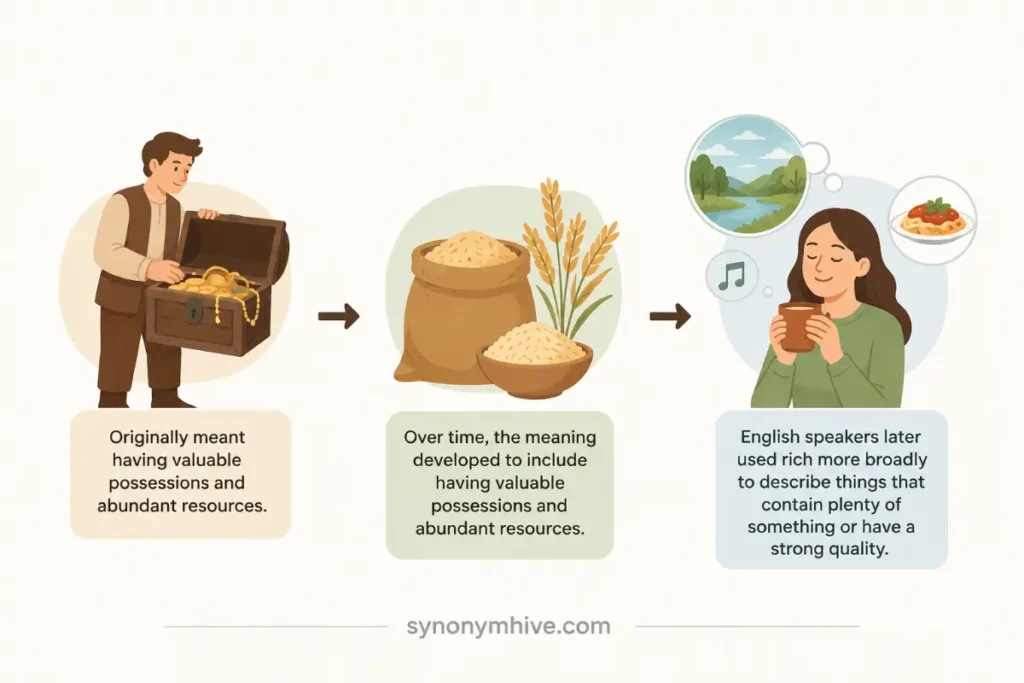
The English word rich comes from Old English rīċe, a word connected with power, authority, and wealth. Its history also reflects older Germanic language forms associated with ruling or having influence.
Over time, the meaning developed to include having valuable possessions and abundant resources. English speakers later used rich more broadly to describe things that contain plenty of something or have a strong quality.
That broader use explains why the word appears in many everyday expressions. People talk about rich soil, rich colors, rich flavors, rich traditions, and rich experiences. In each case, the word suggests fullness, abundance, or strength.
The opposite depends on the quality being described. Poor works well for financial resources and soil quality. Bland works for flavor. Pale may work for a weak color. Sparse fits a collection with few items. No single antonym covers every meaning of rich.
What Is the Difference Between Rich and Poor?
Rich and poor are direct opposites when they describe financial circumstances.
| Word | Meaning | Example |
|---|---|---|
| Rich | Having substantial wealth | The rich investor bought several properties. |
| Poor | Having little money or resources | The poor household needed help with rent. |
| Wealthy | Having a high level of financial assets | A wealthy donor funded the library. |
| Needy | Lacking resources and requiring assistance | The program provides meals for needy families. |
| Affluent | Having considerable money and a comfortable lifestyle | They live in an affluent neighborhood. |
| Impoverished | Extremely poor or deprived of resources | The charity supports impoverished communities. |
Rich and poor are broad terms. Wealthy and affluent often sound more formal or more focused on financial status. Needy highlights a need for assistance, while impoverished often suggests severe hardship.
Use the word that matches the facts. A person can earn a modest income without being completely destitute. Someone can also experience a short period without cash but still own a home or have savings. Precise language helps avoid unfair assumptions about people’s lives.
What Are the Best Synonyms for the Opposite of Rich?
The best word depends on your intended meaning and the tone of your sentence. The following list includes everyday words, formal terms, and informal expressions.
Simple Words for the Opposite of Rich
| Word | Meaning | Tone | Example |
|---|---|---|---|
| Poor | Having little money or few resources | Neutral | The poor village needed clean water. |
| Needy | Lacking essentials or financial support | Neutral | The school collected supplies for needy children. |
| Broke | Having little or no available money | Informal | I am broke until payday. |
| Penniless | Having no money | Strong | The traveler arrived penniless. |
| Destitute | Lacking basic necessities | Serious | The relief group helped destitute families. |
| Indigent | Poor and in need of help | Formal | The clinic offers care to indigent patients. |
| Impoverished | Extremely poor or deprived | Formal | The project serves impoverished areas. |
Poor is the most direct choice in everyday writing. Broke is common in casual speech, especially when someone has spent most of their available money. Penniless means having no money at all, so it is stronger than poor.
Destitute and indigent often appear in formal, legal, social service, or charitable contexts. Impoverished can describe individuals, families, regions, and communities facing serious economic hardship.
Everyday Words for the Opposite of Rich
| Word | Meaning | Tone | Example |
|---|---|---|---|
| Low income | Earning a limited amount of money | Neutral | The program helps low income households. |
| Underprivileged | Having fewer social or economic advantages | Formal | The center offers tutoring to underprivileged students. |
| Struggling | Having difficulty meeting needs or paying costs | Conversational | The struggling family received temporary assistance. |
| Disadvantaged | Facing social or economic barriers | Neutral | The grant supports disadvantaged students. |
| Deprived | Lacking resources, opportunities, or basic needs | Serious | The report focused on deprived communities. |
| Modest | Limited in size or amount | Polite | She grew up in a modest household. |
| Economically insecure | Facing uncertainty about financial needs | Formal | Economically insecure workers may delay medical care. |
These words are not exact replacements for poor. Each adds a detail about the person’s circumstances.
Low income describes earnings, not total wealth. Someone may have a low income but own valuable property. Underprivileged and disadvantaged point to broader barriers, such as limited access to education, housing, or services. Modest can describe a simple lifestyle without suggesting severe hardship.
Formal Words for the Opposite of Rich
| Word | Meaning | Tone | Example |
|---|---|---|---|
| Insolvent | Unable to pay debts when due | Financial or legal | The company became insolvent after months of losses. |
| Bankrupt | Legally unable to repay debts under applicable law | Legal | The bankrupt business closed its main office. |
| Depleted | Used up or greatly reduced | Formal | The household’s savings were depleted. |
| Scarce | Available in small amounts | Neutral | Clean water was scarce during the drought. |
| Limited | Restricted in amount or availability | Neutral | The family had limited financial resources. |
| Meager | Too small or insufficient | Formal | He earned a meager wage. |
| Insufficient | Not enough for a particular need | Formal | Their income was insufficient to cover rent. |
These choices work best when you need a more exact description. Insolvent and bankrupt have specific financial meanings, so they should not be used as general labels for someone who has little money. Depleted describes resources that have been used up, while scarce and limited can refer to money, supplies, time, or opportunities.
Meager often suggests that an amount is disappointingly small. Insufficient focuses on whether the available amount meets a particular need.
Informal and Slang Words for the Opposite of Rich
| Word | Meaning | Tone | Example |
|---|---|---|---|
| Broke | Having little or no money available | Casual | I cannot join dinner tonight because I am broke. |
| Skint | Having very little money | Mainly British informal | I am skint until Friday. |
| Hard up | Short of money | Informal | They were hard up after the car repair. |
| Flat broke | Having no money available | Casual and emphatic | He was flat broke after moving apartments. |
| Down and out | In a very difficult situation, often involving poverty | Informal | The shelter provides meals for people who are down and out. |
| Scraping by | Managing with barely enough money | Conversational | They were scraping by on one income. |
Slang can work well in texts and friendly conversations, but it may sound out of place in a formal essay or business report. Broke is widely understood in the United States. Skint is more common in British English.
Down and out carries a stronger meaning than simply having a low bank balance. It often suggests serious hardship. Scraping by describes a situation in which someone manages to cover basic expenses but has little left over.
Which Words Describe Someone With Little Money?
Several words describe a person who has limited financial resources, but they do not all mean the same thing. The best choice depends on the level of hardship, the reason for it, and the tone you want to use.
- Poor is the broadest everyday term. It describes someone who has little money or few resources.
- Broke usually describes a temporary shortage of available money. Someone might say they are broke after paying bills, even if they normally earn a steady income.
- Needy focuses on the need for help, such as food, clothing, shelter, or financial support.
- Impoverished suggests serious or long term economic hardship. It often describes a family, community, or region.
- Destitute is a strong term for someone who lacks basic necessities and has very few resources.
- Low income describes a household or person whose earnings fall below a particular level. The exact threshold can depend on the program or location.
- Financially struggling describes someone who is having difficulty managing expenses or meeting financial obligations.
Use these terms carefully. Calling a person destitute suggests much greater hardship than calling them broke. Similarly, low income is often more precise than poor when discussing earnings in a report.
The phrase you choose can also affect how respectful your writing sounds. When discussing real people, describe the situation instead of reducing someone to a label. For example, the family is facing financial hardship gives useful information without defining the family entirely by its finances.
What Is the Opposite of Rich in Different Situations?
The opposite of rich changes when the word describes something other than money. Before choosing an antonym, look at the noun that rich describes and the quality it represents.
| Meaning of rich | Suitable opposite | Example |
|---|---|---|
| Financial wealth | Poor | The poor household qualified for support. |
| Strong food flavor | Bland | The soup tasted bland without herbs. |
| Deep color | Pale | The fabric looked pale in daylight. |
| Full sound | Thin | The recording captured a thin, weak tone. |
| Nutrient filled soil | Nutrient poor | The plants struggled in nutrient poor soil. |
| Detailed information | Sparse | The report offered sparse details. |
| Abundant experience | Limited | The applicant had limited experience. |
| Complex writing | Simple | The story used simple language. |
| High concentration | Dilute | The drink tasted dilute after extra water was added. |
These examples show why a direct word replacement can fail. The sentence A rich sauce tastes poor is not a natural way to describe a sauce with little flavor. A better sentence is The sauce tastes bland.
Likewise, a rich history does not usually have a poor history as its direct opposite. Depending on the meaning, a limited history or a history with few recorded details may express the intended idea more clearly.
What Is the Opposite of Rich in Taste?
Bland is often the best opposite when rich describes food with a strong or deep flavor. Bland food has little noticeable flavor, while flavorless food has almost none.
For example, a rich cheese sauce may have a creamy texture and a strong taste. A bland sauce may lack salt, herbs, spices, or other ingredients that add flavor.
Use mild when the flavor is gentle rather than strong. Mild is not always negative. A mild curry can be flavorful without being hot, while bland usually suggests that the food needs more flavor.
What Is the Opposite of Rich in Color?
Pale is a good choice when a rich color lacks depth or intensity. Faded may work when the color has lost its strength over time. Dull describes a color that lacks brightness or shine.
For example, a rich blue curtain may look deep and vivid. A pale blue curtain looks lighter, while a faded blue curtain may have lost its color after repeated washing or sun exposure.
Muted can also describe a color that is less bright or intense. However, muted colors can be attractive by design, so the word does not always suggest poor quality.
What Is the Opposite of Rich Soil?
Poor soil or nutrient poor soil can describe soil that lacks the nutrients plants need. Barren is stronger and often suggests land that cannot support much plant growth. Infertile is a more technical choice for soil that has little ability to support plant reproduction or growth.
For example, the garden produced little food because the soil lacked key nutrients. Adding compost may improve the soil’s condition over time.
Avoid using barren for every patch of weak soil. The word can suggest a much more severe condition, such as land with almost no vegetation.
What Is the Opposite of a Rich Voice?
A thin or weak voice can describe a sound that lacks depth, fullness, or strength. Flat may describe a voice that lacks variation or expression. Harsh describes a sound that seems rough or unpleasant, which is different from simply lacking richness.
For example, the singer’s voice sounded thin in the recording, while the other singer had a full, resonant tone.
Choose the word that describes the actual problem. A quiet voice is not automatically weak, and a soft voice can still have a rich tone.

Which Opposite of Rich Works Best by Intensity?
Some antonyms describe a small difference, while others suggest serious deprivation. Thinking about intensity helps you avoid language that exaggerates a situation.
| Intensity | Word | What it suggests | Example |
|---|---|---|---|
| Mild | Modest | Simple or limited resources | They lived in a modest home. |
| Mild | Limited | A small amount of something | He had limited savings. |
| Moderate | Low income | Earnings below a chosen level | The survey included low income households. |
| Moderate | Struggling | Difficulty paying expenses | The business was struggling to cover costs. |
| Strong | Poor | A lack of money or resources | Poor families received food assistance. |
| Strong | Impoverished | Serious financial hardship | The program serves impoverished regions. |
| Very strong | Destitute | Almost no resources or basic necessities | Emergency teams helped destitute residents. |
| Very strong | Penniless | No money available | She arrived penniless in a new city. |
The order is a guide rather than a strict ranking. Penniless focuses on having no money, while destitute focuses on a broader lack of basic resources. A person may be penniless for a short time without lacking food or shelter.
Mild Words for Financial Difficulty
Choose modest, limited, or tight on money when the situation is not severe or you want a less harsh description.
- They have modest savings and avoid unnecessary spending.
- We have a limited budget for the school project.
- I am a little tight on money until my next paycheck.
These phrases explain the situation without suggesting extreme poverty.
Strong Words for Serious Hardship
Choose impoverished, destitute, or severely deprived when the facts support a more serious description.
- The report examined access to clean water in impoverished communities.
- The emergency shelter provided meals and clothing to destitute residents.
- The project aims to improve services in severely deprived areas.
These terms carry more weight. Use them when the level of hardship matters to the reader, not simply to make a sentence sound dramatic.
Compare more word options with Opposite of Open: Best Words for Every Situation.
How Does Part of Speech Change the Opposite of Rich?
Rich is an adjective. It describes a person, place, object, or experience. Its opposite is often another adjective, such as poor, bland, pale, or limited.
However, you may need a noun or an adverb to make your sentence grammatically correct.
| Part of speech | Word related to rich | Opposite or related form | Example |
|---|---|---|---|
| Adjective | Rich | Poor | The poor family received help. |
| Noun | Richness | Poverty | Poverty affected access to food. |
| Noun | Wealth | Poverty | The report compared wealth and poverty. |
| Adverb | Richly | Poorly, in a relevant context | The land was poorly nourished. |
| Adjective | Wealthy | Impoverished | The group supported impoverished families. |
| Adjective | Flavorful | Bland | The first dish was flavorful, but the second was bland. |
| Noun | Abundance | Scarcity | Water scarcity affected the region. |
Not every word has a perfect grammatical opposite. Poorly often means badly or inadequately, rather than in a state of poverty. For that reason, do not automatically use poorly as the opposite of richly.
Consider the sentence The author described the scene richly. If you mean the description lacked details, you might write The author described the scene briefly or with few details. The right phrase depends on the meaning you want to preserve.
Is Poverty the Opposite of Wealth?
Yes. Poverty is the noun most directly opposed to wealth when both refer to financial resources.
Use rich and poor when describing people or things with adjectives. Use wealth and poverty when discussing financial conditions as nouns.
For example, The region has high levels of poverty is natural. The region has high levels of poor is not grammatically correct.
Is Wealthy the Same as Rich?
Wealthy and rich often mean the same thing in everyday English. Wealthy can sound more formal and may suggest substantial assets, investments, or property rather than a large amount of available cash.
The opposite of wealthy is commonly poor or impoverished. In a financial report, however, low wealth or limited assets may be more precise than a broad label.
What Is the Difference Between Poor and Broke?
Poor and broke both describe a lack of money, but their usual meanings differ. Poor often describes a person’s broader financial circumstances, while broke usually refers to having little or no money available at the moment.
| Poor | Broke |
|---|---|
| Often describes a long term or wider financial condition. | Usually describes a temporary cash shortage. |
| Common in general, educational, and social discussions. | Common in casual conversation. |
| Can refer to a person, household, or community. | Often used by a person talking about their own money. |
| Example: The poor community lacked reliable public transport. | Example: I am broke after paying for repairs. |
A person who says I am broke may still have a job, a home, or savings that are not easy to access. Someone described as poor may face ongoing limits on income, housing, food, healthcare, or other resources.
For formal writing, use financially struggling, low income, or experiencing financial hardship when one of those phrases describes the facts more clearly. In casual speech, broke is usually natural and easy to understand.
What Is the Difference Between Poor and Impoverished?
Poor is a broad, common word. Impoverished usually emphasizes severe hardship or a lack of resources, and it often appears in discussions of communities, regions, or social conditions.
| Poor | Impoverished |
|---|---|
| General and widely used. | More formal and often stronger. |
| Can describe many levels of financial hardship. | Usually suggests serious deprivation. |
| Works well in everyday conversation. | Often fits reports, essays, and social discussions. |
| Example: The poor family needed help with bills. | Example: The program improved access to education in impoverished areas. |
Impoverished should not be used simply to make ordinary financial limits sound more serious. If a family earns less than its neighbors but can meet its needs, modest income or lower income may be more accurate.
Also, avoid assuming that every person in a low income community has the same experience. A clear description of the actual conditions is more informative than a broad label.
Which Word Should You Use in a Resume or Essay?
The best word depends on your goal and your audience. In professional writing, precise language usually works better than dramatic labels. In personal messages, familiar words may sound more natural.
What Is the Best Opposite of Rich for a Resume?
For a resume, avoid describing yourself or another person as poor unless financial circumstances are directly relevant to the role. If you mean a lack of experience, use limited experience, entry level experience, or developing skills.
For example, instead of writing I have poor experience in sales, write I have limited sales experience and strong customer service skills. The second sentence is clearer and focuses on a specific area.
If you are describing a company with limited funds, use a phrase such as a small budget or limited financial resources. These terms sound more professional and explain the actual condition.
What Is the Best Opposite of Rich for an Essay?
In an essay about economics or social issues, poor, low income, impoverished, and disadvantaged may fit. Choose the term that matches your evidence and the point you are making.
Example: Low income families may face greater barriers to affordable housing.
For a literature essay, the best word may depend on the author’s meaning. A rich description might have many details, so sparse or limited may be a better opposite than poor.
Example: The writer uses sparse details to create a sense of mystery.
When writing an academic essay, define technical terms if the topic depends on them. Poverty, low income, and material deprivation can describe related but different conditions.
What Is the Best Opposite of Rich for Texting?
Broke is often the most natural choice in a casual text. It is short, familiar, and commonly used to describe a temporary lack of spending money.
Example: I would love to go out, but I am broke until Friday.
You could also write I am short on cash or I am trying to save money. These options sound less absolute than broke and may better match your situation.
Avoid calling someone destitute or impoverished in a playful text unless the context clearly supports that meaning. Those words can sound harsh when used to describe a minor money problem.
What Is the Best Opposite of Rich for an Email?
For a work email, use specific phrases such as limited funds, a restricted budget, or insufficient resources. These terms explain the issue without making the message sound personal or judgmental.
Example: Our department has limited funds for additional equipment this quarter.
If you need to explain that a proposal lacks detail, use incomplete, brief, or limited instead. For example, The current proposal provides limited detail about delivery costs is clearer than The proposal is poor.
What Is the Best Opposite of Rich in Everyday Speech?
Poor is the usual direct opposite when talking about wealth. Broke works for an immediate shortage of money, while struggling is useful when you want to describe financial difficulty without making a broad judgment about a person.
Example: My neighbors are struggling to keep up with rising bills.
For food, color, or sound, choose a word that describes the specific quality. Bland works for weak flavor, pale works for a light color, and thin can describe a sound that lacks depth.
What Are Some Real Examples of the Opposite of Rich?
Examples make the differences easier to understand. The following sentences cover money, education, work, food, art, and daily life.
- Family finances. The family had a modest income and planned each purchase carefully.
- Personal spending. I am broke this week because I paid for an unexpected car repair.
- Community support. The local organization provides food and clothing to needy families.
- Economic research. The report examined poverty rates in rural communities.
- School writing. The essay explains how low income can limit access to educational resources.
- Professional communication. Our team has limited funds for new software this year.
- Job applications. Although I have limited experience, I have completed relevant training.
- Cooking. The soup tasted bland, so we added herbs and a little salt.
- Interior design. The pale walls made the small room look brighter.
- Music. The recording captured a thin voice with little depth.
- Gardening. The plants grew slowly in nutrient poor soil.
- News reporting. The article described the serious challenges faced by impoverished communities.
- Travel. We chose a modest hotel to keep our expenses low.
- Business planning. The company delayed the project because its resources were limited.
- Story writing. The author used sparse details to make the setting seem empty.
- Daily conversation. I am short on cash, so I will cook at home tonight.
Notice that these examples do not all use poor. Each sentence selects a word that matches the meaning. This approach creates clearer writing and prevents repetition.
What Mistakes Should You Avoid When Choosing an Opposite?
The most common mistake is treating rich as if it has only one meaning. Poor is a useful antonym for wealth, but it rarely works as a direct replacement when rich describes taste, sound, color, or detail.
Mistake One Using Poor for Every Meaning
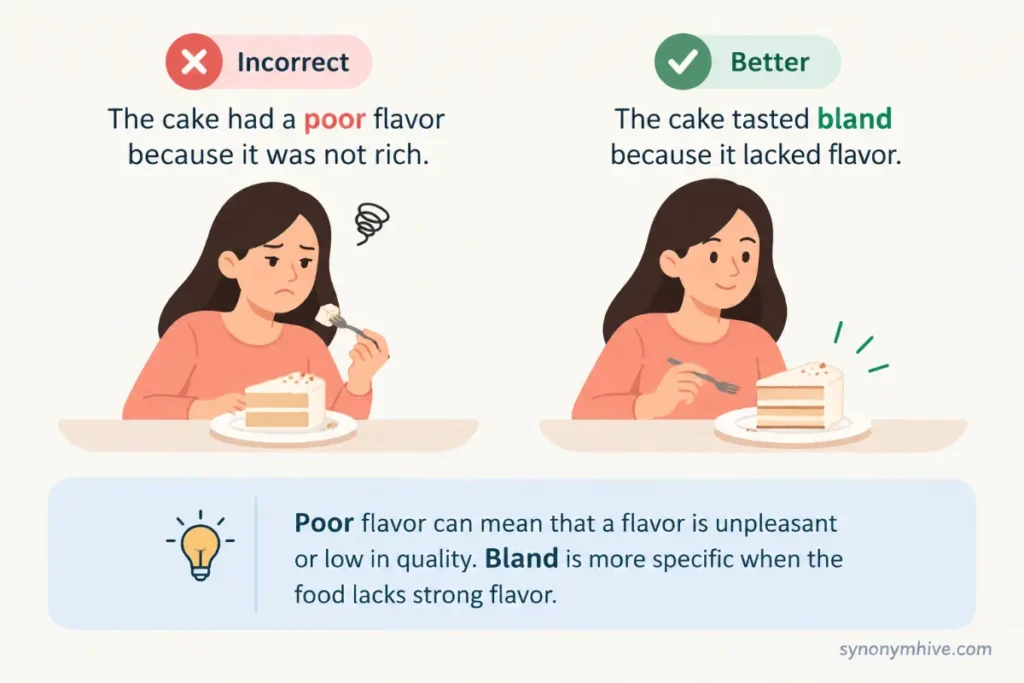
Incorrect: The cake had a poor flavor because it was not rich.
Better: The cake tasted bland because it lacked flavor.
Poor flavor can mean that a flavor is unpleasant or low in quality. Bland is more specific when the food lacks strong flavor.
Mistake Two Confusing Low Income With No Money
Low income describes earnings below a chosen threshold. Penniless means having no money. They describe different conditions.
A person with a low income may have savings, a home, or other assets. Someone who is temporarily penniless may still have a job or valuable property.
Use the term that reflects the available information instead of making assumptions.
Mistake Three Using Harsh Labels When a Neutral Phrase Works
Words such as destitute and impoverished can describe severe hardship, but they may be unnecessarily strong for a minor budget problem.
Instead of writing The team is poor, consider The team has a limited budget. The revised sentence identifies the problem and keeps attention on the practical issue.
Mistake Four Using Slang in Formal Writing
Broke and skint work in casual conversation, but they may not suit an academic paper, formal email, or business report.
Use financially struggling, low income, or facing financial hardship in formal settings when those phrases fit the facts.
Mistake Five Assuming Poor Always Describes a Person
Poor can describe quality as well as financial status. A poor result may be weak or unsuccessful, while poor soil may lack nutrients. These uses are not the same as describing someone who has little money.
Check the noun in your sentence. The surrounding words will usually reveal the intended meaning.
Mistake Six Treating Modest as a Perfect Synonym for Poor
Modest often describes something simple or limited in size. A modest income may be enough to meet basic needs, so it does not automatically mean a person lives in poverty.
For example, She lives in a modest home describes the home’s size or style. It does not prove that she is poor.
What Are the Antonyms of Rich Besides Poor?
The most useful antonyms depend on the meaning of rich.
| Meaning | Antonyms |
|---|---|
| Wealth | Poor, needy, impoverished |
| Strong flavor | Bland, flavorless, mild |
| Deep color | Pale, faded, dull |
| Full sound | Thin, weak, flat |
| Nutrient filled soil | Nutrient poor, infertile, barren |
| Detailed content | Sparse, brief, limited |
| Abundant resources | Scarce, insufficient, depleted |
| Full experience | Limited, narrow, restricted |
Some of these words are opposites only in certain contexts. Mild does not always mean bland, and brief does not always mean poorly detailed. A short report may still contain all the information a reader needs.
How Can You Choose the Right Opposite of Rich?
Use these practical tips to select a word that matches your sentence.
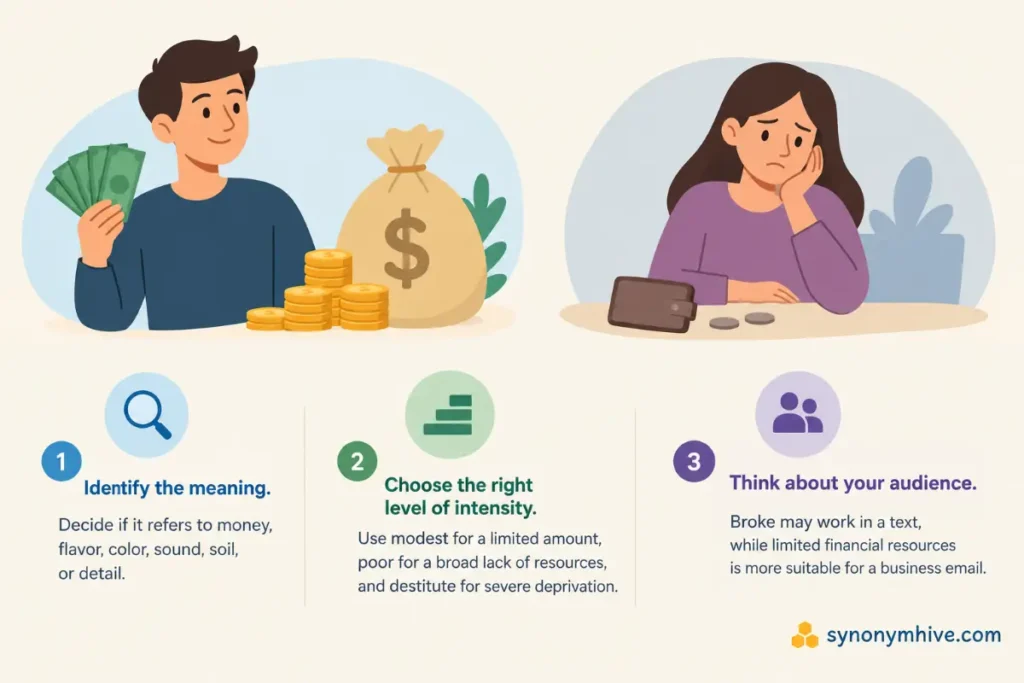
- Identify the meaning. Decide if rich refers to money, flavor, color, sound, soil, or detail.
- Choose the right level of intensity. Use modest for a limited amount, poor for a broad lack of resources, and destitute for severe deprivation.
- Think about your audience. Broke may work in a text, while limited financial resources is more suitable for a business email.
- Be specific. Low income describes earnings, while insufficient funds means the available money does not cover a particular need.
- Avoid unfair assumptions. A person’s income does not tell you everything about their assets, living conditions, or personal circumstances.
- Read the sentence aloud. Check that the chosen word sounds natural and expresses the intended meaning.
- Use context instead of repetition. You can often replace a repeated word with a precise phrase rather than searching for a dramatic synonym.
A useful test is to ask what exactly is missing. Is it money, flavor, nutrients, detail, or depth? Once you identify the missing quality, the right antonym becomes easier to find.
Compare more word options with Opposite of Fast Best Words for Every Situation.
Conclusion
The best opposite of rich depends on what you want to describe. Poor is the most common choice for financial wealth, but words such as broke, needy, impoverished, and destitute express different levels or types of financial hardship. For other meanings, bland, pale, thin, sparse, and limited may be more accurate.
When deciding on the opposite of rich, start with the meaning of the original sentence. Think about your audience, the seriousness of the situation, and the level of detail you need. A casual text may call for broke, while a school essay or business report may need low income or limited financial resources.
You do not need the most complicated word to write well. Choose the clearest word that matches the facts, and your message will be easier to understand.
Frequently Asked Questions
What is the opposite of rich in one word?
Poor is the most common one word opposite of rich when the topic is money or wealth. For flavor, color, or detail, a word such as bland, pale, or sparse may fit better.
What is a polite word for poor?
Low income, financially struggling, and facing financial hardship can be more specific and respectful in many situations. The best choice depends on the person’s circumstances and the purpose of your writing.
Is broke the same as poor?
No. Broke usually describes having little or no money available at a particular time, while poor often describes a broader financial condition. Someone may be broke before payday without experiencing long term poverty.
What is the opposite of rich in taste?
Bland is often the best opposite when rich describes food with a deep or strong flavor. Flavorless works when the food has almost no noticeable taste, while mild describes a gentle flavor that is not necessarily unpleasant.
What is the opposite of rich in color?
Pale, faded, and dull can work as opposites of rich when describing color. Pale refers to lightness, faded suggests lost color, and dull describes a lack of brightness or intensity.
What’s another way to say someone is not rich?
You can say the person has a modest income, is short on money, or is experiencing financial hardship. The phrase opposite of rich usually means poor, but a more specific description may be more accurate and considerate.
What is the difference between poverty and wealth?
Wealth refers to valuable assets and financial resources, while poverty describes a lack of money or resources needed to meet basic needs. The terms describe different financial conditions and can have specific meanings in research and public policy.