
When you write an email, prepare an essay, or send a text, choosing the right word can change how your message sounds. Calling someone mean, rude, cruel, or unfriendly may describe similar behavior, but each word carries a different meaning. The opposite of kind is usually unkind or mean. Unkind describes behavior that lacks care or consideration for others, while mean often suggests deliberate hurtfulness. Stronger words such as cruel and heartless describe more serious behavior.
The best word depends on what happened and how strongly you want to describe it. A classmate who ignores your greeting may seem unfriendly. Someone who mocks another person’s mistake is being mean. A person who deliberately causes suffering may be described as cruel.
This guide explains the word’s meaning and origin, compares more than 30 useful alternatives, and shows how to choose the right term for schoolwork, professional writing, everyday conversation, and personal messages. You’ll also find real examples, close word comparisons, common mistakes, and quick answers to frequent questions.
Looking for another word? See Opposite of Hot Best Words for Every Situation.
What Is the Opposite of Kind?
The most direct opposite is unkind, which means not considerate, caring, or thoughtful toward others. Mean is another common choice, especially when someone says or does something hurtful.
Kindness involves treating people with care, respect, patience, and compassion. The opposite describes behavior that lacks these qualities or works against them.
Consider these examples.
- A kind teacher explains a mistake patiently. An unkind teacher embarrasses a student for making it.
- A kind friend listens when you’re upset. A mean friend makes fun of your problems.
- A kind stranger offers help. An indifferent stranger notices your difficulty but shows no interest in helping.
These examples reveal an important distinction. Not every person who fails to help is cruel, and not every rude comment proves that someone is a bad person. The situation, intention, and effect all matter.
What Does Kind Mean in Plain English?
Kind means caring about other people and treating them with consideration. A kind person may offer help, speak politely, forgive a small mistake, or make someone feel welcome.
Kindness doesn’t require expensive gifts or grand gestures. It can appear in ordinary actions, such as letting someone finish speaking, giving honest advice without humiliation, or checking on a friend who seems troubled.
Words such as unkind, mean, rude, and cruel describe different ways people may fail to show kindness. Some refer to poor manners, while others suggest a lack of concern or a desire to hurt someone.
Is Unkind or Mean the Better Opposite?
Unkind is the closest direct opposite because it negates the idea of kindness without adding too much extra meaning. It works well in school assignments, thoughtful discussions, and formal writing.
Mean is more conversational and often sounds stronger. People commonly use it when someone insults, mocks, excludes, or deliberately upsets another person.
Use unkind when you want a measured description. Choose mean when the behavior seems personally hurtful. Reserve cruel for conduct that causes serious suffering or shows a troubling lack of compassion.
Where Did the Word Kind Come From?
The history of kind helps explain why its modern meaning includes warmth, care, and good treatment.
The English word developed from older forms connected with the idea of family, nature, type, or shared origin. Old English cynd and related Germanic forms carried meanings associated with nature, lineage, or what was natural to a group. Over time, the word developed a sense of being considerate and benevolent.
The word kind still carries several meanings today. In the phrase a kind person, it describes someone who treats others with care. In what kind of book, it refers to a type or category. The meanings are related through the word’s history, but context tells readers which sense applies.
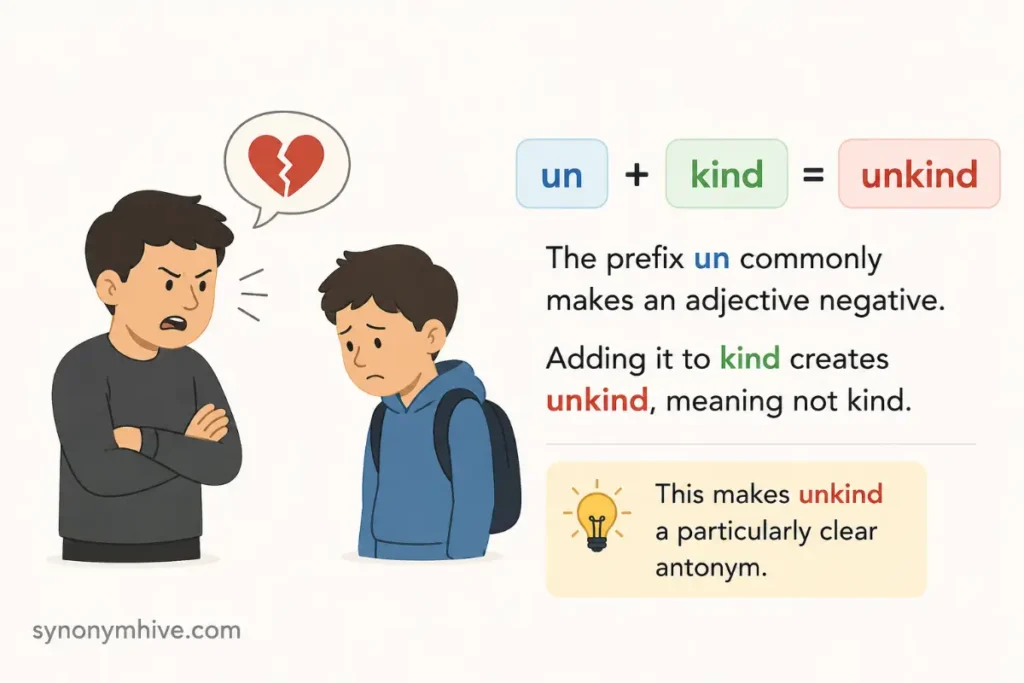
The prefix un commonly makes an adjective negative. Adding it to kind creates unkind, meaning not kind. This makes unkind a particularly clear antonym.
Other opposites developed through different routes. Mean has several historical senses, including low in status or quality, before developing its familiar sense of spiteful or hurtful behavior. Cruel refers to causing pain or suffering without adequate concern for the person affected.
These words are not perfect substitutes. Their histories and current meanings have given them different shades of meaning.
How the Word Kind Changed Over Time
The older meaning connected with nature or shared origin gradually gained a moral sense associated with natural affection and good treatment. Today, kindness commonly describes a person’s character, a particular action, or the way someone speaks.
For example, a kind gesture describes a helpful action, while a kind response describes a considerate reply. The opposite depends on the situation. A gesture may be thoughtless, a response may be rude, and a person’s repeated behavior may be described as unkind.
Understanding this difference helps you select a word that describes the actual behavior instead of making a broad judgment about someone’s entire character.
What Words Mean the Opposite of Kind?
English has many words for behavior that lacks kindness. Some describe a small lapse in courtesy, while others suggest deliberate harm. The table below groups useful choices by tone so you can find a word that fits your sentence.
Simple Words for Everyday Use
| Word | Meaning | Tone | Example |
|---|---|---|---|
| Unkind | Not caring or considerate | Direct and measured | His unkind remark upset his friend. |
| Mean | Hurtful or spiteful | Everyday and personal | It was mean to laugh at her answer. |
| Rude | Showing poor manners or disrespect | Direct | The customer was rude to the cashier. |
| Nasty | Very unpleasant or hurtful | Strong and informal | She sent a nasty message after the argument. |
| Cold | Showing little warmth or sympathy | Quiet and serious | His cold reply ended the conversation. |
| Selfish | Caring mainly about personal needs | Critical | It was selfish to take all the supplies. |
| Thoughtless | Failing to consider others | Mild to moderate | That thoughtless joke embarrassed him. |
| Unfriendly | Not warm or welcoming | Mild | The new neighbor seemed unfriendly. |
These words work in everyday conversation because most readers understand them immediately. Unkind is a safe general choice, while rude focuses on manners and selfish focuses on putting personal needs first.
Everyday Alternatives
| Word | Meaning | Tone | Example |
|---|---|---|---|
| Insensitive | Not noticing or respecting others’ feelings | Moderate | His insensitive comment hurt the family. |
| Disrespectful | Failing to show proper respect | Direct and critical | The student was disrespectful during the meeting. |
| Harsh | Severe, sharp, or unnecessarily hard | Serious | Her harsh criticism discouraged the team. |
| Heartless | Showing little sympathy or compassion | Strong | It seemed heartless to ignore the injured dog. |
| Uncaring | Showing little concern | Critical | An uncaring response made the problem worse. |
| Spiteful | Intending to upset or harm someone | Strong | He made a spiteful comment about her success. |
| Hostile | Openly unfriendly or aggressive | Strong | The discussion turned hostile after the accusation. |
| Hurtful | Causing emotional pain | Clear and personal | His hurtful words stayed with her for days. |
Choose these alternatives when a basic word does not explain the behavior clearly enough. Insensitive often describes a failure to notice the effect of one’s words. Spiteful suggests a wish to cause distress, while hostile points to open opposition or aggression.
Formal Words for Essays and Professional Writing
| Word | Meaning | Tone | Example |
|---|---|---|---|
| Inconsiderate | Failing to think about other people’s needs | Formal and measured | The decision was inconsiderate of residents. |
| Callous | Showing little concern for suffering | Strong and formal | The report described a callous response to the complaint. |
| Cruel | Causing pain or suffering without compassion | Very strong | The story exposes the cruel treatment of workers. |
| Malicious | Intending to cause harm | Formal and serious | The message contained malicious claims. |
| Contemptuous | Showing that someone is considered unworthy | Formal and critical | He gave the applicant a contemptuous look. |
| Scornful | Showing open disrespect or disdain | Formal | Her scornful reply ended the discussion. |
| Abrasive | Rough or harsh in manner | Professional and critical | His abrasive style created tension on the team. |
| Dismissive | Treating someone or something as unworthy of attention | Formal and measured | The manager gave a dismissive answer. |
Formal writing benefits from precision. Callous describes a lack of concern for suffering. Malicious emphasizes an intention to harm. Dismissive describes a response that brushes someone aside, even when it does not involve open cruelty.
Slang and Informal Choices
| Word or phrase | Meaning | Tone | Example |
|---|---|---|---|
| Jerk | A person who acts rudely or selfishly | Casual and insulting | He acted like a jerk when he cut the line. |
| Mean spirited | Showing a desire to mock or hurt | Informal and critical | That was a mean spirited joke. |
| Two faced | Acting friendly while secretly being disloyal | Informal and accusatory | She called him two faced after he spread the rumor. |
| Shady | Dishonest or suspicious in behavior | Casual | His shady excuse made the group question his story. |
| Toxic | Harmful to people’s well being over time | Informal and strong | Their toxic friendship left little room for trust. |
| Petty | Focused on small grievances or minor revenge | Casual and critical | He made a petty complaint over a tiny mistake. |
| Savage | Extremely harsh or cutting, sometimes admired as witty | Slang and context dependent | Her savage reply silenced the heckler. |
Informal terms can sound natural in conversation, but they may be too casual for school essays, work reports, or sensitive discussions. Toxic is often used for repeated harmful patterns, not just one bad moment. Savage can praise a sharp joke in one context and criticize cruelty in another.
Which Opposite of Kind Fits Each Level of Severity?
The right word should match the seriousness of the action. Calling someone cruel for one impatient reply may sound exaggerated. Describing repeated humiliation as merely thoughtless may understate the harm.
Use this scale as a guide.
| Intensity | Useful words | Best use |
|---|---|---|
| Mild | Unfriendly, distant, thoughtless | A small lack of warmth or consideration |
| Moderate | Unkind, rude, insensitive, inconsiderate | A hurtful comment or careless action |
| Strong | Mean, harsh, spiteful, disrespectful | Behavior that clearly upsets or demeans someone |
| Very strong | Cruel, heartless, callous, malicious | Serious harm or a marked lack of compassion |
Mild Words for Small Lapses
Choose thoughtless when someone fails to consider the effect of an action. For example, a person may forget to invite a colleague without intending to hurt them. Calling that person malicious would claim more than the facts support.
Use unfriendly when someone seems distant or does not welcome others. A quiet person may be unfriendly in one moment without being rude or cruel.
Moderate Words for Clear Disrespect
Rude, insensitive, and inconsiderate work when someone crosses a social boundary. A person who interrupts repeatedly may be rude. Someone who jokes about a painful loss may be insensitive. A person who plays loud music late at night may be inconsiderate of neighbors.
The distinction helps you explain the problem instead of relying on a broad insult.
Strong Words for Deliberate Harm
Mean, spiteful, and harsh fit behavior that seems intended to embarrass, upset, or put someone down. Look at the action and its pattern before choosing one.
If a person repeatedly shares private information to humiliate a friend, spiteful may fit better than thoughtless. If someone uses severe words during a disagreement, harsh may describe the speech without making a claim about the person’s entire character.
Very Strong Words for Serious Cruelty
Cruel, heartless, callous, and malicious carry more weight. They are useful when someone causes serious distress, ignores clear suffering, or deliberately tries to harm another person.
These words should not be used simply to make a sentence sound dramatic. Strong labels can distract readers from the facts if the example does not support them.
Which Word Works Best by Part of Speech?
Most common alternatives to kind are adjectives, but you can also describe unkind behavior with nouns and verbs. Changing the part of speech can make a sentence clearer and less repetitive.
| Part of speech | Word | Meaning | Example |
|---|---|---|---|
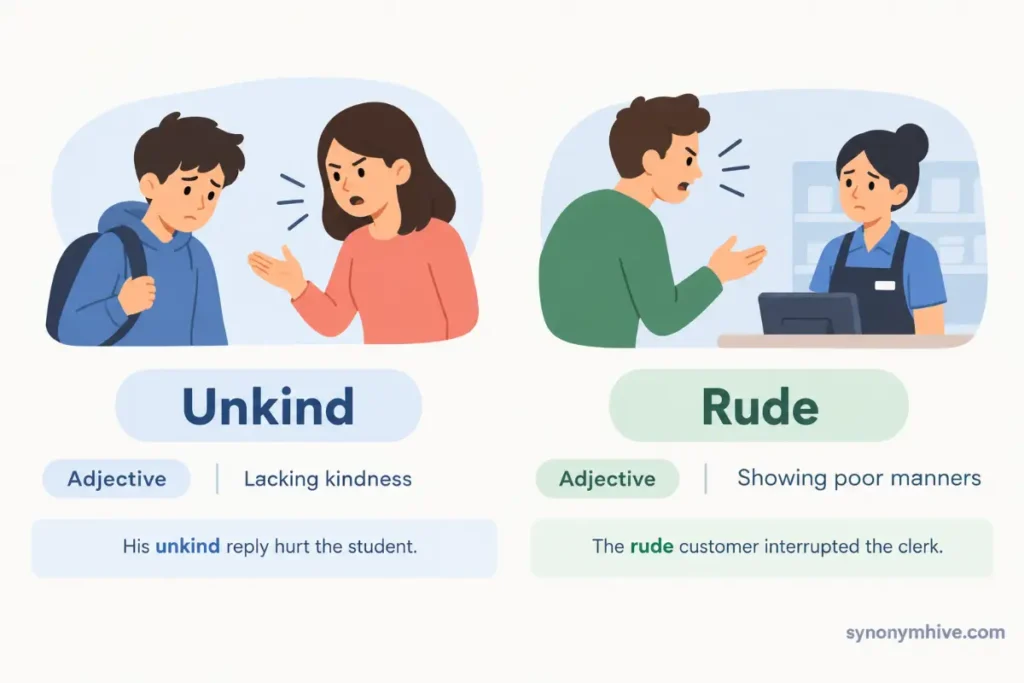
| Adjective | Unkind | Lacking kindness | His unkind reply hurt the student. |
| Adjective | Rude | Showing poor manners | The rude customer interrupted the clerk. |
| Adjective | Cruel | Causing suffering without compassion | The cruel decision harmed vulnerable families. |
| Noun | Cruelty | Behavior that causes suffering | The story describes the cruelty of the guards. |
| Noun | Rudeness | Poor manners or disrespect | Her rudeness surprised the guests. |
| Noun | Selfishness | Concern mainly for personal needs | His selfishness caused conflict at home. |
| Noun | Insensitivity | Lack of care for others’ feelings | The comment showed insensitivity. |
| Verb | Insult | To offend or disrespect someone | Do not insult your teammate. |
| Verb | Mock | To make fun of someone | The group mocked his accent. |
| Verb | Humiliate | To make someone feel deeply ashamed | The coach should correct players without humiliating them. |
How Adjectives Describe Behavior
Adjectives give a direct description of a person, comment, decision, or action. For example, an insensitive joke describes the joke, while a cruel decision describes a choice that causes suffering.
When possible, describe the action instead of defining a whole person. Saying that someone made an unkind remark is often fairer and more specific than declaring that the person is unkind in every part of life.
How Nouns Name the Behavior
Nouns help when you want to discuss a pattern or quality. A sentence such as The manager’s rudeness upset the staff focuses on conduct. The manager was rude to the staff describes the same event more directly.
In essays, nouns can make a discussion more formal. However, too many abstract nouns can make writing heavy. Choose the form that sounds natural and keeps the main point clear.
How Verbs Show What Happened
Verbs often provide the clearest description because they identify the action. Instead of writing He was unkind to his teammate, you could write He mocked his teammate’s mistake. The second sentence gives readers specific evidence.
Use verbs such as insult, mock, dismiss, or humiliate only when they accurately describe what happened. A person who disagrees with an idea has not automatically insulted its author.
What Is the Best Word for Kindness in Different Situations?
A useful word does more than label behavior. It helps readers understand what happened and why it matters. The best choice for a resume, essay, text, or workplace email may be different because each setting has its own tone.
What Word Should You Use in a Resume?
In a resume, describe the behavior or result rather than calling someone unkind. Personal labels rarely help employers understand your skills or work experience.
For example, instead of writing I handled an unkind coworker, explain how you managed a difficult interaction.
Example sentence: I handled tense conversations with patience and professionalism.
If you need to describe a workplace problem in a performance review, consider disrespectful, inconsiderate, or unprofessional. These words identify conduct without turning a work document into a personal attack.
Example sentence: The employee’s disrespectful comments made team discussions less productive.
Use a neutral description when you cannot prove intent. A coworker may sound harsh under pressure without trying to cause harm. Specific examples make your writing more credible.
What Word Works Best in an Essay?
For an essay, unkind is a clear general choice. Use cruel when the subject involves serious suffering, insensitive when someone ignores another person’s feelings, and selfish when someone puts personal interests ahead of others.
Example sentence: The character’s selfish choices reveal how personal ambition can damage close relationships.
Academic writing benefits from words that match the evidence. If you are analyzing a character, explain the action that supports your description. A character who refuses to share may be selfish, but a character who deliberately harms a vulnerable person may be cruel.
You can also use a noun to avoid repeating the same adjective.
Example sentence: The novel explores the cruelty of judging people by their social status.
What Should You Say in a Text Message?
In a text, mean and rude usually sound natural. They are easy to understand and suit everyday conversations.
Example sentence: That was a mean thing to say, and it hurt me.
If you want to explain your concern without starting a fight, describe the behavior and its effect. This approach gives the other person a clearer chance to understand your point.
Example sentence: Your reply sounded rude, and I felt dismissed.
For a lighter situation, not cool or unkind may work better than a strong insult. Slang such as jerk can communicate anger, but it may also turn a discussion into an argument.
Which Word Is Best for a Work Email?
Work emails usually need calm, specific language. Inconsiderate, disrespectful, dismissive, and unprofessional can describe behavior without sounding overly emotional.
Example sentence: The dismissive response did not address the concerns raised by the team.
For a direct but polite message, focus on the action and the change you need.
Example sentence: Interrupting colleagues during presentations can come across as disrespectful, so please allow each speaker to finish.
Avoid calling a coworker heartless or malicious unless the situation is serious and you have strong reasons for that description. Neutral language keeps attention on the issue rather than the personal conflict.
What Word Sounds Natural in Conversation?
In everyday speech, mean is usually the easiest choice. People also use rude, selfish, cold, and nasty to describe different types of behavior.
Example sentence: It was rude of him to leave without thanking the host.
For a person who offers little warmth, cold may be more accurate than mean. For someone who takes more than their fair share, selfish explains the problem more clearly.
Choose the word that describes the actual behavior. A precise description usually communicates more than a stronger insult.
Learn more useful word alternatives in Opposite of Happy Best Words for Every Situation 2026.
What Are Some Real Examples of the Opposite of Kind?
Examples make the differences between these words easier to understand. In each case, the best word depends on the action, the context, and the level of harm.
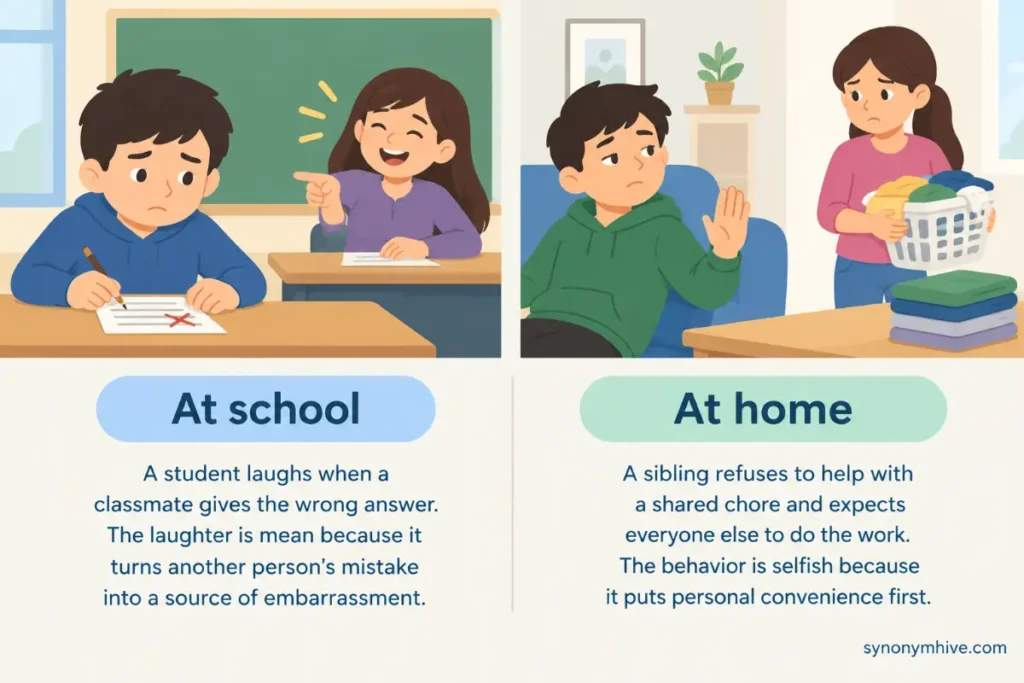
- At school. A student laughs when a classmate gives the wrong answer. The laughter is mean because it turns another person’s mistake into a source of embarrassment.
- At home. A sibling refuses to help with a shared chore and expects everyone else to do the work. The behavior is selfish because it puts personal convenience first.
- At work. A manager interrupts an employee every time they try to explain a problem. The behavior is disrespectful because it prevents the employee from speaking.
- In a friendship. A friend shares a private story to embarrass someone in front of a group. The action is spiteful if the friend intends to cause distress.
- Online. A person posts insulting comments about someone’s appearance. The comments are hurtful and may also be cruel if they deliberately target a vulnerability.
- In customer service. A worker responds to a simple question with an irritated insult. The response is rude because it violates basic standards of courtesy.
- During a disagreement. Someone calls an idea stupid without explaining their objection. The response is dismissive because it rejects the idea without serious consideration.
- At a family gathering. A guest makes a joke about another person’s recent loss. The joke is insensitive because it ignores the pain connected with the subject.
- In a neighborhood. A resident plays loud music late at night despite repeated requests to lower the volume. The behavior is inconsiderate because it ignores the needs of others.
These examples show why a list of synonyms cannot replace careful judgment. Two actions may both lack kindness, yet one may reflect poor manners while another shows a deliberate attempt to harm someone.
What Is the Difference Between Unkind and Mean?
Unkind and mean overlap, but they do not always communicate the same level of intent or emotion.
| Point of comparison | Unkind | Mean |
|---|---|---|
| Main meaning | Lacking care or consideration | Hurtful, spiteful, or unpleasant |
| Typical tone | Measured and neutral | More personal and emotional |
| Common setting | Essays, thoughtful feedback, everyday speech | Conversation, texts, informal writing |
| Implied intention | May be careless or deliberate | Often suggests deliberate hurtfulness |
| Example | It was unkind to ignore her request. | It was mean to mock her mistake. |
The difference is not absolute. Someone can describe an accidental comment as mean, and an unkind act can be deliberate. Still, unkind is often the more restrained choice.
For example, a person who forgets to thank a host may have acted thoughtlessly or unkindly. A person who deliberately insults the host in front of guests may be described as mean.
Use unkind when you want to identify a lack of consideration without making a strong claim about motive. Use mean when the behavior sounds openly hurtful or spiteful.
What Is the Difference Between Rude and Cruel?
Rude and cruel describe different kinds of harm. Rudeness involves poor manners or disrespect. Cruelty involves causing suffering or showing a serious lack of compassion.
| Point of comparison | Rude | Cruel |
|---|---|---|
| Main focus | Manners and respect | Pain and suffering |
| Typical severity | Mild to serious | Usually serious |
| Common behavior | Interrupting, insulting, or speaking disrespectfully | Deliberately hurting someone or ignoring severe suffering |
| Example | The guest was rude to the waiter. | The bully was cruel to a frightened child. |
A person can be rude without being cruel. For example, someone who interrupts a meeting may show poor manners but cause little lasting harm.
Cruelty is more serious. Repeatedly tormenting someone, taking pleasure in their suffering, or deliberately harming a vulnerable person can justify the stronger term.
If the behavior mainly involves a lack of courtesy, choose rude. If it involves serious suffering or a marked lack of compassion, cruel may be more accurate.
What Are the Common Mistakes When Choosing an Opposite of Kind?
A word can be grammatically correct and still be the wrong choice for the situation. These mistakes can make writing sound unfair, unclear, or unnecessarily aggressive.
Using Cruel for Every Hurtful Action
Cruel is a strong word. It should describe serious conduct rather than every disagreement or unpleasant comment.
Less accurate: My friend was cruel because she did not agree with my choice.
Clearer: My friend was blunt because she disagreed with my choice.
Disagreement alone does not prove a lack of kindness. The manner of speaking and the surrounding facts matter.
Confusing Rudeness With Selfishness
Rudeness concerns manners and respect. Selfishness concerns putting personal interests ahead of other people.
A person who interrupts someone may be rude. A person who takes all the food without considering anyone else may be selfish. One person can show both qualities, but the words explain different problems.
Treating Unfriendly and Unkind as Identical
An unfriendly person may seem distant, quiet, or unwilling to socialize. An unkind person acts without adequate consideration for others.
Someone who prefers to spend time alone is not automatically unkind. A quiet response may reflect shyness, tiredness, or personal preference rather than hostility.
Assuming Every Hurtful Action Is Intentional
People sometimes hurt others without meaning to. They may speak carelessly, misunderstand a situation, or fail to notice a sensitive subject.
Thoughtless and insensitive can describe such behavior more accurately than malicious. Use malicious only when there is a reasonable basis for saying that the person intended to cause harm.
Using Slang in Formal Writing
Words such as jerk, shady, and toxic may work in casual conversation, but they can weaken a professional report or academic essay.
For formal writing, use terms such as disrespectful, inconsiderate, callous, or dismissive when they fit the evidence. Explain the behavior rather than relying on an insult.
Labeling a Whole Person Based on One Action
A single mistake does not always define someone’s character. Saying he made an unkind comment is more precise than saying he is an unkind person when you know only about one incident.
Focus on what the person did. If the same behavior happens repeatedly, you can explain the pattern and support your description with examples.
What Are the Antonyms of Kind in a Quick List?
The main antonyms of kind include the following words.
- Unkind.
- Mean.
- Rude.
- Cruel.
- Unfriendly.
- Insensitive.
- Inconsiderate.
- Selfish.
- Heartless.
- Callous.
- Spiteful.
- Malicious.
- Harsh.
- Disrespectful.
- Uncaring.
These words are related, but they do not all mean exactly the same thing. Unkind is the closest general opposite. Rude focuses on manners, selfish focuses on personal interests, and cruel focuses on suffering.
The antonym that works best depends on the sentence. If you are describing one comment, choose a word that explains the comment. If you are discussing a repeated pattern of behavior, a broader description may be appropriate.

How Can You Choose the Right Opposite of Kind?
A few simple checks can help you select a word that sounds natural and conveys the right meaning.
- Identify the behavior. Decide if the problem involves poor manners, selfishness, emotional harm, or a lack of compassion.
- Check the severity. Use a mild word for a small lapse and a stronger word for serious harm.
- Consider the intention. Choose thoughtless when someone fails to consider others. Choose spiteful or malicious only when deliberate harm is supported by the facts.
- Match the setting. A text can use mean, while a formal report may benefit from disrespectful or inconsiderate.
- Describe actions instead of guessing character. A specific example gives readers more useful information than a broad personal label.
- Read the sentence aloud. If the word sounds too harsh or too weak for the situation, try a more accurate alternative.
- Avoid repeating the same term. If you have already used unkind several times, consider thoughtless, rude, or insensitive when the meaning fits.
- Keep the reader in mind. A school essay needs clear language. A workplace message needs professionalism. A personal text may need a more direct emotional tone.
For example, compare these sentences.
General: The response was unkind.
More specific: The response was dismissive because it ignored the employee’s main concern.
The second sentence gives readers a clearer picture of the problem. It explains how the behavior lacked consideration instead of simply assigning a label.
Looking for another word? See Opposite of Beautiful Best Words and Examples 2026.
Conclusion
The best opposite of kind depends on the behavior you want to describe. Unkind is the closest general antonym, while mean works well in everyday speech. Rude describes poor manners, selfish highlights personal interests, and insensitive points to a lack of awareness of other people’s feelings. For more serious conduct, words such as cruel, callous, or malicious may be appropriate.
When choosing among these words, consider the action, its effect, and the evidence of intent. A measured word can communicate a problem clearly without making an unfair judgment about someone’s entire character. In schoolwork, professional writing, and everyday conversation, precise language makes your point easier to understand. Start with the simplest accurate term, then choose a stronger one only when the situation supports it.
Frequently Asked Questions
What is the opposite of kind in one word?
The closest one word opposite is unkind. Mean is another common choice when describing behavior that is hurtful or spiteful.
What is a stronger word than unkind?
Cruel is stronger than unkind when someone causes serious suffering or shows little compassion. Spiteful is useful when the person appears to want to upset or hurt someone.
Is mean the same as unkind?
Mean and unkind have similar meanings, but mean often sounds more personal and hurtful. Unkind is usually more measured and can describe careless behavior as well as deliberate actions.
What is a formal word for not kind?
Inconsiderate, insensitive, callous, and disrespectful can work in formal writing. Choose the word that best describes the specific behavior instead of using the strongest option by default.
What’s another way to say someone is not nice?
You can say the person is unkind, rude, unfriendly, inconsiderate, or insensitive. The best choice depends on whether the person showed poor manners, a lack of care, or deliberate hostility.
What is the difference between unkind and unfriendly?
Unkind describes behavior that lacks care or consideration. Unfriendly describes someone who seems distant, cold, or not welcoming, even when that person has not done anything hurtful.
Can a person be rude without being cruel?
Yes. Rudeness involves poor manners or disrespect, while cruelty involves serious harm or a lack of compassion toward suffering. A rude remark does not automatically prove cruelty.