
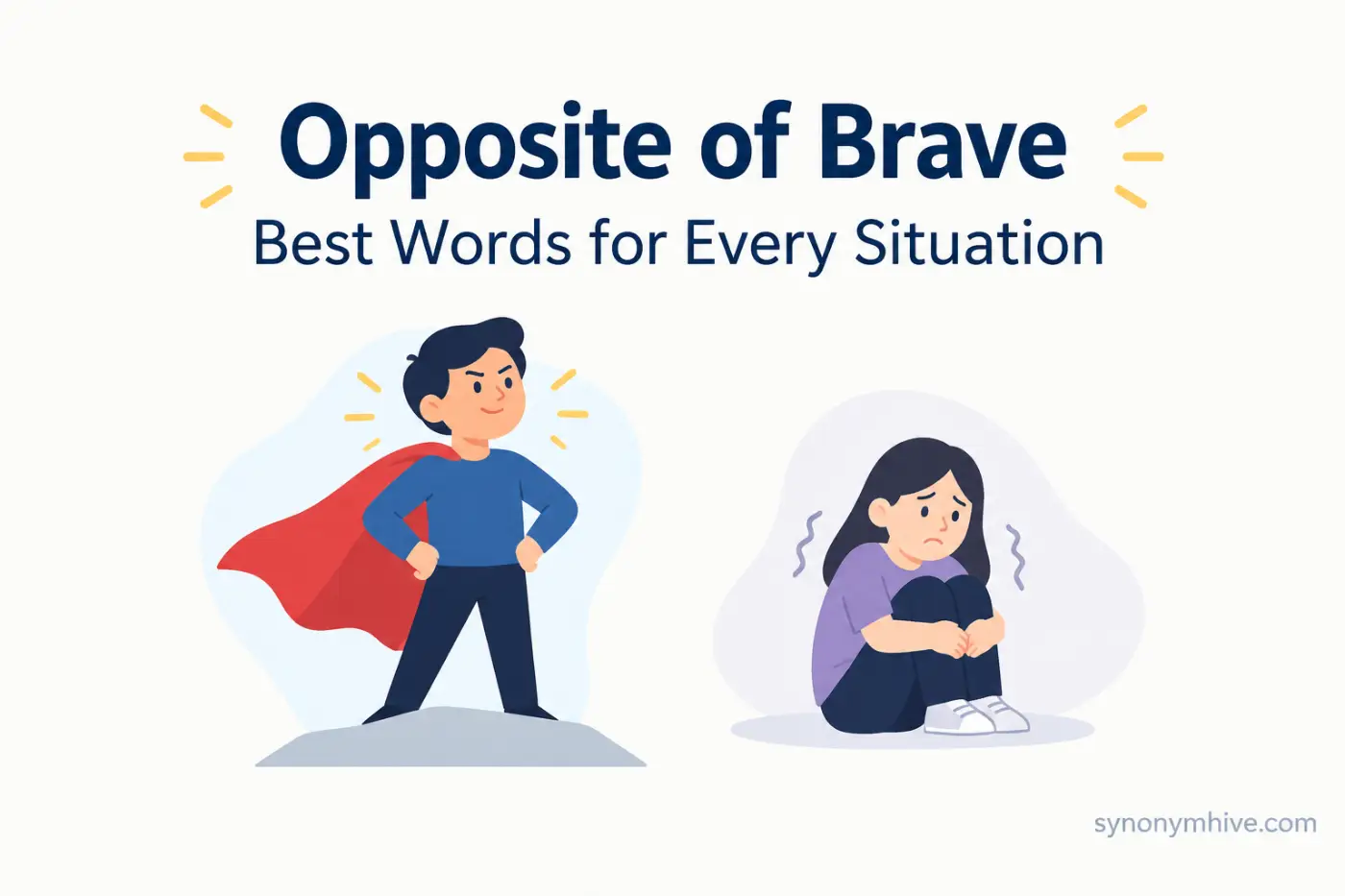
You might need the opposite of brave when writing an essay, describing a character, filling out a work review, or sending a text to a friend. The word you choose matters because not every person who lacks courage is simply scared. Someone might be timid in a crowd, fearful of a real danger, hesitant about a decision, or unwilling to take a risk.
The best opposite depends on what you want to say. Cowardly describes a lack of courage, often with a negative judgment. Fearful describes someone who experiences fear. Timid suggests shyness or a lack of confidence, while cautious can describe a sensible effort to avoid danger.
The opposite of brave is not always a harsh word. A child who is nervous about speaking in class may be shy rather than cowardly. A worker who checks the risks before making a major decision may simply be cautious. Choosing a precise word helps you describe the person fairly.
This guide explains the main meanings, explores more than 30 related words, and shows how each choice changes the tone of a sentence. You will also find examples for essays, resumes, emails, conversations, and texts, along with tips for avoiding common word choice mistakes.
Discover another helpful synonym list in Opposite of Light Best Words for Every Meaning.
Quick Answer
The most direct opposite of brave is cowardly, which describes a lack of courage when facing fear or danger. Other useful opposites include fearful, timid, fainthearted, and afraid. The best choice depends on the person’s behavior and the tone you want to convey.
What Does Brave Mean and Where Did the Word Come From?
To choose an accurate opposite, start with the meaning of the original word. Brave describes someone who faces fear, danger, difficulty, or uncertainty with courage. A brave person may feel afraid but still take action because something matters enough to make the risk worthwhile.
Bravery does not mean a person never experiences fear. A firefighter can feel fear while entering a dangerous building. A student can feel nervous before giving a speech and still stand up to speak. In both cases, courage means acting despite discomfort or risk.
The word brave came into English through French, with roots linked to ideas such as boldness and courage. Its history reflects the way English has borrowed words and meanings across centuries. Today, people use it for physical courage, emotional strength, and the willingness to speak up or try something difficult.
Why the Meaning Matters
The word brave can describe different kinds of courage. Someone might be brave in a physical emergency, brave enough to admit a mistake, or brave enough to defend another person. Each situation calls for a slightly different opposite.
For example, a person who refuses to help someone in danger might be called cowardly. A person who worries about giving a speech might be described as nervous or timid. Someone who avoids a risky investment may simply be cautious.
These descriptions are not interchangeable. Calling someone cowardly makes a strong judgment about their behavior. Calling someone nervous usually describes a temporary state. Calling someone cautious can even express respect for careful thinking.
Before choosing an antonym, ask yourself what the person did, what kind of fear was involved, and how strongly you want to judge the action.

What Is the Best Opposite of Brave?
There is no single word that fits every situation, but cowardly is one of the clearest antonyms when you mean a lack of courage. It is especially useful when someone avoids a challenge or fails to act because they are afraid.
Still, it is not always the fairest choice. A person may stay away from danger because the risk is unreasonable. Another person may need time to build confidence. In these cases, cautious, hesitant, fearful, or timid may communicate the meaning more accurately.
Use this quick guide.
| Word | Main Meaning | Best Used When |
|---|---|---|
| Cowardly | Showing a lack of courage | You are judging behavior that avoids a challenge out of fear. |
| Fearful | Experiencing fear | You want to describe someone’s emotional state. |
| Timid | Shy or lacking confidence | Someone struggles to speak up or take social risks. |
| Afraid | Feeling fear | You want a simple, direct word. |
| Fainthearted | Lacking courage or resolve | You need a more formal or literary term. |
| Hesitant | Slow to act because of doubt or uncertainty | Someone pauses before making a choice. |
| Cautious | Careful about possible danger or loss | Someone avoids unnecessary risks. |
| Meek | Quiet, gentle, or unlikely to assert oneself | You are describing a reserved manner, not necessarily fear. |
One useful rule is to separate emotion from action. Afraid describes a feeling, while cowardly judges a person’s response to a situation. A person can be afraid and still act bravely. Likewise, a person can decline a dangerous task for a sound reason without showing a lack of courage.
A Complete List of Opposites of Brave
The table below groups related words by tone and use. Some are direct antonyms, while others describe behaviors that may contrast with bravery in certain settings. That distinction matters because a word that works in a story may sound unfair in a work email.
Simple Words for Everyday Use
| Word | Meaning | Tone | Example |
|---|---|---|---|
| Afraid | Feeling fear | Simple and direct | He was afraid to walk into the dark room. |
| Scared | Feeling fear or alarm | Conversational | She was scared to ask the question. |
| Fearful | Full of fear or worry | Neutral | The fearful child stayed close to her parent. |
| Timid | Shy or lacking confidence | Mildly critical or sympathetic | The timid student spoke in a quiet voice. |
| Shy | Uncomfortable around people or attention | Usually gentle | He was shy about meeting new classmates. |
| Nervous | Worried about what may happen | Everyday | I was nervous before the interview. |
| Hesitant | Unsure about taking action | Neutral | She was hesitant to share her opinion. |
| Unsure | Not confident about a choice | Neutral | He was unsure about trying the new activity. |
These words are useful when you want clear language without a harsh judgment. Scared and afraid work in everyday conversation. Nervous often fits situations involving public speaking, tests, interviews, or new experiences. Timid and shy are better for describing a person’s manner or behavior over time.
Everyday Words With a Stronger Meaning
| Word | Meaning | Tone | Example |
|---|---|---|---|
| Cowardly | Avoiding action because of a lack of courage | Strongly negative | It was cowardly to blame another person for his mistake. |
| Spineless | Lacking the will to stand up for oneself | Harsh and informal | His friends called the decision spineless. |
| Weak | Lacking strength, resolve, or confidence | Critical and broad | She worried that refusing to speak up would look weak. |
| Fainthearted | Lacking courage or determination | Formal or literary | The fainthearted traveler turned back before reaching the pass. |
| Chicken | A person who avoids something out of fear | Informal and teasing | Don’t be a chicken about asking for help. |
| Gutless | Lacking courage or nerve | Harsh and informal | The speaker called the refusal gutless. |
| Wimpish | Acting timid or lacking toughness | Informal and often insulting | The character was portrayed as wimpish at the start of the story. |
| Yellow | Cowardly, especially in older or playful usage | Informal or dated | The old story described the villain as yellow. |
Use these stronger words with care. Spineless, gutless, and wimpish can insult a person rather than describe one action. Chicken is common in casual speech, but it may sound childish or rude in serious writing. Yellow has a long history as slang for cowardly, yet many readers may find it old fashioned.
Formal and Literary Words
| Word | Meaning | Tone | Example |
|---|---|---|---|
| Pusillanimous | Showing a lack of courage or determination | Very formal | The critic described the leader’s response as pusillanimous. |
| Craven | Contemptibly lacking courage | Formal and severe | The novel presents the craven official as unwilling to defend the truth. |
| Timorous | Easily frightened or lacking confidence | Literary or formal | The timorous witness spoke softly. |
| Apprehensive | Worried that something bad may happen | Formal and neutral | The team was apprehensive about the difficult test. |
| Diffident | Lacking confidence in oneself | Formal | His diffident manner made him reluctant to lead the discussion. |
| Trepidatious | Nervous or fearful about what lies ahead | Formal, less common | The trepidatious applicant waited outside the interview room. |
| Irresolute | Unable to decide or act firmly | Formal | The irresolute manager delayed the decision. |
| Unassertive | Not expressing needs or opinions firmly | Formal and descriptive | Her unassertive style made it hard to challenge unfair requests. |
These choices can add precision to essays, stories, and character analysis. Craven is a strong moral judgment. Timorous emphasizes fear, while diffident focuses on a lack of confidence. Irresolute is about weak decision making, so it is not a direct synonym for fear in every case.
Slang and Casual Expressions
| Word or Phrase | Meaning | Tone | Example |
|---|---|---|---|
| Chicken out | Decide not to do something because of fear | Casual | He chickened out before the first jump. |
| Wimp | Someone seen as weak or easily frightened | Informal and insulting | His brother called him a wimp for leaving early. |
| Scaredy cat | Someone who gets scared easily | Playful or childish | The kids teased him for being a scaredy cat. |
| No guts | Lacking courage | Informal and critical | She said he had no guts to tell the truth. |
| All talk | Making bold claims but failing to act | Informal and critical | He promised to confront the bully, but he was all talk. |
| Back down | Withdraw from a position or challenge | Neutral to critical | She backed down when the argument became tense. |
| Fold | Give up under pressure | Casual | The team folded when the other side scored. |
| Bottle it | Lose courage at the last moment | British informal | He bottled it before the audition. |
Slang can make dialogue sound natural, but it is rarely the best choice for formal writing. Some expressions also describe an action rather than a person’s personality. For example, chicken out means to withdraw because of fear, while all talk suggests a gap between what someone says and what they do.
Which Opposite of Brave Should You Use by Intensity?
The right word depends on how strong the contrast needs to be. Some words describe a small amount of fear. Others suggest a serious failure to act or a lack of moral courage. Moving from mild to strong language helps you avoid making a person sound worse than the facts support.
Mild Words for Low Confidence
Choose nervous, hesitant, unsure, or shy when a person struggles with confidence but has not shown a clear lack of courage.
A nervous student might still give an excellent speech. A hesitant employee may need more facts before making a choice. A shy person may be comfortable with close friends but quiet around strangers.
These words often describe a temporary feeling or a specific situation. They do not suggest that someone lacks courage in every part of life.
Examples.
- I felt nervous before asking my teacher for help.
- He was hesitant to join the discussion because he did not know anyone.
- The shy child needed time to become comfortable with the group.
- She was unsure about accepting the offer, so she asked for another day to think.
Moderate Words for Fear or Avoidance
Words such as fearful, timid, apprehensive, and timorous suggest a clearer sense of fear or a pattern of low confidence. They can fit a person who avoids attention, worries about possible danger, or finds it hard to take action.
The differences are useful. Fearful centers on fear. Timid often describes someone’s behavior or manner. Apprehensive points to worry about something that may happen. Timorous is less common and often sounds literary.
Examples.
- The fearful dog backed away from the unfamiliar visitor.
- A timid reply made it difficult to hear her opinion.
- He felt apprehensive about moving to a new city.
- The timorous character avoided every argument.
These words usually describe a condition or behavior without the strong moral blame found in cowardly.
Strong Words for a Lack of Courage
Use cowardly, craven, spineless, or gutless when the situation calls for a strong negative judgment. These words suggest that someone failed to show courage when the writer believes courage was needed.
For example, a person who lies to escape blame and lets an innocent colleague suffer may be described as cowardly. A leader who refuses to defend a team member against unfair treatment might be called spineless in an opinion piece.
Still, strong language needs strong evidence. A person may refuse a challenge for a valid reason. They may face a real threat, have a health concern, or lack the authority to act. Before calling a person cowardly, consider what the situation required and what risks they faced.
Examples.
- The character made a cowardly choice by blaming his friend.
- The reviewer called the leader’s refusal to take responsibility spineless.
- The narrator describes the official as craven because he abandons others to protect himself.
- The insult gutless made the argument more personal and less useful.
For most school essays, cowardly is strong enough. Save harsher words for contexts where their tone is intentional, such as literary analysis, direct dialogue, or a clearly stated opinion.
Opposites of Brave by Part of Speech
The word brave is usually an adjective, so its direct opposites are often adjectives too. However, you can express a similar contrast through nouns, adverbs, and verbs. Choosing the right form helps your sentence sound natural.
Adjectives That Contrast With Brave
Adjectives describe people, actions, or things. Useful choices include afraid, fearful, timid, cowardly, fainthearted, apprehensive, and unassertive.
Compare the following examples.
- The brave student raised her hand.
- The timid student waited for someone else to speak.
- The fearful dog hid behind the chair.
- The cowardly character abandoned his friends.
- The apprehensive applicant worried about the interview.
Each adjective adds a different meaning. A timid student may lack confidence in public. A fearful dog may react to a threat. A cowardly character is being judged for a failure to show courage.
Nouns That Describe a Lack of Courage
Nouns name a person, feeling, quality, or condition. Depending on the sentence, you can use fear, timidity, cowardice, apprehension, or diffidence.
| Noun | Meaning | Example |
|---|---|---|
| Fear | The feeling caused by a threat or possible danger | Fear kept him from entering the room. |
| Timidity | Shyness or a lack of confidence | Her timidity made group discussions difficult. |
| Cowardice | A failure to show courage | The story treats his betrayal as an act of cowardice. |
| Apprehension | Worry about a future event | Apprehension grew as the test date approached. |
| Diffidence | A lack of confidence in oneself | His diffidence stopped him from sharing useful ideas. |
Use cowardice when you mean a lack of courage as a quality or act. Use fear when you mean the feeling itself. The distinction is similar to the difference between cowardly and afraid.
Adverbs That Describe Timid or Fearful Behavior
Adverbs explain how someone acts. Words such as fearfully, timidly, and hesitantly can describe the way a person speaks, moves, or responds.
Examples.
- She spoke timidly during her first class presentation.
- He stepped fearfully into the unfamiliar room.
- The witness answered hesitantly because she was unsure of the details.
- The child looked apprehensively toward the loud noise.
These adverbs are useful when you want to describe one action rather than label a whole person. For example, she spoke timidly describes a particular moment. It does not claim that she is always timid.
Verbs and Phrases That Show a Lack of Courage
English does not have one single verb that works as the exact opposite of to be brave in every setting. Instead, writers use phrases that describe the action.
Common options include back down, retreat, shrink from, avoid, give in, and chicken out. The best choice depends on the reason and result of the action.
- He backed down when his friends challenged his claim.
- She avoided the conversation because she feared an argument.
- The runner retreated when the path became unsafe.
- He chickened out before the ride began.
- The manager gave in to pressure instead of defending the team.
Be careful with these verbs. Retreating from a dangerous situation can be wise, and avoiding an unnecessary argument can be sensible. The action alone does not prove that a person lacks courage.
Is There a Difference Between American and British English?
Most common antonyms of brave work in both American and British English. Words such as afraid, fearful, timid, cowardly, and nervous are widely understood in both varieties.
The main differences appear in slang, everyday tone, and how often people use a particular expression. American speakers may use chicken out in casual conversation. British speakers also understand it, but they may use bottle it to describe losing courage at the last moment.
| Word or Phrase | American English | British English | Notes |
|---|---|---|---|
| Afraid | Common | Common | Neutral and widely understood. |
| Cowardly | Common | Common | Strong negative judgment in both varieties. |
| Chicken out | Common | Understood and used | Informal expression for giving up because of fear. |
| Bottle it | Less common | Common informal use | Means losing courage or failing to act at the last moment. |
| Timid | Common | Common | Often describes shy or hesitant behavior. |
| Yellow | Old fashioned | Old fashioned | Can mean cowardly, but sounds dated in many settings. |
Regional meaning can also depend on age, community, and context. A slang expression may sound playful among friends but rude in a workplace. If you are writing for a broad audience, choose a familiar word such as afraid, hesitant, or cowardly.
For schoolwork, reports, and public content, standard words are usually the safest choice. Use regional slang when you are writing dialogue or when the intended audience will understand the expression.
What Is the Best Opposite of Brave for a Resume?
A resume is rarely the place to call yourself cowardly, timid, or afraid. These words can sound overly negative and do not explain how you work. If you need to describe a lack of confidence or an area you want to improve, use specific, constructive language.
For example, instead of writing, I am not brave enough to lead meetings, you could say, I am developing greater confidence when leading group discussions. This statement identifies a skill you are improving without making a broad judgment about your character.
A resume should focus on job related behavior and results. If you are describing a decision making style, words such as careful, measured, or risk aware may be more accurate than fearful. They show that you consider possible outcomes before acting.
Example for a professional development section.
I am building confidence in public speaking and taking a more active role in team discussions.
This phrasing is honest and specific. It also shows effort and progress, which give an employer more useful information than a label about bravery.

What Is the Best Opposite of Brave in an Essay?
For an essay, cowardly is often the clearest antonym when you are discussing a character or action that shows a lack of courage. It works well in literary analysis, history writing, and arguments about personal choices.
However, use fearful when the subject is the emotion of fear, and timid when the subject is a lack of confidence. A strong essay does not rely on the strongest possible word. It uses the word that matches the evidence.
Consider these examples.
Weak: The character was not brave.
Clearer: The character was timid and avoided speaking in front of the group.
Stronger moral judgment: The character acted cowardly when he abandoned his friends to escape blame.
The third sentence makes a judgment about behavior, while the second describes a trait. If your essay analyzes a character’s choices, explain what the person did and why that action supports your interpretation.
For academic work, avoid labels that replace evidence. Follow a word such as cowardly with a specific example from the text or event. That approach makes your claim easier to understand and defend.
Explore another synonym guide: Opposite of Honest The Best Words to Use.
What Is the Best Opposite of Brave for Texting?
Text messages often sound more natural with simple words and familiar phrases. If a friend is nervous about trying something new, scared, chicken, or backing out may fit a casual conversation. The right choice depends on how close you are to the person and how serious the situation is.
Here are some natural examples.
- I was too scared to ask him.
- Don’t chicken out now. You’ve practiced for weeks.
- She backed out at the last minute.
- I was nervous, so I waited until my friend came with me.
- He talked a big game but backed down when it mattered.
Keep the tone in mind. Calling a friend a chicken can sound playful if you both understand the joke. In another situation, it can sound insulting. If your goal is to encourage someone, a phrase such as you seem nervous or take your time may work better than a label.
What Is the Best Opposite of Brave in an Email?
In an email, clarity and respect matter more than dramatic language. Words such as hesitant, concerned, uncertain, and cautious can describe a lack of confidence without attacking someone’s character.
For example, you might write, I was hesitant to raise this concern during the meeting, but I would like to discuss it now. This sentence explains the situation without suggesting that the writer is weak or cowardly.
If you are describing a colleague’s behavior, focus on what happened rather than making a personal judgment.
Less helpful: Your response was cowardly.
More professional: The team needed a clear response, but the concern was left unaddressed.
The second version identifies the problem and leaves room for a useful discussion. Save cowardly for situations where a strong moral judgment is needed and supported by the facts.
What Is the Best Opposite of Brave in Speaking?
In everyday speech, afraid, scared, shy, and nervous are usually easy for people to understand. They also let you explain a feeling without judging the person who has it.
For instance, if someone refuses to sing in front of a crowd, you could say that they are nervous about performing. If they regularly avoid speaking with new people, shy or timid may be a better description. If someone knowingly leaves another person in danger to protect themselves, cowardly may be more accurate.
The same care applies when describing yourself. Saying I was afraid to ask for help is honest and direct. It does not mean you can never act bravely. People often build confidence through practice, support, and experience.
More Than 15 Example Sentences Using Opposites of Brave
The following examples show how the words work in real situations. Notice how the choice changes the meaning and tone.
School and Learning
- The timid student knew the answer but waited for someone else to speak.
- I felt nervous before the science presentation, but I finished it.
- The fearful child asked the teacher to stay nearby during the first activity.
- He was hesitant to join the debate because he worried about making a mistake.
- The teacher encouraged the shy student to share one idea at a time.
Work and Leadership
- The manager seemed hesitant to approve the plan until she reviewed the costs.
- The report described the decision as cowardly because the leader blamed an employee for a problem he had caused.
- A cautious approach helped the team avoid an unnecessary expense.
- The unassertive employee struggled to ask for a fair share of the work.
- The supervisor was apprehensive about the changes but agreed to test them.
Family and Friendships
- He was afraid to tell his parents that he had broken the window.
- She backed down from the argument because she wanted to avoid a fight.
- The timid puppy hid behind the sofa when visitors arrived.
- His friends teased him for chickening out of the swimming contest.
- She felt unsure about joining the trip without someone she knew.
Stories and Personal Choices
- The craven ruler abandoned the town when the enemy arrived.
- The character’s cowardice became clear when he betrayed his closest friend.
- The apprehensive traveler checked the route before leaving home.
- The fainthearted knight refused to defend the people he had promised to protect.
- The character looked timid at first, but later showed courage when a friend needed help.
Safety and Everyday Decisions
- The cautious driver slowed down when the road became slippery.
- The nervous patient asked the nurse to explain the next step.
- The fearful hiker turned back after noticing signs of dangerous weather.
- The hesitant buyer asked for more time before signing the agreement.
- The witness was afraid to speak at first but eventually shared what she had seen.
These sentences highlight an important point. Fear is not proof of cowardice. Someone can feel nervous and still take action. Someone can also step away from a risky situation for a sensible reason. The surrounding details help readers decide which word fits.
Cowardly vs Fearful What Is the Difference?
Cowardly and fearful are related, but they do not express the same idea. Fearful describes someone who feels fear. Cowardly judges a person or action as lacking courage.
| Cowardly | Fearful |
|---|---|
| Often judges a choice or behavior negatively. | Usually describes an emotional state. |
| Suggests that courage was needed but not shown. | Suggests that a person is afraid or worried. |
| Example: He made a cowardly choice by blaming his teammate. | Example: He was fearful before the difficult test. |
| Often sounds harsh or critical. | Can sound neutral, sympathetic, or descriptive. |
Imagine a student who feels afraid before an exam. Calling the student fearful describes the feeling. Calling the student cowardly would be unfair if the student simply feels nervous and still attends the test.
Now imagine a character who deliberately leaves a friend in danger to escape blame. A writer may call that action cowardly because the character abandons someone who needs help. The word carries a judgment about the choice, not just the feeling.
Use fearful when the emotion is the main point. Use cowardly when the behavior shows a failure of courage and you intend to make that judgment.
Timid vs Shy What Is the Difference?
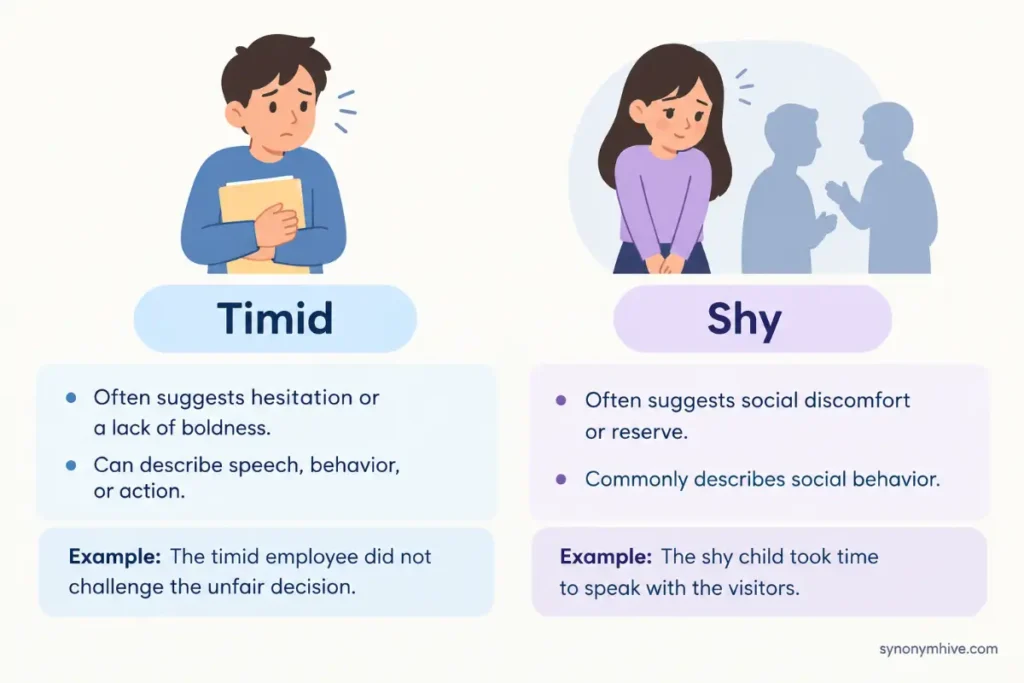
Timid and shy both describe a lack of ease or confidence, but they often point to slightly different patterns. Shy commonly refers to discomfort around people, attention, or new social settings. Timid can suggest a more general reluctance to act, speak firmly, or take risks.
| Timid | Shy |
|---|---|
| Often suggests hesitation or a lack of boldness. | Often suggests social discomfort or reserve. |
| Can describe speech, behavior, or action. | Commonly describes social behavior. |
| Example: The timid employee did not challenge the unfair decision. | Example: The shy child took time to speak with the visitors. |
| Can sound mildly critical or sympathetic. | Often sounds gentle or understanding. |
The words can overlap. A shy person may act timidly in a group, and a timid person may also be shy. Still, they are not exact matches in every sentence.
Use shy when the difficulty centers on social contact. Use timid when the person seems reluctant to act or speak with confidence. If you only mean that someone needs time to decide, hesitant may be more accurate than either word.
Common Mistakes When Choosing an Opposite of Brave
Choosing a word with the wrong strength or meaning can change the point of a sentence. A useful antonym should describe the person, feeling, or action that you actually have in mind.
Mistake 1 Calling Every Afraid Person Cowardly
Fear is a normal human response. A person can experience fear and still act with courage. Calling everyone who feels afraid cowardly confuses an emotion with a judgment about behavior.
Instead of writing, She was cowardly because she felt scared, write, She was afraid but decided to try anyway. If the person avoids an important responsibility without a reasonable cause, explain that behavior before choosing a stronger label.
Mistake 2 Using Timid When You Mean Careful
A careful person thinks about possible risks before acting. That can be a strength. A timid person may avoid action because they lack confidence or worry about being judged.
Compare these examples.
Careful: The engineer checked the design before approving the project.
Timid: The engineer was too timid to share a concern about the design.
The first sentence describes a sensible step. The second suggests that fear or low confidence stopped someone from speaking up.
Mistake 3 Choosing Slang in Formal Writing
Expressions such as chicken, wimp, and bottle it may work in casual conversation, but they can weaken an essay, report, or professional email. They may also sound disrespectful.
For formal writing, use words such as fearful, hesitant, timid, or cowardly, depending on the intended meaning. In a work setting, it may be even better to describe the behavior directly instead of assigning a label.
Mistake 4 Treating Every Opposite as a Perfect Match
Some antonyms describe feelings, while others describe traits or actions. Afraid describes an emotion. Cowardly expresses a judgment. Hesitant describes a delay or reluctance to act. Unassertive describes difficulty expressing needs or opinions firmly.
Before replacing brave, check the sentence. If the original describes a person who faces a threat, fearful may work. If it describes a person who speaks up for a belief, unassertive may fit the opposite behavior. The best word depends on what bravery means in that context.
Mistake 5 Using a Harsh Word Without Evidence
Words such as craven, spineless, and gutless make strong judgments. They can be effective in fiction or an opinion piece, but they may sound unfair if the situation is unclear.
Instead of labeling someone, explain the action. For example, He refused to defend his colleague even after seeing the unfair treatment gives readers details they can consider. You can then explain why you see the action as a failure of courage.
What Are the Antonyms of Brave?
The main antonyms of brave include cowardly, fearful, timid, afraid, fainthearted, and timorous. Each word describes a different kind of contrast.
Cowardly is useful when judging behavior that shows a lack of courage. Fearful and afraid describe the feeling of fear. Timid and timorous suggest low confidence or reluctance to act. Fainthearted points to a lack of courage or resolve.
Other words can express a related idea in specific settings. Hesitant fits someone who pauses because of doubt. Unassertive fits someone who struggles to state a need or defend an opinion. Cautious can contrast with boldness, but it is not always a true antonym because careful behavior may be wise.
Quick Tips for Choosing the Right Word
Use these simple checks before you settle on an antonym.
- Name the main idea. Are you describing fear, shyness, hesitation, or a failure to act?
- Check the tone. Choose a neutral word for a factual description and a stronger word only when you intend to judge the behavior.
- Think about the situation. A person who avoids a dangerous stunt may be cautious, not cowardly.
- Match the audience. Use plain words in conversation and more precise terms in essays or formal writing.
- Describe behavior when possible. A clear example often says more than a label.
- Avoid overstatement. Do not use a harsh term when a milder word explains the facts.
The opposite of brave is most often cowardly when the intended meaning is a lack of courage. For other situations, the more accurate word may be afraid, timid, hesitant, or cautious. A little attention to context makes your writing clearer and fairer.
Looking for another word? See Opposite of Clean The Best Words to Use.
Conclusion
The best word for a lack of bravery depends on the person, action, and situation you are describing. Cowardly is a direct choice when someone fails to show courage, but it carries a strong negative judgment. Fearful describes the feeling of fear, timid suggests low confidence, and hesitant points to uncertainty before action.
When choosing the opposite of brave, think about the difference between feeling afraid and acting without courage. A person can be nervous and still do something difficult. Another person may step away from danger because it is the sensible choice. Those details matter more than finding the strongest sounding word.
For everyday writing, start with simple terms such as afraid, scared, or shy. Use stronger words when the facts support them, and choose precise language when writing essays, work emails, or character descriptions. The right word will explain your meaning without overstating it.
Frequently Asked Questions
What is the exact opposite of brave?
Cowardly is one of the clearest opposites of brave when you mean a lack of courage. It usually judges a person’s behavior, so it may sound stronger than the situation requires. Fearful or timid can be better when you only want to describe fear or low confidence.
What is a simple word for the opposite of brave?
Afraid is a simple and common choice. It describes someone who feels fear without automatically judging their character. Scared is another natural option for casual conversation.
Is cowardly the same as afraid?
No, cowardly and afraid do not mean the same thing. Afraid describes a feeling, while cowardly judges behavior as lacking courage. A person can be afraid and still act bravely.
What is a stronger word than timid?
Cowardly is stronger when you want to criticize a lack of courage. Spineless and gutless are even harsher and more informal. Use them carefully because they can sound insulting.
What’s another way to say someone is not brave?
You can say that the person is afraid, timid, hesitant, fearful, or reluctant to act. If the person avoids a duty despite having a clear reason to act, cowardly may fit. The best phrase depends on the behavior you want to describe.
What is the opposite of brave in a sentence?
In the sentence, The brave character defended his friend, you could write, The timid character stayed silent. If you want to show a serious failure of courage, you could write, The cowardly character abandoned his friend. Each version changes the meaning and the strength of the judgment.
What is a formal word for cowardly?
Craven and pusillanimous are formal words that describe a lack of courage. Craven is especially strong and critical, while pusillanimous is rare and may sound overly academic. In most formal writing, cowardly is clearer and easier to understand.