
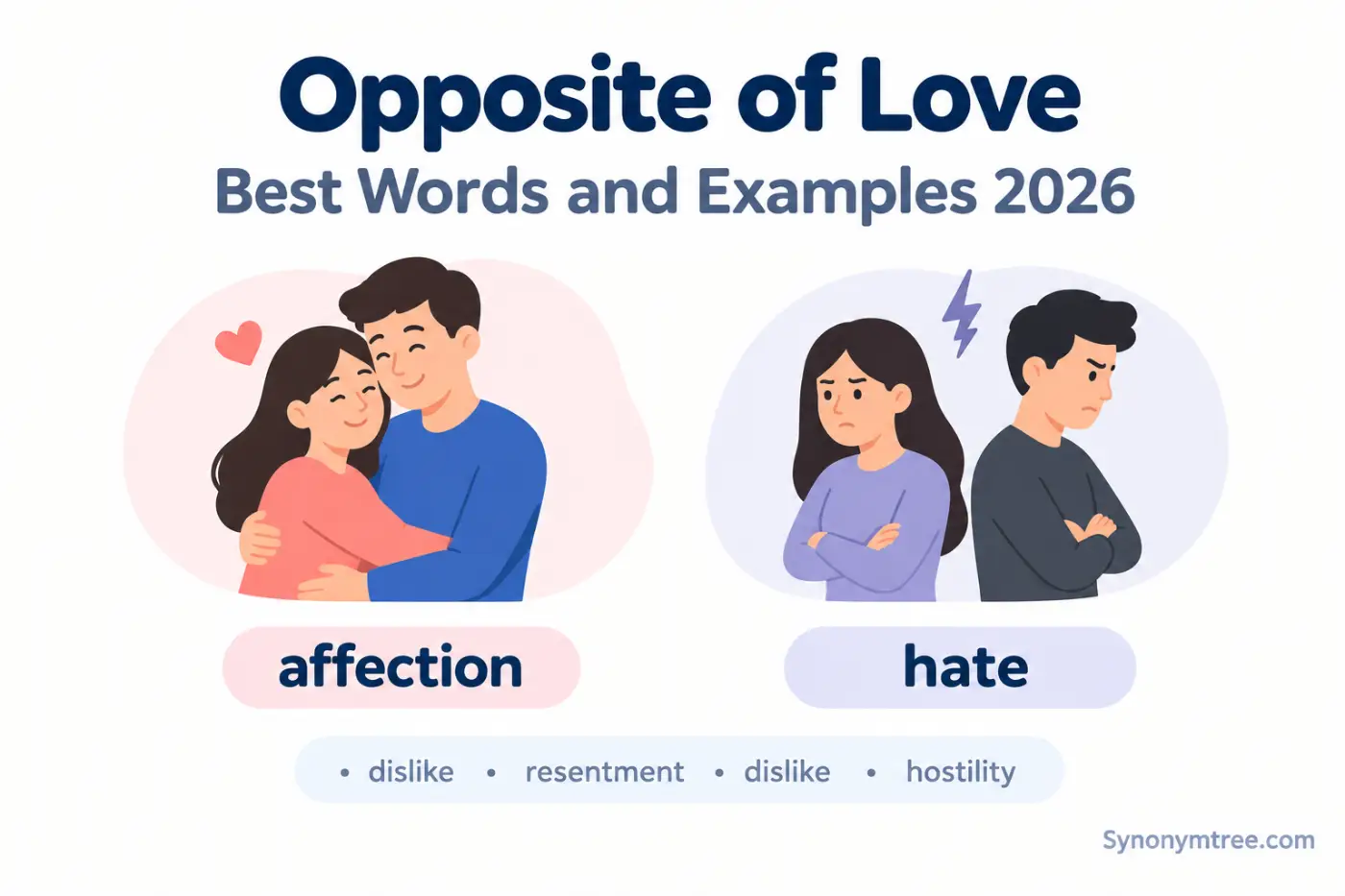
When you write a personal message, an English essay, or a thoughtful email, choosing the right word for the opposite of love can be harder than it seems. You might mean hate, but you could also mean indifference, dislike, resentment, or emotional distance. Each word describes a different response to another person, an idea, or an experience.
The best choice depends on the situation. Hate expresses strong hostility. Dislike shows that someone does not enjoy or approve of something. Indifference means a person does not care much either way. These words are related, but they do not carry the same meaning or emotional weight.
The opposite of love is often described as hate, especially when two strong emotions stand against each other. However, indifference can also be a meaningful contrast because love involves care and emotional investment, while indifference involves little or no concern. The right word depends on the point you want to make.
This guide explains the meaning and origin of these words, compares more than 30 useful alternatives, and shows how to choose the right term for essays, resumes, emails, texts, and everyday conversations. You will also find original examples, common mistakes, and answers to frequently asked questions.
Quick Answer: Hate is the most common opposite of love because it expresses strong hostility. Indifference can also contrast with love because it describes a lack of care or emotional interest.
Learn more useful word alternatives in Opposite of Hard Best Words for Every Situation.
What Is the Opposite of Love in Simple English
The opposite of love is usually hate, but the best word depends on the kind of contrast you want to express. Love involves affection, care, warmth, or deep attachment. Hate involves strong dislike, hostility, or intense negative feelings toward someone or something.
Consider two simple examples.
- Maya loves spending time with her cousin because she enjoys their conversations and trusts him.
- Maya hates spending time with her cousin because she strongly dislikes being around him.
The first sentence describes affection and enjoyment. The second describes a strong negative response. In this case, hate works as a direct contrast to love.
Now consider a different situation. Maya once loved spending time with her cousin, but after years of distance, she no longer has much interest in their relationship. She does not hate him. She simply feels indifferent. That word describes the absence of strong concern rather than an active negative emotion.
This difference matters because love and hate are both emotional responses. Indifference is closer to a lack of emotional involvement. A person can stop loving someone without beginning to hate them.
Is Hate Always the Best Opposite of Love
Hate is usually the clearest answer when a question asks for a direct antonym of love. It works well in dictionaries, school assignments, general writing, and conversations about strong emotions.
Still, hate is not the best choice for every situation. If you mean that someone no longer cares, indifference may be more accurate. If you mean that someone has mild negative feelings, dislike may fit better.
For example, a person might say, I do not hate my former friend. I just do not care about the friendship anymore. The sentence separates hostility from emotional distance.
The main lesson is simple. Use hate for strong hostility, dislike for a negative preference, indifference for a lack of concern, and resentment for lasting anger linked to a real or perceived wrong.
Where Do the Words Love and Hate Come From
The word love has a long history in English. It comes from Old English lufu, a word used for affection, care, and deep attachment. Related forms appear in older Germanic languages, showing that the idea of love has been part of the language for many centuries.
The word hate also comes from Old English. The verb hatian meant to hate or regard something with strong dislike. Its meaning has remained fairly stable over time. Today, hate can describe intense hostility toward a person, group, action, or idea.
Both words describe strong responses, but they point in different emotional directions. Love often brings to mind affection, closeness, care, and a desire for another person’s well being. Hate often suggests hostility, anger, rejection, or a wish to avoid someone or something.
The word indifference comes through Latin and French roots connected with the idea of making no distinction or showing no preference. In modern English, it describes a lack of interest, concern, or emotional response. That makes it useful when the contrast is not active hatred but the absence of care.
How the Word History Helps You Choose
Word history can explain how a term developed, but its current meaning should guide your writing. Hate is a strong word. Use it when the sentence needs that strength. Indifference is quieter and more neutral. It works when a person feels detached rather than angry.
For example, a character who shouts at an old friend may show anger or hatred. A character who barely notices that friend may show indifference. Both reactions can stand in contrast to love, but they tell the reader very different things about the relationship.

What Words Can Mean the Opposite of Love
Many words can express the opposite of love in a particular context. Some describe strong hostility. Others describe mild dislike, broken trust, emotional distance, or a lack of interest. The table below groups useful choices by tone so you can select a word that fits your message.
Simple Words for Everyday Writing
These words work well in schoolwork, casual messages, and clear everyday explanations. Most readers will understand them without extra context.
| Word | Meaning | Tone | Example |
|---|---|---|---|
| Hate | To strongly dislike someone or something | Very strong | He hates the way she treats others. |
| Dislike | To have a negative opinion or preference | Mild to moderate | I dislike being interrupted. |
| Indifference | A lack of interest or concern | Neutral | Her indifference surprised the team. |
| Coldness | A lack of warmth or kindness | Negative | His coldness made the conversation uncomfortable. |
| Distance | A lack of closeness or connection | Neutral to negative | Emotional distance grew between them. |
| Rejection | Refusal to accept or welcome someone or something | Strong | She took his rejection personally. |
| Disgust | A strong feeling of dislike or revulsion | Very strong | He expressed disgust at the cruel joke. |
| Antipathy | A strong feeling of dislike | Formal | She felt antipathy toward the dishonest leader. |
Everyday Words for Feelings and Relationships
These options help describe specific emotional states. They can be more accurate than hate when the situation involves disappointment, lost trust, or unresolved conflict.
| Word | Meaning | Tone | Example |
|---|---|---|---|
| Resentment | Lasting anger about unfair treatment | Strong | Resentment grew after years of broken promises. |
| Hostility | Unfriendly or aggressive behavior | Strong | Hostility filled the room during the argument. |
| Aversion | A strong desire to avoid something | Moderate to strong | He has an aversion to needless conflict. |
| Distrust | A lack of trust | Moderate | Distrust weakened their partnership. |
| Contempt | A feeling that someone is unworthy of respect | Very strong | She spoke with contempt about his dishonesty. |
| Antagonism | Active opposition or hostility | Strong | Antagonism between the groups slowed the project. |
| Alienation | A feeling of separation or disconnection | Moderate to strong | Years of silence led to alienation. |
| Disaffection | A loss of loyalty, support, or interest | Formal | The poor decision caused disaffection among workers. |
Formal Words for Essays and Thoughtful Writing
Formal vocabulary can help when you need to describe a complex relationship, a social problem, or an emotional response in an essay. These words have more specific meanings, so use them only when they fit the evidence.
| Word | Meaning | Tone | Example |
|---|---|---|---|
| Loathing | Intense hatred or disgust | Very strong | The character expressed loathing for the cruel ruler. |
| Detestation | Strong hatred or dislike | Formal and strong | His detestation of corruption shaped his public work. |
| Abhorrence | Deep disgust or moral rejection | Formal and very strong | She spoke with abhorrence about the abuse of power. |
| Enmity | Deep seated hostility between people or groups | Formal and strong | Enmity between the families lasted for decades. |
| Estrangement | A state of being distant or separated | Formal | Their estrangement began after a serious disagreement. |
| Disdain | A sense that someone or something is beneath respect | Formal and negative | He showed disdain for the rules. |
| Repugnance | Strong disgust or aversion | Formal | The proposal caused repugnance among local residents. |
| Apathy | Lack of interest, feeling, or motivation | Neutral to negative | Public apathy reduced attendance at the meeting. |
Slang and Casual Expressions
Casual expressions can make dialogue and texting sound natural. Some are blunt or rude, so think about your audience before using them in a work email or formal essay.
| Word or expression | Meaning | Tone | Example |
|---|---|---|---|
| Can’t stand | Strongly dislike someone or something | Casual and strong | I can’t stand that constant noise. |
| Have a grudge | Keep anger about a past event | Casual | He still has a grudge over the argument. |
| Be fed up with | Have no patience left for a situation | Casual and frustrated | She is fed up with his excuses. |
| Be over someone | No longer have romantic interest or attachment | Casual | He is over his former partner. |
| Not care | Have little or no concern | Casual and direct | I do not care about the competition. |
| Be done with | Want to end involvement with someone or something | Casual and firm | I am done with the constant drama. |
| Give someone the cold shoulder | Deliberately ignore someone | Casual | He gave his former friend the cold shoulder. |
| Have no time for | Refuse to give attention or approval to someone or something | Casual and firm | She has no time for dishonest behavior. |
These expressions are not exact replacements for love in every sentence. For example, being over someone usually refers to moving on from a romantic relationship. Being fed up with someone suggests frustration. Not caring may express indifference, but it does not always mean dislike.
Which Words Show Different Levels of Negative Feeling
Choosing a word by intensity helps you avoid making a mild situation sound extreme. It also helps your reader understand the difference between a passing dislike and a deep emotional conflict.
Mild Feelings
Use mild terms when the negative response is limited or temporary.
- Disinterest means a lack of attention or curiosity.
- Indifference means little concern or emotional involvement.
- Dislike means a negative preference or opinion.
- Distance means limited closeness or connection.
Example: I felt some distance from the group because we had different interests.
This sentence does not claim that anyone felt hatred. It describes a weaker connection.
Moderate Feelings
Moderate terms work when a person feels hurt, uneasy, or unwilling to stay close.
- Aversion suggests a strong wish to avoid something.
- Distrust means a lack of confidence in another person.
- Resentment describes anger that remains after a hurtful experience.
- Alienation describes separation from a person or group.
Example: Repeated broken promises created resentment between the friends.
The word resentment suggests that the anger lasted beyond one moment. It gives the reader a reason to understand the relationship’s strain.
Strong Feelings
Strong terms describe intense hostility, rejection, or moral disgust.
- Hatred means a deep and lasting feeling of hate.
- Loathing means intense hatred or disgust.
- Contempt suggests that someone views another person as unworthy of respect.
- Hostility can involve open anger or aggressive behavior.
- Enmity describes deep opposition, often between people or groups.
Example: The long conflict turned their early disagreement into open hostility.
Do not choose the strongest word simply to make a sentence sound dramatic. Strong words can change the meaning of a scene, argument, or personal message. Use them when the context supports that level of emotion.
Which Part of Speech Should You Use
Love and hate can function as nouns and verbs. Many related terms have different grammatical roles, so a direct replacement may require a small change to the sentence.
Nouns That Describe Feelings
Nouns name emotions, states, or relationships. Examples include hate, hatred, dislike, indifference, resentment, hostility, and contempt.
Example: Her indifference hurt him more than a direct disagreement.
Here, indifference names the emotional state. It does not describe an action.
Verbs That Describe Emotional Responses
Verbs show what a person feels or does. Useful choices include hate, dislike, resent, distrust, reject, despise, and loathe.
Example: He resents the way his manager takes credit for his work.
Resents is a verb, so it fits directly into the sentence. By contrast, resentment is a noun. You could write, He feels resentment about the manager’s behavior.
Adjectives That Describe People or Situations
Adjectives describe a person, feeling, action, or relationship. Examples include hateful, hostile, indifferent, resentful, distant, and cold.
Example: Their relationship became distant after the disagreement.
The adjective distant describes the relationship. It does not claim that either person hates the other.
Adverbs That Describe How Someone Acts
Adverbs can explain how a person speaks or behaves. Examples include coldly, hatefully, resentfully, and indifferently.
Example: She replied coldly because she did not want to continue the argument.
Use an adverb when you need to describe the manner of an action. Do not force a noun into a sentence that needs a verb or adjective. Correct grammar keeps the meaning clear.

Is There a Difference Between American and British English
The main words for negative feelings have the same basic meanings in American and British English. Hate, dislike, indifference, resentment, and hostility are understood in both varieties. The bigger differences often involve tone, formality, and the expressions people use in daily conversation.
In the United States, people commonly say they cannot stand someone or that they are fed up with a situation. These expressions are direct and informal. British speakers use them too, although the preferred expression can vary by person, region, and social setting.
The phrase not keen on is common in British English and can express mild dislike. For example, I am not keen on his attitude means the speaker does not approve of the attitude. It does not usually suggest deep hatred.
Some expressions also differ in how forceful they sound. Calling a person hostile suggests unfriendly or aggressive behavior in both countries. Describing someone as cold may suggest a lack of warmth, but the word does not prove that the person feels hatred.
Which Expression Sounds Natural in Each Region
| Expression | Common use | Example |
|---|---|---|
| Do not like | Clear and widely understood | I do not like his behavior. |
| Cannot stand | Informal and strong | I cannot stand the constant interruptions. |
| Not keen on | Often associated with British English | I am not keen on that idea. |
| Fed up with | Common in both varieties | We are fed up with the delays. |
| Have a grudge | Informal in both varieties | She still holds a grudge against him. |
| Indifferent to | Neutral and more formal | He is indifferent to public opinion. |
For school assignments and professional writing, choose words that are clear across regions. Hate, dislike, indifference, resentment, and hostility are dependable choices. Slang can add personality to dialogue, but it may not suit a formal report or business email.
Which Word Should You Use in Different Situations
The best word depends on the purpose of your writing and the relationship between the people involved. A resume needs professional language. An essay may need a precise description of an emotion. A text message can be more casual, while a sensitive email often benefits from a calm and measured tone.
What Is the Best Word for a Resume
A resume rarely needs a word that expresses hatred. If you are describing a workplace conflict, focus on the specific issue rather than using an emotional label. Words such as disagreement, tension, distrust, and conflict can describe professional challenges without sounding hostile.
Example: I helped resolve tension between team members by listening to concerns and agreeing on clear responsibilities.
Another example: I rebuilt trust with a client after a series of communication problems.
These sentences focus on actions and results. They do not attack another person or make the applicant sound bitter. If you need to describe a difficult working relationship, use language that explains the problem and shows how you responded.
Avoid writing that you hated a manager, disliked coworkers, or felt contempt for a former employer. Even if the feelings were real, that wording may distract from your skills and achievements.
What Is the Best Word for an Essay
For an English essay, hate is often the clearest direct contrast to love. However, an analytical essay may benefit from a more precise word. Indifference works when a character stops caring. Resentment works when a character holds on to anger. Contempt works when a character looks down on someone.
Example: The author uses indifference to show how the main character has become emotionally distant from her family.
Another example: Resentment grows between the two characters because neither one admits responsibility for the conflict.
These sentences explain the role of the emotion in the story. They also give the reader a clearer picture of the characters’ relationship.
When writing an essay, connect the word to evidence from the text. If you describe a character as hateful, explain what the character says or does that supports that description.
What Is the Best Word for Texting
In a text message, simple expressions usually sound more natural than formal vocabulary. You might say you dislike something, cannot stand a behavior, or no longer care about a situation.
Example: I do not hate you. I just need some space.
Example: I am fed up with arguing about the same thing.
Example: I am over the relationship and ready to move on.
Each message communicates a different idea. The first separates hostility from the need for distance. The second shows frustration. The third suggests that romantic attachment has ended.
Avoid using a strong word just to get a reaction. If you want to set a boundary, explain the behavior that bothers you. A clear message is often more useful than an insult.
What Is the Best Word for an Email
Professional and personal emails often need careful wording, especially when the topic is sensitive. Indifference may sound too clinical in a personal email, while hate can sound aggressive. Words such as concern, disappointment, distrust, or frustration may communicate the actual problem more clearly.
Example: I am concerned about the lack of communication during the project.
Example: I was disappointed by the decision because it did not address the team’s concerns.
These sentences focus on the issue instead of attacking the person. They also give the reader a better chance to understand the problem and respond constructively.
If the email concerns a personal relationship, use honest but respectful language. Saying I feel distant from you explains the situation without claiming to know the other person’s intentions.
What Is the Best Word for Speaking
In conversation, the best choice is usually the word that matches the feeling and the setting. Hate works for a strong negative reaction. Dislike works for a milder response. Indifference works when a person has little concern. Resentment works when anger remains after a painful event.
Example: I do not hate him. I just do not want to be close to him anymore.
Example: I dislike the way he speaks to new employees.
Example: She still resents the unfair treatment she received.
When speaking about another person, describe what you know rather than guessing at their inner feelings. Saying that someone acts coldly describes observable behavior. Claiming that the person feels hatred makes a stronger statement that may need more evidence.
Need another vocabulary suggestion? Read Opposite of Confident Best Words for Every Situation.
What Are Some Original Examples of the Opposite of Love
The following examples show how different words work in real situations. They cover family, friendships, school, work, public life, and personal choices.
- After several broken promises, Lena felt resentment toward her longtime friend.
- The two neighbors showed open hostility during the dispute over the fence.
- Marcus did not hate his former partner, but he no longer wanted to continue the relationship.
- Her indifference to the award surprised everyone who had helped with the project.
- The student disliked the new rule because it gave him less time to finish his work.
- Years of silence led to estrangement between the brothers.
- The manager treated the complaint with contempt instead of considering the facts.
- He felt distrust after the company changed its explanation several times.
- The audience reacted with disgust when the speaker made a cruel joke.
- She was fed up with repeated delays and asked for a clear deadline.
- Their friendship became distant after they moved to different cities.
- The character’s loathing for the corrupt king shaped every decision in the story.
- I have no interest in the argument, so I am staying out of it.
- The coach addressed the team’s frustration before it turned into conflict.
- Her dislike of public speaking did not stop her from giving a strong presentation.
These examples show that negative feelings are not all the same. Some describe an emotion, some describe a relationship, and others describe behavior. Pick the term that best matches the details in your sentence.
What Is the Difference Between Hate and Indifference
Hate and indifference are two common answers when people discuss the opposite of love, but they describe different states.
| Feature | Hate | Indifference |
|---|---|---|
| Main meaning | Strong dislike or hostility | Little or no concern |
| Emotional strength | Often intense | Often emotionally neutral |
| Attention | The person or issue may receive strong attention | The person or issue may receive little attention |
| Typical response | Anger, rejection, or opposition | Lack of interest or involvement |
| Example | He hates being treated unfairly. | He is indifferent to the result. |
Hate is an active negative feeling. Indifference is a lack of interest or emotional investment. Someone may hate a former friend because of a serious betrayal. Another person may simply stop caring about a friendship after growing apart.
The distinction matters in stories and personal conversations. A character who hates another person may still be emotionally tied to that person through anger. A character who feels indifferent may have stopped investing time and attention in the relationship.
Neither response is automatically stronger in every situation. The right choice depends on the point you want to make.

What Is the Difference Between Dislike and Resentment
Dislike and resentment both express negative feelings, but they usually have different causes and levels of emotional history.
Dislike means that you do not enjoy, approve of, or have a positive opinion of someone or something. You might dislike a song, a habit, or a person’s communication style without having a serious conflict with them.
Resentment is anger that continues because of a perceived wrong, unfair treatment, or disappointment. It often develops over time. A person may resent a friend who repeatedly breaks promises or a coworker who takes credit for their work.
Compare these examples.
| Dislike | Resentment |
|---|---|
| I dislike his habit of interrupting people. | I resent him for taking credit for my work. |
| She dislikes the new policy. | She resents the unfair way the policy was applied to her. |
| They dislike the team’s playing style. | They resent the coach for blaming them for a decision he made. |
Use dislike for a general negative preference or opinion. Use resentment when the sentence involves lingering anger about an event or perceived injustice.
What Common Mistakes Should You Avoid
Choosing the wrong term can make a sentence sound harsher, weaker, or less accurate than you intended. These mistakes are common in essays, personal messages, and everyday speech.
Treating Hate and Indifference as Exact Matches
Hate and indifference do not mean the same thing. Hate describes strong negative feelings, while indifference describes a lack of concern.
Incorrect: She felt indifference toward him, so she wanted to punish him.
Better: She felt resentment toward him and wanted him to take responsibility for his actions.
The second sentence gives a clearer reason for the desire to punish someone. Indifference alone does not normally explain an active wish to retaliate.
Using Contempt When You Only Mean Dislike
Contempt suggests that someone sees another person or thing as beneath respect. It carries a judgment that ordinary dislike does not.
If you dislike a movie, that does not mean you hold it in contempt. If you describe a coworker with contempt, you suggest more than a simple difference in preference.
Use contempt when the sentence involves scorn or a strong sense of superiority. Choose dislike when you only mean that you do not approve of something.
Confusing Emotional Distance With Hatred
People can become distant for many reasons. They may have different priorities, live far apart, or need time to recover from an argument. Distance alone does not prove that love has turned into hate.
For example, I need space from my friend describes a boundary. I hate my friend describes a strong negative emotion. These sentences are not interchangeable.
Using Formal Words in Casual Messages
Words such as detestation, abhorrence, and repugnance can sound unnatural in an ordinary text. They are useful in formal writing, literary analysis, or discussions that require a precise tone. In daily conversation, dislike or cannot stand may be clearer.
Choose vocabulary that suits the reader. A simple word is often the best option when it communicates the idea accurately.
Assuming Every Relationship Has Only Two Emotional States
Relationships are rarely limited to love and hate. A person may care about someone while feeling disappointed in them. Another person may forgive a past mistake but decide to keep some distance. Someone else may feel affection for a family member while disliking that person’s behavior.
A useful sentence can describe mixed feelings directly. For example, I still care about him, but I do not trust him. This is more precise than forcing the relationship into a single emotional category.
What Are the Antonyms of Love
Antonyms are words with opposite or contrasting meanings. The most direct antonym of love is hate, but other terms can serve as contrasts in specific contexts.
- Hate is the clearest direct antonym when love means affection or strong positive feeling.
- Hatred is the noun form that describes a deep feeling of hate.
- Dislike is a milder contrast when the sentence describes preference or approval.
- Indifference contrasts with love when the focus is on care and emotional investment.
- Hostility describes unfriendly or aggressive opposition.
- Aversion describes a strong desire to avoid something.
- Resentment describes lasting anger connected to a perceived wrong.
- Contempt describes a lack of respect combined with a sense of superiority.
The opposite of love in a particular sentence may be a state rather than a single emotion. If a person once loved a hobby but has lost interest, indifference or disinterest may fit. If a person feels deep anger toward someone, hate may be more accurate.
How Can You Choose the Right Word Quickly
A few simple checks can help you choose a precise term without overthinking the sentence.
- Identify the main feeling. Ask yourself if the person feels angry, disappointed, uninterested, distrustful, or hostile.
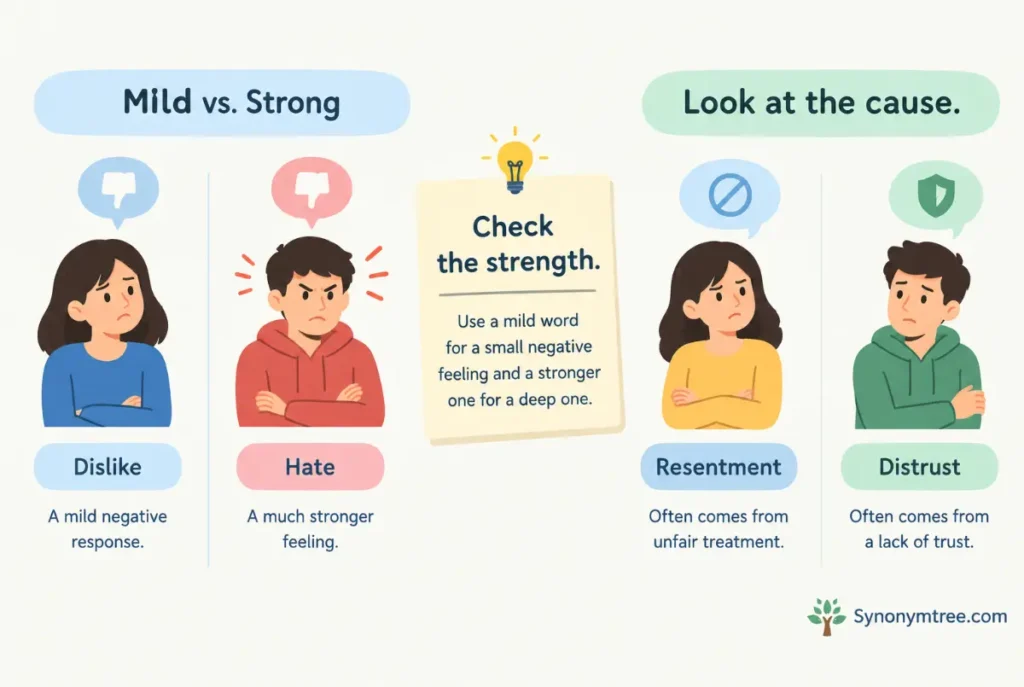
- Check the strength. Use dislike for a mild negative response and hate for a much stronger one.
- Look at the cause. If the feeling comes from unfair treatment, resentment may fit. If it comes from a lack of trust, distrust may be more accurate.
- Consider the relationship. Estrangement describes separation, while indifference describes a lack of concern.
- Match the audience. Use plain words for everyday messages and more specific terms for essays or formal writing.
- Read the sentence aloud. If the word sounds too harsh or too formal for the situation, choose a simpler alternative.
- Check the grammar. Make sure you use the noun, verb, adjective, or adverb that the sentence needs.
- Look for evidence. In an essay or report, make sure the word describes the person’s actions or stated feelings rather than an unsupported guess.
These checks are especially helpful when writing about conflict. The aim is not to find the strongest possible word. It is to find the word that gives the reader the most accurate picture.
Learn more useful word alternatives in Opposite of Loud The Best Words to Use.
Conclusion
The best word to use depends on the feeling you want to describe. Hate is the clearest direct contrast to love when you mean strong hostility. Dislike works for a milder negative response, while indifference describes a lack of care or emotional interest. Resentment points to lasting anger after a perceived wrong, and contempt suggests a lack of respect.
When choosing the opposite of love, consider the cause, strength, and context of the feeling. A school essay may need a precise term such as hostility or estrangement, while a casual message may sound more natural with dislike or cannot stand. You do not need a dramatic word to make a sentence meaningful. Choose the term that says exactly what you mean, and your writing will be clearer and more convincing.
Frequently Asked Questions
What is the opposite of love in one word?
Hate is the most common one word answer because it describes strong hostility or intense dislike. Indifference can also contrast with love when the focus is on a lack of care.
Can indifference be the opposite of love?
Yes, indifference can contrast with love because it describes little or no emotional concern. It differs from hate, which involves an active negative feeling.
What is a stronger word than hate?
Loathing, abhorrence, and detestation can express intense hatred or disgust. The best choice depends on the sentence and the kind of emotion you want to describe.
What is the opposite of love in a relationship?
The answer depends on the relationship. Hate describes strong hostility, while indifference may describe a loss of emotional interest. Distrust, resentment, and estrangement can also describe problems that weaken a relationship.
What’s another way to say I do not love someone?
You can say I do not have romantic feelings for that person, I no longer feel close to them, or I do not share the same feelings. These expressions are often clearer and kinder than using hate when you do not actually feel hostility.
Is dislike the same as hate?
No, dislike is usually milder than hate. Dislike means you do not approve of or enjoy someone or something, while hate expresses a much stronger negative feeling.
Can you stop loving someone without hating them?
Yes, a person can stop loving someone without developing hatred. Feelings may fade, priorities may change, or a relationship may end without either person feeling hostility.