
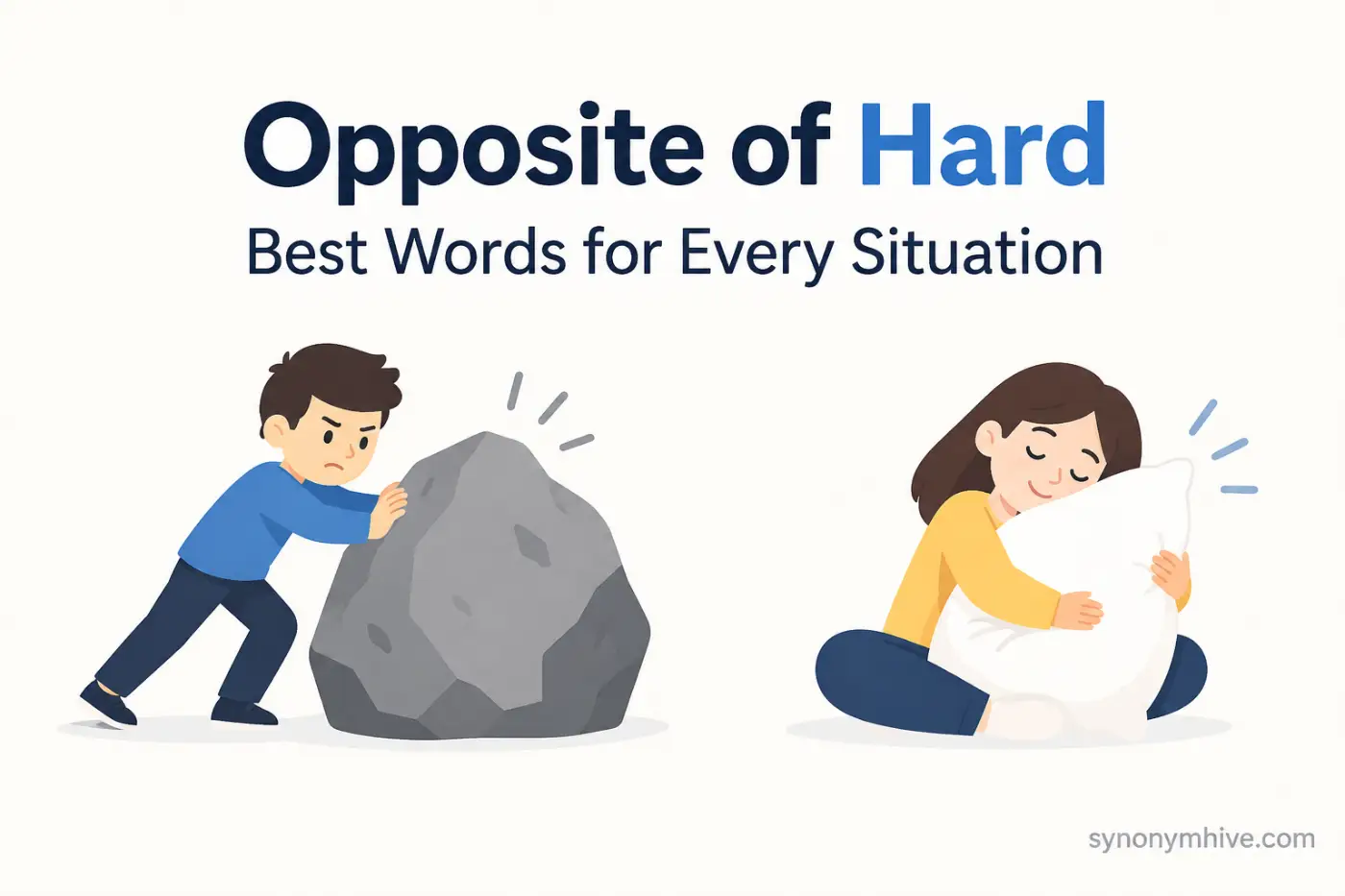
You might need the opposite of hard when writing a school essay, describing a task at work, or sending a quick text. The tricky part is that hard has several meanings. A hard pillow is not soft enough, a hard test is difficult, and a hard worker puts in a lot of effort. Each meaning can have a different opposite.
The best word depends on what you want to say. Soft works for texture. Easy works for something that takes little effort. Simple describes something that is easy to understand or do. Gentle can describe a touch or manner that is not rough or harsh.
The opposite of hard is usually soft when hard means firm or solid, and easy when hard means difficult. Other useful choices include simple, gentle, flexible, and weak, depending on the context.
This guide covers more than a short list of antonyms. You will find 30 useful alternatives grouped by tone, examples for school and work, and clear comparisons between words that seem alike but have different meanings. You will also learn how to choose the right word for an essay, resume, email, or casual conversation.
Discover related words in Opposite of Love Best Words and Examples 2026.
What Does Hard Mean and Where Did the Word Come From?
The word hard has been part of English for centuries. It comes from Old English heard, which meant firm, solid, or difficult to deal with. Over time, the word developed several related meanings.
Today, hard can describe a physical object, a task, a person’s behavior, or the amount of effort someone puts into something. That range explains why one opposite does not work in every sentence.
The Main Meanings of Hard
- Firm or solid. A hard surface does not give way easily when you press it. The opposite is usually soft. Example: The hard mattress was uncomfortable, so we replaced it with a softer one.
- Difficult. A hard task takes effort, skill, or time. The opposite is usually easy. Example: The first question was hard, but the last one was easy.
- Complicated. A hard problem may be difficult to understand or solve. Simple or straightforward may work as the opposite. Example: The instructions looked complicated at first, but the new guide made them simple.
- Harsh or severe. A hard tone or response can sound strict, unkind, or unpleasant. Gentle, kind, or mild may express the opposite. Example: The manager gave gentle feedback instead of a hard response.
- Strong or forceful. A hard hit or hard blow involves a lot of force. Light or gentle may be the right contrast. Example: He tapped the door lightly instead of hitting it hard.
- Requiring effort. A person who works hard puts in a lot of effort. In this case, the opposite is not always easy. You might say the person worked little, put in less effort, or took it easy, depending on the sentence.
Why Context Matters
A word can have more than one meaning, so its opposite can change. Consider these sentences.
- The rock is hard. Its opposite is soft.
- The exam is hard. Its opposite is easy.
- The teacher sounded hard. Its opposite might be gentle or kind.
- The wind blew hard. Its opposite might be lightly or gently.
- The worker tried hard. The opposite might be made little effort, not soft.
These differences matter because an antonym should fit the meaning of the original word. Replacing hard with soft in a sentence about a difficult exam would change the meaning rather than correct it.
A Master List of Opposites for Hard
The table below groups useful words by how people commonly use them. Some are direct opposites in certain situations, while others work only when the context supports them.
| Word | Meaning | Tone | Example |
|---|---|---|---|
| Soft | Not firm, rough, or rigid | Everyday | The pillow is soft. |
| Easy | Not difficult or demanding | Everyday | The first lesson was easy. |
| Simple | Easy to understand or do | Everyday | She gave a simple answer. |
| Gentle | Mild and careful, not rough | Everyday | He used a gentle touch. |
| Effortless | Requiring little or no effort | Neutral | The move looked effortless. |
| Kind | Caring and considerate | Everyday | She gave a kind reply. |
| Compassionate | Showing care for another person’s trouble | Formal | The nurse was compassionate. |
| Tolerant | Willing to accept differences or mistakes | Formal | The supervisor was tolerant of small errors. |
| Relaxed | Calm and not tense | Everyday | The meeting had a relaxed tone. |
| Delicate | Easily damaged or requiring care | Neutral | The glass was delicate. |
| Fragile | Easily broken or harmed | Neutral | The fragile item needed careful packing. |
| Weak | Lacking strength or force | Everyday | The weak signal kept dropping. |
| Feeble | Very weak or lacking power | Formal | The plant had a feeble stem. |
| Flimsy | Thin or poorly made | Everyday | The flimsy box broke open. |
| Loose | Not tight or firmly fixed | Everyday | The screw was loose. |
| Breezy | Casual and light in manner | Informal | His breezy reply kept things friendly. |
| Chill | Relaxed or easygoing | Slang | The group had a chill attitude. |
Discover another helpful synonym list in Opposite of Easy Best Words and Examples 2026.
Opposites of Hard From Mild to Strong
Sometimes you know the general meaning you need but want a word with the right level of intensity. A mild word may suit a friendly conversation, while a stronger word may be more accurate in a technical or formal setting.
Mild Opposites
These words describe a small difference in effort, force, or severity.
- Gentle. Use it for a touch, voice, response, or action that is careful and mild.
- Mild. Use it for a reaction, punishment, flavor, or condition that is not severe.
- Light. Use it for a small amount of force, pressure, or effort.
- Manageable. Use it when something still requires work but does not feel overwhelming.
- Straightforward. Use it when a task has clear steps and little confusion.
Example: The assignment was manageable once the teacher explained the instructions. The word does not claim that the assignment took no effort. It says the task could be handled.
Moderate Opposites
These choices suggest a clear difference without making the situation sound extreme.
- Soft. A direct choice for something firm or rough.
- Easy. A direct choice for something difficult.
- Simple. A good choice for a task or idea that is not complicated.
- Flexible. Useful for material, rules, or plans that can bend or change.
- Comfortable. Useful when hard describes something unpleasant to sit on, wear, or use.
Example: The company replaced its hard schedule with a flexible one. Flexible works because the sentence is about a schedule that can change, not a physical object.
Strong Opposites
These words can describe a clear lack of force, difficulty, or strictness. They need careful use because some have negative meanings.
- Effortless. Something seems to require almost no work.
- Painless. A process causes little discomfort or trouble.
- Lenient. A person or rule is not strict.
- Feeble. Something lacks strength or power.
- Flimsy. An object is weakly made and can break or bend easily.
Example: The software update was painless for most users. This means the change caused little trouble. It does not mean the update was physically soft.
A strong word is not always a better word. If a project takes some effort, calling it effortless may be inaccurate. The best choice describes the real situation rather than making the sentence sound more impressive.
Which Opposite Fits Each Part of Speech?
Hard can act as an adjective or an adverb, and it also appears in common phrases. The right alternative depends on how the word works in the sentence.
When Hard Is an Adjective
An adjective describes a person, place, thing, or idea. In The floor is hard, hard describes the floor. In The test is hard, it describes the test.
Common alternatives include soft, easy, simple, gentle, mild, and flexible. Pick the one that matches the intended meaning.
Examples:
- The hard cushion became a soft cushion.
- The hard question became an easy question after practice.
- The hard rule became a more flexible rule.
- The hard tone became a gentle tone.
When Hard Is an Adverb
In some sentences, hard describes how an action happens. For example, She hit the ball hard. Here, hard tells us how forcefully she hit the ball.
Possible alternatives include lightly, gently, softly, easily, or with little effort. The right option depends on the verb.
Examples:
- He pushed the box hard. He pushed the box gently.
- The rain fell hard. The rain fell lightly.
- She worked hard. She worked with little effort is grammatically possible, but it means she did not put in much effort. She took it easy may sound more natural in casual speech.
Be careful with the phrase worked hard. Its opposite is not soft, because the word describes effort rather than texture.
When Hard Appears in a Phrase
Some common phrases use hard in ways that need a full expression as the opposite.
| Phrase with hard | Possible opposite | Example |
|---|---|---|
| Hard work | Easy work or light work | The task turned out to be light work. |
| Hard surface | Soft surface | The hard surface was covered with a soft mat. |
| Hard choice | Easy choice | After comparing the options, it became an easy choice. |
| Hard deadline | Flexible deadline | The team received a flexible deadline. |
| Hard tone | Gentle tone | She answered in a gentle tone. |
| Hit hard | Hit lightly | He tapped the ball lightly. |
| Hard to understand | Easy to understand | The new guide is easy to understand. |
These examples show why word choice requires more than a dictionary lookup. Read the whole sentence and identify what hard describes before choosing an opposite.
What Does Hard Mean and Where Did the Word Come From?
The word hard has been part of English for centuries. It comes from Old English heard, which meant firm, solid, or difficult to deal with. Over time, the word developed several related meanings.
Today, hard can describe a physical object, a task, a person’s behavior, or the amount of effort someone puts into something. That range explains why one opposite does not work in every sentence.
The Main Meanings of Hard
- Firm or solid. A hard surface does not give way easily when you press it. The opposite is usually soft. Example: The hard mattress was uncomfortable, so we replaced it with a softer one.
- Difficult. A hard task takes effort, skill, or time. The opposite is usually easy. Example: The first question was hard, but the last one was easy.
- Complicated. A hard problem may be difficult to understand or solve. Simple or straightforward may work as the opposite. Example: The instructions looked complicated at first, but the new guide made them simple.
- Harsh or severe. A hard tone or response can sound strict, unkind, or unpleasant. Gentle, kind, or mild may express the opposite. Example: The manager gave gentle feedback instead of a hard response.
- Strong or forceful. A hard hit or hard blow involves a lot of force. Light or gentle may be the right contrast. Example: He tapped the door lightly instead of hitting it hard.
- Requiring effort. A person who works hard puts in a lot of effort. In this case, the opposite is not always easy. You might say the person worked little, put in less effort, or took it easy, depending on the sentence.
Why Context Matters
A word can have more than one meaning, so its opposite can change. Consider these sentences.
- The rock is hard. Its opposite is soft.
- The exam is hard. Its opposite is easy.
- The teacher sounded hard. Its opposite might be gentle or kind.
- The wind blew hard. Its opposite might be lightly or gently.
- The worker tried hard. The opposite might be made little effort, not soft.
These differences matter because an antonym should fit the meaning of the original word. Replacing hard with soft in a sentence about a difficult exam would change the meaning rather than correct it.
A Master List of Opposites for Hard
| Word | Meaning | Tone | Example |
|---|---|---|---|
| Light | Not heavy or forceful | Everyday | She gave the door a light push. |
| Flexible | Able to bend or adapt | Everyday | The flexible material bends easily. |
| Pliable | Easy to bend or shape | Neutral | The pliable clay was easy to mold. |
| Cushioned | Softened by padding | Everyday | The chair had a cushioned seat. |
| Tender | Soft or easy to cut, chew, or touch | Everyday | The meat was tender. |
| Comfortable | Pleasant and free from discomfort | Everyday | The soft chair was comfortable. |
| Effortless | Requiring little or no effort | Neutral | The move looked effortless. |
| Straightforward | Clear and easy to follow | Neutral | The process was straightforward. |
| Manageable | Possible to handle or complete | Everyday | The workload was manageable. |
| Painless | Causing little or no pain or trouble | Everyday | The update was painless. |
| Convenient | Easy to use or arrange | Everyday | The new schedule was convenient. |
| Mild mannered | Calm and not aggressive | Descriptive | The mild mannered coach spoke quietly. |
| Kind | Caring and considerate | Everyday | She gave a kind reply. |
| Compassionate | Showing care for another person’s trouble | Formal | The nurse was compassionate. |
| Lenient | Not strict or severe | Formal | The judge took a lenient approach. |
| Tolerant | Willing to accept differences or mistakes | Formal | The supervisor was tolerant of small errors. |
| Relaxed | Calm and not tense | Everyday | The meeting had a relaxed tone. |
| Delicate | Easily damaged or requiring care | Neutral | The glass was delicate. |
| Fragile | Easily broken or harmed | Neutral | The fragile item needed careful packing. |
| Weak | Lacking strength or force | Everyday | The weak signal kept dropping. |
| Feeble | Very weak or lacking power | Formal | The plant had a feeble stem. |
| Flimsy | Thin or poorly made | Everyday | The flimsy box broke open. |
| Loose | Not tight or firmly fixed | Everyday | The screw was loose. |
| Breezy | Casual and light in manner | Informal | His breezy reply kept things friendly. |
| Chill | Relaxed or easygoing | Slang | The group had a chill attitude. |
Opposites of Hard From Mild to Strong
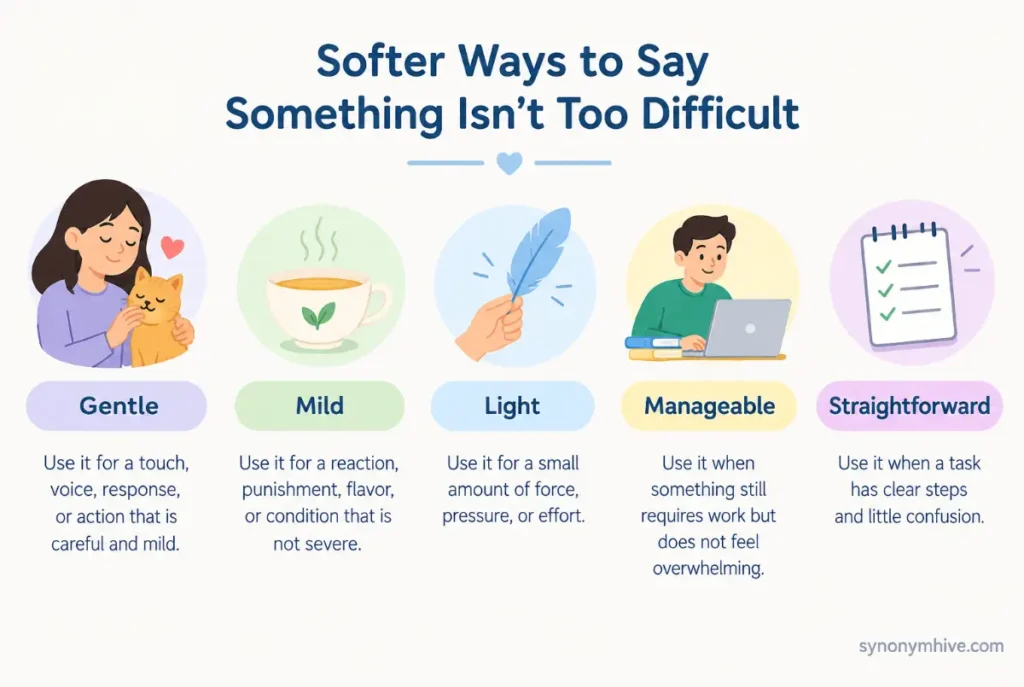
Sometimes you know the general meaning you need but want a word with the right level of intensity. A mild word may suit a friendly conversation, while a stronger word may be more accurate in a technical or formal setting.
Mild Opposites
These words describe a small difference in effort, force, or severity.
- Gentle. Use it for a touch, voice, response, or action that is careful and mild.
- Mild. Use it for a reaction, punishment, flavor, or condition that is not severe.
- Light. Use it for a small amount of force, pressure, or effort.
- Manageable. Use it when something still requires work but does not feel overwhelming.
- Straightforward. Use it when a task has clear steps and little confusion.
Example: The assignment was manageable once the teacher explained the instructions. The word does not claim that the assignment took no effort. It says the task could be handled.
Moderate Opposites
These choices suggest a clear difference without making the situation sound extreme.
- Soft. A direct choice for something firm or rough.
- Easy. A direct choice for something difficult.
- Simple. A good choice for a task or idea that is not complicated.
- Flexible. Useful for material, rules, or plans that can bend or change.
- Comfortable. Useful when hard describes something unpleasant to sit on, wear, or use.
Example: The company replaced its hard schedule with a flexible one. Flexible works because the sentence is about a schedule that can change, not a physical object.
Strong Opposites
These words can describe a clear lack of force, difficulty, or strictness. They need careful use because some have negative meanings.
- Effortless. Something seems to require almost no work.
- Painless. A process causes little discomfort or trouble.
- Lenient. A person or rule is not strict.
- Feeble. Something lacks strength or power.
- Flimsy. An object is weakly made and can break or bend easily.
Example: The software update was painless for most users. This means the change caused little trouble. It does not mean the update was physically soft.
A strong word is not always a better word. If a project takes some effort, calling it effortless may be inaccurate. The best choice describes the real situation rather than making the sentence sound more impressive.
Which Opposite Fits Each Part of Speech?
Hard can act as an adjective or an adverb, and it also appears in common phrases. The right alternative depends on how the word works in the sentence.
When Hard Is an Adjective
An adjective describes a person, place, thing, or idea. In The floor is hard, hard describes the floor. In The test is hard, it describes the test.
Common alternatives include soft, easy, simple, gentle, mild, and flexible. Pick the one that matches the intended meaning.
Examples:
- The hard cushion became a soft cushion.
- The hard question became an easy question after practice.
- The hard rule became a more flexible rule.
- The hard tone became a gentle tone.
When Hard Is an Adverb
In some sentences, hard describes how an action happens. For example, She hit the ball hard. Here, hard tells us how forcefully she hit the ball.
Possible alternatives include lightly, gently, softly, easily, or with little effort. The right option depends on the verb.
Examples:
- He pushed the box hard. He pushed the box gently.
- The rain fell hard. The rain fell lightly.
- She worked hard. She worked with little effort is grammatically possible, but it means she did not put in much effort. She took it easy may sound more natural in casual speech.
Be careful with the phrase worked hard. Its opposite is not soft, because the word describes effort rather than texture.
When Hard Appears in a Phrase
Some common phrases use hard in ways that need a full expression as the opposite.
| Phrase with hard | Possible opposite | Example |
|---|---|---|
| Hard work | Easy work or light work | The task turned out to be light work. |
| Hard surface | Soft surface | The hard surface was covered with a soft mat. |
| Hard choice | Easy choice | After comparing the options, it became an easy choice. |
| Hard deadline | Flexible deadline | The team received a flexible deadline. |
| Hard tone | Gentle tone | She answered in a gentle tone. |
| Hit hard | Hit lightly | He tapped the ball lightly. |
| Hard to understand | Easy to understand | The new guide is easy to understand. |
These examples show why word choice requires more than a dictionary lookup. Read the whole sentence and identify what hard describes before choosing an opposite.
Does American or British English Use Different Opposites?
American and British English generally use the same main opposites for hard. Soft is common for texture, and easy is common for difficulty. The spelling and basic meaning of these words do not change between the two varieties.
Some phrases and word choices can vary by region. In both the United States and the United Kingdom, people may use hard to describe a difficult task, a firm surface, or a strong hit. However, the surrounding words can differ depending on local habits.
For example, an American might commonly say, The test was hard. A British speaker can say the same thing. Both might also say, The test was difficult. These are ordinary choices in both varieties.
Regional slang can vary more than standard vocabulary. A casual word that sounds natural among one group of friends may sound unusual to another group. For formal writing, choose a clear standard word such as easy, soft, simple, or gentle rather than relying on local slang.
More Examples of Opposites in Real Sentences
Examples help show how the meaning changes with the context. The following sentences cover school, work, home, relationships, technology, and everyday decisions.
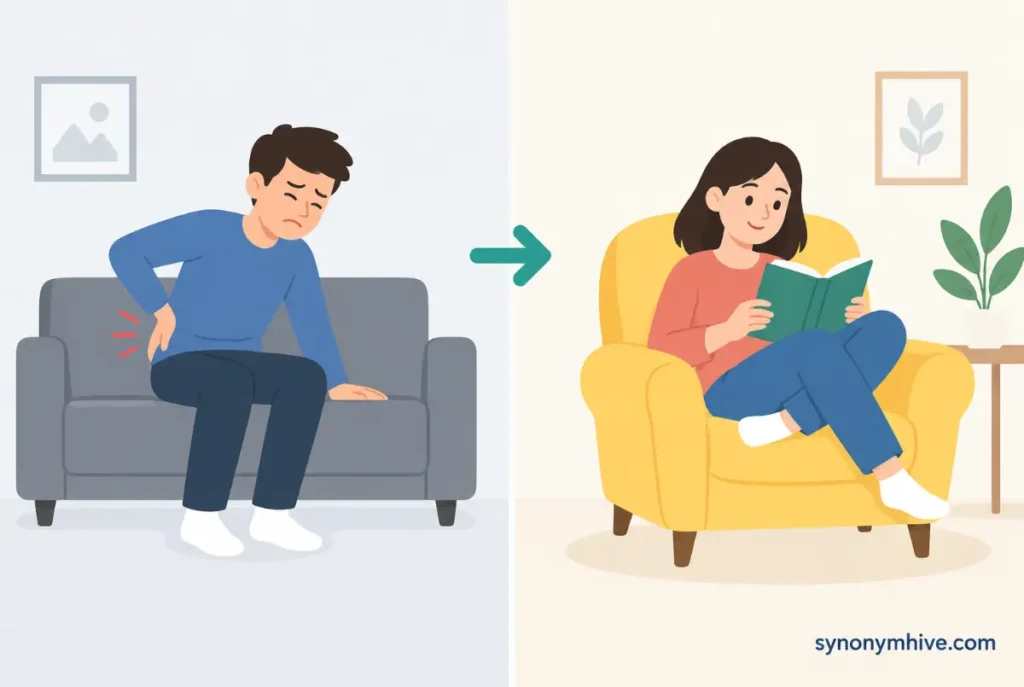
- The hard sofa made my back ache, so I bought a soft chair.
- The final exam seemed hard at first, but the practice questions made it easier.
- The instructions were hard to follow until the company published a simple guide.
- Her hard reply upset the customer, so she sent a gentler message.
- The mechanic replaced the hard rubber part with a more flexible material.
- The old door was hard to open, but the repaired door moved easily.
- My manager gave me a hard deadline, while the new project has a more flexible schedule.
- The coach spoke in a hard tone during the match, then gave the team a gentle reminder afterward.
- The hard mattress caused discomfort, while the softer mattress helped me rest.
- The software looked hard to use, but the updated menu made it straightforward.
- The company had a hard approval process, so it created a simpler form.
- The strong wind blew hard in the morning, then became light in the afternoon.
Notice that not every sentence uses a single word as the opposite. Sometimes a phrase such as took it easy or more flexible schedule communicates the contrast more naturally. Clear writing matters more than forcing one word into every example.
Quick Tips for Choosing the Right Word
Use these simple checks when you need an antonym in a sentence.
- Identify the meaning first. Ask what hard describes. Is it a surface, a task, a voice, a rule, or an action?
- Choose a matching contrast. Use soft for texture, easy for difficulty, gentle for behavior, and flexible for something that can change.
- Read the whole sentence. A word that looks correct in isolation may not fit the sentence’s meaning.
- Think about your audience. Easy and soft work well in everyday writing. Straightforward, manageable, and lenient may fit more specific professional contexts.
- Check the strength of the claim. Do not call a task effortless if it still takes a lot of work.
- Avoid repeating the same word. If you use easy several times, consider simple or straightforward when the meaning fits.
- Prefer clarity over fancy vocabulary. A familiar word often explains an idea faster than an obscure synonym.
- Use a phrase when needed. Hard work may contrast with light work, while worked hard may contrast with put in little effort. The sentence may need more than one word.
A final check is to replace the original word and read the sentence aloud. If the meaning changes in an unexpected way, try a different alternative.
Find similar expressions in Opposite of Kind Best Words for Every Situation.
Conclusion
The best opposite of hard depends on what you mean. Soft is the clearest choice for a firm surface or rough texture. Easy works for a difficult task, while simple describes something with few steps or little complexity. Gentle and mild suit situations involving tone, behavior, or severity.
For everyday writing, start with the meaning rather than a list of synonyms. Think about the object or action you are describing, then choose a word that creates the right contrast. A soft pillow, an easy test, a simple process, and a gentle reply each use a different word for a reason.
When you need the opposite of hard, remember the basic pairings first. Then consider words such as flexible, manageable, straightforward, or lenient if they express your idea more clearly. The right word is the one that makes your meaning easy to understand.
Frequently Asked Questions
What is the opposite of hard?
The most common opposites are soft and easy. Use soft for something firm or rough, and use easy for something difficult or demanding. The sentence tells you which word fits.
What is another way to say hard?
You can use difficult, firm, solid, harsh, or demanding, depending on the meaning. If you want the opposite, consider easy, soft, gentle, or simple. Always check the context before choosing a replacement.
Is soft the opposite of hard?
Yes, soft is the opposite of hard when you describe texture, firmness, or touch. For example, a hard pillow can be uncomfortable, while a soft pillow may feel pleasant. For a difficult exam, however, easy is the better opposite.
What is the opposite of hard in an essay?
Easy is usually the best opposite when hard means difficult. Simple works when you mean something is not complicated, while gentle works when you describe a person’s tone or manner. Choose the word that matches the point you want to make.
What is the opposite of hard work?
The best alternative depends on the meaning. Light work describes a task that requires little effort, while taking it easy means doing something in a relaxed way or reducing effort. If you mean a person did not try much, you can say that the person put in little effort.
What is the opposite of hard in a resume?
Words such as manageable, straightforward, and simple may work when describing a task or process. For example, you could say you made a complex process more straightforward. Choose a word that accurately describes your work rather than making a task sound easier than it was.
Can easy and simple mean the same thing?
Yes, the words can overlap, but they are not always interchangeable. Easy means something takes little effort or skill, while simple means it has few parts or is easy to understand. A simple task can still take a long time to complete.