

If you are writing an email, essay, story, text, or personal message, you may need the right words to describe silence. Saying something was simply “quiet” can work, but it does not always show what that quietness meant. Silence can be peaceful, awkward, tense, empty, comforting, frightening, or full of meaning.
The best word depends on the kind of silence you want to show. A quiet room after a long day is different from the silence after an argument. A silent forest has a different mood from a silent classroom after a difficult question.
Words to describe silence can show the sound level, emotional mood, social meaning, or atmosphere of a scene. The strongest choice depends on what the silence makes the reader understand or feel.
This guide covers more than a basic synonym list. You will find useful words grouped by tone, intensity, context, and part of speech. You will also see natural examples, close word comparisons, common mistakes, and practical tips for choosing a precise description.
Learn more useful word alternatives in words to describe light Best Guide in 2026.
What does silence mean in simple English
Silence means the absence of sound or speech. It can describe a place with very little noise, a person who is not speaking, or a moment when everyone stops talking.
The word can describe something physical or emotional. A silent room has little or no sound. A silent response can suggest anger, confusion, fear, sadness, or disagreement.
The meaning often comes from context. That is why simply replacing silence with quiet does not always give you the same effect.
Where does the word silence come from
The English word silence comes from the Latin word silentium, which means quietness or stillness. It entered English through Old French and Middle English forms connected with being quiet or not speaking.
The word has kept its basic meaning for centuries. It can refer to sound, speech, or communication.
Silence also has a wider meaning in modern English. Someone can remain silent during a conversation, stay silent about a secret, or respond with silence. In these cases, the word is about more than noise. It describes a lack of spoken communication.
That wider meaning gives writers many options. You can describe the physical sound in a scene, or you can describe the feeling created by the lack of speech.
What are the best words to describe silence
The right word depends on the kind of silence you want to show. Some choices are simple and neutral, while others create a strong emotional image.
| Word | Meaning | Tone | Example |
|---|---|---|---|
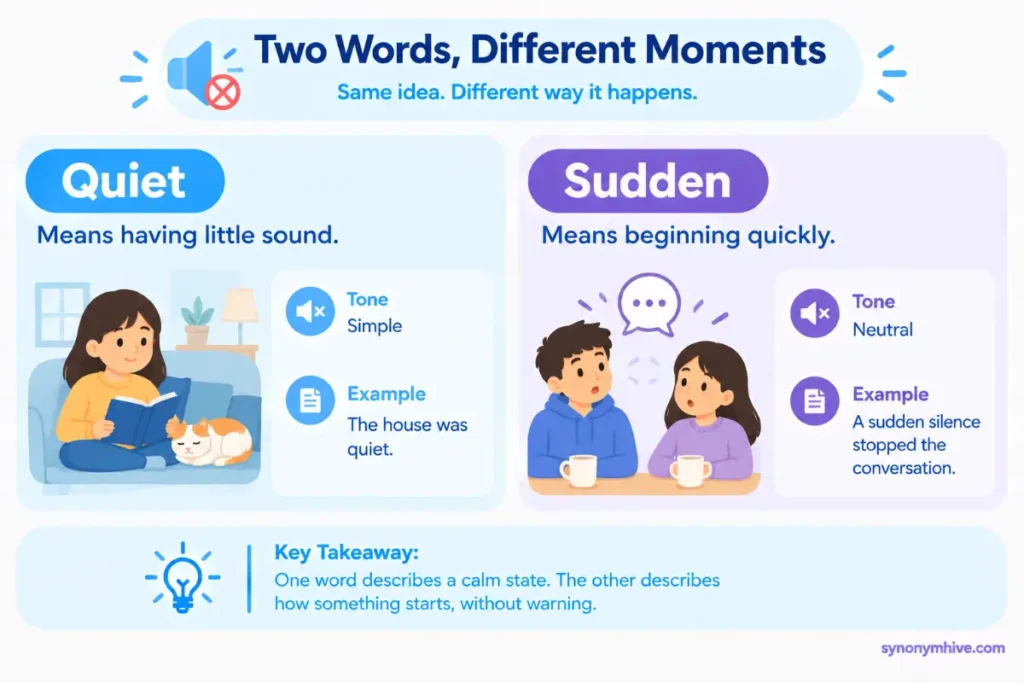
| Quiet | Having little sound | Simple | The house was quiet. |
| Sudden | Beginning quickly | Neutral | A sudden silence stopped the conversation. |
| Complete | Having no noticeable sound | Strong | Complete silence filled the room. |
| Absolute | Total and uninterrupted | Strong | Absolute silence surrounded the cabin. |
| Profound | Deep and meaningful | Formal | A profound silence followed the speech. |
| Solemn | Serious and respectful | Formal | A solemn silence marked the ceremony. |
| Meditative | Quiet in a thoughtful way | Formal | The room had a meditative silence. |
| Restful | Quiet in a way that helps you relax | Positive | The countryside offered a restful silence. |
| Serene | Very calm and peaceful | Formal | A serene silence settled over the valley. |
| Oppressive | So quiet that it becomes uncomfortable | Strong | An oppressive silence filled the hallway. |
| Suspenseful | Quiet because something uncertain may happen | Dramatic | A suspenseful silence came before the answer. |
| Uncomfortable | Quiet in a way that causes discomfort | Everyday | An uncomfortable silence followed the complaint. |
| Nervous | Quiet caused by worry or fear | Everyday | A nervous silence spread through the group. |
| Expectant | Quiet because people are waiting for something | Formal | An expectant silence filled the theater. |
| Dead | Completely quiet and inactive | Informal | The office was dead after six o’clock. |
| Pin drop quiet | Extremely quiet | Informal | The classroom was so quiet you could hear a pin drop. |
| Awkward | Quiet because nobody knows what to say | Everyday | There was an awkward silence after the question. |
| Calm | Quiet and relaxed | Everyday | We enjoyed a calm silence by the lake. |
This list gives you a wide range of choices. The simple words work well in everyday writing. The stronger choices help create a specific mood.
How can you describe silence by intensity
Not all silence has the same strength. A mild description can make a scene feel relaxed. A stronger word can make the same scene feel frightening or dramatic.
Mild silence
Use mild words when the quietness is ordinary or pleasant.
Good choices include:
- Quiet
- Calm
- Still
- Peaceful
- Restful
- Soft
- Gentle
- Hushed
For example, “The house was quiet” gives a simple picture. It does not suggest anything unusual.
“The house was peacefully quiet” adds a relaxed mood.
“The room was hushed” suggests that people may be present but are speaking very softly or not at all.
Moderate silence
Choose stronger words when the silence is noticeable or carries some meaning.
Good choices include:
- Muted
- Solemn
- Uncomfortable
- Nervous
- Tense
- Unspoken
- Expectant
- Heavy
A tense silence often follows conflict. An expectant silence often happens before an important event.
For example, “An expectant silence filled the room” tells the reader that people are waiting for something.
Strong silence
Use strong descriptions when the quietness dominates the scene.
Good choices include:
- Eerie
- Haunting
- Oppressive
- Deafening
- Absolute
- Profound
- Heavy
- Overwhelming
“The hallway was eerily silent” creates a very different picture from “The hallway was quiet.”
The first sentence suggests something strange or unsettling. The second simply describes low noise.
What words describe peaceful silence
Peaceful silence usually feels safe, calm, and comfortable. It can happen in nature, at home, during rest, or during private reflection.
Useful choices include:
- Peaceful
- Serene
- Calm
- Restful
- Gentle
- Still
- Quiet
- Tranquil
- Meditative
- Soothing
Consider these examples.
“The cabin was surrounded by peaceful silence.”
“Morning brought a serene silence to the garden.”
“She enjoyed the restful silence of the library.”
“The lake sat in still silence beneath the trees.”
These descriptions work well in travel writing, personal essays, reflective writing, and stories.
What words describe uncomfortable silence
Uncomfortable silence happens when people do not know what to say or are worried about what might happen next.
Useful choices include:
- Awkward
- Tense
- Uncomfortable
- Nervous
- Heavy
- Strained
- Uneasy
- Forced
- Stiff
- Expectant
For example, an awkward silence often follows a joke that nobody finds funny.
A tense silence may follow an argument.
A nervous silence can appear before someone receives important news.
A forced silence can happen when people avoid discussing an uncomfortable subject.
The exact word helps the reader understand the reason behind the quietness.
What words describe scary silence
Scary silence often appears in stories, movies, essays, and descriptions of unfamiliar places.
Strong choices include:
- Eerie
- Haunting
- Unsettling
- Ominous
- Oppressive
- Chilling
- Sinister
- Unnatural
- Frightening
- Deafening
“An eerie silence settled over the empty house” suggests that something feels wrong.
“The forest became unnaturally silent” suggests that the quietness itself is unusual.
“A deafening silence followed the explosion” creates a dramatic contrast. The word deafening normally describes a very loud sound, but it can also describe an overwhelming silence.
What words describe silence after an argument
Silence after conflict often carries emotional weight. It may show anger, hurt, regret, fear, or stubbornness.
Useful descriptions include:
- Tense
- Heavy
- Strained
- Awkward
- Bitter
- Cold
- Uncomfortable
- Hostile
- Painful
- Loaded
A loaded silence is especially useful when people understand that something important remains unsaid.
For example:
“After the accusation, a heavy silence filled the room.”
“They sat in cold silence for the rest of the evening.”
“A tense silence followed the argument.”
“Her question was met with an uncomfortable silence.”
These sentences do more than say nobody spoke. They show the emotional meaning behind the lack of speech.
What words describe silence in nature
Nature can create many types of quietness. A forest at night may feel eerie, while a lake at sunrise may feel peaceful.
Useful words include:
- Still
- Serene
- Peaceful
- Tranquil
- Hushed
- Restful
- Soundless
- Gentle
- Quiet
- Undisturbed
For example:
“The valley was still before sunrise.”
“The snowy field was almost soundless.”
“A serene silence covered the lake.”
“The woods were hushed after the rain.”
“The beach was peaceful before the crowds arrived.”
The surrounding details help decide the best word. Snow, dawn, rain, and empty fields often suggest calm. Darkness, isolation, and abandoned places can suggest something more unsettling.
What words describe silence in a room
The room itself does not always determine the mood. The people inside it matter too.
A library may have peaceful silence. A courtroom may have solemn silence. A meeting may have tense silence. An empty office may have eerie silence.
Try these examples:
“The classroom fell silent when the teacher entered.”
“The meeting room became tense after the announcement.”
“The library was peaceful and quiet.”
“The courtroom held a solemn silence.”
“The empty office had an eerie stillness.”
The noun you choose can also change the sentence. Silence, stillness, quiet, hush, and calm are related, but they are not exact matches.
What are the parts of speech related to silence
The word silence can work as a noun and a verb. Related words also appear as adjectives and adverbs.
Silence as a noun
As a noun, silence names the absence of sound or speech.
Examples:
“The silence was difficult to ignore.”
“An uneasy silence followed.”
“The silence of the forest was beautiful.”
Silent as an adjective
Silent describes someone or something that makes no sound or does not speak.
Examples:
“The audience remained silent.”
“The machine was silent.”
“She gave him a silent look.”
Silently as an adverb
Silently tells how an action happens.
Examples:
“She walked silently into the room.”
“He listened silently.”
“They left the house silently.”
Silence as a verb
Silence can also mean to stop someone or something from making sound.
Examples:
“The teacher raised a hand to silence the class.”
“The alarm was finally silenced.”
“He tried to silence his doubts.”
Knowing these forms helps you build smoother sentences instead of repeating the same word.
Which word works best in an essay
For an essay, choose a word that clearly shows the type of silence. Simple words are often better than dramatic ones.
Good choices include quiet, still, peaceful, tense, solemn, and unspoken.
Example:
“After the announcement, the classroom fell into a tense silence.”
This sentence works well because it gives the reader a clear reason for the quietness.
In a personal essay, you might write:
“I sat beside the window and enjoyed the peaceful silence of the early morning.”
For academic writing, avoid dramatic words unless the subject calls for them. A word such as eerie may work in a literary analysis, but it may sound out of place in a formal report.
Which word works best on a resume
A resume rarely needs a description of silence. Still, you may need related words when describing communication, meetings, leadership, or conflict.
Words such as reserved, attentive, thoughtful, composed, and discreet can be more useful than silent.
Example:
“Maintained a calm and composed presence during difficult client meetings.”
This describes a useful professional quality instead of simply saying the person did not speak.
Avoid describing yourself as silent on a resume. It may suggest that you do not communicate well.

Which word works best in an email
In an email, clarity matters more than dramatic language.
Use phrases such as no response, no reply, quiet, or no communication when you need to describe a lack of communication.
Examples:
“We have not received a response yet.”
“The discussion ended without further comment.”
“The team remained quiet after the announcement.”
Avoid phrases such as deafening silence in a professional email unless the situation is informal and the phrase fits your relationship with the reader.
Which word works best in a text message
Text messages allow more casual language.
You might say:
“Why the silence?”
“That was awkward.”
“Total silence after that.”
“Crickets.”
“Everyone went quiet.”
“Dead silent in here.”
These choices sound natural in casual conversation. The best option depends on your relationship with the person and the mood of the message.
Which word works best in creative writing
Creative writing gives you more freedom. The strongest description is usually the one that creates a clear image instead of simply using a dramatic synonym.
Compare these sentences:
“The room was silent.”
“The room was so silent that every small movement seemed loud.”
The third example gives the reader a stronger experience. It uses contrast and detail instead of relying only on an adjective.
You can also describe what the silence does.
“The silence pressed against her.”
“The silence seemed to wait for an answer.”
These are figurative descriptions. They can make a scene more vivid.
What is the difference between quiet and silent
Quiet and silent are close, but they are not always interchangeable.
| Quiet | Silent |
|---|---|
| Means there is little sound | Means there is no sound or speech |
| Allows some noise | Suggests complete or near complete absence of sound |
| Often sounds softer | Often sounds stronger |
| Common in daily speech | Can sound more deliberate or dramatic |
“The library was quiet” means people were keeping noise low.
“The library was silent” creates a stronger image of no talking or noticeable sound.
Quiet can also describe people.
“She is quiet” may mean she does not talk much.
“She is silent” usually means she is not speaking at that moment.
Explore another synonym guide: Words to Describe a Voice: Words for Every Voice 2026.
What is the difference between silence and stillness
Silence relates mainly to sound. Stillness relates mainly to movement.
A place can be still without being silent. For example, a lake may be completely still while birds are singing nearby.
A room can also be silent while people are moving around.
Compare these examples:
“The forest was silent.”
“The forest was still.”
The first focuses on sound. The second focuses on movement.
You can combine them when both ideas matter.
“The forest was silent and still.”
That sentence creates a stronger sense of complete calm.
What is the difference between silence and hush
Silence is a broad term. A hush often describes a sudden or deliberate reduction in sound.
For example:
“The room fell silent.”
“A hush fell over the room.”
Both sentences work, but the second often suggests that people suddenly became quiet because something happened.
You might use hush when an audience stops talking before a performance begins.
“A hush fell over the crowd as the speaker walked onto the stage.”
The word hush can also be a verb.
“She hushed the children.”
That means she told them to become quiet.
What is the difference between eerie and unsettling silence
Eerie describes something strange, unnatural, or frightening in a quiet way. Unsettling is broader. It means something causes discomfort or worry.
An eerie silence often feels like something is wrong.
An unsettling silence may simply make you uncomfortable.
For example:
“The abandoned house was eerily silent.”
“The silence during the meeting was unsettling.”
The first sentence creates a spooky image. The second describes social discomfort.
What is the difference between awkward and tense silence
Awkward silence usually comes from a social problem. People do not know what to say.
Tense silence usually comes from conflict, pressure, fear, or serious expectations.
For example:
“An awkward silence followed his joke.”
“A tense silence followed the accusation.”
The first situation is uncomfortable because the social moment failed. The second carries more emotional pressure.
How does silence change meaning in different situations
The same quiet moment can communicate different things.
Imagine two people sitting without speaking.
If they are watching a sunset, the silence may be peaceful.
If they have just argued, it may be tense.
The surrounding situation gives the silence its meaning. Good writing makes that connection clear.
What are common mistakes when describing silence
One common mistake is using a dramatic word when a simple word would be more accurate.
For example, “The classroom was deafeningly silent” can work in creative writing, but it may sound exaggerated in a normal school report.
Another mistake is treating all quiet moments as peaceful. Silence can be pleasant, but it can also signal conflict, fear, sadness, confusion, or respect.
A third mistake is repeating the same word too often.
Instead of writing:
“The room was silent. The students were silent. The hallway was silent.”
You can vary the wording.
“The room was quiet. The students said nothing. A hush filled the hallway.”
Another mistake is choosing a word without considering its emotional tone. Eerie, peaceful, awkward, solemn, and tense are not interchangeable.
When should you not use dramatic words for silence
Avoid strong descriptions when the context does not support them.
Do not call a quiet office “haunting” simply because nobody is there. Do not describe a normal pause in conversation as “deafening” unless you want a dramatic or figurative effect.
Formal writing usually benefits from precise language.
Instead of:
“The meeting ended in a terrifying silence.”
Try:
“The meeting ended without further discussion.”
The second sentence gives a clear fact. It does not add emotion that the situation may not support.
Creative writing has more room for strong language, but even there, the word should match the scene.
What are the antonyms of silence
Common opposites of silence include:
- Noise
- Sound
- Speech
- Conversation
- Talking
- Chatter
- Commotion
- Clamor
- Laughter
- Music
- Shouting
- Conversation
The best antonym depends on the meaning.
If silence means no speech, conversation may be the opposite.
If silence means calm, commotion may be the better contrast.
For example:
“The peaceful silence was replaced by loud chatter.”
“The quiet street suddenly filled with noise.”
How can you choose the right word for silence
Start by asking what the silence means.
Is it peaceful? Try peaceful, serene, calm, or restful.
Is it uncomfortable? Try awkward, uneasy, or uncomfortable.
Is it caused by conflict? Try tense, strained, heavy, or cold.
Is it frightening? Try eerie, haunting, ominous, or unsettling.
Is it respectful? Try solemn, respectful, or reverent.
Is it very strong? Try absolute, complete, profound, or deafening.
Is it simply low in sound? Try quiet, still, hushed, or muted.
Think about the reader’s reaction. A good word should help the reader understand the scene without needing a long explanation.
What are some original examples of silence in real situations
Here are practical examples you can adapt for essays, stories, messages, and everyday writing.
- “The classroom became completely quiet when the principal entered.”
- “A peaceful silence settled over the garden before sunrise.”
- “An awkward silence followed the question.”
- “The two friends sat in tense silence after their argument.”
- “The empty hallway had an eerie silence.”
- “A solemn silence filled the church during the memorial.”
- “The cabin offered a restful silence far from the city.”
- “An expectant silence filled the theater before the curtain rose.”
- “The announcement was followed by several seconds of stunned silence.”
- “She answered his question with a long silence.”
- “The forest grew strangely quiet as the storm approached.”
- “A heavy silence settled over the family after the news.”
- “The library was so quiet that she could hear the clock ticking.”
- “The crowd fell silent as the final player walked onto the field.”
- “He left the room without a word, leaving an uncomfortable silence behind.”
- “The snow covered the street and gave the neighborhood a soft, peaceful quiet.”
- “Nobody spoke during the tense drive home.”
- “The old house seemed to hold an unnatural silence.”
- “She welcomed the calm silence after a busy week.”
- “A sudden hush spread through the audience.”
These examples show why context matters. Each sentence uses quietness to communicate something different.
What words describe silence in emotional writing
Emotional writing often needs words that show what silence represents.
If silence shows sadness, try painful, heavy, empty, lonely, or mournful.
If it shows anger, try cold, bitter, hostile, strained, or tense.
The goal is not to choose the strongest word. The goal is to choose the most accurate word.
What words describe silence in poetry
Poetry often uses silence as an image rather than a simple lack of sound.
Words such as still, hollow, empty, endless, deep, soft, gentle, haunting, and heavy can work well.
For example:
“Deep silence rested over the field.”
“The hollow silence of the empty house remained.”
“Soft silence followed the falling snow.”
These descriptions can create rhythm and mood. Still, the best choice depends on the rest of the poem.
What words describe silence in a story
Stories often use silence to build tension or reveal character.
A character who remains silent may be afraid, angry, thoughtful, embarrassed, or unwilling to answer.
For example:
“Maria stared at the floor. Her silence told him everything.”
Here, silence is not just the absence of sound. It becomes part of the character’s response.
Another example is:
“The hallway was silent, but the silence did not feel peaceful.”
This creates suspense because the reader expects something to happen.
You can make silence more vivid by describing what happens around it.
“The clock ticked loudly in the silent room.”
“The rain stopped, leaving the house strangely quiet.”
“Not a single voice came from the empty hallway.”
These details help readers experience the silence instead of simply being told about it.
How do US and UK English differ when describing silence
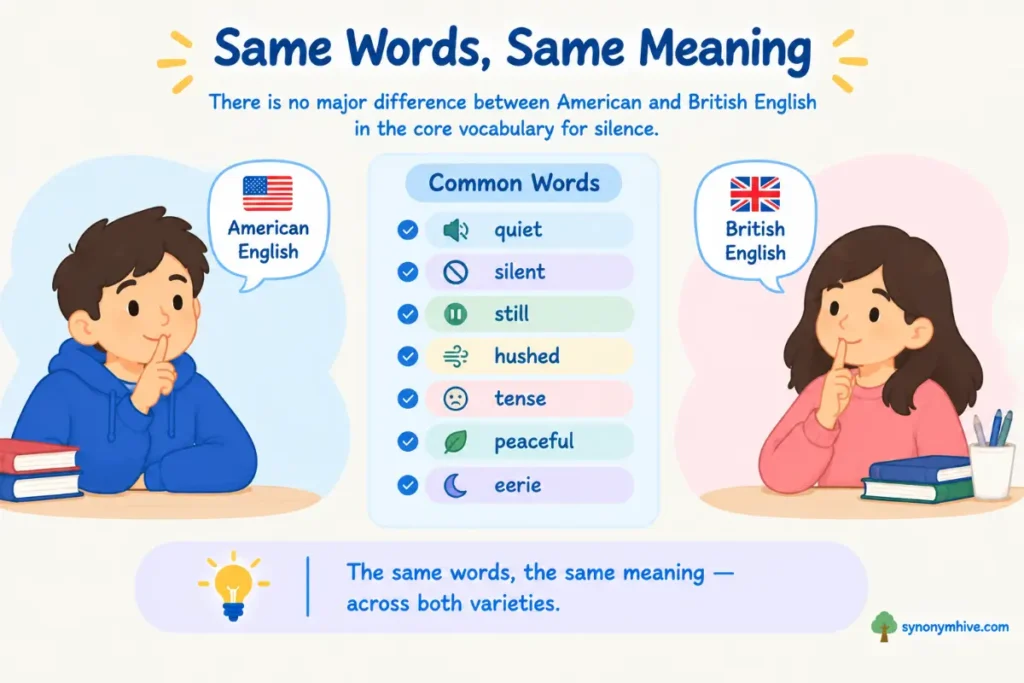
There is no major difference between American and British English in the core vocabulary for silence. Words such as quiet, silent, still, hushed, tense, peaceful, and eerie are used in both varieties.
Some related expressions can vary by region or style. British English may use certain informal phrases more often in particular settings, but the standard vocabulary remains widely understood in the United States and the United Kingdom.
For US English writing, simple choices such as quiet, silent, tense, peaceful, awkward, and eerie are safe and natural.
How can you avoid repeating the word silence
You do not always need a direct synonym. Sometimes you can describe the effect of the quietness.
Instead of:
“The silence was uncomfortable.”
Try:
“No one knew what to say.”
Instead of:
“The silence was peaceful.”
Try:
“She finally had a moment to think.”
Instead of:
“The silence was tense.”
Try:
“Everyone waited for his answer.”
Instead of:
“The silence was eerie.”
Try:
“Not even the usual night sounds came from the woods.”
This approach can make your writing more natural because you show the meaning instead of naming it every time.
Quick tips for choosing the best description
- Decide if the silence is positive, negative, neutral, or uncertain.
- Think about the reason nobody is speaking.
- Use quiet for a simple low sound level.
- Use silent when you want to stress the lack of sound or speech.
- Use hushed for very soft or controlled sound.
- Use awkward for social discomfort.
- Use tense for conflict or pressure.
- Use solemn for serious or respectful moments.
- Use eerie for strange or frightening quietness.
- Use peaceful or serene for calm surroundings.
- Use heavy when silence carries strong emotion.
- Use deafening as a dramatic or figurative description of extreme silence.
- Avoid dramatic words in formal writing when a plain word gives the same meaning.
- Read the sentence aloud and ask what mood it creates.
- Pick the word that gives the reader the clearest picture.
Explore more word choices in Words to Describe Pain Best Guide In 2026.
Conclusion
Choosing the right words to describe silence starts with understanding what the quiet moment means. Quiet and still are useful for simple descriptions. Peaceful, serene, and restful suggest comfort. Awkward, tense, and strained show social or emotional pressure. Eerie, haunting, and oppressive create a darker mood.
You do not need the most dramatic word to make your writing strong. A precise word often works better than an exaggerated one. Think about the setting, the people involved, and the emotion behind the silence.
When you are unsure, start with a simple word such as quiet or silent. Then ask what the reader should understand from that moment. If the answer is peace, conflict, fear, respect, or uncertainty, choose a word that shows that meaning clearly.
Good descriptions make silence more than an absence of sound. They turn it into part of the scene.
Frequently Asked Questions
What are the best words to describe silence?
The best choices include quiet, still, hushed, peaceful, tense, awkward, eerie, solemn, heavy, and deafening. The right word depends on the mood and reason behind the silence.
What’s another way to say silence?
You can say quiet, stillness, hush, lack of sound, muteness, or no response. The best replacement depends on what kind of silence you mean.
What is a strong word for silence?
Deafening, absolute, profound, oppressive, and haunting can describe very strong silence. These words create a stronger emotional effect than simple words such as quiet.
What word describes an uncomfortable silence?
Awkward, tense, strained, uneasy, and uncomfortable are useful choices. Awkward usually points to a social situation, while tense often suggests conflict or pressure.
What word describes peaceful silence?
Peaceful, serene, tranquil, restful, calm, and still can describe quietness that feels safe and relaxing. These words work well for nature, meditation, rest, and quiet mornings.
What words to describe silence work best in creative writing?
Eerie, haunting, heavy, oppressive, hushed, hollow, and unnatural can work well in creative writing. Choose the word based on the mood you want the reader to experience.
Can silence be described as deafening?
Yes. Deafening silence is a common figurative expression. It describes silence that feels extremely intense or overwhelming, often after a shocking event or during a tense moment.