

Have you ever tried to describe someone’s voice in an essay, email, resume, or text message, only to find that the word you want is just out of reach? You might know that a person sounds pleasant, confident, or nervous, but those simple words don’t always capture the full picture. The right description can help readers hear a voice in their minds and understand the feeling behind it.
Finding the best terms to describe a voice means looking beyond basic terms like loud, soft, and deep. A voice can sound warm and comforting, sharp and commanding, light and playful, or rough and tired. Each word creates a different impression, so your choice should match the speaker, setting, and message.
The best words to describe a voice explain how it sounds and how it makes people feel. Words like soothing, raspy, melodic, breathy, confident, and authoritative can describe a voice’s tone, texture, pitch, or emotional effect.
This guide covers the meanings and origins of useful voice descriptions, more than 30 options grouped by tone, and examples for everyday conversations and professional writing. You’ll also learn how to compare similar words, avoid common mistakes, and choose a description that feels natural instead of forced.
Learn more useful word alternatives in words to describe chaos: Best Guide.
What Does It Mean to Describe a Voice?
Describing a voice means explaining its sound, quality, delivery, or emotional effect. Instead of simply saying that someone spoke, you give the reader a clearer idea of what the person sounded like.
For example, consider these two sentences.
- She spoke during the meeting.
- She spoke in a calm, steady voice that put the team at ease.
The second sentence gives readers more information. They can imagine the speaker’s delivery and understand how it affected the people listening.
Voice descriptions can focus on several different qualities. Understanding these categories makes it easier to choose an accurate word.
What Are the Main Qualities of a Voice?
Pitch describes how high or low a voice sounds. A high pitched voice may sound light or bright, while a low pitched voice may sound deep or resonant.
Texture describes the physical quality of a voice. A voice can be raspy, smooth, breathy, gravelly, or husky.
Volume describes how loud or quiet someone sounds. Words such as soft, booming, faint, and thunderous belong in this category.
Tone describes the attitude or feeling carried by the voice. A speaker might sound cheerful, irritated, gentle, sarcastic, or serious.
Rhythm and pace describe how quickly and smoothly someone speaks. A person may speak slowly, rapidly, rhythmically, or hesitantly.
Clarity describes how easily listeners understand the words. A voice may sound clear, crisp, muffled, slurred, or indistinct.
Emotional effect describes how a voice makes listeners feel. A voice may be soothing, reassuring, captivating, intimidating, or comforting.
These categories often overlap. A singer might have a smooth, melodic voice, while a teacher might use a calm, clear, reassuring tone. You don’t need to identify every quality. Pick the one that best supports your message.
Where Does the Word Voice Come From?
The word voice has a long history connected to speech, sound, and expression. It comes from Old French voiz or voix, which developed from Latin vox, meaning voice or sound. The Latin term also gave English related words such as vocal and vocalize.
Over time, voice came to mean more than the sound that comes from a person’s mouth. It can also describe a person’s way of expressing ideas, feelings, and identity.
For example, a writer may have a distinctive voice because of their word choices and style. A public speaker may have a powerful voice because they communicate with confidence. In grammar, voice also describes how a sentence presents an action, as in active voice and passive voice.
When you describe a person’s speaking voice, you’re usually talking about the sound they produce and the impression that sound creates.
What Is the Difference Between Voice and Tone?
Voice usually refers to the sound of a person speaking or to their broader style of expression. Tone refers more specifically to the attitude or emotion conveyed in a particular moment.
Imagine that your friend usually has a low, smooth voice. During a stressful conversation, that same voice may sound tense, cold, or impatient. The basic sound of the voice stays similar, but the tone changes.
Here’s another example.
- Voice description: He has a deep, resonant voice.
- Tone description: He answered in an irritated tone.
The distinction matters in writing. Use words such as deep, raspy, and breathy to describe sound quality. Use words such as angry, cheerful, and sarcastic to describe attitude. Some terms, including gentle and warm, can describe both the sound and its emotional effect.

What Are the Best Words to Describe a Voice?
The most useful descriptions depend on the quality you want to highlight. Some words focus on sound, while others reveal emotion, personality, or speaking style.
The following table groups common and useful voice descriptions into simple, everyday, formal, and slang categories. The tone labels explain how each word generally feels in context. They aren’t strict rules, since the same word can work differently depending on the sentence.
Simple Phrases to Describe a Voice
These familiar words work well in school assignments, everyday conversations, and basic descriptions. They’re easy to understand and don’t draw too much attention to themselves.
| Word | Meaning | Tone | Example |
|---|---|---|---|
| Soft | Quiet and gentle | Calm | She spoke in a soft voice. |
| Loud | Easy to hear because of strong volume | Direct | His loud voice carried across the room. |
| Deep | Low in pitch | Neutral | He has a deep voice. |
| High pitched | High in sound | Descriptive | The child spoke in a high pitched voice. |
| Clear | Easy to understand | Positive | Her clear voice made the instructions simple to follow. |
| Sweet | Pleasant and gentle | Warm | She greeted us with a sweet voice. |
| Strong | Powerful and firm | Confident | His strong voice filled the hall. |
| Quiet | Low in volume | Neutral | He gave a quiet reply. |
These words are useful when you want a straightforward description. However, they may not provide enough detail for a vivid story or character profile. You can make them more specific by combining a sound quality with an emotional effect.
For example, soft and reassuring tells readers more than soft alone. Likewise, deep and confident gives a clearer impression than deep by itself.
Everyday Expressions to Describe a Voice
Everyday descriptions add personality and detail without sounding overly formal. They work well in conversations, personal essays, reviews, and creative writing.
| Word | Meaning | Tone | Example |
|---|---|---|---|
| Warm | Friendly and welcoming | Positive | Her warm voice made everyone feel comfortable. |
| Raspy | Slightly rough or scratchy | Descriptive | He spoke in a raspy voice after the long game. |
| Husky | Deep, rough, or slightly breathy | Rich | She had a husky voice that stood out in the crowd. |
| Breathy | Airy, with noticeable breath | Soft | His breathy voice made the secret sound even quieter. |
| Smooth | Even and free from roughness | Pleasant | The host had a smooth voice on the radio. |
| Gentle | Mild and kind in delivery | Reassuring | The nurse used a gentle voice with the child. |
| Bright | Lively and clear | Cheerful | Her bright voice lifted the mood. |
| Gravelly | Rough and coarse | Strong | The older actor spoke in a gravelly voice. |
| Melodic | Musical and pleasing in its rise and fall | Expressive | His melodic voice made the story enjoyable. |
| Mellow | Soft, relaxed, and rich | Relaxed | She had a mellow voice that suited the late night show. |
Everyday words are often the best choice because readers understand them without stopping to interpret the description. They also give you room to show the speaker’s personality through context.
A warm voice may make a stranger seem approachable. A gravelly voice may help readers picture a weathered character. A melodic voice can suggest natural rhythm, but it doesn’t automatically mean the speaker sings well.
Formal Synonyms to Describe a Voice
Formal descriptions are useful for literary analysis, professional profiles, speeches, interviews, performance reviews, and detailed character studies. They can be precise, but you should use them only when they fit the situation.
| Word | Meaning | Tone | Example |
|---|---|---|---|
| Resonant | Full, deep, and rich in sound | Powerful | The presenter had a resonant voice that reached the back row. |
| Articulate | Clear and effective in expressing words | Professional | She was articulate and easy to understand. |
| Authoritative | Conveying confidence and command | Firm | His authoritative voice kept the discussion focused. |
| Measured | Controlled and carefully paced | Composed | She answered in a measured voice. |
| Sonorous | Deep, full, and impressive in sound | Formal | The narrator had a sonorous voice. |
| Monotone | Showing little change in pitch | Flat | The recording featured a monotone voice. |
| Persuasive | Able to influence listeners | Convincing | His persuasive voice helped explain the proposal. |
| Eloquent | Expressive and effective in communication | Refined | Her eloquent voice gave the speech emotional weight. |
| Commanding | Strong enough to attract attention or obedience | Forceful | The coach used a commanding voice during practice. |
| Articulate | Expressing words and ideas clearly | Positive | His articulate delivery made a complex topic easier to follow. |
Some of these terms describe more than sound. Articulate, eloquent, and persuasive focus mainly on how someone communicates. They may reflect word choice, structure, clarity, and delivery rather than the natural quality of the speaker’s voice.
Use authoritative when a person sounds knowledgeable and in control, not simply loud. Use commanding when the voice naturally demands attention. A measured voice can still be emotional, but the speaker controls the pace and delivery.
Slang and Casual Expressions to Describe a Voice
Casual descriptions can make dialogue and informal writing sound natural. They’re common in texts, social media posts, reviews, and conversations among friends. Their meaning can vary by region and context, so choose them with your audience in mind.
| Word or Phrase | Meaning | Tone | Example |
|---|---|---|---|
| Gravelly | Rough and coarse sounding | Casual | That singer has a gravelly voice. |
| Croaky | Rough, weak, or hoarse | Informal | I sounded croaky after cheering all night. |
| Husky | Deep or slightly rough | Casual | She has a husky voice that’s easy to recognize. |
| Silky | Exceptionally smooth and pleasant | Complimentary | His silky voice sounds great on the podcast. |
| Velvety | Soft, rich, and smooth | Expressive | She has a velvety voice that suits jazz. |
| Tinny | Thin and slightly metallic | Critical | His voice sounded tinny through the cheap speaker. |
| Whiny | Complaining in a high or drawn out way | Negative | He used a whiny voice to ask for another turn. |
| Booming | Very loud and full | Informal | Her booming voice could be heard outside. |
| Raspy | Rough or scratchy | Casual | My voice gets raspy when I have a cold. |
| Mumbly | Difficult to understand because words aren’t clear | Informal | His mumbly voice made the announcement hard to follow. |
Words such as silky and velvety are figurative. They compare the sound of a voice to a smooth texture. This kind of comparison can be effective in creative writing, but it may feel too decorative in a short professional email.
Likewise, whiny is a judgment rather than a neutral description. It can make a speaker sound annoying or immature. If you need a fairer description, consider complaining, strained, or irritated, depending on what you observed.
Which Words Describe a Voice From Mild to Strong?
The strength of a description should match the sound you want readers to imagine. A quiet voice isn’t always weak, and a loud voice isn’t always powerful. The best choice depends on volume, texture, emotion, and the situation.
Use this scale to find the right level of intensity.
| Intensity | Useful Words | What They Suggest | Example |
|---|---|---|---|
| Mild | Soft, gentle, quiet | Low volume or a calm manner | She spoke in a gentle voice. |
| Noticeable | Clear, warm, bright | A recognizable quality | His warm voice welcomed the guests. |
| Distinctive | Husky, raspy, melodic | A sound people may remember | The singer had a husky voice. |
| Strong | Firm, resonant, commanding | Confidence and presence | The manager used a firm voice. |
| Very strong | Booming, thunderous, powerful | Great volume or force | His thunderous voice echoed through the stadium. |
You can also describe the strength of an emotional quality. A pleasant voice sounds nice, while a captivating voice holds attention. A reassuring voice helps someone feel safe, while a deeply soothing voice may help them relax.
Avoid treating every strong word as an improvement. If a character whispers a secret, thunderous won’t fit. If a speaker gives a quiet, thoughtful answer, commanding might misrepresent the moment. Good descriptions are accurate first and vivid second.
How Can You Describe a Voice That Gets Louder?
Choose a word that explains the amount of volume and the reason behind it.
| Word | What It Communicates | Example |
|---|---|---|
| Raised | Louder than the usual speaking level | She raised her voice to reach the group. |
| Forceful | Strong and intense delivery | He gave a forceful reply. |
| Booming | Loud, full sound | The announcer had a booming voice. |
| Thunderous | Extremely loud and powerful | A thunderous voice rang through the hall. |
| Shouted | Speaking with a very high level of volume | He shouted across the playground. |
| Piercing | Sharp and intense enough to cut through other sounds | A piercing voice broke through the noise. |
A loud voice can show excitement, urgency, anger, or a need to be heard. The surrounding sentence should help readers understand the reason.
For example, she shouted with excitement communicates a different feeling from she shouted in anger. The verb may be the same, but the emotional context changes the scene.
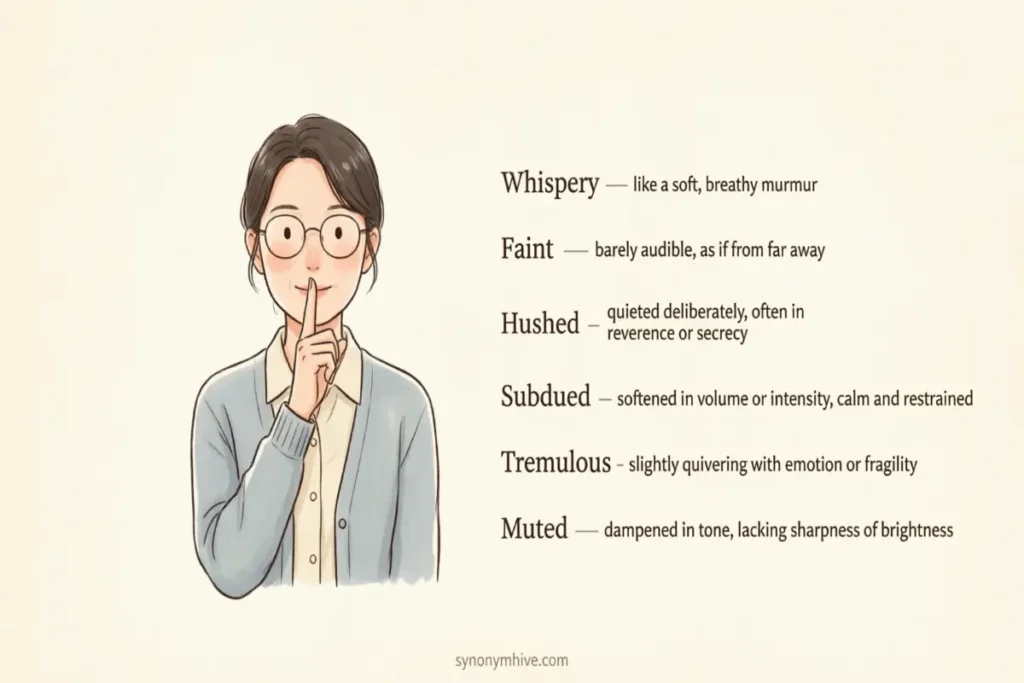
How Can You Describe a Very Quiet Voice?
Quiet voices can suggest kindness, fear, privacy, sadness, or a lack of confidence. Pick a word that reflects the reason for the low volume.
| Word | Meaning | Example |
|---|---|---|
| Whispery | Very soft, almost like a whisper | He had a whispery voice during the call. |
| Faint | Barely audible | A faint voice came from the next room. |
| Hushed | Deliberately quiet | She spoke in a hushed voice near the sleeping baby. |
| Subdued | Quiet because of a low emotional state or controlled manner | His subdued voice reflected his disappointment. |
| Tremulous | Shaking slightly with emotion or nervousness | She answered in a tremulous voice. |
| Muted | Soft or restrained in sound | His muted voice showed little excitement. |
Notice the difference between hushed and faint. A hushed voice is often intentionally quiet, while a faint voice may simply be difficult to hear. A tremulous voice reveals a shaky delivery, often because of nerves, fear, or strong feelings.
Which Voice Descriptions Match Different Parts of Speech?
You can describe voices with adjectives, explain the sound with nouns, or show delivery through verbs and adverbs. Using different parts of speech helps your writing sound natural instead of relying on the same adjective in every sentence.
What Adjectives Describe a Voice?
Adjectives are the most direct option when you want to explain a voice’s qualities.
| Category | Useful Adjectives | Example |
|---|---|---|
| Pitch | Deep, low, high, shrill | His deep voice sounded calm. |
| Texture | Smooth, raspy, breathy, gravelly | Her raspy voice was easy to recognize. |
| Emotion | Cheerful, anxious, angry, soothing | His anxious voice revealed his concern. |
| Delivery | Steady, hesitant, measured, hurried | She gave a measured response. |
| Impact | Captivating, commanding, reassuring, striking | The speaker had a captivating voice. |
| Clarity | Clear, crisp, muffled, indistinct | A crisp voice delivered the announcement. |
Adjectives work best when they add information. You can say a low, warm voice if both qualities matter. However, a long chain such as a deep, warm, rich, smooth, soft, gentle voice may overwhelm the sentence. Choose two or three details that work together.
What Nouns Describe Voice Qualities?
Nouns name the quality itself. They’re helpful when you want to explain how someone speaks rather than simply label their voice.
| Noun | Meaning | Example |
|---|---|---|
| Resonance | Fullness and richness of sound | The resonance of his voice filled the room. |
| Clarity | How easily speech can be understood | Her clarity made the instructions easy to follow. |
| Warmth | A friendly and welcoming quality | The warmth in his voice comforted the child. |
| Hesitation | A pause or delay caused by uncertainty | A brief hesitation entered her voice. |
| Cadence | The rhythm and pattern of speech | His steady cadence made the speech easy to follow. |
| Inflection | A change in pitch during speech | Her rising inflection made the statement sound like a question. |
| Timbre | The distinctive quality of a sound | The singer had a rich timbre. |
Timbre is especially useful in music, audio production, and detailed sound analysis. It describes the quality that helps distinguish one voice from another, even when the voices have similar pitch and volume.
Cadence refers to speech rhythm, including the rise and fall of phrases. It can help describe a speaker who sounds rhythmic, deliberate, or naturally expressive.
Which Verbs Describe the Way Someone Speaks?
Sometimes the strongest description comes from a verb rather than an adjective. Instead of writing that a person has a loud voice, you can show how they use it.
| Verb | Meaning | Example |
|---|---|---|
| Whisper | Speak very quietly | She whispered the answer. |
| Murmur | Speak in a low, soft voice | He murmured a few words of thanks. |
| Mutter | Speak quietly and often unclearly | She muttered a complaint under her breath. |
| Exclaim | Speak suddenly with strong feeling | He exclaimed with delight. |
| Declare | State something firmly | She declared her decision. |
| Croak | Speak in a rough, hoarse voice | He croaked a greeting after waking up. |
| Squeak | Make a high, thin sound while speaking | The nervous child squeaked out a reply. |
| Bellow | Speak or shout in an extremely loud voice | The coach bellowed instructions from the sideline. |
| Drawl | Speak slowly, often stretching sounds | He drawled his answer. |
| Stammer | Speak with repeated sounds or broken words | She stammered through the introduction. |
Verbs can create movement in a scene. Murmured gives a different impression from declared, even without an extra adjective. Choose the verb that matches the action, then add a short description only if the reader needs more detail.
How Do Adverbs Help Describe a Voice?
Adverbs explain how a person delivers their words. They’re useful when the delivery matters more than the speaker’s natural sound.
Examples include quietly, confidently, nervously, gently, angrily, clearly, and hesitantly.
Compare these sentences.
- He answered.
- He answered calmly.
- He answered calmly and clearly, giving everyone time to understand.
Each version adds a little more information. Still, you don’t need an adverb after every speech verb. Strong verbs and clear context often do the work on their own.
Are There Differences Between American and British Voice Descriptions?
Most common voice descriptions work in both American and British English. Words such as soft, deep, raspy, clear, warm, and hoarse are widely understood in both places.
The differences often come from regional vocabulary, spelling, pronunciation, and the situation in which a word is used.
For instance, hoarse describes a rough or strained voice and is common in both countries. Croaky is also widely understood, though some speakers may use it more often in casual conversation than others. Gravelly and husky can describe rough or deep voices on either side of the Atlantic.
A few terms deserve extra attention.
| Word or Phrase | Common Use | What to Know |
|---|---|---|
| Accent | US and UK | Describes pronunciation associated with a region or language background. |
| Hoarse | US and UK | Describes a rough voice, often after strain or illness. |
| Croaky | Common in both varieties | Informal word for a rough or frog like voice. |
| Drawl | US and UK | Describes slow speech with stretched sounds. It can suggest a regional pattern in some contexts. |
| Twang | US and UK | Describes a distinctive nasal or sharp quality, often linked to a regional accent. |
| Mumbling | US and UK | Describes speech that’s quiet or unclear. |
| Voiceover | Common in both varieties | Refers to spoken audio added to a video or other recording. |
An accent is not the same as a voice quality. Someone may have a smooth voice and a strong regional accent at the same time. An accent tells you something about pronunciation, while words such as smooth and raspy describe the sound’s texture.
Avoid using regional terms as shortcuts for personality. A Southern American accent doesn’t automatically mean a person sounds friendly, just as a British accent doesn’t automatically mean someone sounds formal. Describe what you can actually hear rather than relying on stereotypes.
If you’re writing for an American audience, familiar terms such as warm, clear, raspy, deep, and soothing are safe choices. For a British audience, those words also work. Choose regional expressions only when they add a useful detail to the description.

You may also like words to describe strength: Best Guide.
What Are the Best Words to Describe a Voice in Different Situations?
The right description depends on what you’re writing and what the reader needs to understand. A resume calls for clear, professional language. A story may need sensory details, while a text message usually sounds better with simple, familiar words.
Here are practical ways to choose the best terms to describe a voice for common situations.
What Words Describe a Voice on a Resume?
On a resume, focus on communication skills rather than the natural sound of your voice. Employers usually want to know if you can speak clearly, explain ideas, lead discussions, and communicate with confidence.
Useful terms include articulate, clear, confident, persuasive, professional, composed, and well spoken.
For example, you could write:
- I communicate complex information in a clear and confident manner.
- I deliver articulate presentations to clients and team members.
- I use a calm, professional speaking style when handling customer concerns.
- I explain technical topics clearly to audiences with different levels of experience.
These descriptions work because they connect communication qualities to job related skills. Saying that you have a beautiful voice may sound positive, but it doesn’t tell an employer much about your ability to perform the job.
If the role involves broadcasting, sales, teaching, public speaking, customer service, or voice acting, vocal qualities may be relevant. In those cases, you can mention a clear speaking voice, expressive delivery, strong vocal presence, or the ability to adjust your tone for different audiences.
What Words Describe a Voice in an Essay?
In an essay, choose words that explain the speaker’s sound, attitude, or effect on the audience. Literary analysis may also require you to connect a voice description to the character’s personality or the meaning of a scene.
Useful terms include measured, hesitant, authoritative, persuasive, somber, sarcastic, reassuring, and monotone.
For example:
- The teacher’s measured voice helped the students follow her detailed explanation.
- The character’s hesitant voice revealed his uncertainty about the decision.
- The narrator’s somber tone reflected the sadness of the scene.
- The speaker used an authoritative voice to establish control over the audience.
When analyzing a speech or passage, explain why the word fits. Instead of writing that a character has a powerful voice, describe how the character uses volume, rhythm, or emphasis to influence other people.
For instance, a speaker may use a commanding voice to gain attention, while a soft and steady voice may make a difficult message feel more personal. The evidence makes your analysis stronger than a list of adjectives alone.
What Words Describe a Voice in a Text Message?
Text messages usually need short, natural descriptions. Unless you’re discussing a performance or writing creatively, simple words often work better than formal terms.
Try cute, sweet, deep, soft, raspy, smooth, warm, or soothing.
For example:
- Your voice sounds so soothing.
- You have such a warm voice.
- That raspy voice is really distinctive.
- Your laugh makes your voice sound even more cheerful.
- Your voice sounds different when you’re excited.
If you’re complimenting someone, be specific and sincere. Saying your voice is nice is perfectly fine, but your voice sounds warm and comforting gives the compliment a more personal touch.
Think about the relationship and setting, too. Calling a coworker’s voice seductive may feel inappropriate in a professional conversation. A description such as clear and confident is usually a safer choice.
What Words Describe a Voice in an Email?
Email writing benefits from precise and respectful language. If you’re discussing a speaker, interviewer, customer, or colleague, describe the quality that matters to the situation.
Useful terms include clear, calm, professional, articulate, confident, reassuring, and engaging.
For example:
- Your presentation was clear and engaging, and your calm delivery helped the audience follow the main points.
- The speaker used a confident and measured tone throughout the discussion.
- Her warm and professional manner helped put the new clients at ease.
- The recording has a clear voice quality that makes the instructions easy to follow.
Avoid personal descriptions that could distract from the purpose of the email. A coworker’s husky voice might be relevant when discussing an audio recording, but it usually isn’t relevant to a performance review.
When in doubt, focus on how the person communicates and how that communication affects the listener.
What Words Describe a Voice When Speaking?
When describing a voice out loud, choose words that people can understand immediately. Everyday terms such as soft, deep, clear, warm, rough, and loud are usually enough.
You might say:
- He has a deep, steady voice.
- Her voice sounds warm and friendly.
- The singer has a rich, resonant voice.
- The speaker’s tone was calm but firm.
- His voice became shaky when he discussed the difficult experience.
If you’re giving feedback to someone, explain what you noticed without making the comment sound like an attack.
For example, instead of saying, Your voice is too weak, try, Your voice was a little quiet at the back of the room. The second sentence describes the situation and gives the speaker a clear idea of what to improve.
What Are Some Examples of Terms to Describe a Voice in Real Life?
Examples make it easier to see how a word works in context. The same voice can sound different depending on the setting, the speaker’s emotions, and the listener’s perspective.
Here are original examples from everyday life, creative writing, school, work, and personal conversations.
How Do You Describe a Voice in Everyday Life?
1. My grandmother had a soft, comforting voice that made even ordinary stories feel special.
2. The cashier greeted every customer with a bright, cheerful voice.
3. His voice sounded rough and raspy after he spent the afternoon cheering at the game.
4. The baby made a tiny, squeaky sound when she tried to get her parents’ attention.
5. Her low, steady voice made the instructions easy to follow.
These examples show how simple adjectives can create a clear picture without adding unnecessary detail. The description also becomes more meaningful when it connects to a situation.
How Do You Describe a Voice in Creative Writing?
6. The stranger spoke in a gravelly voice that seemed worn down by years of hard work.
7. A melodic voice drifted through the open window, carrying a song from the next street.
8. His normally warm voice turned cold when he heard the accusation.
9. She answered in a trembling voice, struggling to keep her emotions under control.
10. The narrator’s smooth, measured voice guided the audience through the story.
Creative writing often benefits from descriptions that combine sound and emotion. However, the sound itself should still make sense. A trembling voice suggests an unsteady delivery, while a cold voice suggests emotional distance rather than low temperature.
How Do You Describe a Voice in Professional Settings?
11. The presenter used a clear, confident voice to explain the new policy.
12. Her articulate delivery helped the team understand the results of the research.
13. The interviewer maintained a calm, neutral tone during the difficult questions.
14. His commanding voice brought the noisy room to attention.
15. The recorded message had a flat, monotone delivery that made the instructions difficult to follow.
In professional settings, useful descriptions focus on communication. Words such as clear, confident, and measured tell readers how the person delivers information and how that delivery affects the audience.
How Do You Describe a Voice That Shows Emotion?
16. His voice brightened when he heard that his family was coming to visit.
17. She spoke in a subdued voice after receiving the disappointing news.
18. The child’s excited voice filled the kitchen as he described his first day at school.
19. Her voice grew sharp when the conversation turned to the missed deadline.
20. He answered in a hesitant voice, unsure of what to say next.
Emotional descriptions work best when they match the speaker’s behavior and the surrounding context. A sharp voice may suggest irritation, but it could also indicate urgency. A hesitant voice may show fear, uncertainty, or careful thought. The rest of the scene helps readers interpret the sound.
What Is the Difference Between Similar Voice Descriptions?
Many words that describe voices appear interchangeable at first. However, each one carries a slightly different meaning. Understanding those differences helps you avoid vague descriptions and choose a term that fits the moment.
Warm vs. Soothing
A warm voice sounds friendly and welcoming. A soothing voice helps someone feel calmer or less worried.
| Warm | Soothing |
|---|---|
| Focuses on friendliness and emotional closeness | Focuses on comfort and calm |
| Often sounds welcoming or affectionate | Often sounds gentle and reassuring |
| Example: Her warm voice made the new employee feel welcome. | Example: His soothing voice helped the child settle down. |
A voice can be both warm and soothing, but the words emphasize different effects. Use warm when you want to highlight friendliness. Use soothing when the voice reduces stress or creates a sense of peace.
Raspy vs. Gravelly
Both raspy and gravelly describe rough voice textures. The difference is mainly in the type and degree of roughness.
| Raspy | Gravelly |
|---|---|
| Rough or scratchy | Deep, coarse, and rough |
| Can describe a temporary voice change | Often suggests a more textured or heavy sound |
| Example: Her voice became raspy after the long rehearsal. | Example: The actor’s gravelly voice suited the old detective. |
These words aren’t medical diagnoses. A raspy voice may follow heavy voice use, while a gravelly voice may be a person’s usual speaking quality. If someone develops persistent hoarseness or a sudden voice change, a descriptive adjective shouldn’t replace appropriate medical advice.
Deep vs. Resonant
A deep voice has a low pitch. A resonant voice sounds full and rich, often with a strong sense of vibration or presence.
| Deep | Resonant |
|---|---|
| Describes pitch | Describes fullness and richness |
| Example: He has a deep voice. | Example: He has a resonant voice that carries across the auditorium. |
A voice can be deep without being resonant. It can also be relatively high in pitch yet still have a rich, full quality. Use deep when you mean low pitch and resonant when you mean a full, carrying sound.
Loud vs. Commanding
A loud voice has high volume. A commanding voice communicates authority and naturally attracts attention.
| Loud | Commanding |
|---|---|
| Focuses on volume | Focuses on authority and presence |
| May sound angry, excited, or simply audible | Usually suggests confidence and control |
| Example: He spoke loudly over the music. | Example: The captain used a commanding voice to organize the team. |
Someone can speak quietly and still sound commanding. Likewise, a person can shout without sounding authoritative. Choose the word that reflects the quality you actually want to communicate.
Clear vs. Articulate
A clear voice is easy to hear and understand. An articulate speaker expresses words and ideas clearly and effectively.
A recorded announcement may have a clear voice even if the speaker uses simple language. An articulate speaker can explain a complex topic in an organized way, even if their natural voice is soft or rough.
For example, the narrator had a clear voice describes the sound and intelligibility. The narrator was articulate says more about the person’s ability to communicate.
What Are the Common Mistakes When Describing a Voice?
Even a good vocabulary can lead to awkward writing if you choose words that don’t fit the situation. Avoid these common mistakes when selecting a description.
Why Should You Avoid Using Too Many Adjectives?
Stacking several similar adjectives can make a sentence harder to read. A voice described as soft, gentle, quiet, delicate, soothing, calm, mellow, and sweet may not give the reader eight separate details. Many of those words overlap.
Choose the strongest two or three qualities.
Instead of writing, She had a soft, gentle, quiet, mellow, sweet, soothing voice, try, Her soft voice soothed the worried child.
The shorter sentence communicates both the sound and its effect. It also gives the reader a clear image without slowing down the writing.
Why Should You Avoid Confusing Pitch With Emotion?
A low voice isn’t automatically confident, and a high voice isn’t automatically nervous. Pitch describes sound, while emotion describes a speaker’s state or attitude.
For example, a person may have a naturally high voice and still speak with authority. Another person may have a deep voice but sound uncertain during an interview.
Keep those qualities separate unless the context connects them. Write he spoke in a deep voice with a nervous tone when both details matter.
When Should You Avoid Calling a Voice Beautiful?
The word beautiful can work for singing, storytelling, compliments, and personal writing. However, it’s subjective and often too general for detailed analysis.
If you want to explain why a voice stands out, choose a more specific term.
- Use melodic when the voice has a musical rhythm.
- Use resonant when the sound feels full and rich.
- Use clear when the words are easy to understand.
- Use expressive when the delivery communicates emotion effectively.
- Use soothing when the sound helps listeners relax.
These words help readers picture the quality instead of asking them to accept a general judgment.
Why Should You Avoid Judging Someone’s Personality From Their Voice Alone?
A voice can influence how people perceive someone, but it doesn’t reveal a person’s full character. A quiet voice doesn’t prove that someone is shy. A loud voice doesn’t prove that someone is rude. A smooth voice doesn’t guarantee honesty.
Describe what you can hear rather than making unsupported claims about personality.
For instance, he spoke quietly and paused before answering describes observable behavior. He was weak and dishonest makes judgments that the voice alone can’t support.
This distinction matters in professional writing, character analysis, and everyday communication. Accurate descriptions are more useful and fair.
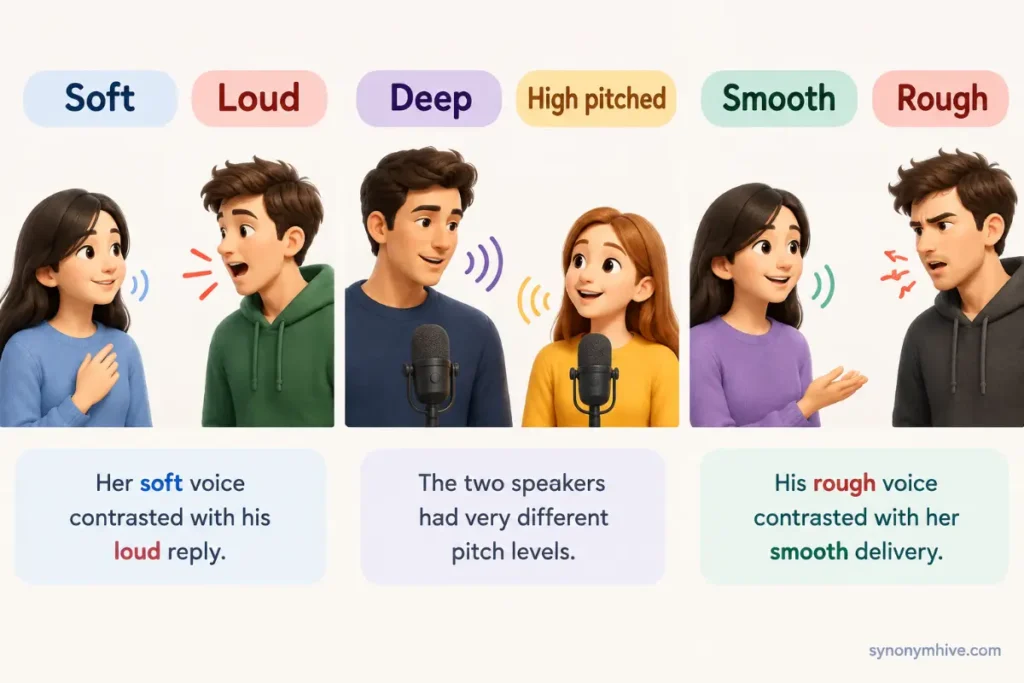
What Are the Opposite Words for Voice Descriptions?
Antonyms can help you describe a change in someone’s voice or find a contrasting quality. Keep in mind that some words have several possible opposites depending on the context.
| Description | Opposite or Contrast | Example |
|---|---|---|
| Soft | Loud | Her soft voice contrasted with his loud reply. |
| Deep | High pitched | The two speakers had very different pitch levels. |
| Smooth | Rough | His rough voice contrasted with her smooth delivery. |
| Clear | Muffled | The first recording was clear, but the second sounded muffled. |
| Warm | Cold | Her warm greeting followed his cold response. |
| Calm | Agitated | His calm delivery contrasted with her agitated speech. |
| Melodic | Monotone | The song had a melodic sound, unlike the flat narration. |
| Confident | Hesitant | She sounded confident, while he seemed hesitant. |
| Gentle | Harsh | The gentle reply contrasted with the harsh criticism. |
| Resonant | Thin | His resonant voice sounded fuller than the thin recording. |
Not every pair represents a strict dictionary opposite. For example, resonant and thin describe contrasting sound qualities, but a thin voice isn’t always the opposite of a resonant one in every technical context.
Choose a contrast that matches the quality you want to change. If you’re describing a speaker who becomes more confident, use hesitant and confident. If the recording loses clarity, clear and muffled may be more accurate.
How Can You Choose the Right Word to Describe a Voice?
Choosing a strong description doesn’t require memorizing a long vocabulary list. Start by deciding what you want the reader to notice, then select a word that communicates that quality clearly.
Use these practical tips to narrow your options.
1. Listen for the main quality. Decide if the voice is high, low, smooth, rough, quiet, loud, clear, or muffled.
2. Identify the emotional tone. Ask if the speaker sounds cheerful, angry, nervous, calm, serious, or reassuring.
3. Consider the setting. A formal presentation may call for articulate or measured, while a casual conversation may suit warm or raspy.
4. Think about the effect on listeners. Choose captivating if the voice holds attention, soothing if it calms people, or commanding if it attracts attention through authority.
5. Use familiar words first. Simple descriptions are often clearer than rare or technical terms. Choose specialized vocabulary only when it adds meaning.
6. Avoid unsupported assumptions. Describe the voice itself instead of using it to guess someone’s intelligence, honesty, or personality.
7. Read the sentence aloud. If the description sounds unnatural when spoken, simplify it or choose a more familiar word.
8. Check for repetition. If you’ve already described a voice as smooth, you may not need to add silky, mellow, and velvety unless each term contributes something different.
9. Use context to make the description specific. Instead of saying she had a lovely voice, explain what made it memorable, such as its gentle rhythm or clear delivery.
10. Keep the reader in mind. A school essay, job application, text message, and novel have different needs. Match the vocabulary to the purpose.
The best words to describe a voice are the ones that help readers imagine a real sound. You don’t need an unusual adjective in every sentence. A simple word used accurately can be more effective than an impressive word used poorly.
You may also like words to describe success Best Guide in 2026.
Conclusion
A good voice description helps readers hear a speaker in their minds and understand the feeling behind the sound. Start with the basics, such as pitch, volume, texture, clarity, and rhythm. Then consider the speaker’s tone and the effect their voice has on other people. This approach makes it easier to find precise language for essays, emails, resumes, text messages, and creative writing.
The most useful words to describe a voice aren’t always the fanciest ones. Warm, clear, raspy, resonant, melodic, and soothing each communicate a different quality. Choose the word that fits the moment, support it with context, and avoid adding details that don’t help the reader. With practice, you’ll be able to describe voices naturally and confidently.
Frequently Asked Questions
What Are the Best Words to Describe a Voice?
The best words depend on the quality you want to highlight. Warm, smooth, raspy, deep, clear, melodic, soothing, and resonant are useful choices for different voice types.
What’s Another Way to Say Someone Has a Nice Voice?
You can say someone has a warm, pleasant, soothing, melodic, or captivating voice. Choose melodic for a musical quality and soothing for a voice that helps people feel calm.
How Do You Describe a Deep Voice?
Use words such as low, rich, resonant, full, or bass like to describe a deep voice. Low refers to pitch, while rich and resonant describe the fullness of the sound.
What Words Describe a Soft and Gentle Voice?
Words such as quiet, mellow, soothing, tender, hushed, and reassuring can describe a soft voice. Use hushed when someone deliberately speaks quietly and reassuring when the voice helps another person feel safe.
How Do You Describe a Rough or Raspy Voice?
You can use raspy, gravelly, hoarse, husky, or croaky. These words describe related qualities, but they aren’t identical. Hoarse often suggests a strained voice, while gravelly suggests a deep and coarse texture.
What Are Some Professional Words to Describe a Voice?
Professional descriptions include clear, articulate, confident, measured, authoritative, persuasive, and composed. These words work well when discussing presentations, interviews, customer service, or public speaking.
How Can I Describe a Voice Without Repeating the Same Words?
Focus on different qualities instead of searching for a new adjective every time. You might describe the pitch as deep, the texture as raspy, the delivery as measured, and the emotional tone as reassuring.