
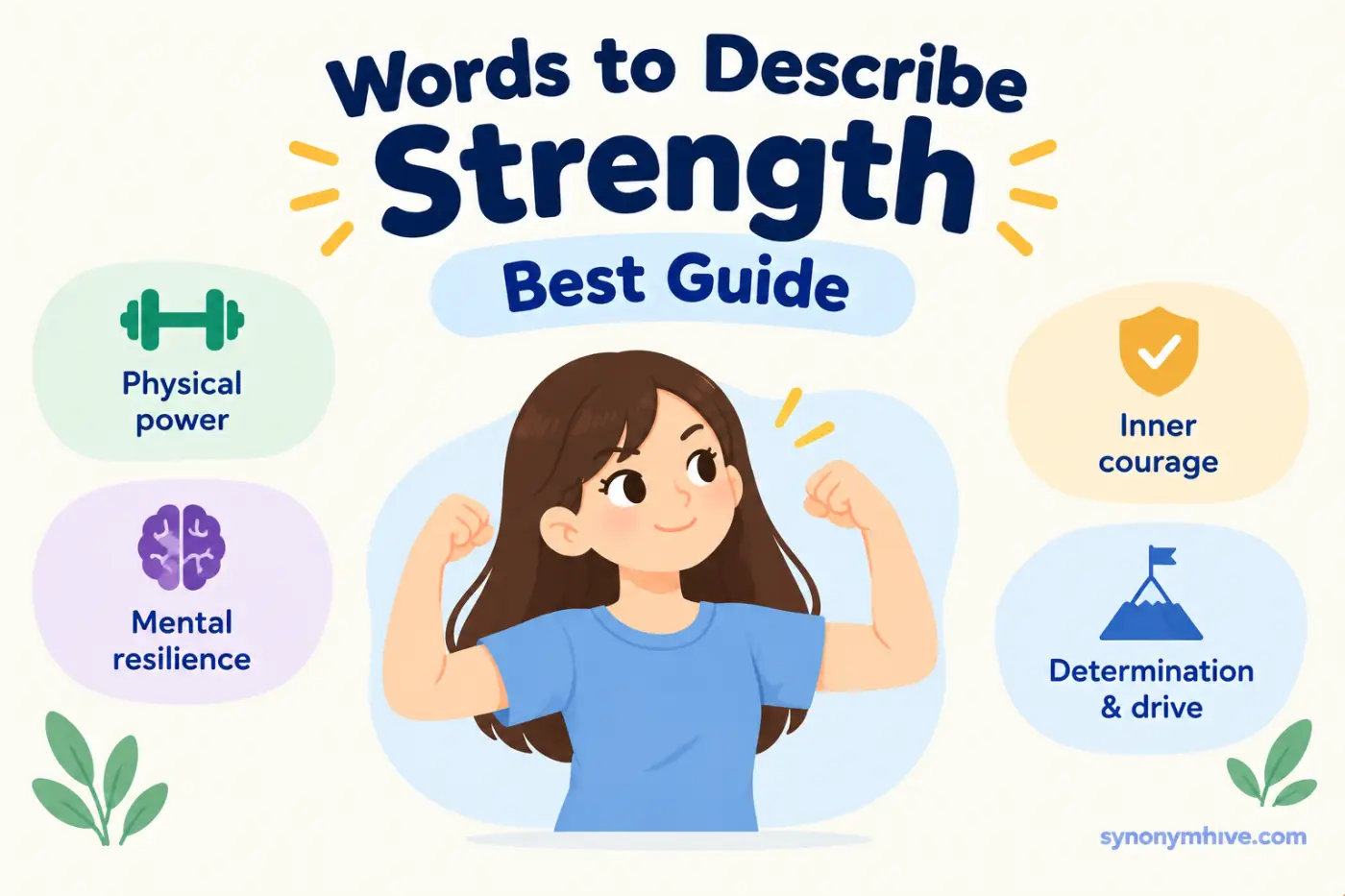
Writing an email, essay, resume, or personal statement can get tricky when you need to explain that someone is strong. The word strong works, but it can sound too general. If you’re searching for words to describe strength, the best choice depends on the kind of strength you mean. Physical power, mental toughness, emotional control, courage, and inner resolve all need slightly different words.
Words to describe strength can show physical power, mental toughness, emotional stability, courage, confidence, or the ability to keep going through hard situations.
A good word gives the reader a clearer picture. A weightlifter might be powerful or muscular. A person who stays calm during a crisis might be composed or resilient. Someone who keeps working after repeated setbacks could be determined or persistent. The right word adds detail instead of simply saying that someone is strong.
This guide covers simple and advanced choices, levels of strength, useful synonyms by context, close word differences, example sentences, common mistakes, antonyms, and practical tips. By the end, you’ll have a much better way to describe strength in a resume, essay, email, text, conversation, or speech.
Looking for a better alternative? Visit words to describe chaos: Best Guide.
What does strength mean in simple English?
Strength means the ability to use physical power, mental control, emotional stability, courage, or determination to handle something difficult. The meaning changes based on the situation.
For example, physical strength helps someone lift a heavy object. Mental strength helps someone deal with pressure. Emotional strength helps a person manage difficult feelings. Inner strength helps someone continue despite setbacks.
The noun strength comes from the Old English word strengþ, which was related to the idea of being strong or powerful. The modern word has kept that basic idea, but its meaning has grown. Today, strength can describe the body, mind, emotions, character, skills, relationships, and even the quality of an argument.
That wider meaning explains why there are so many ways to describe strength. You aren’t always talking about muscles. Sometimes you’re describing patience, courage, self control, confidence, endurance, or character.
What are the best words to describe strength?
The best word depends on the kind of strength you want to show. Powerful, sturdy, robust, muscular, resilient, determined, courageous, steadfast, confident, and tough are useful choices, but they do not all mean the same thing.
| Word | Meaning | Tone | Example |
|---|---|---|---|
| Vigorous | Full of energy and strength | Formal | They took a vigorous approach to training. |
| Firm | Strong, steady, or not easily changed | Everyday | She gave a firm response. |
| Solid | Reliable, strong, or well built | Everyday | He has a solid work ethic. |
| Hardy | Strong enough to survive hard conditions | Formal | The hardy plant survived the winter. |
| Enduring | Able to last for a long time | Formal | Their friendship showed enduring strength. |
| Tenacious | Not willing to give up | Formal | The tenacious player kept competing. |
| Determined | Having a strong desire to reach a goal | Everyday | She is determined to finish the project. |
| Persistent | Continuing despite difficulty | Formal | His persistent effort paid off. |
| Courageous | Willing to face fear or danger | Positive | The courageous firefighter entered the building. |
| Brave | Ready to face fear or danger | Simple | She was brave during the emergency. |
| Fearless | Showing little or no fear | Strong | The fearless climber reached the summit. |
| Steadfast | Firm and loyal over time | Formal | He remained steadfast in his decision. |
| Resolute | Very determined and firm | Formal | The leader was resolute during the crisis. |
| Unyielding | Refusing to give in or change | Strong | Her unyielding focus helped her succeed. |
| Gritty | Showing courage and determination | Informal | He gave a gritty performance. |
| Unstoppable | Seeming impossible to stop | Informal | The team looked unstoppable. |
| Built | Physically strong or well developed | Casual | He’s really built from years of training. |
| Solid | Dependable and mentally or physically strong | Casual | She stayed solid when things got difficult. |
| Rock solid | Extremely reliable or strong | Informal | His confidence was rock solid. |
| Strong willed | Having firm determination | Everyday | Her strong willed nature helped her succeed. |
Which words describe mild to strong levels of strength?
Not every situation calls for the strongest possible word. A useful way to choose a description is to think about intensity.
Mild strength words
Words such as steady, firm, capable, sturdy, reliable, and solid suggest strength without making the person sound extreme.
A capable employee can handle a task well. A steady person remains calm and dependable. A sturdy object can take normal wear without breaking.
These words work well when you want a balanced description.
For example:
“She has a steady approach to difficult problems.”
“His work ethic is solid and reliable.”
“The chair is sturdy enough for everyday use.”
Moderate strength words
Words such as strong, tough, durable, resilient, determined, persistent, and courageous show a clearer level of strength.
They work well when the person or thing has already faced some challenge.
For example:
“Her resilient attitude helped her recover from the setback.”
“He remained determined even after the first plan failed.”
“That material is durable enough for heavy use.”
Strong strength words
Powerful, mighty, vigorous, tenacious, fearless, resolute, and unyielding create a stronger impression.
These words should match the facts. Calling someone fearless suggests they show little fear. Calling a person unyielding suggests they refuse to change or give in.
For example:
“The tenacious runner kept going despite the difficult conditions.”
“Her resolute leadership helped the team stay focused.”
Very strong or dramatic words
Words such as unstoppable, mighty, heroic, formidable, and invincible can create a dramatic effect.
Use them carefully. They can sound exaggerated in a resume or formal report.
“The boxer looked formidable in the ring.”
“The team seemed unstoppable after winning eight games in a row.”
A strong word is useful only when the surrounding sentence supports it.
Which words describe physical strength?
Physical strength relates to the body, muscles, force, fitness, or physical ability. Common choices include muscular, powerful, sturdy, robust, vigorous, strong, tough, hardy, and well built.
The best word depends on the exact quality you’re describing.
Muscular focuses on visible muscle development. Powerful focuses on force. Sturdy often describes a person, object, or structure that is strong and solid. Robust can describe a healthy body, system, or structure.
For example:
“She has a muscular build from years of training.”
“His powerful legs helped him win the cycling race.”
“The young athlete is strong and well conditioned.”
“Despite his small size, he is remarkably powerful.”
“Her sturdy frame helped her handle the physical demands of the job.”
Avoid using muscular when you simply mean strong. Someone can have great physical strength without having a visibly muscular body.
Which words describe mental strength?
Mental strength is the ability to stay focused, make decisions, handle pressure, and continue working toward a goal.
Useful words include resilient, determined, disciplined, focused, persistent, tenacious, composed, adaptable, resourceful, and strong willed.
These words describe different parts of mental toughness.
A disciplined person follows a plan. A focused person keeps attention on a goal. A resilient person recovers after difficulty. A resourceful person finds ways to solve problems. A persistent person keeps trying.
Consider these examples:
“Her mental strength helped her stay focused during the long project.”
“He is disciplined enough to keep working toward his goal.”
“She remained composed when the situation became stressful.”
“His persistent effort eventually produced better results.”
Mental strength doesn’t mean a person never struggles. It often means the person can deal with struggle and keep moving.
Which words describe emotional strength?
Emotional strength means being able to handle difficult feelings without losing control or giving up. It can include patience, self control, calmness, resilience, maturity, and inner confidence.
Good choices include emotionally strong, resilient, composed, calm, grounded, patient, mature, stable, self controlled, and understanding.
These words are useful when describing someone who handles conflict, loss, stress, criticism, or disappointment.
For example:
“She remained calm during a difficult conversation.”
“He showed emotional maturity when he accepted the criticism.”
“Her resilience helped her recover from a painful experience.”
“His grounded personality made him a dependable friend.”
Be careful with the phrase emotionally strong. It can be positive, but it can also suggest that people should hide their feelings. A better description may explain what the person actually does.
Instead of saying:
“She is emotionally strong.”
You could write:
“She stays calm during conflict and gives herself time to think before responding.”
The second version gives evidence instead of making a broad claim.
Which words describe inner strength?
Inner strength refers to qualities that come from a person’s character rather than physical power.
Words such as courageous, resilient, steadfast, determined, principled, patient, confident, disciplined, and strong willed work well here.
Inner strength often appears when there is no easy solution. A person may continue helping others, stick to a value, accept a hard truth, or keep working toward a goal.
For example:
“Her inner strength helped her remain hopeful during a difficult period.”
“He showed remarkable courage when he spoke up for his team.”
“His steadfast character made people trust him.”
“She stayed true to her values even when the decision was unpopular.”
What are the best words to describe strength on a resume?
For a resume, choose words that connect strength to a useful skill or result. Determined, resilient, reliable, disciplined, resourceful, adaptable, confident, proactive, and persistent are usually more useful than dramatic words such as mighty or unstoppable.
A resume should show what your strength helped you accomplish.
Best resume words for strength
Determined suggests a strong drive toward a goal.
Resilient suggests that you recover and keep working after setbacks.
Disciplined shows that you can follow a plan and maintain good habits.
Resourceful shows that you can find practical solutions.
Reliable shows that others can count on you.
Adaptable shows that you can handle change.
Persistent shows that you continue working despite obstacles.
Confident suggests that you trust your ability and decisions.
Resume examples
“Resilient project coordinator who consistently meets deadlines during high pressure periods.”
“Determined sales professional with a record of building long term client relationships.”
“Resourceful team member who finds practical solutions to customer problems.”
“Disciplined employee known for accurate work and dependable follow through.”
Avoid writing “I am extremely strong and unstoppable” on a resume. It sounds like a claim without evidence.
A stronger version is:
“Maintained performance during a major system change while helping teammates adjust to new procedures.”
That sentence demonstrates strength through action.
What are the best terms to describe strength in an essay?
An essay usually benefits from precise words. Courageous, resilient, determined, steadfast, powerful, formidable, enduring, and persistent can work well depending on the subject.
If you’re describing a character, focus on the kind of strength the character shows.
For example:
“The character’s greatest strength is her resilience.”
“The hero shows courage by protecting others despite his fear.”
“The leader’s steadfast nature helps the group remain united.”
“The athlete demonstrates remarkable determination after losing the first race.”
Academic writing often sounds stronger when you explain the reason for the word.
Instead of:
“Maria is strong.”
Try:
“Maria demonstrates emotional strength by remaining calm and supportive during the crisis.”
The second sentence gives the reader something specific to understand.
What are the best terms to describe strength in an email?
Professional emails usually need clear and moderate language. Reliable, capable, dependable, resilient, confident, committed, and determined are useful choices.
For example:
“James has shown a strong ability to manage urgent requests.”
“Sarah has been remarkably dependable during this project.”
“The team has shown resilience while working through the transition.”
“Her confident approach helped us make the decision quickly.”
Avoid overly dramatic language in most professional emails. Words such as invincible, mighty, and unstoppable can sound unnatural unless you’re writing in a playful or highly expressive setting.
What are the best words to describe strength in a text?
Texts allow more casual language. Tough, strong, solid, fearless, bold, gritty, powerful, built, and unstoppable can work well.
For example:
“She’s seriously tough.”
“That guy is built.”
“He’s strong under pressure.”
“She’s got a lot of grit.”
“That was a powerful move.”
The right choice depends on the relationship between the people texting. Casual words can sound friendly with friends but too informal in a workplace message.
What are the best phrases to describe strength when speaking?
In conversation, simple words usually sound the most natural. Strong, tough, brave, determined, confident, calm, resilient, and powerful are easy to understand.
You might say:
“She’s really strong, both physically and mentally.”
“He’s tough. He doesn’t give up easily.”
“She stayed calm when everyone else was stressed.”
“He’s incredibly determined.”
Spoken English doesn’t need fancy vocabulary to sound intelligent. A clear word used at the right time is often better than an unusual synonym.
What are the best words to describe strength in a character?
When describing a fictional character, the best word depends on what the character does.
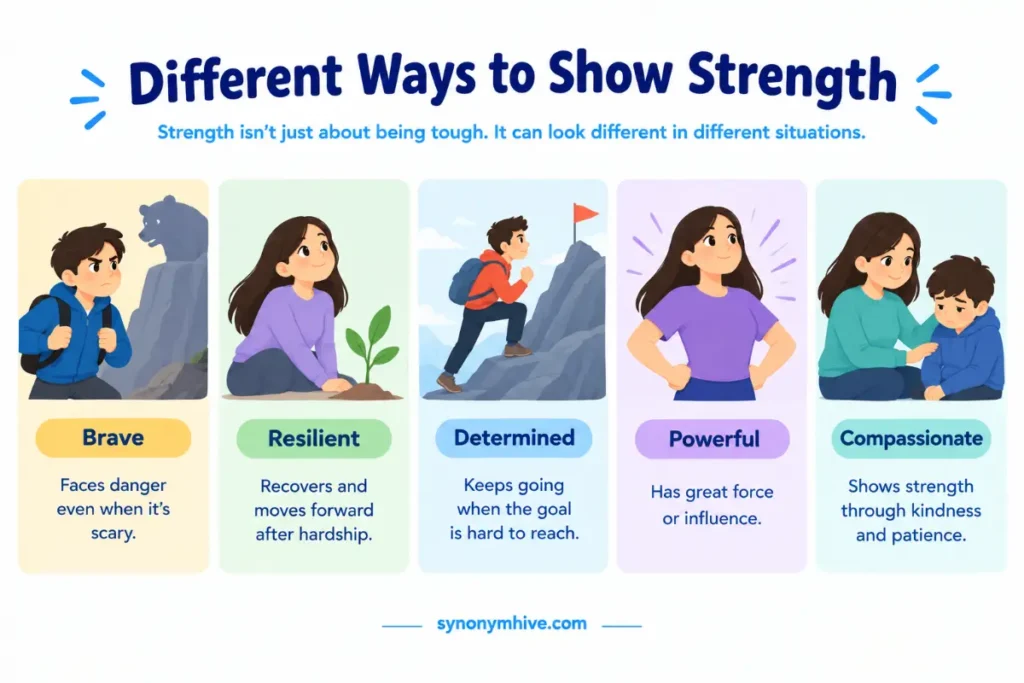
A brave character faces danger. A resilient character recovers after hardship. A determined character keeps pursuing a goal. A powerful character has great force or influence. A compassionate character may show strength through kindness and patience.
You can also combine two qualities.
“She is courageous and compassionate.”
“He is physically strong but emotionally gentle.”
“Her greatest strength is her ability to remain hopeful.”
“The character’s quiet determination becomes clear when he refuses to abandon his friends.”
These combinations create a more complete picture than using strong alone.
How do strong words differ from powerful words?
Strong and powerful overlap, but they are not always interchangeable.
Strong is broad. It can describe physical force, character, emotions, arguments, materials, relationships, and many other things.
Powerful often suggests force, influence, impact, or authority.
Compare these sentences:
“She is strong.”
“She is powerful.”
The first could describe physical ability or character. The second may suggest influence, authority, or a noticeable effect.
You can also say:
“That is a strong argument.”
“That is a powerful argument.”
The first means the argument is convincing or well supported. The second suggests that the argument has a strong effect on the audience.
Strong vs tough: what’s the difference?
Strong usually describes ability or power. Tough focuses more on the ability to withstand difficulty, damage, pain, pressure, or hard conditions.
| Word | Main idea | Example |
|---|---|---|
| Strong | Has power or ability | She is strong enough to lift the box. |
| Tough | Can handle hardship | She is tough enough to handle the pressure. |
A person can be physically strong but not emotionally tough. Someone else may not be very muscular but can be extremely tough during difficult situations.
That difference matters when you choose a description.
Resilient vs determined: what’s the difference?
Resilient means recovering after difficulty. Determined means having a strong desire to reach a goal.
| Word | Main idea | Example |
|---|---|---|
| Resilient | Recovers after setbacks | She bounced back after the loss. |
| Determined | Keeps pursuing a goal | She continued training for the race. |
A person can be both resilient and determined.
For example:
“She was resilient after failing the exam and determined to pass the next one.”
The first word describes recovery. The second describes continued effort.
Learn more useful word alternatives in Words to Describe Joy Best Guide In 2026.
Courageous vs fearless: what’s the difference?
Courageous and fearless are close, but they carry different ideas.
A courageous person can feel fear and still act. Fearless suggests little or no fear.
That makes courageous a more realistic word for many situations.
For example:
“She was courageous enough to speak in front of the entire class.”
This doesn’t mean she felt no fear. It means she acted despite it.
“She was fearless during the dangerous climb.”
This makes a stronger claim about her lack of fear.
Use fearless only when the context supports it.
What parts of speech can describe strength?
Strength related vocabulary appears in several parts of speech.
Nouns name the quality:
- strength
- courage
- resilience
- endurance
- determination
- toughness
- power
- stamina
- confidence
- discipline
Adjectives describe a person or thing:
- strong
- powerful
- resilient
- courageous
- tough
- determined
- durable
- sturdy
- fearless
- steadfast
Adverbs explain how an action happens:
- strongly
- powerfully
- courageously
- confidently
- firmly
- persistently
- patiently
- steadily
Verbs can show strength through action:
- endure
- persist
- withstand
- overcome
- resist
- persevere
- recover
- withstand
Choosing the right form can make your sentence sound more natural.
Instead of:
“She showed strong.”
Write:
“She showed strength.”
Or:
“She remained strong.”
Are there US and UK differences in strength words?
Most common strength words have the same meaning in American and British English. Strong, tough, powerful, resilient, courageous, determined, sturdy, and durable are widely understood in both varieties.
Some spelling differences may appear in related words. For example, British English often uses “labour,” while American English uses “labor.” That difference does not change the meaning of strength related vocabulary in general.
Regional slang can vary more. Words such as built, ripped, jacked, or buff may be common in casual American speech when describing a muscular person. Their use depends heavily on age, setting, and social group.
For formal writing, stick with clear words such as strong, muscular, fit, powerful, or well built.
What are 10 examples of strength words in real sentences?
The best way to understand these words is to see them in normal situations.
- “The firefighter showed remarkable courage when he entered the burning building.”
- “Her resilience helped her recover after the project failed.”
- “The athlete is physically strong and highly disciplined.”
- “His calm response showed real emotional strength.”
- “She is determined to finish the course despite the difficult schedule.”
- “The sturdy bridge can handle heavy traffic.”
- “His powerful speech changed the way the audience viewed the issue.”
- “The team remained steadfast during a difficult season.”
- “Her persistent effort helped her improve her writing skills.”
- “The durable material can withstand years of regular use.”
- “He stayed composed when the meeting became tense.”
- “Her resourceful approach helped the company solve the problem quickly.”
- “The young player showed grit after making an early mistake.”
- “His confident attitude helped the team stay focused.”
- “She demonstrated inner strength by standing up for what she believed was right.”
Each sentence gives a slightly different picture. That is the main reason to choose a precise word instead of using strong every time.
What are common mistakes when describing strength?
One common mistake is using the strongest possible word for every situation. If someone is determined, calling them fearless may change the meaning. If someone is reliable, calling them unstoppable may sound exaggerated.
Another mistake is using physical words for emotional situations. Muscular describes the body. It doesn’t normally describe someone’s patience or courage.
A third mistake is using formal vocabulary in casual situations. Words such as resolute and unyielding can sound stiff in an ordinary text message.
A fourth mistake is making unsupported claims. On a resume, saying “I am extremely powerful and resilient” tells the reader very little. Show how you demonstrated those qualities.
A fifth mistake is confusing strength with aggression. A strong person doesn’t have to be loud, angry, forceful, or controlling. Strength can appear as patience, calmness, discipline, kindness, or self control.
When should you avoid using the word strong?
Avoid strong when a more specific word can explain your meaning better.
Instead of:
“She is strong.”
Try:
“She is determined to reach her goal.”
“She has a strong work ethic.”
Each sentence gives the reader more information.
You should also avoid repeating strong several times in the same paragraph. Repetition makes writing sound flat. Use related words only when they add a different shade of meaning.
What are the antonyms of strength?
Antonyms depend on the type of strength you mean.
For physical strength, possible opposites include weak, frail, fragile, delicate, and feeble.
For emotional strength, possible opposites include vulnerable, unstable, overwhelmed, and distressed. These words need care because emotional vulnerability isn’t automatically a flaw.
For determination, opposites include hesitant, reluctant, passive, uncertain, and uncommitted.
For durability, opposites include fragile, breakable, delicate, and flimsy.
Context matters. A word that works as an opposite in one situation may not fit another.
How do you choose the right strength word?
Start by asking what kind of strength you’re describing.
If the person has physical power, consider strong, muscular, powerful, sturdy, or vigorous.
If they handle pressure well, consider composed, resilient, tough, or calm.
Then consider the setting. A resume needs professional language. A text message can be casual. An academic essay needs precise wording. A speech may benefit from more expressive language.
Finally, check the evidence. The best word should match what the person actually does.
How can you make a strength description more specific?
Add the reason behind the strength.
Instead of saying:
“Maria is strong.”
Write:
“Maria remains calm and focused when deadlines become tight.”
Instead of:
“James is determined.”
Write:
“James continued training for six months after missing his first competition.”
Instead of:
“She is resilient.”
Write:
“She recovered quickly after the project was canceled and helped create a new plan.”
Specific details make descriptions more believable. They also help the reader understand the type of strength you mean.
Can kindness be a form of strength?
Yes. Kindness can show emotional strength, confidence, patience, and self control.
A person who stays kind during conflict may have strong emotional control. Someone who helps others during a difficult time may show courage and compassion. Strength doesn’t always look forceful.
For example:
“Her greatest strength was her ability to remain patient and kind during difficult conversations.”
This sentence shows a form of strength that words such as muscular or powerful cannot capture.
Can quiet people be described as strong?
Yes. Quietness and strength are not opposites.
A quiet person can be determined, resilient, courageous, disciplined, confident, or steadfast. Some people show strength through calm decisions instead of loud behavior.
For example:
“His quiet determination helped him finish the project.”
“She has a calm confidence that makes people trust her.”
“Her quiet strength became clear when she stood up for her friend.”
The phrase quiet strength is useful because it describes power that isn’t loud or aggressive.
How can you describe strength without sounding exaggerated?
Use evidence based language. Describe the action, behavior, or result that proves the quality.
Instead of “She is incredibly strong,” write “She stayed focused through three difficult rounds of testing.”
Instead of “She is the strongest leader ever,” write “She kept the team organized during a major project delay.”
Specific writing sounds more believable because the reader can see the strength in action.
What is the best word for physical and mental strength together?
Strong, resilient, tough, capable, and formidable can describe a mix of physical and mental strength.
Formidable is especially useful when someone seems difficult to challenge because of their skill, power, confidence, or experience.
For example:
“She became a formidable competitor after years of training.”
Tough is more casual:
“He’s tough both physically and mentally.”
Resilient focuses more on recovery:
“She is resilient and able to recover after demanding challenges.”
Choose the word based on the exact quality you want the reader to notice.
Quick tips for choosing words to describe strength
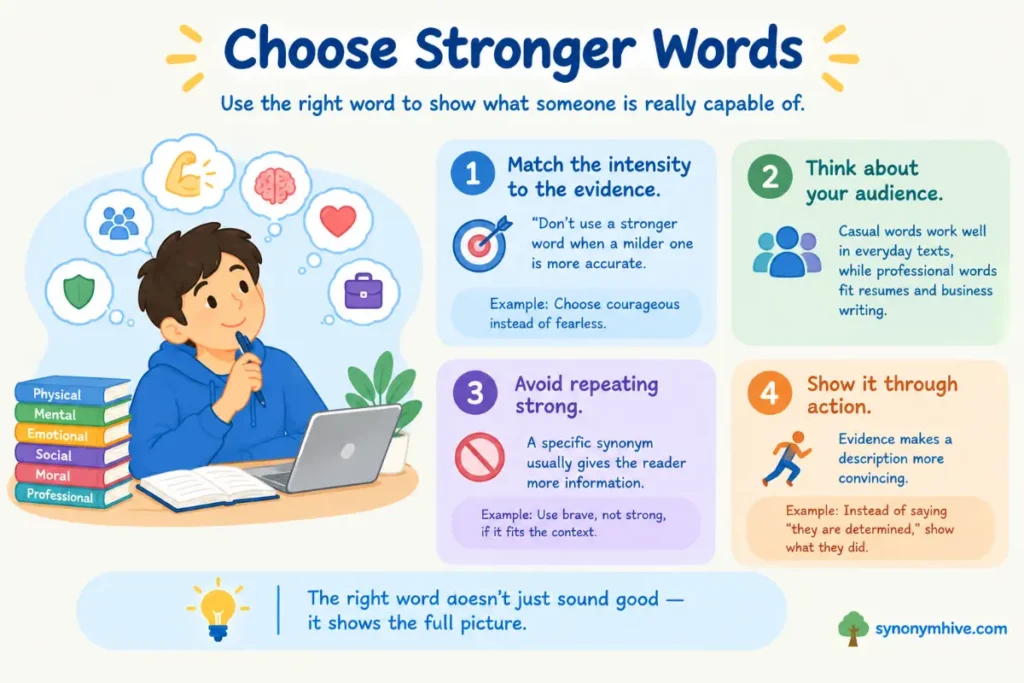
- Identify the type of strength first. Physical, mental, emotional, social, moral, and professional strength need different words.
- Match the intensity to the evidence. Don’t use fearless when courageous is more accurate.
- Think about your audience. Casual words work well in texts, while professional words fit resumes and business writing.
- Avoid repeating strong. A specific synonym usually gives the reader more information.
- Show the strength through action. Evidence makes a description more convincing.
- Use simple words when possible. Strong, brave, tough, calm, and determined are often better than rare vocabulary.
- Check the emotional meaning. Tough, forceful, aggressive, and dominant can create different impressions.
- Don’t confuse confidence with arrogance. Confident suggests healthy belief in your ability. Arrogant suggests an overly high opinion of yourself.
- Use resilient for recovery. The word works especially well when someone has faced a setback and continued.
- Use powerful for force or impact. It can describe people, speeches, arguments, movements, tools, and many other things.
- Use durable for things that last. It usually works better for objects, materials, and systems than for people.
- Use courageous when someone acts despite fear. This gives the word a more precise meaning than simply saying fearless.
Which strength word should you use in different situations?
| Situation | Good choices | Why |
|---|---|---|
| Resume | Resilient, determined, reliable, disciplined | Professional and useful |
| Essay | Courageous, steadfast, powerful, resilient | Precise and descriptive |
| Text | Tough, strong, solid, fearless | Natural and casual |
| Reliable, capable, confident, resilient | Clear and professional | |
| Speech | Courageous, powerful, determined, inspiring | Strong audience impact |
| Character description | Brave, tenacious, resilient, formidable | Adds personality |
| Physical description | Muscular, sturdy, powerful, vigorous | Focuses on the body |
| Mental strength | Focused, disciplined, determined, resilient | Shows inner control |
| Emotional strength | Calm, composed, mature, resilient | Shows emotional control |
| Leadership | Confident, decisive, steadfast, resolute | Shows direction and control |
What should you use when you need one simple word?
If you need one broad word, strong is the safest choice. If you want more detail, choose a word that identifies the exact kind of strength.
For physical power, use powerful.
For recovery, use resilient.
The best word isn’t always the most impressive one. It is the one that says exactly what you mean.
You may also like Words to Describe Kindness: Best Word Choices In 2026.
Conclusion
The best words to describe strength depend on the kind of strength you want to show. Strong is a useful general choice, but words such as resilient, determined, courageous, sturdy, powerful, disciplined, and steadfast give the reader a clearer picture.
Think about the evidence behind your description. A person who recovers after failure is resilient. Someone who keeps working toward a goal is determined. A person who faces danger despite fear is courageous. A reliable object may be sturdy or durable.
For a resume or formal writing, choose precise words and support them with real actions or results. For texts and casual conversations, simpler words often sound more natural. Before you choose a synonym, ask one question: What kind of strength am I actually describing? That answer will usually lead you to the right word.
Frequently Asked Questions
What’s another way to say strong?
Another way to say strong is powerful, tough, resilient, sturdy, determined, courageous, or robust. The best choice depends on the kind of strength you mean.
What are good words to describe strength in a person?
Good words include resilient, courageous, determined, confident, disciplined, steadfast, tough, capable, and powerful. Each word highlights a different quality.
What is a strong word for mental strength?
Resilient is one of the best words for mental strength because it describes the ability to recover from difficulty and continue. Determined, disciplined, persistent, and tenacious can also work.
What are the best words to describe strength on a resume?
Resilient, determined, disciplined, resourceful, reliable, adaptable, and persistent work well on resumes. Choose a word that you can support with a real example or result.
What is the difference between strong and powerful?
Strong is a broad word for having strength or ability. Powerful usually suggests greater force, influence, impact, or authority.
What is a word for someone who never gives up?
Persistent, determined, tenacious, and resilient can describe someone who keeps going. Tenacious is especially strong because it suggests that the person refuses to give up easily.
Can quietness be a sign of strength?
Yes, quietness can show confidence, patience, self control, or inner strength. A person doesn’t need to be loud or aggressive to be strong.