
If you’re writing an essay, email, story, or text and need the right way to describe chaos, the word you choose can change the whole sentence. A busy room, a wild crowd, and a total disaster may all seem chaotic, but they don’t create the same picture. The best words to describe chaos include disorderly, frantic, turbulent, hectic, wild, confused, unruly, chaotic, frantic, and pandemonium. The right choice depends on how intense the situation is and what kind of disorder you want to show.
Chaos can describe noise, movement, emotions, confusion, conflict, or a complete lack of control. A mild situation may be simply messy or disorganized, while a serious one may be frantic, turbulent, or even catastrophic.
This guide explains the meaning and origin of the word, gives you more than 30 useful alternatives, compares close synonyms, and shows which choices work best in essays, emails, texts, resumes, and everyday speech.
Compare more word options with Words to Describe Joy Best Guide In 2026.
What Does Chaos Mean in Plain English?
Chaos means a state of complete disorder, confusion, or lack of control. When many things happen at once without a clear order, we often describe the situation as chaotic.
The word can describe a physical place, a difficult event, a noisy group, or even a person’s thoughts. For example, a crowded airport during a major delay can become chaotic, while a person’s mind may feel chaotic after receiving several stressful messages.
Where Did the Word Chaos Come From?
The English word chaos comes from the ancient Greek word khaos, which referred to a vast gap, void, or open space. Greek mythology used Chaos as the name for the original state that existed before the ordered world was formed.
The word later entered Latin as chaos and then passed into English. Over time, its meaning developed from an idea of a vast empty gap into the modern idea of disorder and confusion.
Today, chaos does not always mean complete destruction. Someone might say, “My desk is chaos,” simply because papers, books, and other items are scattered everywhere.
What Are the Best Words to Describe Chaos?
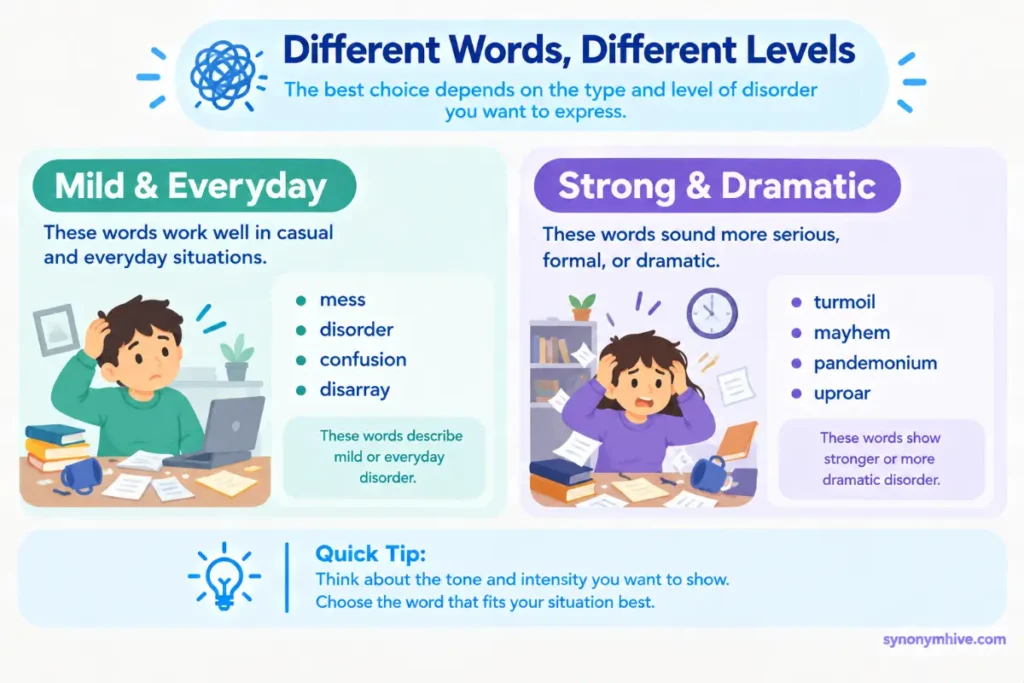
The best choice depends on the type and level of disorder you want to express. Some words are mild and useful in everyday conversation, while others sound stronger, more formal, or more dramatic.
| Word | Meaning | Tone | Example |
|---|---|---|---|
| Messy | Untidy or disorganized | Simple | The kitchen was messy after the party. |
| Disorganized | Lacking order or structure | Neutral | The office became disorganized after the move. |
| Confused | Difficult to understand or follow | Everyday | The instructions left everyone confused. |
| Hectic | Very busy and full of activity | Everyday | The morning was hectic at work. |
| Frantic | Extremely rushed or panicked | Strong | The crowd became frantic when the doors opened. |
| Disorderly | Lacking order or discipline | Formal | The crowd became disorderly after the announcement. |
| Unruly | Difficult to control | Formal | The unruly group ignored the staff. |
| Turbulent | Full of conflict or sudden change | Formal | The country went through a turbulent period. |
| Chaotic | Completely disordered | Neutral | The scene became chaotic within minutes. |
| Wild | Uncontrolled or extreme | Everyday | The celebration turned wild. |
| Cluttered | Filled with too many scattered things | Neutral | His desk was cluttered with papers. |
| Scattered | Spread around without order | Neutral | Her notes were scattered across the table. |
| Haphazard | Lacking a clear plan | Formal | The boxes were stacked in a haphazard way. |
| Tumultuous | Full of noise, conflict, or disorder | Formal | It was a tumultuous year for the company. |
| Anarchy | A state without effective control or authority | Strong | The city descended into anarchy. |
| Chaotic | Marked by confusion and disorder | Neutral | Traffic was chaotic after the accident. |
| Hectic | Extremely busy and active | Everyday | It was a hectic afternoon. |
| Uncontrolled | Not managed or restrained | Neutral | The fire quickly became uncontrolled. |
| Volatile | Likely to change suddenly and dangerously | Formal | The situation remained volatile. |
| Catastrophic | Causing extreme damage or failure | Very strong | The flood had catastrophic effects. |
| Out of control | No longer manageable | Everyday | The argument quickly got out of control. |
Which Words Show Mild Chaos?
Not every chaotic situation is a disaster. Sometimes you only need a word that shows a small amount of disorder.
Words such as messy, cluttered, scattered, disorganized, and untidy work well for mild situations. They usually suggest that things can be fixed without much trouble.
For example, you could say:
My bedroom is messy after a long week.
That sentence does not suggest danger or panic. It simply tells the reader that the room lacks order.
“Disorganized” works well when the problem involves planning or structure.
The team’s schedule became disorganized after two meetings were canceled.
“Scattered” is useful when objects, people, ideas, or information are spread across different places.
My thoughts were scattered after the stressful meeting.
These words are useful because they add detail without making the situation sound worse than it is.
Which Words Show Moderate Chaos?
For stronger disorder, try hectic, confused, unruly, turbulent, haphazard, disordered, or tumultuous.
“Hectic” works especially well for busy schedules and crowded situations.
The hospital had a hectic morning.
“Unruly” focuses on people who are difficult to control.
The unruly crowd refused to follow the rules.
“Turbulent” often describes periods filled with conflict, sudden change, or instability.
The company went through a turbulent year.
“Haphazard” describes something done without a clear plan.
The boxes were placed in a haphazard order.
These words help you explain what kind of chaos is present instead of simply calling everything chaotic.
Which Words Show Extreme Chaos?
When a situation is severe, use stronger terms such as pandemonium, mayhem, frenzy, turmoil, anarchy, bedlam, or catastrophic.
“Pandemonium” suggests loud, uncontrolled confusion.
Pandemonium broke out when the doors suddenly opened.
“Mayhem” suggests serious disorder and often carries a sense of damage or violence.
The storm caused mayhem across the town.
“Frenzy” focuses on wild excitement or intense activity.
Shoppers rushed into the store in a frenzy.
“Turmoil” often refers to emotional, social, political, or personal trouble.
The sudden loss left the family in emotional turmoil.
“Anarchy” is stronger still. It suggests a breakdown of authority or control.
Without effective leadership, the group descended into anarchy.
These words should be used carefully. Calling a slightly messy classroom “pandemonium” can sound exaggerated.
What Are the Different Parts of Speech for Chaos?
The word chaos is mainly used as a noun, but English gives you several related forms that let you describe disorder in different ways.
Chaos as a Noun
Chaos is a noun when it names the state of disorder.
The office was complete chaos after the power outage.
The sudden announcement caused chaos at the station.
Other nouns include disorder, confusion, turmoil, mayhem, pandemonium, commotion, frenzy, and disarray.
Chaotic as an Adjective
Chaotic is the main adjective related to chaos.
The meeting became chaotic after several people started arguing.
It describes something that is full of confusion or disorder.
Chaotically as an Adverb
Chaotically describes how something happens.
The crowd moved chaotically toward the exits.
This form is less common in casual conversation, but it can be useful in formal or descriptive writing.
Chaos and Chaotic Are Not Interchangeable
A common grammar mistake is using chaos when an adjective is needed.
Incorrect:
The classroom was chaos.
Better:
The classroom was chaotic.
You can also write:
The classroom was in chaos.
The first version uses chaotic as an adjective. The second uses chaos as a noun.
Which Word Works Best for a Resume?
A resume usually needs professional language. Avoid dramatic words such as mayhem, bedlam, or pandemonium unless you are using them in a very specific context.
For professional writing, use words such as disorganized, unstructured, inefficient, unstable, demanding, fast moving, or high pressure.
For example:
I helped organize a disorganized filing system and reduced document retrieval time.
That sounds stronger than saying:
I fixed a chaotic office.
A resume should focus on what you did about the problem. Instead of simply labeling a workplace as chaotic, explain the challenge and your result.
You can write:
Managed a high pressure workflow while maintaining accurate customer records.
Or:
Reorganized an inefficient process and improved team response times.
These phrases show skill instead of simply describing disorder.
Which Word Works Best in an Essay?
For essays, the best term depends on the subject.
“Disorder” works well in academic writing.
The sudden policy change created disorder within the department.
“Turbulent” is useful for history, politics, economics, and social change.
The country experienced a turbulent decade.
“Unstable” works well when a system cannot remain steady.
The region had an unstable political climate.
“Confusing” works well when the problem affects understanding.
The report contained confusing instructions.
“Chaotic” is still perfectly acceptable in an essay. You do not need to replace it every time. The goal is precision, not complicated vocabulary.
Which Word Works Best in a Text?
Texting allows more casual language.
You might say:
This morning was so hectic.
The party was absolute chaos.
Traffic is crazy right now.
The whole place is a mess.
That group chat is pure chaos.
Words such as hectic, crazy, messy, wild, and chaos sound natural in casual messages.
“Pandemonium” can also be funny in a text when you want to exaggerate.
My kids are home from school today. Total pandemonium.
The word adds humor because it sounds more dramatic than the situation may really be.
Which Word Works Best in an Email?
Professional emails usually need calm and clear wording.
Instead of writing:
Everything was chaos today.
Try:
The schedule changed several times today, which caused some confusion.
Or:
We experienced a high volume of requests this morning.
Specific language makes an email more useful. It tells the reader what caused the problem.
If you need to describe a disorganized process, “disorganized” or “unclear” may be better than “chaotic.”
The current process is disorganized, so I suggest creating a shared schedule.
That sentence identifies a problem without sounding emotional.
Which Word Works Best in Speaking?
In everyday speech, simple words usually sound most natural.
“Hectic” is excellent for a busy day.
Work has been hectic this week.
“Chaos” works well for a situation that feels hard to control.
The house was complete chaos after the party.
“Crazy” is common in casual American speech, but it is broad and informal.
Traffic was crazy this morning.
If you want to sound more precise, explain what made the situation chaotic.
Traffic was backed up for miles, and nobody could move.
The second sentence gives the listener a clear picture.
How Do Hectic and Chaotic Differ?
Hectic and chaotic are close, but they do not mean exactly the same thing.
| Hectic | Chaotic |
|---|---|
| Very busy | Disordered or hard to control |
| Often involves lots of activity | Often involves confusion or lack of structure |
| Usually does not suggest complete loss of control | Can suggest serious loss of control |
| Common for schedules and workdays | Common for events, systems, places, and situations |
Consider these examples.
My workday was hectic.
This means the person was very busy.
My workday was chaotic.
This suggests that things were not just busy. They were also disorganized, confusing, or difficult to manage.
A hectic day can still be well organized. A chaotic day usually is not.
How Do Chaos and Disorder Differ?
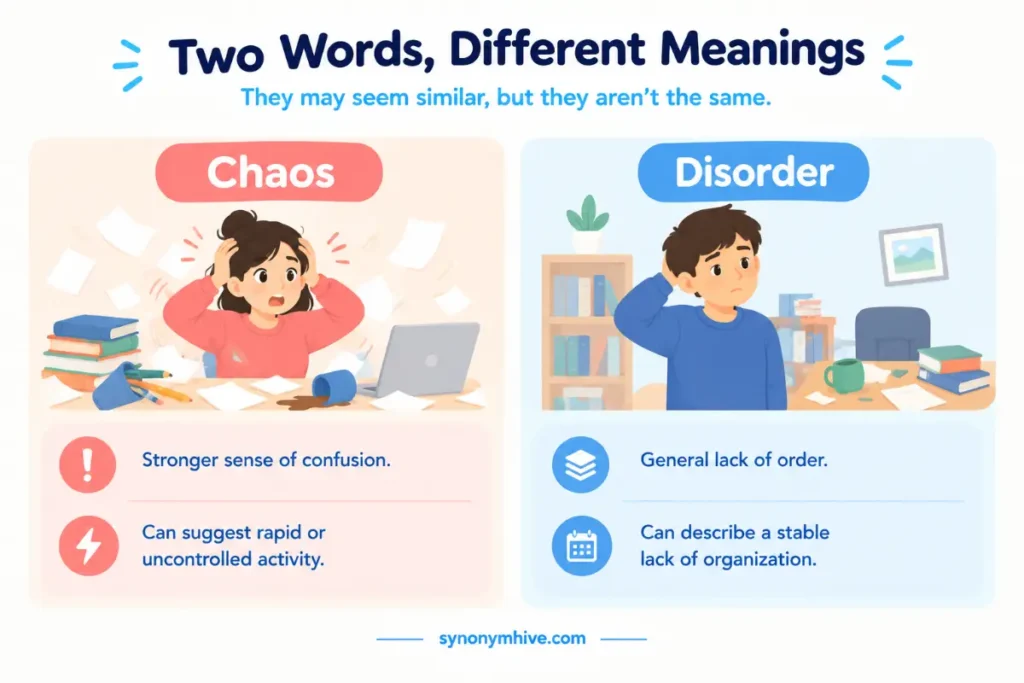
Chaos and disorder are also similar, but “disorder” often sounds more neutral.
| Chaos | Disorder |
|---|---|
| Stronger sense of confusion | General lack of order |
| Can suggest rapid or uncontrolled activity | Can describe a stable lack of organization |
| Often more vivid | Often more neutral or formal |
| Common in casual speech | Common in formal writing |
For example:
The office was in disorder.
This sounds fairly neutral.
The office was complete chaos.
This sounds stronger and more vivid.
The best choice depends on the effect you want.
Discover another helpful synonym list in Words to Describe Fear Best Guide In 2026.
How Do Mayhem and Pandemonium Differ?
Mayhem and pandemonium both describe severe disorder, but they have slightly different shades of meaning.
Mayhem often suggests damage, violence, or extreme confusion.
The crash caused mayhem on the highway.
Pandemonium focuses more on loud, wild, uncontrolled activity.
Pandemonium broke out when the singer appeared on stage.
A crowded concert may create pandemonium without causing actual damage. A serious accident may cause mayhem.
How Do Confusion and Chaos Differ?
Confusion mainly concerns understanding.
There was confusion about the new schedule.
People do not know what is happening or what they should do.
Chaos is broader.
The station was in chaos after the train was canceled.
The problem may include crowds, noise, delays, arguments, and confusion.
So confusion can be one part of chaos, but the two words are not always interchangeable.
What Are Natural Examples of These Words?
Here are real sentence patterns you can adapt to different situations.
- The classroom became chaotic after the fire alarm went off.
- My schedule has been hectic all week.
- The kitchen was messy after we cooked dinner.
- The files were scattered across several desks.
- The instructions were confusing, so nobody knew what to do.
- The crowd became unruly after the game ended.
- The newsroom was frenetic as reporters prepared the story.
- The company faced turmoil after its main supplier closed.
- The sudden storm caused mayhem on local roads.
- Pandemonium broke out when the doors opened.
- Her thoughts were scattered after the difficult conversation.
- The project became disorganized when the manager left.
- The political period was turbulent and uncertain.
- The children turned the living room into complete chaos.
- The emergency created confusion among passengers.
- The team worked through a hectic but successful week.
- The old filing system was haphazard and hard to use.
- The event descended into disorder after the power failed.
These examples show why one replacement word cannot fit every situation. The cause, intensity, and setting all matter.
What Are Common Mistakes When Describing Chaos?
One common mistake is treating every synonym as an exact replacement. Words that seem similar often carry different meanings.
For example, “messy” usually describes poor physical order. It does not automatically mean something is dangerous or out of control.
Another mistake is using very strong words for small problems.
My desk is total anarchy.
This could be funny, but it sounds exaggerated because anarchy suggests a breakdown of authority or control.
A third mistake is using “chaotic” when you mean “busy.”
The conference was chaotic.
This might mean the event was poorly organized. If you only mean that many things happened, “busy” or “hectic” may be better.
You should also avoid using “frantic” for something that is simply fast.
Frantic suggests panic, fear, or desperation.
She made a frantic attempt to find her child.
That is much stronger than:
She made a quick attempt to find her keys.
Finally, do not assume formal words are always better. A simple word often gives the clearest meaning.
When Should You Not Use the Word Chaos?
Avoid “chaos” when the situation is merely busy, crowded, or active but still organized.
A busy airport is not automatically chaotic. If flights are leaving on time, passengers know where to go, and staff are managing the crowd well, “busy” is more accurate.
Likewise, a colorful desk covered with books may not be chaotic. It could simply be cluttered.
Choose a stronger word only when the facts support it.
Good writing is not about making every sentence sound dramatic. It is about choosing a word that matches what actually happened.
What Are the Antonyms of Chaos?
The main opposites of chaos are order, organization, structure, stability, control, calm, peace, and harmony.
| Antonym | Best Use |
|---|---|
| Order | Things are arranged correctly |
| Organization | A system works in a planned way |
| Structure | Parts follow a clear system |
| Stability | A situation remains steady |
| Control | Someone manages events successfully |
| Calm | There is little noise or excitement |
| Peace | There is no conflict |
| Harmony | People or parts work well together |
| Clarity | Things are easy to understand |
For example:
The room went from chaos to order.
The manager brought structure to the disorganized process.
The team restored calm after the emergency.
These contrasts can make descriptions stronger because they show the change from one state to another.
Are There US and UK Differences?
Most common words for disorder work the same way in American and British English.
Words such as chaos, chaotic, disorder, confusion, hectic, messy, turbulent, mayhem, and pandemonium are understood in both varieties of English.
Some informal expressions may differ by region, but the standard vocabulary does not change much.
For a US audience, “mess,” “hectic,” “crazy,” “out of control,” and “chaos” are common in everyday speech.
British English also uses these terms, although some local expressions may be more common in casual conversation.
If you’re writing for an international audience, simple words such as disorder, confusion, messy, chaotic, and disorganized are safe choices.
How Can You Choose the Right Word?
Start by asking what kind of disorder you are describing.
- If things are simply untidy, use messy, cluttered, or untidy.
- If something lacks a plan, use disorganized or haphazard.
- If people are difficult to control, use unruly.
- If a situation is very busy, use hectic.
- If people are panicking, use frantic.
- If there is loud confusion, use commotion or pandemonium.
- If there is serious damage or violent disorder, use mayhem.
- If there is emotional or social trouble, use turmoil.
- If a system lacks authority or control, use anarchy carefully.
- If the situation simply lacks order, use chaos, disorder, or disarray.
This approach helps you choose based on meaning instead of picking the most dramatic word.
How Can You Describe Chaos Without Using the Word Chaos?
Sometimes the strongest description does not use a direct synonym at all.
Instead of saying:
The office was chaotic.
You could write:
Papers covered every desk, phones rang nonstop, and three employees were trying to answer the same customer.
That sentence gives the reader evidence of disorder.
For a story, this method can be even more effective.
People shouted from every corner of the room while chairs scraped across the floor.
The reader can picture the situation without being told that it was chaotic.
This is especially useful in creative writing. Concrete details often create a stronger image than an adjective alone.
What Are Better Words for Emotional Chaos?
Chaos can describe emotions as well as physical events.
For emotional situations, try turmoil, distress, confusion, panic, agitation, unrest, uncertainty, conflict, or inner conflict.
For example:
She was in emotional turmoil after the breakup.
He felt confused after hearing two different explanations.
Panic spread through the crowd.
The sudden change caused anxiety and uncertainty.
These terms are more precise than simply saying someone felt chaotic. In standard English, “I feel chaotic” can sound unusual when the speaker means their thoughts or emotions are unsettled.
Better options include:
My thoughts feel scattered.
I feel overwhelmed.
My mind is racing.
I’m confused about what to do.
I’m under a lot of stress.
What Are Better Words for a Chaotic Person?
Be careful when describing a person. “Chaotic” can describe someone’s behavior, habits, schedule, or lifestyle, but it can sound judgmental.
If someone acts without planning, you might say:
He’s impulsive.
If someone creates excitement and confusion, “wild” or “unpredictable” may fit casual writing.
For professional writing, focus on behavior rather than labeling the person.
Instead of:
She is chaotic.
Try:
She often changes priorities without warning.
That sentence is clearer and more useful.
What Are Better Words for a Chaotic Situation?
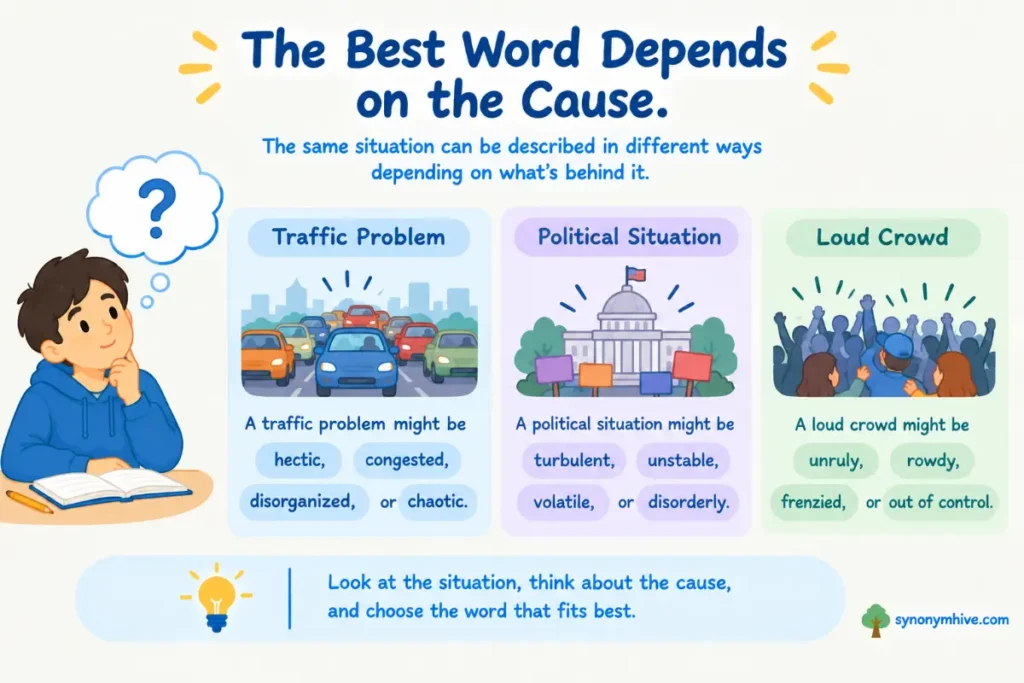
The best word depends on the cause.
A traffic problem might be hectic, congested, disorganized, or chaotic.
A political situation might be turbulent, unstable, volatile, or disorderly.
A loud crowd might be unruly, rowdy, frenzied, or out of control.
A workplace problem might be disorganized, confusing, inefficient, or unstable.
A party might be wild, noisy, hectic, or chaotic.
A natural disaster might create mayhem, devastation, destruction, or widespread disorder.
This kind of detail makes your writing more exact. Instead of asking only for a synonym, ask yourself what the disorder actually looks like.
Quick Tips for Better Word Choice
Keep these tips nearby when you need a stronger description.
- Match the word to the intensity of the situation.
- Use “hectic” for heavy activity that may still be organized.
- Use “disorganized” for poor planning or structure.
- Use “unruly” for people who are hard to control.
- Use “frantic” when panic or desperation is present.
- Use “turmoil” for serious emotional, social, or political trouble.
- Use “pandemonium” for loud and uncontrolled confusion.
- Use “mayhem” when disorder involves serious disruption or damage.
- Avoid dramatic words when a simple word gives a more accurate meaning.
- In professional writing, describe the problem and its effect instead of relying on a dramatic label.
- In creative writing, show the disorder through sights, sounds, movement, and actions.
- Read the sentence aloud. The best word should sound natural in the setting.
Need a similar word? Read words to describe change Best Guide in 2026.
Conclusion
Choosing the right description starts with identifying what kind of disorder you mean. A messy desk needs a different word from a panicked crowd, a turbulent political period, or a damaged city after a storm.
The best words to describe chaos range from simple choices such as messy, scattered, and disorganized to stronger terms such as frantic, tumultuous, pandemonium, and mayhem. Each word adds a slightly different shade of meaning.
For everyday writing, clear words usually work best. For essays and professional writing, choose precise terms that explain the problem without exaggerating it. In creative writing, you can also show disorder through action, sound, and detail.
When you need one final check, ask yourself what the reader should picture. Once you know that, the right word becomes much easier to choose.
Frequently Asked Questions
What are the best words to describe chaos?
The best choices include chaotic, disorganized, hectic, frantic, turbulent, unruly, disorderly, tumultuous, pandemonium, mayhem, and turmoil. The right word depends on the type and intensity of the disorder.
What’s another way to say chaos?
Another way to say chaos is disorder, confusion, turmoil, mayhem, pandemonium, disarray, commotion, or frenzy. Use the word that best matches the situation instead of treating all synonyms as identical.
What is a strong word for chaos?
Pandemonium, mayhem, turmoil, and anarchy are strong words for serious disorder. Each has a different meaning, so the strongest word is not always the best word.
What words describe a chaotic person?
Disorganized, unpredictable, impulsive, restless, unruly, or scattered may describe different types of chaotic behavior. Choose the word based on what the person actually does.
What is a good word for emotional chaos?
Turmoil is one of the best choices for serious emotional disorder. Other useful words include confusion, distress, agitation, panic, unrest, and inner conflict.
How do you describe chaos in an essay?
Use precise words such as disorder, turbulence, instability, confusion, turmoil, or disorganization. Explain what caused the disorder and what effect it had so the description has clear meaning.
What is the difference between chaos and confusion?
Confusion mainly means that something is difficult to understand or people do not know what to do. Chaos is broader and can include confusion, noise, disorder, conflict, and a lack of control.