

Winter can turn an ordinary scene into something worth describing. Snow settles on rooftops, frost covers the grass, and cold wind moves through bare trees. Perhaps you are writing a school essay, creating a winter caption for social media, or describing a snowy scene in a story. The right words can help readers picture the season and understand the mood you want to create.
The best words to describe winter depend on what you want your reader to notice. Some words describe the weather, such as freezing, snowy, and blustery. Others capture the scenery, such as frosty, snow covered, and wintry. Words like peaceful, gloomy, magical, and harsh can also express the mood of a winter day.
Winter is a cold season often marked by shorter days, low temperatures, frost, ice, and snow in many regions. You can describe it with words that focus on its weather, natural beauty, quiet atmosphere, or difficult conditions.
This guide explores descriptive winter vocabulary, explains the differences between similar words, and shows how to use each term naturally. You will find simple adjectives, powerful alternatives, formal vocabulary, casual expressions, examples for essays and emails, and practical tips for choosing the right word.
Check out more vocabulary ideas in Words to Describe Autumn Best Word List.
What Winter Means and Where the Word Comes From
Winter is one of the four seasons of the year. In the Northern Hemisphere, it usually includes December, January, and February. In the Southern Hemisphere, it usually includes June, July, and August. Exact dates depend on the calendar system, and local weather can vary widely.
In places with cold winters, the season may bring snow, ice, frost, frozen ground, and icy winds. Other places have mild winters with rain, clouds, and cooler temperatures but little or no snow. That difference matters when you choose descriptive language. A snowy mountain town and a rainy coastal city may both experience winter, yet they offer very different scenes.
The English word winter comes from Old English winter and is related to similar words in other Germanic languages. People have used it to name the cold season for many centuries. Over time, winter also developed figurative meanings. Writers sometimes use it to suggest old age, hardship, stillness, decline, or a period of waiting.
The word itself is a noun. In a phrase such as winter weather, it also works as a noun that describes another noun. The adjective wintry describes something that resembles or belongs to winter, as in a wintry sky or a wintry afternoon.
These differences give you more choices when writing. You can describe a winter morning as cold, call the air wintry, or say the landscape looks frozen. Each phrase focuses on a slightly different part of the scene.
The Best Words to Describe Winter by Category
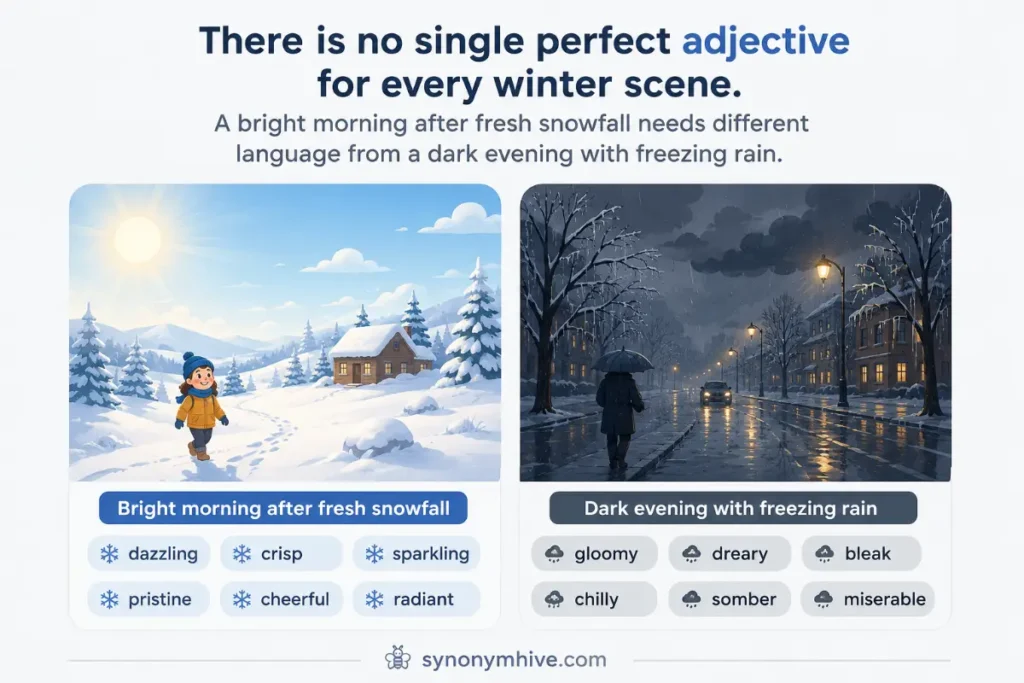
There is no single perfect adjective for every winter scene. A bright morning after fresh snowfall needs different language from a dark evening with freezing rain. Use the following categories to find words that match the weather, setting, and mood you want to express.
Simple Words for Winter
Simple words work well in school assignments, everyday conversations, short messages, and clear descriptions. Readers understand them quickly, so you can focus on the scene instead of explaining difficult vocabulary.
|
Word
|
Meaning
|
Tone
|
Example
|
| — | — | — | — |
|
Cold
|
Having a low temperature.
|
Neutral.
|
The cold morning made me reach for my coat.
|
|
Snowy
|
Covered with or receiving snow.
|
Neutral.
|
We walked along a snowy path.
|
|
Icy
|
Covered with ice or extremely cold.
|
Cautionary.
|
The icy steps were hard to climb.
|
|
Chilly
|
Uncomfortably cool.
|
Casual.
|
A chilly breeze came through the window.
|
|
Frosty
|
Covered with frost or very cold.
|
Descriptive.
|
Frosty grass sparkled in the sunlight.
|
|
White
|
Covered in or showing the color of snow.
|
Visual.
|
White fields stretched beyond the road.
|
|
Dark
|
Having little light.
|
Neutral or gloomy.
|
Dark winter afternoons arrived early.
|
|
Quiet
|
Making little noise.
|
Peaceful.
|
The quiet woods rested beneath the snow.
|
These words work because they are clear and flexible. You can combine them to add detail without making a sentence complicated.
For example, the cold, snowy morning was quiet gives the reader three details. The temperature was low, snow covered the area, and the setting had little noise. A more focused sentence might be the frosty grass glittered in the morning sun. That version lets one image carry the description.
Everyday Words for Winter
Everyday descriptive words give your writing more variety while staying natural. They are useful in stories, journal entries, travel descriptions, conversations, and seasonal posts.
|
Word
|
Meaning
|
Tone
|
Example
|
| — | — | — | — |
|
Wintry
|
Typical of winter.
|
Neutral.
|
A wintry wind swept across the field.
|
|
Freezing
|
Extremely cold.
|
Strong.
|
We waited in the freezing rain.
|
|
Snow covered
|
Covered with a layer of snow.
|
Visual.
|
Snow covered hills surrounded the village.
|
|
Blustery
|
Marked by strong, gusty wind.
|
Energetic.
|
A blustery afternoon kept us indoors.
|
|
Crisp
|
Cool, fresh, and sharp.
|
Pleasant.
|
The crisp air made the walk refreshing.
|
|
Damp
|
Slightly wet.
|
Neutral.
|
Damp winter air settled over the garden.
|
|
Gloomy
|
Dark or lacking cheer.
|
Negative.
|
A gloomy sky hung over the town.
|
|
Peaceful
|
Calm and free from disturbance.
|
Positive.
|
The peaceful woods looked untouched.
|
|
Bleak
|
Cold, bare, and without much hope or cheer.
|
Somber.
|
The bleak field had no green grass left.
|
|
Misty
|
Filled with fine water droplets that limit visibility.
|
Atmospheric.
|
A misty morning softened the distant hills.
|
The best everyday words often combine physical details with mood. Crisp describes the air and can suggest freshness. Bleak describes a setting that looks bare or unwelcoming. Peaceful focuses on the absence of noise or trouble.
Choose based on what you want the reader to notice first. If the wind is the main feature, blustery may be more precise than cold. If the scene looks empty and harsh, bleak may communicate more than snowy.
Formal Words for Winter
Formal vocabulary can help in essays, reports, literary analysis, nature writing, and serious descriptions. These words often communicate a precise quality or create a more polished tone.
|
Word
|
Meaning
|
Tone
|
Example
|
| — | — | — | — |
|
Frigid
|
Extremely cold.
|
Formal and strong.
|
Frigid air moved through the mountain pass.
|
|
Inclement
|
Unpleasant or severe, especially when describing weather.
|
Formal.
|
Inclement conditions forced the hikers to turn back.
|
|
Dormant
|
Inactive or resting for a period.
|
Scientific or literary.
|
Many plants remain dormant during winter.
|
|
Austere
|
Plain, severe, or lacking decoration.
|
Literary.
|
The austere landscape revealed every bare branch.
|
|
Desolate
|
Empty, lonely, or abandoned in appearance.
|
Somber.
|
A desolate stretch of land lay beneath the gray sky.
|
|
Inhospitable
|
Unwelcoming or difficult to live in.
|
Formal.
|
The icy plateau was an inhospitable place to camp.
|
|
Wintry
|
Cold or bleak in a way associated with winter.
|
Literary or neutral.
|
A wintry light filled the room.
|
|
Severe
|
Very harsh or intense.
|
Formal.
|
Severe winter weather disrupted local travel.
|
Formal words should improve precision rather than make writing harder to read. Inclement is useful when weather creates difficult conditions. Dormant is suitable for plants or animals that become inactive during part of the year. Austere works when a scene looks plain, severe, or stripped of decoration.
Do not use a formal word simply because it sounds impressive. A clear word that fits the scene is usually more effective than a rare word that distracts the reader.
Slang and Casual Expressions for Winter
Casual vocabulary is useful for texts, social media captions, informal blogs, and conversations with friends. Some expressions are regional, so readers may not interpret every phrase in the same way.
|
Word or Expression
|
Meaning
|
Tone
|
Example
|
| — | — | — | — |
|
Freezing cold
|
Extremely cold.
|
Casual.
|
It is freezing cold outside today.
|
|
Chilly
|
A little too cold for comfort.
|
Casual.
|
This chilly weather calls for a warm drink.
|
|
Snowed in
|
Unable to leave easily because of heavy snow.
|
Informal.
|
We got snowed in and watched movies all day.
|
|
Bundle up
|
Put on warm clothing.
|
Friendly and casual.
|
Bundle up before you head out.
|
|
Nippy
|
Slightly cold, especially in British English.
|
Informal.
|
It is a bit nippy this morning.
|
|
Bitter cold
|
Cold that feels painfully intense.
|
Conversational.
|
The bitter cold kept everyone inside.
|
|
Slushy
|
Wet and partly melted, especially when describing snow mixed with water.
|
Casual.
|
The sidewalks turned slushy by noon.
|
|
Frostbite weather
|
Very cold conditions that raise concern about frostbite.
|
Informal and cautionary.
|
It felt like frostbite weather on the exposed ridge.
|
Casual expressions can add personality, but context matters. Snowed in describes a situation rather than the weather alone. Bundle up is a command or suggestion, not an adjective. Nippy is common in British usage and may sound less familiar to some American readers.
For a casual caption, it is freezing out there sounds natural. For a school science report, temperatures remained below freezing is more precise.
Words to Describe Winter by Intensity
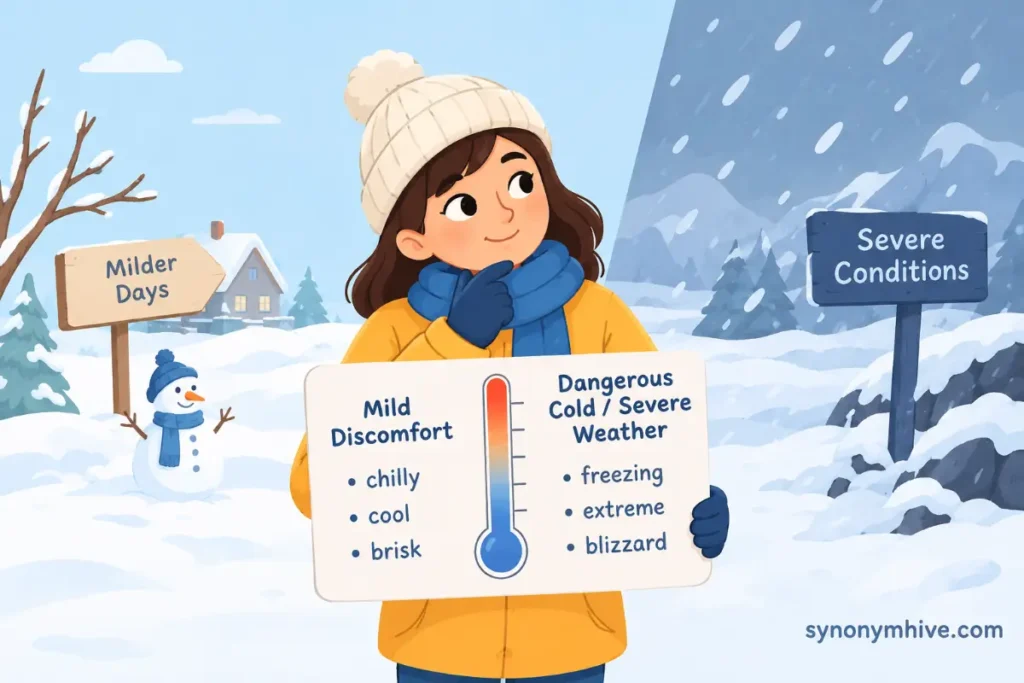
Some winter words describe mild discomfort, while others suggest dangerous cold or severe weather. Choosing the right level of intensity helps readers understand how strong the conditions are.
Mild Winter Weather
Use these words when the weather is cool or slightly uncomfortable but not severe.
|
Word
|
Meaning
|
Example
|
| — | — | — |
|
Cool
|
A little cold, but often comfortable.
|
The cool morning was perfect for a walk.
|
|
Chilly
|
Uncomfortably cool.
|
A chilly breeze slipped through the open door.
|
|
Crisp
|
Cool and fresh.
|
We enjoyed the crisp air on our hike.
|
|
Brisk
|
Cool and refreshing, often with a little wind.
|
A brisk walk warmed us up.
|
|
Nippy
|
Slightly cold.
|
The nippy weather called for gloves.
|
|
Fresh
|
Pleasantly cool and clean.
|
Fresh winter air filled the garden.
|
These words work well when winter is manageable. Crisp and brisk can even suggest pleasant weather, especially when the sun is out. Chilly and nippy usually suggest that an extra layer of clothing would help.
Moderate Winter Conditions
These words describe weather that is clearly cold, damp, windy, or uncomfortable.
|
Word
|
Meaning
|
Example
|
| — | — | — |
|
Cold
|
Low in temperature.
|
Cold air poured through the doorway.
|
|
Frosty
|
Cold enough for frost to form or covering something with frost.
|
The frosty lawn sparkled at sunrise.
|
|
Icy
|
Covered with ice or dangerously cold.
|
Icy roads slowed the morning traffic.
|
|
Windy
|
Having noticeable or strong wind.
|
A windy afternoon scattered leaves across the yard.
|
|
Damp
|
Slightly wet.
|
Damp air hung over the empty park.
|
|
Raw
|
Cold and damp in an uncomfortable way.
|
The raw weather made the walk unpleasant.
|
|
Bleak
|
Bare, cold, or lacking cheer.
|
The bleak fields stretched beneath a gray sky.
|
Raw is especially useful for describing weather that seems to chill you through your clothes. It often refers to a mix of cold air, moisture, and wind. Bleak adds an emotional or visual quality, so it works well for descriptions of empty fields, bare trees, or dull skies.
Severe Winter Conditions
Choose stronger words when temperatures drop sharply or weather becomes dangerous.
|
Word
|
Meaning
|
Example
|
| — | — | — |
|
Freezing
|
At or below the freezing point, or extremely cold in everyday speech.
|
Freezing temperatures covered the pond with ice.
|
|
Frigid
|
Extremely cold.
|
Frigid winds swept across the open plain.
|
|
Bitter
|
Painfully cold.
|
Bitter air stung our cheeks.
|
|
Arctic
|
Extremely cold or associated with the Arctic region.
|
Arctic conditions reached the northern town.
|
|
Bone chilling
|
So cold that it seems to reach deep into the body.
|
A bone chilling wind blew through the valley.
|
|
Subzero
|
Below zero on a temperature scale.
|
Subzero temperatures froze the standing water.
|
|
Harsh
|
Severe and difficult to endure.
|
Harsh winter weather damaged several roads.
|
|
Brutal
|
Extremely severe or unpleasant.
|
Brutal cold kept the workers indoors.
|
Use severe words with care. Frigid, brutal, and bone chilling create a much stronger impression than cool or chilly. They are best when the scene supports that level of intensity.
The word subzero also needs care because the temperature scale matters. A temperature below zero degrees Fahrenheit is much colder than a temperature just below zero degrees Celsius. If the exact measurement matters, include the scale.
Words to Describe Winter Weather
Weather descriptions become stronger when you name the exact condition instead of calling everything cold. Winter can bring snowfall, sleet, freezing rain, fog, wind, or bright sunshine. Each creates a different scene.
Words for Snowy Weather
Snow changes the appearance and sound of a landscape. Fresh snow can cover roads, soften the shapes of trees, and make a familiar neighborhood look new.
Useful words include snowy, snow covered, snow laden, powdery, drifting, flurrying, blanketed, and wintry.
Snowy describes weather or a place where snow is falling or present. Snow covered tells the reader that a surface has a layer of snow. Powdery describes snow that is light and loose. Drifting refers to snow moved by wind, while flurrying suggests light or brief snowfall.
Examples show how these words differ.
- Powdery snow covered the garden in a thin white layer.
- Snow laden branches bent over the narrow path.
- Light flakes were flurrying above the rooftops.
- Wind driven snow drifted against the front door.
- The snow covered village looked peaceful at dawn.
Blanketed is a useful figurative word. When you write that snow blanketed the fields, you compare the layer of snow to a blanket. This creates a clear image without needing a long explanation.
Words for Rainy and Wet Winter Weather
Not every winter brings snow. In many areas, rain, damp air, puddles, and gray skies are more common.
Words such as rainy, damp, soggy, drizzly, wet, sleety, misty, and overcast can describe these conditions.
Drizzly means that light rain is falling. Soggy suggests that something has become very wet. Sleety describes conditions involving sleet, which consists of small ice particles or frozen raindrops depending on regional usage. Overcast describes a sky covered by clouds.
Try these examples.
- A drizzly winter morning left the pavement shining.
- The soggy field was too wet for the children to play.
- An overcast sky hid the hills behind a layer of gray.
- Misty air blurred the lights along the road.
- Cold rain tapped against the kitchen window.
The exact word helps the reader picture the weather. Rainy is broad. Drizzly gives a more specific sense of light rain. Soggy focuses on the wet result, while overcast focuses on the sky.
Words for Windy Winter Weather
Wind can make a winter day much more uncomfortable. It can push snow across roads, shake bare branches, and make a moderate temperature feel colder.
Blustery, gusty, biting, howling, fierce, cutting, and wind swept are useful choices.
Blustery describes strong, changing winds. Gusty means the wind comes in short bursts. Howling describes a loud wind, often around buildings or through trees. Biting and cutting suggest that the wind feels painfully cold.
Here are examples.
- A blustery wind swept leaves along the frozen path.
- Gusty conditions made the tall trees sway.
- The biting wind made my eyes water.
- A howling wind rattled the loose window frame.
- The wind swept hillside had little shelter from the cold.
Use howling when sound matters. Choose gusty when the wind rises and falls. Biting is more about the sensation on your skin than the speed of the wind.
Words for Frost and Ice
Frost and ice create some of winter’s most striking details. Frost can coat grass, windows, and branches. Ice can cover ponds, form on roads, or hang from roofs.
Useful words include frosted, icy, frozen, glassy, slick, brittle, crystalline, and glazed.
Frosted means covered with frost. Frozen means turned into ice or made solid by cold. Glassy describes a smooth surface that looks like glass. Slick describes a surface that is slippery. Crystalline suggests a clear, crystal like structure or appearance.
Examples include the following.
- Frosted windows blurred the garden outside.
- A glassy layer of ice covered the pond.
- The frozen lake reflected the pale morning sky.
- Slick sidewalks made the walk to school dangerous.
- Crystalline frost sparkled on the fence.
Safety can matter in these descriptions. A beautiful icy path may also be dangerous. If you are writing practical advice, choose words that make the risk clear instead of focusing only on appearance.
Words to Describe Winter Scenery and Nature
Winter changes trees, plants, fields, lakes, mountains, and forests. These changes give writers plenty of details to work with, even in places that receive little snow.
Words for Winter Trees and Plants
Many trees lose their leaves during winter. Other plants remain green, and some flowers and shrubs survive cold weather. The right adjective depends on the plant and its condition.
Bare describes a tree without leaves. Leafless is more literal. Dormant describes a plant that has slowed or paused its growth. Evergreen describes a plant that keeps its leaves or needles through the year. Frost covered describes a surface coated with frost.
Examples include these sentences.
- Bare branches reached toward the pale winter sky.
- Leafless trees lined the quiet country road.
- Dormant plants rested beneath the frozen soil.
- Evergreen pines stood dark against the white hillside.
- Frost covered shrubs glittered beside the path.
Bare and leafless are close in meaning, but bare can sound more visual or literary. Dormant has a specific meaning related to reduced activity or growth. Do not use dormant to describe every plant in winter, since some plants continue growing in cold weather.
Words for Winter Forests
A winter forest can look quiet, open, mysterious, or severe. Snow may cover the ground, while the trees create long shadows. Without leaves, the space between branches becomes more visible.
Words such as silent, shadowy, still, hushed, tangled, stark, secluded, and snow laden can help describe a forest.
- The hushed forest held the soft sound of falling snow.
- Stark branches crossed the pale sky.
- A secluded trail wound between snow covered pines.
- Shadowy trees stretched across the frozen ground.
- The still forest seemed far away from the busy town.
Silent and hushed suggest little sound, though hushed can also imply that a place has become unusually quiet. Stark describes a scene with few details or little decoration. Secluded focuses on being away from other people.
These words can create atmosphere without relying on repeated references to cold or snow. That variety helps nature writing stay interesting.
Words for Winter Mountains and Fields
Mountains and open fields can look very different in winter. Mountains may appear rugged, snow capped, towering, or remote. Fields may look barren, frozen, windswept, or dormant.
|
Word
|
Best Use
|
Example
|
| — | — | — |
|
Snow capped
|
Mountains or peaks with snow on top.
|
Snow capped peaks rose beyond the village.
|
|
Rugged
|
Rough and uneven terrain.
|
Rugged slopes disappeared into low clouds.
|
|
Windswept
|
Exposed to strong wind.
|
Windswept fields stretched toward the horizon.
|
|
Barren
|
Lacking plant life or growth.
|
Barren fields surrounded the old farmhouse.
|
|
Frozen
|
Covered with or hardened by ice.
|
Frozen ground crunched under our boots.
|
|
Vast
|
Very large or wide.
|
Vast white plains reached toward the distant hills.
|
|
Remote
|
Far from towns or populated places.
|
A remote cabin stood beneath the mountain ridge.
|
|
Stark
|
Bare and visually striking.
|
Stark hills rose above the quiet valley.
|
A strong description often pairs one landscape word with a specific detail. Instead of saying the mountain was beautiful, you could describe its snow capped peak shining in the morning sun. The detail lets the reader understand the beauty for themselves.
Words for Winter Light and the Sky
Winter light often appears softer or less direct, especially on cloudy days. The sun may sit low in the sky, shadows can stretch across the ground, and short daylight hours can change the mood of a scene.
Words such as pale, silver, muted, golden, dim, overcast, hazy, and luminous can describe winter skies and light.
- Pale sunlight rested on the snow covered roof.
- Silver light spread across the frozen pond.
- Muted colors filled the garden on a cloudy afternoon.
- Golden rays slipped through the bare branches.
- A hazy sky softened the distant mountains.
- The snow looked luminous beneath the moon.
These words focus on visual qualities rather than temperature. That distinction can make your writing more vivid. A winter scene does not have to be described as cold in every sentence. Sometimes the most striking detail is the light, color, shape, or shadow.
Words to Describe the Mood of Winter
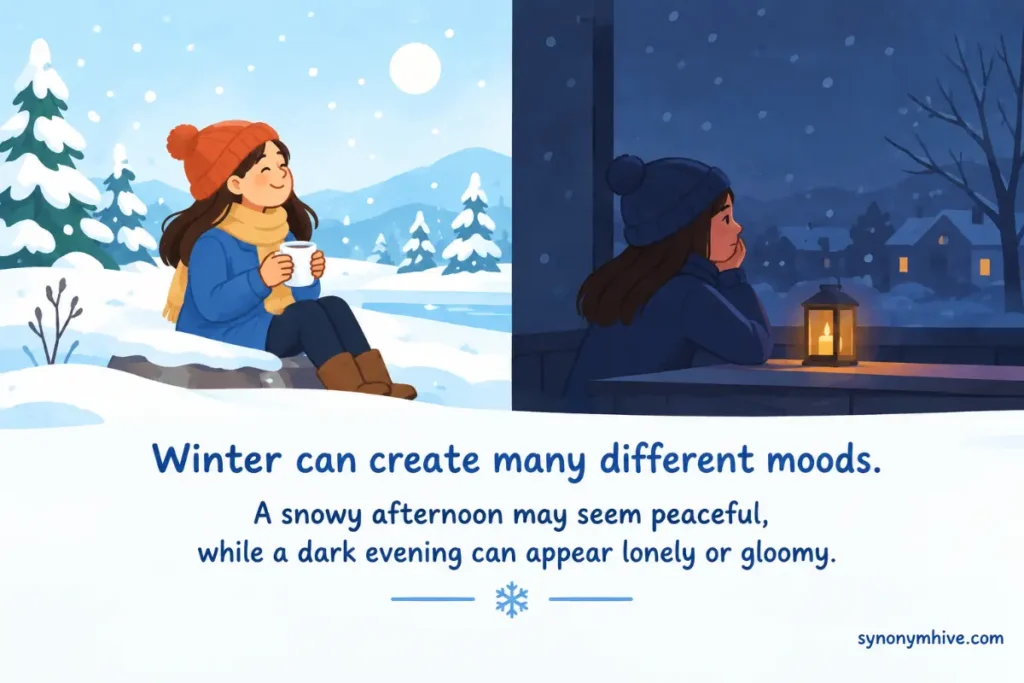
Winter can create many different moods. A snowy afternoon may seem peaceful, while a dark evening can appear lonely or gloomy. The mood depends on the weather, the setting, and the details you choose to emphasize.
Positive Words for Winter
Use these words when you want to show winter’s beauty, comfort, or charm.
|
Word
|
Meaning
|
Example
|
| — | — | — |
|
Peaceful
|
Calm and quiet.
|
A peaceful winter morning greeted us at the cabin.
|
|
Magical
|
So beautiful or unusual that it seems unreal.
|
Fresh snow gave the garden a magical look.
|
|
Cozy
|
Warm, comfortable, and inviting.
|
We spent a cozy evening beside the fireplace.
|
|
Serene
|
Calm and undisturbed.
|
A serene lake reflected the winter sky.
|
|
Charming
|
Pleasant and attractive.
|
The charming village glowed with holiday lights.
|
|
Sparkling
|
Shining with small flashes of light.
|
Sparkling frost covered the garden fence.
|
|
Inviting
|
Appealing and welcoming.
|
An inviting fire warmed the room.
|
|
Refreshing
|
Pleasantly cool or renewing.
|
The refreshing air cleared my head.
|
Positive words can make winter sound appealing without pretending that every winter day is pleasant. Cozy works best for warm indoor settings. Serene suits quiet outdoor scenes. Sparkling highlights light and movement.
For example, the cozy cabin stood beside a serene lake gives the reader two connected images. One suggests warmth and shelter, while the other creates a sense of calm.
Negative Words for Winter
Some scenes need words that show discomfort, sadness, or danger. These choices work well in serious stories, essays, and descriptions of severe weather.
|
Word
|
Meaning
|
Example
|
| — | — | — |
|
Miserable
|
Very uncomfortable or unhappy.
|
The miserable weather ruined our plans.
|
|
Dreary
|
Dull, gray, and depressing.
|
A dreary sky covered the town.
|
|
Bleak
|
Bare, cold, or without hope.
|
The bleak hillside looked empty.
|
|
Grim
|
Harsh, serious, or threatening.
|
Grim winter conditions slowed the rescue team.
|
|
Oppressive
|
Heavy or difficult to endure.
|
An oppressive cold settled over the valley.
|
|
Lonely
|
Lacking company or connection.
|
A lonely road crossed the frozen fields.
|
|
Hostile
|
Unfriendly or dangerous.
|
Hostile weather made the mountain route unsafe.
|
|
Forbidding
|
Seeming dangerous or unwelcoming.
|
The forbidding cliffs disappeared into the snow.
|
These words are not interchangeable. Dreary usually describes a dull scene or mood. Grim suggests something serious or threatening. Hostile works when the environment creates real difficulty or danger.
Choose negative language to match the scene. A gray afternoon may be dreary, but it does not need to be described as hostile unless the conditions are genuinely threatening.
Words for a Mysterious Winter Mood
Winter can also create suspense or mystery. Fog hides distant objects, snow muffles sounds, and darkness makes familiar places look different.
Consider words such as eerie, haunting, shadowy, hushed, ghostly, mysterious, and otherworldly.
- An eerie silence filled the snow covered woods.
- Ghostly branches appeared through the morning fog.
- A haunting stillness settled over the abandoned house.
- Shadowy shapes moved across the frozen lake.
- The mysterious forest disappeared into the mist.
Eerie suggests that something feels strange or unsettling. Haunting describes something that stays in the mind or creates a deep emotional effect. Ghostly often refers to a pale, faint, or unreal appearance.
These words work particularly well in fiction, poetry, and seasonal storytelling. They help build a mood instead of simply listing weather conditions.
Words to Describe Winter by Part of Speech
Adjectives usually do most of the work when you describe winter, but nouns and verbs can make your writing more varied. Using several parts of speech helps you create complete scenes instead of repeating the same descriptive pattern.
Adjectives for Winter
An adjective describes a person, place, object, or condition. These are some of the most useful adjectives for winter.
Cold describes low temperatures. Frosty describes frost or very cold conditions. Snowy describes snow. Wintry describes something typical of the season. Frigid describes extreme cold. Bleak suggests a bare or depressing scene. Crisp describes cool, fresh air. Serene suggests calm and quiet.
Examples include the following.
- The frigid air made the walk difficult.
- A crisp breeze crossed the open field.
- The bleak landscape stretched beneath the gray sky.
- Serene hills surrounded the frozen lake.
- Frosty branches framed the cottage window.
Nouns for Winter
Nouns name people, places, objects, events, or ideas. Winter related nouns can give your description more specific details.
Useful choices include frost, snowfall, flurries, sleet, slush, ice, blizzard, thaw, chill, and hibernation.
Frost is a thin layer of ice crystals that forms on cold surfaces. A blizzard is a severe snowstorm with strong winds and poor visibility. A thaw is a period when ice or snow melts. Slush is partly melted snow mixed with water.
Examples show how these nouns work.
- A thin layer of frost covered the grass.
- The snowfall continued through the night.
- Morning flurries dusted the pavement.
- The afternoon thaw revealed patches of brown grass.
- Slush collected along the edge of the road.
Specific nouns help readers picture what is happening. Snowfall tells the reader that snow is coming down. Thaw tells them that melting has begun. Each word adds information that a general term like winter weather cannot provide.
Verbs for Winter
Verbs describe actions or states. Strong winter verbs can make a scene more active and reduce the need for several adjectives.
Useful verbs include freeze, melt, drift, sparkle, shimmer, crackle, howl, blanket, glisten, and crunch.
Snow can drift across a road, blanket a field, or sparkle in sunlight. Ice can crackle under pressure. Wind can howl around a house. Frost can glisten on a window.
Consider these examples.
- Snow drifted across the empty road.
- Frost glistened on the garden gate.
- The lake froze during the cold spell.
- Bright sunlight made the ice shimmer.
- Boots crunched through the fresh snow.
- A strong wind howled around the cabin.
- Warm sunlight began to melt the snow.
Notice how the verbs bring movement into the description. The sentence snow fell on the field gives basic information. Snow drifted across the field adds a sense of wind and direction.
Explore another synonym guide: Words to Describe Eyes: Words for Eye Colors 2026.
Words to Describe Winter for Different Situations
The right vocabulary depends on your audience and purpose. A school essay needs clear descriptions, while a social media caption may benefit from a short and playful phrase. Professional writing usually calls for precise language rather than dramatic wording.
What Words Should You Use in a School Essay
For a school essay, choose words that are easy to understand and specific enough to create a picture. You do not need rare vocabulary to write well.
Useful choices include cold, snowy, frosty, peaceful, crisp, barren, icy, and quiet.
Example sentence.
The frosty morning covered the grass with tiny ice crystals, while the quiet streets waited for the first signs of activity.
This sentence works because it gives the reader a visual detail and a sense of atmosphere. It also avoids repeating the word cold several times.
For a longer essay, organize your details by topic. You might describe the weather in one paragraph, the landscape in another, and the mood of the season in a third.
What Words Should You Use in an Essay About Nature
Nature writing benefits from specific details about plants, animals, weather, and the land. Use words that explain what the natural world looks like or how it changes during the season.
Good choices include dormant, leafless, snow covered, windswept, frozen, evergreen, stark, and crystalline.
Example sentence.
Dormant plants rested beneath the frozen soil, while evergreen trees stood against the pale winter sky.
This description uses words that explain the condition of plants and trees. It gives readers a clearer picture than a sentence that simply says winter was cold and beautiful.
When writing about nature, be accurate. Some plants remain active in winter, and many regions do not receive snow. Describe the setting you are actually discussing rather than assuming every winter looks the same.
What Words Should You Use in a Story
Stories often need words that establish mood, setting, and tension. A writer may describe a pleasant winter morning at the beginning of a story, then shift to threatening weather as the plot develops.
Useful choices include eerie, hushed, bleak, bitter, haunting, shimmering, and desolate.
Example sentence.
A bitter wind swept through the hushed village, and the last streetlight flickered above the frozen road.
The words bitter and hushed create discomfort and silence. The flickering streetlight adds a visual detail that makes the scene more vivid.
For a warm, cheerful story, choose a different group of words. Cozy, sparkling, peaceful, and inviting can help create a welcoming setting.
What Words Should You Use in a Text or Social Media Caption
Short captions usually work best with familiar language and a clear image. You can use one strong adjective instead of a long description.
Try crisp, cozy, snowy, magical, frosty, chilly, or peaceful.
Examples include these captions.
- Crisp air and quiet trails.
- Cozy evenings and snowy windows.
- A little frost and a lot of sparkle.
- Snowy streets and warm drinks.
- Finding peace in the winter quiet.
These phrases are brief enough for a caption but still create a clear picture. If you want a funny or casual tone, you might write, Freezing outside, staying cozy inside.
What Words Should You Use in a Professional Email
Professional emails usually need clarity more than colorful language. If you are writing about weather related delays, travel, or outdoor plans, use precise terms.
Words such as icy, snowy, severe, freezing, inclement, and hazardous may be suitable depending on the situation.
Example sentence.
Due to icy road conditions, the morning delivery may arrive later than planned.
Another example is the outdoor meeting has been moved indoors because of severe winter weather.
These sentences explain the issue without adding unnecessary drama. For professional writing, describe the condition and its effect on the plan.
What Words Should You Use When Speaking
In conversation, familiar words usually sound most natural. People often say chilly, freezing, cold, snowy, windy, or crisp.
For example, you might say it is pretty chilly this morning, so bring a jacket.
You could also say the air is crisp, and it is a great day for a walk.
Use stronger words when they fit. It is freezing outside is common casual speech, even when the temperature is above the freezing point. In a scientific or safety related discussion, give the actual temperature if it matters.
More Than 10 Example Sentences About Winter
The examples below show how descriptive language works in everyday situations. Each sentence focuses on a different detail, so the season does not become a repeated list of cold weather words.
- The first snowfall covered the garden in a soft white blanket.
- A bitter wind swept across the bridge as commuters hurried home.
- Frosty windows framed the pale light of an early morning.
- The peaceful forest stood beneath a layer of fresh snow.
- Dark clouds gathered over the hills before the winter storm.
- Golden sunlight shone through the bare branches.
- The frozen pond reflected the trees along its edge.
- A blustery afternoon sent loose snow swirling across the field.
- The cozy kitchen smelled of cinnamon and freshly baked bread.
- A gloomy sky made the empty street seem even quieter.
- Crystalline frost sparkled on the fence after a clear night.
- The remote cabin offered shelter from the harsh mountain weather.
- Light flurries danced beneath the streetlights.
- The dreary afternoon called for a book and a warm blanket.
- Snow laden branches bent toward the narrow woodland path.
- A crisp breeze carried the scent of pine through the garden.
- Slushy snow gathered near the curb as the temperature rose.
- The stark landscape revealed every hill and every bare tree.
- A serene lake rested beneath the pale morning sky.
- The howling wind shook the shutters throughout the night.
These examples also show that strong descriptions do not require several adjectives in every sentence. One precise word can be enough when the rest of the sentence supplies useful details.
Close Synonyms and Their Differences
Many descriptive words seem interchangeable at first. However, small differences can change the meaning or mood of a sentence.
Cold vs Chilly
Cold is a broad word for a low temperature. Chilly usually suggests that the temperature is cool enough to cause discomfort.
The cold air froze the puddles overnight describes a low temperature and its effect. The chilly breeze made me reach for a sweater describes mild discomfort.
Use cold when the temperature itself matters. Choose chilly when you want a more casual description of how the weather affects someone.
Frosty vs Icy
Frosty often describes a thin coating of ice crystals on a surface or very cold weather. Icy describes actual ice, a slippery surface, or extreme cold.
Frosty grass sparkled in the sun gives a delicate visual image. Icy steps made the entrance dangerous highlights a safety concern.
The distinction is useful because frost and ice form in different ways and create different conditions. A surface can look frosty without being covered in a thick layer of ice.
Bleak vs Dreary
Bleak suggests a bare, harsh, or hopeless quality. Dreary usually describes something dull, gray, or depressing.
The bleak fields stretched beyond the abandoned house creates an image of emptiness and hardship. A dreary afternoon passed beneath the clouds focuses more on dull weather and mood.
Choose bleak for a stronger sense of emptiness or severity. Use dreary when the main impression is dullness or gloom.
Peaceful vs Serene
Peaceful suggests a lack of disturbance, conflict, or noise. Serene suggests a deeper calm and often has a graceful or beautiful quality.
The peaceful village slept beneath the snow focuses on quiet surroundings. A serene lake reflected the snowy mountains emphasizes calm beauty.
Both words are positive, but serene often sounds slightly more formal or literary.
Snowy vs Snow Covered
Snowy can describe a place, day, or period that has snow or receives snowfall. Snow covered specifically means that a surface has a layer of snow.
It was a snowy afternoon tells us about the conditions. The snow covered roof gleamed in the sunlight tells us what the roof looked like.
Use snowy for a broad description. Choose snow covered when the layer of snow on a specific object or area matters.
Common Mistakes When Describing Winter
Good descriptive writing depends on accuracy and variety. Some common habits can make a winter description vague, repetitive, or misleading.
Using Cold for Every Detail
Cold is useful, but repeating it can flatten a paragraph. Instead of writing cold air, cold trees, cold streets, and cold weather, identify the details that matter.
You might describe icy streets, bare trees, a biting wind, and a gray sky. Each phrase gives the reader a different piece of information.
Choosing Words That Are Too Strong
Do not describe a slightly cool morning as brutal or arctic. Those words suggest much harsher conditions.
Match the word to the facts. Chilly works for mild discomfort, while frigid suggests extreme cold. Inclement is suitable for unpleasant or severe weather, especially when it interferes with travel or outdoor activity.
Confusing Weather With Mood
A word can describe physical conditions, emotions, or both. Gloomy may refer to dark weather, a sad mood, or a scene that creates sadness. Peaceful describes a calm atmosphere but does not tell the reader the temperature.
Check what your sentence needs. If you are describing the sky, overcast may be more precise than gloomy. If you are describing the mood of a quiet village, peaceful may be a better choice than cold.
Assuming Every Winter Is Snowy
Winter looks different around the world. Some areas have heavy snowfall, while others have rain, fog, dry air, or mild temperatures.
If you are describing a winter scene in a warm region, words such as cool, damp, breezy, overcast, or mild may be more accurate than snow covered or frozen.
Adding Too Many Adjectives
Several adjectives in a row can make writing feel crowded. A phrase such as the cold, freezing, icy, bitter, snowy morning repeats related ideas.
Choose the word that carries the most useful meaning. Then add a detail that gives the reader something new.
For example, the bitter wind sent snow across the road is clearer and more active than a long string of similar adjectives.
Antonyms for Winter Descriptions
Antonyms are words with opposite or contrasting meanings. They help you describe a change in weather or compare winter with another season.
|
Winter Word
|
Opposite or Contrast
|
Example
|
| — | — | — |
|
Cold
|
Warm or hot.
|
The warm afternoon melted the remaining frost.
|
|
Frozen
|
Thawed.
|
The thawed ground softened beneath our feet.
|
|
Snowy
|
Snowless.
|
The snowless hillside showed patches of brown grass.
|
|
Icy
|
Ice free.
|
The ice free path was safe to cross.
|
|
Gloomy
|
Bright or cheerful.
|
A bright sky lifted the mood of the town.
|
|
Bleak
|
Lush or inviting.
|
A lush garden looked very different from the bare winter field.
|
|
Dormant
|
Active or growing.
|
The plants became active again in spring.
|
|
Harsh
|
Mild.
|
Mild weather allowed the workers to return outdoors.
|
|
Still
|
Moving or lively.
|
A lively breeze moved through the trees.
|
|
Dark
|
Bright or light.
|
Bright sunlight filled the room.
|
Some words do not have a single exact opposite. For example, the opposite of blustery might be calm, still, or windless, depending on the sentence. Pick the contrast that makes sense for your context.
Quick Tips for Choosing the Right Winter Word
Use these simple guidelines when you want a description that sounds natural and clear.
1. Start with the detail you can observe. Decide if the main feature is temperature, snow, wind, light, scenery, or mood.
2. Match the intensity. Use chilly for mild discomfort, cold for a general low temperature, and frigid for extreme cold.
3. Choose a word that adds new information. If you have already mentioned snow, consider describing the light, trees, wind, or sounds instead of repeating snowy.
4. Think about your audience. Simple words usually work best for school assignments and everyday messages. Formal vocabulary may suit reports and literary analysis.
5. Use verbs to create movement. Snow can drift, ice can shimmer, wind can howl, and frost can glisten.
6. Keep your description accurate. Do not call a surface frozen if it is only wet, or describe weather as arctic when the conditions are mild.
7. Read the sentence aloud. If a word sounds unnatural or too dramatic, replace it with a simpler choice.
8. Let details carry the mood. A silent street, a dim window, and bare branches can create a lonely atmosphere without directly stating that the scene is sad.
Need a similar word? Read words to describe the ocean Best Guide.
Conclusion
The strongest winter descriptions come from choosing words that match the scene. Cold, chilly, and frigid describe different levels of temperature. Frosty, icy, and snow covered help readers picture the surface of the land. Peaceful, bleak, cozy, and eerie express different moods.
When searching for words to describe winter, start by deciding what matters most in your sentence. Is the weather uncomfortable, the scenery beautiful, or the mood quiet and mysterious? Choose one or two precise terms, then support them with a real detail, such as wind moving through bare branches or frost shining in the morning sun.
You do not need complicated vocabulary to write well. A clear word used in the right place often creates a stronger image than several fancy words packed together. Keep this list nearby when writing an essay, story, caption, or seasonal message, and choose the words that help your reader picture the winter you have in mind.
Frequently Asked Questions
What are the best words to describe winter?
The best words to describe winter include cold, snowy, frosty, crisp, icy, peaceful, bleak, cozy, and wintry. The right choice depends on the weather and mood you want to express. Use precise words rather than repeating cold in every sentence.
What are five adjectives that describe winter?
Five useful adjectives are chilly, snowy, frosty, blustery, and peaceful. Chilly describes mild discomfort, snowy refers to snow, frosty suggests frost or intense cold, blustery describes strong winds, and peaceful expresses a calm atmosphere.
What are some positive words to describe winter?
Positive choices include cozy, magical, serene, sparkling, refreshing, charming, and peaceful. These words can describe warm indoor moments, beautiful snowy scenery, or calm winter mornings. Pick a word that matches the scene instead of forcing every winter description to sound cheerful.
What are some negative words to describe winter?
Negative words include bleak, dreary, harsh, bitter, miserable, gloomy, and unforgiving. They can describe severe weather, bare scenery, or a sad atmosphere. Use stronger terms when the scene supports them.
What’s another way to say winter is cold?
You can say winter is chilly, freezing, frigid, bitter, or icy, depending on the conditions. Chilly suggests moderate discomfort, while frigid and freezing communicate much stronger cold. For formal writing, you could say temperatures remained very low.
How can I describe winter in a creative way?
Focus on specific sights, sounds, and sensations. You might describe frost sparkling on a fence, wind whispering through bare branches, or snow muffling the sounds of a quiet street. Strong verbs and precise details often create a more vivid picture than a long list of adjectives.
Which words to describe winter work best in a poem?
Words such as hushed, crystalline, bleak, shimmering, dormant, and haunting can work well in poetry. They offer visual detail, sound, and mood. Choose words that fit the poem’s rhythm and meaning rather than using unusual vocabulary only to sound poetic.