
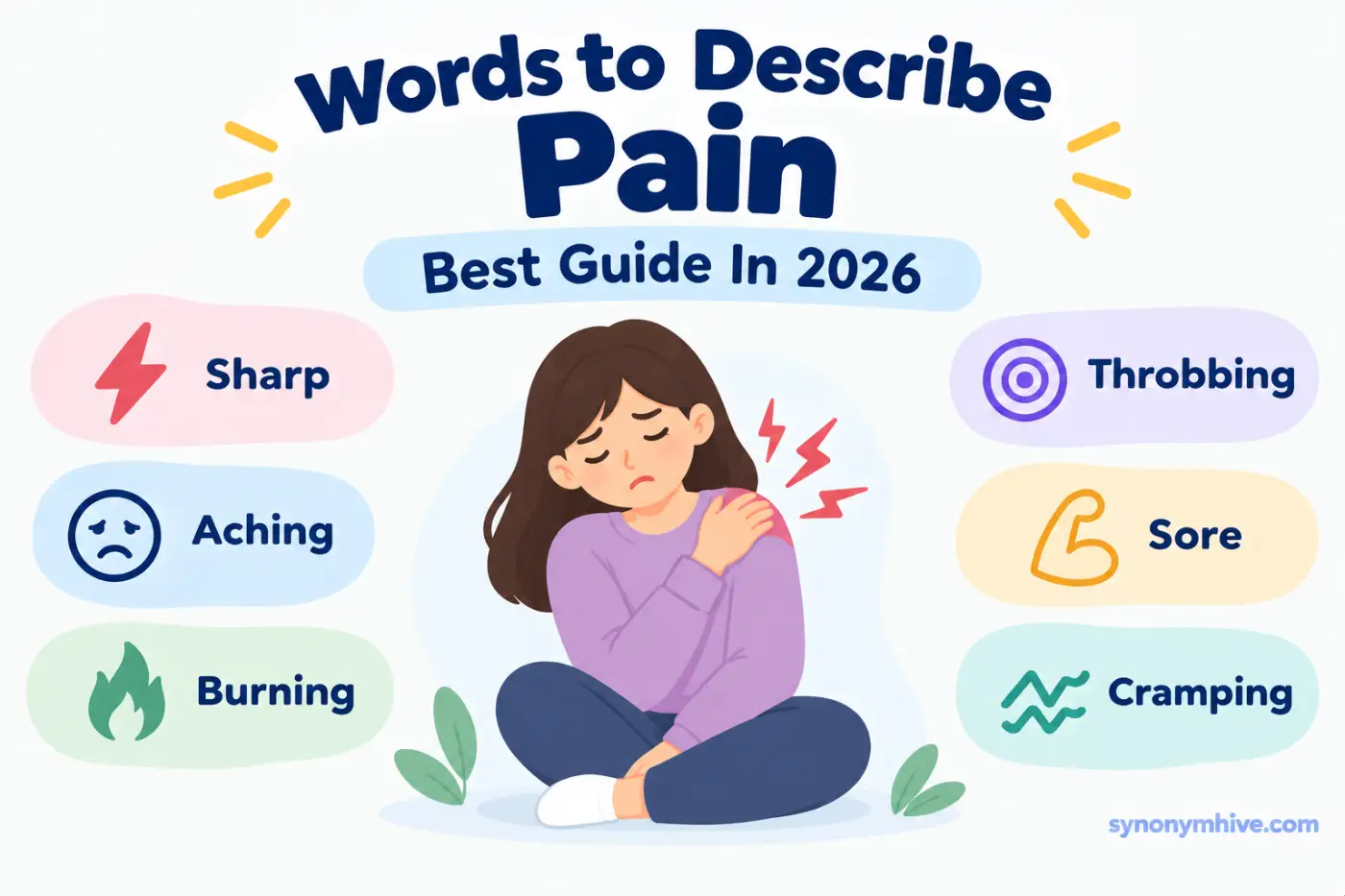
Finding the right words to describe pain can be harder than describing the pain itself. You may be writing a message to a doctor, explaining an injury in an essay, filling out a health form, or simply trying to tell someone how you feel. Saying that something hurts is easy. Explaining exactly how it hurts takes more care.
The best words to describe pain depend on the type, strength, location, and timing of the pain. Words such as sore, aching, tender, sharp, throbbing, burning, stabbing, crushing, and unbearable can give a much clearer picture than simply saying painful.
The right description can help another person understand the experience more clearly. A word like sore suggests something different from stabbing. Burning pain is different from a dull ache. Mild discomfort is not the same as agony.
This guide explains the most useful terms, from simple everyday words to stronger descriptions. You will also learn how to describe pain in writing, choose words by intensity, compare similar terms, avoid common mistakes, and pick the best expression for a specific situation.
Compare more word options with Words to Describe Joy Best Guide In 2026.
Quick Definition
Terms to describe pain are terms that explain how physical or emotional pain feels, how strong it is, where it occurs, and how long it lasts. Common choices include aching, sharp, dull, burning, throbbing, stabbing, tender, severe, mild, and unbearable.
What Are the Best Words to Describe Pain?
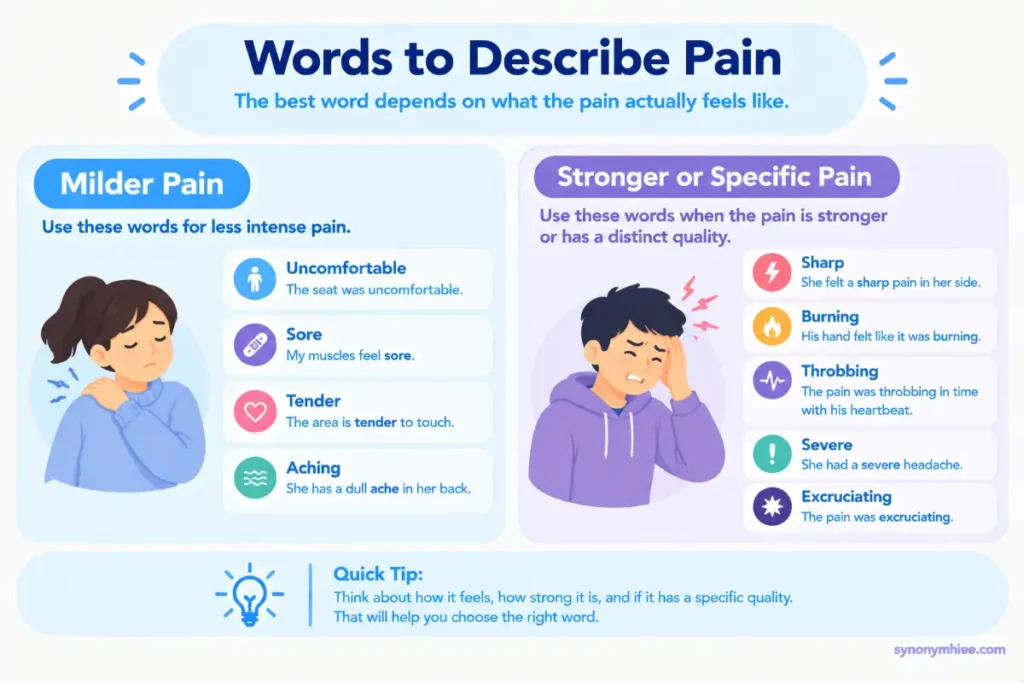
The best word depends on what the pain actually feels like. Use mild terms such as uncomfortable, sore, tender, or aching for less intense pain. Use sharp, stabbing, burning, throbbing, severe, or excruciating when the pain is stronger or has a distinct quality.
A clear description often combines more than one detail. For example, you might say, “I have a sharp pain in my lower back that gets worse when I bend.” That gives more information than simply saying, “My back hurts.”
Master List of Words to Describe Pain
The following table groups useful pain words by how they sound in everyday communication. Some are simple and familiar. Others are more formal or expressive.
| Word | Meaning | Tone | Example |
|---|---|---|---|
| Sore | Painful or sensitive, often after activity or injury | Simple | My legs are sore after the hike. |
| Aching | A steady, often dull pain | Everyday | I have an aching pain in my shoulder. |
| Pounding | Strong pain that seems to beat repeatedly | Everyday | My head is pounding. |
| Dull | Low level pain without a sharp quality | Everyday | There is a dull ache in my knee. |
| Intense | Very strong or difficult to ignore | Formal | The pain became intense after the fall. |
| Severe | Extremely serious or strong | Formal | He reported severe pain in his abdomen. |
| Excruciating | Extremely painful | Strong | The injury caused excruciating pain. |
| Agonizing | Causing extreme physical or emotional suffering | Strong | The wait was agonizing because of the pain. |
| Debilitating | So painful that normal activity becomes difficult | Formal | The condition caused debilitating pain. |
| Unbearable | Too painful to tolerate | Strong | The pain became unbearable. |
| Piercing | Sharp and intense | Strong | A piercing pain ran through her ear. |
| Crushing | Heavy, intense, squeezing pain | Strong | He described a crushing pain in his chest. |
| Splitting | Extremely strong, usually describing a headache | Everyday | She had a splitting headache. |
| Miserable | Causing strong discomfort or distress | Everyday | I have been miserable with this toothache. |
| Nagging | Mild but persistent and annoying | Everyday | A nagging pain stayed in his shoulder. |
| Relentless | Continuing without giving much relief | Strong | The relentless pain made it hard to sleep. |
| Excruciating | Extremely severe or unbearable | Formal | The patient described the pain as excruciating. |
| Raw | Feeling exposed, irritated, or painfully sensitive | Descriptive | The skin felt raw after the scrape. |
| Tenderhearted | Emotional sensitivity rather than physical pain | Figurative | He was tenderhearted after the loss. |
The last example shows why context matters. Not every word connected with pain describes a physical sensation. Some words can describe emotional suffering or sensitivity.
Where Does the Word Pain Come From?
The English word pain has a long history. It comes through Old French from Latin poena, meaning punishment or penalty. The same Latin root is connected to the idea of suffering and punishment.
Over time, pain became a general English word for physical suffering. Today, it can also describe emotional distress. Someone can experience physical pain from an injury, or emotional pain after losing someone they love.
This history helps explain why pain has such a wide meaning. It can refer to a physical sensation, mental suffering, hardship, or even an effort that causes difficulty.
For example, “The pain in my shoulder is getting worse” refers to physical discomfort. “The pain of losing a close friend was difficult to express” refers to emotional suffering.
How Do Pain Words Differ by Intensity?
Not all pain words mean the same level of discomfort. Choosing the right intensity makes your writing more accurate.
Mild Pain
Use mild terms when the discomfort is noticeable but manageable.
Common choices include:
- Uncomfortable.
- Slightly painful.
- Sore.
- Tender.
- Aching.
- Irritating.
- Nagging.
- Sensitive.
- Mild.
- Minor.
Examples:
“My ankle is slightly sore after the game.”
“I have a mild ache in my neck.”
“The skin is tender around the cut.”
A mild description should not make a small problem sound extreme. If you can continue your normal activity without much trouble, a word such as mild, sore, or uncomfortable may fit better than severe.
Moderate Pain
Moderate pain is stronger and harder to ignore, but it may still be manageable.
Useful terms include:
- Persistent.
- Noticeable.
- Strong.
- Throbbing.
- Sharp.
- Burning.
- Cramping.
- Intense.
- Significant.
- Distracting.
Examples:
“The headache became strong enough to distract me from my work.”
“I have a persistent ache in my lower back.”
“The pain is moderate but gets worse when I walk.”
Severe Pain
Strong pain calls for stronger language. Terms such as severe, intense, excruciating, unbearable, agonizing, and debilitating communicate a high level of suffering.
Examples:
“The injury caused severe pain when he tried to stand.”
“She described the headache as excruciating.”
“The pain became unbearable during the night.”
Choose strong words carefully. If every minor ache is called excruciating, the description loses accuracy.
What Are the Different Types of Pain?
Pain can differ in quality as well as intensity. Two people can have pain that is equally strong but describe it in very different ways.
Sharp Pain
Sharp pain can feel sudden, pointed, or cutting. It may appear quickly and may be triggered by movement.
Example:
“I felt a sharp pain when I twisted my knee.”
The word sharp works well when the sensation seems sudden or focused.
Dull Pain
Dull pain is usually less pointed. It may feel like a steady ache that stays in one area.
Example:
“I have a dull pain behind my eyes.”
Dull does not always mean mild. A dull pain can still be strong and persistent.
Throbbing Pain
Throbbing pain seems to pulse or beat. The word is often used for headaches, toothaches, and some injuries.
Example:
“My tooth has been throbbing since yesterday.”
The word connects the pain with a repeated pulsing sensation.
Burning Pain
Burning pain can feel hot, fiery, or irritated.
Example:
“There is a burning sensation in my shoulder.”
Burning describes the quality of the sensation rather than simply its strength.
Stabbing Pain
Stabbing pain feels sharp and pointed. The word creates a strong image because it compares the sensation to being stabbed.
Example:
“I felt a stabbing pain in my side when I took a deep breath.”
This term is stronger and more vivid than simply saying sharp.
Cramping Pain
Cramping describes pain that feels tight, squeezing, or contracting.
Example:
“My stomach is cramping after the meal.”
The term is often used for muscle or stomach discomfort.
Stinging Pain
Stinging pain feels sharp, irritating, or biting. It is often associated with cuts, scratches, irritated skin, or minor wounds.
Example:
“The scrape caused a stinging sensation when I washed it.”
Pounding Pain
Pounding pain feels forceful and repetitive. It is especially common in descriptions of headaches.
Example:
“I woke up with a pounding headache.”
Piercing Pain
Piercing suggests pain that seems to pass sharply through a specific area.
Example:
“A piercing pain shot through his ear.”
This word is more vivid than simply saying painful.
Which Words Describe Pain by Duration?
The length of time pain lasts is another useful detail.
Temporary Pain
Temporary pain lasts for a short period.
Useful words include:
- Brief.
- Short lived.
- Sudden.
- Temporary.
- Passing.
- Momentary.
Example:
“I felt a brief sharp pain when I stood up.”
Persistent Pain
Persistent pain continues for a long time or keeps returning.
Example:
“She has persistent pain in her shoulder.”
Persistent does not automatically mean severe. It only tells the reader that the pain continues.
Constant Pain
Constant pain does not seem to stop.
Example:
“The pain has been constant since yesterday.”
Constant is stronger than occasional because it suggests the sensation remains present.
Intermittent Pain
Intermittent pain comes and goes.
Example:
“I have intermittent pain in my lower back.”
This term is useful in formal writing because it clearly explains that the pain is not present all the time.
Recurring Pain
Recurring pain returns after going away.
Example:
“His knee pain keeps recurring after long walks.”
Recurring focuses on the repeated pattern rather than how long each episode lasts.
What Words Describe the Location of Pain?
A good description can also explain where the pain occurs.
Common location words include:
- Localized.
- Widespread.
- Generalized.
- Central.
- One sided.
- Deep.
- Surface level.
- Around.
- Behind.
- Beneath.
- Along.
- Near.
For example:
“The pain is localized to my right shoulder.”
“I have a deep ache in my lower back.”
“The discomfort is mostly around my knee.”
“The pain spreads along my arm.”
These phrases help make a description more precise without requiring complicated language.
What Words Describe Pain That Spreads?
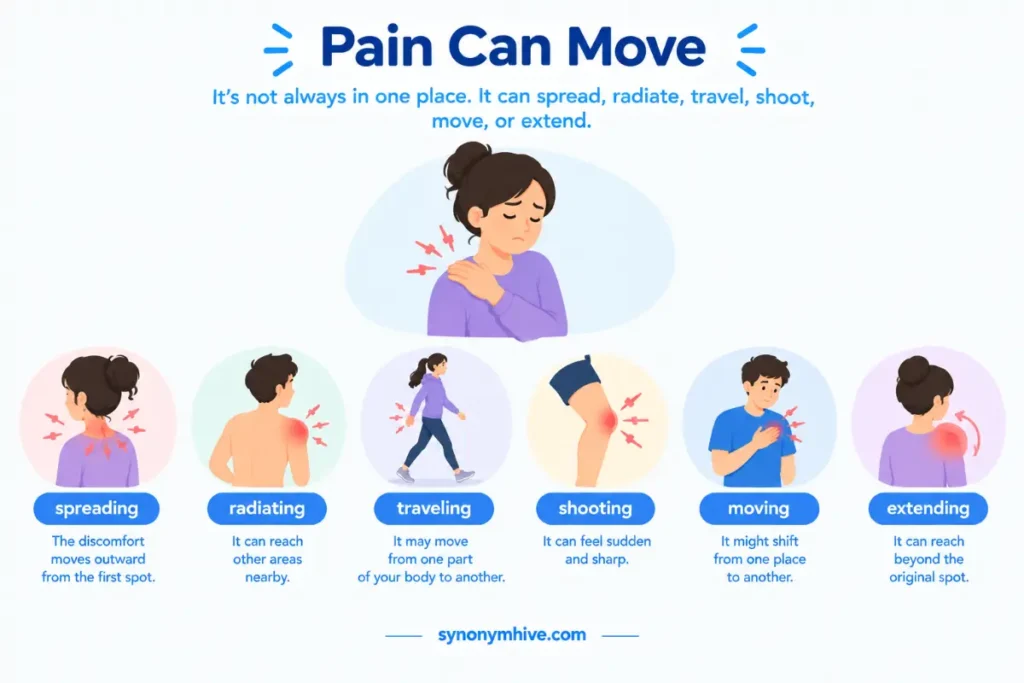
Pain does not always stay in one place. You can use words such as spreading, radiating, traveling, shooting, moving, or extending to explain this pattern.
Examples:
“The pain spreads from my neck into my shoulder.”
“I have a shooting pain that travels down my leg.”
“The discomfort seems to radiate from my lower back.”
“Pain moves from my hip toward my thigh.”
Radiating is especially useful when pain seems to move outward from one central area. Shooting can describe a sudden sensation that travels along a path.
How Do You Describe Pain in a Resume?
Pain is not usually a resume topic, but the phrase may appear when describing work related to health, caregiving, nursing, physical therapy, research, or patient support.
In professional writing, choose precise words instead of dramatic ones.
For example:
“Recorded patient reports of severe and persistent pain.”
“Assisted patients experiencing chronic discomfort.”
“Documented changes in pain intensity during treatment.”
“Communicated patient reports of sharp or throbbing pain to clinical staff.”
Professional writing should focus on clear facts. Words such as severe, persistent, acute, chronic, localized, and intermittent often work better than highly emotional terms.
How Do You Describe Pain in an Essay?
An essay can use more descriptive language. The best choice depends on the subject.
For an academic essay:
“The character experiences persistent emotional pain after the loss of her family.”
For a personal essay:
“A dull ache settled in my shoulder after hours of carrying the bag.”
For creative writing:
“A sharp pain flashed through his leg.”
Avoid using dramatic words simply to make a sentence sound powerful. The strongest descriptions usually work because they match the situation.
How Do You Describe Pain in a Text Message?
Text messages usually need simple, natural language.
You might say:
“My head is pounding.”
“My back is really sore.”
“I have a sharp pain in my side.”
“My tooth is throbbing.”
“My stomach is cramping.”
“The pain is getting worse.”
These expressions sound natural in everyday American English. You do not need a formal term when talking with a friend.
How Do You Describe Pain in an Email?
Email language depends on the reader. A message to a friend can be casual, while a workplace or medical message may need a more direct tone.
For a casual email:
“I’ve had a dull headache all morning.”
For a professional message:
“I am experiencing persistent back pain and may need to leave early for an appointment.”
For a school message:
“I have been experiencing severe pain since last night and may not be able to attend class today.”
The key is to give useful information without making the message longer than necessary.
How Do You Describe Pain When Speaking?
Spoken descriptions usually sound best when they are simple.
You can describe:
- Where the pain is.
- What it feels like.
- How strong it is.
- When it started.
- What makes it better or worse.
- How often it happens.
For example:
“I have a sharp pain in my right knee. It started this morning, and it gets worse when I walk.”
That sentence gives several useful details without sounding complicated.
What Are the Best Words for Emotional Pain?
Pain does not always involve the body. English also has many words for emotional suffering.
Useful choices include:
- Hurt.
- Sadness.
- Grief.
- Heartbreak.
- Distress.
- Anguish.
- Sorrow.
- Loneliness.
- Regret.
- Despair.
- Misery.
- Suffering.
- Emotional exhaustion.
- Devastation.
These words are not interchangeable.
Grief usually relates to loss. Heartbreak often relates to deep emotional loss or the end of a close relationship. Anguish suggests intense emotional suffering. Loneliness describes the pain of feeling alone or disconnected.
Examples:
“She was overwhelmed by grief after her father’s death.”
“The breakup left him heartbroken.”
“He spoke openly about the emotional pain he had experienced.”
“Years of regret caused lasting distress.”
Pain Versus Ache
Pain is the broader word. It can describe many kinds of discomfort.
Ache often suggests a steady, dull, or lasting discomfort.
Compare these sentences:
“I have pain in my knee.”
“I have an ache in my knee.”
The first sentence gives general information. The second suggests a more specific type of discomfort.
Ache also appears naturally in compound words such as headache, toothache, stomachache, and backache.
Looking for another word? See words to describe success Best Guide in 2026.
Sharp Versus Stabbing Pain
Sharp and stabbing are similar, but stabbing creates a stronger image.
Stabbing pain sounds more severe and resembles the sensation of being struck by something pointed.
Compare:
“I felt a sharp pain in my shoulder.”
“I felt a stabbing pain in my shoulder.”
The second sentence gives a stronger mental image. Use sharp when you want a broad description. Use stabbing when the sensation truly feels piercing and severe.
Sore Versus Tender
Sore usually means that an area hurts or feels painful.
Tender often means that the area hurts when touched or pressed.
Compare:
“My muscles are sore after exercise.”
“My shoulder is tender when I touch it.”
This difference is useful because tenderness tells the reader something about how the pain responds to touch.
Aching Versus Throbbing
Aching usually describes a steady, dull discomfort.
Throbbing suggests a repeated pulse or beat.
Compare:
“I have an aching pain in my back.”
“I have a throbbing pain in my head.”
The first sounds steady. The second suggests a rhythmic sensation.
Burning Versus Stinging
Burning and stinging can both describe irritating pain, but they create different images.
Stinging suggests a sharp, biting sensation.
Compare:
“The cream caused a burning sensation.”
“The cut caused a stinging sensation.”
Choosing between these words makes your description more exact.
Acute Versus Chronic Pain
Acute pain generally refers to pain that begins suddenly and is often linked to an injury, illness, procedure, or other clear event. Chronic pain generally refers to pain that continues or returns over a long period.
The terms are not simply synonyms for severe and mild. Acute pain can be intense or mild. Chronic pain can also be mild, moderate, or severe.
For example:
“The patient reported acute pain after the injury.”
“The patient has chronic back pain.”
These terms are common in medical and health related writing, but everyday readers may prefer simpler wording when the formal distinction is not needed.
Common Mistakes When Describing Pain
One common mistake is using the strongest word available. Calling every headache excruciating can make the description sound less trustworthy.
Another mistake is giving only an intensity word. Saying “I have severe pain” tells the reader that the pain is strong, but it does not explain what it feels like or where it occurs.
A stronger description might be:
“I have severe, throbbing pain behind my right eye.”
Another mistake is using words that do not match the sensation. Burning, stabbing, aching, and cramping each suggest different qualities.
It is also easy to confuse physical and emotional meanings. The sentence “I am hurting” can describe a physical injury or emotional distress. Context tells the reader which meaning you intend.
When Should You Not Use a Strong Pain Word?
Avoid words such as excruciating, unbearable, agonizing, and debilitating unless they truly fit the situation.
These words suggest very high levels of suffering.
For example:
“The paper cut caused unbearable pain.”
The sentence is possible in a fictional or humorous context, but it usually sounds exaggerated in a normal description.
A better choice might be:
“The paper cut caused a sharp sting.”
Strong language should add accuracy, not drama.
What Are the Antonyms of Pain?
The opposite of pain depends on the context.
For physical pain, possible opposites include:
- Comfort.
- Relief.
- Ease.
- Wellness.
- Comfortableness.
- Numbness.
For emotional pain, possible opposites include:
- Happiness.
- Joy.
- Peace.
- Contentment.
- Relief.
- Calm.
Numbness is an interesting case because it does not always mean comfort. A numb area may have reduced sensation rather than a pleasant feeling.
What Are the Best Words to Describe Pain in Creative Writing?
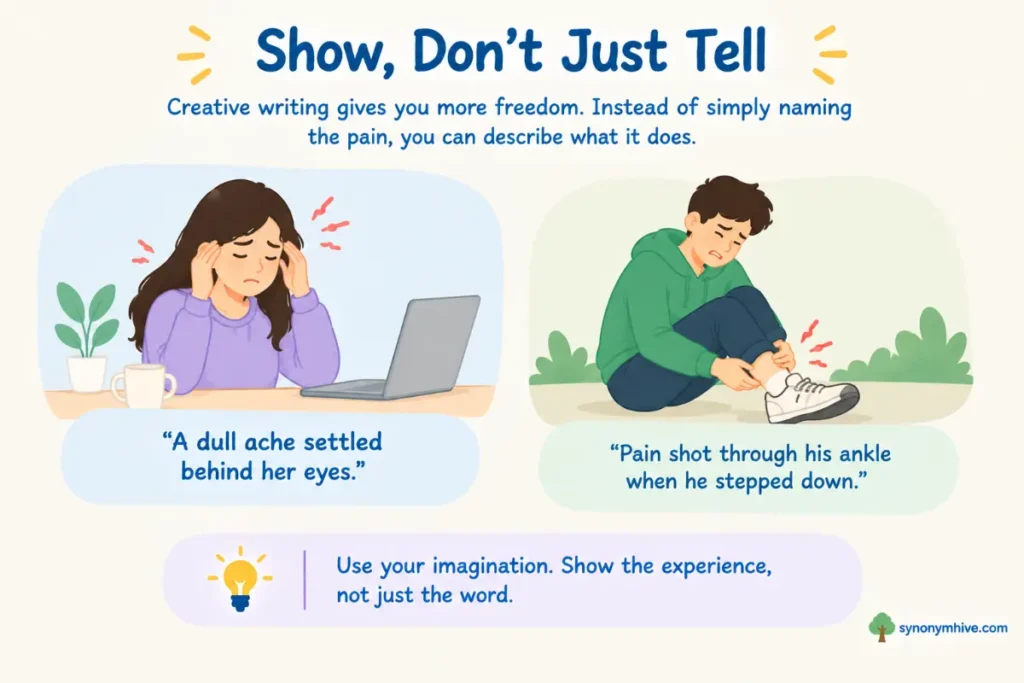
Creative writing gives you more freedom. Instead of simply naming the pain, you can describe what it does.
For example:
“A dull ache settled behind her eyes.”
“Pain shot through his ankle when he stepped down.”
“His shoulder burned after carrying the heavy box.”
“Her chest tightened as grief washed over her.”
“Each step sent a sharp jolt through his knee.”
These examples work because they show the sensation instead of repeating the word pain.
You can also describe physical reactions:
“He winced.”
“She grabbed her side.”
“He pulled his hand away.”
“She clenched her jaw.”
“His face tightened.”
These verbs add detail without requiring another adjective.
Ten Practical Examples of Pain Descriptions
The following examples show how different words work in real sentences.
- “I have a dull ache in my lower back after sitting all day.”
- “She felt a sharp pain in her ankle when she stepped off the curb.”
- “His tooth had been throbbing for most of the night.”
- “The cut caused a brief stinging sensation.”
- “My legs are sore after yesterday’s workout.”
- “The bruise is tender when I press on it.”
- “A burning sensation spread across her shoulder.”
- “He experienced severe pain after the accident.”
- “The headache became so intense that she had trouble focusing.”
- “A stabbing pain suddenly ran through his side.”
- “The stomach cramps came and went throughout the afternoon.”
- “She described the pain as constant and exhausting.”
- “The discomfort was mild at first but became stronger later.”
- “His knee pain returned after he started running again.”
- “The injury caused persistent discomfort for several days.”
Notice that each sentence gives more than a simple label. Some tell you how the pain feels. Others tell you how long it lasts or when it happens.
How Can You Make a Pain Description More Precise?
A useful formula is:
Location + sensation + intensity + timing + trigger.
For example:
“I have a sharp pain in my left knee that becomes severe when I climb stairs.”
The location is the left knee. The sensation is sharp. The intensity is severe. The trigger is climbing stairs.
You do not always need all five details. Use the ones that matter.
Another example is:
“I have a dull headache that has lasted since this morning.”
This gives the sensation and timing without adding unnecessary detail.
How Do You Choose the Right Word?
Start with the basic sensation. Ask yourself what the pain actually feels like.
If it feels like pressure or a beat, try throbbing or pounding.
If it feels pointed, try sharp or stabbing.
Next, think about intensity. A mild ache should not automatically become severe pain. Match the word to the experience.
Finally, consider the audience. A doctor may need precise details. A friend may only need a simple sentence. A story may benefit from vivid imagery.
Are Some Pain Words More Formal Than Others?
Yes. English has casual, everyday, and formal ways to describe discomfort.
Casual terms include sore, hurting, aching, throbbing, and hurting badly.
Everyday descriptive terms include sharp, burning, stabbing, tender, pounding, and cramping.
More formal terms include severe, persistent, intermittent, localized, chronic, acute, and debilitating.
A medical form might ask about the intensity and location of pain. A friend may simply ask, “What hurts?”
Good writing does not always use the most formal word. It uses the word that fits the reader and situation.
What Are the Best Pain Words for Different Situations?
The best choice changes with context.
| Situation | Useful Words | Example |
|---|---|---|
| Casual conversation | Sore, aching, hurting | My shoulder is really sore. |
| Text message | Hurting, pounding, sharp | My head is pounding. |
| Persistent, severe, uncomfortable | I am experiencing persistent back pain. | |
| Essay | Aching, intense, emotional, severe | The character suffers intense emotional pain. |
| Creative writing | Piercing, stabbing, burning, crushing | A stabbing pain ran through his leg. |
| Formal report | Severe, acute, chronic, intermittent | The patient reported intermittent pain. |
| Personal story | Sore, aching, throbbing, unbearable | My ankle was throbbing after the fall. |
| Medical discussion | Localized, radiating, persistent, acute | The pain is localized near the right hip. |
The goal is not to choose the fanciest word. The goal is to choose the clearest one.
How Can You Describe Pain Without Repeating the Word Pain?
You do not have to use pain in every sentence.
Try words such as:
- Ache.
- Discomfort.
- Soreness.
- Tenderness.
- Agony.
- Distress.
- Sensation.
- Irritation.
- Throbbing.
- Burning.
- Cramping.
- Hurt.
You can also describe the physical reaction.
“He winced.”
“She rubbed her shoulder.”
“He struggled to stand.”
“She clenched her teeth.”
“His breathing became shallow.”
This approach makes writing more natural and avoids repetition.
Quick Tips for Choosing the Right Pain Word
Keep these simple rules in mind.
- Use aching for steady, dull discomfort.
- Use sharp for sudden or pointed pain.
- Use stabbing for a stronger pointed sensation.
- Use throbbing for pain that seems to pulse.
- Use burning for a hot or fiery feeling.
- Use cramping for squeezing or tightening pain.
- Use tender when touch makes an area hurt.
- Use sore for general muscle or body discomfort.
- Use severe for very strong pain.
- Use persistent when pain continues.
- Use intermittent when pain comes and goes.
- Use chronic for pain that lasts over a long period.
- Use acute for pain that begins suddenly or relates to a recent condition or injury.
- Use unbearable when the pain is extremely difficult to tolerate.
- Use excruciating for extremely severe pain.
- Add the location when it helps.
- Add the timing when it matters.
- Add a trigger when movement or another action changes the pain.
- Do not exaggerate mild discomfort.
- Pick the simplest accurate word for your reader.
Discover another helpful synonym list in Words to Describe Kindness: Best Word Choices In 2026.
Conclusion
Choosing the right words to describe pain comes down to accuracy. Start by asking what the sensation feels like. Then consider how strong it is, where it occurs, how long it lasts, and what makes it better or worse.
Words such as aching, sharp, throbbing, burning, stabbing, cramping, sore, and tender each give the reader a different picture. Stronger terms such as severe, excruciating, unbearable, and debilitating should be saved for situations that truly call for them.
A simple description is often the strongest one. Instead of saying only that something hurts, explain what the sensation feels like and add one or two useful details. “I have a sharp pain in my right knee that gets worse when I walk” gives a much clearer picture than “My knee hurts.”
When you’re unsure, choose the simplest accurate word. Clear language helps your reader understand the experience without making the description sound forced or exaggerated.
Frequently Asked Questions
What are the best phrases to describe pain?
The best words depend on the type and intensity of the pain. Common choices include aching, sharp, dull, throbbing, burning, stabbing, cramping, sore, tender, severe, and unbearable.
What’s another way to say pain?
Another way to say pain is ache, discomfort, soreness, tenderness, agony, or distress. The best choice depends on the kind of pain and the situation.
What words describe severe pain?
Words such as excruciating, unbearable, agonizing, debilitating, intense, severe, crushing, and relentless can describe very strong pain. Use the strongest terms only when they accurately match the experience.
What are good words to describe pain in writing?
Good choices include sharp, aching, throbbing, burning, stabbing, piercing, dull, crushing, and persistent. In creative writing, you can also describe how the character reacts instead of naming the sensation directly.
What words describe mild pain?
Mild pain can be described as uncomfortable, sore, tender, aching, irritating, nagging, slight, or minor. These words work well when the discomfort is noticeable but manageable.
How do you describe pain in a professional way?
Use clear terms such as severe, mild, persistent, intermittent, localized, radiating, acute, or chronic when they accurately describe the experience. Add the location, timing, intensity, and triggers when those details matter.
What are the best terms to describe pain emotionally?
Emotional pain can be described with words such as grief, heartbreak, sorrow, anguish, distress, loneliness, regret, despair, misery, and suffering. Choose the word that best matches the emotion rather than using physical pain terms.