
Writing about darkness can be harder than it looks. If you’re working on an essay, story, email, text, or description, the word dark may seem too plain. Darkness can be peaceful, frightening, mysterious, lonely, deep, heavy, or almost comforting.
The best words to describe darkness depend on the mood you want to create. A dark bedroom at night does not have the same feeling as a dark forest, an abandoned building, or a stormy sky. The setting matters, but so does the emotion behind the scene.
Words to describe darkness can show how little light is present, but they can also reveal mood, danger, mystery, fear, loneliness, or peace.
This guide gives you more than a basic synonym list. You will find useful words grouped by tone and intensity, examples for real situations, close word comparisons, common mistakes, and tips for choosing a word that fits your exact meaning.
Looking for another word? See words to describe light Best Guide in 2026.
What does darkness mean in simple English
Darkness is the absence or lack of light. It can describe a place where there is little light, a period when the sun is not visible, or a figurative state linked to fear, sadness, mystery, or danger.
The word darkness is usually a noun. You can describe a dark room, walk through darkness, or say that darkness covered the sky.
Darkness can also have a symbolic meaning. In stories and poems, it may represent fear, evil, grief, confusion, secrecy, or the unknown.
The meaning depends heavily on context. A peaceful night can contain darkness without being frightening. A dark hallway may seem threatening because the reader cannot see what is ahead.
Where does the word darkness come from
The word darkness comes from the older English word dark, combined with the noun forming ending ness. The basic idea has stayed connected to a lack of light for many centuries.
The word dark has also developed several figurative meanings. Someone can describe a dark mood, dark thoughts, a dark secret, or a dark period in life. These uses do not refer to physical light, but they still connect to the idea of something hidden, unclear, serious, or difficult.
That gives writers many choices. You can describe actual darkness with words such as dim, shadowy, black, or unlit. You can describe emotional darkness with words such as gloomy, bleak, ominous, or sorrowful.
Knowing this difference helps you choose a stronger word instead of using dark for every situation.
What are the best words to describe darkness
There is no single best word for every kind of darkness. The strongest choice depends on what you want the reader to picture or feel.
| Word | Meaning | Tone | Example |
|---|---|---|---|
| Dark | Having little or no light | Neutral | The room was dark. |
| Dim | Having weak or low light | Mild | A dim light glowed near the door. |
| Shadowy | Full of shadows | Descriptive | The shadowy hallway seemed empty. |
| Murky | Dark and difficult to see through | Negative | The path disappeared into the murky woods. |
| Gloomy | Dark and depressing | Negative | The room had a gloomy atmosphere. |
| Dusky | Darkened by evening | Soft | The garden looked beautiful in the dusky light. |
| Obscure | Difficult to see or understand | Formal | The doorway was hidden in an obscure corner. |
| Black | Extremely dark or without visible light | Strong | The sky looked almost black. |
| Sombre | Dark or serious in mood | Formal | A sombre darkness filled the church. |
| Unlit | Without artificial or visible light | Neutral | The road remained unlit after sunset. |
| Lightless | Completely without light | Strong | They entered a lightless tunnel. |
| Shadowy | Dark because of shadows | Descriptive | A shadowy figure stood near the gate. |
| Dusky | Becoming dark, especially near evening | Soft | The dusky sky faded behind the hills. |
| Gloom | Deep darkness linked with sadness | Emotional | Gloom settled over the empty room. |
| Blackness | Complete or deep darkness | Strong | The blackness of the cave was overwhelming. |
| Nighttime | Relating to the period after dark | Everyday | The nighttime streets were unusually quiet. |
Some of these words describe physical light. Others add an emotional or symbolic meaning. That difference is what makes word choice useful.
Which words describe mild darkness
Mild darkness is not necessarily frightening. It may simply mean that there is less light than usual.
Useful choices include:
- Dim
- Dusky
- Shadowy
- Soft
- Muted
- Shaded
- Clouded
- Low lit
- Faint
- Dusk filled
For example, a room may become dim as evening approaches. A garden may look dusky just after sunset. A shaded path may remain dark beneath trees.
These words work well when you want a calm or natural mood.
How to describe gentle darkness
Gentle darkness often appears in peaceful scenes.
“The room was dim and quiet.”
“Dusky light settled over the garden.”
“Soft shadows covered the walls.”
“The shaded path disappeared beneath the trees.”
These descriptions suggest low light without making the scene threatening.
Which words describe deep darkness
Deep darkness means there is very little visible light.
Good choices include:
- Pitch black
- Absolute darkness
- Complete darkness
- Lightless
- Blackness
- Impenetrable
- Deep
- Total
- Inky
- Thick
“Inky darkness” is a figurative phrase that compares darkness to black ink.
“Impenetrable darkness” suggests that the darkness seems impossible to see through.
“The cave was pitch black” is more direct and conversational.
“Absolute darkness surrounded the hikers” sounds more dramatic.
Choose the expression based on the style of your writing.
Which words describe frightening darkness
Fear changes the way darkness feels. A dark room can be ordinary during the day, but the same room may seem frightening during a power outage at midnight.
Useful words include:
- Eerie
- Ominous
- Sinister
- Haunting
- Chilling
- Unsettling
- Threatening
- Terrifying
- Menacing
- Oppressive
For example:
“An eerie darkness filled the hallway.”
“An ominous darkness gathered outside.”
“The basement was swallowed by oppressive darkness.”
“A sinister darkness seemed to surround the house.”
These words work especially well in fiction, horror writing, suspense, and dramatic descriptions.
Which words describe peaceful darkness
Darkness does not always mean danger. Night can create a quiet and restful setting.
Useful words include:
- Serene
- Peaceful
- Calm
- Gentle
- Soft
- Quiet
- Restful
- Still
- Velvet
- Dreamlike
“Velvet darkness” is a poetic phrase. It suggests darkness that feels soft rather than frightening.
“A peaceful darkness covered the valley” creates a calm image.
“The dreamlike darkness of the evening made the garden seem distant” gives the scene a softer, more imaginative quality.
These choices can work well in poetry, personal essays, travel writing, and reflective stories.
Which words describe mysterious darkness
Mystery often comes from not knowing what is hidden.
Useful choices include:
- Mysterious
- Shadowy
- Veiled
- Hidden
- Obscured
- Cloaked
- Shrouded
- Unseen
- Unknown
- Enigmatic
For example:
“A mysterious darkness surrounded the cave entrance.”
“The village was shrouded in darkness.”
“An unseen shape moved through the shadowy trees.”
“The mountain remained cloaked in darkness.”
These words create curiosity. They suggest that something exists beyond what the reader can see.
Which words describe emotional darkness
Darkness can describe a person’s emotional state rather than a physical place.
Useful choices include:
- Gloomy
- Bleak
- Heavy
- Sorrowful
- Depressing
- Lonely
- Empty
- Hopeless
- Troubled
- Somber
For example:
“He went through a dark period after losing his job.”
“She struggled with a gloomy mood.”
“The story takes place during a bleak period in the character’s life.”
These uses are figurative. They describe sadness, grief, fear, confusion, or hardship rather than a lack of physical light.
What words describe darkness in nature
Nature creates many different kinds of darkness. A forest at midnight may feel mysterious. A storm can make daytime seem unusually dark. A sunset creates softer darkness.
Useful choices include:
- Dusky
- Shadowy
- Clouded
- Stormy
- Moonless
- Nightbound
- Misty
- Murky
- Deep
- Still
Examples include:
“The moonless forest was difficult to cross.”
“Dark clouds gave the afternoon a stormy look.”
“The dusky hills faded into the distance.”
“Murky shadows covered the forest floor.”
“The moonless road seemed longer than usual.”
The details around the darkness help establish the mood.
How can you describe a dark room
A dark room can be described in many ways depending on the situation.
If the room feels frightening, use eerie, sinister, oppressive, or unsettling.
If it feels peaceful, use soft, calm, still, or restful.
Compare these examples:
“The bedroom was softly darkened by the curtains.”
Each sentence creates a different impression.
How can you describe darkness in a forest
Forests often have natural shadows because trees block sunlight. At night, the lack of light can make the setting feel mysterious or threatening.
Useful choices include:
- Shadowy
- Moonless
- Murky
- Dense
- Eerie
- Black
- Impenetrable
- Unlit
- Mysterious
- Ominous
For example:
“The moonless forest seemed endless.”
“Dense darkness covered the forest floor.”
“An eerie darkness filled the trees.”
“The trail disappeared into the shadowy woods.”
“An ominous darkness waited beyond the clearing.”
The word moonless is especially useful when you want to explain why the night is unusually dark.
How can you describe darkness in the sky
The sky can become dark because of nighttime, clouds, storms, smoke, or an approaching weather system.
Useful choices include:
- Clouded
- Stormy
- Overcast
- Black
- Murky
- Gray
- Dusky
- Heavy
- Ominous
- Darkened
Examples:
“The sky grew dark before the storm.”
“Heavy clouds darkened the sky.”
“The dusky sky turned deep blue.”
“An ominous sky stretched over the town.”
“The clouds made the afternoon seem unusually dark.”
These descriptions work well in essays, stories, weather writing, and poetry.
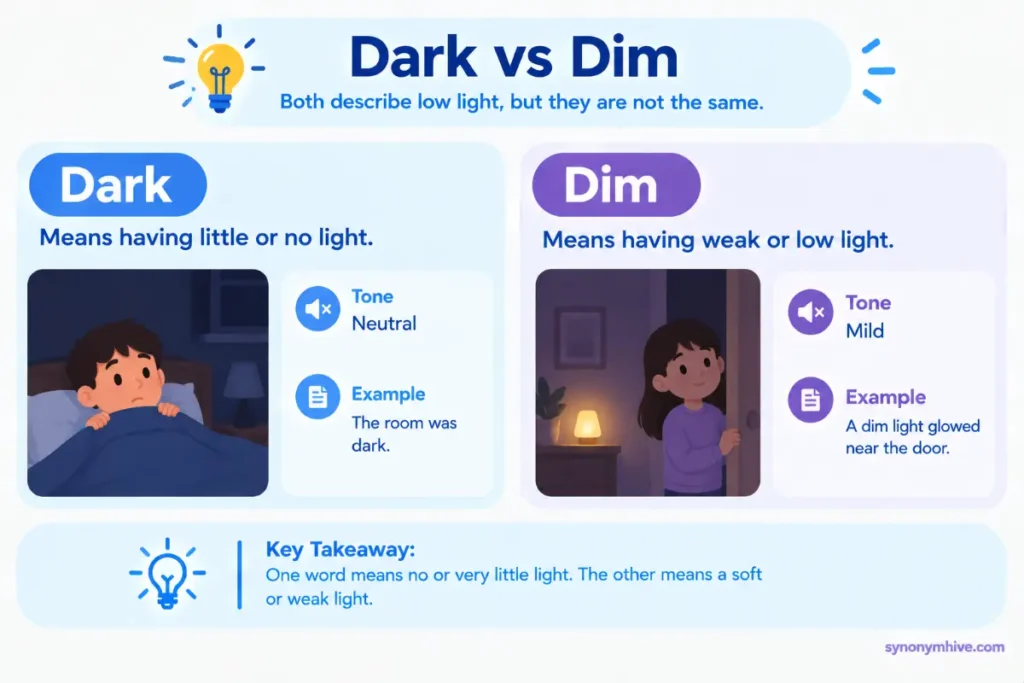
What is the difference between dark and dim
Dark and dim are related, but they do not mean exactly the same thing.
| Dark | Dim |
|---|---|
| Means there is little or no light | Means there is weak or low light |
| Can suggest complete darkness | Usually suggests some light remains |
| Can describe mood or color | Usually focuses on light level |
| Can sound stronger | Usually sounds milder |
“The room was dark” may mean you could barely see anything.
“The room was dim” suggests that some light was present.
A dim lamp gives off weak light. A dark room may have almost none.
What is the difference between dark and gloomy
Dark can describe physical light. Gloomy often adds an emotional meaning.
“The room was dark” gives a physical description.
“The room was gloomy” suggests that the room also feels sad, depressing, or unpleasant.
You can combine them.
“The dark, gloomy room made everyone uncomfortable.”
In this sentence, dark describes the light while gloomy describes the mood.
What is the difference between eerie and ominous darkness
Eerie means strange, unnatural, or frightening. Ominous means that something bad seems likely to happen.
An eerie darkness may make you uncomfortable because it feels unusual.
An ominous darkness suggests danger ahead.
Compare:
“An eerie darkness filled the abandoned house.”
“An ominous darkness gathered before the battle.”
The first sentence creates a spooky feeling. The second suggests that an important or dangerous event may be coming.
What is the difference between shadowy and murky
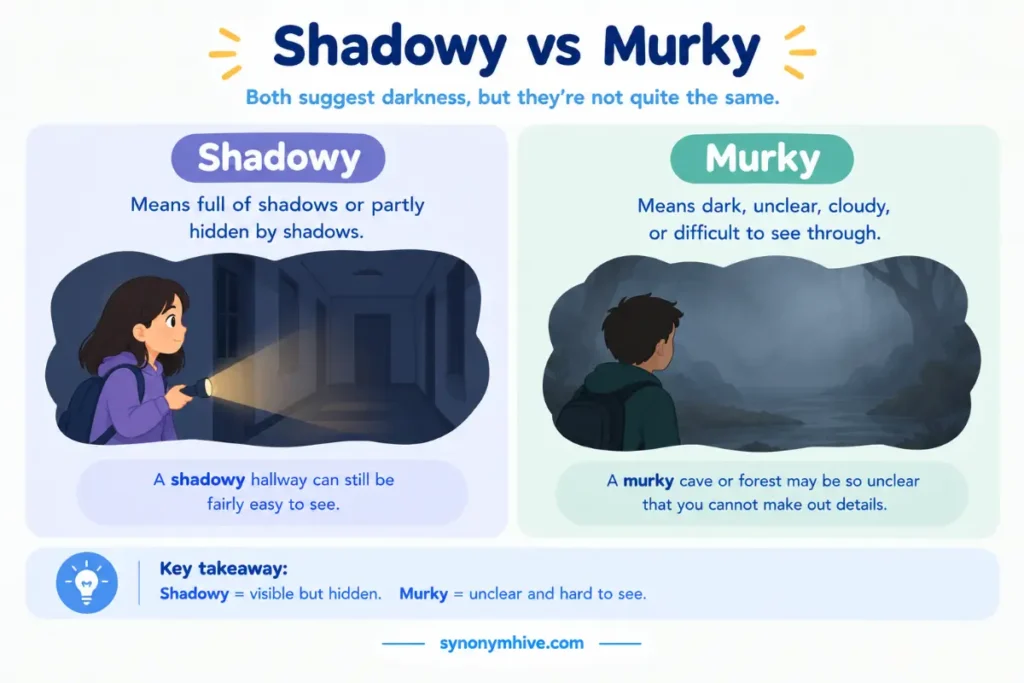
Shadowy means full of shadows or partly hidden by shadows.
Murky means dark, unclear, cloudy, or difficult to see through.
A shadowy hallway can still be fairly easy to see.
A murky cave or forest may be so unclear that you cannot make out details.
For example:
“The shadowy room contained several old chairs.”
“The murky tunnel made it difficult to see the walls.”
Shadowy is often visual and neutral. Murky often suggests poor visibility or an unclear view.
Expand your vocabulary with Words to Describe Fear Best Guide In 2026.
What is the difference between blackness and darkness
Darkness is the general absence or lack of light.
Blackness emphasizes the deep black appearance of something.
“The room was filled with darkness” is broad.
“The blackness of the tunnel seemed endless” puts more focus on the visual depth of the dark space.
Blackness can sound stronger and more dramatic.
What is the difference between night and darkness
Night is a period of the day. Darkness is a condition caused by a lack of light.
Night usually brings darkness, but not always complete darkness. A bright moon, streetlights, buildings, or city lights can make a nighttime area fairly bright.
For example:
“It was night, but the street was well lit.”
“The darkness inside the cave was complete.”
This distinction matters in precise writing.
How should you describe darkness in an essay
For an essay, choose clear words that match your subject.
If you are discussing fear in literature, try eerie, ominous, sinister, or haunting.
If you are writing about symbolism, words such as hidden, mysterious, unknown, or metaphorical may work better.
Avoid using an overly dramatic word simply because it sounds powerful. Precision is usually stronger than exaggeration.
For example:
“The novel uses darkness to represent fear and uncertainty.”
This is clearer than:
“The novel uses an overwhelmingly terrifying darkness to represent fear.”
The first sentence says exactly what the darkness represents.
How should you describe darkness on a resume
A resume usually does not need descriptions of physical darkness. If you are using darkness as a metaphor, choose professional language.
For example, instead of saying:
“I helped the company move out of a dark period.”
You could write:
“Helped the team recover during a difficult period.”
Instead of describing an industry as dark, use terms such as uncertain, challenging, unstable, or difficult when those ideas are accurate.
Professional writing usually benefits from direct language.
How should you describe darkness in an email
Most emails need simple language.
You might write:
“The room was too dark for the presentation.”
“The hallway was poorly lit.”
“The building became dark after the power outage.”
“The storm darkened the sky.”
Words such as eerie, sinister, and haunting are usually better suited to creative or casual writing.
How should you describe darkness in a text
Text messages can be casual and expressive.
You might say:
“It was pitch black in there.”
“That hallway was so creepy.”
“Everything went dark.”
“The sky looks super gloomy.”
“It got really dark outside.”
These phrases sound natural in everyday conversation.
How should you describe darkness in creative writing
Creative writing gives you room to use imagery.
Instead of writing:
“It was dark.”
You might write:
“Darkness swallowed the narrow path.”
“Moonless shadows covered the trees.”
“The house stood beneath a blanket of blackness.”
“An eerie darkness gathered around the windows.”
“The last light disappeared, leaving the valley completely unlit.”
These examples use figurative language to make the scene more vivid.
Still, strong writing does not require a dramatic phrase in every sentence. A simple sentence can create contrast.
“The room was bright at noon. By midnight, it was completely dark.”
The change in light creates the effect.
What are the parts of speech related to darkness
Darkness is a noun. Dark is commonly used as an adjective, while darkly works as an adverb.
Darkness as a noun
“Darkness covered the street.”
“She was afraid of the darkness.”
“The darkness came quickly after the storm.”
Dark as an adjective
“The room was dark.”
“He wore a dark coat.”
“The story has a dark ending.”
Darkly as an adverb
“He smiled darkly.”
“The clouds hung darkly over the town.”
The exact form depends on the role the word plays in the sentence.
How does darkness change meaning in different situations
Darkness can mean different things depending on context.
A dark bedroom may feel peaceful.
A dark story may contain serious, disturbing, or tragic ideas.
This is why there is no single perfect synonym. The surrounding details tell the reader how to understand the darkness.
What are common mistakes when describing darkness
One common mistake is using dark too often.
For example:
“The dark room had dark walls. Outside, the dark sky covered the dark street.”
The repetition makes the writing flat.
Try:
“The dim room had charcoal walls. Outside, heavy clouds covered the street.”
Another mistake is using gloomy when you only mean low light. Gloomy often suggests sadness or depression, so it adds an emotional meaning.
A third mistake is using eerie or sinister without enough context. These words suggest fear or danger. They should fit the scene.
A fourth mistake is confusing night with darkness. Night refers to time. Darkness refers to a lack of light.
When should you avoid dramatic words for darkness
Strong words are useful when the situation supports them. They can weaken writing when used too often.
For example, calling a normal bedroom “sinister” may confuse the reader unless something about the room suggests danger.
Calling a cloudy afternoon “terrifying darkness” may also sound exaggerated.
Use simple words when simple words are enough.
“The hallway was dark.”
Use a stronger word when the scene needs it.
“The hallway was eerily dark, with no light coming from the rooms.”
The second version works because the surrounding detail supports the mood.
What are the antonyms of darkness
The most direct antonyms are:
- Light
- Brightness
- Illumination
- Daylight
- Sunshine
- Radiance
- Glow
- Clarity
- Brightness
- Visibility
The best opposite depends on the context.
Light is the direct physical opposite.
Daylight is the natural light of daytime.
Brightness describes the amount of light.
Radiance suggests strong or glowing light.
Clarity can work as a figurative opposite when darkness represents confusion.
For example:
“The darkness gave way to daylight.”
“Her confusion gave way to clarity.”
The second sentence uses darkness symbolically.
What words describe darkness by mood
A useful way to choose a word is to start with the mood.
| Mood | Useful Words |
|---|---|
| Peaceful | Serene, calm, soft, restful |
| Sad | Gloomy, bleak, heavy, somber |
| Frightening | Eerie, chilling, terrifying, haunting |
| Dangerous | Ominous, sinister, menacing, threatening |
| Mysterious | Shadowy, veiled, hidden, enigmatic |
| Dramatic | Deep, absolute, oppressive, blackness |
| Natural | Dusky, moonless, shaded, dim |
| Lonely | Empty, hollow, bleak, isolated |
| Confusing | Murky, unclear, obscure, clouded |
| Beautiful | Velvet, soft, dusky, dreamlike |
This method is often more useful than simply looking for a synonym.
What words describe darkness by intensity
You can also choose based on how dark the setting is.
Light darkness
Use:
- Dim
- Dusky
- Shaded
- Faint
- Soft
Medium darkness
Use:
- Shadowy
- Murky
- Clouded
- Gloomy
- Darkened
Deep darkness
Use:
- Pitch black
- Lightless
- Absolute
- Complete
- Impenetrable
- Blackness
Extreme or dramatic darkness
Use:
- Oppressive
- Ominous
- Eerie
- Sinister
- Haunting
- Chilling
Intensity gives your reader a clearer picture of the scene.
What are some original examples of darkness in real situations
- “The bedroom was dim after she closed the curtains.”
- “The forest became pitch black after the moon disappeared.”
- “A gloomy darkness covered the empty street.”
- “The hallway looked eerie after the lights went out.”
- “Dusky shadows stretched across the garden.”
- “The storm brought an ominous darkness to the afternoon.”
- “The cave was completely lightless.”
- “A peaceful darkness settled over the village after midnight.”
- “The old house stood in a shadowy corner of the valley.”
- “The blackness inside the tunnel made everyone stop.”
- “Heavy clouds darkened the sky before the rain began.”
- “A mysterious darkness surrounded the doorway.”
- “The moonless road disappeared into the forest.”
- “The room had a soft darkness that made it easy to rest.”
- “An oppressive darkness filled the basement.”
- “The city lights pushed back the darkness of the night.”
- “The character entered a bleak period filled with emotional darkness.”
- “A haunting darkness remained over the abandoned town.”
- “The sunset left a dusky glow across the hills.”
- “The power outage left the entire building unlit.”
These examples show how a single idea can take many forms. The best choice depends on what you want the reader to see or feel.
How can you choose the right word for darkness
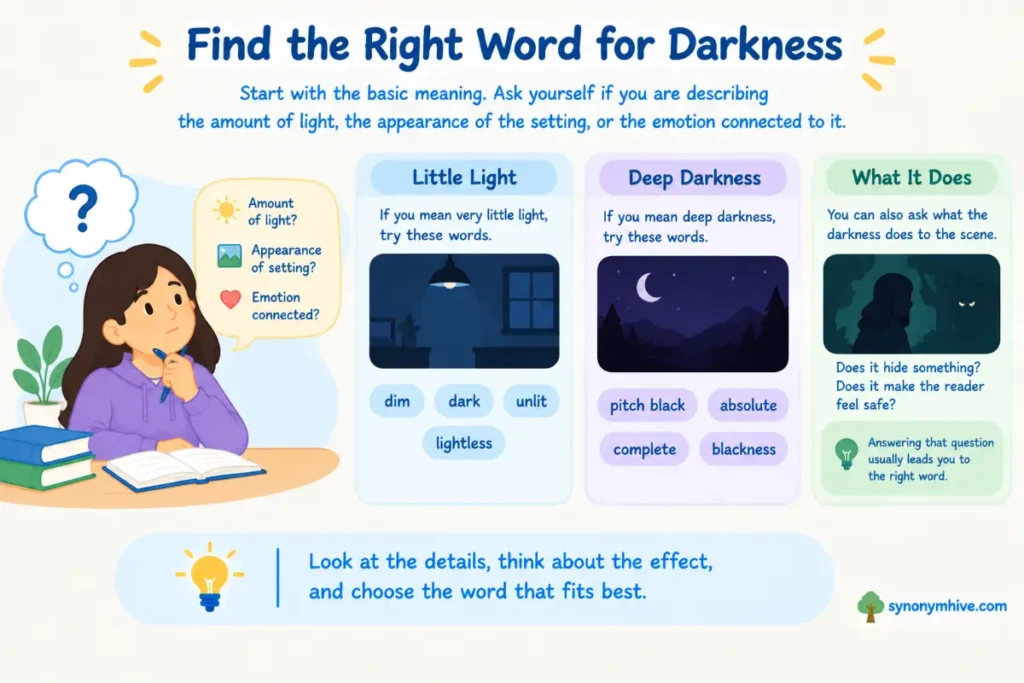
Start with the basic meaning. Ask yourself if you are describing the amount of light, the appearance of the setting, or the emotion connected to it.
If you mean very little light, try dim, dark, unlit, or lightless.
If you mean deep darkness, try pitch black, absolute, complete, or blackness.
You can also ask what the darkness does to the scene. Does it hide something? Does it make the reader feel safe?
Answering that question usually leads you to the right word.
Quick tips for choosing better descriptions
- Start with the basic amount of light.
- Decide if the mood is positive, negative, neutral, or mysterious.
- Use dim when some light remains.
- Use pitch black when almost no light is visible.
- Use shadowy when shadows are the main visual feature.
- Use gloomy when darkness creates a sad or depressing mood.
- Use eerie when the darkness feels strange or frightening.
- Use ominous when the darkness suggests future danger.
- Use peaceful or serene when the darkness feels calm.
- Use dusky for the soft darkness around evening.
- Use moonless when the absence of moonlight matters.
- Use murky when darkness makes something difficult to see clearly.
- Use lightless when you want to stress a complete lack of light.
- Avoid using sinister or terrifying unless the scene supports that mood.
- Replace repeated uses of dark with a precise description or a sensory detail.
- Remember that darkness can be physical or symbolic.
- Read the whole sentence before choosing the final word.
- Pick the word that gives the reader the clearest picture.
Explore another synonym guide: Words to Describe Struggle Best Guide In 2026.
Conclusion
Choosing the right words to describe darkness means looking beyond the simple idea of no light. A dim room, a moonless forest, a gloomy day, and an eerie hallway all contain darkness, but they create very different experiences.
Use dim, dusky, and shadowy for ordinary changes in light. Choose peaceful, serene, or soft when the scene feels calm. Words such as gloomy and bleak add sadness. Eerie, ominous, sinister, and haunting create fear or danger. For extreme darkness, pitch black, lightless, absolute, and blackness can give the scene more force.
The best description is not always the most dramatic one. Choose the word that tells the reader exactly what the darkness looks like and what it means in the scene. That small choice can turn a plain sentence into a clear and memorable description.
Frequently Asked Questions
What are the best words to describe darkness?
The best choices include dim, shadowy, gloomy, dusky, murky, eerie, ominous, sinister, peaceful, lightless, and pitch black. The right word depends on the amount of light and the mood you want to create.
What’s another way to say darkness?
You can use words such as blackness, gloom, shadow, night, dimness, obscurity, or stillness in certain contexts. The best replacement depends on what kind of darkness you mean.
What is a strong word for darkness?
Blackness, lightless, impenetrable, oppressive, and Stygian can describe very deep darkness. Eerie, sinister, and ominous add fear or danger rather than simply describing the lack of light.
What words describe peaceful darkness?
Serene, calm, soft, restful, gentle, dreamlike, and peaceful can describe darkness that feels safe or comforting. These words work well in nature writing, poetry, stories, and personal essays.
What words describe scary darkness?
Eerie, ominous, sinister, haunting, chilling, menacing, threatening, and oppressive are strong choices. Each one adds a slightly different kind of fear or danger.
What words to describe darkness work best in creative writing?
Shadowy, moonless, veiled, haunting, ominous, eerie, velvet, and lightless can work well in creative writing. Choose the word that matches the scene instead of using the strongest word every time.
Can darkness have a positive meaning?
Yes. Darkness can suggest peace, rest, privacy, mystery, or beauty. A quiet night or dark bedroom can feel calm and comforting rather than frightening.