
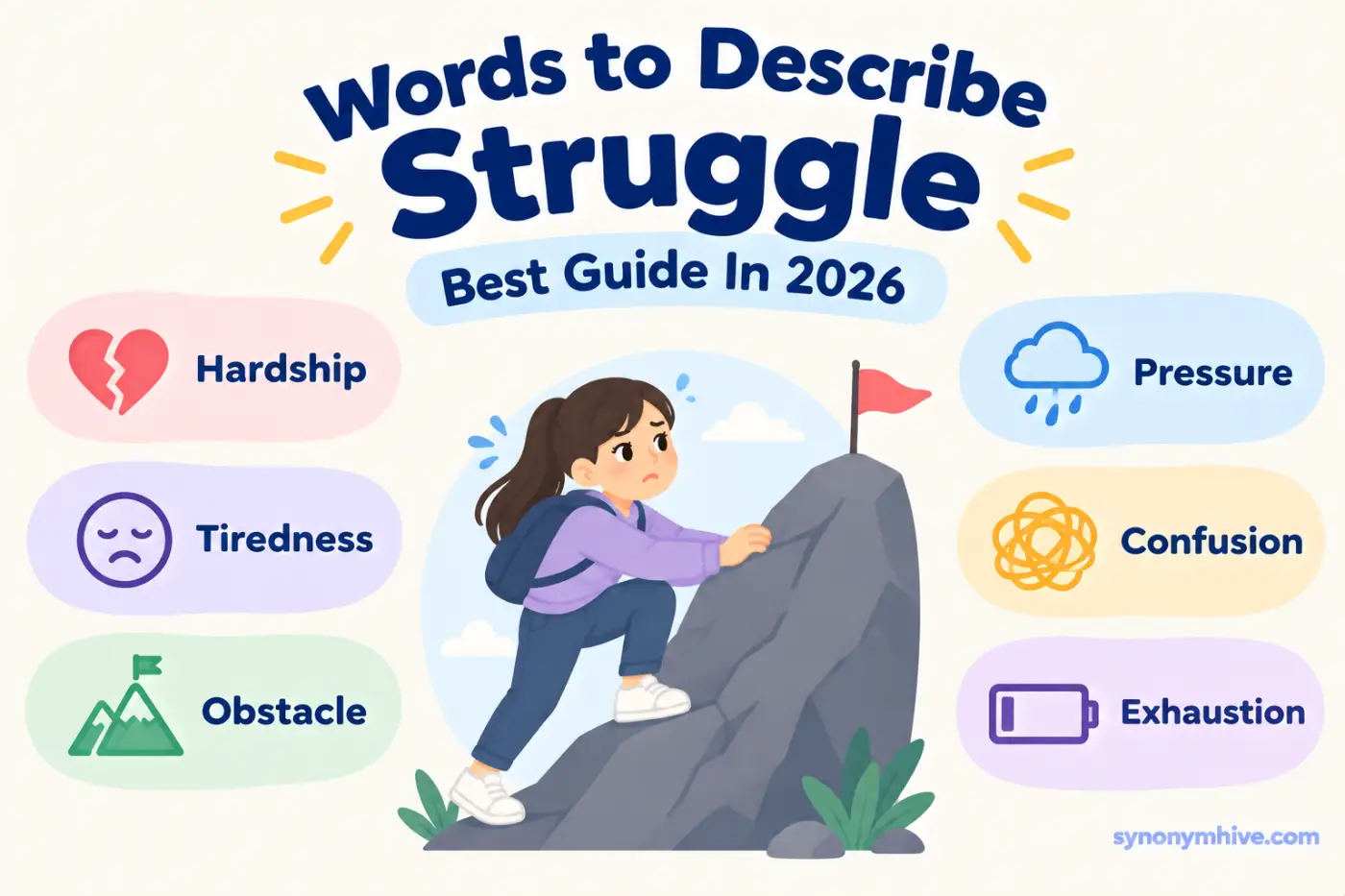
When you’re writing an essay, personal statement, work email, or text, the word struggle can feel too plain. You may want to explain a hard experience with more detail, but you may not know which word fits. The best words to describe struggle depend on the kind of difficulty involved. You might be dealing with a challenge, hardship, conflict, setback, battle, or long period of effort.
Words to describe struggle can show difficulty, effort, conflict, pain, persistence, or resistance. The best choice depends on what kind of struggle you want to describe and how strong you want the word to sound.
A good word does more than make your writing sound better. It tells the reader what the person is facing. A student can struggle with a difficult subject. A family can face hardship. An athlete can battle through an injury. A worker can overcome setbacks. Someone dealing with a difficult personal situation may be enduring a long and painful period.
This guide explains the meaning and history behind struggle, gives you a large list of useful alternatives, and shows how their meanings differ. You’ll also find examples for essays, resumes, emails, texts, speeches, and everyday conversations.
Need another vocabulary suggestion? Read words to describe light Best Guide in 2026.
What Does Struggle Mean?
Struggle means to have difficulty dealing with something or to make a strong effort to achieve something. It can describe physical effort, emotional difficulty, financial hardship, personal problems, or conflict.
The word can work as both a noun and a verb. As a noun, struggle refers to a difficult situation or effort. As a verb, it means to have difficulty doing something or to work hard against resistance.
For example:
She struggled to understand the difficult lesson.
Here, struggle is a verb because it describes an action.
His struggle taught him patience.
Here, struggle is a noun because it names a difficult experience.
The word can also describe a conflict between people, groups, or opposing forces.
The two teams struggled for control of the game.
That use focuses more on competition and conflict than personal hardship.
Where Does the Word Struggle Come From?
The English word struggle has a long history. It developed from older words connected with physical effort and resistance. Its exact early history is not fully certain, but Middle English forms such as struglen were used for difficult physical movement or fighting.
Over time, the meaning expanded. Struggle came to describe more than physical conflict. It began to refer to mental effort, emotional pain, social problems, financial difficulty, and attempts to reach a goal.
That change explains why the word has such a wide range today.
You can struggle to lift a heavy box. You can struggle to pay a bill.
The basic idea stays the same: something is difficult, and effort is needed to deal with it.
What Are the Best Words to Describe Struggle?
There is no single best replacement for struggle. The right word depends on the exact situation.
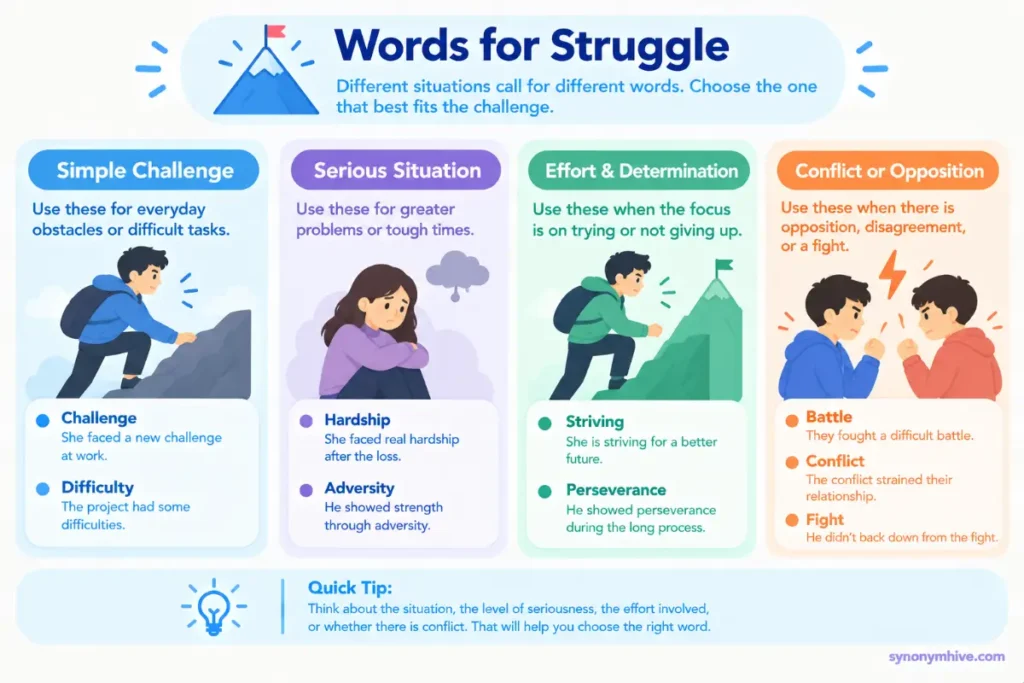
If you want a simple word, try challenge or difficulty. For a more serious situation, hardship or adversity may work better. If the focus is on effort, use striving or perseverance. If conflict matters most, consider battle, conflict, or fight.
The table below gives you more than 30 choices.
| Word | Meaning | Tone | Example |
|---|---|---|---|
| Challenge | Something difficult that tests you | Simple | She faced a difficult challenge. |
| Difficulty | A problem that makes something hard | Simple | He had difficulty finding work. |
| Suffering | Experiencing pain or distress | Strong | The war caused widespread suffering. |
| Pain | Physical or emotional distress | Direct | She carried the pain for years. |
| Anguish | Severe emotional pain | Strong | He spoke openly about his anguish. |
| Crisis | A serious problem that needs quick action | Strong | The company entered a financial crisis. |
| Tension | Pressure or conflict between people or groups | Everyday | Tension grew between the two teams. |
| Friction | Conflict caused by disagreement | Everyday | Small disagreements created friction. |
| Pressure | A strong demand or force | Everyday | She worked under intense pressure. |
| Strenuousness | The quality of requiring great effort | Formal | The strenuousness of the task surprised him. |
| Grind | Long, tiring, repeated work | Informal | He kept going through the daily grind. |
| Hurdle | A problem that must be overcome | Informal | Passing the exam was his next hurdle. |
| Uphill battle | A task that is very hard to complete | Informal | Getting approval was an uphill battle. |
| Tough spot | A difficult situation | Informal | The team was in a tough spot. |
How Do These Words Differ in Strength?
Not every synonym carries the same emotional weight. Choosing a stronger word can make a situation sound more serious than it really is.
Mild Struggle Words
Use mild terms when the difficulty is real but manageable.
Good choices include:
- Challenge.
- Difficulty.
- Problem.
- Hurdle.
- Obstacle.
- Setback.
For example, calling a missed deadline a crisis may sound dramatic. Calling it a setback is more accurate if the problem can be fixed quickly.
A student might say:
I faced a challenge when I started learning algebra.
That sounds balanced. The sentence shows difficulty without suggesting severe hardship.
Moderate Struggle Words
These words suggest more pressure or a longer period of difficulty.
Good choices include:
- Hardship.
- Strain.
- Burden.
- Conflict.
- Pressure.
- Resistance.
- Adversity.
- Turmoil.
Consider the difference between these two sentences:
The project was a challenge.
The project placed a heavy strain on the team.
The second sentence suggests greater pressure. It tells the reader that the problem affected the people involved.
Strong Struggle Words
Strong words should be saved for serious situations.
Useful choices include:
- Ordeal.
- Anguish.
- Suffering.
- Crisis.
- Strife.
- Battle.
- Turmoil.
For example:
The evacuation was an ordeal for the entire family.
This sentence suggests an experience that was painful, frightening, or exhausting.
You would not normally use ordeal for a small inconvenience.
What Parts of Speech Can Describe Struggle?
The word struggle itself can be a noun or a verb. Many related words can also appear in different forms.
Nouns
Nouns name the difficult experience, problem, or effort.
Examples include:
- Challenge.
- Hardship.
- Difficulty.
- Conflict.
- Setback.
- Obstacle.
- Adversity.
- Burden.
- Ordeal.
- Resistance.
- Pressure.
- Suffering.
Example:
The setback did not stop her from applying again.
Verbs
Verbs describe the action of dealing with difficulty.
Useful verbs include:
- Struggle.
- Endure.
- Persist.
- Resist.
- Fight.
- Battle.
- Overcome.
- Cope.
- Persevere.
- Withstand.
- Endure.
- Push through.
Example:
He persevered despite several failed attempts.
The verb persevered focuses on continued effort. It does not simply say that something was difficult.
Adjectives
Adjectives describe a person, experience, situation, or period.
Useful choices include:
- Difficult.
- Challenging.
- Painful.
- Tough.
- Demanding.
- Grueling.
- Stressful.
- Troubling.
- Difficult.
- Adverse.
- Hard.
- Exhausting.
Example:
She went through a difficult period after losing her job.
What Are the Best Words for Different Types of Struggle?
The best description changes depending on what the person is dealing with.
Words for Emotional Struggle
Emotional difficulty often involves sadness, fear, grief, stress, confusion, or inner conflict.
Good choices include:
- Anguish.
- Distress.
- Pain.
- Turmoil.
- Heartache.
- Conflict.
- Grief.
- Anxiety.
- Frustration.
- Loneliness.
Example:
He experienced deep emotional turmoil after the relationship ended.
Turmoil works well because it suggests that several difficult emotions are happening at once.
Words for Financial Struggle
Financial difficulty has its own useful vocabulary.
Consider:
- Hardship.
- Financial strain.
- Poverty.
- Debt.
- Need.
- Deprivation.
- Economic difficulty.
- Financial pressure.
- Instability.
Example:
The family experienced financial hardship after the business closed.
Hardship sounds serious but still fits many everyday situations.
Words for Physical Struggle
Physical difficulty may involve effort, pain, weakness, or resistance.
Useful words include:
- Exertion.
- Strain.
- Effort.
- Pain.
- Fatigue.
- Resistance.
- Exhaustion.
- Battle.
- Endurance.
Example:
The climber endured extreme physical strain during the final part of the climb.
Words for Academic Struggle
Students often need language that sounds honest without sounding negative.
Good options include:
- Difficulty.
- Challenge.
- Setback.
- Learning gap.
- Weakness.
- Frustration.
- Effort.
- Persistence.
- Improvement.
- Growth.
For school writing, challenge is often better than failure if the student eventually improves.
She faced challenges in math but improved through regular practice.
That sentence gives the difficulty and the positive result.
Words for Personal Struggle
Personal hardship can cover many situations, so the best word depends on the details.
Possible choices include:
- Hardship.
- Adversity.
- Difficulty.
- Pain.
- Conflict.
- Setback.
- Burden.
- Ordeal.
- Challenge.
- Turmoil.
Example:
He used his experience with adversity to help others facing similar problems.
What Is the Best Word for a Resume?
A resume should focus on action, results, and growth. It usually does not need dramatic language.
The strongest choices include challenge, obstacle, setback, persistence, resilience, and perseverance.
Instead of:
I struggled to learn the new software.
Try:
I overcame a steep learning curve and became proficient in the new software.
Or:
I persisted through a difficult training period and completed the program ahead of schedule.
These versions show action and progress. They also avoid making the applicant sound passive.
If you need to describe a difficult work situation, use a specific term.
Managed project setbacks while keeping the team on schedule.
That sounds clearer than:
Struggled with project problems.
What Is the Best Word for an Essay?
For an essay, challenge, adversity, hardship, conflict, and struggle are useful choices.
The best option depends on the topic.
Use challenge when the difficulty is part of growth.
The challenge taught her how to work with people from different backgrounds.
Use adversity when the situation involved serious hardship.
His experience with adversity changed how he viewed success.
Academic writing often benefits from precise words instead of emotional ones. Choose the word that tells the reader exactly what happened.
What Is the Best Word for Texting?
Text messages usually call for simple, natural language.
Good choices include:
- Tough time.
- Rough patch.
- Hard time.
- Challenge.
- Struggle.
- Stress.
- Problem.
- Battle.
- Mess.
- Tough spot.
For example:
I know you’re going through a rough patch right now.
That sounds warmer and more natural than:
I know you’re experiencing significant adversity.
The second sentence is grammatically correct, but it does not sound like normal texting.
What Is the Best Word for an Email?
The best word in an email depends on the relationship and purpose.
For a professional email, challenge, difficulty, setback, concern, obstacle, and issue are usually safe choices.
For example:
We experienced a setback during testing, but the team has already identified the cause.
This sentence is clear and professional.
A more personal email might use hardship or difficult period.
I’ve been going through a difficult period, so I may need a little extra time.
Choose a word that matches the seriousness of the situation. Professional writing often sounds stronger when it stays calm and specific.
What Is the Best Word for Speaking?
In everyday speech, simple words usually sound best.
Try:
- Hard time.
- Challenge.
- Problem.
- Tough situation.
- Rough patch.
- Difficulty.
- Setback.
- Fight.
- Battle.
For example:
She’s been having a hard time since she moved.
Or:
We hit a few setbacks, but we kept going.
These choices sound natural in conversation.
What Are 10 Examples of Struggle in Real Sentences?
The following examples show how different words can describe different kinds of difficulty.
- She faced a major challenge when she started her new job.
- The family went through financial hardship after losing its main source of income.
- He overcame several setbacks before finishing the project.
- The athlete endured intense physical strain during training.
- Students often experience difficulty when they first learn advanced math.
- The community showed remarkable resilience during the crisis.
- She continued working despite the pressure of a demanding schedule.
- His perseverance helped him finish the course after several failed attempts.
- The long recovery was an exhausting ordeal for the patient.
- The two groups remained locked in conflict for months.
- He carried the burden of caring for his family while working full time.
- The company faced serious financial pressure during the economic downturn.
- She experienced emotional turmoil after the sudden loss.
- The team overcame a major obstacle just before the final presentation.
- He described the first year of college as difficult but rewarding.
These examples show why simply replacing struggle with a random synonym can create problems. Each word adds a different shade of meaning.
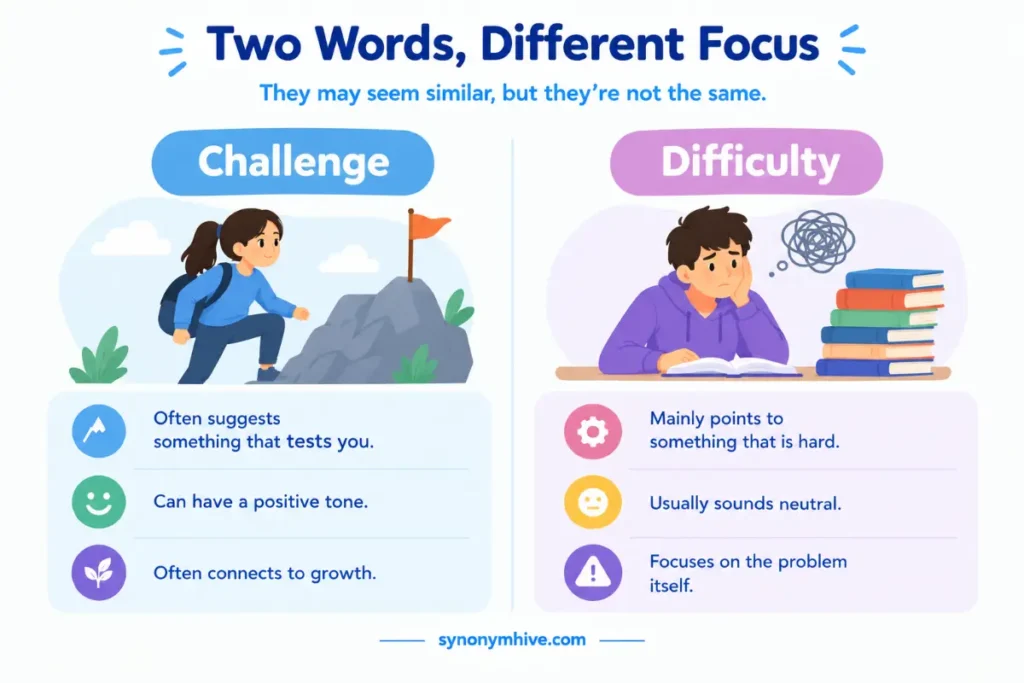
Challenge vs Difficulty What Is the Difference?
Challenge and difficulty are close, but they do not always suggest the same thing.
| Challenge | Difficulty |
|---|---|
| Often suggests something that tests you | Mainly points to something that is hard |
| Can have a positive tone | Usually sounds neutral |
| Often connects to growth | Focuses on the problem itself |
| Common in school and work | Common in everyday descriptions |
Compare these sentences:
Learning to code was a challenge.
Learning to code was a difficulty.
The first sounds natural and can suggest personal growth. The second is grammatical but less natural in this context.
Difficulty works better when describing a specific problem.
She had difficulty understanding the instructions.
Challenge works well when the situation tests someone’s ability.
Managing the larger team was a new challenge.
Hardship vs Adversity What Is the Difference?
Hardship and adversity both describe serious difficulty, but they have slightly different uses.
The family experienced years of financial hardship.
Adversity is broader and often refers to serious problems that test a person’s ability to cope.
She remained determined in the face of adversity.
Hardship can point to the condition itself. Adversity often highlights the difficult circumstances someone must overcome.
Struggle vs Battle What Is the Difference?
Struggle is a broad word. Battle is stronger and more dramatic.
You can struggle with homework, stress, money, or a difficult decision.
He struggled to choose the right career.
Battle often suggests a serious or prolonged fight.
She battled through a difficult recovery.
Battle can also be used metaphorically.
The company battled rising costs.
Still, battle can sound too dramatic for ordinary problems. If someone missed one deadline, saying they battled their workload may make the situation sound larger than it was.
Struggle vs Suffering What Is the Difference?
Struggle focuses on difficulty and effort. Suffering focuses on pain or distress.
Someone may struggle to finish a difficult task without suffering.
Likewise, someone can suffer emotionally even when they are not actively trying to solve the problem.
Compare:
He struggled to rebuild his business.
He suffered after losing his business.
The first sentence focuses on effort. The second focuses on pain.
That distinction can help you choose a more accurate word.
What Words Describe a Struggle That Leads to Growth?
Some words describe difficulty while also suggesting progress.
Useful choices include:
- Challenge.
- Perseverance.
- Persistence.
- Resilience.
- Determination.
- Effort.
- Endurance.
- Growth.
- Progress.
- Overcoming.
For example:
The challenge helped her become more confident.
His persistence paid off after months of practice.
She showed resilience after the setback.
These words work especially well in personal statements, motivational writing, interviews, and speeches.
Find more synonyms in Words to Describe Pain Best Guide In 2026.
What Words Describe a Long Struggle?
A long struggle may be described as prolonged difficulty, hardship, adversity, an ongoing battle, or a sustained challenge.
Examples include:
The family faced years of financial hardship.
He endured a long period of uncertainty.
The recovery became a prolonged struggle.
She faced an ongoing battle with self doubt.
The phrase long term difficulty is also useful in formal writing.
The key is to show duration when duration matters. Words such as prolonged, ongoing, sustained, and years of can make the time span clearer.
What Words Describe a Quiet Inner Struggle?
An inner struggle happens inside a person’s thoughts or emotions.
Useful terms include:
- Inner conflict.
- Self doubt.
- Uncertainty.
- Emotional turmoil.
- Anxiety.
- Distress.
- Frustration.
- Doubt.
- Fear.
- Confusion.
For example:
She faced an inner conflict between following her dream and staying close to her family.
Or:
His quiet struggle with self doubt affected his confidence.
Inner conflict is especially useful when someone has two competing feelings, goals, or choices.
What Words Describe a Struggle That Others Cannot See?
Not every difficult experience is visible.
Words such as private, internal, hidden, silent, emotional, personal, and unseen can describe this kind of difficulty.
For example:
She was dealing with a silent struggle that few people knew about.
His outward confidence hid a great deal of internal conflict.
These descriptions work well when writing about emotions or personal experiences. Still, avoid assuming what another person is going through unless you have clear evidence.
What Are Common Mistakes When Describing Struggle?
One common mistake is using a dramatic word for a small problem.
Calling a minor inconvenience an ordeal can make the sentence sound exaggerated.
Another mistake is using hardship when you really mean effort.
She put in a lot of hardship to finish the project.
This is incorrect in normal English. Hardship is something difficult that a person experiences. Effort is the work a person puts into a task.
A better sentence is:
She put in a lot of effort to finish the project.
Another mistake is confusing struggle with failure.
Struggle does not automatically mean that someone failed. A person can struggle and still succeed.
He struggled with the course but eventually earned a high grade.
The sentence shows difficulty and success at the same time.
When Should You Not Use the Word Struggle?
Avoid struggle when a more precise word tells the reader what actually happened.
For example, if someone simply needs more time, difficulty may be enough.
I had difficulty completing the form.
If someone faced a financial problem, hardship may be clearer.
The family faced financial hardship.
If two people disagreed, conflict may be more accurate.
The disagreement created conflict between the departments.
Specific language makes writing stronger because the reader does not have to guess what kind of difficulty you mean.
What Are the Antonyms of Struggle?
The best opposite depends on the meaning of struggle.
For difficulty, possible opposites include:
- Ease.
- Comfort.
- Simplicity.
- Convenience.
- Smoothness.
For conflict, opposites include:
- Peace.
- Agreement.
- Harmony.
- Cooperation.
- Unity.
Example:
The first few months were a struggle.
The opposite could be:
The first few months were surprisingly easy.
Or:
The groups moved from conflict to cooperation.
How Do US and UK English Differ?
The main vocabulary for describing struggle is the same in American and British English.
Words such as challenge, hardship, adversity, difficulty, setback, obstacle, and perseverance work in both varieties.
Some informal phrases may differ in popularity. British speakers may use expressions such as rough patch, hard slog, or uphill struggle. American speakers also understand these expressions, though some may sound more regional or less common.
Spelling can also vary in related words. For example, American English generally uses perseverance and emphasizes simple spelling patterns that are also accepted in British English.
There is no major US versus UK rule that changes the basic meaning of struggle.
How Can You Choose the Right Word Quickly?
Start by asking what the difficulty actually involves.
- Is it simply hard?
Use difficulty or challenge.
- Is it a serious living condition?
Use hardship.
This approach keeps your writing precise without forcing a thesaurus word into every sentence.
How Can You Make a Struggle Sound More Specific?
Instead of only naming the difficulty, explain what caused it, how long it lasted, or what happened next.
Compare:
She faced a struggle.
With:
She faced financial pressure after losing her job.
The second sentence gives the reader useful information.
You can also show the result.
He struggled with public speaking but became confident after months of practice.
Or explain the source.
The team faced a major setback when the main supplier canceled the order.
Specific details usually make a sentence stronger than a more dramatic synonym.
What Are the Best Words to Describe Struggle in a Positive Way?
If the goal is to show strength, use words that focus on effort and growth.
Strong choices include:
- Resilient.
- Determined.
- Persistent.
- Tenacious.
- Courageous.
- Patient.
- Persistent.
- Adaptable.
- Strong.
- Resourceful.
For example:
She remained determined despite several setbacks.
His resilience helped him recover after a major loss.
Her persistence turned an early failure into a valuable lesson.
These descriptions shift attention from the problem to the person’s response.
What Are the Best Words to Describe Struggle in a Negative Way?
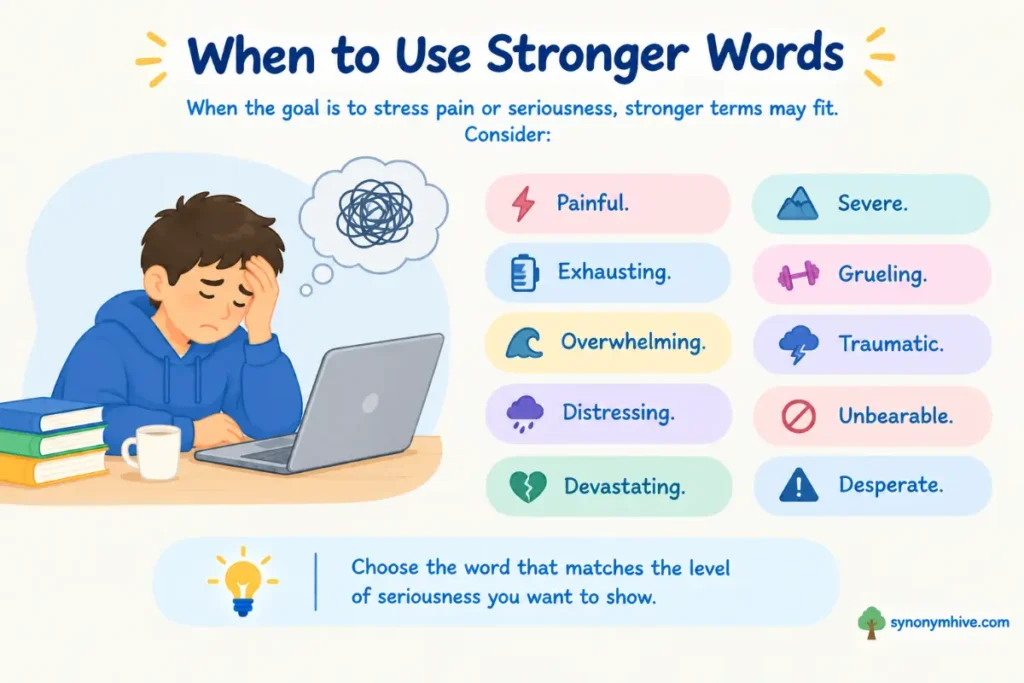
When the goal is to stress pain or seriousness, stronger terms may fit.
Consider:
- Painful.
- Exhausting.
- Overwhelming.
- Distressing.
- Devastating.
- Severe.
- Grueling.
- Traumatic.
- Unbearable.
- Desperate.
These words carry more emotional weight. Use them only when the facts support that level of intensity.
For example:
The long recovery was exhausting.
That sounds reasonable for a demanding recovery.
The long recovery was devastating.
That suggests a much deeper emotional impact.
The second word should not be used simply because it sounds stronger.
How Do You Describe Struggle Without Sounding Negative?
Focus on the process, effort, or learning that came from the difficult experience.
Instead of:
I struggled with public speaking.
Try:
I developed confidence in public speaking through regular practice.
Instead of:
She struggled in her first year at college.
Try:
She adapted to the demands of college during her first year.
The second versions do not hide the difficulty. They simply give more attention to action and progress.
This is useful in resumes, interviews, scholarship essays, and personal statements.
How Do You Describe Someone Who Keeps Going?
Several words can describe a person who continues despite difficulty.
Persistent
Persistent means continuing to do something even when it is difficult.
She was persistent and kept applying for jobs.
Determined
Determined means strongly committed to reaching a goal.
He was determined to finish the course.
Resilient
Resilient describes someone who recovers or adapts after difficulty.
The team proved resilient after the early loss.
Tenacious
Tenacious describes someone who refuses to give up easily.
Her tenacious approach helped the company survive the crisis.
Persevering
Persevering describes continued effort despite obstacles.
His persevering attitude helped him complete the program.
These words are related, but they are not exact copies of one another. Persistence stresses continued action. Determination stresses a strong goal. Resilience stresses recovery. Tenacity stresses refusing to let go.
Why Context Matters More Than a Thesaurus
A thesaurus can give you many alternatives, but it cannot always tell you which word fits the situation.
Suppose you want to describe a student who finds chemistry difficult.
You could write:
The student suffered through chemistry.
That sounds dramatic.
You could write:
The student faced adversity in chemistry.
That sounds too formal and broad.
A better sentence is:
The student had difficulty understanding chemistry at first.
Now suppose the student improved after months of study.
The student struggled with chemistry at first but improved through regular practice.
Here, struggle works because the sentence shows both difficulty and effort.
The strongest word is often the one that gives the reader the clearest picture, not the one that sounds most impressive.
A Simple Formula for Stronger Writing
When describing a difficult experience, use this simple pattern:
Person + difficulty + cause + response + result.
For example:
Maria struggled with public speaking because she lacked confidence, but regular practice helped her become a stronger presenter.
The sentence gives the reader the full story.
Another example:
The company faced financial hardship after sales dropped, but careful planning helped it recover.
This approach works because it connects the problem with what happened next.
You do not always need all five parts. Even adding one detail can make a sentence much clearer.
How Should You Describe Struggle in Different Situations?
| Situation | Best Choices | Example |
|---|---|---|
| School | Challenge, difficulty, setback | Math was a challenge at first. |
| Work | Obstacle, setback, pressure | The team overcame a major obstacle. |
| Resume | Persistence, resilience, determination | Demonstrated resilience during a major project change. |
| Personal essay | Hardship, adversity, challenge | The experience taught me how to face adversity. |
| Text message | Hard time, rough patch, tough spot | I know you’re going through a rough patch. |
| Formal report | Adversity, resistance, hardship | The project faced significant resistance. |
| Speech | Battle, challenge, perseverance | Her perseverance inspired everyone. |
| Story | Ordeal, conflict, turmoil | The journey became an unexpected ordeal. |
| Conversation | Problem, challenge, hard time | He’s having a hard time right now. |
| Personal statement | Challenge, resilience, growth | The challenge helped me become more resilient. |
What Makes a Word for Struggle Sound Natural?
Natural writing matches the word to the situation.
A casual message should sound casual.
I’m having a tough time with this.
A formal report should sound measured.
The organization faced significant financial pressure.
A personal essay can be more reflective.
That period of adversity taught me to ask for help.
A resume should be direct.
Overcame project setbacks and delivered the final presentation on schedule.
The same experience can be described in several ways. Your audience decides which version works best.
Expand your vocabulary with words to describe success Best Guide in 2026.
Conclusion
Choosing the right words to describe struggle comes down to accuracy. Use challenge for something that tests you, hardship for serious difficult conditions, setback for delayed progress, conflict for disagreement, and perseverance for continued effort. Stronger words such as ordeal, anguish, and suffering should be reserved for experiences that truly deserve that level of intensity.
Think about the main idea you want your reader to understand. Are you describing the problem, the effort, the pain, the conflict, or the person’s response? Once you answer that question, the right word becomes much easier to find.
Good writing does not need the biggest word. It needs the clearest one. Pick the word that gives your reader the most accurate picture of what happened, and your sentence will usually become stronger at once.
Frequently Asked Questions
What are the best words to describe struggle?
The best choices include challenge, hardship, adversity, difficulty, obstacle, setback, conflict, persistence, and perseverance. Choose the word that matches the type and seriousness of the difficulty.
What is another way to say struggle?
Another way to say struggle is challenge, difficulty, hardship, battle, effort, conflict, or adversity. The best choice depends on the context and the kind of difficulty involved.
What is a strong word for a difficult struggle?
Ordeal, adversity, anguish, hardship, and suffering are strong choices. They should be used for serious situations because they carry more emotional weight.
What are good words to describe struggle in an essay?
Challenge, adversity, hardship, conflict, setback, perseverance, and resilience work well in essays. They can describe both the difficulty and the response to it.
What are good terms to describe struggle on a resume?
Use action focused words such as overcame, persisted, adapted, resolved, persevered, and demonstrated resilience. A resume is usually stronger when it shows what you did and what result you achieved.
Can struggle have a positive meaning?
Yes. Struggle can describe a difficult experience that leads to learning, growth, strength, or achievement. For example, someone may struggle with a new skill and become more capable through practice.
Are struggle and suffering the same thing?
No. Struggle focuses on difficulty or effort, while suffering focuses more on pain or distress. A person can struggle without suffering, and someone can suffer without actively struggling against a problem.