
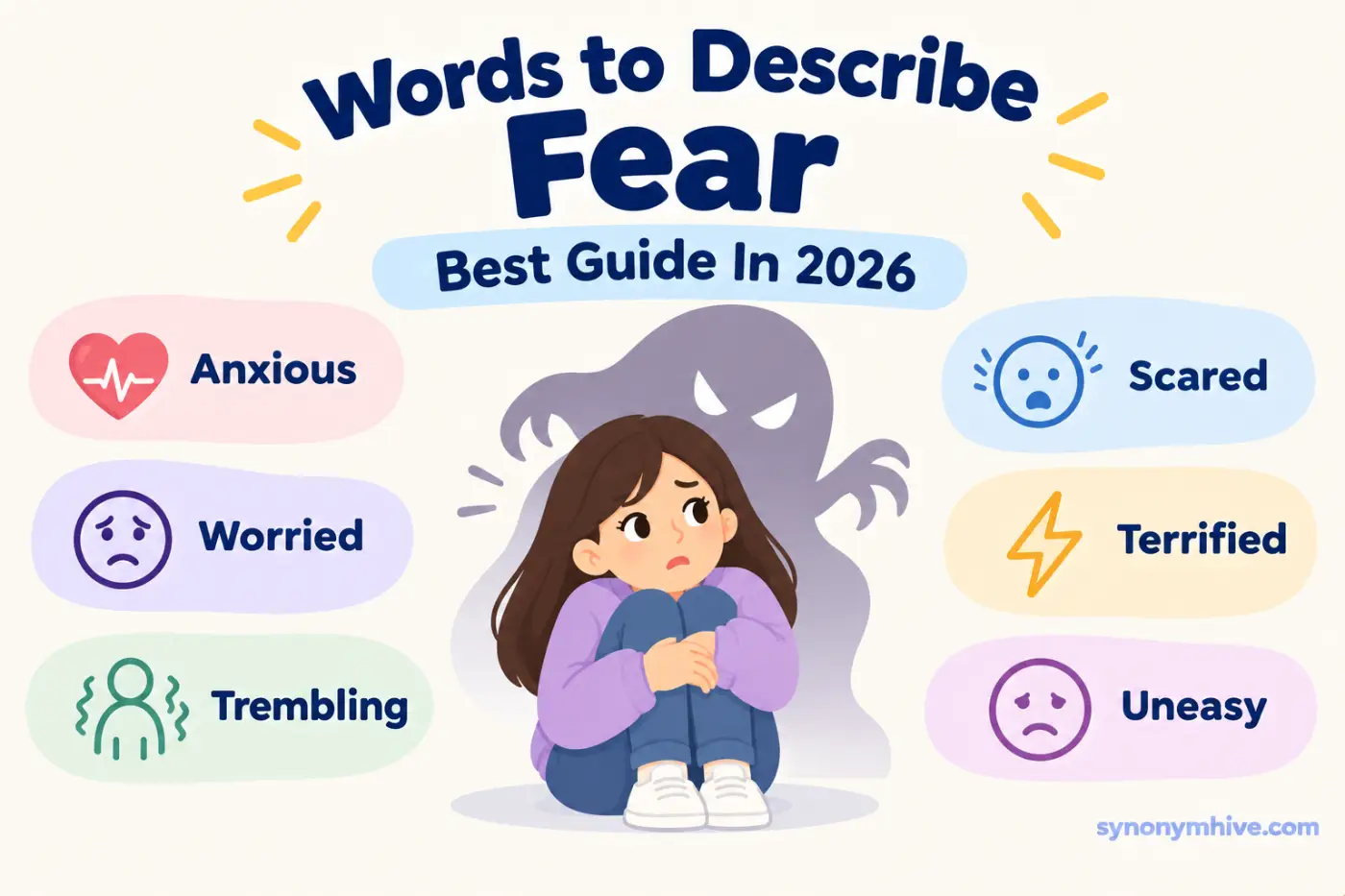
Writing about fear can be harder than feeling it. You might be describing a character in an essay, explaining a tense moment in a story, or trying to tell someone how you felt during a difficult event. The right words can show much more than simply saying scared. The phrase words to describe fear covers many shades of emotion, from mild worry to intense terror.
Fear does not always look the same. Someone might tremble, freeze, panic, hesitate, or become unusually quiet. A person can also feel nervous without being truly afraid. Choosing a precise word helps readers understand the strength and type of fear you want to describe.
Words to describe fear can show physical reactions, mental distress, sudden danger, or a lasting sense of worry. Some words work well in formal writing, while others sound natural in conversation or text messages.
This guide explains the meaning and history of fear related words, gives you more than 30 useful choices, and shows how their meanings differ. You will also find examples, intensity levels, context based choices, common mistakes, and quick tips for choosing the right word.
Expand your vocabulary with Words to Describe Pain Best Guide In 2026.
What Are Words to Describe Fear?
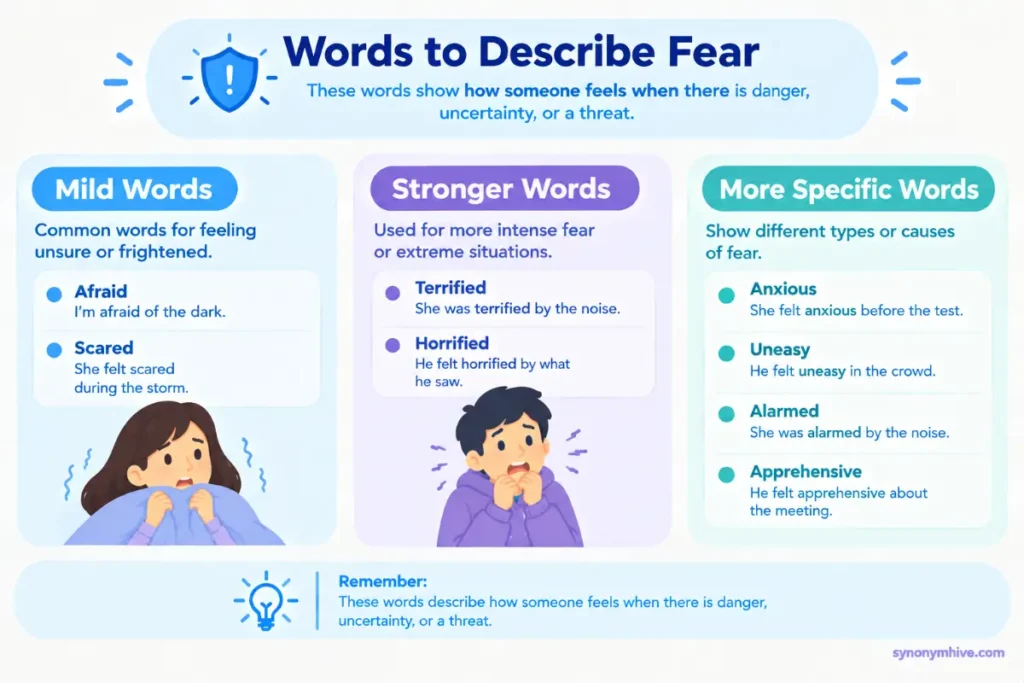
Terms to describe fear are terms that show a person’s emotional or physical response to danger, uncertainty, threat, or worry. They include simple words such as afraid and scared, stronger words such as terrified and horrified, and more specific terms such as anxious, uneasy, alarmed, and apprehensive.
Fear can be sudden or gradual. It can come from a real threat, an imagined event, a painful memory, or uncertainty about what may happen next.
What Is the Difference Between Fear and Being Scared?
Fear is a broad emotion caused by a perceived threat or danger. Scared is a common everyday word used to describe the feeling of fear.
For example, you can say, “I felt fear when I heard the alarm.” You can also say, “I was scared when I heard the alarm.” The first sentence sounds more formal, while the second sounds more natural in everyday speech.
The word fear can also refer to a general concern rather than an immediate reaction. Someone might say, “She has a fear of failure.” In that sentence, the person is not necessarily afraid at that exact moment.
Quick Answer
The best word depends on the kind and strength of fear you want to express. Use words such as nervous, uneasy, worried, or apprehensive for mild fear, afraid or frightened for ordinary fear, and terrified, horrified, or petrified for very strong fear.
Comparison Table of Fear Words
| Word | Meaning | Tone | Example |
|---|---|---|---|
| Afraid | Feeling fear or concern | Everyday | I was afraid to go inside. |
| Scared | Feeling fear | Everyday | The child was scared by the noise. |
| Frightened | Feeling fear | Neutral | She looked frightened. |
| Nervous | Worried or uneasy | Everyday | He felt nervous before the test. |
| Terrified | Extremely afraid | Very strong | She was terrified during the storm. |
| Petrified | So afraid that you can hardly move | Very strong | He stood petrified at the doorway. |
| Horrified | Extremely shocked and frightened | Very strong | They were horrified by what they saw. |
| Alarmed | Frightened or concerned by a warning | Neutral | The staff became alarmed by the smoke. |
| Dreading | Feeling strong fear about something expected | Strong | I was dreading the conversation. |
| Appalled | Deeply shocked or disturbed | Strong | She was appalled by the cruel act. |
| Timid | Lacking confidence because of fear | Mild | The timid child stayed close to her mother. |
| Cowardly | Showing a lack of courage | Negative | His cowardly choice hurt the team. |
| Skittish | Easily frightened or startled | Informal | The skittish horse backed away. |
| Jumpy | Easily startled | Informal | I felt jumpy after hearing strange noises. |
| Spooked | Frightened or unsettled | Informal | The strange sound spooked the dog. |
| Scared stiff | Extremely frightened | Informal | That sudden scream scared me stiff. |
| Frozen | Unable to act because of fear | Descriptive | She stood frozen in place. |
| Trembling | Shaking because of fear or stress | Descriptive | His hands were trembling. |
| Horrified | Deeply shocked by something frightening or awful | Strong | She looked horrified by the scene. |
| Fearful | Full of fear or concern | Neutral | The villagers were fearful of another attack. |
| Intimidated | Made afraid by someone or something powerful | Neutral | He felt intimidated by the large crowd. |
| Distressed | Very upset or troubled | Neutral | The frightened child was visibly distressed. |
Where Does the Word Fear Come From?
The English word fear has a long history. It comes from Old English words connected with danger, sudden calamity, and the feeling caused by a threat. Over time, its meaning developed into the broad word we use today for an emotional response to danger or possible harm.
Fear is now both a noun and a verb.
As a noun, it describes the emotion itself.
“Fear filled the room.”
As a verb, it means to be afraid of something or to expect something bad.
“She feared that the storm would become stronger.”
The word has also developed many related forms. Fearful describes someone who is full of fear. Fearless describes someone who does not show fear. Fearfully describes an action done with fear.
Understanding this basic word family makes it easier to choose related terms without repeating the same word in every sentence.
How Can You Describe Fear at Different Levels?
Not every frightening situation deserves the same word. Saying someone was terrified when they were only slightly nervous can make the writing sound exaggerated. Strong writing matches the word to the actual level of fear.
Mild Fear
Mild fear does not usually stop someone from thinking or acting. The person may simply feel uncomfortable or unsure.
Useful choices include:
- Uneasy.
- Nervous.
- Concerned.
- Worried.
- Apprehensive.
- Cautious.
- Unsure.
- Uncomfortable.
- Timid.
- Hesitant.
Example:
“Maria felt uneasy as she walked through the quiet hallway.”
The word uneasy suggests that something did not seem right. It does not mean Maria was in complete panic.
Moderate Fear
Moderate fear is stronger and more noticeable. It can affect a person’s behavior and concentration.
Good choices include:
- Afraid.
- Scared.
- Frightened.
- Alarmed.
- Disturbed.
- Intimidated.
- Shaken.
- Tense.
- Fearful.
- Dreading.
Example:
“James was frightened when he realized he had taken the wrong road.”
This tells the reader that his fear is real but does not necessarily suggest extreme terror.
Strong Fear
Strong fear can affect a person’s ability to think or act normally.
Useful words include:
- Terrified.
- Petrified.
- Horrified.
- Panicked.
- Dreadful.
- Overwhelmed.
- Frozen.
- Trembling.
- Distraught.
- Frantic.
Example:
“She was petrified when the elevator stopped between floors.”
The word petrified suggests a very high level of fear.
Extreme Fear
The strongest terms should be saved for situations that truly call for them.
Words and phrases include:
- Terrified.
- Petrified.
- Horrified.
- Panic stricken.
- Frozen with fear.
- Scared stiff.
- Beside herself with fear.
- Overcome with terror.
- In a state of panic.
- Shaking with terror.
These expressions create a much stronger emotional picture than simple words such as worried or nervous.
What Words Describe Fear in the Body?
Fear often appears through physical reactions. If you want your writing to show fear instead of simply naming it, describe what the body does.
Common physical signs include:
- Trembling hands.
- Shaking knees.
- A racing heart.
- Rapid breathing.
- Sweaty palms.
- A dry mouth.
- A tight chest.
- Wide eyes.
- A pale face.
- Goosebumps.
- A weak voice.
- Frozen movement.
- Clenched muscles.
- Restlessness.
- Sudden silence.
For example, instead of writing, “He was afraid,” you could write:
“His hands began to shake as he reached for the door.”
Another option is:
“Her heart raced when she heard footsteps behind her.”
These sentences let the reader see the fear through action.
What Words Describe Fear in the Mind?
Fear is not only physical. It can also change the way someone thinks.
A frightened person might feel:
- Worried.
- Anxious.
- Uncertain.
- Confused.
- Overwhelmed.
- Helpless.
- Vulnerable.
- Suspicious.
- Distracted.
- Restless.
- Dreadful.
- Panicked.
- Concerned.
- Apprehensive.
- Distressed.
For example:
“She could not stop imagining everything that might go wrong.”
This sentence does not use the word fear at all, yet the emotion is clear.
Another example is:
“He kept checking the locked door because he was worried someone might enter.”
Specific thoughts can make descriptions more believable.
How Do You Describe Fear Without Saying Afraid?
You can describe fear through actions, body language, thoughts, speech, and setting.
Instead of saying, “He was afraid,” try showing what happened:
“His voice dropped to a whisper.”
“She stepped backward without taking her eyes off the dark doorway.”
“He checked the lock twice before sitting down.”
“Her hands shook as she reached for the phone.”
“His mind raced as he searched for a safe place.”
This method is especially useful in fiction. It gives readers evidence of the emotion instead of simply naming it.
What Are the Best Words to Describe Fear in an Essay?
For an essay, choose words that are clear and precise. Strong options include anxious, apprehensive, concerned, frightened, alarmed, distressed, fearful, and terrified.
The best choice depends on your subject.
For a mild concern:
“The students were apprehensive about the difficult examination.”
For a serious threat:
“The residents were alarmed by the sudden rise in floodwater.”
For extreme fear:
“The witness was terrified by the violent explosion.”
Formal writing usually benefits from precise words rather than slang such as spooked or jumpy.
What Are the Best Terms to Describe Fear in a Resume?
A resume usually does not need direct fear words. If you are describing how you handled a difficult situation, focus on your actions and strengths.
Instead of:
“I was afraid but continued working.”
Try:
“I remained calm during a high pressure situation.”
You can also use words such as composed, confident, steady, resilient, and calm when describing how you responded to pressure.
Fear itself is rarely the strongest focus in professional writing. Your response to the difficult situation matters more.
What Are the Best Terms to Describe Fear in a Text?
Text messages usually sound more natural with simple words.
You might say:
“I was so scared.”
“That honestly freaked me out.”
“I got really nervous.”
“That gave me chills.”
“I was totally spooked.”
“I nearly panicked.”
These expressions are casual. They work well with friends but may sound too informal in an essay or business email.
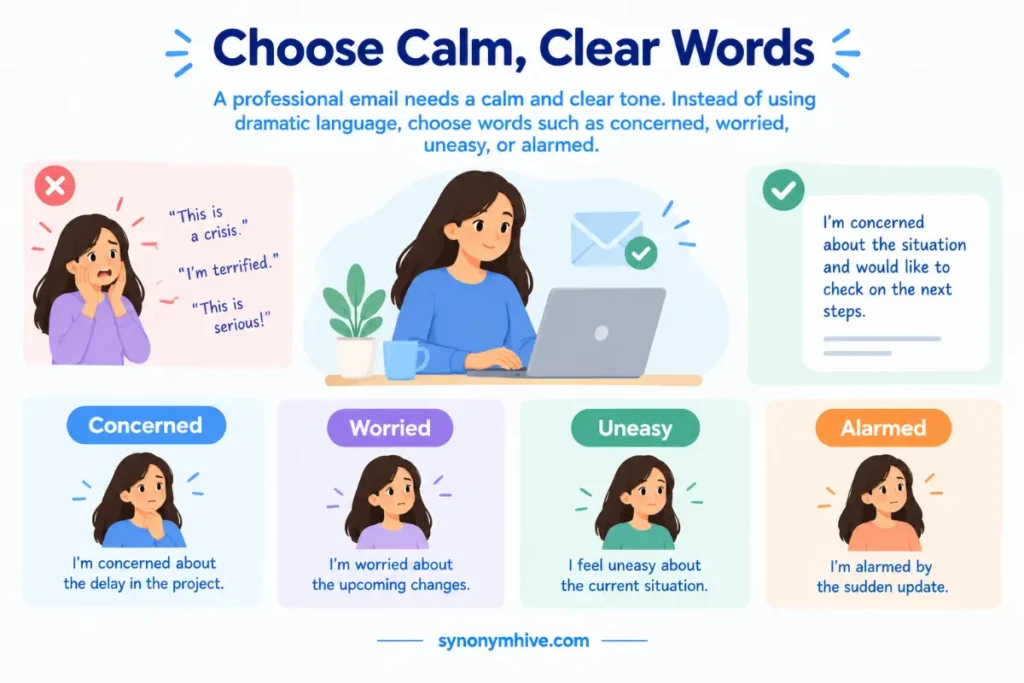
What Are the Best Words to Describe Fear in an Email?
A professional email needs a calm and clear tone. Instead of using dramatic language, choose words such as concerned, worried, uneasy, or alarmed.
For example:
“I was concerned about the delay because the deadline is tomorrow.”
Another option is:
“We became concerned when we did not receive confirmation.”
If the situation is serious, you can write:
“The team was alarmed by the safety issue.”
The goal is to explain the problem without making the message sound emotional or exaggerated.
What Are the Best Words to Describe Fear When Speaking?
Everyday speech usually favors simple words.
Common choices include scared, afraid, nervous, worried, terrified, and freaked out.
For example:
“I was really nervous before the interview.”
“I got scared when the lights went out.”
“She was terrified when she saw the snake.”
“I was worried that we would miss the last train.”
The best spoken word is often the one that sounds natural in your normal conversation.
What Are the Best Terms to Describe Fear in a Story?
Stories give you more room to show fear through detail.
You can describe:
- Facial expressions.
- Body movement.
- Breathing.
- Voice.
- Thoughts.
- Decisions.
- Avoidance.
- Silence.
- Physical sensations.
- Changes in behavior.
For example:
“Daniel reached for the handle, then stopped. His breathing became shallow. He stared at the narrow gap beneath the door and listened.”
The passage creates tension without repeatedly saying that Daniel was afraid.
What Is the Difference Between Nervous and Anxious?
Nervous and anxious are close, but they often point to different situations.
Nervous usually describes worry or tension before a specific event.
“I was nervous before my job interview.”
Anxious can describe stronger worry about an upcoming event or an uncertain outcome.
“She was anxious about her father’s surgery.”
Anxious can also have a broader meaning. It may describe a person who often feels worried or uneasy.
In casual speech, people sometimes use nervous and anxious almost interchangeably. Context helps show the intended meaning.
Fearful vs Frightened What Is the Difference?
Fearful means full of fear or likely to experience fear. Frightened usually describes a person who has become afraid because of something.
Compare these sentences:
“The villagers were fearful of another attack.”
“The villagers were frightened by the sudden explosion.”
Fearful can suggest an ongoing state or concern. Frightened often points to a specific event.
The distinction is small, but it can make your writing more precise.
Check out more vocabulary ideas in Words to Describe Joy Best Guide In 2026.
Afraid vs Scared What Is the Difference?
Afraid and scared usually mean the same basic thing, but their tone differs.
Scared is very common in casual American English.
“I was scared when I heard the noise.”
Afraid is also common, but it can sound slightly more serious or formal.
“I was afraid that something had happened.”
Afraid also appears in polite phrases that do not describe physical fear.
For example:
“I’m afraid I can’t help you.”
In that sentence, afraid is a polite way to say that something cannot be done. It does not mean the speaker is frightened.
Terrified vs Petrified What Is the Difference?
Both words describe very strong fear.
Terrified simply means extremely afraid.
“She was terrified during the storm.”
Petrified can suggest such intense fear that the person cannot move or act.
“He stood petrified when the large dog charged toward him.”
Petrified is especially useful when fear seems to freeze someone in place.
Horrified vs Terrified What Is the Difference?
Terrified focuses mainly on extreme fear. Horrified often combines fear with shock, disgust, or deep distress.
For example:
“The child was terrified by the barking dog.”
The focus is fear.
“She was horrified when she saw the damage.”
The second sentence can suggest shock and distress as well as fear.
That distinction matters in emotional writing. Use horrified when the person is deeply shocked by something disturbing.
How Do Fear Words Change by Part of Speech?
Many fear related terms can appear as nouns, verbs, adjectives, or adverbs.
| Part of Speech | Word | Example |
|---|---|---|
| Noun | Fear | His fear was obvious. |
| Noun | Terror | Terror spread through the crowd. |
| Noun | Anxiety | Her anxiety grew as the time passed. |
| Verb | Fear | They feared the storm would return. |
| Verb | Frighten | The noise frightened the baby. |
| Verb | Alarm | The message alarmed the staff. |
| Adjective | Afraid | He was afraid of heights. |
| Adjective | Frightened | She looked frightened. |
| Adjective | Fearful | The animals were fearful. |
| Adjective | Nervous | I felt nervous before speaking. |
| Adverb | Fearfully | He looked fearfully toward the door. |
Knowing the part of speech prevents awkward sentences.
For example, you cannot replace afraid with fear in every sentence.
“I was afraid.”
“I felt fear.”
Both are correct, but they use different grammar.
What Are Some Real Examples of Fear Words?
The following examples show how different terms work in everyday situations, school writing, stories, and conversations.
- I felt nervous before walking onto the stage.
- The sudden crash left everyone startled.
- She was afraid to open the message.
- He became uneasy when he noticed that the door was open.
- The hikers were alarmed by the sound of thunder.
- Maria felt apprehensive about moving to a new city.
- The little boy was frightened by the barking dog.
- We were worried that the storm would cancel the flight.
- The witness looked shaken after the accident.
- He was terrified when he realized he was alone.
- She stood petrified as the car moved toward the gate.
- The crowd became tense when the lights went out.
- His hands were trembling as he reached for the phone.
- The strange noise spooked the cat.
- I was jumpy after watching the scary movie.
- She dreaded telling her parents about the broken window.
- The students were anxious while waiting for their results.
- He felt intimidated by the large audience.
- The warning made the residents concerned about their safety.
- She froze when she heard footsteps behind her.
These examples show why one general term cannot cover every kind of fear.
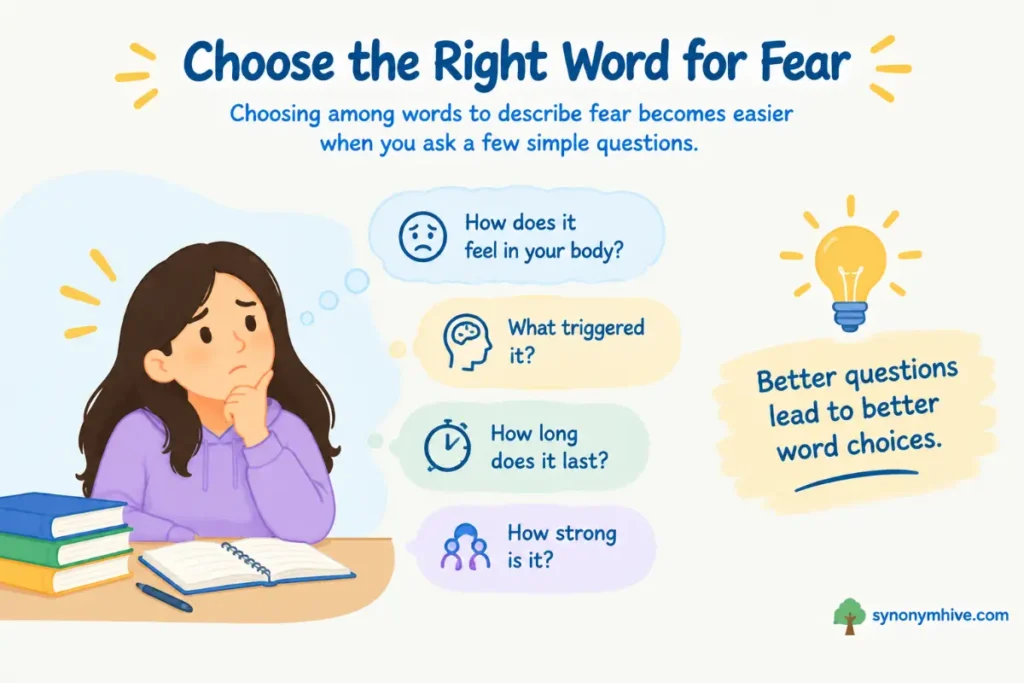
How Can You Choose the Right Fear Word?
Choosing among words to describe fear becomes easier when you ask a few simple questions.
How Strong Is the Fear?
Start with intensity.
Use uneasy for mild discomfort. Use frightened for ordinary fear.
Do not call someone petrified if they are simply nervous about giving a speech.
What Caused the Fear?
The cause can guide your word choice.
A dangerous animal may frighten someone. A strange situation may make them uneasy. An uncertain future may make them apprehensive. A sudden warning may leave someone alarmed.
The cause often gives the word more meaning.
How Long Does the Fear Last?
A sudden reaction and a long lasting concern are not the same.
Startled works well for a sudden response.
Anxious can describe ongoing worry.
Dreading often describes fear about something that has not happened yet.
How Does the Person React?
Look at the person’s behavior.
Someone who cannot move may be frozen or petrified.
Someone who cannot think clearly may be panicked.
The reaction can tell you more than the emotion label.
Who Is the Audience?
Think about where the sentence will appear.
A school essay may need precise words such as apprehensive or alarmed.
A text message can use scared or freaked out.
A professional email usually works better with concerned or worried.
A novel can use a physical description instead of a direct emotion word.
What Are Common Mistakes When Describing Fear?
Several mistakes can make emotional writing less precise.
Using Terrified for Every Situation
Terrified means extremely afraid. If you use it for every small worry, the word loses its force.
Weak:
“I was terrified because my friend was five minutes late.”
Better:
“I was worried because my friend was five minutes late.”
Save terrified for situations that create intense fear.
Treating Nervous and Afraid as Exact Matches
Nervous often describes tension before something happens. Afraid usually points to a perceived threat or danger.
“I was nervous before my presentation.”
“I was afraid when the stranger followed me.”
The first situation involves performance pressure. The second involves a possible threat.
Using Slang in Formal Writing
Words such as freaked out, spooked, and jumpy can sound too casual in academic or professional writing.
Use them in conversation, informal messages, or dialogue when they fit the speaker.
Repeating the Same Word
Repeating scared in every sentence makes writing flat.
Instead, use a mix of precise terms.
“She was scared at first. As the noise grew louder, she became alarmed. Soon, she was trembling and unable to speak.”
The changing words create a clearer emotional progression.
Telling Instead of Showing
Simply writing “He was afraid” can work, but it does not always give the reader much information.
Try showing the reaction.
“He stepped backward and kept his eyes fixed on the dark window.”
The second sentence gives the reader something to picture.
Choosing a Word That Is Too Strong
A dramatic word can change the meaning of a sentence.
If someone is mildly worried, uneasy is often better than horrified.
Precision matters more than drama.
What Are Antonyms of Fear?
Fear has several useful opposites and related contrasts.
Common antonyms include:
- Brave.
- Fearless.
- Confident.
- Calm.
- Relaxed.
- Secure.
- Courageous.
- Bold.
- Assured.
- Unafraid.
These words do not all mean exactly the same thing.
Fearless means showing little or no fear.
Brave means acting despite fear.
Calm means not showing strong worry or distress.
Confident means believing in your ability or judgment.
Courageous is often used when someone chooses to act despite danger or difficulty.
For example:
“She was afraid, but she was brave enough to enter the building.”
This sentence shows an important idea. Courage does not always mean having no fear. A person can feel afraid and still act with courage.
What Are Some Quick Memory Tricks for Fear Words?
A simple way to remember fear vocabulary is to connect each word with a picture.
Think of uneasy as a person who keeps looking over their shoulder.
Think of nervous as someone waiting outside an interview room.
You can also remember the difference between fear and courage this way:
Fear asks, “What if something goes wrong?”
Courage says, “I’m afraid, but I’ll act anyway.”
That contrast is useful in essays, stories, speeches, and character descriptions.
What Are the Best Words for Different Types of Fear?
Different situations call for different vocabulary.
Fear of Failure
Use anxious, worried, apprehensive, concerned, or doubtful.
Example:
“She was apprehensive about failing the final exam.”
Fear of Danger
Use afraid, frightened, alarmed, terrified, or fearful.
Example:
“The hikers became alarmed when the river began to rise.”
Fear of the Unknown
Use uneasy, uncertain, apprehensive, nervous, or anxious.
Example:
“He felt uneasy about what might happen next.”
Fear Before an Event
Use nervous, anxious, tense, worried, or apprehensive.
Example:
“She was nervous before her first public speech.”
Sudden Fear
Use startled, alarmed, frightened, shocked, or panicked.
Example:
“I was startled when someone knocked on the window.”
Long Lasting Fear
Use fearful, anxious, worried, concerned, or apprehensive.
Example:
“The family remained anxious about the missing dog.”
How Do Writers Make Fear More Powerful?
Strong writing does not always need stronger adjectives. Sometimes a small physical detail creates more impact.
Compare these two sentences:
“He was very afraid of the storm.”
“His fingers tightened around the edge of the table as thunder shook the windows.”
The second sentence gives the reader a physical reaction. It also creates a clearer scene.
You can build fear through small details such as silence, breathing, movement, sound, distance, and uncertainty.
For example:
“The hallway was silent. She took one step forward, then stopped.”
The reader understands that something feels wrong without being told directly.
You can also use short sentences during moments of fear.
“The door moved.
She froze.
Someone was inside.”
Short sentences can make a scene feel faster and more tense. Use this technique carefully so it does not become repetitive.
How Does Fear Affect Word Choice in Character Writing?
When describing a character, choose a word that matches the character’s personality.
A shy character may be timid.
A cautious character may be apprehensive.
A confident character may hide fear but still appear tense.
A person facing extreme danger may become panicked or terrified.
Someone who has experienced a frightening event may be shaken afterward.
This creates more depth than giving every character the same emotional label.
For example:
“The confident firefighter was nervous for a moment, but he quickly regained control.”
The word nervous makes the character human without making him seem weak.
Another example:
“The normally cheerful child became unusually quiet and watchful.”
Here, fear is shown through a change in behavior.
How Does Context Change the Meaning of Fear Words?
A word can take on a slightly different meaning depending on the sentence.
Consider anxious.
“He was anxious about the exam.”
This usually means he was worried.
“She was anxious to meet the new teacher.”
Here, anxious can mean eager rather than afraid.
Context matters.
Consider alarmed.
“The manager was alarmed by the report.”
This means the report caused serious concern.
“The alarmed bird flew away.”
Here, alarmed describes a frightened reaction.
Words connected to fear can overlap with surprise, concern, stress, shock, and caution. The surrounding sentence tells the reader which meaning you intend.
How Can You Avoid Overusing Fear Words?
One of the easiest ways to improve emotional writing is to alternate direct descriptions with actions.
Instead of writing:
“She was scared. She was terrified.”
Write:
“She stared at the doorway. Her hands began to shake. When the handle turned, she stepped backward and held her breath.”
The second version gives the reader a sequence of reactions.
You can also vary the focus.
Start with the person’s thoughts.
Then describe the body.
Next, show the person’s action.
Finally, show how the fear changes the situation.
This creates movement and keeps the writing natural.
Quick Guide to the Most Useful Fear Words
If you need a fast choice, use this guide.
| If you mean | Try |
|---|---|
| Slight worry | Uneasy |
| Concern about something | Worried |
| Tension before an event | Nervous |
| Fear about the future | Apprehensive |
| Normal fear | Afraid |
| Everyday fear | Scared |
| Formal fear | Frightened |
| Sudden concern | Alarmed |
| Sudden surprise | Startled |
| Fear that affects thinking | Panicked |
| Extreme fear | Terrified |
| Fear that freezes movement | Petrified |
| Fear mixed with shock | Horrified |
| Fear after an event | Shaken |
| Easy to frighten | Skittish |
| Casual fear | Spooked |
| Fear shown through the body | Trembling |
| Fear that causes hesitation | Timid |
| Fear of an expected event | Dreading |
| Fear caused by someone’s power | Intimidated |
Keep this chart in mind when you need a quick word. The strongest choice is usually the most precise one, not the most dramatic one.
How Can You Improve Your Fear Vocabulary?
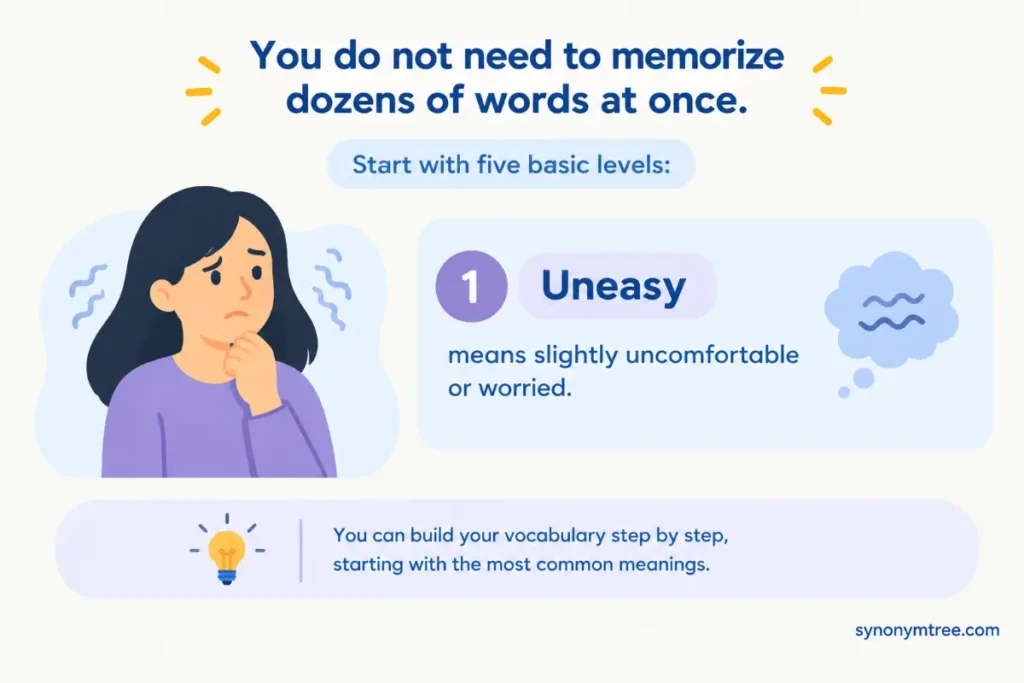
You do not need to memorize dozens of words at once.
Start with five basic levels:
Uneasy means slightly uncomfortable or worried.
Nervous means tense or worried, often before an event.
Afraid means experiencing fear.
Terrified means extremely afraid.
Petrified means extremely afraid, often to the point of being unable to move.
Then add words for special situations.
Use alarmed for a sudden warning.
Use startled for a sudden surprise.
This small group gives you enough range for most everyday writing.
You may also like words to describe silence Best Guide in 2026.
Conclusion
Choosing words to describe fear is easier when you first decide what kind of fear you mean. A person who is slightly uncomfortable may be uneasy, while someone facing a serious threat may be frightened or terrified. A person waiting for difficult news may be anxious or apprehensive.
The strongest writing also considers how fear appears. A trembling hand, racing heart, frozen movement, or sudden silence can show emotion without naming it directly. That approach often makes a sentence more vivid and believable.
Remember that word choice should match the situation. Use simple terms in everyday speech, precise terms in essays, and stronger language only when the emotion truly calls for it.
When you are unsure, start with the basic feeling and then ask how strong it is, what caused it, and how the person reacted. That quick check will help you choose a word that says exactly what you mean.
Frequently Asked Questions
What are good words to describe fear?
Good choices include afraid, scared, frightened, nervous, uneasy, anxious, apprehensive, alarmed, terrified, petrified, and horrified. The best word depends on the strength and type of fear you want to show.
What’s another way to say someone is scared?
You can say someone is frightened, afraid, fearful, alarmed, nervous, uneasy, terrified, or spooked. In casual speech, you can also say that something freaked someone out.
What is a strong word for fear?
Terror is a strong noun for intense fear, while terrified and petrified are strong adjectives. These words should be used when the situation involves a very high level of fear.
How do you describe fear without saying afraid?
Show the person’s physical reactions, thoughts, or actions. For example, you can describe shaking hands, rapid breathing, a racing heart, silence, hesitation, or someone stepping away from danger.
What is the difference between anxious and afraid?
Anxious often describes worry about an uncertain event or future outcome, while afraid usually describes fear caused by a perceived threat. The two words can overlap in some situations.
What are some words to describe fear in writing?
Useful words to describe fear include uneasy, nervous, apprehensive, frightened, alarmed, anxious, panicked, terrified, petrified, and horrified. For creative writing, physical details can make the emotion clearer.
What is the best word for extreme fear?
Terrified is a common choice for extreme fear, while petrified suggests fear so strong that a person may feel unable to move. Horrified works best when the fear also involves deep shock or distress.