
Have you ever been writing an email, an essay, or even a simple text message and noticed you’ve used the word when over and over? It happens more often than you think. That’s why many people search for synonyms to make their writing sound smoother, more natural, and less repetitive. The word when is one of the most common words in English. It helps us talk about time, events, and conditions. While it’s useful, repeating it too often can make your writing feel dull. Choosing the right alternative can improve both clarity and style.
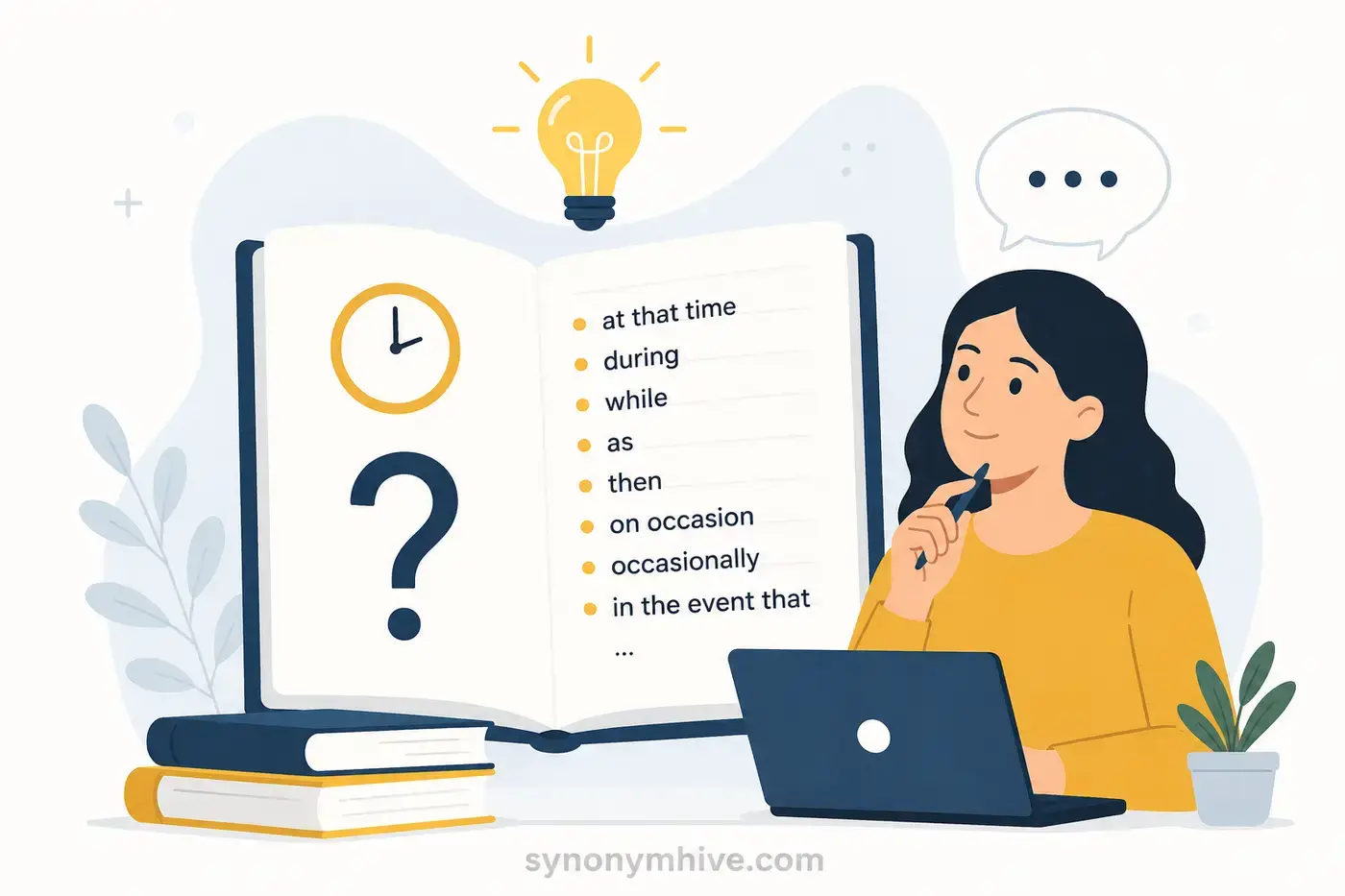
Synonyms for when include whenever, as, while, once, after, before, upon, at the time that, during, and the moment. The best choice depends on whether you’re talking about time, a condition, or a specific event.
In this guide, you’ll learn what when really means, where it came from, and how to choose the best replacement in different situations. You’ll also find a large synonym list, practical examples, usage tips, and common mistakes to avoid.
Find more synonyms in Synonyms for Went: Better Words to Use (2026).
What Does “When” Mean in Plain English?
The word when is mainly used to talk about time. It tells us at what time, during what period, or at the moment something happens.
Here are a few simple examples.
- When will you arrive?
- Call me when you get home.
- I smiled when I saw the surprise.
- When school ended, everyone cheered.
- Do you remember when we first met?
In every example, when connects an event with a time.
Many people look for synonyms because they want to avoid repeating the same word or because another expression fits the sentence better.
Where Does the Word “When” Come From?
The word when has been part of English for hundreds of years. It comes from Old English hwænne, a word that asked about time or referred to the moment something happened. Over time, the spelling became simpler, but the meaning stayed much the same.
Today, when serves several purposes.
- It asks questions.
- It joins two parts of a sentence.
- It introduces a time clause.
- It connects events in a logical order.
Because it has several uses, there isn’t one perfect replacement for every sentence. The right synonym depends on the context.
Why Should You Use Another Word Instead of “When”?
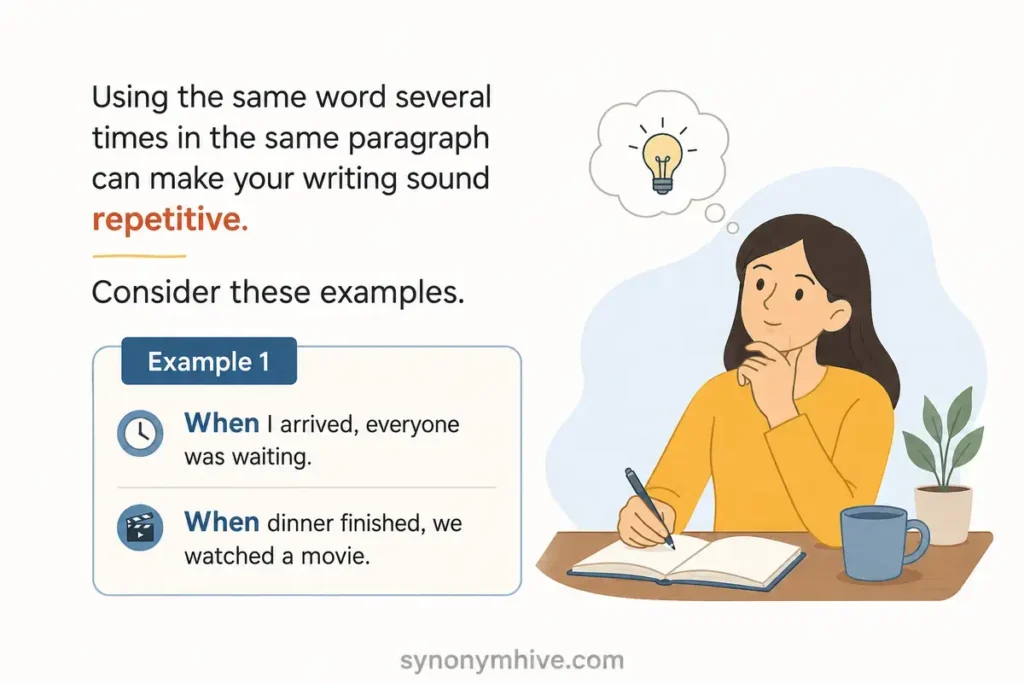
Using when several times in the same paragraph can make your writing sound repetitive.
Consider these examples.
Example 1
When I arrived, everyone was waiting.
When dinner finished, we watched a movie.
When it became late, we went home.
The repeated opening feels predictable.
Example 2
As I arrived, everyone was waiting.
After dinner, we watched a movie.
Once it became late, we went home.
The second version flows more naturally because different time expressions add variety.
Using different alternatives can help you:
- Avoid repeating the same word
- Improve sentence variety
- Make your writing sound more natural
- Match formal or casual situations
- Create smoother transitions
- Keep readers engaged
When Should You Replace “When”?
Sometimes, when is already the best choice.
For example:
When are you coming over?
No synonym sounds more natural in that question.
In other cases, another word or phrase works better.
Instead of writing:
When the meeting ended, everyone left.
You could write:
- After the meeting ended, everyone left.
- Once the meeting ended, everyone left.
- As the meeting ended, everyone left.
- Upon the meeting ending, everyone left.
Each version creates a slightly different feeling while keeping the meaning similar.
What’s the Best Synonym for “When”?
There isn’t one perfect answer.
The best alternative depends on the sentence.
If two events happen at the same time, while or as often works well.
If one event happens after another, once or after is usually a better choice.
If you’re writing formally, upon or at the time that may fit better.
Instead of replacing when automatically, think about the relationship between the events.
Master List of Synonyms for When
The following groups include some of the most useful alternatives.
Simple Alternatives
As
- Meaning: At the same time
- Tone: Neutral
- Example: As the sun rose, the birds began singing.
While
- Meaning: During the time that
- Tone: Neutral
- Example: Please stay quiet while I’m on the phone.
Once
- Meaning: After something happens
- Tone: Neutral
- Example: Once you finish your homework, we’ll go outside.
After
- Meaning: Following an event
- Tone: Everyday
- Example: After lunch, we’ll start the meeting.
Before
- Meaning: Earlier than a specific event
- Tone: Everyday
- Example: Finish your work before dinner.
Whenever
- Meaning: Every time or any time
- Tone: Everyday
- Example: Call me whenever you need help.
During
- Meaning: Throughout a period of time
- Tone: Neutral
- Example: Please stay seated during the presentation.
The Moment
- Meaning: Immediately when
- Tone: Everyday
- Example: The moment I saw the message, I replied.
These alternatives work well in many everyday situations.
Everyday Synonyms
At the Time
- Meaning: During a particular moment
- Tone: Neutral
- Example: At the time, we didn’t know the truth.
Every Time
- Meaning: Whenever something happens
- Tone: Casual
- Example: Every time I visit, we eat together.
As Soon As
- Meaning: Immediately after
- Tone: Everyday
- Example: I’ll call you as soon as I arrive.
The Minute
- Meaning: Right after something happens
- Tone: Informal
- Example: The minute class ended, everyone left.
The Second
- Meaning: Immediately
- Tone: Casual
- Example: The second I heard the news, I smiled.
Anytime
- Meaning: At any time
- Tone: Informal
- Example: You can stop by anytime.
From the Time That
- Meaning: Beginning at a certain point
- Tone: Neutral
- Example: From the time that we met, we’ve been friends.
Since
- Meaning: From a particular time onward
- Tone: Neutral
- Example: I’ve lived here since I graduated.
Formal Varient
Upon
- Meaning: Immediately after
- Tone: Formal
- Example: Upon receiving your application, we’ll review it.
At the Time That
- Meaning: When
- Tone: Formal
- Example: At the time that the report was written, the data was current.
Following
- Meaning: After
- Tone: Formal
- Example: Following the meeting, the team shared updates.
Subsequent to
- Meaning: After
- Tone: Very formal
- Example: Subsequent to approval, construction began.
On the Occasion That
- Meaning: If or when a specific event happens
- Tone: Formal
- Example: On the occasion that assistance is needed, contact support.
These formal alternatives are especially useful in reports, contracts, academic papers, and professional documents.
What’s Coming in Part 2?
In the next section, you’ll learn:
- More than 30 complete alternatives
- substitutes grouped by meaning and strength
- Parts of speech and grammar notes
- American vs. British English usage
- The best choices for resumes, essays, emails, texting, and speaking
- More than 10 original example sentences
- Side-by-side comparisons such as “when vs. while” and “when vs. once”
- Practical tips for choosing the right word in every situation
More alternatives for When
Below are additional alternatives that can replace when in the right context. Remember that not every synonym works in every sentence. Always think about the relationship between the events.
More Everyday Varient
Immediately After
- Meaning: Right after something happens
- Tone: Neutral
- Example: Immediately after the game ended, everyone celebrated.
Right After
- Meaning: Directly following an event
- Tone: Casual
- Example: Right after breakfast, we’ll leave.
By the Time
- Meaning: Before or at a certain moment
- Tone: Neutral
- Example: By the time we arrived, the movie had started.
As Long As
- Meaning: During the period that or on the condition that
- Tone: Everyday
- Example: You can stay as long as you finish your homework.
Until
- Meaning: Up to a certain time
- Tone: Everyday
- Example: Wait here until I return.
Meanwhile
- Meaning: During the same period
- Tone: Neutral
- Example: I’ll cook dinner. Meanwhile, you can set the table.
In the Meantime
- Meaning: During the waiting period
- Tone: Neutral
- Example: The repairs will take a week. In the meantime, use the back entrance.
At That Point
- Meaning: At a particular moment
- Tone: Neutral
- Example: At that point, everyone agreed.
More Formal Varient
Thereafter
- Meaning: After that time
- Tone: Formal
- Example: The agreement was signed. Thereafter, work began.
Thereupon
- Meaning: Immediately after
- Tone: Very formal
- Example: The judge spoke, and thereupon the hearing ended.
Following Which
- Meaning: After that event
- Tone: Formal
- Example: The interview ended, following which the candidates received feedback.
In Which Case
- Meaning: If that happens
- Tone: Formal
- Example: The shipment may be delayed, in which case we’ll notify customers.
At Which Time
- Meaning: At that moment
- Tone: Formal
- Example: The software will restart, at which time the update will finish.
Informal and Conversational Alternatives
Then
- Meaning: Next or after that
- Tone: Casual
- Example: Finish your homework, then we’ll play.
Next
- Meaning: Afterward
- Tone: Casual
- Example: Next, we’ll review your answers.
Later
- Meaning: At a future time
- Tone: Everyday
- Example: We’ll discuss that later.
Afterward
- Meaning: Following an event
- Tone: Everyday
- Example: We had dinner, and afterward we watched a movie.
With these additions, you now have well over 30 useful alternatives that can replace when in different situations.
Which Phrase Express Different Time Relationships?
Not every synonym means exactly the same thing. Some describe events happening together, while others show that one event happens before or after another.
At the Same Time
Use these when two actions happen together.
- As
- While
- During
- Meanwhile
Example:
She listened to music while studying.
Immediately After
These show that one action happens right after another.
- Once
- Upon
- As soon as
- The moment
- The minute
- Right after
Example:
Once the rain stopped, we went outside.
Before Another Event
These refer to an earlier point in time.
- Before
- Until
- By the time
Example:
Finish your report before Friday.
Repeated Events
These describe something that happens again and again.
- Whenever
- Every time
- Anytime
Example:
Whenever I visit my grandparents, we play board games.
Do These Varient Belong to Different Parts of Speech?
Yes. Some are conjunctions, while others are prepositions or adverbs.
Conjunctions
These connect two parts of a sentence.
Common examples include:
- When
- While
- As
- Once
- Before
- After
- Whenever
- Since
Example:
Call me when you arrive.
Prepositions
These come before nouns or noun phrases.
Examples include:
- During
- After
- Before
- Following
- Upon
Example:
After dinner, we took a walk.
Adverbs and Adverbial Phrases
These describe time without joining clauses.
Examples include:
- Then
- Later
- Afterward
- Meanwhile
- Thereafter
Example:
We finished lunch. Then we went shopping.
Understanding these differences helps you build correct sentences.
Are There US vs. UK Differences?
Most alternatives are common in both American and British English.
However, a few are used more often in one variety.
More Common in American English
- Right after
- Anytime
- The second
- The minute
- Then
These expressions appear frequently in everyday American conversation.
More Common in British English
- Whilst
- Thereafter
- Upon (formal writing)
- At the time that
You’ll also see whilst in British English, but while is far more common in American English.
What’s the Best Word on a Resume?
Resumes usually describe achievements rather than time relationships, so replacing when is not always necessary.
Instead of writing:
Managed a team when working overseas.
You could write:
- Managed a team while working overseas.
- Managed a team during an overseas assignment.
- Managed a team throughout an international project.
These versions sound more polished.
Need another vocabulary suggestion? Read Synonyms for A Lot Simple Guide Write Like a Pro (2026).
What’s the Best Word in an Essay?
Academic writing often benefits from more formal transitions.
Good choices include:
- While
- As
- Following
- Once
- Upon
- During
Example
Basic:
When the experiment ended, researchers recorded the results.
Improved:
After the experiment ended, researchers recorded the results.
Or:
Following the experiment, researchers recorded the results.
These alternatives create smoother academic writing.
What’s the Best Word in an Email?
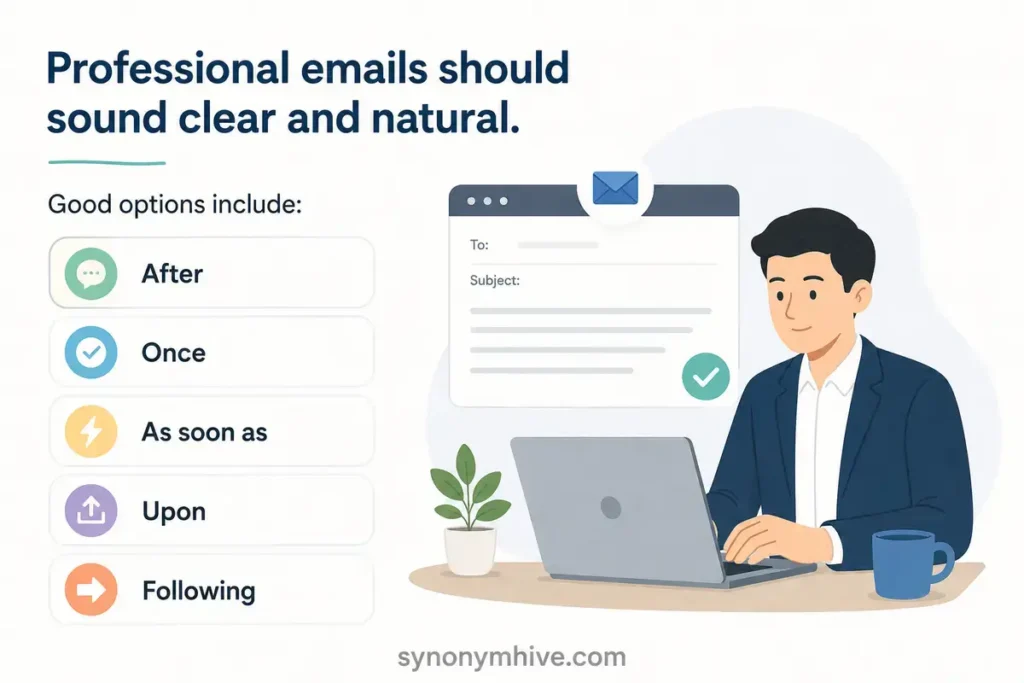
Professional emails should sound clear and natural.
Good options include:
- After
- Once
- As soon as
- Upon
- Following
Examples
Once you’ve reviewed the document, please let me know.
After the meeting, I’ll send the notes.
As soon as the order ships, you’ll receive a tracking number.
What’s the Best Word in Text Messages?
People usually keep things simple while texting.
Common alternatives include:
- Once
- Then
- After
- Anytime
- The minute
- As soon as
Examples
Text me once you get home.
Call me after work.
See you anytime this weekend.
What’s the Best Word in Everyday Speaking?
In normal conversations, simple expressions sound the most natural.
People often say:
- When
- While
- Once
- After
- Before
- As soon as
- Whenever
Long formal expressions like subsequent to or thereupon are rarely used in everyday speech.
Real-Life Example Sentences
Here are original examples showing different ways to replace when.
- As the sun set, the sky turned orange.
- Once the store opened, customers walked inside.
- After the movie ended, we went for ice cream.
- During the meeting, everyone shared ideas.
- Whenever I visit my cousins, we play soccer.
- Call me as soon as you arrive.
- The moment the bell rang, students left the classroom.
- Following the announcement, employees asked questions.
- By the time we reached the station, the train had already left.
- Meanwhile, the children played outside.
- Right after dinner, we took the dog for a walk.
- Upon receiving the email, she replied immediately.
When vs. While: What’s the Difference?
These words are similar, but they are not always interchangeable.
When
- Refers to a specific time or event.
- Often introduces a single action.
Example:
When the phone rang, I answered it.
While
- Describes two actions happening at the same time.
- Can also show contrast.
Example:
While I cooked dinner, my brother washed the dishes.
Choose while when both actions happen together.
When vs. Once: What’s the Difference?
These words both introduce time clauses, but they focus on different moments.
When
- Refers to the time something happens.
- Does not always suggest order.
Example:
When she arrived, everyone smiled.
Once
- Means immediately after something happens.
- Shows a clear sequence.
Example:
Once she arrived, the meeting began.
If one event must happen before another, once is usually the better choice.
What’s Coming in Part 3?
The final section includes:
- Common mistakes and when not to replace when
- Brief antonyms and opposite ideas
- Quick tips for choosing the best synonym
- A practical conclusion
- Frequently Asked Questions
- An SEO-friendly Meta Description
What Are the Most Common Mistakes When Using Synonyms for “When”?
Using different words instead of when can improve your writing, but only if the replacement matches the meaning. Here are the mistakes people make most often.
Replacing “When” Without Checking the Meaning
Not every synonym works in every sentence.
For example:
Less accurate:
While I arrived, the meeting started.
Better:
When I arrived, the meeting started.
Or:
As I arrived, the meeting started.
The word while usually describes actions happening at the same time, not a single event.
Confusing “When” and “Whenever”
These words are close, but they are not identical.
When usually refers to one specific time.
Example:
Call me when you get home.
Whenever refers to any time or every time.
Example:
Call me whenever you need help.
Using whenever for a single event can sound unnatural.
Using Formal Words in Everyday Conversation
Some alternatives are correct but sound too formal in daily speech.
Examples include:
- Subsequent to
- Thereupon
- At which time
- Following which
Instead of saying:
Subsequent to dinner, let’s watch a movie.
Most native speakers would simply say:
After dinner, let’s watch a movie.
Choose words that match your audience.
Forgetting Grammar Differences
Some synonyms are conjunctions.
Others are prepositions.
For example:
Correct:
After lunch, we left.
Correct:
After we ate lunch, we left.
Although both are correct, the sentence structure changes.
Understanding these grammar differences helps you avoid awkward writing.
Replacing Every “When”
Sometimes when is already the clearest choice.
Trying to replace every occurrence can make your writing sound forced.
Use a synonym only if it improves the sentence.
Are There Antonyms of “When”?
Unlike many words, when doesn’t have one direct opposite because it refers to time rather than an object or action.
However, depending on the sentence, these words express opposite ideas.
Never
Shows that something does not happen at any time.
Example:
He never misses practice.
Before
Can be the opposite of after in many time expressions.
Example:
Finish your work before dinner.
After
Acts as the opposite of before.
Example:
We’ll leave after the meeting.
No Longer
Shows that something has stopped happening.
Example:
She no longer works here.
At No Time
Means something never happened.
Example:
At no time was anyone in danger.
These aren’t direct antonyms of when, but they often express opposite time relationships.
Quick Tips for Choosing the Right Synonym
Choosing the right alternative doesn’t have to be difficult.
Keep these simple tips in mind.
Think About the Time Relationship
Ask yourself:
- Do both events happen together?
- Does one happen first?
- Does one happen immediately afterward?
Your answer helps you choose the correct word.
Match the Tone
For formal writing, use words like:
- Following
- Upon
- During
- At the time that
For everyday writing, choose:
- When
- After
- Once
- While
- As soon as
Simple language is usually easier to read.
Don’t Choose Long Words Just to Sound Smart
Long expressions don’t automatically improve writing.
Instead of:
Subsequent to completing dinner…
Simply write:
After dinner…
Readers usually prefer clear language.
Read the Sentence Aloud
One of the easiest editing tips is to read your writing aloud.
If the replacement sounds awkward, try another synonym.
Natural writing should sound natural when spoken.
Keep Your Reader in Mind
Think about who’s reading your work.
For:
- School assignments, use clear academic language.
- Business emails, choose professional but simple words.
- Text messages, keep things relaxed.
- Blog posts, use natural everyday English.
The best synonym is the one your readers understand immediately.
Quick Reference Guide
Best for Everyday Conversation
- When
- While
- Once
- After
- Before
- Whenever
Best for Essays
- As
- During
- Following
- Upon
- Once
Best for Emails
- After
- Once
- As soon as
- Following
Best for Text Messages
- Then
- After
- Once
- Anytime
- The minute
Best for Formal Writing
- Upon
- Following
- At the time that
- Subsequent to
Keeping these groups in mind makes it much easier to choose the right word.
Explore more word choices in Synonyms for Good: The Ultimate Guide Write Like a Pro (2026).
Conclusion
Learning the best synonyms for when can make your writing smoother, more varied, and easier to read. Although when is one of the most useful words in English, it isn’t always the only choice. Depending on your sentence, words like while, after, once, during, as, and whenever may communicate your meaning more clearly.
The key is to think about the relationship between the events. Are they happening at the same time? Does one happen first? Is the action repeated? Once you answer those questions, choosing the right word becomes much easier. Practice using these alternatives in your own writing, and you’ll soon notice that your emails, essays, conversations, and stories sound more natural and engaging.
Frequently Asked Questions
What’s another way to say “when”?
Some of the best alternatives include while, after, once, as, during, whenever, and the moment. The right choice depends on the sentence and the time relationship you want to express.
What are the best substitutes in formal writing?
For formal writing, common choices include upon, following, during, at the time that, and subsequent to because they sound more professional.
Can “while” replace “when”?
Sometimes. While works when two actions happen at the same time, but it doesn’t replace when in every sentence.
What are the most common phrase for when?
The most common alternative for when are after, before, while, once, as, whenever, and during because they’re easy to understand and widely used.
What’s another way to say “when” in a text message?
People often use once, then, after, the minute, or as soon as in casual text messages.
Is “once” the same as “when”?
Not exactly. Once means after something has happened, while when simply refers to the time an event happens.
Can I use synonyms for when in essays?
Yes. Using synonyms naturally can improve sentence variety and make essays sound more polished, provided each replacement fits the context.