

Have you ever been writing an email, school essay, resume, or even a text message and realized you’ve used the word good over and over? It happens to almost everyone. That’s why many people search for a synonyms for good to make their writing sound more natural, clear, and engaging.
The word good is one of the most common words in English. It can describe a person, a result, a skill, an experience, or even food. Because it has so many meanings, there’s no single synonym of good that works in every sentence. Common choices include great, excellent, nice, fine, positive, wonderful, outstanding, impressive, valuable, beneficial, and effective. The best synonym of good depends on your sentence, context, and the tone you want to convey.
In this guide, you’ll learn where the word good came from, what it really means, and how to choose the best synonym for every situation. You’ll also find dozens of alternatives, example sentences, comparison charts, and practical writing tips.
Explore another synonym guide: Synonyms for Using: The Ultimate Guide 2026 Edition.
What Does “Good” Mean in Plain English?
The word good describes something that is pleasant, helpful, high quality, successful, kind, or suitable.
Its meaning changes depending on the sentence.
For example:
- She’s a good teacher.
- We had a good vacation.
- That’s a good idea.
- The food tastes good.
- He did a good job.
Although the same word appears in every sentence, it describes different qualities. That’s why choosing the right synonym depends on what you’re talking about.
Where Does the Word “Good” Come From?
The word good comes from the Old English word gōd, which meant worthy, favorable, suitable, or desirable. Its roots go back even further to ancient Germanic languages, where it carried the idea of something positive, useful, or morally right. Over hundreds of years, good became one of the most flexible words in English. Today it can describe people, actions, products, feelings, performance, character, quality, health, and much more. Because the word has so many meanings, English includes dozens of useful alternatives for good that fit different situations.
Why Look for Another Word Instead of “Good”?
There’s nothing wrong with using good.
The problem comes when it appears too many times in the same paragraph.
For example:
The movie was good.
The acting was good.
The music was good.
The ending was good.
The repeated word makes the writing feel flat.
A stronger version could be:
The movie was excellent.
The acting was outstanding.
The music was beautiful.
The ending was memorable.
Each sentence now gives the reader more information.
When Should You Replace “Good”?
Sometimes good is already the best choice.
For example:
Have a good day.
Most native English speakers would naturally say good, not excellent or outstanding.
Other times, a more specific word creates a clearer picture.
Instead of:
She gave a good presentation.
You might write:
- She gave an excellent presentation.
- She gave an engaging presentation.
- She gave an impressive presentation.
- She gave an well-prepared presentation.
The meaning becomes more precise.
What’s the Best Synonym for “Good”?
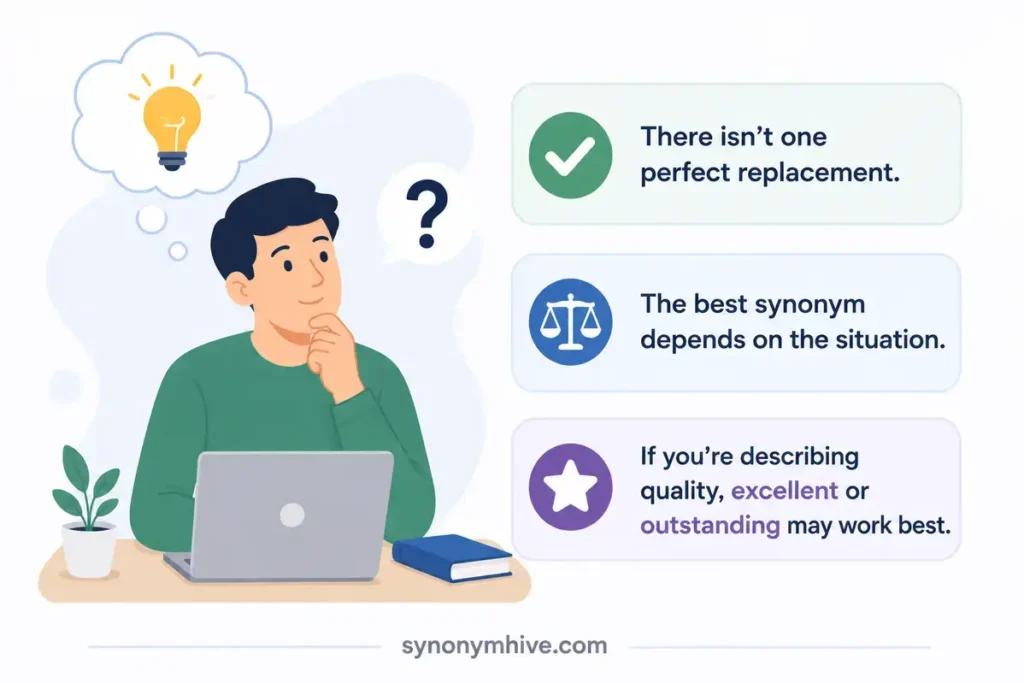
There isn’t one perfect replacement.
The best synonym depends on the situation.
If you’re describing quality, excellent or outstanding may work best.
Use kind or caring when talking about kindness, as these words usually fit better.
If you’re describing results, effective or successful may be stronger choices.
Choosing the right word makes your writing more accurate instead of simply different.
Master List of Synonyms for Good
Simple Similar Words
| Word | Meaning | Tone | Example |
|---|---|---|---|
| Nice | Pleasant or enjoyable | Everyday | She’s a nice neighbor. |
| Fine | Acceptable or satisfactory | Everyday | Everything looks fine now. |
| Great | Better than good | Everyday | You did a great job. |
| Better | Higher in quality | Neutral | This option is better. |
| Best | The highest quality | Neutral | She gave her best effort. |
| Okay | Acceptable | Casual | The movie was okay. |
| Decent | Fairly good | Neutral | The restaurant serves decent food. |
| Solid | Reliable and dependable | Everyday | That was a solid performance. |
Everyday Expressions
| Word | Meaning | Tone | Example |
|---|---|---|---|
| Excellent | Extremely good | Neutral | The service was excellent. |
| Wonderful | Very enjoyable | Friendly | We had a wonderful trip. |
| Amazing | Surprisingly impressive | Casual | The concert was amazing. |
| Fantastic | Extremely enjoyable | Casual | That’s fantastic news. |
| Awesome | Very impressive | Informal | The game was awesome. |
| Pleasant | Comfortable or enjoyable | Neutral | It was a pleasant afternoon. |
| Enjoyable | Giving pleasure | Neutral | The class was enjoyable. |
| Lovely | Attractive or delightful | Friendly | She has a lovely smile. |
Formal Phrases
| Word | Meaning | Tone | Example |
|---|---|---|---|
| Outstanding | Exceptionally good | Formal | She delivered an outstanding presentation. |
| Exceptional | Better than expected | Formal | The team achieved exceptional results. |
| Remarkable | Worth noticing | Formal | He made remarkable progress. |
| Impressive | Causing admiration | Professional | The candidate has an impressive background. |
| Superior | Higher in quality | Formal | This material offers superior performance. |
| Beneficial | Helpful or useful | Formal | Exercise is beneficial for your health. |
| Effective | Producing the desired result | Professional | The new strategy proved effective. |
| Valuable | Having great worth | Professional | Your feedback was valuable. |
Informal and Slang Alternatives
| Word | Meaning | Tone | Example |
|---|---|---|---|
| Cool | Good or enjoyable | Informal | That’s a cool idea. |
| Sweet | Really nice or exciting | Slang | Sweet! We won the game. |
| Dope | Excellent | Slang | That song is dope. |
| Lit | Very exciting | Slang | The party was lit. |
| Fire | Outstanding | Slang | That performance was fire. |
| Top-notch | Very high quality | Informal | They provide top-notch service. |
| First-rate | Excellent quality | Informal | The hotel offers first-rate facilities. |
| World-class | Among the very best | Professional | The university has world-class researchers. |
This collection includes more than 30 useful substitutes that can replace good in different situations. Some are perfect for everyday conversation, while others work better in essays, resumes, presentations, or professional writing.
What’s Coming in Part 2?
In the next section, you’ll learn:
- phrases grouped by meaning and strength
- alternatives by intensity (mild to very strong)
- Parts of speech and grammar notes
- US vs. UK usage differences
- The best words for resumes, essays, emails, texting, and speaking
- More than 10 original example sentences
- Side-by-side comparisons such as good vs. great and good vs. excellent
Can Synonyms for “Good” Be Grouped by Meaning?
Yes. One reason good is so common is that it has many meanings. Grouping phrases by purpose makes it much easier to choose the right word.
Words That Mean High Quality
Use these when talking about products, work, services, or performance.
- Excellent
- Outstanding
- Superior
- Exceptional
- First-rate
- Top-notch
- High-quality
- Premium
Examples:
- The restaurant serves excellent food.
- She did an outstanding job on the project.
- The laptop offers superior performance.
Words That Mean Pleasant or Enjoyable
These describe experiences, places, weather, or events.
- Nice
- Pleasant
- Lovely
- Wonderful
- Delightful
- Enjoyable
- Fantastic
- Amazing
Examples:
- We had a wonderful vacation.
- It was a pleasant afternoon.
- The concert was fantastic.
Words That Mean Kind or Caring
These describe a person’s behavior or personality.
- Kind
- Caring
- Friendly
- Compassionate
- Thoughtful
- Generous
- Helpful
- Considerate
Examples:
- She’s always kind to everyone.
- He’s a thoughtful friend.
- Our neighbors are very friendly.
Words That Mean Successful or Effective
These fit business writing, reports, and academic work.
- Effective
- Successful
- Productive
- Beneficial
- Valuable
- Useful
- Efficient
- Reliable
Examples:
- The new strategy was effective.
- The meeting was productive.
- Exercise is beneficial for your health.
Words That Mean Morally Right
These describe honesty or ethical behavior.
- Virtuous
- Honest
- Noble
- Righteous
- Moral
- Respectable
Examples:
- She’s known for her honest advice.
- He made the right decision.
Which Synonyms Are Stronger Than Others?
Some alternatives are only slightly stronger than good, while others express much greater praise.
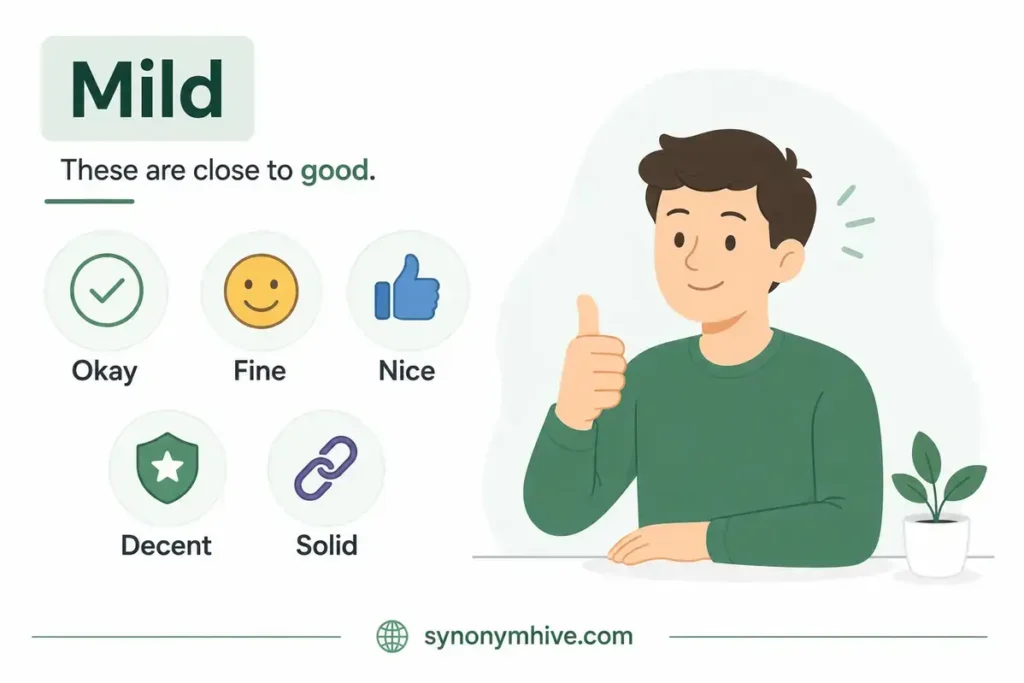
Mild
These are close to good.
- Okay
- Fine
- Nice
- Decent
- Solid
Medium
These sound more positive.
- Great
- Pleasant
- Enjoyable
- Valuable
- Effective
- Helpful
Strong
These express high praise.
- Excellent
- Outstanding
- Exceptional
- Remarkable
- Impressive
- Fantastic
- Wonderful
Very Strong
Use these only when something truly deserves them.
- Incredible
- Extraordinary
- Phenomenal
- World-class
- Perfect
- Superb
Choosing a stronger word gives readers a clearer idea of how positive something really is.
Can “Good” Have Different Parts of Speech?
Yes, although good is usually an adjective.
Adjective
This is the most common use.
Examples:
- She’s a good teacher.
- That’s a good book.
- The food tastes good.
Noun
Sometimes good refers to benefit or positive value.
Examples:
- Exercise does a lot of good.
- The charity works for the public good.
Related Adverb
The adverb form is well, not good.
Correct:
She sings well.
Incorrect:
She sings good.
This is one of the most common grammar mistakes in English.
Are There US vs. UK Differences?
Most synonyms for good are used in both American and British English. However, there are small differences.
More Common in American English
- Awesome
- Amazing
- Great
- Cool
- Top-notch
More Common in British English
- Brilliant
- Lovely
- Splendid
- Proper (informal)
- Smashing (less common today)
Most readers in both countries understand these words, but local preferences can make writing sound more natural.
What’s the Best Word for a Resume?
Resumes should describe achievements instead of simply saying something was good.
Good alternatives include:
- Outstanding
- Successful
- Effective
- Exceptional
- Proven
- Accomplished
- Strong
Example
Less effective:
Good communication skills.
Better:
Strong communication skills.
Or:
Proven communication and leadership skills.
Another example:
Instead of:
Did a good job managing projects.
Write:
Successfully managed multiple projects ahead of schedule.
Need another vocabulary suggestion? Read Synonyms For Think Simple Guide Smart Choices (2026).
What’s the Best Word for an Essay?
Academic writing benefits from more specific vocabulary.
Good choices include:
- Effective
- Significant
- Beneficial
- Valuable
- Remarkable
- Outstanding
- Positive
Example
Basic:
The program had good results.
Better:
The program produced positive results.
Or:
The program delivered significant improvements.
What’s the Best Word for an Email?
Professional emails should be clear and friendly.
Useful alternatives include:
- Great
- Excellent
- Helpful
- Valuable
- Positive
Examples
Thank you for your excellent support.
You shared several valuable suggestions.
That’s great news for the team.
What’s the Best Word for Text Messages?
Casual conversations usually use simple language.
Common choices include:
- Great
- Nice
- Awesome
- Cool
- Amazing
- Sweet
Examples
That sounds great.
Your new car looks awesome.
The movie was amazing.
What’s the Best Word for Speaking?
When speaking naturally, people usually choose everyday words instead of formal ones.
Popular choices include:
- Great
- Nice
- Wonderful
- Fantastic
- Excellent
- Awesome
These sound friendly without being overly formal.
Real-Life Example Sentences
Here are different ways to replace good naturally.
- She gave an excellent presentation during the meeting.
- We had a wonderful weekend at the beach.
- The doctor recommended a beneficial exercise routine.
- His advice was extremely valuable.
- The new software delivered outstanding performance.
- They received positive feedback from customers.
- The teacher created an enjoyable classroom environment.
- Her cooking is amazing every single time.
- The manager made an effective decision under pressure.
- The hotel provides first-rate customer service.
- He’s known as a kind and thoughtful neighbor.
- The company’s remarkable growth surprised investors.
Good vs. Great: What’s the Difference?
These words are close in meaning but express different levels of praise.
Good
- Positive but general.
- Suitable for everyday situations.
Example:
The presentation was good.
Great
- Stronger than good.
- Suggests above-average quality.
Example:
The presentation was great.
Choose great when you want to express more enthusiasm.
Good vs. Excellent: What’s the Difference?
These words are not always interchangeable.
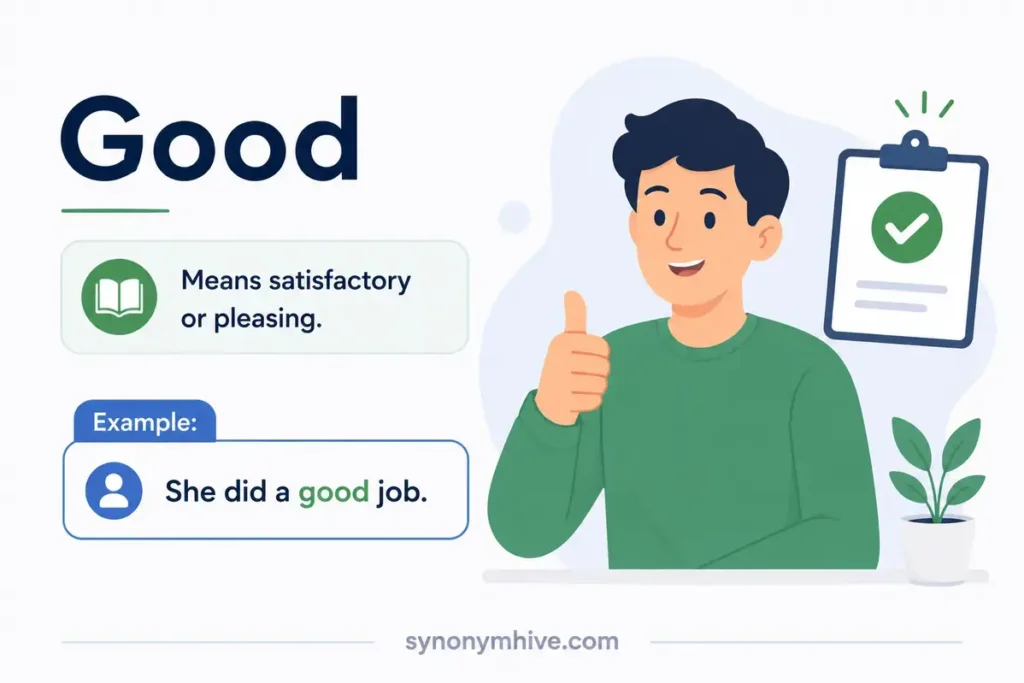
Good
Means satisfactory or pleasing.
Example:
She did a good job.
Excellent
Means extremely high quality.
Example:
She did an excellent job.
Reserve excellent for situations that truly deserve high praise.
Good vs. Effective: What’s the Difference?
People sometimes confuse quality with results.
Good
Describes overall quality.
Example:
It’s a good plan.
Effective
Focuses on achieving a goal.
Example:
It’s an effective marketing strategy.
A plan can be good, but an effective plan actually produces the desired outcome.
What Are the Most Common Mistakes When Using Synonyms for “Good”?
Replacing good can make your writing more interesting, but only if the new word fits the situation. Here are the mistakes writers make most often.
Using “Amazing” for Ordinary Things
Words like amazing, incredible, and phenomenal express very strong praise.
Less natural:
The sandwich was amazing.
This might be fine in casual conversation, but in formal writing it can sound exaggerated.
Better:
The sandwich was delicious.
Or:
The sandwich was very good.
Use stronger words only when they truly match the situation.
Confusing “Good” and “Well”
This is one of the most common English grammar mistakes.
Good is usually an adjective.
Well is usually an adverb.
Correct:
- She is a good singer.
- She sings well.
Incorrect:
- She sings good.
Remember this simple rule:
- Good describes a noun.
- Well describes an action.
Choosing a Word That’s Too Formal
Formal words like exceptional, superior, and exemplary work well in reports or resumes but may sound unnatural in everyday conversations.
Instead of:
That pizza was exceptional.
Most people would simply say:
That pizza was really good.
Match your vocabulary to your audience.
Replacing Every “Good”
Not every use of good needs another word.
For example:
- Good morning.
- Good luck.
- Good evening.
- Good idea.
- Good job.
These expressions are natural English. Replacing good often makes them sound awkward.
Picking a Synonym That Changes the Meaning
Many alternatives have different meanings.
For example:
- Effective means something achieves its purpose.
- Beneficial means something is helpful.
- Outstanding means far above average.
- Kind describes personality.
- Delicious describes food.
Think about what you actually mean before choosing a replacement.
What Are the Antonyms of “Good”?
The opposite of good depends on the sentence.
Here are some common antonyms.
Bad
The most direct opposite.
Example:
The weather was bad.
Poor
Describes low quality.
Example:
The report received poor reviews.
Terrible
Much stronger than bad.
Example:
The movie was terrible.
Harmful
Opposite of beneficial.
Example:
Smoking is harmful to your health.
Ineffective
Opposite of effective.
Example:
The plan proved ineffective.
Inferior
Lower in quality.
Example:
This product is inferior to the newer model.
Quick Tips for Choosing the Right Word
Choosing the best synonym is easier when you think about the meaning instead of simply replacing a word.
Ask Yourself What “Good” Means
Does it mean:
- High quality?
- Kind?
- Helpful?
- Successful?
- Enjoyable?
- Healthy?
Once you know the meaning, the right synonym becomes much clearer.
Use Specific Words
Specific words help readers understand exactly what you mean.
Instead of:
The lesson was good.
Try:
- The lesson was interesting.
- The lesson was helpful.
- The lesson was informative.
- The lesson was engaging.
Each one paints a clearer picture.
Match the Tone
For casual writing, choose simple words like:
- Great
- Nice
- Awesome
- Cool
- Wonderful
For professional writing, use words like:
- Effective
- Outstanding
- Valuable
- Exceptional
- Impressive
Don’t Use Strong Words Too Often
If everything is amazing, fantastic, or incredible, those words lose their impact.
Save them for situations that truly deserve them.
Read the Sentence Out Loud
After replacing good, read the sentence aloud.
If it sounds awkward or unnatural, try another synonym or keep the original word.
Natural writing is always better than complicated writing.
Quick Reference Guide
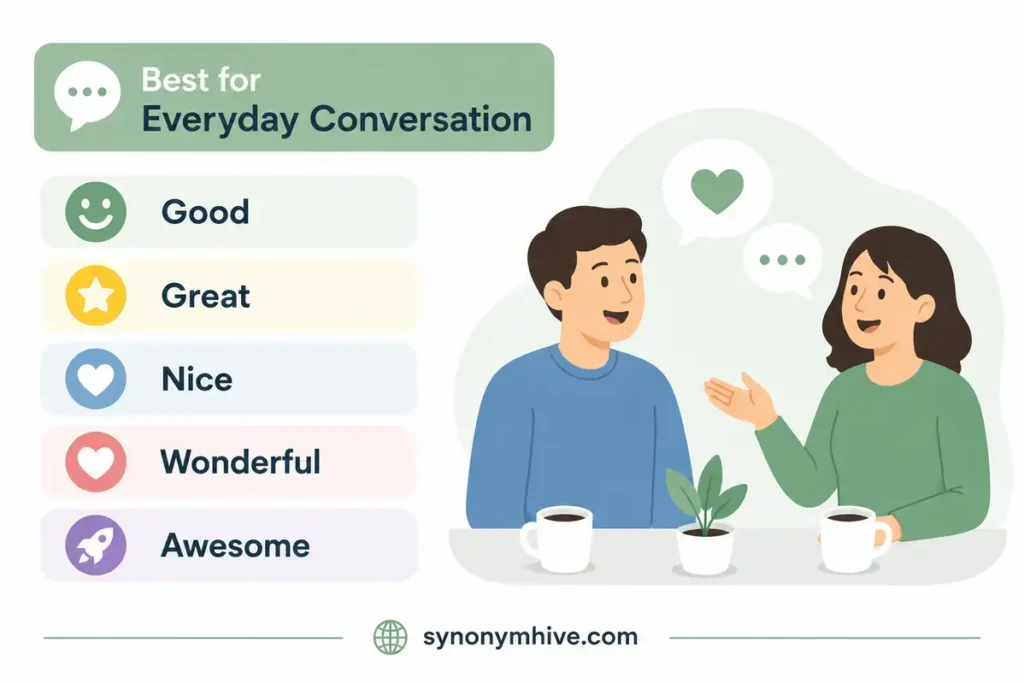
Best for Everyday Conversation
- Good
- Great
- Nice
- Wonderful
- Awesome
Most Suitable for Essays
- Effective
- Beneficial
- Significant
- Valuable
- Positive
Best for Professional Emails
- Excellent
- Helpful
- Valuable
- Positive
- Strong
Appropriate for Resumes
- Outstanding
- Proven
- Successful
- Effective
- Accomplished
Best for Reviews
- Excellent
- Impressive
- Outstanding
- Exceptional
- Top-notch
Keeping these groups in mind makes it much easier to choose the right word for any situation.
Expand your vocabulary with Synonyms for Run: Smart Alternatives for Every Context (2026).
Conclusion
Learning the best synonyms for good helps you write with more variety and precision. While good is one of the most useful words in English, it doesn’t always tell readers exactly what you mean. Depending on the situation, words like great, excellent, effective, valuable, pleasant, outstanding, or kind may communicate your message more clearly.
The key is to choose a word that matches your meaning instead of replacing good just for variety. Think about whether you’re describing quality, personality, success, usefulness, or enjoyment. Once you know the purpose of the sentence, selecting the right synonym becomes much easier. A few thoughtful word choices can make your writing stronger, more natural, and more enjoyable to read.
Frequently Asked Questions
What’s another way to say “good”?
Common alternatives include great, excellent, nice, wonderful, outstanding, effective, valuable, pleasant, and impressive. The best choice depends on the context.
What are the best expressions for good in formal writing?
For professional or academic writing, good choices include excellent, effective, exceptional, valuable, remarkable, superior, and outstanding.
Can I use “great” instead of “good”?
Yes. Great is one of the most common similar words for good and expresses stronger praise. Use it when something is better than simply satisfactory.
What are the most common substitutes for good?
Some of the most useful variants for good are great, excellent, nice, pleasant, effective, valuable, wonderful, outstanding, and amazing.
What’s another way to say “good” in an essay?
In essays, words like effective, beneficial, valuable, significant, positive, and remarkable often sound more precise than good.
Is “excellent” stronger than “good”?
Yes. Excellent means something is much better than average, while good simply means satisfactory or pleasing.
Can I use alternatives for good in a resume?
Absolutely. Strong action words and descriptive adjectives such as outstanding, effective, successful, proven, and accomplished can make your resume sound more professional and persuasive.