
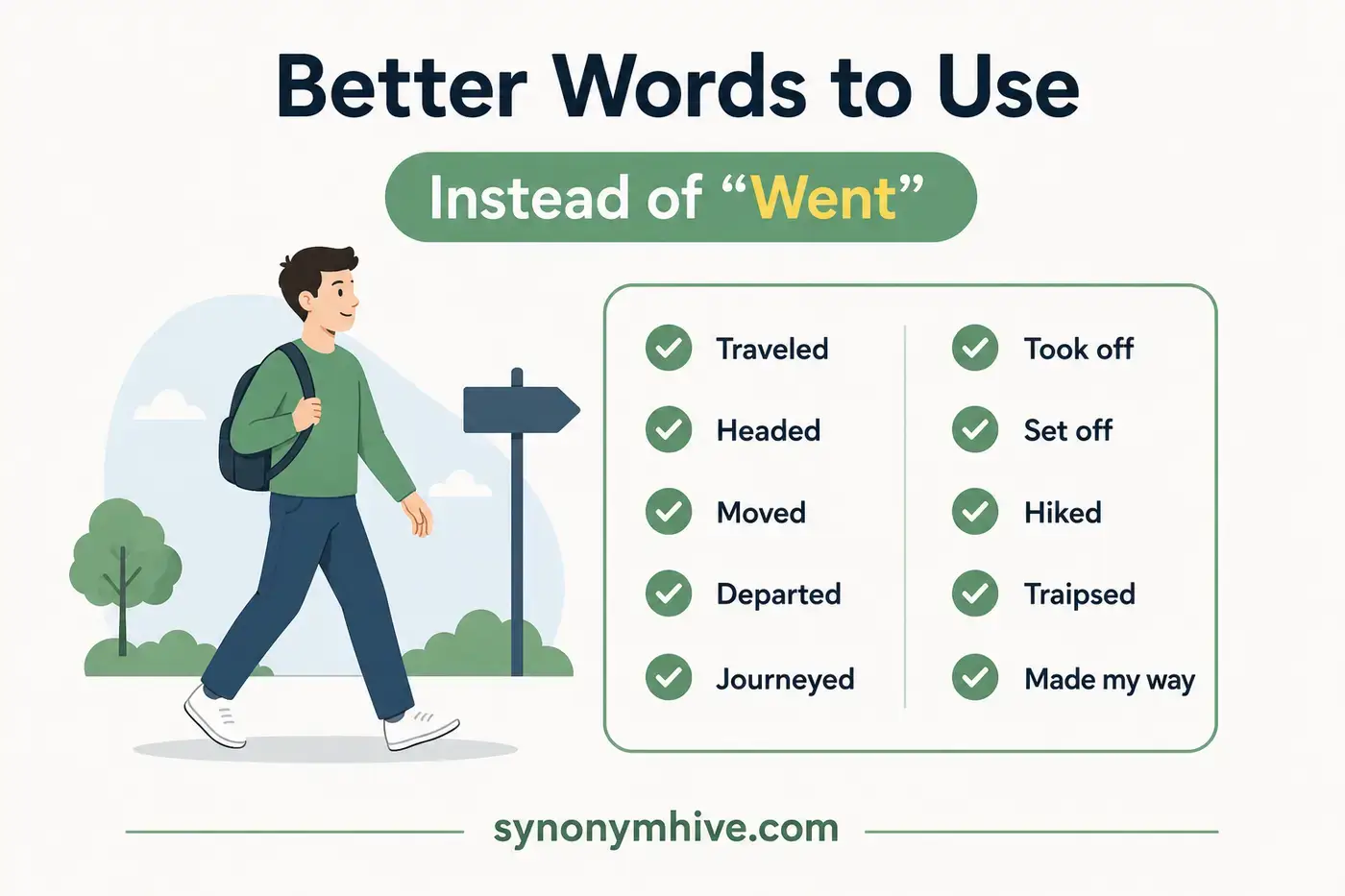
Have you ever written an email essay or text message and noticed you used the word went over and over. It happens more often than you might think. Many people search for synonyms for went because they want their writing to sound smoother without changing the meaning. The word went is easy to use but repeating it in every sentence can make your writing feel dull. A better word can add variety make your point clearer and help your message sound more natural.
Synonyms include traveled moved visited headed journeyed proceeded left walked drove and many other words. The best choice depends on where someone went and how they got there.
In this guide you’ll learn what went really means where it came from the best alternatives for different situations and how to choose the right word with confidence. You’ll also find real examples easy comparisons and practical tips you can use right away.
Find similar expressions in Synonyms For Many Simple Guide WordWise (2026).
What Does Went Mean.
The word went is the past tense of the verb go. It describes moving from one place to another. It can also describe changes events and progress depending on the sentence.
Here are a few examples.
- She went to the library after school.
- The meeting went well.
- Time went by quickly.
- He went home early.
As you can see went does much more than describe travel. It can also talk about results feelings or changes. That’s why people often search for synonyms for went. They want a word that matches the exact meaning instead of using the same verb every time.
Where Did The Word Went Come From.
The history of went is surprisingly interesting.Most English verbs form the past tense by adding ed. The verb go is different. Its past tense became went through the history of the English language.
The word went originally came from an older verb called wend which meant to turn or travel in a certain direction. Over time English speakers began using went as the past tense of go. Eventually that became the standard form used today. Even though its history is unusual the meaning is simple. It tells us that someone or something moved happened or changed in the past.
Why People Search For Synonyms For Went.
There are several reasons people look for better alternatives.
Sometimes they want to avoid repeating the same word.
Other times they need a word that paints a clearer picture.
Compare these examples.
He went into the room.
He walked into the room.
The second sentence gives the reader more information.
Now compare another example.
She went across the country.
She traveled across the country.
Again the second sentence creates a stronger image.
Good writing is not about replacing every common word. It is about choosing the word that tells the story more clearly.
Can You Always Replace Went.
No.
Many people think every use of went has a direct replacement. That is not true.
Look at these examples.
The meeting went well.
You cannot replace went with walked or traveled because the sentence is talking about the result of the meeting instead of movement.
Another example.
Time went by quickly.
The word describes the passing of time. In these cases the best replacement could be passed instead of another travel related verb. That is why understanding the whole sentence matters more than memorizing a list of words.
Master List Of Synonyms For Went.
The table below groups common alternatives by tone and everyday use. Some describe physical movement while others fit specific situations.
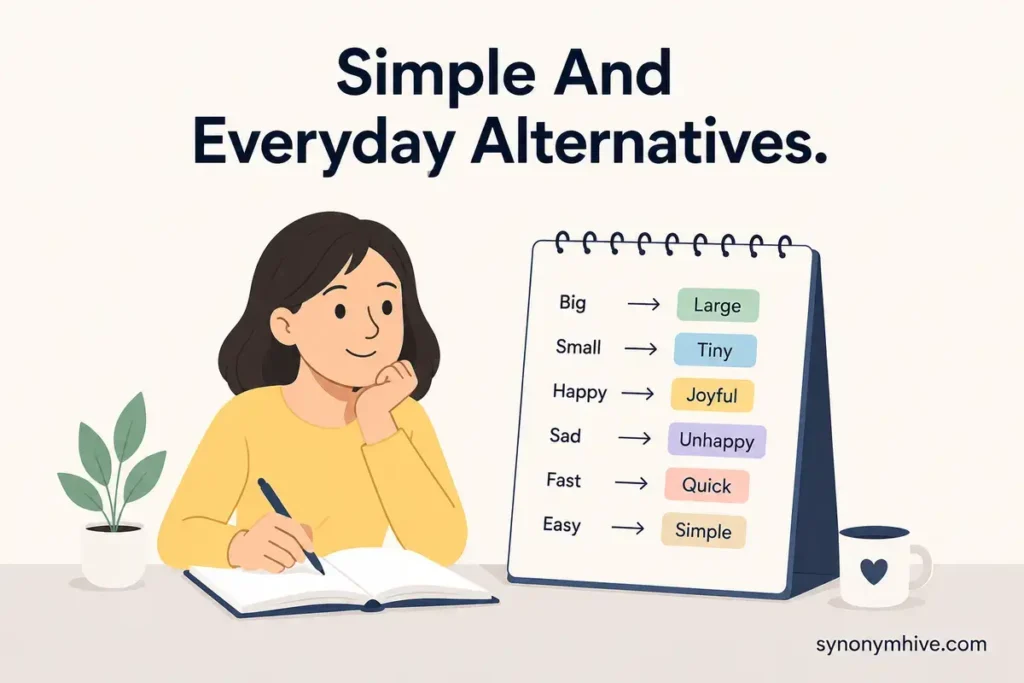
Simple And Everyday Alternatives.
| Word | Meaning | Tone | Example |
|---|---|---|---|
| Moved | Changed location | Everyday | She moved to the front of the line. |
| Walked | Traveled on foot | Everyday | He walked to school. |
| Ran | Moved quickly | Everyday | She ran across the field. |
| Drove | Traveled by car | Everyday | We drove home after dinner. |
| Rode | Traveled using a bike horse or vehicle | Everyday | They rode the bus together. |
| Came | Arrived at a place | Everyday | He came home late. |
| Left | Departed | Everyday | She left before sunrise. |
| Returned | Came back | Everyday | They returned after lunch. |
| Entered | Went inside | Everyday | The teacher entered the classroom. |
| Exited | Went out | Everyday | Everyone exited the building calmly. |
Common Alternatives For Everyday Writing.
| Word | Meaning | Tone | Example |
|---|---|---|---|
| Traveled | Moved over a distance | Neutral | We traveled across the state. |
| Visited | Went to see someone or somewhere | Neutral | They visited their grandparents. |
| Headed | Moved toward a place | Casual | She headed home after work. |
| Reached | Arrived at a destination | Neutral | We reached the station before noon. |
| Proceeded | Continued forward | Neutral | The group proceeded to the next room. |
| Arrived | Got to a place | Neutral | He arrived early. |
| Passed | Moved beyond something | Neutral | We passed the old bridge. |
| Crossed | Moved from one side to another | Neutral | She crossed the street safely. |
| Escaped | Got away from danger | Neutral | The hikers escaped the storm. |
| Followed | Moved behind someone | Neutral | The children followed their teacher. |
Formal Alternatives.
| Word | Meaning | Tone | Example |
|---|---|---|---|
| Journeyed | Traveled over a long distance | Formal | They journeyed through the mountains. |
| Advanced | Moved forward | Formal | The team advanced to the finals. |
| Departed | Left a place | Formal | The train departed on time. |
| Continued | Kept moving | Formal | The hikers continued along the trail. |
| Progressed | Moved forward step by step | Formal | The project progressed quickly. |
| Navigated | Found a way through | Formal | She navigated the busy streets. |
| Ventured | Went somewhere with some risk | Formal | They ventured into the forest. |
| Approached | Came closer | Formal | He approached the stage calmly. |
| Migrated | Moved from one region to another | Formal | Many birds migrated south. |
| Transferred | Moved from one place to another | Formal | She transferred to another office. |
These alternatives cover many different situations but none of them fits every sentence. The strongest choice depends on the action the setting and the tone you want to create.
Slang And Informal Alternatives For Went.
Casual conversations often use different words than school essays or business emails. These options sound natural when you’re talking with friends or writing text messages.
| Word | Meaning | Tone | Example |
|---|---|---|---|
| Took off | Left quickly | Casual | He took off after dinner. |
| Headed out | Left for another place | Casual | We headed out before sunset. |
| Popped over | Made a quick visit | Casual | I popped over to my neighbor’s house. |
| Stopped by | Visited for a short time | Casual | She stopped by after work. |
| Rolled in | Arrived in a relaxed way | Slang | They rolled in around noon. |
| Split | Left a place | Slang | We split before the crowd arrived. |
| Bounced | Left quickly | Slang | He bounced after the game. |
| Dropped by | Visited briefly | Casual | My cousin dropped by yesterday. |
| Pulled up | Arrived in a vehicle | Casual | She pulled up right on time. |
| Showed up | Arrived at a place | Casual | Everyone showed up early. |
These words work well in relaxed conversations. They usually don’t belong in formal writing.
Synonyms By Intensity.
Some alternatives describe simple movement. Others make the action feel stronger or more dramatic.
Mild Alternatives.
These work for everyday situations.
- Moved.
- Walked.
- Came.
- Left.
- Visited.
- Returned.
Moderate Alternatives.
These add more detail.
- Traveled.
- Headed.
- Reached.
- Crossed.
- Arrived.
- Continued.
Strong Alternatives.
These create a vivid picture.
- Journeyed.
- Ventured.
- Escaped.
- Migrated.
- Advanced.
- Navigated.
The stronger the word the more specific your sentence becomes.
What Part Of Speech Is Went.
What Part Of Speech Is Went.
The word went is a verb. More specifically it is the past tense of the verb go.
Examples.
- She went to the store.
- They went home after dinner.
- We went hiking last weekend.
Since it is a verb every synonym should also work as a verb in the sentence.
For example.
She traveled to the store.
They returned home after dinner.
We hiked last weekend.
Notice that you don’t always need another form of went. Sometimes choosing a completely different verb makes the sentence shorter and clearer.
Looking for another word? See Synonyms for With: The Ultimate Guide Write Like a Pro (2026).
Do Americans And British People Use Different Words.
Most alternatives are understood in both American and British English. A few choices are more common in one region than the other.
| Situation | American English | British English |
|---|---|---|
| Left home | Headed out | Set off |
| Quick visit | Stopped by | Popped round |
| Arrived | Showed up | Turned up |
| Began a trip | Took off | Set off |
These differences are small. Readers from both countries will understand almost all of these expressions.
Which Synonym Works Best For Different Types Of Writing.
The right word depends on your audience and the kind of writing you’re doing.
Best Word For A Resume.
A resume should sound professional and direct.
Good choices include.
- Managed.
- Traveled.
- Visited.
- Advanced.
- Transferred.
Example.
Traveled to client locations to provide technical support.
Best Word For An Essay.
Essays should be clear and descriptive.
Good choices include.
- Traveled.
- Proceeded.
- Continued.
- Reached.
- Journeyed.
Example.
The explorers journeyed across the desert despite difficult conditions.
Best Word For Text Messages.
Simple language works best.
Good choices include.
- Went.
- Came.
- Headed.
- Stopped by.
- Took off.
Example.
I headed home after work.
Best Word For Emails.
Professional emails should be easy to read.
Good choices include.
- Visited.
- Attended.
- Reached.
- Returned.
- Left.
Example.
I visited the client’s office this morning.
Best Word For Speaking.
Everyday conversations usually sound best with simple words.
Good choices include.
- Went.
- Came.
- Walked.
- Drove.
- Headed.
Example.
We drove to the beach before sunrise.
Real Life Example Sentences.
These examples show how different words can replace went in everyday situations.
- My family traveled across the country during summer vacation.
- She walked to school because the weather was nice.
- We drove home after the concert ended.
- The doctor visited every patient before lunch.
- He headed straight to the airport.
- They returned before the rain started.
- The hikers crossed the river safely.
- She entered the meeting room with confidence.
- Our team advanced to the championship game.
- The children ran outside as soon as school ended.
- The birds migrated south before winter arrived.
- My grandparents journeyed across Europe many years ago.
These examples show that searching for synonyms for went is really about finding the verb that paints the clearest picture.
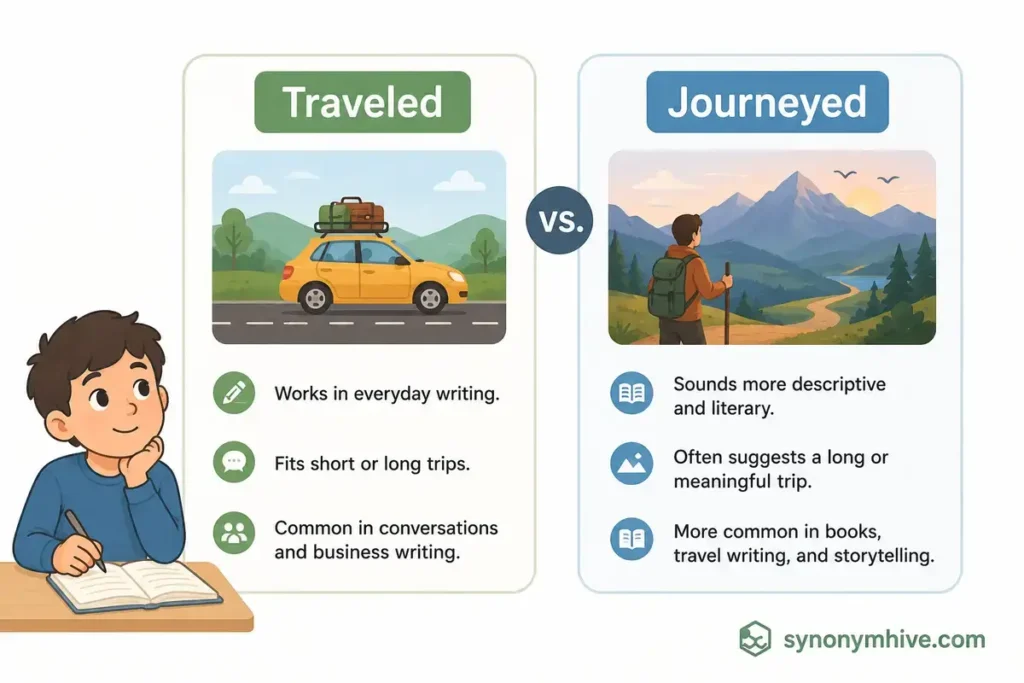
Traveled Vs Journeyed.
Both words describe moving from one place to another. Still they don’t create the same picture.
| Traveled | Journeyed |
|---|---|
| Works in everyday writing. | Sounds more descriptive and literary. |
| Fits short or long trips. | Often suggests a long or meaningful trip. |
| Common in conversations and business writing. | More common in books travel writing and storytelling. |
Examples.
- We traveled across Texas during spring break.
- The pioneers journeyed across the country in search of a better life.
If you’re writing an email report or school assignment traveled is usually the better choice. Journeyed works best when you want to make the trip feel more memorable.
Went Vs Left.
People often think these words mean the same thing. They don’t.
| Went | Left |
|---|---|
| Focuses on moving to another place. | Focuses on departing from a place. |
| May or may not mention the destination. | Emphasizes the act of leaving. |
Examples.
- She went to the grocery store.
- She left the office at five.
If your sentence is about the destination use went. If the important detail is the departure use left.
Common Mistakes To Avoid.
Searching for synonyms for went can improve your writing. Still there are a few mistakes that many people make.
- Replacing went with a word that changes the meaning.
- Using journeyed for a short walk to the mailbox.
- Choosing formal words in casual conversations.
- Repeating the same replacement in every paragraph.
- Forgetting that went also describes results instead of movement in some sentences.
- Using arrived and left as if they mean the same thing.
- Picking a longer word just to sound more impressive.
Clear writing always beats complicated writing.
Antonyms Of Went.
The opposite depends on the sentence. These words often express the opposite idea.
| Word | Best Use |
|---|---|
| Stayed | Did not leave a place. |
| Remained | Continued to be in the same place. |
| Stopped | Ended movement. |
| Waited | Stayed until something happened. |
| Rested | Stayed still for a period of time. |
Examples.
- We stayed home because of the storm.
- She remained in the office until everyone finished.
- They stopped before crossing the road.
Quick Tips For Choosing The Right Word.
The best replacement is the one that matches your sentence naturally.
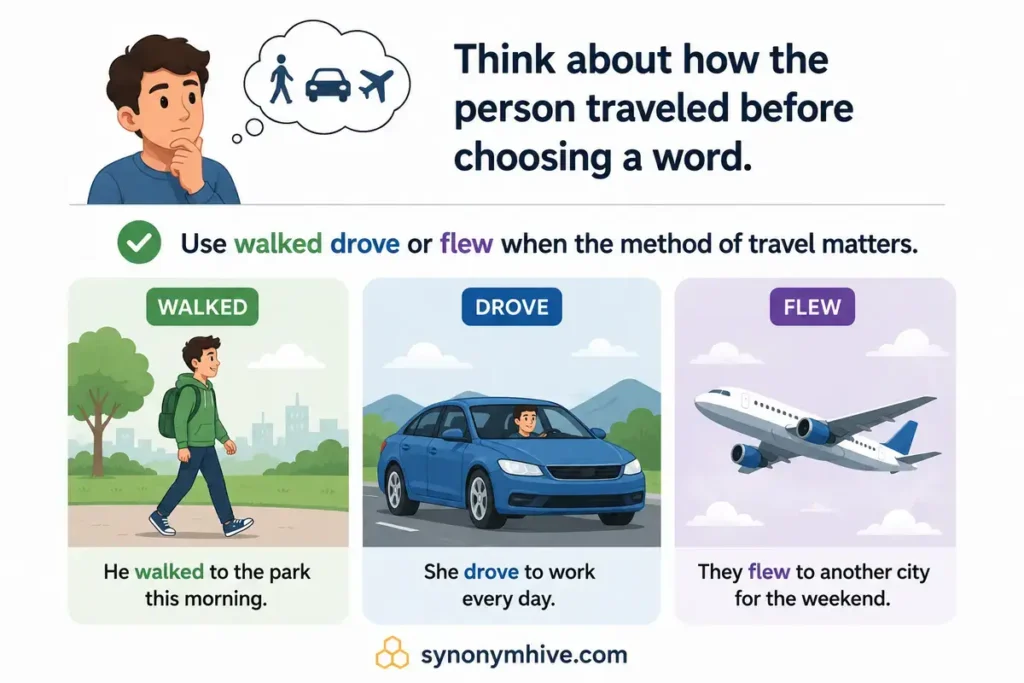
- Think about how the person traveled before choosing a word.
- Use walked drove or flew when the method of travel matters.
- Choose visited if the purpose was seeing a person or place.
- Pick arrived if the focus is reaching the destination.
- Use left if the departure matters more than the destination.
- Save formal words like journeyed and ventured for stories or descriptive writing.
- Read your sentence aloud. If it sounds natural you’ve probably picked the right word.
- Don’t replace went just because it appears twice. Sometimes it’s already the clearest choice.
Looking for another word? See Synonyms for Using: The Ultimate Guide 2026 Edition.
Conclusion.
Choosing the right synonyms for went can make your writing more interesting without making it harder to read. The best alternative depends on the situation the tone and the message you want to share. Words like traveled visited walked headed arrived and left all have different meanings even though they can replace went in the right context. Instead of looking for one perfect substitute focus on finding the word that fits your sentence best. With regular practice you’ll build a stronger vocabulary and write with more confidence in emails essays reports and everyday conversations.
Frequently Asked Questions.
What’s Another Way To Say Went.
Common alternatives include traveled walked visited headed arrived left proceeded and journeyed. The best choice depends on the meaning of your sentence.
What Is The Best Synonym For Went.
There isn’t one perfect answer. Synonyms for went change based on the context. Traveled is one of the most flexible choices because it works in many situations.
Can I Replace Went In Every Sentence.
No. Sometimes went is already the clearest and most natural word. Replace it only when another verb adds useful detail or improves the flow.
What’s The Difference Between Went And Traveled.
Went is a general verb for movement. Traveled usually suggests covering a longer distance or taking a trip.
Which Synonym Sounds Best In Formal Writing.
Words like proceeded departed advanced continued and journeyed often fit formal or academic writing. Pick the one that matches your meaning.
What’s Another Way To Say Went In A Text Message.
Simple words like headed came left stopped by or showed up sound natural in everyday conversations.
Can Went Describe More Than Travel.
Yes. It can describe results time emotions and events. For example you can say The meeting went well or Time went by quickly. In these cases many travel related replacements won’t work.