
Have you ever paused while writing an email, updating your resume, or finishing an essay because the word manage didn’t feel quite right? It happens all the time. Using the right word can make your writing sound clearer, stronger, and more natural. That’s why many people search for synonyms for manage when they want a better way to express an idea. Whether you’re talking about leading a team, handling a problem, organizing a project, or simply getting through a busy day, there’s usually a better word than manage. The best choice depends on your situation, your audience, and the tone you want to create.
Synonyms for manage are words or phrases that can replace manage depending on the context. Common choices include handle, control, oversee, direct, supervise, run, organize, coordinate, and administer.
In this guide, you’ll learn where the word came from, what it really means, and how to choose the best alternative in different situations. You’ll also find a large grouped synonym list, practical examples, comparison tables, writing tips, common mistakes to avoid, FAQs, and much more.
Compare more word options with Synonyms for This: Better Words to Use (2026).
What Does “Manage” Mean in Plain English?
The word manage has a simple idea at its core: to deal with something successfully or stay in control of it. People use it in many different ways. You can manage:
- A business
- A group of employees
- Your money
- A project
- Your schedule
- Your emotions
- A difficult situation
- A sports team
- Your time
- Household chores
Because it has so many meanings, using the same word repeatedly can make your writing sound repetitive. That’s one reason people often look for synonyms for manage that better match a specific situation.
Here are a few examples:
- She manages a restaurant.
- He managed the project from start to finish.
- I managed my budget carefully.
- They managed the emergency calmly.
- We managed to finish before sunset.
Notice how manage means something slightly different in each sentence. Sometimes it means lead, sometimes control, and sometimes simply succeed.
Where Does the Word “Manage” Come From?
Many everyday words have interesting histories, and manage is one of them. The English word comes from the Italian word maneggiare, which meant to handle or train a horse by hand. That word came from the Latin word manus, meaning hand. Over time, the meaning became much broader.
Instead of only handling horses, people began using manage to describe handling almost anything:
- Managing money
- Managing people
- Managing businesses
- Managing responsibilities
- Managing emotions
- Managing time
Today, the word simply means to take charge of something, keep it organized, or deal with it successfully. Knowing this history also explains why many related words focus on ideas like handling, guiding, controlling, and directing.
Why Use a Synonym Instead of “Manage”?
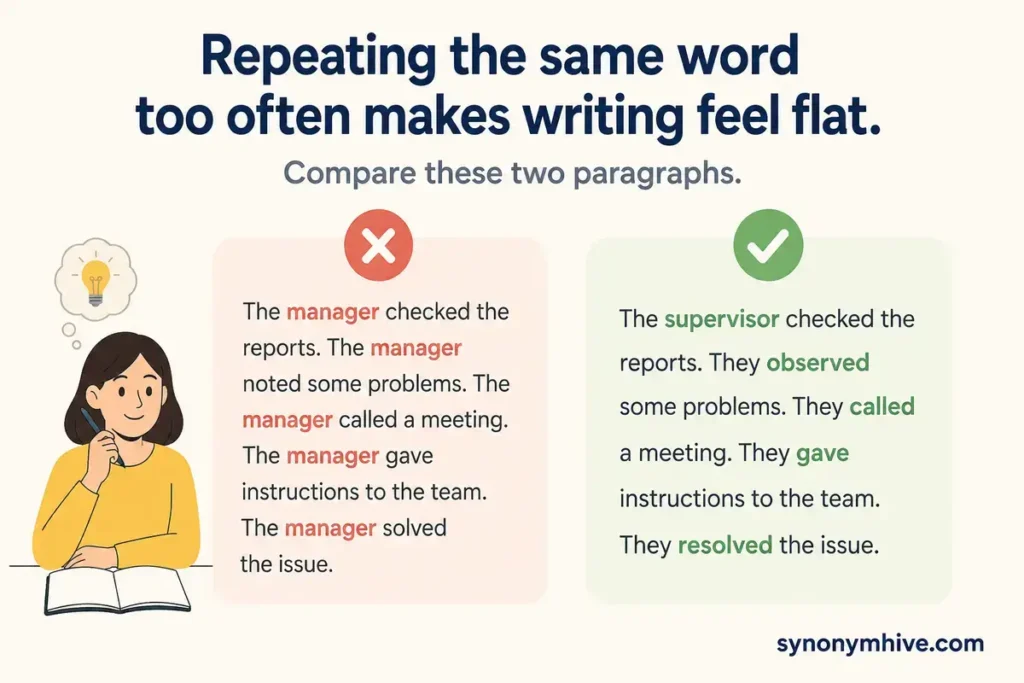
Repeating the same word too often makes writing feel flat.
Compare these two paragraphs.
Example 1
Sarah managed the office.She managed five employees. In addition, she handled customer complaints. Company records were also under her responsibility.
It gets repetitive quickly.
Example 2
Sarah supervised the office. She led five employees. Customer complaints were handled promptly. Company records were organized and maintained accurately. The second version sounds smoother because each word fits the job more precisely.
Choosing better synonyms for manage can help you:
- Avoid repeating the same word
- Match the tone of your writing
- Sound more confident
- Make your message clearer
- Improve essays and reports
- Strengthen resumes
- Write better emails
What’s the Best Synonym for “Manage”?
There isn’t just one. The best replacement depends on what you’re trying to say.
| If you mean… | Better word |
|---|---|
| Lead people | Lead |
| Run a business | Operate |
| Watch over workers | Supervise |
| Stay in control | Control |
| Organize work | Coordinate |
| Handle a problem | Handle |
| Guide a team | Direct |
| Take care of something | Oversee |
| Arrange activities | Organize |
| Successfully deal with something | Cope |
Instead of memorizing one replacement, think about what kind of managing you’re talking about.
Master List of Synonyms for Manage
Below is a large collection of words arranged by tone. This makes it easier to choose the right word for your writing instead of picking one at random.
Simple and Everyday Synonyms
These are the words most people use in daily conversations and casual writing.
| Word | Meaning | Tone | Example |
|---|---|---|---|
| Handle | Deal with something | Everyday | She handled the complaint politely. |
| Run | Be in charge of | Everyday | He runs a small bakery. |
| Lead | Guide people | Everyday | She leads the marketing team. |
| Guide | Show the way | Friendly | He guided the new employees. |
| Organize | Put things in order | Everyday | We organized the event together. |
| Control | Keep something under control | Neutral | She controlled the discussion well. |
| Take care of | Be responsible for | Casual | I’ll take care of the paperwork. |
| Look after | Care for something or someone | Casual | He looks after the office while I’m away. |
These words work well in everyday conversations, school assignments, and many workplace situations.
Formal Synonyms for Manage
If you’re writing a business report, professional email, resume, or academic paper, these words often sound stronger and more precise.
| Word | Meaning | Tone | Example |
|---|---|---|---|
| Oversee | Watch and direct work | Formal | She oversees several departments. |
| Supervise | Monitor employees or tasks | Formal | He supervises a team of engineers. |
| Direct | Lead operations | Formal | She directed the entire campaign. |
| Coordinate | Organize multiple activities | Formal | They coordinated the conference schedule. |
| Administer | Manage officially | Very formal | He administers company policies. |
| Govern | Rule or control | Formal | The board governs the organization. |
| Operate | Run a business or system | Formal | They operate three warehouses. |
| Conduct | Carry out an activity | Formal | She conducted daily meetings. |
These words are common in professional writing because they describe specific leadership responsibilities instead of using the broader word manage.
Advanced and Professional Synonyms for “Manage”
Some situations call for words that sound more specialized. These are common in business, education, healthcare, government, and project management.
| Word | Meaning | Tone | Example |
|---|---|---|---|
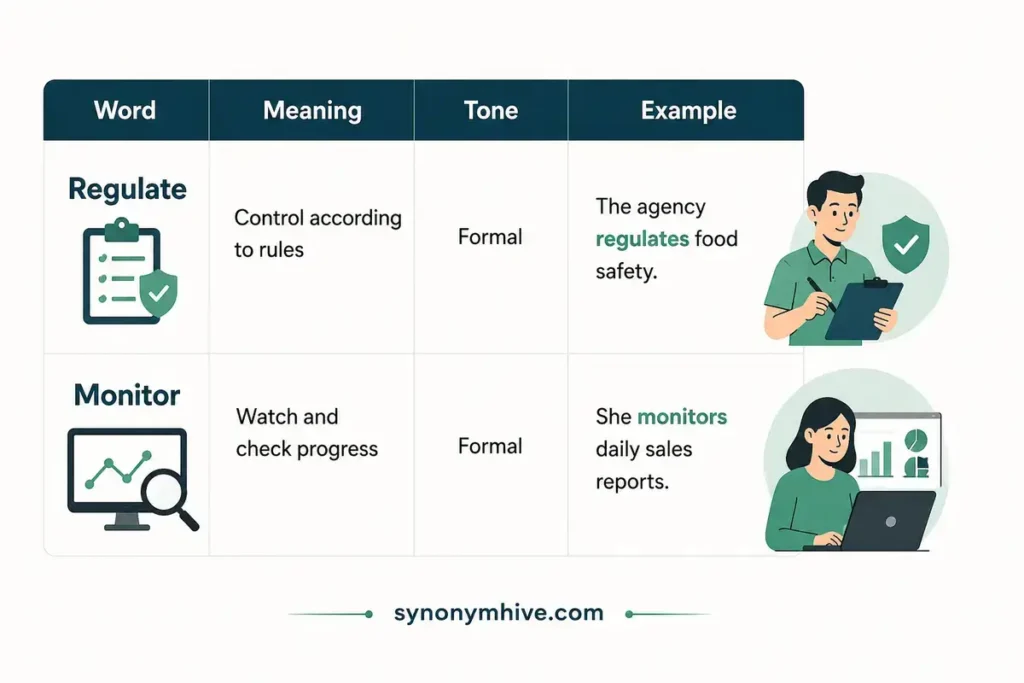
| Regulate | Control according to rules | Formal | The agency regulates food safety. |
| Monitor | Watch and check progress | Formal | She monitors daily sales reports. |
| Steward | Take care of resources responsibly | Formal | The nonprofit stewards donated funds carefully. |
| Facilitate | Help a process move smoothly | Formal | He facilitated the workshop discussion. |
| Execute | Carry out a plan | Formal | The team executed the project successfully. |
| Implement | Put a plan into action | Formal | The company implemented a new policy. |
| Maintain | Keep something in good condition | Neutral | She maintains accurate records. |
| Allocate | Distribute resources | Formal | The manager allocated the budget wisely. |
These words don’t always replace manage in every sentence, but they often communicate a more specific responsibility.
Casual and Slang Alternatives
In everyday conversations, people don’t always say manage. They often use more relaxed expressions.
| Word or Phrase | Meaning | Tone | Example |
|---|---|---|---|
| Take care of | Handle something | Casual | I’ll take care of dinner tonight. |
| Deal with | Handle a situation | Casual | She dealt with the issue quickly. |
| Keep on top of | Stay in control | Informal | I’m trying to keep on top of my homework. |
| Stay on top of | Continue managing well | Informal | He stays on top of every deadline. |
| Keep things running | Continue operations | Informal | She keeps things running smoothly. |
| Call the shots | Make the decisions | Slang | He calls the shots around here. |
| Be in charge of | Have responsibility | Everyday | She’s in charge of customer support. |
| See to | Make sure something gets done | Casual | I’ll see to the repairs tomorrow. |
| Sort out | Fix or organize | Informal | We’ll sort out the schedule later. |
| Keep under control | Prevent problems | Everyday | He kept the crowd under control. |
Use these mostly in conversations, personal writing, or informal emails rather than academic papers.
Complete Master List of Synonyms
Here’s a quick reference list of more than 30 useful alternatives.
| Simple | Formal | Casual & Informal |
|---|---|---|
| Handle | Oversee | Take care of |
| Run | Supervise | Deal with |
| Lead | Coordinate | Stay on top of |
| Guide | Direct | Keep on top of |
| Organize | Administer | Call the shots |
| Control | Govern | Sort out |
| Arrange | Operate | See to |
| Conduct | Regulate | Be in charge of |
| Maintain | Monitor | Keep things running |
| Support | Implement | Keep under control |
| Plan | Execute | Look after |
| Assist | Steward | Handle |
This variety lets you choose a word that matches your audience instead of relying on one general verb.
Which Synonyms Show More or Less Control?
Not every synonym suggests the same level of authority. Here’s a helpful scale from the lightest meaning to the strongest.
| Intensity | Synonyms | Typical Use |
|---|---|---|
| Mild | Help, assist, support | Offering help |
| Light | Organize, arrange, guide | Planning and structure |
| Medium | Handle, deal with, coordinate | Managing work or tasks |
| Strong | Lead, supervise, oversee | Managing people or teams |
| Very Strong | Direct, administer, govern, control | Full authority |
For example:
- You can assist a project without leading it.
- You can coordinate a project without being the boss.
- You usually supervise employees if you’re officially responsible for their work.
- Governments govern countries, not simply manage them.
Understanding this difference helps you choose a word that accurately reflects your role.
Are There Different Parts of Speech?
Yes—but only to a point.
The word manage is mainly a verb.
Related forms include:
| Part of Speech | Word | Example |
|---|---|---|
| Verb | Manage | She manages the office. |
| Noun | Management | Good management improves teamwork. |
| Noun | Manager | The manager approved the request. |
| Adjective | Manageable | The workload is manageable now. |
| Adverb (related phrase) | Under management | The property is under new management. |
Most synonyms for manage are also verbs because they describe actions.
Do Americans and Britons Use Different Words?
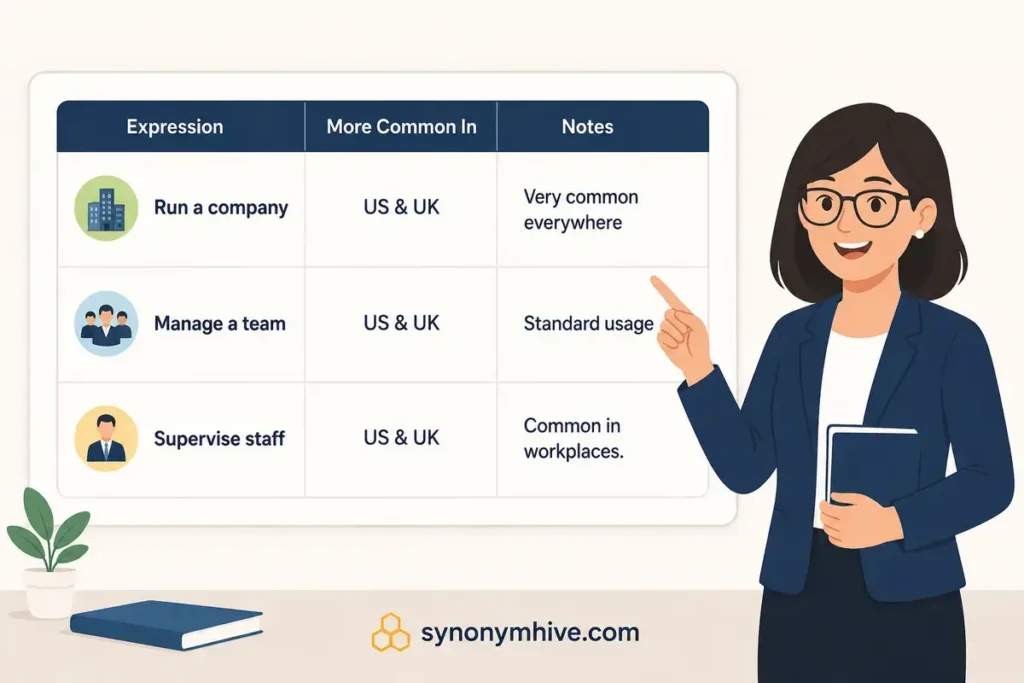
Most synonyms work in both American and British English. However, some expressions are more common in one region than another.
| Expression | More Common In | Notes |
|---|---|---|
| Run a company | US & UK | Very common everywhere |
| Manage a team | US & UK | Standard usage |
| Supervise staff | US & UK | Common in workplaces |
| Look after | UK | More common than in the US |
| Take care of | US | Slightly more common in American English |
| Sort out | UK | Frequently used in everyday British speech |
| Deal with | US & UK | Common worldwide |
If you’re writing for an international audience, words like handle, oversee, coordinate, organize, and lead are safe choices because they’re widely understood.
Find similar expressions in Synonyms for That: The Ultimate Guide Expert Picks (2026).
What’s the Best Word to Use on a Resume?
A resume should show impact, not just responsibility.
Instead of writing:
Managed customer service.
Use stronger action verbs like:
| Better Word | Resume Example |
|---|---|
| Led | Led a team of 15 customer service representatives. |
| Directed | Directed daily operations across three departments. |
| Coordinated | Coordinated project timelines for multiple clients. |
| Supervised | Supervised warehouse staff during peak seasons. |
| Oversaw | Oversaw annual budgets exceeding $2 million. |
| Administered | Administered employee training programs. |
| Operated | Operated retail locations across two cities. |
These words sound more specific and help hiring managers understand your responsibilities.
What’s the Best Word for an Essay?
Essays usually benefit from precise language.
Instead of repeating manage, try these depending on your meaning:
| Instead of… | Try… |
|---|---|
| Manage a country | Govern |
| Manage resources | Allocate |
| Manage a project | Coordinate |
| Manage employees | Supervise |
| Manage an organization | Oversee |
| Manage change | Navigate |
| Manage conflict | Resolve or Handle |
Example
Basic:
The principal managed the school effectively.
Improved:
The principal oversaw the school’s daily operations effectively.
Or:
The principal led the school through several important improvements.
The second versions sound more natural because they’re more specific.
What’s the Best Word in an Email?
Emails should sound clear without being overly formal.
Here are common replacements.
| Situation | Best Choice |
|---|---|
| Helping someone | Handle |
| Organizing work | Coordinate |
| Taking responsibility | Take care of |
| Following up | See to |
| Running a project | Oversee |
Examples
- I’ll handle the client meeting tomorrow.
- Sarah will coordinate the event schedule.
- I’ll take care of the invoices this afternoon.
- John will see to the final edits before publishing.
- Maria will oversee the transition next month.
These sound natural in professional communication without feeling stiff.
What’s the Best Word in Text Messages?
When texting friends or family, people usually choose simpler words.
Examples include:
- I’ll take care of it.
- Don’t worry—I can handle it.
- We’ll sort it out later.
- She’ll deal with it tomorrow.
- He’s got it under control.
These phrases sound much more conversational than repeatedly saying manage.
What’s the Best Word in Everyday Conversation?
When speaking, shorter and more familiar words often sound the most natural.
Instead of always saying:
I managed everything.
You might say:
- I handled everything.
- I took care of everything.
- I dealt with it.
- I kept everything organized.
- I stayed on top of it.
Native speakers often choose these alternatives because they fit everyday speech better.
Real-Life Example Sentences
Here are original examples showing different ways to replace manage in everyday situations.
- Emily handled the customer complaint with patience.
- Our coach led the team to a championship season.
- James organized the neighborhood cleanup event.
- The director oversaw construction from beginning to end.
- Maria coordinated travel plans for the entire group.
- The nurse monitored each patient’s recovery throughout the week.
- I’ll take care of the grocery shopping after work.
- We finally sorted out the computer problem yesterday.
- The supervisor guided new employees during training.
- They operated three restaurants before expanding overseas.
- She implemented a new filing system that saved hours every week.
- David maintained accurate financial records for the organization.
Notice how each sentence highlights a different kind of responsibility. Choosing the right verb makes the meaning clearer.
Handle vs. Manage — What’s the Difference?
These two words are close in meaning, but they aren’t always interchangeable.
| Handle | Manage |
|---|---|
| Often refers to dealing with a specific task or problem | Often refers to ongoing responsibility |
| Usually short-term | Often long-term |
| Can describe one situation | Can describe an entire role |
| “Handle the complaint.” | “Manage the customer service department.” |
Example
✔ She handled today’s emergency.
✔ She manages the emergency response team.
The first sentence focuses on one event. The second describes an ongoing leadership role.
Lead vs. Oversee — Which One Should You Use?
People often confuse these two words because both involve responsibility.
| Lead | Oversee |
|---|---|
| Focuses on inspiring and guiding people | Focuses on monitoring work and results |
| Often hands-on | Often supervisory |
| Emphasizes leadership | Emphasizes responsibility and accountability |
| Common in team settings | Common in management settings |
Example
- She led the design team through the project.
- She oversaw the project’s budget and deadlines.
A person may do both, but the words highlight different parts of the job.
What Are the Most Common Mistakes When Using Synonyms for “Manage”?
Choosing a synonym isn’t just about replacing one word with another. Every alternative has its own meaning, tone, and level of responsibility. Using the wrong one can make your writing sound awkward or even change the meaning of your sentence.
Here are the mistakes people make most often.
Using “Control” When You Mean “Lead”
Although these words are related, they aren’t the same.
Less Natural
She controlled the marketing team.
This can sound like she forced people to obey her.
Better
She led the marketing team.
Or:
She supervised the marketing team.
Use control when talking about machines, processes, emotions, or situations—not everyday leadership.
Using “Govern” for Businesses
Govern usually refers to countries, states, organizations, or official boards.
✔ The board governs the association.
✔ The government governs the country.
✘ She governs a coffee shop.
For a business, use:
- Runs
- Manages
- Operates
- Oversees
Using “Administer” in Casual Conversation
Administer sounds formal.
Instead of saying:
My sister administers the grocery shopping.
Most people would simply say:
My sister handles the grocery shopping.
Or:
My sister takes care of the grocery shopping.
Thinking Every Synonym Fits Every Sentence
One of the biggest writing mistakes is assuming every synonym can replace manage.
Consider these examples.
✔ I handled the complaint.
✘ I governed the complaint.
✔ She coordinated the meeting.
✘ She supervised the meeting.
The meaning changes depending on the action you’re describing.
Forgetting the Audience
Always match the word to your reader.
| Audience | Better Choice |
|---|---|
| Friends | Handle, take care of, deal with |
| Teacher | Organize, coordinate, oversee |
| Employer | Led, supervised, directed |
| Academic paper | Administer, regulate, coordinate |
| Business email | Handle, oversee, coordinate |
Choosing the right tone makes your writing sound more natural and professional.
What Are the Antonyms of “Manage”?
Sometimes you need the opposite meaning.
Here are common antonyms.
| Antonym | Meaning |
|---|---|
| Mismanage | Handle badly |
| Neglect | Fail to care for |
| Ignore | Pay no attention to |
| Abandon | Leave behind |
| Lose control | Fail to stay in charge |
| Disorganize | Make something messy |
| Misdirect | Lead incorrectly |
| Confuse | Create disorder |
Examples
- The company mismanaged its finances.
- He neglected his responsibilities.
- They lost control of the situation.
Knowing opposites can improve both your vocabulary and your writing.
How Do You Choose the Right Synonym?
With so many choices, picking the best word can feel difficult.
These simple tips make the decision easier.
Ask Yourself What You’re Managing
Is it:
- People?
- Money?
- Time?
- A business?
- A problem?
- A project?
- An event?
The answer points you toward the best word.
Think About the Level of Responsibility
If you’re leading people:
- Lead
- Supervise
- Direct
- Oversee
To solve a problem:
- Handle
- Deal with
- Resolve
If you’re organizing work:
- Coordinate
- Organize
- Arrange
Match the Tone
For formal writing:
- Administer
- Govern
- Coordinate
- Oversee
For everyday conversation:
- Handle
- Take care of
- Deal with
- Sort out
Avoid Repeating the Same Word
Repeating manage several times in one paragraph can make your writing feel repetitive.
Instead of this:
He oversaw the department’s daily operations.
Try this:
He led the project, supervised the team, and controlled the budget. The second version is more engaging and gives readers a clearer picture of each responsibility.
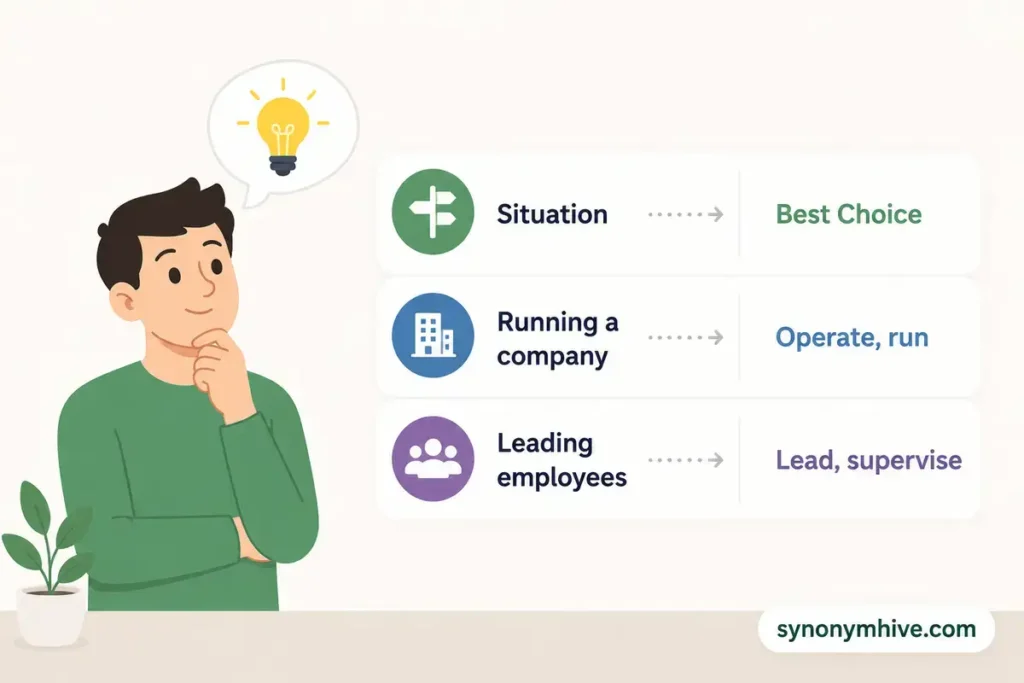
Quick Reference: Which Word Should You Pick?
| Situation | Best Choice |
|---|---|
| Running a company | Operate, run |
| Leading employees | Lead, supervise |
| Watching progress | Monitor |
| Organizing schedules | Coordinate |
| Solving problems | Handle, deal with |
| Taking responsibility | Oversee |
| Managing money | Control, allocate |
| Caring for daily tasks | Take care of |
| Official administration | Administer |
| Government or public policy | Govern |
Keep this table in mind whenever you’re unsure which word fits best.
Discover related words in Synonyms for Believe Simple Guide Boost Your Vocabulary (2026).
Conclusion
Finding the right synonyms for manage isn’t about using bigger words—it’s about choosing the word that best matches your meaning. Sometimes handle is the clearest choice. In other situations, lead, coordinate, oversee, or operate tells readers much more about what someone actually does.
The more you match your word choice to the situation, the stronger your writing becomes. Whether you’re updating a resume, writing an essay, sending an email, or having a casual conversation, using the right alternative helps your message sound clear, natural, and confident. Keep this guide handy, practice with the examples, and you’ll soon find that choosing the best replacement for manage becomes much easier.
Frequently Asked Questions
What’s another way to say “manage”?
Common alternatives include handle, oversee, supervise, coordinate, lead, direct, organize, operate, and control. The best choice depends on what you’re trying to describe.
What are the best synonyms for manage on a resume?
For resumes, strong action verbs usually work best. Consider led, supervised, directed, coordinated, oversaw, administered, or operated because they sound specific and achievement-focused.
Is “handle” the same as “manage”?
Not exactly. Handle usually refers to dealing with a specific task or problem, while manage often describes ongoing responsibility for people, projects, or resources.
What’s another word for managing people?
Good choices include lead, supervise, oversee, direct, mentor, and coordinate. The right word depends on how much authority the person has.
Can I use synonyms for manage in academic writing?
Yes. Using synonyms for manage can improve academic writing by reducing repetition. Just make sure the replacement accurately matches the meaning of your sentence.
What’s the easiest synonym for “manage” in everyday speech?
For most conversations, people naturally say handle, take care of, or deal with. These sound friendly and are easy to understand.
Which synonym sounds the most professional?
Words like oversee, administer, supervise, coordinate, and direct are often the most professional choices because they clearly describe leadership and responsibility.