
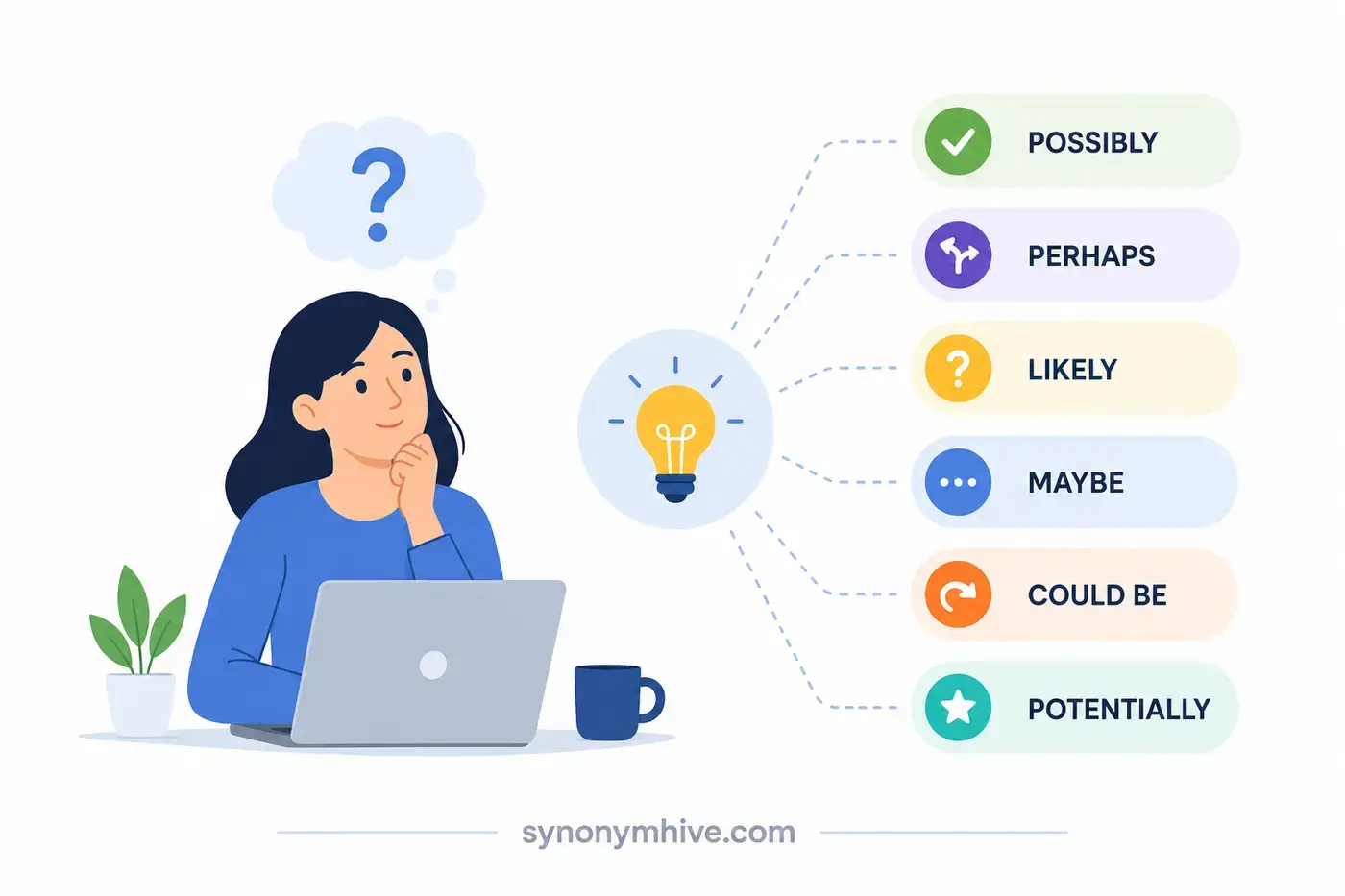
Have you ever been writing an email, finishing an essay, replying to a text, or working on a school assignment when you realized you’d used the word maybe several times? It can make your writing sound repetitive. That’s why many people search for synonyms for maybe to make their writing smoother, clearer, and more interesting. The word maybe is short and simple, but it doesn’t always fit every situation. Sometimes you want to sound more formal. Other times, you want to sound more confident or more conversational. Choosing the right alternative helps your writing match your purpose.
Alternatives for maybe include perhaps, possibly, probably, potentially, conceivably, might, could be, and there’s a chance. The best choice depends on how certain you are and the tone you want to create.
In this guide, you’ll learn what maybe really means, where it came from, and how to choose the best replacement for different situations. You’ll also find a complete synonym list, practical examples, writing tips, and common mistakes to avoid.
Compare more word options with Synonyms for With: The Ultimate Guide Write Like a Pro (2026).
What Does “Maybe” Mean in Plain English?
The word maybe means something is possible but not certain. You use it when you aren’t completely sure about something or when an event could happen but hasn’t happened yet.
Here are a few examples:
- Maybe it will rain tomorrow.
- Maybe she’s already home.
- Maybe we should leave early.
- Maybe this idea will work.
- Maybe I’ll call you later.
In every sentence, the speaker is expressing uncertainty rather than certainty. That’s one reason many people search for synonyms. Different situations call for different words, and some alternatives express stronger or weaker levels of possibility.
Where Does the Word “Maybe” Come From?
The word maybe has been part of the English language for hundreds of years.
It developed from two separate words:
- May
- Be
Originally, writers often used them together as may be. Over time, maybe became a single word used as an adverb to express possibility. This history also explains one of the most common grammar mistakes in English.
Compare these examples:
- Maybe we’ll leave after lunch.
- She may be waiting outside.
Although they look similar, they do different jobs.
- Maybe means perhaps.
- May be is a verb phrase that means could be.
Learning this difference makes your writing more accurate.
Why Should You Use Another Word Instead of “Maybe”?
Repeating the same word too often makes writing sound flat.
Look at these two examples.
Example 1
Maybe we’ll go hiking. It might rain instead.
If the weather turns bad, we’ll stay home.
We could also watch a movie.
The repeated word quickly becomes noticeable.
Example 2
Perhaps we’ll go hiking.
There’s a chance it’ll rain.
If that happens, we’ll probably stay home.
Otherwise, we might watch a movie.
The second version sounds smoother because each expression shows a different level of certainty.
Using different alternatives can help you:
- Avoid repetition
- Make your writing easier to read
- Match the tone of your audience
- Express different levels of confidence
- Improve essays and reports
- Write stronger emails
- Sound more natural in conversations
When Should You Replace “Maybe”?
Sometimes maybe is already the best choice.
For example:
Maybe I’ll see you tomorrow.
That sentence sounds completely natural.
However, other situations benefit from a more specific word.
Instead of writing:
Maybe the project will succeed.
You could write:
- Perhaps the project will succeed.
- The project could succeed.
- The project will probably succeed.
- There’s a chance the project will succeed.
Each sentence communicates a slightly different degree of possibility.
What’s the Best Synonym for “Maybe”?
There isn’t one perfect replacement.
The right choice depends on your meaning.
Perhaps is usually the closest match when you’re expressing a simple possibility.
Use probably when something seems more likely than not.
Potentially may be the better option when referring to a future opportunity.
For casual conversations, phrases like could be or there’s a chance sound very natural.
Instead of choosing a synonym randomly, think about how certain you want to sound.
Master List of Synonyms for Maybe
The following list groups the most useful alternatives by tone and everyday use.
Simple Synonyms for “Maybe”
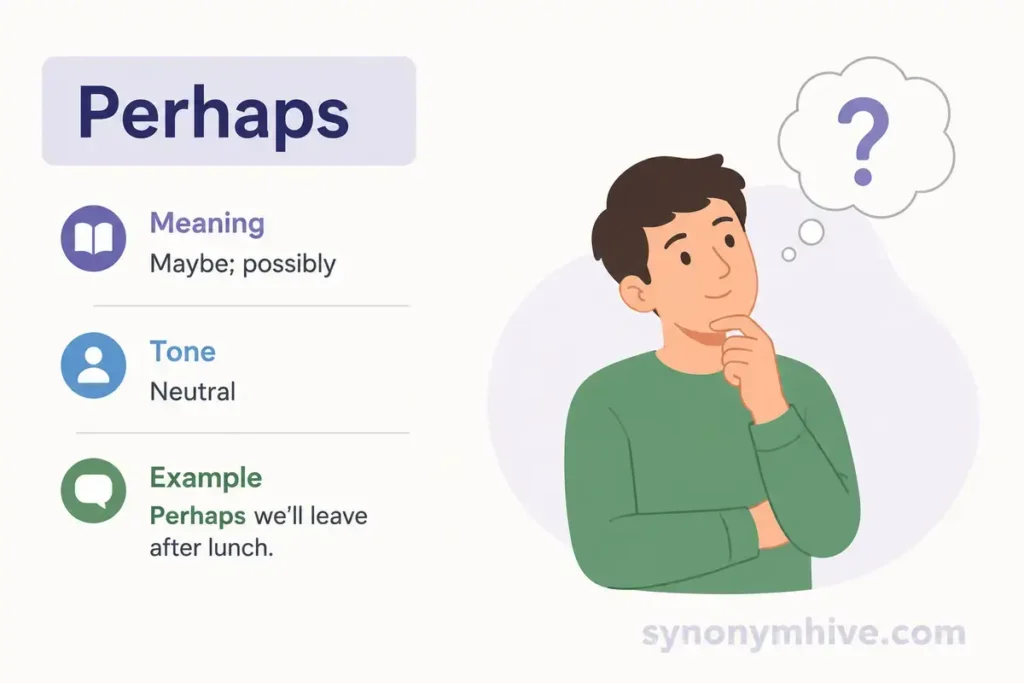
Perhaps
- Meaning: Maybe; possibly
- Tone: Neutral
- Example: Perhaps we’ll leave after lunch.
Possibly
- Meaning: Could happen
- Tone: Neutral
- Example: It could possibly rain tonight.
Probably
- Meaning: Likely to happen
- Tone: Neutral
- Example: We’ll probably finish before noon.
Potentially
- Meaning: Has the possibility
- Tone: Slightly formal
- Example: This could potentially solve the problem.
Conceivably
- Meaning: It is possible
- Tone: Formal
- Example: The idea could conceivably work.
Might
- Meaning: Expresses possibility
- Tone: Everyday
- Example: We might visit our grandparents this weekend.
Could Be
- Meaning: May be true
- Tone: Casual
- Example: That could be the right answer.
Perchance
- Meaning: Perhaps
- Tone: Literary
- Example: Perchance we’ll meet again someday.
These words fit many situations without changing the meaning very much.
Everyday Synonyms for “Maybe”
There’s a Chance
- Meaning: Something may happen
- Tone: Everyday
- Example: There’s a chance we’ll finish early.
It’s Possible
- Meaning: Could happen
- Tone: Neutral
- Example: It’s possible the meeting will be delayed.
I Guess
- Meaning: I’m not completely sure
- Tone: Informal
- Example: I guess we’ll find out tomorrow.
I Suppose
- Meaning: I think so, but I’m unsure
- Tone: Neutral
- Example: I suppose that’s true.
Who Knows
- Meaning: Nobody is certain
- Tone: Casual
- Example: Who knows what tomorrow will bring?
One Never Knows
- Meaning: Anything is possible
- Tone: Everyday
- Example: One never knows what life has planned.
For All I Know
- Meaning: Based on what I know
- Tone: Informal
- Example: For all I know, they’ve already left.
It Could Happen
- Meaning: It is possible
- Tone: Casual
- Example: It could happen if we keep trying.
Formal Synonyms for “Maybe”
Presumably
- Meaning: Based on reasonable assumptions
- Tone: Formal
- Example: Presumably, the report will be completed today.
Plausibly
- Meaning: In a believable way
- Tone: Formal
- Example: The new policy could plausibly improve results.
Feasibly
- Meaning: In a way that is possible
- Tone: Formal
- Example: The project could feasibly finish ahead of schedule.
Hypothetically
- Meaning: In theory
- Tone: Academic
- Example: Hypothetically, both solutions could work.
Arguably
- Meaning: It can reasonably be claimed
- Tone: Formal
- Example: Arguably, this is the better option.
Ostensibly
- Meaning: Apparently, though not with certainty
- Tone: Formal
- Example: Ostensibly, the delay was unavoidable.
Reasonably
- Meaning: With good reason
- Tone: Formal
- Example: We can reasonably expect higher sales next quarter.
In Theory
- Meaning: According to theory
- Tone: Academic
- Example: In theory, the system should operate smoothly.
These alternatives often have more specific meanings than maybe, so choose them based on your context instead of using them as direct replacements.
Complete Master List of Synonyms for Maybe
Below is a complete reference list with more than 30 alternatives. Each word or phrase expresses possibility in a slightly different way, so choosing the right one depends on your sentence and your audience.
Simple Alternatives
Perhaps
- Meaning: Maybe; possibly
- Tone: Neutral
- Best for: Essays, emails, everyday writing
- Example: Perhaps we’ll leave after lunch.
Possibly
- Meaning: It could happen
- Tone: Neutral
- Best for: General writing
- Example: Possibly, the package will arrive tomorrow.
Probably
- Meaning: More likely than not
- Tone: Neutral
- Best for: Everyday conversation
- Example: We’ll probably finish before sunset.
Potentially
- Meaning: Has the possibility of happening
- Tone: Slightly formal
- Best for: Business and academic writing
- Example: This update could potentially improve performance.
Conceivably
- Meaning: It is possible, even if unlikely
- Tone: Formal
- Example: The plan could conceivably succeed.
Might
- Meaning: Expresses possibility
- Tone: Everyday
- Example: We might visit the museum this weekend.
Could Be
- Meaning: May be true
- Tone: Casual
- Example: That could be the correct answer.
Perchance
- Meaning: Perhaps
- Tone: Literary
- Example: Perchance our paths will cross again.
Everyday Alternatives
There’s a Chance
- Meaning: Something may happen
- Tone: Everyday
- Example: There’s a chance the game will be canceled.
It’s Possible
- Meaning: Something could happen
- Tone: Neutral
- Example: It’s possible the meeting will start late.
I Guess
- Meaning: I’m not completely sure
- Tone: Informal
- Example: I guess we’ll find out tomorrow.
I Suppose
- Meaning: I think so, but I’m uncertain
- Tone: Neutral
- Example: I suppose that’s one way to solve it.
Who Knows
- Meaning: Nobody can be certain
- Tone: Casual
- Example: Who knows what next year will bring?
One Never Knows
- Meaning: Anything is possible
- Tone: Everyday
- Example: One never knows when an opportunity will appear.
For All I Know
- Meaning: Based on what I know
- Tone: Informal
- Example: For all I know, they’ve already arrived.
It Could Happen
- Meaning: There’s a possibility
- Tone: Casual
- Example: It could happen if everything goes as planned.
Formal Alternatives
Presumably
- Meaning: Based on reasonable assumptions
- Tone: Formal
- Example: Presumably, the documents have been approved.
Plausibly
- Meaning: In a believable way
- Tone: Formal
- Example: The changes could plausibly increase sales.
Feasibly
- Meaning: In a practical way that is possible
- Tone: Formal
- Example: The project could feasibly finish early.
Hypothetically
- Meaning: In theory
- Tone: Academic
- Example: Hypothetically, either solution could work.
Arguably
- Meaning: It can reasonably be claimed
- Tone: Formal
- Example: Arguably, this is the simplest approach.
Ostensibly
- Meaning: Apparently, though not certainly
- Tone: Formal
- Example: Ostensibly, the delay was unavoidable.
Reasonably
- Meaning: With good reason
- Tone: Formal
- Example: We can reasonably expect better results.
In Theory
- Meaning: According to theory rather than reality
- Tone: Academic
- Example: In theory, the system should work.
Informal and Slang Alternatives
Maybe So
- Meaning: That could be true
- Tone: Casual
- Example: Maybe so, but I’d still wait.
Could Well
- Meaning: Quite possibly
- Tone: Informal
- Example: She could well win the competition.
You Never Know
- Meaning: The future is uncertain
- Tone: Casual
- Example: You never know what might happen.
If We’re Lucky
- Meaning: It may happen if things go well
- Tone: Casual
- Example: If we’re lucky, we’ll catch the earlier train.
Fingers Crossed
- Meaning: I hope it happens
- Tone: Informal
- Example: Fingers crossed the weather stays nice.
Time Will Tell
- Meaning: We’ll know later
- Tone: Everyday
- Example: Time will tell whether the plan succeeds.
Which Synonyms Show Different Levels of Certainty?
Not every alternative expresses the same amount of confidence.
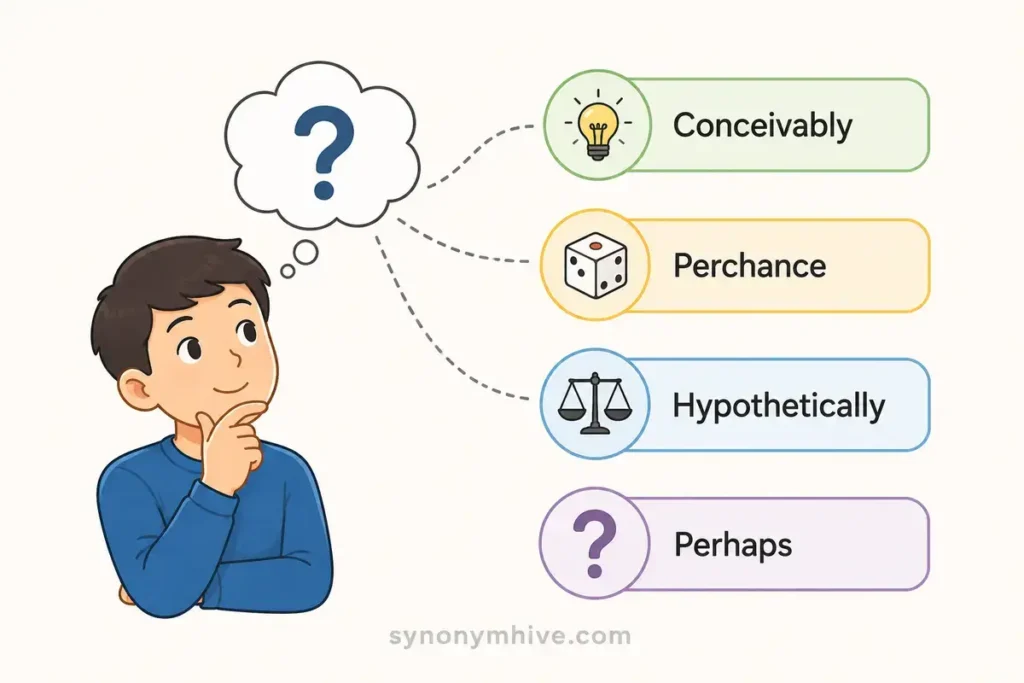
Very Uncertain
These suggest only a small possibility.
- Conceivably
- Perchance
- Hypothetically
- Perhaps
Some Possibility
These express uncertainty without suggesting the outcome is likely.
- Maybe
- Possibly
- Might
- Could be
- There’s a chance
- It’s possible
Fairly Likely
These suggest something has a good chance of happening.
- Probably
- Presumably
- Could well
- Reasonably
Strong Expectation
These suggest confidence, though not complete certainty.
- Likely
- Almost certainly
- In all likelihood
Notice that words become stronger as you move down the list. That’s why they aren’t always interchangeable.
Are There Different Parts of Speech?
Yes. This is important because not every alternative works in the same place in a sentence.
Adverbs
These directly replace maybe in most sentences.
Examples include:
- Maybe
- Perhaps
- Possibly
- Probably
- Conceivably
- Presumably
- Plausibly
Example:
Perhaps we’ll leave early.
Modal Verbs
Some alternatives use helping verbs instead of adverbs.
Examples include:
- Might
- Could
- May
Example:
We might leave early.
Phrases
Many everyday alternatives are phrases rather than single words.
Examples include:
- There’s a chance
- It could happen
- For all I know
- One never knows
- Who knows
These often sound more conversational.
Are There US vs. UK Differences?
Most alternatives work in both American and British English.
However, some words appear more often in one variety.
More Common in American English
- Maybe
- Probably
- There’s a chance
- I guess
More Common in British English
- Perhaps
- I suppose
- One never knows
- Perchance (mostly literary)
Neither version is wrong. The differences are mostly about style and frequency.
What’s the Best Word on a Resume?
The word maybe rarely belongs on a resume because resumes should show confidence.
Instead of writing:
Maybe experienced in project management.
Write:
- Experienced in project management.
- Familiar with project management.
- Skilled in project management.
- Knowledgeable about project management.
A resume should focus on what you know, not what you think you might know.
Learn more useful word alternatives in Synonyms for Using: The Ultimate Guide 2026 Edition.
What’s the Best Word in an Essay?
Essays often benefit from more formal language.
Instead of maybe, consider:
- Perhaps
- Possibly
- Conceivably
- Arguably
- Presumably
Example
Basic:
Maybe this policy will improve education.
Improved:
Perhaps this policy will improve education.
Or:
Arguably, this policy could improve education. These choices sound more polished in academic writing.
What’s the Best Word in an Email?
Professional emails should sound polite and clear.
Good choices include:
- Perhaps
- Possibly
- It may be
- There’s a chance
Examples
- Perhaps we can meet next Tuesday.
- It’s possible that the shipment will arrive tomorrow.
- There’s a chance the schedule may change.
- We could possibly finish the project this week.
These expressions sound natural without being too casual.
What’s the Best Word in Text Messages?
Text messages usually sound better with relaxed language.
Common choices include:
- Maybe
- I guess
- Could be
- Who knows
- We’ll see
- You never know
Examples:
- Maybe I’ll come later.
- I guess we’ll find out.
- Could be.
- We’ll see what happens.
What’s the Best Word in Everyday Conversation?
In everyday speech, people usually keep things simple.
Instead of searching for complicated words, native speakers often say:
- Maybe
- Perhaps
- Probably
- Might
- Could be
- There’s a chance
- I guess
These sound natural in most conversations.
Real-Life Example Sentences
Here are original examples showing different ways to express possibility.
- Perhaps we’ll visit the zoo this weekend.
- There’s a chance the flight will be delayed.
- I guess we’ll have to wait for the results.
- The weather will probably improve tomorrow.
- It could possibly take another hour.
- We might order pizza tonight.
- Presumably, the meeting has already started.
- Conceivably, the company could expand overseas.
- Who knows what the future holds?
- For all I know, she’s already finished the assignment.
- You never know when a great opportunity will appear.
- Hypothetically, both solutions could solve the problem.
Maybe vs. Perhaps — What’s the Difference?
These two words are very close, but they aren’t always used the same way.
Maybe
- More common in everyday conversation
- Sounds relaxed and friendly
- Used frequently in American English
Example:
Maybe we’ll leave after lunch.
Perhaps
- Slightly more formal
- Common in essays and professional writing
- Often sounds more polished
Example:
Perhaps we’ll leave after lunch.
The meaning is almost identical, but the tone is different.
Possibly vs. Probably — What’s the Difference?
Many learners confuse these words because they both describe uncertainty.
Possibly
- Means something could happen.
- Does not suggest it’s likely.
Example:
It could possibly rain tomorrow.
Probably
- Means something is more likely than not.
Example:
It’ll probably rain tomorrow.
Possibly expresses uncertainty.
Probably expresses expectation.
These small differences make your writing much more precise.
What Are the Most Common Mistakes When Using Synonyms for “Maybe”?
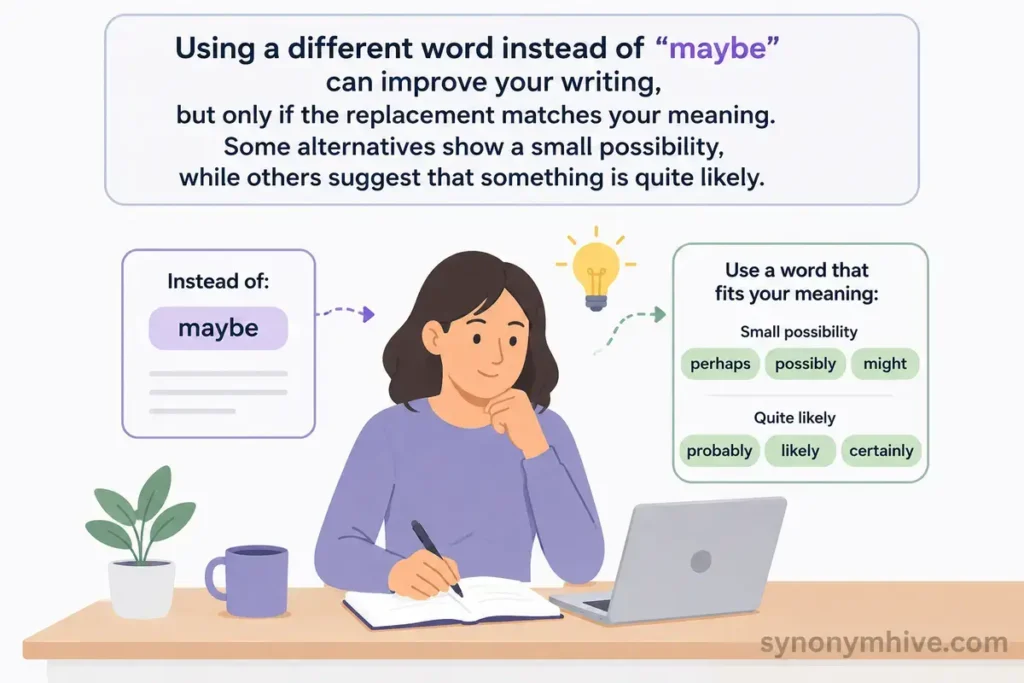
Using a different word instead of maybe can improve your writing, but only if the replacement matches your meaning. Some alternatives show a small possibility, while others suggest that something is quite likely.
Here are the most common mistakes to avoid.
Using “Probably” When You’re Not Sure
Probably means something is more likely than not.
If you’re very uncertain, perhaps or possibly is usually a better choice.
Less accurate:
Probably she’ll come to the party, but I have no idea.
Better:
Perhaps she’ll come to the party.
Or:
She might come to the party.
Choose probably only when you believe something is likely to happen.
Confusing “Maybe” and “May Be”
These expressions look almost the same, but they have different meanings.
Correct:
Maybe we’ll leave early.
Correct:
The answer may be correct.
Remember:
- Maybe = perhaps
- May be = could be
This is one of the most common grammar mistakes in English.
Using Very Formal Words in Casual Conversations
Some formal alternatives sound unusual in everyday speech.
For example:
- Conceivably
- Ostensibly
- Hypothetically
- Plausibly
Instead of saying:
Conceivably we’ll order pizza.
Most people would naturally say:
Maybe we’ll order pizza.
Or:
We might order pizza.
Save formal words for essays, reports, or professional writing.
Thinking Every Synonym Means the Same Thing
Many people assume every alternative can replace maybe. That’s not true.
For example:
Perhaps we’ll win. – Suggests a possibility; fairly neutral. There’s a chance we’ll win. – Also expresses possibility in a more conversational way. We’ll probably win. – Indicates a stronger expectation that winning is likely.
These three sentences express different levels of confidence. Choosing the wrong word can change the meaning of your sentence.
Overusing Uncertain Language
Sometimes writers use too many words that show uncertainty.
For example:
Maybe, perhaps, it’s possible that we might finish tomorrow. Only one expression is usually enough.
A clearer version is:
We might finish tomorrow.
Or:
Perhaps we’ll finish tomorrow. Simple writing is usually stronger.
What Are the Antonyms of “Maybe”?
Sometimes you need to express certainty instead of possibility.
Here are common opposites.
Definitely
Shows complete certainty.
Example:
We’ll definitely finish today.
Certainly
Means there is no real doubt.
Example:
She will certainly attend the meeting.
Absolutely
Adds strong confidence.
Example:
That’s absolutely correct.
Surely
Expresses confidence or expectation.
Example:
Surely they already know.
Without a Doubt
Means something is completely certain.
Example:
He is without a doubt the best candidate.
Of Course
Shows something is expected.
Example:
Of course I’ll help you.
These words are useful when you want to sound confident instead of uncertain.
How Do You Choose the Right Synonym?
The best choice depends on what you’re trying to communicate.
Here are a few simple tips.
Think About Your Level of Certainty
Ask yourself:
- Is it only a small possibility?
- Is it equally possible?
- Is it likely to happen?
Then choose a word that matches.
Small possibility:
- Conceivably
- Perhaps
Average possibility:
- Maybe
- Possibly
- Might
High possibility:
- Probably
- Presumably
Match Your Audience
For formal writing, choose words like:
- Perhaps
- Presumably
- Plausibly
- Arguably
For casual conversations, use:
- Maybe
- Could be
- I guess
- We’ll see
- Who knows
Matching the tone makes your writing sound more natural.
Don’t Replace Words Just for Variety
Sometimes maybe is already the best option.
Avoid changing every occurrence simply because you want different vocabulary.
Use a synonym only when it makes the sentence clearer or better suited to the situation.
Read the Sentence Out Loud
One of the easiest editing tricks is reading your sentence aloud.
If a synonym sounds awkward when spoken, choose a simpler alternative.
Natural writing almost always sounds natural when you read it.
Quick Reference: Which Word Should You Choose?
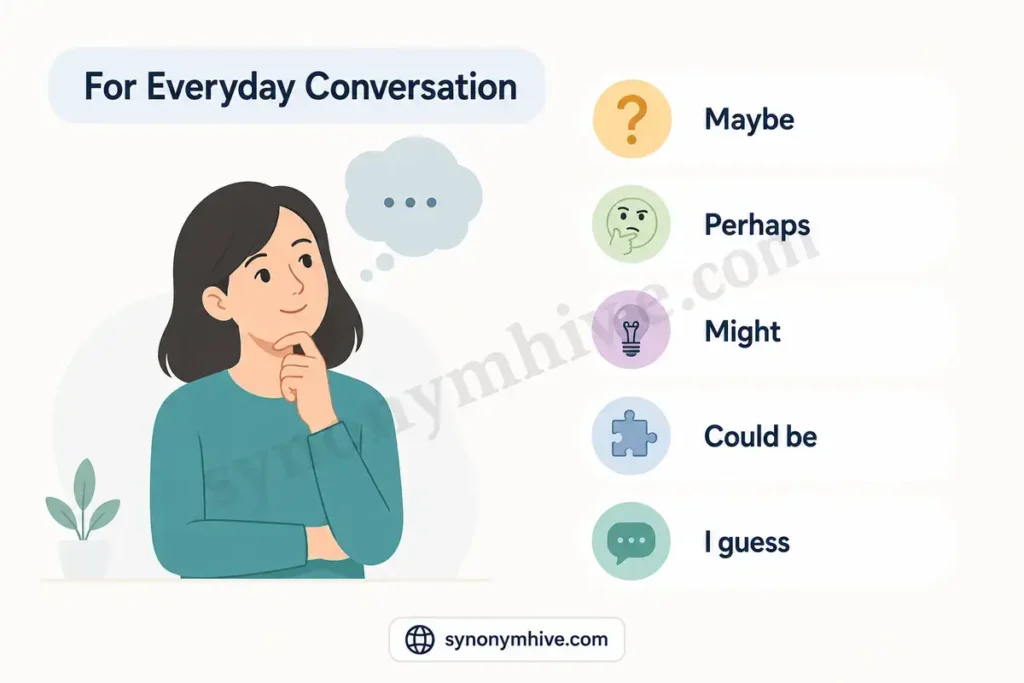
For Everyday Conversation
- Maybe
- Perhaps
- Might
- Could be
- I guess
Professional Email Communication
- Perhaps
- Possibly
- Presumably
- It may be
For Essays
- Perhaps
- Arguably
- Conceivably
- Hypothetically
Communicating by Text Message
- Maybe
- We’ll see
- Could be
- Who knows
For Strong Probability
- Probably
- Presumably
- Likely
Keeping these groups in mind makes it much easier to choose the right expression.
Looking for a better alternative? Visit Synonyms for Good: The Ultimate Guide Write Like a Pro (2026).
Conclusion
Finding the right synonyms for maybe is about more than avoiding repetition. Each alternative expresses a different level of possibility and creates a different tone. Words like perhaps, possibly, might, and probably may seem similar, but each has its own place in everyday conversations, professional emails, essays, and other types of writing.
The next time you’re unsure which word to use, think about how confident you want to sound and who will be reading your work. A small change in wording can make your writing clearer, more natural, and more effective. Keep this guide handy, practice using the examples, and choosing the right synonym will soon become much easier.
Frequently Asked Questionsy
What’s another way to say “maybe”?
Some of the best alternatives are perhaps, possibly, might, could be, probably, and there’s a chance. The best option depends on how certain you are.
What are the best synonyms in formal writing?
For formal writing, common choices include perhaps, possibly, presumably, arguably, and conceivably because they sound more professional than maybe.
Is “perhaps” the same as “maybe”?
Almost. Both express possibility, but perhaps sounds slightly more formal, while maybe is more common in everyday conversation.
Can I use synonyms in academic writing?
Yes. Using this alternative can improve variety and make academic writing sound more polished, as long as the replacement fits the meaning.
What’s another way to say “maybe” in a text message?
People often say could be, I guess, we’ll see, who knows, or simply might in casual conversations and text messages.
Is “probably” a synonym for “maybe”?
It can be, but the meaning is stronger. Probably suggests something is likely, while maybe simply means it’s possible.
What’s the easiest synonym for “maybe”?
Perhaps is usually the closest and easiest replacement. It’s widely understood and works well in both casual and formal writing.