

You are writing an email, finishing an essay, or updating your resume when you need a word that means the opposite of fast. The word you choose can change the tone of your sentence. Slow may be the simplest option, but gradual, unhurried, sluggish, and leisurely each express a different idea.
The best opposite of fast depends on what you want to describe. A person can work slowly, a computer can respond sluggishly, a business can grow gradually, and a driver can move at a low speed. These examples share a basic idea, but they do not all use the same word naturally.
The most common opposite of fast is slow. It describes something that moves, happens, or operates at a low speed. Depending on the situation, words such as gradual, leisurely, sluggish, delayed, and unhurried may express the meaning more precisely.
This guide explains the meaning and origin of slow, compares more than 30 related words, and shows how to choose the right term for essays, resumes, emails, texts, and everyday conversations. You will also find example sentences, common mistakes, close word comparisons, and answers to frequently asked questions.
Need a similar word? Read Opposite of Happy Best Words for Every Situation 2026.
What Is the Opposite of Fast?
The most direct answer is slow. It describes movement, action, or progress that happens at a lower speed than expected or desired.
For example, a slow car travels at a low speed. A slow internet connection takes longer to load a page. A slow process needs more time to finish. The same word works across these situations because it describes a general lack of speed.
However, context matters. A slow morning can be peaceful, while a slow checkout line can be frustrating. A slow learner may need more time to understand a topic, but that phrase can sound judgmental. The word itself is neutral enough for everyday use, yet the surrounding sentence affects how readers interpret it.
Is Slow Always the Best Choice?
No. Slow is the clearest general opposite, but another word may communicate your meaning more accurately.
Use gradual when a change happens little by little. Choose leisurely when someone moves or acts without rushing. Use sluggish when a person, device, or system responds with less speed or energy than expected. Delayed works best when an event or action starts or finishes later than planned.
Consider these sentences.
- The slow train arrived after the scheduled time.
- The company made gradual improvements to its service.
- We took a leisurely walk through the park.
- My laptop became sluggish after I opened several programs.
- The delayed flight finally reached the airport.
Each sentence describes a different situation. Replacing every highlighted idea with slow would make the meaning less precise.
What Does Slow Mean in Plain English?
Slow means moving, working, developing, or happening at a low rate of speed. It can describe physical movement, the pace of an activity, the speed of a machine, or the rate at which something changes.
The word has several common uses.
- Physical speed. A slow runner takes more time to cover a distance than a faster runner.
- Work and performance. A slow worker completes tasks at a low pace.
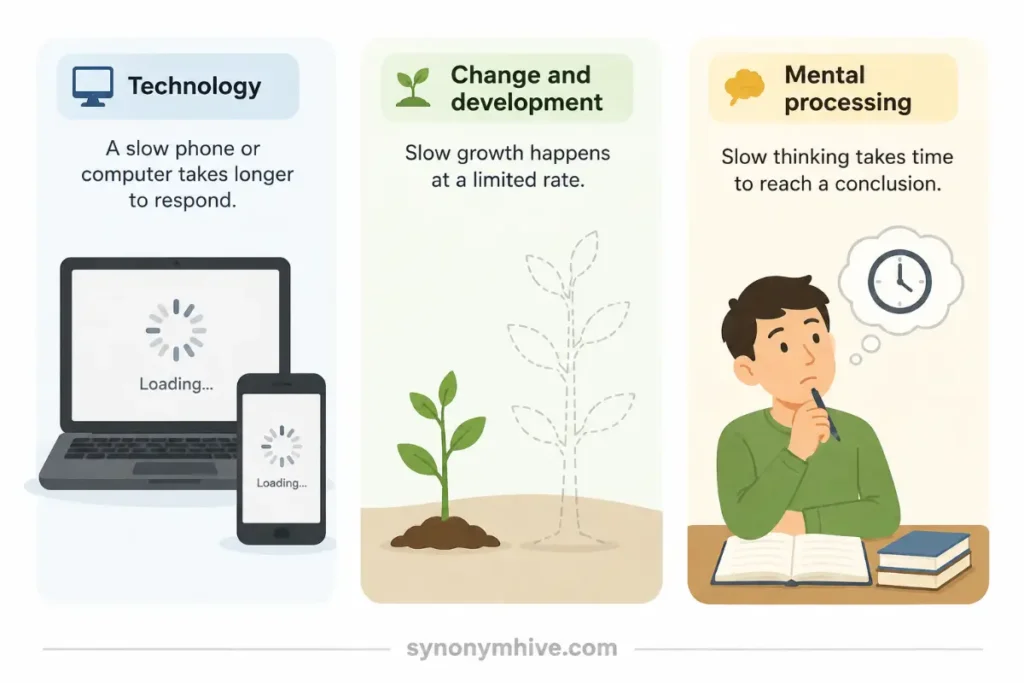
- Technology. A slow phone or computer takes longer to respond.
- Change and development. Slow growth happens at a limited rate.
- Mental processing. Slow thinking takes time to reach a conclusion. Use this description carefully because it can sound insulting when applied to another person.
- Business activity. A slow sales period has fewer transactions or less customer demand than usual.
- Pace and atmosphere. A slow afternoon may be quiet and relaxed rather than unproductive.
These meanings are related, but they are not interchangeable in every sentence. For example, gradual describes a change that develops step by step. It does not usually describe a car’s speed. Sluggish often suggests poor performance or a lack of responsiveness, while leisurely suggests that a person has time to spare.
What Is the Difference Between Slow and Slowly?
Slow is commonly an adjective, while slowly is an adverb.
An adjective describes a noun. For example, you can have a slow train, a slow computer, or a slow process.
An adverb describes an action. For example, a person can walk slowly, speak slowly, or work slowly.
In everyday American English, slow can also appear as an adverb in certain familiar expressions, such as drive slow. In formal writing, drive slowly is often the safer choice.
Compare these examples.
| Sentence | Word role | Why It Works |
|---|---|---|
| The bus is slow. | Adjective | Slow describes the bus. |
| The bus moves slowly. | Adverb | Slowly describes how the bus moves. |
| We need a slow response time. | Adjective | Slow describes the response time. |
| The website loads slowly. | Adverb | Slowly describes the loading action. |
| Please drive slowly in the rain. | Adverb | Slowly describes how to drive. |
When you are unsure, ask what the word describes. If it describes a person, object, or condition, an adjective may be needed. If it explains how an action happens, an adverb is usually appropriate.
Where Did the Word Slow Come From?
The word slow has roots in Old English. It developed from the Old English word slaw, which described someone or something as slow, sluggish, or inactive. Its spelling and use changed over centuries, but the central idea of limited speed remained.
Fast has a different history. It comes from an Old English word related to firmness, security, or being firmly fixed. Over time, fast developed the meaning of moving quickly. Today, the two words form a familiar contrast in modern English.
The history of these words helps explain why their meanings do not match perfectly in every context. English words often develop several related meanings as people use them in new situations. Fast can describe speed, quick action, or a short amount of time. Slow can describe low speed, limited progress, delayed activity, or a relaxed pace.
For example, fast delivery means a package arrives quickly. Slow delivery means the package takes more time to arrive. A fast decision happens quickly, while a slow decision takes longer. In contrast, a gradual decision is not a natural replacement because gradual usually describes a process of change rather than the time needed to choose.
The history is useful background, but you do not need to memorize it to use the word correctly. Focus on the meaning you want to express and the noun or action you are describing.
What Words Mean the Opposite of Fast?
English has many words that contrast with fast. Some describe low speed, others focus on delays, and a few suggest a calm or unhurried pace. The table below groups useful choices by tone and meaning so you can pick a word that fits your sentence.
What Are the Best Simple Alternatives to Slow?
Simple words work well in everyday conversations, school assignments, and clear business writing. They are easy to understand and rarely sound formal or unusual.
| Word | Meaning | Tone | Example |
|---|---|---|---|
| Slow | Moving or happening at a low speed | Neutral | The bus was slow during rush hour. |
| Late | Arriving or happening after the expected time | Neutral | The delivery was late by twenty minutes. |
| Long | Taking a lot of time | Neutral | The repair took a long time. |
| Gradual | Happening little by little | Neutral | We saw gradual progress over the month. |
| Leisurely | Done without hurry | Relaxed | They enjoyed a leisurely breakfast. |
| Unhurried | Done at a comfortable pace | Positive or neutral | She took an unhurried walk home. |
| Steady | Continuing at a regular pace | Positive or neutral | The team made steady progress. |
| Delayed | Happening later than planned | Often negative | The delayed train reached the station at noon. |
These words are useful because they focus on different parts of the situation. Late and delayed refer to timing, while long refers to duration. Gradual describes change, and steady suggests a consistent pace. Leisurely and unhurried often imply that there is no need to rush.
What Are Everyday Alternatives to Slow?
Everyday alternatives are useful when the basic word does not quite express the problem. Some suggest weak performance, while others describe a process that takes too much time.
| Word | Meaning | Tone | Example |
|---|---|---|---|
| Sluggish | Moving or responding with little speed | Often negative | My phone feels sluggish today. |
| Lagging | Falling behind the expected pace | Negative or neutral | Our sales are lagging behind last month. |
| Dragging | Seeming to take too long | Informal | The meeting was dragging by noon. |
| Unresponsive | Reacting slowly or not reacting | Negative | The website became unresponsive. |
| Leisurely paced | Moving at a relaxed rate | Positive or neutral | The tour was leisurely paced. |
| Crawling | Moving extremely slowly | Informal | Traffic was crawling along the highway. |
| Plodding | Moving or working with heavy, steady effort | Often negative | He made plodding progress on the report. |
| Languid | Moving in a relaxed, low energy way | Literary or descriptive | A languid breeze moved through the garden. |
Sluggish is a good choice for a device that struggles to respond. Lagging works when someone or something falls behind a target. Dragging often expresses frustration, especially with long meetings, dull lessons, or tasks that seem endless.
Crawling is usually figurative when it describes traffic, a queue, or progress. A sentence such as the project is crawling tells readers that the work is moving far more slowly than expected.
What Are Formal Words That Mean Slow?
Formal terms can make reports, essays, and professional explanations more precise. Choose them for their meaning, not just because they sound advanced.
| Word | Meaning | Tone | Example |
|---|---|---|---|
| Gradual | Developing in small stages | Neutral or formal | The policy led to gradual improvement. |
| Protracted | Continuing for longer than expected | Formal, often negative | The company faced a protracted review. |
| Tardy | Late or behind schedule | Formal | The tardy submission missed the deadline. |
| Deliberate | Done with careful thought rather than haste | Positive or neutral | The board took a deliberate approach. |
| Measured | Carefully controlled in pace or response | Professional | She gave a measured reply to the complaint. |
| Unhurried | Not rushed | Neutral or positive | The manager took an unhurried approach to training. |
| Incremental | Happening in small steps | Formal or technical | Incremental changes improved the system. |
| Prolonged | Lasting for a long time | Neutral or negative | The prolonged delay affected customers. |
Protracted and prolonged both suggest a long duration, but they often imply more than a simple lack of speed. A protracted dispute or prolonged delay usually lasts longer than people expected or wanted.
Deliberate and measured are different. They can describe a thoughtful choice rather than poor speed. For instance, a deliberate review may take longer because the reviewer is checking details carefully. That pace can be useful rather than inefficient.
What Are Slang Words for Slow?
Slang and informal expressions can make a text or casual conversation sound natural. Most are unsuitable for formal essays or professional reports.
| Word or Phrase | Meaning | Tone | Example |
|---|---|---|---|
| Snail paced | Extremely slow | Informal | The approval process was snail paced. |
| Dragging its feet | Delaying action on purpose or through reluctance | Informal | The landlord is dragging his feet on repairs. |
| Taking forever | Seeming to take too much time | Casual | This download is taking forever. |
| Moving at a crawl | Moving extremely slowly | Informal | The line is moving at a crawl. |
| Pokey | Slow or not very quick | Casual, more common in some regions | This old computer is pokey. |
| Dead slow | Very slow | Informal, especially in some varieties of English | The connection is dead slow today. |
| At a snail’s pace | Moving very slowly | Familiar idiom | The paperwork moved at a snail’s pace. |
| Sleepy | Quiet or inactive, with little activity | Casual | The store was sleepy on Monday morning. |
Use these expressions when the audience expects casual language. For a formal report, replace the line is moving at a crawl with the line is progressing slowly. If you want to say that someone is avoiding work, dragging their feet is more accurate than simply calling them slow.
Which Words Describe Different Levels of Slowness?
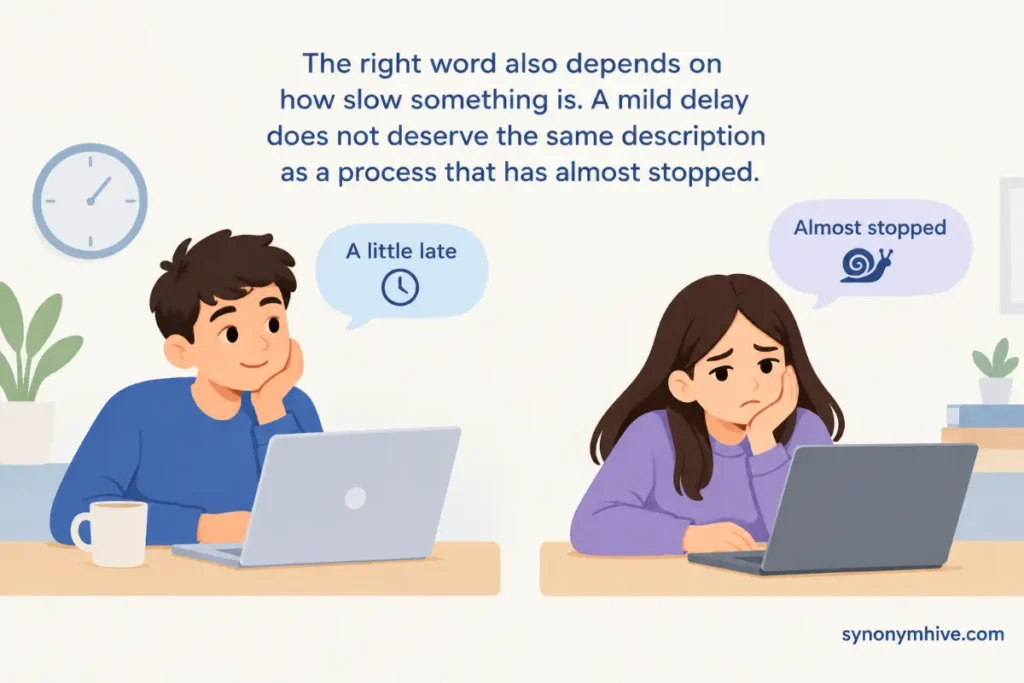
The right word also depends on how slow something is. A mild delay does not deserve the same description as a process that has almost stopped.
What Is a Mild Word for Slow?
Use gradual, measured, steady, or unhurried when the pace is controlled and the result is not necessarily a problem.
A gradual recovery happens step by step. A measured response shows care and control. Steady progress continues at a reliable rate. An unhurried walk happens without pressure to move quickly.
Examples include the following.
- The patient made gradual progress during recovery.
- The editor took a measured approach to the changes.
- The team maintained a steady pace throughout the project.
- We enjoyed an unhurried lunch before the meeting.
These terms can describe a slower pace without criticizing it.
What Is a Strong Word for Slow?
Use sluggish, dragging, crawling, or protracted when you want to emphasize a frustrating or unusually low pace.
Sluggish often describes poor performance. Dragging suggests that an activity feels too long. Crawling paints a clear picture of almost no movement. Protracted emphasizes that a situation has lasted longer than expected.
For example, the website was sluggish after the update. The meeting kept dragging because no one made a decision. Traffic crawled for miles after the accident. The negotiations became protracted after both sides rejected the first proposal.
Choose the strongest term that the facts support. A brief pause is not a protracted delay, and a careful review is not necessarily sluggish.
What Is a Word for Extremely Slow?
Crawling and snail paced are vivid ways to describe extremely slow movement or progress. At a standstill is stronger when movement or progress has stopped altogether.
For example, the traffic was crawling near the tunnel. The permit process moved at a snail’s pace. After the budget was cut, the project came to a standstill.
Be precise with these expressions. Slow progress means work is continuing at a low rate. A standstill means it has stopped for the time being.
How Does Slow Change by Part of Speech?
The opposite of fast can appear in different grammatical forms. The correct form depends on the word you want to describe and the job that word performs in a sentence.
| Part of Speech | Useful Word | Example |
|---|---|---|
| Adjective | Slow | The service is slow. |
| Adverb | Slowly | The elevator moved slowly. |
| Noun | Slowness | The slowness of the network frustrated users. |
| Verb | Decelerate | The driver began to decelerate near the crossing. |
| Verb | Slow down | Please slow down before the turn. |
| Adjective | Sluggish | The computer became sluggish. |
| Adjective | Gradual | The change was gradual. |
Can You Use Slowness as a Noun?
Yes. Slowness names the quality or condition of being slow. It works when you want to discuss speed as a general problem.
For example, the slowness of the checkout process annoyed customers. The slowness of the old computer made simple tasks harder. In both cases, the noun describes a condition rather than an action.
However, sluggishness may fit better when the problem involves poor response or low performance. The sluggishness of the website suggests that pages or controls respond poorly. The slowness of the website is broader and less specific.
What Is the Opposite Verb of Speed Up?
Slow down and decelerate are common verbs for reducing speed. Slow down is natural in everyday conversation, while decelerate often appears in technical, scientific, or driving contexts.
Examples include these sentences.
- The driver slowed down as the road became wet.
- The train began to decelerate before entering the station.
- The company needs to slow down spending until revenue improves.
- The rate of growth began to decelerate near the end of the year.
The best verb depends on what is changing. A car decelerates when its speed decreases. A business can slow down its spending. A market’s growth rate can decelerate. Avoid using a word about physical speed when you mean a change in frequency, cost, or activity unless the meaning is clear from context.
Learn more useful word alternatives in Opposite of Honest The Best Words to Use.
What Is the Best Word for Slow in Different Situations?
A useful synonym should fit the subject, audience, and purpose of your sentence. The best choice for a resume may sound unnatural in a text message, while a casual expression may weaken a formal essay.
What Is the Best Word for Slow on a Resume?
On a resume, describe the specific issue instead of labeling yourself or a coworker as slow. Words such as methodical, deliberate, and thorough can highlight a careful approach when the facts support that description. If you are discussing a process that needs improvement, use terms such as delayed, inefficient, or time consuming.
For example, instead of writing, I am slow but careful, try this sentence.
I review complex records methodically to maintain accuracy and reduce errors.
If you need to explain a business problem, you could write the following.
I identified delays in the approval process and recommended changes that reduced turnaround time.
The second sentence names a real problem and shows a useful contribution. It avoids making a broad negative judgment about a person.
Do not use methodical as a softer label for poor performance if the real issue is missed deadlines. A methodical worker follows an organized process. Someone who regularly misses deadlines may need to improve time management or task completion.
What Is the Best Word for Slow in an Essay?
For an essay, choose the term that explains the kind of pace you mean. Gradual works for change over time. Protracted describes an event that lasts longer than expected. Sluggish suits weak performance, while deliberate can describe careful decision making.
For example, a history essay might say that social change was gradual. A business essay could explain that a protracted approval process increased costs. A science report might describe a sluggish reaction when the results support that observation.
Consider this sentence.
The slow growth of the town changed its economy over several decades.
You could make the meaning more specific by writing this.
The town’s gradual growth changed its economy over several decades.
The second version highlights development over time rather than simply saying the town grew at a low rate. That small change can make an academic explanation clearer.
What Is the Best Word for Slow in a Text Message?
In a text message, simple language usually works best. Slow, lagging, crawling, and taking forever sound natural in casual conversations.
Examples include these messages.
- My internet is really slow today.
- The download is taking forever.
- Traffic is crawling near the mall.
- Your old phone is lagging again.
- The line is moving so slowly.
You can also use playful expressions with friends, but consider the effect before describing a person as slow. The word can sound insulting when it refers to someone’s intelligence or ability. If you mean that someone has not replied, say they have not responded yet rather than calling them slow.
What Is the Best Word for Slow in an Email?
Professional emails should explain delays clearly and respectfully. Delayed, pending, extended, and taking longer than expected are useful options when they match the facts.
For example, write this.
The review is taking longer than expected, and I will send an update by Thursday.
Or use this sentence when you know the cause.
The approval was delayed because two required documents were missing.
These statements tell the reader what happened. They also avoid unnecessary blame. If you are responsible for a delay, acknowledge it directly and provide a realistic next step.
Avoid vague phrases such as the process is kind of slow when the reader needs a clear status update. State what is taking time, explain the reason when you know it, and give a useful estimate if one is available.
What Is the Best Word for Slow in Speaking?
In conversation, slow is usually the clearest choice. Use unhurried for a relaxed pace, gradual for a change that develops over time, and sluggish for something that responds poorly.
For example, you might say, The service was sluggish during lunch. You could also say, We took a leisurely walk after dinner. Both sentences sound natural because each word matches the situation.
If you are giving someone instructions, slowly is often better than a more advanced synonym.
Please read the directions slowly.
This sentence gives a clear request. Saying please read the directions in a languid manner would sound unusual because languid describes a relaxed or low energy quality rather than a simple need to reduce reading speed.
What Are Examples of the Opposite of Fast in Real Life?
Examples make small differences between words easier to understand. The following sentences cover work, school, technology, travel, shopping, and daily routines.
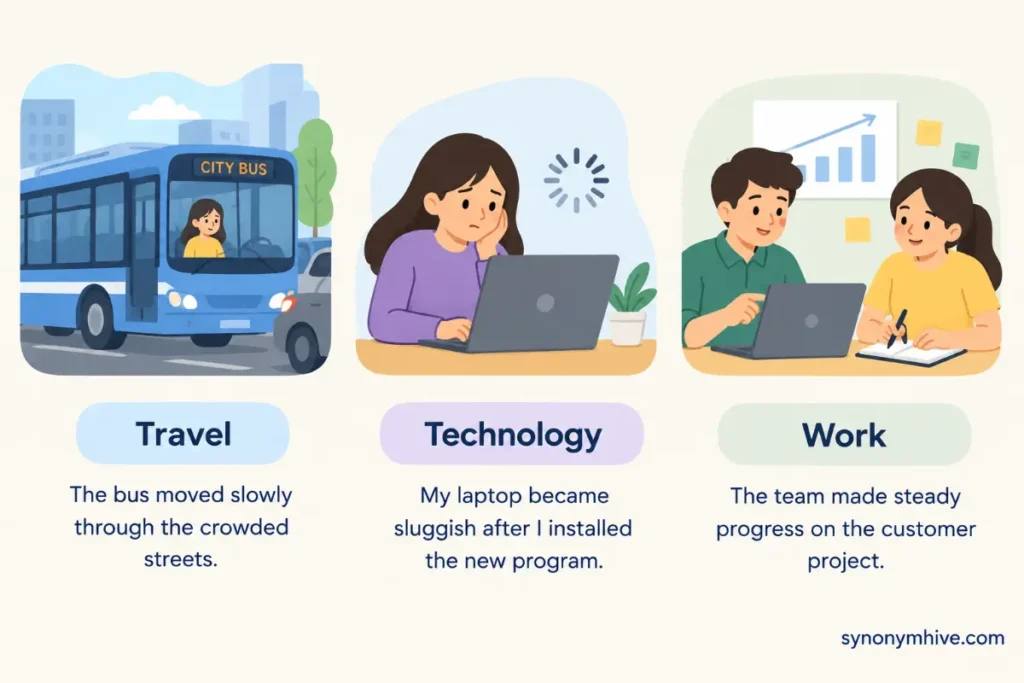
- Travel. The bus moved slowly through the crowded streets.
- Technology. My laptop became sluggish after I installed the new program.
- Work. The team made steady progress on the customer report.
- School. The student read the passage slowly to understand each sentence.
- Business. Gradual growth helped the company manage its expenses.
- Customer service. The delayed response left the customer waiting for an answer.
- Health and recovery. Her recovery was gradual, but she continued to improve.
- Home life. We enjoyed a leisurely breakfast on Sunday morning.
- Traffic. Cars were crawling along the road after the heavy rain.
- Online shopping. The delivery took longer than expected because of the weather.
- Meetings. The discussion was dragging because the group could not agree on a plan.
- Writing. A measured response helped the manager handle the complaint calmly.
- Personal goals. Small, steady steps helped him build a regular exercise habit.
- Public services. The permit process became protracted after officials requested additional records.
- Gaming. The game started lagging when too many players joined the server.
- Learning. She took an unhurried approach to learning the new software.
- Shopping. The checkout line moved at a snail’s pace before closing time.
- Project management. The work came to a standstill when the supplier ran out of materials.
These examples show why the basic word does not always give readers enough information. A sluggish device has a performance problem. A leisurely breakfast is a pleasant experience. A protracted process lasts too long, while a gradual recovery develops in stages.
What Is the Difference Between Similar Words?
Some alternatives appear interchangeable at first, but each carries a slightly different meaning. Choosing the more precise term can make your writing clearer and help you avoid an unintended tone.
Slow vs Sluggish
Slow describes a low rate of speed in a broad, neutral way. Sluggish usually suggests weak performance, limited responsiveness, or a lack of energy.
| Slow | Sluggish |
|---|---|
| The train was slow on the steep hill. | The computer was sluggish after the update. |
| Focuses on low speed. | Often suggests poor performance. |
| Works in neutral descriptions. | Often carries a negative tone. |
| The process moved slowly. | The system responded sluggishly. |
Use slow when you only need to describe speed. Choose sluggish when you want to suggest that something is struggling to perform well.
A slow computer may simply be an older model with modest processing power. A sluggish computer often seems to hesitate, freeze briefly, or respond poorly to commands. The distinction is not absolute, but sluggish usually gives the reader a stronger sense of frustration.
Slow vs Gradual
Slow describes a low speed or rate. Gradual describes a change that happens in small steps over time.
| Slow | Gradual |
|---|---|
| The car moved slowly. | The temperature rose gradually. |
| Can describe movement or performance. | Usually describes change or development. |
| Does not require a series of stages. | Often suggests a process that unfolds over time. |
| The service was slow. | The improvement was gradual. |
A gradual improvement may take months, but it can still be successful. Calling it slow might suggest that the improvement rate was disappointing. Use gradual when the stages of change matter more than the speed itself.
Slow vs Leisurely
Slow often focuses on low speed. Leisurely suggests a relaxed pace without pressure or urgency.
A slow walk could happen because someone is tired, injured, or struggling to keep up. A leisurely walk usually happens because the person wants to enjoy the surroundings or has no need to hurry.
Compare these sentences.
The patient took slow steps after the operation.
The couple took a leisurely walk through the garden.
The first sentence focuses on movement and may suggest a physical limitation. The second describes a relaxed activity. Using leisurely for a person who is struggling to move could hide the real situation.
Slow vs Delayed
Slow describes pace. Delayed describes something that happens later than planned or expected.
A slow train may take longer than other trains to complete a journey. A delayed train has missed its expected schedule. A train can be delayed before it begins moving, so the term does not always describe its speed.
For example, the service was slow during the journey describes the travel pace. The service was delayed by a signal problem explains a timing issue.
This difference matters in customer emails, travel updates, and project reports. If the problem is a missed deadline, delayed is usually more precise than slow.
What Mistakes Should You Avoid When Choosing a Word for Slow?
A synonym is useful only when it preserves the meaning of your sentence. Several common mistakes can make writing less clear or give readers the wrong impression.
Do Not Treat Every Synonym as an Exact Match
Gradual, sluggish, delayed, and leisurely describe different situations. Replacing slow with one of these words without checking the context can change the meaning.
For example, a leisurely process sounds relaxed and possibly enjoyable. A protracted process sounds unusually long and often frustrating. Use the word that matches the facts.
Do Not Confuse Speed With Duration
Speed describes how quickly something moves or happens. Duration describes how long it lasts.
A slow meeting may proceed with little progress. A long meeting may last several hours even if everyone speaks quickly. A delayed meeting starts later than planned. These are three separate problems, so they need different descriptions.
Do Not Use Formal Words Just to Sound Smart
A simple word is often stronger than an unusual one. If you write that a car moved slowly, most readers will understand you immediately. A phrase such as the vehicle proceeded in a languid manner adds complexity without adding useful information.
Formal language has a place in reports and academic writing, but clarity should come first.
Do Not Call a Person Slow Without Considering the Tone
Describing a person as slow can sound critical, especially when you refer to intelligence, learning ability, or work performance. If you mean that someone needs more time, explain the specific situation.
For example, instead of saying, He is slow, write, He needs additional time to complete detailed tasks accurately.
This version describes an observable need rather than judging the person as a whole. In a workplace, it is even more useful to mention the expected standard and the support or process change that may help.
Do Not Use Slow When You Mean Unwilling
Someone who delays a task on purpose may be reluctant, hesitant, or dragging their feet. Calling that person slow describes the pace but may miss the reason for the delay.
For example, the team is slow to approve the request could mean the review takes a long time. The team is reluctant to approve the request suggests that the members do not want to approve it.
Use evidence before claiming that a delay is intentional. A missed deadline may result from a heavy workload, missing information, or a technical problem rather than unwillingness.
Do Not Mix Up Slow and Slowly
Use slow to describe a noun, as in a slow response. Use slowly to describe an action, as in responding slowly.
Some informal expressions use slow as an adverb, particularly in casual speech. In careful writing, slowly is usually the clearest choice when you explain how an action happens.
What Are the Antonyms of Slow?
Slow has several opposites, depending on the intended meaning. Fast and quick are the most common choices for speed. Rapid and swift can work in more formal or descriptive writing. Prompt and timely focus on acting or responding without unnecessary delay.
| Word | Best Use | Example |
|---|---|---|
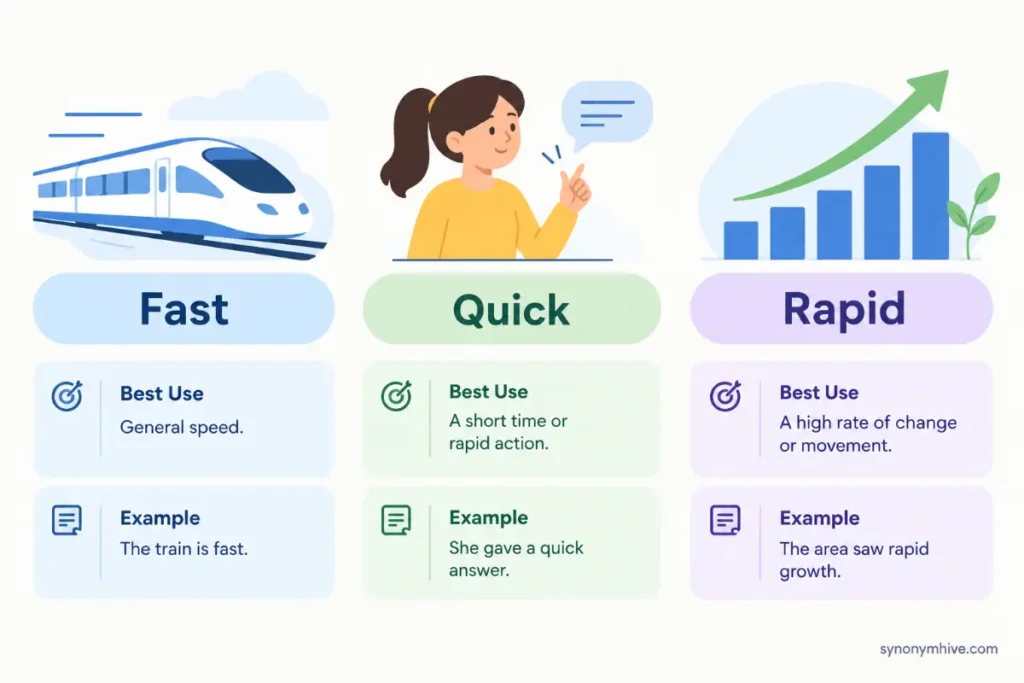
| Fast | General speed | The train is fast. |
| Quick | A short time or rapid action | She gave a quick answer. |
| Rapid | A high rate of change or movement | The area saw rapid growth. |
| Swift | Fast movement or action | The team took swift action. |
| Prompt | Acting without delay | Thank you for your prompt reply. |
| Timely | Happening at a useful or suitable time | The timely warning prevented a mistake. |
Fast and slow are direct opposites when describing speed. Prompt and delayed contrast more naturally when discussing timing. Gradual and rapid can contrast when describing the rate of change.
How Can You Choose the Right Word for Slow?
Use these quick tips to make your choice.
- Identify what is slow. A vehicle, a person, a computer, and a process may need different descriptions.
- Decide if the pace is a problem. Choose sluggish or dragging when performance is poor. Choose leisurely or unhurried when the pace is relaxed.
- Check the meaning you need. Use delayed for timing, gradual for change, and protracted for something that lasts too long.
- Match the audience. Simple terms work well in texts and everyday conversation. More precise terms may suit reports, essays, and professional emails.
- Keep the sentence natural. Do not choose an unfamiliar word just to avoid repeating slow.
- Consider the tone. A word that sounds neutral in one situation may seem insulting or critical in another.
- Read the sentence aloud. If the word sounds unnatural, a simpler option may be better.
For example, the sentence the website is slow is clear enough for casual conversation. In a technical report, the website responds sluggishly may be more useful if the problem involves delayed responses to user actions. The best term is the one that helps the reader picture the actual problem.
Find more synonyms in Opposite of Full Best Words and Examples.
Conclusion
Choosing the right word for a low pace depends on the situation. Slow is the clearest general choice, but it is not the only useful option. Gradual describes change that happens in stages, sluggish suggests weak performance, leisurely conveys a relaxed pace, and delayed points to a missed schedule. Each word gives readers a slightly different picture.
When you need the opposite of fast, start with the meaning you want to communicate. Think about the subject, the audience, and the tone of your sentence. A simple word often works best, while a more precise alternative can make an essay, email, resume, or report clearer. You do not need to make every sentence sound advanced. Choose the word that fits the facts, and your writing will be easier to understand.
Frequently Asked Questions
What is the most common opposite of fast?
The most common opposite of fast is slow. It describes movement, actions, or processes that happen at a lower speed. For example, a slow train takes more time to travel a route than a faster train.
What is a more formal word for slow?
Gradual, sluggish, measured, and protracted can work in formal writing, depending on the meaning. Gradual describes change in stages, sluggish suggests weak performance, measured implies careful control, and protracted describes something that lasts longer than expected.
What is another way to say slow?
You can say gradual, unhurried, leisurely, sluggish, delayed, or steady when the context supports that meaning. The best option depends on whether you are describing speed, timing, progress, or a relaxed pace.
What is the opposite of fast in a resume?
The best term depends on the point you want to make. Methodical or deliberate can describe careful work, while delayed or inefficient may describe a process that needs improvement. Give a specific example instead of labeling a person as slow.
Is sluggish the same as slow?
No. Slow is a general word for low speed, while sluggish often suggests poor performance or a weak response. A sluggish computer, for example, may take a long time to react to commands.
What is the opposite of fast when talking about change?
Gradual is often the best choice when describing change that happens in small steps. Slow growth describes a low rate of growth, while gradual growth emphasizes development over time.
Is slow an adjective or an adverb?
Slow is usually an adjective, as in a slow train. Slowly is an adverb, as in the train moved slowly. Slow also appears as an adverb in some informal expressions, but slowly is often preferred in formal writing.