

If you’re writing an essay, polishing a resume, sending an email, or finishing a text, you may notice that you use the word significant too often. The word works in many situations, but repeating it can make your writing sound flat. Finding another word for significant can help you show exactly how important, noticeable, meaningful, or influential something is.
The best replacement depends on your meaning. Important works for general situations, while major suggests a large effect or change. Notable highlights something worth noticing, and substantial points to a large amount or degree. Meaningful works well when something has personal value or deeper importance.
Answer Box: The best alternative depends on context. Common choices include important, major, notable, meaningful, substantial, considerable, influential, crucial, and remarkable.
This guide explains the meaning and origin of significant, compares more than 30 alternatives, and shows how word choice changes with tone and intensity. You’ll also find examples for resumes, essays, texts, emails, and everyday speech, along with close synonym comparisons and common mistakes.
Compare more word options with another word for demonstrates Best Choices Terms 2026.
What Does Significant Mean In Plain English
Significant usually means important enough to matter or large enough to notice. The exact meaning changes slightly based on context.
For example, a significant decision is an important decision. A significant increase is a noticeable or substantial increase. A significant historical event has enough importance to deserve attention or study.
The word can also describe something meaningful. A significant moment in someone’s life may not affect a large group of people, but it can carry deep personal value.
In academic and scientific writing, significant can have a more specific meaning. Researchers may use it to describe a result that meets a particular statistical standard. That technical meaning differs from the everyday meaning of important.
Context therefore matters. Before replacing significant, identify the idea you want to preserve. You may want to stress importance, size, influence, meaning, visibility, or seriousness.
Where Did Significant Come From
Significant comes from the Latin word significare, which means to indicate, point out, or signify. The word entered English through French and developed into the modern adjective significant.
Its history helps explain why the word has several related meanings. Something significant can point to an important idea, indicate a meaningful change, or stand out as worthy of attention.
Over time, English speakers began using significant for things that carry special importance. The word now appears in everyday conversations as well as academic, professional, scientific, and formal writing.
The related noun significance means the importance or meaning of something. The verb signify means to indicate or represent something.
Consider these three forms.
| Word | Part of Speech | Meaning | Example |
|---|---|---|---|
| Significant | Adjective | Important or noticeable | The change was significant. |
| Significance | Noun | Importance or meaning | The discovery has great significance. |
| Signify | Verb | To indicate or mean | The results signify a major change. |
Understanding these related forms makes it easier to choose a replacement without changing the sentence structure incorrectly.
What Are The Best Another Words For Significant
The table below gives you a broad set of choices instead of a short list of interchangeable words.
| Word | Meaning | Tone | Example |
|---|---|---|---|
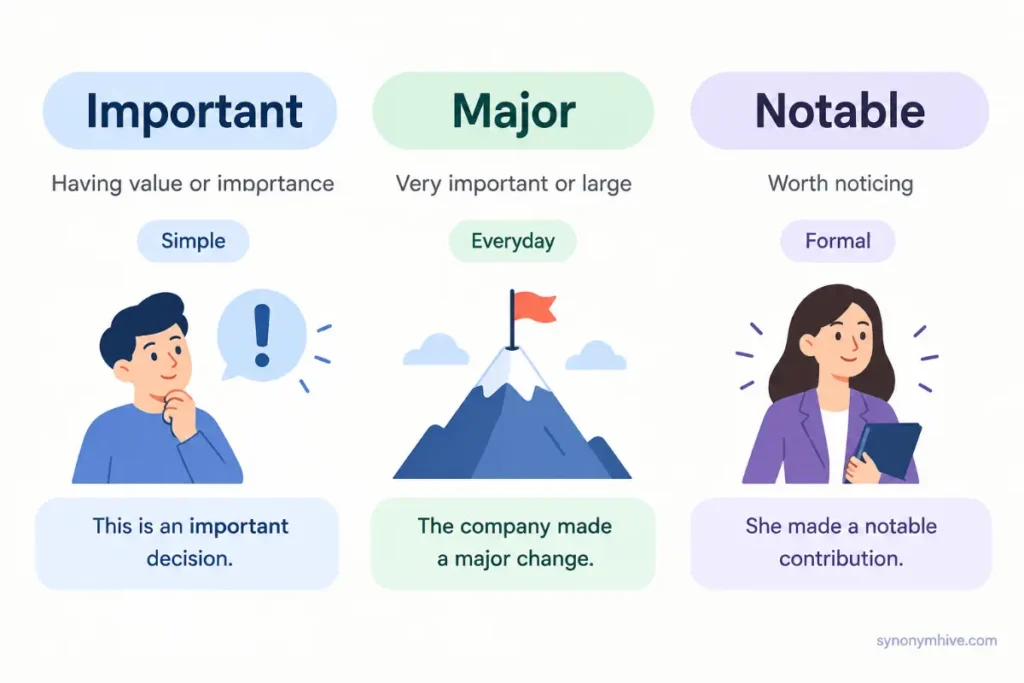
| Important | Having value or importance | Simple | This is an important decision. |
| Major | Very important or large | Everyday | The company made a major change. |
| Notable | Worth noticing | Formal | She made a notable contribution. |
| Meaningful | Having personal or deeper value | Everyday | The conversation was meaningful. |
| Substantial | Large in amount or degree | Formal | The project needs substantial funding. |
| Serious | Important because of possible consequences | Everyday | The issue requires serious attention. |
| Valuable | Worth a lot or useful | Everyday | Your feedback is valuable. |
| Relevant | Closely connected to the matter | Formal | Include only relevant information. |
| Consequential | Producing important results | Formal | It was a consequential decision. |
| Pivotal | Extremely important to an outcome | Formal | Her support played a pivotal role. |
| Vital | Necessary for success or survival | Strong | Clean water is vital to health. |
| Key | Very important to an outcome | Simple | Communication is a key factor. |
| Central | Most important to the main idea | Formal | Trust is central to the argument. |
| Meaningful | Important because of emotional or personal value | Everyday | The gift had meaningful value. |
| Valuable | Useful or beneficial | Everyday | The training provided valuable skills. |
| Dramatic | Large and easily noticed | Everyday | The company saw a dramatic increase. |
| Pronounced | Very noticeable | Formal | The study found a pronounced difference. |
| Extensive | Covering a large area or amount | Formal | The team conducted extensive research. |
| Considerable | Larger than expected or ordinary | Formal | The change required considerable planning. |
| Huge | Extremely large or important | Casual | The project had a huge impact. |
| Big | Large or important | Casual | That was a big decision. |
| Serious | Deserving careful attention | Everyday | The manager raised a serious concern. |
| Standout | Clearly better or more noticeable | Casual | Her work was a standout success. |
| Life changing | Having a major effect on someone’s life | Casual | The experience was life changing. |
Which Alternatives Sound Simple And Natural
For everyday writing, simple words often work best. Important, big, major, key, valuable, and serious are easy for most readers to understand immediately.
Consider the sentence, The meeting had a significant impact on our plans.
You could write, The meeting had a major impact on our plans. This sounds natural and keeps the original meaning close.
You could also write, The meeting had an important impact on our plans. That version is understandable, but major sounds more natural in this particular sentence.
Simple vocabulary often improves clarity because readers don’t have to stop and interpret a formal word. In emails, school assignments, and general business writing, clarity usually matters more than sounding sophisticated.
Which Alternatives Work Best In Formal Writing
Formal writing needs more precise choices. Words such as substantial, considerable, notable, consequential, pivotal, and noteworthy can work well when the context supports them.
For example, instead of writing, The policy had a significant effect on local businesses, you might write, The policy had a substantial effect on local businesses.
The word substantial tells readers that the effect was large. If your goal is to highlight importance rather than size, consequential may work better.
A sentence such as The ruling was consequential for future cases focuses on the results that followed. The word doesn’t simply say that the ruling mattered. It suggests that the ruling produced important consequences.
Formal alternatives should add precision rather than decoration. If a simple word communicates the idea clearly, use it.
Which Alternatives Work In Casual Texting
Text messages usually need short, natural words. Important, big, major, huge, serious, and key can all work well.
You might text, That was a major moment for us.
You could also say, That was a big moment for us.
The second sentence sounds more relaxed. The first has slightly more emphasis without sounding formal.
Words such as consequential, substantial, and noteworthy can sound too formal in casual texting unless you’re using them deliberately for humor or a specific tone.
Which Alternatives Sound Strongest
Not all alternatives carry the same level of force. A useful way to choose a word is to think about intensity.
Mild Alternatives
Words such as relevant, notable, meaningful, and valuable can suggest importance without making an extreme claim.
For example, a useful comment can be valuable without being crucial. A detail can be notable without changing the entire outcome.
These choices work when you want balanced language.
Moderate Alternatives
Important, major, considerable, substantial, and influential communicate stronger importance.
A major change is larger than an ordinary change. A substantial improvement suggests a noticeable increase in quality, amount, or degree.
These words work well when the situation clearly deserves emphasis but doesn’t require the strongest possible language.
Strong Alternatives
Crucial, critical, essential, vital, pivotal, and consequential carry greater force.
If you say something is essential, you’re saying it is needed. If you call something pivotal, you’re saying it plays a central role in the outcome.
Strong words should match strong evidence. Avoid calling every useful detail crucial because excessive emphasis can weaken your writing.
How Does The Part Of Speech Affect Your Word Choice
Significant is an adjective, so most direct replacements should also function as adjectives.
For example, you can write:
The project made a significant improvement.
You can replace significant with substantial.
The project made a substantial improvement.
However, related words can change the grammatical structure.
Significance is a noun.
The significance of the discovery became clear.
Signify is a verb.
The results signify a change in the market.
Importance is also a noun.
The importance of clear communication cannot be ignored.
This distinction becomes especially useful when revising essays. You can’t always replace a word mechanically. The new word needs to fit the sentence’s grammatical role.
Are There US And UK Differences
There is no major US and UK spelling difference for significant. The word is spelled significant in both American and British English.
The main differences appear in the surrounding vocabulary and style rather than in the word itself.
American academic and professional writing often favors direct alternatives such as important, major, key, and substantial. British writing may use some of the same words while also favoring more formal choices depending on the publication or setting.
The best choice still depends on audience and context. You don’t need a different synonym simply because your reader uses British English.
What Is The Best Word For A Resume
A resume benefits from precise and active language. Instead of repeatedly calling achievements significant, choose a word that explains the size or effect of the achievement.
Words such as substantial, major, measurable, notable, strong, and considerable can work well.
For example:
I made a significant improvement in customer retention.
A stronger version could be:
I made a substantial improvement in customer retention.
An even more specific resume statement would explain the result with a number when you have reliable data.
I improved customer retention by 18 percent.
The final version gives the reader useful information instead of asking the adjective to carry the entire message.
For resumes, specificity usually beats impressive sounding vocabulary. If you can describe the actual result, do that first.
What Is The Best Word For An Essay
Essays often require more precise language than casual writing. Important, major, notable, substantial, considerable, crucial, and influential can all work depending on the argument.
For example:
Education played a significant role in the development of modern society.
You could write:
Education played a crucial role in the development of modern society.
That version makes a stronger claim. If your evidence supports the idea that education was necessary to the development being discussed, crucial works well.
If you only want to show that education mattered, important may be safer.
Academic writing improves when each adjective makes a clear claim. Don’t choose a stronger synonym simply because it sounds more impressive.
What Is The Best Word For Texting
Texting calls for familiar vocabulary. Big, major, important, huge, key, and serious are usually better choices than formal alternatives.
For example:
That was a significant win.
You could say:
That was a huge win.
The second version sounds more natural in a casual message and gives the sentence more excitement.
For a calmer tone, you could write:
That was an important win.
The right word depends on the relationship between the people and the mood of the conversation.
What Is The Best Word For Email
Professional emails need clarity and a suitable level of formality. Important, key, major, relevant, valuable, and significant can all work.
For example:
Your feedback was significant to the final decision.
A more natural version might be:
Your feedback was important to the final decision.
If the feedback directly influenced the outcome, influential may be more precise.
Your feedback was influential in the final decision.
In many business emails, simple words sound more confident than complicated alternatives.
What Is The Best Word For Speaking
In conversation, important, big, major, serious, key, and meaningful usually sound natural.
For example:
That was a significant moment in my career.
You could say:
That was an important moment in my career.
If the moment changed your career direction, you might say:
That was a major turning point in my career.
The last sentence gives more information than a simple replacement. It explains the kind of importance involved.

What Are Some Real Examples Of Significant Synonyms
Real examples make synonym choices easier to understand because context controls meaning.
- The company announced a major change to its pricing plan.
- Her research made a notable contribution to the field.
- The new system produced a substantial improvement in response time.
- Good planning is crucial to the project’s success.
- His advice had a meaningful impact on my decision.
- The manager made a critical decision during the meeting.
- The discovery had considerable value for future research.
- The coach played an influential role in the team’s development.
- The new law created a dramatic shift in the industry.
- The interview was a pivotal moment in her career.
- The report includes several noteworthy findings.
- The training provided valuable skills for new employees.
- The problem requires serious attention from the leadership team.
- Clear communication is essential for effective teamwork.
- The campaign had a huge effect on brand awareness.
- The teacher made a meaningful difference in the student’s confidence.
- The organization experienced a pronounced increase in demand.
- The decision had consequential effects on future policy.
- Her contribution was remarkable given the limited resources.
- The issue became a central part of the discussion.
These examples show why a simple synonym list isn’t enough. Each word adds a slightly different shade of meaning.
Significant Vs Important What Is The Difference
Significant and important are close synonyms, but they don’t always communicate the same idea.
| Significant | Important |
|---|---|
| Can mean important or noticeable | Mainly means having importance |
| Can describe size or degree | Usually focuses on value or importance |
| Common in formal and academic writing | Common in almost every type of writing |
| Can have a technical meaning in statistics | Usually keeps its everyday meaning |
Consider these examples.
The study found a significant increase in sales.
Here, significant can mean a large or noticeable increase. In a scientific context, it can also have a technical statistical meaning.
The increase in sales was important to the company.
Here, important focuses on the business value of the increase.
If you simply mean that something matters, important is often the clearer choice.
Explore more word choices in Another Word for Shows Best Alternatives 2026.
Significant Vs Major What Is The Difference
Significant and major overlap when something is important or large, but major often sounds more direct.
A significant change may be noticeable or meaningful. A major change usually suggests something large, serious, or important.
Compare these sentences.
The company experienced a significant change in leadership.
The company experienced a major change in leadership.
Both sentences work. Major makes the change sound more substantial and direct.
For general writing, major often provides a cleaner alternative when you want to emphasize size or importance.
Significant Vs Notable What Is The Difference
Notable means worthy of attention. Significant can mean worthy of attention, but it can also mean important, meaningful, or substantial.
Consider this example.
She made a notable contribution to the project.
The sentence tells readers that her contribution deserves attention. It doesn’t necessarily say that her contribution determined the project’s success.
Now consider:
She made a significant contribution to the project’s success.
This can suggest that her contribution had an important effect on the outcome.
Use notable when attention is the main idea. Use significant when importance or impact matters more.
Significant Vs Substantial What Is The Difference
Substantial usually points to size, amount, degree, or strength. Significant has a wider range of meanings.
For example:
The company received a substantial investment.
This clearly suggests a large amount of money.
The company received significant support.
This could mean the support was large, important, or meaningful.
When you’re describing quantity or degree, substantial may give readers more information than significant.
Significant Vs Meaningful What Is The Difference
Meaningful focuses on personal, emotional, symbolic, or deeper value.
A meaningful conversation can matter deeply to the people involved even if it has no measurable effect.
A significant conversation sounds more formal and may suggest that the conversation had an important result.
For personal writing, meaningful often sounds warmer and more natural.
For example:
Her message was meaningful to me.
That sentence emphasizes emotional value.
Her message was significant to my decision.
That sentence emphasizes its influence on a choice.
Significant Vs Crucial What Is The Difference
Crucial is stronger than significant in many contexts. It means extremely important or necessary to an outcome.
If you call a detail crucial, you’re saying the outcome may depend on it.
For example:
Accurate data is significant to the study.
Accurate data is crucial to the study.
The second sentence makes a stronger claim. Use crucial only when the evidence supports that level of importance.
What Are The Most Common Mistakes With Significant Synonyms
One common mistake is treating every synonym as perfectly interchangeable. Similar words often have different meanings or levels of intensity.
Another mistake is choosing formal words simply to sound smarter. A word like consequential may be correct, but important might communicate the same idea more clearly for a general audience.
Writers also sometimes use substantial when they actually mean important. Substantial usually suggests size, amount, or degree. It isn’t always the right replacement for an idea that simply matters.
Another problem appears with crucial and essential. These words make strong claims. If something is useful but not necessary, calling it essential can exaggerate the situation.
Writers can also overuse major. If every change is major, the word loses its force. Save strong terms for situations that genuinely deserve them.
Finally, don’t replace significant just to avoid repetition. First ask what the sentence means. Then choose the word that expresses that meaning most accurately.
When Should You Not Replace Significant
Sometimes significant is the best word.
In statistical writing, significant may have a specific technical meaning. Replacing it with important could change the meaning.
For example, a research paper may report a statistically significant result. In that setting, the phrase belongs to a technical framework, so casual synonyms can create confusion.
Significant also works well when a sentence intentionally keeps the exact meaning broad.
For example:
The decision had significant consequences.
This sentence leaves room for the consequences to be large, important, or noticeable. If the writer doesn’t need to specify the exact type of importance, significant can be useful.
Don’t change a word simply because you think every repeated word is bad. Good editing focuses on clarity, accuracy, and natural rhythm.
What Are The Antonyms Of Significant
The opposite of significant depends on the intended meaning.
If significant means important, possible antonyms include unimportant, minor, trivial, or insignificant.
If it means large in amount, alternatives such as small, limited, minimal, or slight may work.
The context controls the best choice.
For example:
The change was significant.
The change was minor.
Here, minor directly contrasts with significant because the sentence concerns size or importance.
In another sentence:
The difference was significant.
The difference was slight.
Here, slight works because the focus is on degree.
How Do You Choose The Right Synonym
Start by asking what you mean by significant. Don’t begin by searching for the fanciest replacement.
If you mean something matters, try important or meaningful.
If you mean something is large, consider major or substantial.
Then check the tone. A resume may need precise professional language. A text message usually needs something shorter and more familiar.
Finally, read the sentence aloud. The best synonym should sound natural while preserving the original meaning.
What Is The Quickest Way To Pick The Right Word
Use this simple decision guide when editing.
| What You Mean | Strong Choices |
|---|---|
| It matters | Important, major |
| It has personal value | Meaningful |
| It is large in amount | Substantial, considerable |
| It deserves attention | Notable, noteworthy |
| It affects people or events | Influential |
| It affects the final result | Consequential, pivotal |
| It is absolutely needed | Essential, vital |
| It is extremely important | Crucial, critical |
| It is easy to notice | Pronounced, dramatic |
| It is impressive | Remarkable |
| It is useful | Valuable |
| It connects directly to the topic | Relevant |
| It is central to an argument | Central, key |
This approach keeps your word choice focused. You aren’t simply looking for a replacement. You’re identifying the exact meaning you want your reader to understand.
How Can You Avoid Repeating Significant
The easiest way to reduce repetition is to vary your sentence structure and clarify the underlying idea.
Suppose an essay contains these sentences.
The discovery was significant. The discovery had significant effects. The significant findings changed the field.
The repetition makes the paragraph sound mechanical.
You could revise it like this.
The discovery was important. It produced substantial effects across the field. The findings also changed how researchers approached the topic.
The revised version sounds more natural because each sentence communicates a slightly different idea.
You can also remove the adjective when the noun or verb already provides enough meaning.
Instead of saying, The study made a significant contribution, you could write, The study changed how researchers understood the issue.
That version may be stronger because it tells readers exactly what happened.
How Can You Use Synonyms Without Sounding Forced
Good synonym use should feel invisible. Readers shouldn’t notice that you deliberately replaced a repeated word.
Keep common words for common situations. Important, major, key, and valuable often work better than formal alternatives.
Use stronger words only when they add meaning. If crucial, pivotal, or consequential doesn’t tell the reader something useful, don’t use it.
Also consider sentence rhythm. Sometimes the best revision changes the entire sentence rather than swapping one adjective.
For example:
The program had a significant impact on students.
Could become:
The program helped students build stronger writing skills.
The second sentence removes the vague phrase significant impact and gives a clearer picture of the result.
That kind of revision often produces better SEO content, academic writing, professional writing, and everyday communication because readers get the information faster.
Why Context Matters More Than A Synonym List
A long synonym list can help you discover options, but context determines the winner.
Imagine you want to describe a large increase in sales. Substantial increase is natural because substantial can describe size or degree.
Now imagine you want to describe a decision that changed the direction of a company. Pivotal decision may be stronger because it tells readers that the decision affected the outcome.
If you’re describing an emotional event, meaningful may fit better than substantial.
If you’re describing a dangerous problem, serious may work better than notable.
The goal isn’t to find the closest dictionary match. The goal is to communicate the intended idea with the fewest words and the least confusion.
How Can These Alternatives Improve Essay Transitions
Essay transitions need to show relationships between ideas. Simply replacing significant won’t automatically improve a transition, but precise vocabulary can make an argument clearer.
For example:
This was a significant development. Therefore, the government changed its policy.
You could make the relationship more specific:
This was a major development. As a result, the government changed its policy.
The second version makes the cause and result easier to follow.
Another example:
The study produced significant findings. These findings support the argument.
You could write:
The study produced notable findings that support the argument.
Or:
The study produced important findings that strengthen the argument.
The best choice depends on the point you want to make. Strong essay writing connects ideas clearly instead of relying on repeated adjectives.
How Can You Make Your Writing More Precise
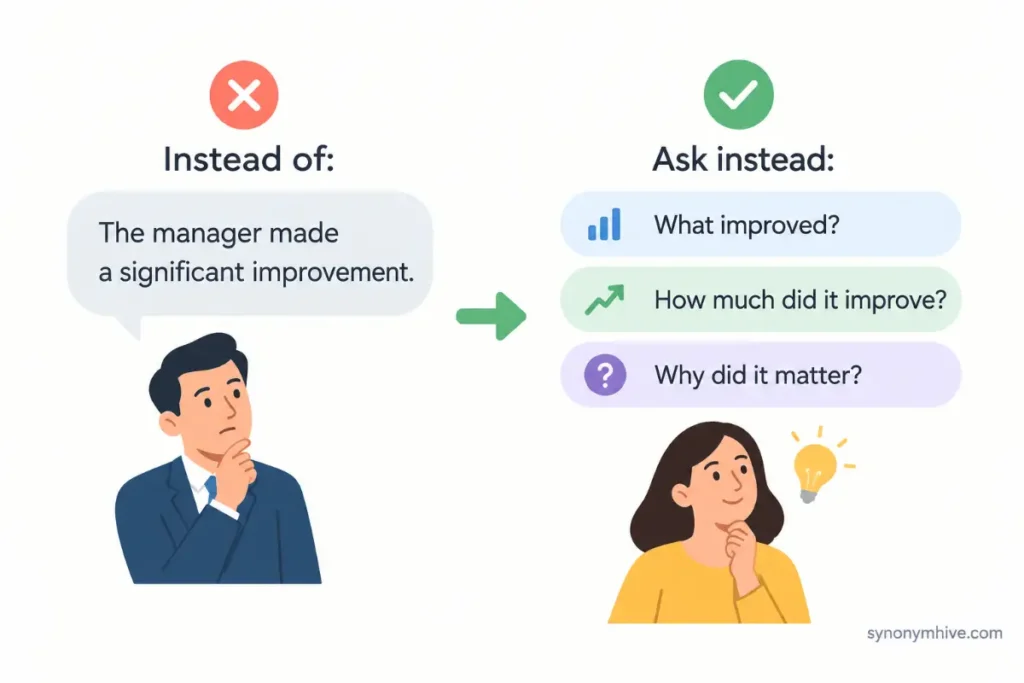
Precision starts with asking what happened instead of simply asking how important something was.
Instead of:
The manager made a significant improvement.
Ask:
What improved?
How much did it improve?
Why did it matter?
What changed because of it?
You might then write:
The manager reduced customer wait times by 20 percent.
That sentence is stronger because it replaces a broad adjective with a specific result.
Specific details can make significant unnecessary. Still, the word remains useful when the exact size or effect isn’t known or doesn’t need to be stated.
Good writing doesn’t avoid common words. It uses them carefully.
What Should You Remember About Significant Synonyms
Significant has a broad meaning, so no single replacement works in every sentence. Important is the safest general alternative, while major, substantial, notable, meaningful, influential, crucial, and pivotal each add a different shade of meaning.
Choose a synonym based on the idea behind the sentence. If you’re describing size, choose a size related word. If you’re describing importance, choose an importance related word.
For resumes and formal writing, precise vocabulary can strengthen your message. For texts and everyday speech, simple words usually sound more natural.
The best replacement isn’t the most complicated word. It’s the word that tells your reader exactly what you mean.
Discover another helpful synonym list in Another Word for Argues Best Alternatives 2026.
Conclusion
Choosing another word for significant starts with identifying the meaning you want to express. Important works well when something matters, while major highlights size or importance. Substantial points to a large amount or degree, notable shows that something deserves attention, and meaningful adds personal or deeper value.
For stronger claims, words such as crucial, essential, pivotal, and consequential can show greater importance. Still, strong vocabulary only helps when it matches the facts and the tone of your writing.
When you’re editing an essay, resume, email, or text, don’t replace words automatically. Look at the full sentence and decide what you want the reader to understand. A precise, natural word will almost always beat a complicated one.
Frequently Asked Questions
What is the best synonym for significant?
Important is the best general synonym because it works in many everyday and professional situations. Other choices can be more precise when you want to emphasize size, influence, meaning, or urgency.
What’s another way to say significant?
Another way to say significant is important, major, notable, meaningful, substantial, considerable, crucial, or influential. The best choice depends on the meaning and tone of your sentence.
What is another word for significant in an essay?
Another term for significant in an essay can be important, notable, substantial, major, influential, crucial, or consequential. Choose the word that matches the specific claim you are making.
What is a stronger word than significant?
Crucial, critical, essential, vital, pivotal, and consequential can sound stronger than significant. Use these words only when the situation genuinely involves a high level of importance or impact.
What is another term for significant on a resume?
On a resume, strong alternatives include substantial, major, notable, measurable, valuable, and influential. Specific results and numbers are often stronger than relying on an adjective alone.
Is significant the same as important?
Significant and important are close in meaning, but significant can also describe something noticeable, substantial, or statistically meaningful. Important usually focuses more directly on value or importance.
Can I use major instead of significant?
Yes, major can replace significant in many sentences when you want to emphasize something large or highly important. It doesn’t work in every context, especially when significant has a technical statistical meaning.