
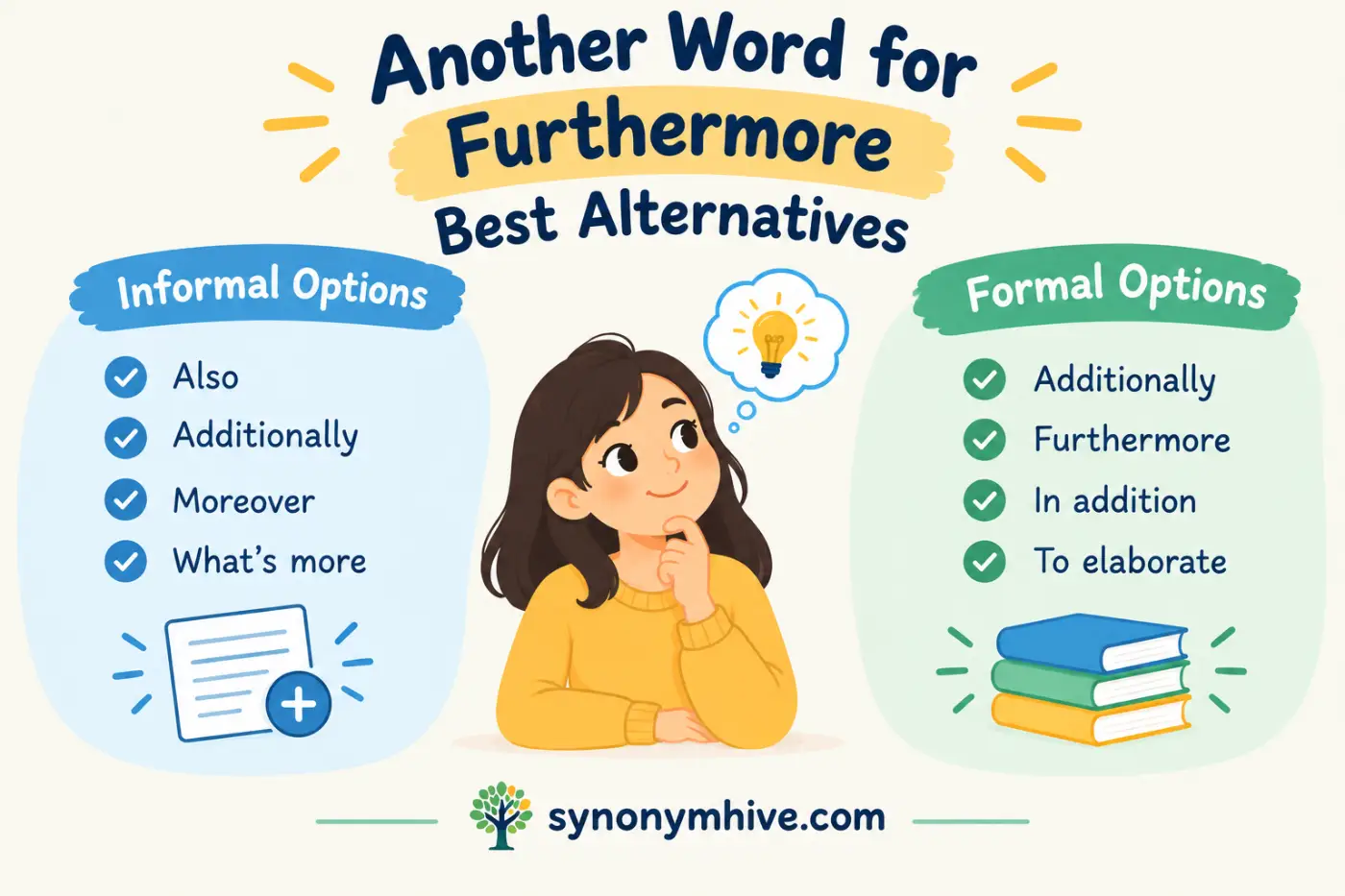
When you’re writing an essay, email, resume, or text, you may pause because you keep using the same transition word. If you need another word for furthermore, you have plenty of choices, including also, besides, in addition, additionally, and what’s more. The best option depends on your tone and the relationship between your ideas.
Furthermore adds another related point to something you have already said. It usually sounds formal, so it can work well in academic and professional writing. However, everyday writing often sounds more natural with simpler transitions.
The best alternative to furthermore is often in addition for formal writing and also for simple everyday writing. Other useful choices include additionally, besides, what’s more, as well as, and on top of that.
This guide covers more than a basic synonym list. You’ll learn what furthermore means, where it came from, how its alternatives differ in tone, and which word works best in an essay, resume, email, text, or conversation. You’ll also see examples and close comparisons that can help you choose a transition with confidence.
Find more synonyms in Another Word for Influence Best Synonyms 2026.
What Does Furthermore Mean
Furthermore means you are adding another point that supports or continues the idea you just gave. It often connects two related thoughts and tells the reader that the next point deserves attention.
For example, you might write, “The plan will save money. Furthermore, it will reduce waste.” The second sentence adds another reason to support the plan.
The word usually appears at the start of a sentence. A comma often follows it.
“Furthermore, the new policy will help employees.”
It can also appear after a semicolon or within a sentence, although those structures are less common in everyday writing.
Furthermore has a formal tone. You will often see it in essays, reports, academic papers, business writing, legal writing, and formal arguments.
In casual conversation, simpler words usually sound more natural. A person might say “Also, it saves time” instead of “Furthermore, it saves time.”
Where Did Furthermore Come From
Furthermore combines two older English words, further and more. The word further has long carried the idea of moving ahead, extending something, or adding to an existing point. More adds the idea of an additional amount or idea.
Over time, furthermore developed into a transition used to introduce an additional point. Its meaning became closely linked with phrases such as in addition and what is more.
The structure of the word gives you a useful clue about its meaning. It essentially signals that the writer wants to go further by adding another idea.
Modern English still uses it in that way. The word doesn’t introduce a completely unrelated thought. Instead, it normally adds information that connects to the point already under discussion.
Its formal sound also comes from its long history in written English. Today, writers often choose simpler alternatives when they want a relaxed and direct style.
What Is Another Word for Furthermore
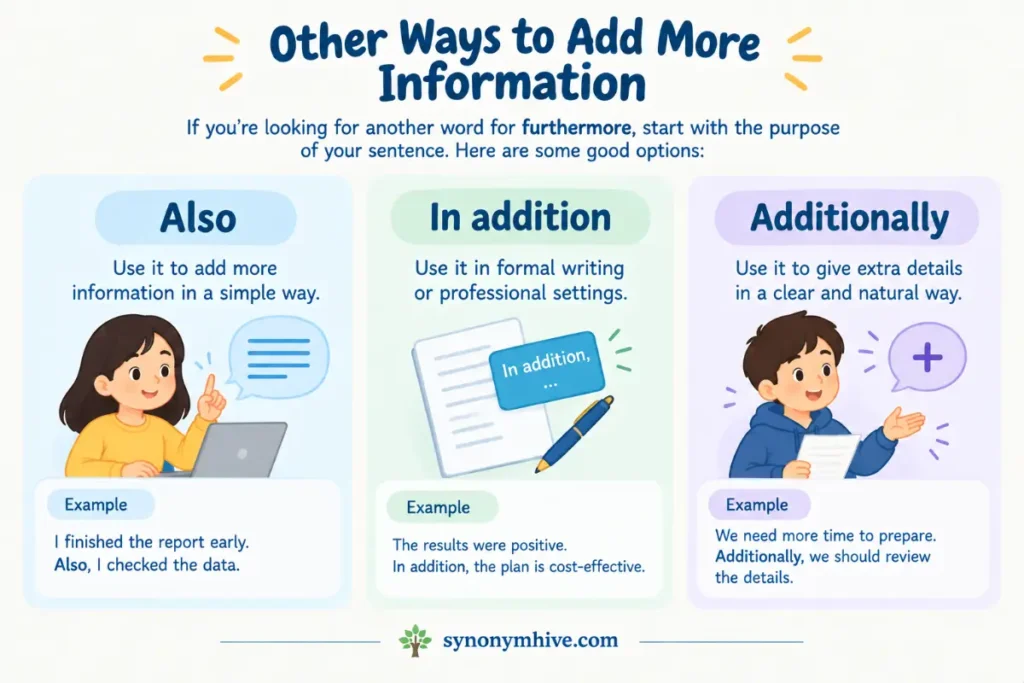
If you’re looking for another word for furthermore, start with the purpose of your sentence. If you simply want to add information, also is usually the easiest choice. For formal writing, in addition and additionally work well.
If you want to make your next point sound stronger, consider what’s more, besides, on top of that, or beyond that. For a very formal argument, you may prefer in addition to this or equally important.
The following table gives you a broad set of options.
30 Synonyms for Furthermore
| Word | Meaning | Tone | Example |
|---|---|---|---|
| Also | Adds another point | Simple | The plan is affordable. Also, it’s easy to use. |
| Too | Adds another fact | Everyday | She writes well and speaks clearly too. |
| Additionally | Adds extra information | Formal | Additionally, the report includes new data. |
| In addition | Adds a related point | Formal | In addition, the plan saves time. |
| Besides | Adds another reason or fact | Everyday | Besides, we already have enough supplies. |
| What’s more | Adds a stronger point | Conversational | What’s more, the service is free. |
| As well | Adds another point | Everyday | The course is useful and affordable as well. |
| On top of that | Adds another supporting fact | Informal | On top of that, the hotel offers free parking. |
| Plus | Adds another benefit or fact | Informal | Plus, the store stays open late. |
| And | Connects another idea | Simple | The room is bright and comfortable. |
| In addition to this | Adds supporting information | Formal | In addition to this, the policy cuts costs. |
| Along with that | Adds a connected idea | Everyday | Along with that, the app tracks progress. |
| Beyond that | Adds a further point | Neutral | Beyond that, the plan needs more testing. |
| Further | Adds another point | Formal | Further, the evidence supports the claim. |
| Equally important | Introduces another important point | Formal | Equally important, the system protects user data. |
| Another point is | Introduces a new related idea | Neutral | Another point is that the process takes less time. |
| Another reason is | Adds another reason | Neutral | Another reason is the lower cost. |
| Not only that | Adds emphasis | Conversational | Not only that, the service is available all week. |
| What is more | Adds another strong point | Formal | What is more, the results remained consistent. |
| On a related note | Shifts to a connected idea | Neutral | On a related note, the team needs more staff. |
| Added to that | Adds another supporting fact | Neutral | Added to that, the schedule is flexible. |
| Coupled with that | Adds a connected factor | Formal | Coupled with that, the new system reduces errors. |
| In the same way | Adds a similar point | Neutral | In the same way, the second method saves time. |
| Likewise | Shows a similar additional idea | Formal | Likewise, the second study found similar results. |
| At the same time | Adds a point while maintaining the main idea | Neutral | At the same time, the cost remains low. |
| Beyond this | Adds information beyond the current point | Formal | Beyond this, the proposal offers long term benefits. |
| To add to this | Adds supporting information | Neutral | To add to this, the results are easy to verify. |
| More importantly | Adds a point with greater importance | Formal | More importantly, the policy protects students. |
| In addition to that | Adds another connected point | Neutral | In addition to that, the service is available online. |
| Even better | Adds a positive extra point | Conversational | Even better, the upgrade costs nothing. |
Not every synonym works in every sentence. Also is much simpler than furthermore, while on top of that sounds far more casual. Likewise usually signals similarity rather than simply adding any new fact.
That difference matters because a transition does more than connect sentences. It also tells the reader how the ideas relate.
Synonyms By Intensity
Some alternatives simply add information. Others make the new point sound stronger or more important.
Mild Alternatives
Also, too, as well, and in addition can add information without giving the new point much extra force.
“The course is affordable. Also, it is easy to access.”
This sounds neutral and direct. The second point matters, but the transition doesn’t tell the reader that it is especially powerful.
Medium Strength Alternatives
Besides, what’s more, added to that, and on top of that can give the added point more weight.
“The course is affordable. What’s more, students can access it from home.”
The second point feels like an extra benefit. What’s more often creates a sense that the writer is building a stronger case.
Strong Alternatives
More importantly, equally important, not only that, and beyond that can draw special attention to the next idea.
“The program costs less than similar courses. More importantly, it gives students practical experience.”
Here, the writer isn’t simply adding another fact. The transition tells readers that the second point deserves greater attention.
Synonyms By Part Of Speech
Most alternatives to furthermore are transition words, phrases, or sentence connectors rather than ordinary synonyms that can replace the word in every grammatical position.
Also is an adverb. It can appear at the beginning of a sentence or inside a sentence.
“Also, the service is free.”
“She also teaches online.”
Additionally is also an adverb.
“Additionally, the company offers weekend support.”
In addition works as a transition phrase.
“In addition, the company offers weekend support.”
Besides can act as an adverb or preposition depending on the sentence.
“Besides the cost, we should consider the quality.”
As well commonly appears at the end of a sentence.
“The course includes practice tests as well.”
Understanding these differences helps you avoid forcing one transition into a sentence structure where it doesn’t belong.
Another Word for Furthermore in an Essay
For students, another word for furthermore can make an essay sound less repetitive. The best choice depends on the relationship between your ideas.
In addition is one of the safest choices for formal essays.
“The study found that exercise improves sleep. In addition, it showed that regular activity can reduce stress.”
Additionally also works well.
“Additionally, the survey showed strong support for the proposal.”
What’s more can add a slightly stronger and more natural voice.
“The plan costs less than the current system. What’s more, it requires less maintenance.”
More importantly works when the second point has greater weight.
“The program gives students useful skills. More importantly, it prepares them for real workplace situations.”
Avoid replacing every instance of furthermore with a different fancy transition. Good writing doesn’t need a new transition in every paragraph. Sometimes no transition works better.
Another Word for Furthermore in a Resume
Resumes need concise language. Long formal transitions can take up space without adding much value.
For a resume, also, additionally, and in addition can work when you need to connect achievements or skills.
For example:
“Managed customer accounts and also trained new team members.”
You could also write:
“Managed customer accounts. Additionally, trained five new team members.”
However, resume writing often benefits from removing the transition altogether.
“Managed customer accounts and trained five new team members.”
This version is shorter and more direct.
A resume should show what you did rather than spend many words explaining how each point connects. Strong verbs and specific results usually matter more than formal transitions.
Another Word for Furthermore in an Email
Email tone varies widely. A formal business email may need a polished transition, while a message to a coworker may sound better with a simpler word.
In addition works well in professional emails.
“The new schedule reduces overtime. In addition, it gives each team more flexibility.”
Also is useful for normal workplace communication.
“Also, please send the updated file by Friday.”
For a friendly email, plus or on top of that may sound natural.
“The hotel is close to the airport. Plus, breakfast is included.”
The key is to match the transition to the relationship and purpose of the message.
Another Word for Furthermore in Texting
Text messages usually don’t need formal transitions. If you’re texting a friend, furthermore will often sound stiff or overly formal.
Use also, plus, and on top of that instead.
“The movie starts at eight. Plus, there’s free parking.”
“You can take the bus. Also, it stops right outside the building.”
“It’s cheaper than the other place. On top of that, the food is better.”
In very casual texting, you can simply use and.
“The place is cheap and it’s close to home.”
Sometimes the strongest replacement for a formal transition is no transition at all.
Another Word for Furthermore in Speaking
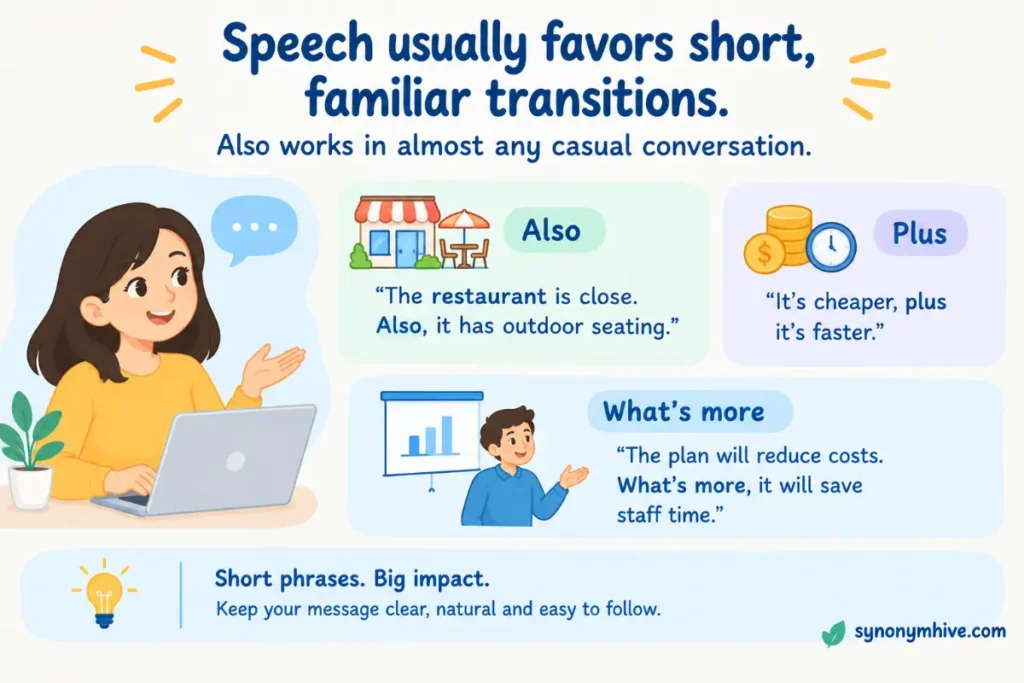
Speech usually favors short, familiar transitions.
Also works in almost any casual conversation.
“The restaurant is close. Also, it has outdoor seating.”
You can use plus when adding a benefit.
“It’s cheaper, plus it’s faster.”
What’s more works in presentations and persuasive speech.
“The plan will reduce costs. What’s more, it will save staff time.”
In a formal presentation, in addition and additionally can also work. Still, too many formal transitions can make spoken language sound stiff.
When speaking, focus on clarity first. A simple connection often sounds better than a complicated one.
Best Alternatives for Academic Writing
Academic writing often needs clear links between ideas. The goal isn’t to sound complicated. The goal is to show the relationship between points.
In addition is a strong general choice.
“Exercise can improve physical health. In addition, it can support better sleep.”
Additionally is another useful formal option.
“Additionally, the researchers examined the effects over a longer period.”
More importantly works when the next idea has greater significance.
“Students need access to reliable resources. More importantly, they need to know how to use those resources effectively.”
Equally important works in a similar way.
“Cost matters when choosing a program. Equally important, students should consider the quality of instruction.”
These transitions help readers follow your reasoning without making the writing sound inflated.
Best Alternatives for Business Writing
Business writing benefits from direct language. A transition should help the reader understand the next point quickly.
In addition works well in reports and proposals.
“The new software will reduce manual work. In addition, it will improve record keeping.”
Additionally is useful when adding a separate business benefit.
“Additionally, the system will provide faster reports.”
More importantly can highlight a major business concern.
“The new process will reduce costs. More importantly, it will lower the risk of errors.”
For internal emails, also may be enough.
“Also, please review the updated schedule before the meeting.”
A good business writer doesn’t use formal transitions simply to sound professional. Clear writing usually sounds more professional than complicated writing.
Best Alternatives for Casual Writing
Casual writing calls for familiar words. Also, plus, besides, and on top of that are strong choices.
For example:
“The apartment is affordable. Plus, it’s close to work.”
“I don’t want to go. Besides, we already have plans.”
“The food was great. On top of that, the service was fast.”
What’s more can work when you want a friendly but slightly polished tone.
“The book is easy to read. What’s more, it gives useful examples.”
These alternatives sound more natural than furthermore in most casual situations.
Furthermore Vs Also
Furthermore and also both add information, but they have different levels of formality.
Also is short, common, and flexible. You can use it in conversation, texts, emails, essays, and many other settings.
Furthermore sounds more formal and deliberate. It often appears when a writer is building an argument.
Compare these sentences.
“The product is affordable. Also, it is easy to use.”
“The product is affordable. Furthermore, it is easy to use.”
The first sounds natural and simple. The second sounds more formal.
Choose also when you want a direct everyday tone. Choose furthermore when the writing calls for a formal transition and the second idea clearly supports the first.
Expand your vocabulary with Another Word for In Conclusion Best Essay Choices 2026.
Furthermore Vs In Addition
Furthermore and in addition are close in meaning. Both introduce another related point.
The main difference is tone. In addition often sounds slightly cleaner and more neutral, while furthermore can sound more formal or argumentative.
Compare:
“The policy saves money. In addition, it reduces paperwork.”
“The policy saves money. Furthermore, it reduces paperwork.”
Both sentences work. The second has a stronger formal tone.
For many essays, reports, and professional documents, in addition is an excellent replacement because it preserves the meaning without sounding overly formal.
Furthermore Vs Besides
Besides can mean something similar to furthermore, but it has a more conversational tone.
“The plan is affordable. Besides, it can be completed quickly.”
The transition sounds natural in everyday writing and speech.
“Besides” can also mean apart from or in addition to.
“Besides the price, we should consider the quality.”
Furthermore doesn’t work in that structure.
This makes besides more flexible in some contexts. However, it can also sound more subjective or persuasive when used as a sentence transition.
Furthermore Vs Additionally
Additionally is one of the closest formal alternatives.
Both words introduce extra information that connects to the previous point.
“The software saves time. Additionally, it reduces errors.”
“The software saves time. Furthermore, it reduces errors.”
The difference is small. Additionally often sounds neutral and professional. Furthermore can sound more formal and may suggest that the added point strengthens the argument.
For reports and professional documents, either can work. Pick the one that matches the rest of your writing.
Furthermore Vs What’s More
What’s more adds information with a stronger conversational touch.
“The house is affordable. What’s more, it has a large backyard.”
The phrase makes the second point sound like an appealing extra benefit.
Furthermore would make the same idea sound more formal.
“The house is affordable. Furthermore, it has a large backyard.”
What’s more fits friendly articles, reviews, emails, and persuasive writing. Furthermore fits formal reports and academic arguments better.
When Not To Use Furthermore
You don’t need a formal transition every time you add a sentence. Sometimes furthermore makes writing heavier than necessary.
Consider this example:
“The store is close to my house. Furthermore, it stays open late.”
The sentence isn’t wrong. It simply sounds more formal than the idea requires.
A more natural version is:
“The store is close to my house. It also stays open late.”
You should also avoid using furthermore when the second sentence doesn’t add a related point. A transition should show a real relationship between ideas.
For example:
“The company hired new staff. Furthermore, the weather was rainy.”
The two ideas don’t connect clearly. The transition creates a relationship that the reader cannot understand.
A better approach is to separate the ideas or explain their connection.
Common Mistakes With Furthermore
One common mistake is using furthermore simply because it sounds sophisticated. A formal word doesn’t automatically make writing stronger.
Another mistake is repeating the same transition in every paragraph. If each paragraph begins with furthermore, the writing becomes predictable.
Some writers also use furthermore when they need a contrast word. Furthermore adds information. It does not normally show an opposing idea.
For contrast, use words such as however, but, instead, in contrast, or on the other hand.
Another mistake is adding furthermore when the connection between ideas is already obvious.
“The store sells books. Furthermore, it sells notebooks.”
The transition is acceptable, but it may be unnecessary. “The store sells books and notebooks” is shorter and clearer.
Good transitions should help readers. They shouldn’t simply decorate the sentence.
Antonyms And Opposing Transitions
Furthermore doesn’t have a true opposite in the same way that hot has cold or early has late. However, several transition words can express an opposite relationship.
However introduces contrast.
“The plan is affordable. However, it takes a long time.”
But also shows contrast.
“The plan is affordable, but it takes a long time.”
In contrast highlights a difference.
“The first option is cheap. In contrast, the second costs much more.”
Instead introduces an alternative.
“The original plan was too expensive. Instead, the team chose a simpler option.”
These transitions are useful because they show a different relationship from addition.
Quick Tips For Choosing The Right Transition
Start by asking what your second sentence does. If it simply adds information, choose also, in addition, or additionally.
If the new point is stronger or more important, try more importantly or equally important.
For casual writing, choose plus, what’s more, or on top of that.
For academic and formal writing, in addition and additionally are safe choices.
Don’t force a transition when the relationship is already clear. Sometimes combining two sentences creates a stronger result.
Finally, read the sentence aloud. If the transition sounds stiff compared with the rest of the paragraph, replace it with a simpler option.
A Practical Transition Guide
| Situation | Best Choices | Example |
|---|---|---|
| Simple writing | Also | The plan is cheap. Also, it’s easy to follow. |
| Academic essay | In addition | In addition, the study found similar results. |
| Formal report | Additionally | Additionally, the report identifies three risks. |
| Business email | Also | Also, please check the attached schedule. |
| Resume | Additionally or no transition | Additionally, trained new employees. |
| Text message | Plus | Plus, the store is nearby. |
| Friendly email | What’s more | What’s more, the tickets are inexpensive. |
| Persuasive writing | More importantly | More importantly, the policy protects workers. |
| Conversation | Besides | Besides, we have plenty of time. |
| Formal argument | Furthermore | Furthermore, the evidence supports the claim. |
The table shows why there isn’t one perfect replacement for every situation. A good writer chooses based on tone, purpose, and the relationship between ideas.
Examples In Real Situations
A college student might write, “The library provides access to thousands of books. In addition, students can use its online databases.”
A manager might write, “The new process will reduce paperwork. Additionally, it will make records easier to review.”
A friend might text, “The restaurant is cheap. Plus, it’s only five minutes away.”
A job applicant might write, “Managed customer accounts and trained new employees.” In this case, no transition is needed because the sentence already connects the achievements clearly.
A teacher might tell a class, “This method saves time. It also helps you avoid common mistakes.”
A business owner might write, “The service is affordable. What’s more, customers can cancel at any time.”
A student could write, “Regular exercise improves physical health. More importantly, it can support better mental well being.”
A speaker might say, “The first option costs less. On top of that, it can be installed faster.”
A researcher might write, “The results support the original theory. In addition to this, the findings suggest a new area for study.”
A parent might say, “The school is close to home. Besides, my child already knows several students there.”
Each example uses a transition that fits the situation. None of these words is automatically better than the others.
How To Avoid Repeating Transition Words
Repeating a transition isn’t always bad. In fact, simple words such as also can appear several times in a long document without causing a problem.
The issue comes when the same formal transition appears again and again. A page filled with furthermore can sound mechanical.
One solution is to vary the transition based on meaning rather than choosing random synonyms.
Use in addition when you add a neutral supporting fact. Use more importantly when the next point carries greater weight.
You can also remove the transition when the connection is clear.
For example:
“The company reduced costs. Furthermore, it improved customer service.”
Could become:
“The company reduced costs and improved customer service.”
The second version is shorter and more direct.
Strong writing doesn’t need a transition between every sentence. Use one when it helps the reader understand the connection.
How To Choose The Best Alternative
Think about four things before replacing furthermore.
First, consider your audience. A professor may accept a formal transition in an essay, while a friend probably won’t expect one in a text.
Next, consider the purpose. Academic arguments often need clear logical links. Casual messages usually benefit from simple language.
Then, look at the relationship between the ideas. Addition, contrast, cause, comparison, and sequence all need different types of transitions.
Finally, check the tone of the surrounding paragraph. A casual sentence can sound strange if you insert a very formal transition into the middle.
The best replacement isn’t always the closest dictionary synonym. It’s the word that makes the whole sentence sound natural.
Why Simple Transitions Often Work Better
Writers sometimes assume that sophisticated words make their work sound more intelligent. In practice, readers usually value clarity more than complexity.
Compare these versions:
“Furthermore, the program provides students with additional resources.”
“The program also gives students more resources.”
The second sentence uses simpler words. It also communicates the point faster.
That doesn’t mean formal transitions are bad. Furthermore, additionally, and in addition all have useful roles. The problem starts when writers choose them only to make ordinary ideas sound more impressive.
A strong writer knows when to use a formal word and when to keep things simple.
Transition Words Beyond Furthermore
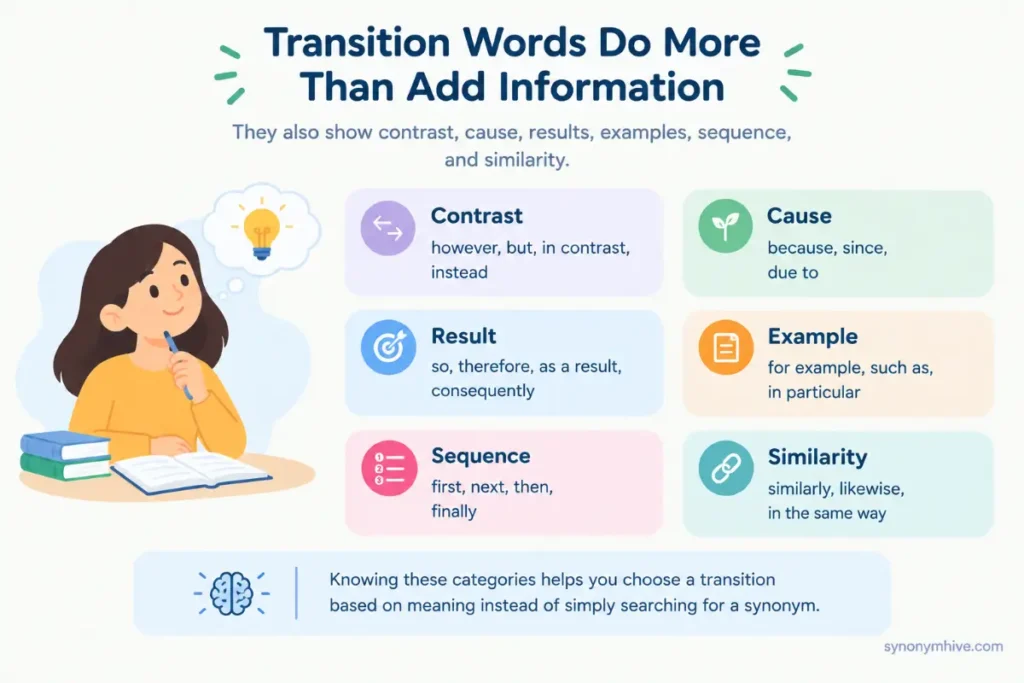
Adding information is only one job that transition words can perform. Good writing also uses transitions to show contrast, cause, results, examples, sequence, and similarity.
For contrast, use however, but, in contrast, and instead.
For cause, use because, since, and due to.
Knowing these categories helps you choose a transition based on meaning instead of simply searching for a synonym.
A Simple Rule To Remember
If you’re introducing a stronger point, try more importantly.
If the second idea contrasts with the first, don’t use an addition word at all. Choose however, but, or another contrast transition.
This rule is more useful than memorizing a long list because it helps you choose based on meaning.
Expand your vocabulary with Another Word for Significant Best Alternatives 2026.
Conclusion
Choosing another word for furthermore doesn’t mean finding one replacement and using it everywhere. The strongest choice depends on your audience, tone, and the connection between your ideas.
For simple writing, also is usually the easiest option. Essays and reports often work well with in addition or additionally. Casual messages can use plus, besides, or what’s more, while more importantly can highlight a point that deserves extra attention.
Remember that a transition should clarify your writing, not make it sound more complicated. If two ideas connect naturally without a transition, you can often remove the extra word altogether. Pick the simplest phrase that clearly shows how your ideas fit together.
Frequently Asked Questions
What’s another way to say furthermore?
Another way to say furthermore is also, in addition, additionally, besides, or what’s more. The best choice depends on your tone and the relationship between your ideas.
What is another word for furthermore in an essay?
In addition and additionally are strong choices for an essay. Both add a related point while keeping a formal and clear tone.
Is additionally better than furthermore?
Additionally is not always better than furthermore. Both are formal transition words, but additionally often sounds slightly more neutral and direct.
Can I use also instead of furthermore?
Yes, also can replace furthermore in many sentences. Also usually sounds simpler and more natural, especially in everyday writing.
What can I use instead of furthermore in a resume?
A resume often works best with additionally or no transition at all. Combining related achievements into one concise sentence can make the writing stronger.
Is furthermore too formal for an email?
Furthermore can sound too formal in a casual email, but it can work in a formal business message. For everyday professional email, also or in addition often sounds more natural.
What transition word means the opposite of furthermore?
There isn’t one exact opposite of furthermore, but however, but, in contrast, and instead can show a contrasting or opposing idea. Choose one based on the relationship between the two sentences.