

Writing an essay can get tricky when you notice the same word showing up again and again. If you keep using demonstrates to explain what evidence proves or shows you may start looking for another word for demonstrates that fits your sentence better.
The right replacement can make your writing sound more natural and precise. Words such as shows, proves, reveals, illustrates, displays, indicates, and establishes can all work. The best choice depends on what your sentence is trying to say.
Answer Box: The best replacement depends on the meaning you need. Use shows for simple writing, illustrates for academic writing, proves for strong evidence, and reveals when evidence makes something clear.
This guide covers the meaning and origin of demonstrates along with more than 25 useful alternatives. You’ll also see examples for essays, resumes, emails, texts, and everyday speech. The later sections compare close synonyms so you can choose a word that sounds natural instead of forcing a replacement.
Compare more word options with Another Word for Therefore Best Essay Choices 2026.
another word for demonstrates In Simple English
What does demonstrates mean?
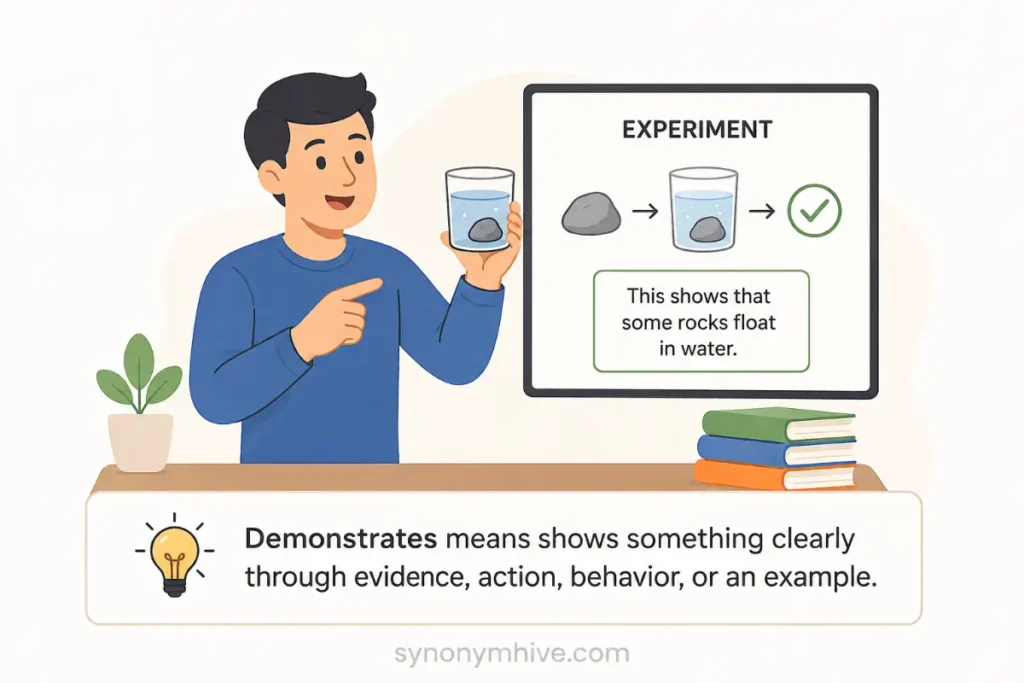
Demonstrates means shows something clearly through evidence, action, behavior, or an example. It can describe a person showing a skill or an action that makes an idea easier to understand.
For example, consider this sentence.
The experiment demonstrates how temperature affects plant growth.
Here, demonstrates means shows clearly. The experiment gives evidence that helps the reader understand the relationship between temperature and plant growth.
Now consider a different example.
Maria demonstrates strong leadership during difficult projects.
In this sentence, demonstrates doesn’t mean that Maria simply talks about leadership. Her actions provide evidence of that quality.
That difference matters. The word can describe both the act of showing something and the evidence that makes something visible or clear.
Where did demonstrates come from?
Demonstrates comes from the verb demonstrate. The word traces back to the Latin word demonstrare. It was formed from ideas connected with pointing out or showing clearly.
English later adopted demonstrate as a formal verb for showing something through evidence or explanation. Over time the word became common in academic writing, professional communication, teaching, science, and everyday speech.
The history explains why the word often sounds more formal than simple alternatives such as shows.
You don’t need to use a formal word just because you’re writing an essay. Good writing depends on accuracy and clarity. A simple word can often make a stronger sentence.
What is the difference between demonstrate and show?
Show is the broadest and simplest choice. Demonstrate usually suggests that something provides clear evidence or makes an idea easier to understand.
Compare these sentences.
The chart shows a rise in sales.
The chart demonstrates a rise in sales.
Both sentences work. The first sounds simple and direct. The second gives the statement a slightly more formal academic tone.
Now consider a skill.
James shows leadership at work.
James demonstrates leadership at work.
The second sentence suggests that James provides clear evidence of leadership through his behavior.
What are the best simple alternatives?
For most everyday situations, shows is the safest replacement. It sounds natural and works in casual and formal writing.
Proves is stronger. Use it only when the evidence supports a firm conclusion.
Reveals works when something becomes known or visible.
Indicates is useful when evidence points toward a conclusion without proving it completely.
Illustrates works well when an example helps explain an idea.
Displays often describes visible behavior, qualities, skills, or results.
Highlights works when you want to draw attention to one important point.
Reflects works when something represents or mirrors a quality, condition, or trend.
Establishes is useful when evidence creates a strong basis for a conclusion.
What are the main synonyms?
The best alternative changes with tone and purpose. Some words sound natural in everyday speech while others fit academic or professional writing better.
| Word | Meaning | Tone | Example |
|---|---|---|---|
| Shows | Makes something clear or visible. | Simple. | The graph shows steady growth. |
| Proves | Gives enough evidence to support a firm conclusion. | Strong. | The test proves the method works. |
| Reveals | Makes hidden or unknown information clear. | Neutral. | The report reveals a major problem. |
| Indicates | Points toward a fact or conclusion. | Formal. | The data indicates higher demand. |
| Illustrates | Makes an idea clear through an example. | Academic. | The example illustrates the main point. |
| Displays | Shows a quality or behavior openly. | Neutral. | The student displays strong focus. |
| Highlights | Draws attention to something important. | Professional. | The study highlights a key concern. |
| Reflects | Represents or mirrors something. | Neutral. | Her response reflects confidence. |
| Conveys | Communicates an idea or feeling. | Formal. | Her tone conveys confidence. |
| Portrays | Presents someone or something in a certain way. | Neutral. | The novel portrays courage clearly. |
| Depicts | Represents something through words or images. | Formal. | The painting depicts village life. |
| Reflects | Shows a condition or quality indirectly. | Everyday. | The result reflects careful planning. |
| Demonstrates | Shows something through evidence or action. | Formal. | The study demonstrates a clear pattern. |
| Makes clear | Removes confusion about an idea. | Simple. | The example makes the concept clear. |
| Brings out | Makes a quality easier to notice. | Everyday. | The exercise brings out her creativity. |
| Lays out | Presents information in an organized way. | Casual. | The report lays out the main findings. |
| Shows off | Displays a skill or quality in a noticeable way. | Casual. | He shows off his design skills. |
another word for demonstrates By Strength
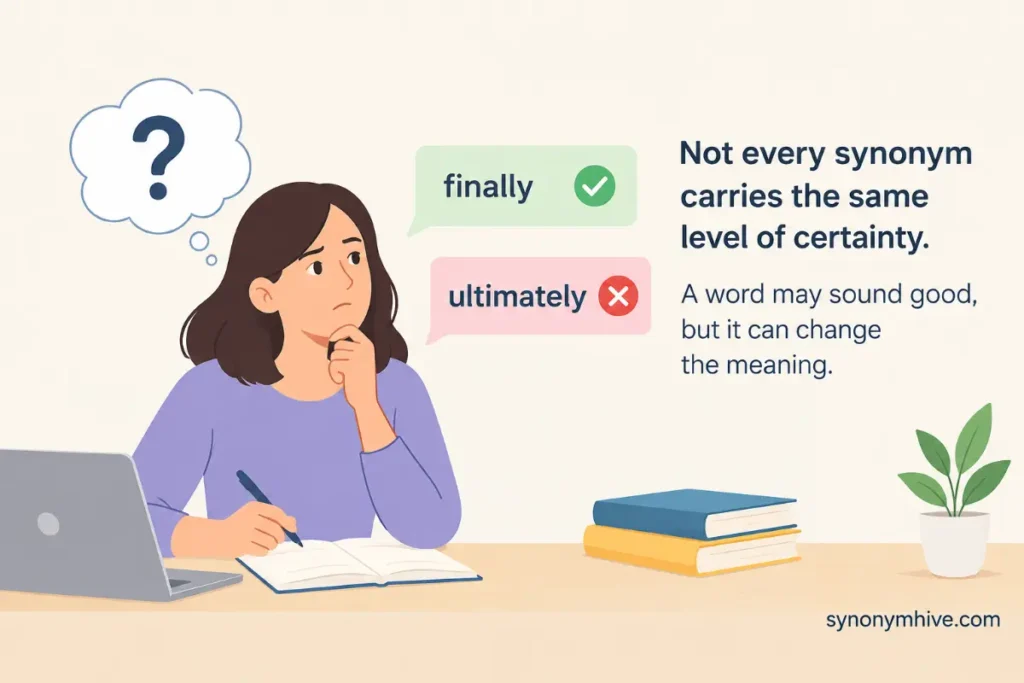
Not every synonym carries the same level of certainty. This is one of the biggest mistakes writers make when replacing a word. They choose a word that sounds good but changes the meaning.
Which alternatives are mild?
Use suggests, indicates, signals, and points to when evidence gives you a clue but doesn’t establish a definite fact.
For example.
The survey suggests that customers prefer shorter delivery times.
The survey indicates growing interest in the product.
The numbers signal a change in buying habits.
These words leave room for further evidence. That’s useful in research writing because good evidence doesn’t always support an absolute conclusion.
Which alternatives are moderate?
Use shows, reflects, illustrates, highlights, and displays when the evidence makes something reasonably clear.
For example.
The chart shows a steady increase in attendance.
The case study illustrates the value of preparation.
Her actions display strong judgment.
These choices work well because they sound confident without overstating the evidence.
Which alternatives are strong?
Use proves, confirms, establishes, and demonstrates when the evidence is strong enough to support a firm conclusion.
For example.
The repeated tests confirm the original result.
The evidence establishes a clear connection between the two events.
The experiment proves that the device can operate under the tested conditions.
Be careful with proves. Academic writing often requires careful claims. An experiment may support a conclusion without proving a universal truth.
Which alternatives work for the strongest claims?
Establishes can sound very strong in academic and professional writing. It suggests that the evidence provides a firm foundation.
Confirms works best when something was already expected or proposed.
Proves makes the strongest claim and should be used only when the evidence truly supports certainty.
Exemplifies is different. It doesn’t mean proves. It means something serves as a strong example of a particular quality or idea.
That distinction can save you from a weak sentence that sounds stronger than the evidence allows.
How does part of speech affect the choice?
Demonstrates is a verb. Most direct alternatives are also verbs.
Shows is a verb.
Illustrates is a verb.
Reveals is a verb.
Indicates is a verb.
Confirms is a verb.
Establishes is a verb.
You can also change the sentence structure and use nouns or adjectives.
For example.
The study provides evidence of improved performance.
The results offer clear support for the claim.
The findings are clear evidence of progress.
This approach can make your writing less repetitive. Instead of replacing one verb with another every time, you can reshape the sentence.
Can you use these words in academic writing?
Yes. Academic writing benefits from precise verbs. The strongest choice depends on the evidence.
Use illustrates when an example explains an idea.
Use indicates when evidence points toward a conclusion.
Avoid choosing a word simply because it sounds more academic. Clear writing beats complicated writing.
synonyms for demonstrates In Different Contexts
What should you use on a resume?
On a resume, shows, displays, demonstrates, delivers, achieves, and reflects can work depending on the sentence.
For professional writing, demonstrates is useful when you want to connect an action with a skill.
Example.
The project demonstrates strong problem solving and leadership skills.
A more active version can often sound better.
Led a team of six employees through a major process improvement project.
The second sentence gives the reader evidence instead of simply naming the skill.
What should you use in an essay?
For an essay, illustrates, shows, indicates, reveals, and supports are strong choices.
Example.
The character’s decision illustrates the pressure created by social expectations.
Another example.
The survey results indicate that access to education affects career choices.
These verbs help you explain the relationship between evidence and your argument.
What should you use in a text?
Text messages usually sound better with simple words. Shows, proves, means, makes clear, and points to are natural choices.
Example.
That picture really shows how much the place has changed.
You wouldn’t normally need a formal replacement in a casual text. Simple language keeps the message easy to read.
What should you use in an email?
For a professional email, shows, indicates, confirms, and highlights usually work well.
Example.
The latest report highlights three areas that need attention.
Another example.
The updated figures indicate that we need more time.
These choices sound professional without making the email feel stiff.
What should you use when speaking?
In conversation, shows is usually the most natural option.
Example.
That really shows how much you’ve improved.
You can also say proves when the evidence is strong.
Example.
That proves you were right about the problem.
Formal choices such as manifests or exemplifies can sound unusual in ordinary conversation. Save them for situations that call for a more formal style.
What should you use for research writing?
Research writing needs careful language. Indicates, suggests, supports, confirms, and establishes are especially useful.
Example.
The findings suggest that sleep quality may affect concentration.
This sentence is careful. It doesn’t claim more than the evidence supports.
What should you use for business writing?
Business writing often benefits from direct verbs. Highlights, shows, indicates, reflects, and confirms work well.
Example.
The quarterly report highlights a rise in customer retention.
Another example.
The latest data confirms strong demand for the service.
Keep the wording direct. Readers shouldn’t need to decode your sentence to understand the point.
What should you use in creative writing?
Creative writing gives you more freedom. Reveals, portrays, depicts, reflects, and expresses can create more depth.
Example.
Her silence reveals more than her words could have.
That sentence does more than say that her silence shows something. Reveals creates a sense of discovery.
What are some original examples?
Good examples help you see how small changes affect meaning. Notice how each verb adds a slightly different shade.
- The research shows a clear connection between exercise and concentration.
- The results indicate that students performed better after receiving extra practice.
- The character’s actions reveal his fear of failure.
- The chart illustrates how quickly prices changed during the year.
- Her response reflects a strong sense of responsibility.
- The experiment confirms the earlier prediction.
- The findings support the writer’s central argument.
- The candidate displays excellent communication skills during interviews.
- The example highlights the importance of careful planning.
- The new evidence establishes a stronger connection between the two events.
- His calm response demonstrates strong leadership during a stressful situation.
- The painting depicts everyday life in a small coastal town.
- The survey suggests that customers want simpler payment options.
- The employee exhibits patience when helping frustrated customers.
- The final chapter reveals why the main character made that decision.
- The data signals a shift in customer preferences.
- The student’s project exemplifies creative problem solving.
- The report presents evidence that supports the proposed change.
- Her actions convey respect for the people around her.
- The results reflect months of careful preparation.
These examples show why synonyms aren’t interchangeable in every situation. A word can be grammatically correct and still be the wrong choice for the meaning.
Discover related words in Another Word for In Conclusion Best Essay Choices 2026.
another word for demonstrates And Close Alternatives
Shows vs illustrates what is different?
Shows is broad and simple. Illustrates is more specific because it often suggests that an example makes an idea easier to understand.
Compare these sentences.
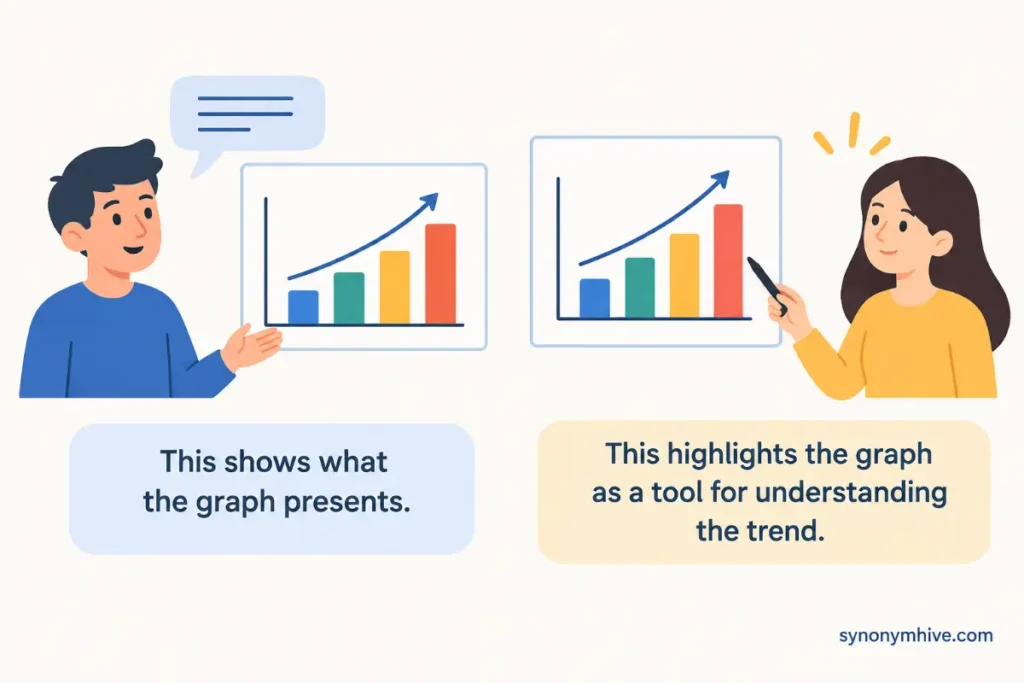
The graph shows a decline in sales.
The graph illustrates the decline in sales.
Both are correct. Shows simply tells the reader what the graph presents. Illustrates gives more emphasis to the graph as a tool for understanding the trend.
Use shows when you want plain and direct language. Use illustrates when an example or visual helps explain a larger idea.
Indicates vs proves what is different?
Indicates means the evidence points toward a conclusion. Proves makes a much stronger claim.
Compare these examples.
The results indicate that the treatment may improve recovery.
The results prove that the treatment improves recovery.
The second sentence is much more certain. If the evidence doesn’t support that level of certainty, proves can make your writing inaccurate.
Indicates is often safer for research and analytical writing. Proves works best when the evidence genuinely establishes the claim.
Reveals vs shows what is different?
Shows is neutral. Reveals often suggests that something wasn’t obvious before.
For example.
The report shows several problems.
The report reveals several problems.
The second sentence creates a stronger sense that the report brought hidden or overlooked problems to light.
Use reveals when discovery matters. Use shows when you simply want to present information.
Confirms vs establishes what is different?
Confirms usually connects to an existing expectation, belief, or prediction.
Establishes suggests that evidence creates a firm basis for a conclusion.
For example.
The test confirms our original prediction.
The test establishes a clear relationship between the two variables.
The first sentence points backward to something already proposed. The second focuses on creating a strong foundation for a conclusion.
Displays vs exhibits what is different?
Displays and exhibits both work for visible qualities. Exhibits often has a more formal tone.
For example.
The employee displays strong attention to detail.
The employee exhibits strong attention to detail.
Both sentences work. Displays is usually easier and more natural for a broad audience.
Shows vs exemplifies what is different?
Shows simply presents or makes something clear. Exemplifies means something serves as a strong example of a larger idea.
For example.
The project shows creativity.
The project exemplifies creative problem solving.
The second sentence makes a bigger claim. It says the project is an example of what creative problem solving looks like.
Use exemplifies carefully. It works best when the example genuinely represents the quality you are discussing.
Are there US and UK differences?
There is no major difference in the meaning or use of demonstrates between American and British English. The verb is standard in both varieties.
Some related spelling differences can appear in connected words. For example, American English commonly uses organize while British English often uses organise. Those spelling patterns don’t change the meaning of demonstrates.
The main difference you should consider is audience and tone. American professional writing often favors direct and simple wording. British writing can sometimes use more formal vocabulary in academic or professional settings.
Still, clarity matters in both varieties. A strong sentence works because the reader understands it quickly.
Common Mistakes With Demonstrates
When should you avoid demonstrates?
Avoid demonstrates when the sentence sounds simpler with shows or another precise verb.
For example.
The photo demonstrates my vacation.
This sentence sounds awkward because a photo usually shows or captures something.
A better sentence is.
The photo shows the beach at sunset.
Now consider a skill.
She demonstrates excellent communication skills during meetings.
This sentence works because her behavior provides evidence of the skill.
Don’t use proves for weak evidence.
Proves carries a heavy load. Don’t use it just because it sounds powerful.
Weak.
The survey proves that everyone prefers online shopping.
Better.
The survey suggests that many customers prefer online shopping.
The second sentence respects the limits of the evidence.
Don’t use indicates when the evidence is direct.
Indicates can sound too cautious in some situations.
For example.
The photograph indicates that the room is empty.
If the room is plainly visible, shows may be clearer.
The photograph shows that the room is empty.
Good writing matches certainty to evidence.
Don’t choose a synonym only because it sounds formal.
A formal word isn’t automatically a better word.
For example, manifests may sound impressive, but shows may communicate the same idea more clearly for a general audience.
The goal isn’t to make a sentence sound complicated. The goal is to make the meaning easy to understand.
Don’t repeat the same synonym.
Replacing demonstrates with shows in every sentence won’t solve repetition. It simply moves the problem to another word.
Mix your wording based on meaning.
Use illustrates for examples.
Use indicates for clues.
What are the antonyms?
The opposite of demonstrating something is hiding, concealing, obscuring, confusing, masking, or withholding information.
For example.
The evidence reveals the problem.
The opposite idea is.
The evidence hides the problem.
You can also use conceals when someone intentionally keeps information from view.
Obscures works when something makes information difficult to understand or see.
Withholds works when a person chooses not to provide information.
These aren’t always direct grammatical opposites. The best antonym depends on the original meaning.
How can you choose the right synonym?
Start by asking what your sentence actually means.
- If you simply mean shows something, use shows.
- If an example makes an idea easier to understand, use illustrates.
- If something hidden becomes known, use reveals.
- If evidence points toward a conclusion, use indicates.
- If evidence strongly supports a conclusion, use establishes or confirms.
- If the evidence truly creates certainty, use proves.
- If something represents a quality or condition, use reflects.
- If a quality appears through behavior, use displays or exhibits.
- If something draws attention to an important point, use highlights.
- If something serves as a strong example, use exemplifies.
The best synonym is the one that keeps your original meaning while making the sentence sound natural.
What makes a natural sound for another word for demonstrates?
Context matters more than vocabulary level.
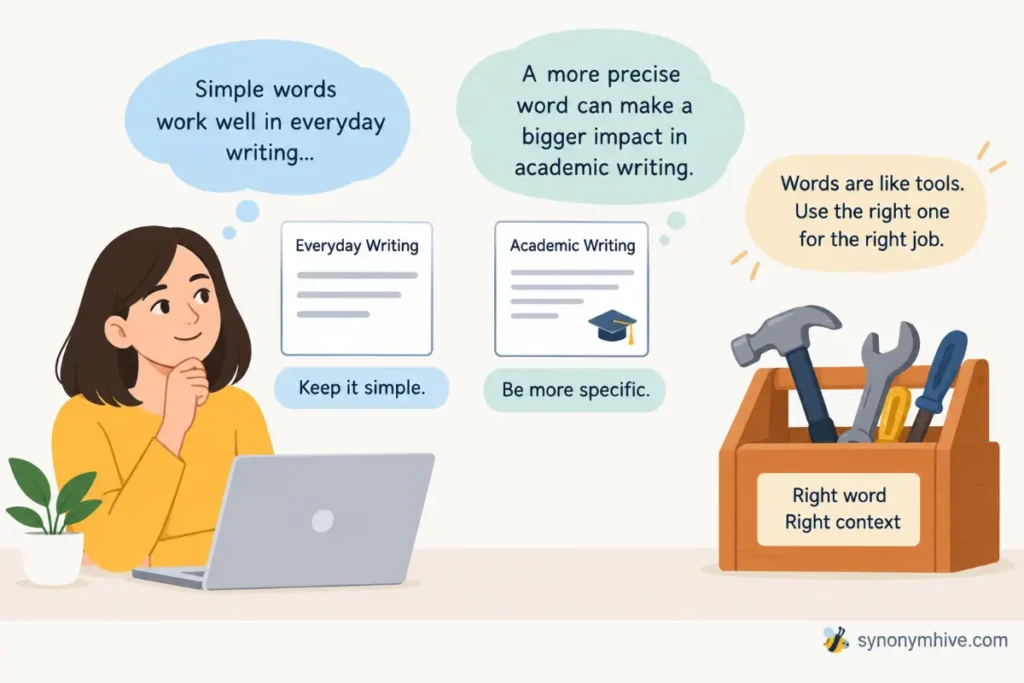
A simple word often wins in everyday writing. A more precise word can work better in academic writing.
Think of synonyms like tools in a toolbox. You wouldn’t use a hammer for every job. The same idea applies to words.
Read the entire sentence after replacing the verb. Ask yourself if the new word changes the strength, tone, or meaning.
If it does, choose another option.
How can you improve your essay style?
Don’t rely on synonyms alone. Improve the sentence itself.
Instead of writing.
The evidence demonstrates that the character is brave.
Try a more specific sentence.
The character risks his safety to protect his younger brother.
The second sentence gives the reader evidence instead of asking the reader to accept a general claim.
Specific details make writing stronger.
The same principle applies to resumes and professional documents. Instead of saying that you demonstrate leadership, describe what you actually did.
For example.
Led a team through a six week process improvement project.
That sentence gives the reader something concrete to evaluate.
What should you remember?
The strongest replacement isn’t always the most advanced word. It is the word that says exactly what you mean.
Shows is usually the safest choice.
Illustrates works well for examples.
Indicates works for evidence that points toward a conclusion.
Reveals works for information that becomes clear.
Supports works for arguments and claims.
Confirms works for findings that match an earlier expectation.
Establishes works for strong evidence.
Proves should be reserved for claims that truly deserve certainty.
Once you understand these differences, choosing the right word becomes much easier.
Expand your vocabulary with Another Word for Explains Best Alternatives 2026.
Conclusion
In the end, good word choice comes down to precision. Don’t replace a word simply to avoid repetition. Replace it because another word expresses the idea more clearly. For essays, another word for demonstrates may be shows, illustrates, indicates, reveals, or establishes depending on the evidence and the point you’re making. Read the sentence aloud and listen for the natural choice. If the replacement sounds forced, go back to the simpler word. Clear writing doesn’t need fancy vocabulary to make a strong impression.
Frequently Asked Questions
What’s another way to say demonstrates?
Good alternatives include shows, illustrates, reveals, indicates, displays, highlights, confirms, supports, and establishes. The best choice depends on the strength and purpose of your sentence.
What is another word for demonstrates in an essay?
Illustrates, indicates, shows, reveals, and supports are useful choices in essays. Pick the word that matches the relationship between your evidence and your claim.
Is shows better than demonstrates?
Shows is often better for simple and direct writing. Demonstrates can sound more formal and can suggest that evidence or action clearly supports an idea.
Is demonstrates a formal word?
Yes, demonstrates has a moderately formal tone and appears often in academic, professional, and analytical writing. It still works in everyday speech when the situation calls for it.
Can I use proves instead of demonstrates?
You can use proves only when the evidence supports a very strong conclusion. Proves is stronger than demonstrates in many contexts and can overstate a claim.
What is the difference between demonstrates and illustrates?
Demonstrates focuses on showing something clearly through evidence or action. Illustrates often focuses on using an example or visual to make an idea easier to understand.
Which word should I use on a resume?
Shows, demonstrates, displays, reflects, and highlights can work on a resume. Specific action verbs are often stronger because they tell the reader what you actually accomplished.