
When you’re finishing an essay, email, report, or discussion post, the last sentence can be harder than it looks. You know your point is clear, but you don’t want to keep writing the same phrase every time. Finding another word for in conclusion can help your ending sound more natural and fit the tone of your writing.
The best alternatives include finally, to sum up, in summary, overall, in closing, and to wrap up. The right choice depends on your purpose, audience, and level of formality.
A strong closing phrase does more than signal that your writing is ending. It helps the reader understand that you’re bringing your main ideas together. In an academic essay, you may need a formal transition. In a text message, you can keep it simple and relaxed.
This guide covers the meaning and origin of the phrase, more than 30 useful alternatives, tone differences, context based choices, examples, common mistakes, and quick tips for choosing the best transition.
Learn more useful word alternatives in another word for demonstrates Best Choices Terms 2026.
What does another word for in conclusion mean
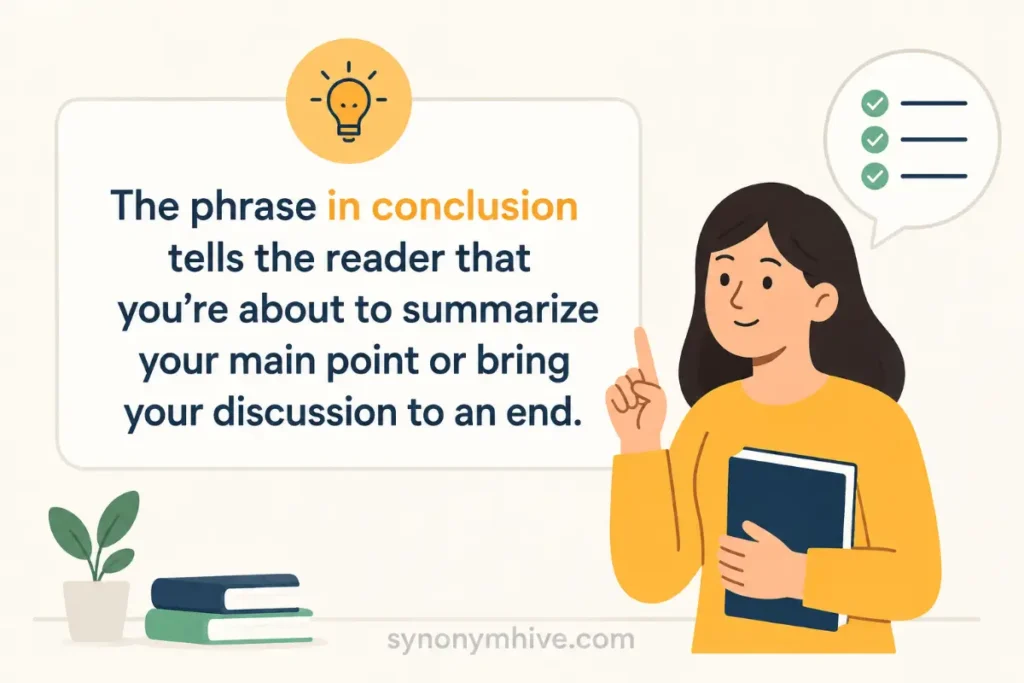
The phrase in conclusion tells the reader that you’re about to summarize your main point or bring your discussion to an end. It often appears at the beginning of a final paragraph.
For example.
In conclusion, regular exercise can improve both physical health and mental well being.
The phrase works well, but it can become repetitive. If you use it in every essay or report, your writing may start to sound predictable. That’s why writers often look for alternatives that express the same basic idea with a different tone.
The closest alternatives include phrases such as finally, in summary, to sum up, overall, in closing, and to conclude. Some are almost interchangeable. Others carry a slightly different feeling.
The important point is that an alternative should match the job your sentence needs to do. A formal research paper calls for a different ending than a casual text.
Where did in conclusion come from
The word conclusion comes from the Latin word conclusio. It developed from a Latin verb meaning to shut or close. The basic idea is simple. A conclusion closes a line of thought.
English later adopted conclusion as a word for the final part of an argument, discussion, essay, or written work. The phrase in conclusion grew from that same idea. It tells readers that the writer is closing the discussion and bringing the main ideas together.
This history helps explain why the phrase feels formal. It has long been connected with structured arguments and formal writing.
Today, in conclusion is especially common in school essays, academic writing, reports, speeches, and professional documents. It’s correct, but correct doesn’t always mean it’s the best choice.
A good writer chooses a transition based on purpose rather than habit.
Best alternatives to another phrase for in conclusion
The best alternative depends on how formal your writing needs to sound. Some choices are short and direct. Others sound more academic or polished.
Here is a broad list you can use as a practical reference.
| Word or phrase | Meaning | Tone | Example |
|---|---|---|---|
| Finally | Signals the last point | Simple | Finally, the results support our original idea. |
| In summary | Gives a short summary | Formal | In summary, the plan meets the main goals. |
| To sum up | Brings key ideas together | Everyday | To sum up, the project was worth the effort. |
| Overall | Gives the general result | Neutral | Overall, the experience was positive. |
| In closing | Signals the end | Formal | In closing, we should consider the long term effects. |
| To conclude | Directly signals an ending | Formal | To conclude, the evidence supports this view. |
| In short | Gives the main idea briefly | Simple | In short, the proposal needs more work. |
| In brief | States the point concisely | Formal | In brief, the findings were encouraging. |
| All in all | Gives a final overall judgment | Everyday | All in all, the trip was a success. |
| In the end | States the final result | Everyday | In the end, patience made the difference. |
| Ultimately | Gives the final or most important point | Formal | Ultimately, strong leadership shaped the result. |
| On the whole | Gives a general assessment | Neutral | On the whole, the changes were helpful. |
| To wrap up | Signals a casual ending | Casual | To wrap up, we need three more volunteers. |
| At last | Shows that something has finally ended | Everyday | At last, the long process came to an end. |
| As a final point | Introduces the last idea | Formal | As a final point, cost should be considered. |
| As a result | Shows the final outcome | Neutral | As a result, the team changed its strategy. |
| Therefore | Shows a logical result | Formal | Therefore, the original plan should be revised. |
| Thus | Shows a logical conclusion | Formal | Thus, the evidence points to one clear answer. |
| Hence | Shows a result | Formal | Hence, the policy needs further review. |
| In essence | States the core idea | Formal | In essence, the issue comes down to trust. |
| Taken together | Combines several ideas | Formal | Taken together, the findings support the theory. |
| Considering everything | Gives an overall view | Everyday | Considering everything, the decision was sensible. |
| When all is said and done | Gives a final judgment | Conversational | When all is said and done, family matters most. |
| In the final analysis | Gives a deeper final judgment | Formal | In the final analysis, preparation made the difference. |
| To bring it all together | Connects the main ideas | Conversational | To bring it all together, each step supports the goal. |
| As we have seen | Refers back to earlier evidence | Formal | As we have seen, the data tells a clear story. |
| Looking at the whole picture | Gives a broad view | Conversational | Looking at the whole picture, the benefits outweigh the costs. |
| The bottom line | States the most important result | Casual | The bottom line is that the plan works. |
| In final terms | Gives a final assessment | Formal | In final terms, the change improved efficiency. |
| To put it simply | Restates the main idea clearly | Everyday | To put it simply, the system needs better support. |
| In a nutshell | Gives a very short summary | Casual | In a nutshell, the idea saves time and money. |
| By and large | Gives a broad judgment | Neutral | By and large, the response was positive. |
| All things considered | Weighs several factors | Formal | All things considered, the decision was reasonable. |
Not every phrase in this table can replace in conclusion in every sentence. That distinction matters.
For example, therefore usually shows a result rather than simply announcing the final paragraph. Likewise, finally can introduce the last point in an argument instead of summarizing the entire discussion.
So, when searching for another term for in conclusion, think about the meaning first and the word second.
Which alternatives sound simple and natural
Simple alternatives are often the strongest choices because readers understand them instantly.
Finally is useful when you’re presenting several points and reaching the last one.
In short works well when you want to reduce a longer discussion to one central idea.
Overall gives a broad judgment without sounding overly formal.
To sum up directly tells the reader that you’re bringing your main points together.
In the end works well when you’re talking about a final result or outcome.
For example.
Overall, the new study shows that students benefit from regular reading.
To sum up, good communication starts with listening.
In the end, the team found a solution that worked for everyone.
These options sound natural in everyday writing. They also work well in many school assignments.
Which alternatives sound formal
Academic and professional writing often needs a more controlled tone. In that setting, formal transitions can make your conclusion feel more polished.
Strong formal choices include to conclude, in summary, in closing, ultimately, in brief, in essence, taken together, and in the final analysis.
For example.
To conclude, the evidence supports the need for further research.
In summary, the findings show a clear connection between sleep and academic performance.
Taken together, these results suggest that the current policy needs revision.
Ultimately, the success of the program depends on consistent participation.
These phrases are useful when your reader expects serious and structured writing.
Still, formal doesn’t mean complicated. A simple phrase that clearly connects your ideas is often better than a fancy expression that feels forced.
Which alternatives work in casual writing
Casual writing gives you more freedom. You don’t need to sound like a textbook.
Good choices include to wrap up, all in all, in a nutshell, the bottom line, in the end, and when all is said and done.
For example.
To wrap up, we just need to finish the last two tasks.
All in all, it was a great weekend.
In a nutshell, the plan saves us time.
The bottom line is that we need more practice.
These choices can work in texts, casual emails, social posts, conversations, and informal messages.
The trick is to avoid using a casual phrase in a setting that expects academic language.
How strong should your conclusion sound
Not every conclusion needs the same level of force. Your transition can quietly close the discussion or strongly emphasize the final point.
Mild choices include overall, in short, in brief, and to sum up. They simply tell the reader that you’re wrapping up.
Medium strength choices include ultimately, in the end, all in all, and all things considered. They suggest that you’ve considered several points before reaching a final view.
Strong choices include the bottom line, in the final analysis, and ultimately when used to emphasize a decisive result.
For example.
Overall, the proposal has several benefits.
All things considered, the proposal is worth supporting.
Ultimately, the proposal offers the most practical solution.
Each sentence reaches an ending, but the strength changes.
This is one reason there isn’t a single perfect answer when you need another term for in conclusion. Your choice should reflect how strongly you want to close the discussion.
What part of speech should you use
Most alternatives to in conclusion are transition phrases rather than simple replacement words.
Overall can work as a sentence adverb.
For example.
Overall, the results were positive.
Ultimately can also work as a sentence adverb.
For example.
Ultimately, the decision belongs to the board.
Finally often works as a transition.
For example.
Finally, the researchers reviewed the final results.
Therefore and thus usually connect a cause with a result.
For example.
The evidence was incomplete. Therefore, the researchers requested more data.
This difference is important. You can’t always replace in conclusion with any transition that sounds like an ending.
A conclusion transition should match the relationship between your final ideas.
Another word for in conclusion in an essay
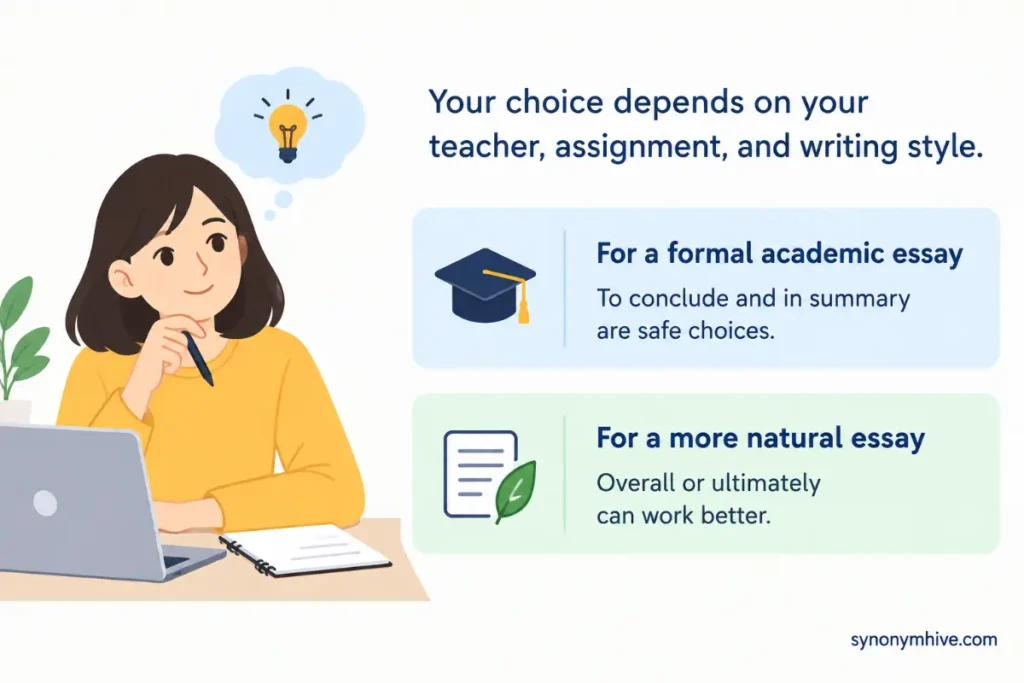
For an essay, the strongest choices are usually in summary, to conclude, overall, ultimately, in closing, and to sum up.
Your choice depends on your teacher, assignment, and writing style.
For a more natural essay, overall or ultimately can work better.
For example.
Overall, the evidence shows that public transportation can reduce traffic and improve access to jobs.
To conclude, the study demonstrates the importance of early childhood education.
Ultimately, the success of the policy depends on how well communities put it into practice.
Try not to begin every final paragraph with the same transition. Your reader already knows that the essay is ending.
A strong conclusion should also add value. Don’t simply repeat every point from the body. Pull the ideas together and leave the reader with a clear final thought.
Another phrase for in conclusion in a resume
A resume usually doesn’t need a conclusion transition at all.
This is an important distinction. Resume writing is different from essay writing. Hiring managers generally want concise evidence of skills, experience, achievements, and results.
Instead of writing a paragraph that starts with in conclusion, use a strong final statement in your professional summary or cover letter.
For example.
Overall, my experience in customer service has helped me build strong communication and problem solving skills.
In a cover letter, a closing transition can work, but keep it professional.
For example.
Ultimately, I believe my project management experience and communication skills would allow me to contribute effectively to the team.
Avoid phrases such as in a nutshell or to wrap up in formal application materials. They may sound too casual.
Another expression for in conclusion in an email
The best choice in an email depends on the relationship with the reader.
For a professional email, use in summary, overall, to conclude, or finally.
For example.
In summary, we need approval before Friday so the project can stay on schedule.
For a friendly workplace email, overall or finally may sound more natural.
For example.
Overall, I think the updated plan will work well for the team.
For a casual email, you can simply write to wrap up.
For example.
To wrap up, I’ll send the final details tonight.
In many emails, you don’t need a conclusion phrase at all. A direct final sentence can sound cleaner.
For example.
Please send your feedback by Friday so we can move forward.
That sentence closes the message without announcing the ending.
Another phrase for in conclusion in a text
Texting calls for short and natural language.
Good options include in short, basically, in the end, all in all, and the bottom line.
For example.
In short, I’m free after six.
Basically, we need more time.
In the end, everything worked out.
The bottom line is that we should wait.
You can also skip the transition completely.
For example.
I think we should wait until tomorrow.
That sounds natural because texting usually doesn’t need formal structure.
Explore another synonym guide: Another Word for Therefore Best Essay Choices 2026.
Another term for in conclusion when speaking
Spoken English often favors natural phrases over formal academic transitions.
Good choices include so, basically, in short, to sum up, and finally.
For example.
So, the main point is that we need to plan ahead.
To sum up, we need better communication between the two teams.
Basically, the project worked because everyone knew their role.
In a speech, repetition can help listeners follow your structure. Still, keep your final transition short so your closing message gets the attention.
A speech ending should sound spoken rather than written.
Which phrase works best in academic writing
Academic writing needs precision. The transition should show the reader how your final statement connects to the evidence.
In summary is a strong choice when you’re reviewing the main findings.
To conclude works when you’re directly closing an argument.
Ultimately works well when your final point identifies the most important result.
Taken together works when several pieces of evidence lead to one larger conclusion.
In the final analysis works best for a deeper judgment after considering multiple factors.
For example.
Taken together, the findings suggest that early intervention can improve long term outcomes.
That sentence does more than announce the end. It shows that several findings have been considered as one group.
This is a key part of strong academic writing. A transition should guide the reader instead of simply decorating the paragraph.
How do these close synonyms differ
Several conclusion phrases look similar but don’t mean exactly the same thing.
In summary vs To conclude
In summary focuses on reviewing the main ideas.
To conclude focuses more directly on ending the discussion.
For example.
In summary, the study found three major benefits.
To conclude, these findings support the use of the new method.
The first phrase points backward toward the information you covered. The second points forward toward your final judgment.
Overall vs Ultimately
Overall gives a broad assessment.
Ultimately emphasizes the final or most important result.
For example.
Overall, the event was successful.
Ultimately, the event succeeded because the organizers planned carefully.
Overall gives the big picture. Ultimately gives greater weight to the final reason or result.
Finally vs In the end
Finally often introduces the last item or stage.
In the end usually refers to the final outcome.
For example.
Finally, the committee reviewed the budget.
In the end, the committee approved the proposal.
This small difference can make your writing more precise.
To sum up vs In a nutshell
Both phrases shorten a discussion.
To sum up sounds neutral and works in many settings.
In a nutshell sounds casual and conversational.
For example.
To sum up, the research supports the original claim.
In a nutshell, the plan works.
Use the second option mainly when the situation is relaxed.
What should you avoid when choosing a conclusion phrase
Some transitions can weaken your writing when you use them at the wrong time.
The first mistake is repeating the same phrase in every essay. Even a correct transition can become stale through overuse.
The second mistake is using a formal phrase in casual writing. A text that says in the final analysis may sound unnecessarily serious.
The third mistake is using a result word when you only want to summarize. Therefore shows a logical result. It isn’t always a direct replacement for in conclusion.
The fourth mistake is adding a conclusion phrase to every paragraph. Most body paragraphs don’t need one.
The fifth mistake is using a conclusion transition and then introducing a completely new major argument. A conclusion should bring the discussion together rather than open another chapter.
The sixth mistake is writing a conclusion that only repeats the introduction. Your ending should give the reader a sense of completion and final insight.
When should you not use a conclusion transition
Sometimes the best transition is no transition.
If your final sentence clearly closes the argument, adding in conclusion may feel unnecessary.
For example.
Regular reading builds vocabulary, improves comprehension, and gives students stronger communication skills.
That sentence already feels final.
Adding a phrase can make it heavier.
In conclusion, regular reading builds vocabulary, improves comprehension, and gives students stronger communication skills.
The second version isn’t wrong. It’s simply more explicit.
Modern writing often benefits from directness. If the reader can see that you’re concluding, you don’t always need to announce it.
This matters especially in short emails, professional messages, and concise essays.
More examples of conclusion transitions
The best way to understand these phrases is to see them in real situations.
- Finally, the team agreed on a schedule that everyone could follow.
- In summary, the survey shows that most customers prefer the new design.
- Overall, the training program helped employees feel more confident.
- To sum up, the proposal offers a practical solution to the problem.
- Ultimately, preparation made the biggest difference.
- In closing, I’d like to thank everyone who contributed to the project.
- In short, the company needs a clearer communication plan.
- All in all, the conference was informative and well organized.
- In the end, the students learned more from the project than they expected.
- Taken together, the results support the need for additional research.
- In essence, the argument comes down to one simple point.
- All things considered, moving forward with the plan is the safest option.
- To wrap up, we need to review the final budget before Friday.
- The bottom line is that the team needs more time.
- In a nutshell, the new process saves both time and money.
- Therefore, the school should consider expanding the program.
- Thus, the evidence supports the original conclusion.
- Hence, the organization decided to revise its policy.
- As we have seen, small changes can produce meaningful results.
- When all is said and done, strong preparation creates better outcomes.
Notice how the phrases perform slightly different jobs. Some summarize. Some show results.
How do you choose the right Another Word for In Conclusion
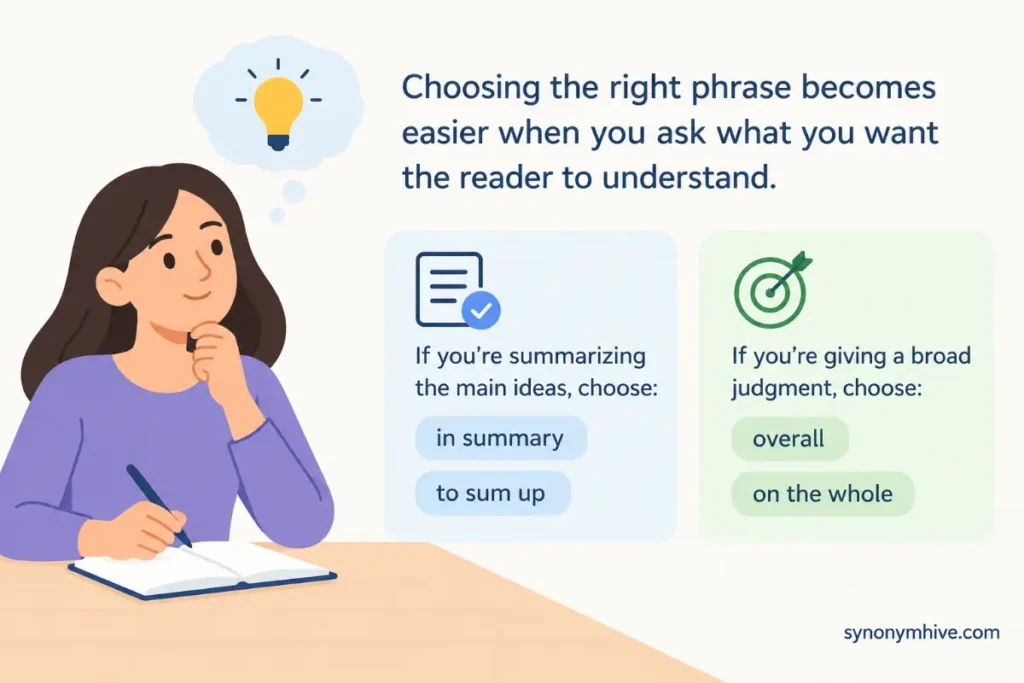
Choosing the right phrase becomes easier when you ask what you want the reader to understand.
If you’re summarizing the main ideas, choose in summary or to sum up.
If you’re giving a broad judgment, choose overall or on the whole.
Think of transitions like road signs. They help readers understand where your argument is going. The best sign is the one that gives exactly the information the reader needs.
US and UK usage notes
There’s no major difference between American and British English for the main conclusion transitions discussed here.
American and British writers both commonly use in conclusion, in summary, finally, overall, ultimately, to conclude, and in the end.
The larger difference usually comes from style and audience rather than region.
Academic writing in both varieties favors clear and controlled transitions. Casual writing in both varieties allows more conversational choices.
Some words may have different spelling patterns in US and UK English, but the conclusion phrases themselves generally remain the same.
So you don’t need a separate American replacement just because your audience is in the United States.
Focus instead on clarity, formality, and purpose.
Antonyms for conclusion language
Conclusion words signal an ending. Their opposite ideas usually involve beginning, continuation, or expansion.
Common opposite concepts include beginning, opening, introduction, start, continuation, development, and discussion.
For example.
To begin, the study examines three major factors.
Next, the researchers compare the results.
The discussion continues with a review of the financial data.
These words move the reader into the discussion rather than out of it.
Understanding the opposite direction can help you choose transitions more accurately. Beginning transitions open an idea. Conclusion transitions close or summarize it.
How to make conclusion transitions sound natural
A good transition should fit the sentence around it.
Don’t choose a phrase just because it sounds impressive. Choose the phrase that makes the relationship between your ideas clear.
Compare these examples.
Ultimately, the evidence supports the proposed change.
In a nutshell, the evidence supports the proposed change.
Both are grammatically correct. The first sounds formal. The second sounds casual.
Now compare these.
Therefore, the city should improve public transportation.
In conclusion, the city should improve public transportation.
The first shows that the recommendation follows from earlier evidence. The second simply announces a final point.
That difference may seem small, but it can make writing much sharper.
A quick guide for every writing situation
If you’re writing an essay, use in summary, to conclude, overall, or ultimately.
If you’re writing a research paper, use in summary, taken together, ultimately, or in the final analysis.
The best another term for in conclusion choice changes with the situation. That’s why memorizing one replacement isn’t enough.
Why variety improves your writing
Using different transitions doesn’t mean you should replace every instance of in conclusion.
The goal is natural variety.
If an essay has five sections and every section uses the same transition, the pattern becomes obvious. A reader may start noticing the wording instead of focusing on the ideas.
Instead, choose transitions based on meaning.
Use finally for the last point.
Use to sum up for a friendly summary.
This approach gives your writing more rhythm without forcing unnecessary synonyms into every paragraph.
Good writing isn’t a thesaurus contest. It’s about choosing the right word at the right moment.
Find more synonyms in Another Word for However Best Alternatives 2026.
Conclusion
Choosing another word for in conclusion isn’t just about finding a synonym. It’s about finding a transition that matches your message.
For formal essays, in summary and to conclude are dependable choices. For a broader judgment, overall works well. When you want to stress the final result, ultimately is stronger. For casual writing, in short, all in all, and in the end feel more natural.
The biggest improvement comes from matching the transition to the idea that follows it. Don’t use therefore simply because it sounds formal. Don’t use in a nutshell in an academic paper just to avoid repetition. Let the meaning guide the choice.
A strong conclusion should feel like the final piece of a puzzle. It brings the ideas together without making the reader work for the point.
Frequently Asked Questions
What is another term for in conclusion?
Common alternatives include finally, in summary, to conclude, overall, ultimately, in closing, and to sum up. The best option depends on your tone and purpose.
What is a good alternative to in conclusion for an essay?
In summary, to conclude, overall, and ultimately are strong choices for essays. In summary works especially well when you’re reviewing the main ideas.
What can I say instead of in conclusion in academic writing?
You can use in summary, to conclude, in closing, ultimately, or taken together. Choose the phrase that matches the relationship between your final ideas.
What’s another way to say in conclusion?
Another way to say it includes to sum up, in short, overall, finally, in the end, or ultimately. Formal writing usually benefits from choices such as in summary or to conclude.
Can I use therefore instead of in conclusion?
You can use therefore when your final statement follows logically from the information before it. It signals a result rather than simply announcing the end.
Is in conclusion too formal for everyday writing?
In conclusion can sound formal in everyday writing. For casual situations, phrases such as in short, all in all, basically, or in the end often sound more natural.
Should I use in conclusion in every essay?
You don’t need to use it in every essay. A varied transition or a direct final sentence can make your writing feel more natural and less repetitive.