
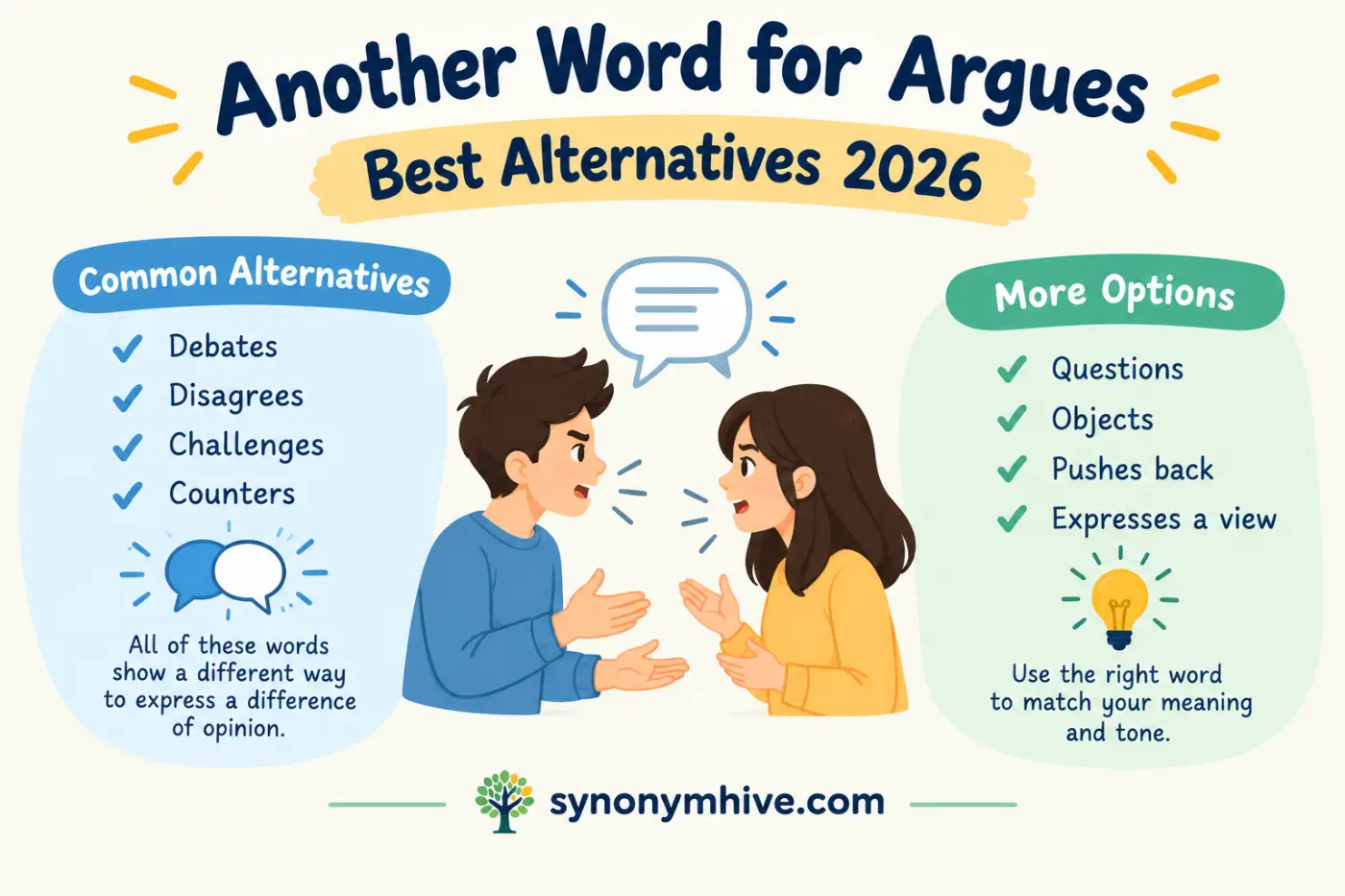
When you’re writing an essay, email, resume, or text, you may notice that another word for argues can make your sentence more precise. The word argues often describes a writer or speaker who presents a position and gives reasons or evidence to support it.
The best replacement depends on the kind of claim being made. You might use claims for a direct position, asserts for a confident statement, maintains for a position someone continues to support, or contends for a formal disagreement. In academic writing, demonstrates, supports, and advocates can also work when the context fits.
Answer Box: Another word for argues is claims, asserts, contends, maintains, states, supports, or advocates. The strongest choice depends on the speaker’s purpose, level of confidence, and use of evidence.
This guide covers the origin and meaning of argues, more than 30 useful alternatives, differences in tone and strength, and the best choices for essays, resumes, emails, texts, and speech. You’ll also find examples, common mistakes, antonyms, and quick tips for choosing the right word.
Expand your vocabulary with Another Word for In Conclusion Best Essay Choices 2026.
What Does Argues Mean
Argues means presents reasons or evidence to support an idea, opinion, position, or conclusion. It can also mean disagrees with someone or tries to persuade another person during a discussion.
In academic writing, argues usually has a more specific meaning. If a paper says, “The author argues that public transportation reduces traffic,” it means the author presents a position and supports it with reasoning or evidence.
The word doesn’t always suggest an angry disagreement. That’s an important point. A person can argue calmly in an essay, research paper, presentation, or professional discussion.
For example, “The researcher argues that the policy needs revision” doesn’t mean the researcher is fighting with someone. It means the researcher takes a clear position and gives reasons for it.
In casual conversation, however, argues can describe a disagreement.
“John argues with his brother about money.”
Here, argues means disagrees or fights verbally.
The surrounding context determines the intended meaning.
Where Does Argues Come From
Argues comes from the verb argue, which entered English through Anglo French from Latin arguere. The Latin word carried meanings related to making something clear, proving, accusing, or demonstrating.
Over time, argue developed several connected meanings in English. It can involve presenting reasons to support a position, trying to persuade someone, or engaging in a disagreement.
That history helps explain why argues has more than one use today. In an academic essay, it often refers to reasoning and persuasion. In everyday conversation, it can refer to conflict.
This distinction matters when choosing a synonym. A word such as contends usually fits formal argumentation. A word such as quarrels suggests personal conflict.
What Is Another Word for Argues
| Word | Meaning | Tone | Example |
|---|---|---|---|
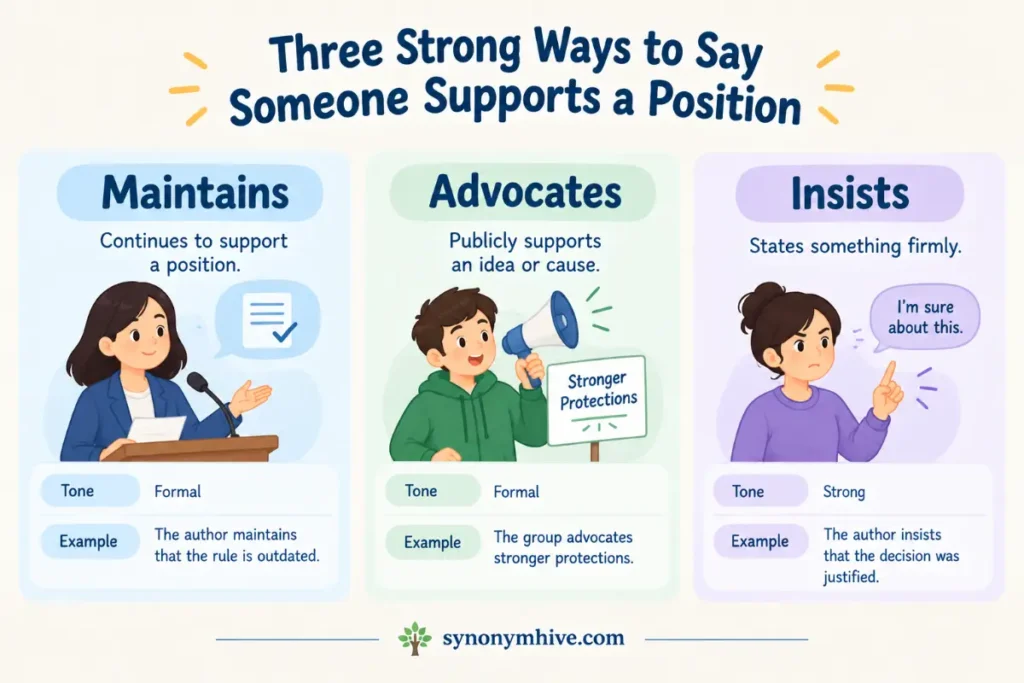
| Maintains | Continues to support a position | Formal | The author maintains that the rule is outdated. |
| Advocates | Publicly supports an idea or cause | Formal | The group advocates stronger protections. |
| Insists | States something firmly | Strong | The author insists that the decision was justified. |
| Emphasizes | Gives special importance to an idea | Neutral | The report emphasizes the need for reform. |
| Affirms | States that something is true or valid | Formal | The study affirms the value of early education. |
| Posits | Puts forward an idea for consideration | Academic | The paper posits a connection between stress and sleep. |
| Urges | Strongly encourages an action | Strong | The report urges leaders to act quickly. |
| Pleads | Makes an emotional or urgent request | Emotional | The speaker pleads for greater support. |
| Reasons with | Uses logic to persuade someone | Conversational | She reasons with her son about the decision. |
| Debates | Discusses opposing ideas | Neutral | The students debate the proposed rule. |
| Challenges | Questions an existing belief or claim | Strong | The study challenges the traditional view. |
| Questions | Expresses doubt about an idea | Neutral | The article questions the current approach. |
| Disputes | Says that a claim is incorrect | Formal | The researcher disputes the earlier conclusion. |
| Counters | Responds with an opposing point | Formal | The writer counters the criticism with new evidence. |
| Rebuts | Directly argues against a claim | Formal | The paper rebuts the earlier argument. |
| Refutes | Shows that a claim is wrong | Strong | The evidence refutes the original theory. |
| Opposes | Takes a position against something | Neutral | The organization opposes the proposed law. |
| Objects | Expresses disagreement or disapproval | Formal | The committee objects to the proposal. |
| Criticizes | Points out faults or weaknesses | Neutral | The article criticizes the current system. |
| Contests | Challenges the truth or validity of something | Formal | The researcher contests the earlier findings. |
| Argues for | Gives reasons supporting something | Neutral | The author argues for stricter regulations. |
| Argues against | Gives reasons opposing something | Neutral | The writer argues against the proposed change. |
| Endorses | Publicly supports an idea or position | Formal | The organization endorses the recommendation. |
Which Alternatives Are Simple And Everyday
Simple words often make writing easier to understand. You don’t need a formal synonym every time you mention someone’s position.
Says is the simplest option. It works when you only need to report what someone stated.
Claims is useful when someone presents something as true. It can sound neutral, but in some contexts it can also suggest that the claim still needs proof.
Believes focuses on a person’s opinion or view.
Suggests is useful when the speaker presents an idea without making a very strong claim.
Questions works when someone expresses doubt.
Opposes works when someone takes a position against something.
For example, compare these sentences.
“The writer suggests that school uniforms are unnecessary.”
“The writer opposes mandatory school uniforms.”
These sentences aren’t identical. Each one tells readers something slightly different about the writer’s position.
Which Alternatives Sound More Formal
Academic and professional writing often benefits from precise verbs. Contends, maintains, asserts, posits, advocates, disputes, and refutes can work well in formal contexts.
Still, formal doesn’t mean complicated. A word should earn its place in the sentence.
For example, “The researcher contends that the results support the theory” sounds appropriate in academic writing.
“The researcher says that the results support the theory” is simpler but less formal.
On the other hand, “The researcher posits that the results support the theory” sounds more specialized. Posits often introduces an idea or proposition rather than simply reporting a general opinion.
Choose the word that matches the exact action instead of automatically choosing the most advanced sounding term.
How Do Synonyms For Argues Change In Intensity
The alternatives to argues range from mild statements to strong challenges. Understanding this scale can help you avoid overstating an author’s position.
Mild Alternatives
Suggests, believes, says, and states are relatively mild.
They don’t automatically suggest that the speaker is strongly defending a controversial position.
“The study suggests that exercise improves sleep.”
This sentence leaves room for uncertainty.
Moderate Alternatives
Claims, maintains, supports, proposes, and advocates carry more weight.
“The author maintains that the policy should change.”
This suggests a position the author continues to support.
“Researchers propose a new approach.”
This introduces an idea or solution without necessarily presenting it as proven.
Strong Alternatives
Asserts, insists, challenges, disputes, rebuts, and refutes are stronger.
“The evidence refutes the earlier claim.”
That sentence makes a strong statement. It says the evidence shows the earlier claim is wrong.
Don’t use a strong verb unless the evidence or context supports it.
What Part Of Speech Is Argues
Argues is a verb. It is the third person singular present form of argue.
The main forms are argue, argues, argued, and arguing.
For example:
“The author argued for reform.”
“The author is arguing for reform.”
Most synonyms in this guide are also verbs. However, they don’t always follow the same grammar.
You can write:
“The author claims that the policy is unfair.”
“The author maintains that the policy is unfair.”
But some expressions require different structures.
“The organization advocates stronger protections.”
You generally wouldn’t write, “The organization advocates that stronger protections.”
Instead, advocates for or advocates with a noun phrase works better depending on the sentence.
Always check the grammar after replacing a word.
Is There A US And UK Difference
The basic meaning of argues is the same in American and British English. The major difference comes from context and register rather than the meaning of the word.
Words such as argues, claims, contends, maintains, asserts, and disputes work naturally in both varieties.
American academic writing often uses straightforward verbs such as argues, claims, shows, demonstrates, and suggests. British academic writing also uses these forms.
Casual phrases can vary more by region, but there isn’t a major US versus UK difference that requires a different synonym for most general writing.
For US readers, clarity should remain your main goal.
What Is Another Word for Argues In A Resume
On a resume, argues usually isn’t the best verb because resumes focus on actions, skills, and results rather than debate.
Still, you may need a related verb when describing communication, leadership, negotiation, or advocacy.
Advocates, supports, presents, defends, and negotiates can work depending on the task.
For example:
“Advocates for customer needs during contract negotiations.”
“Defends project recommendations with data and research.”
“Supports strategic proposals with financial analysis.”
These sentences show what the person actually did. They also avoid making the resume sound argumentative.
If you need to describe a communication skill, focus on the result. A phrase such as “Presents data backed recommendations to senior leaders” tells the reader more than “Argues for better business decisions.”
What Is Another Term for Argues In An Essay
In an essay, contends, maintains, claims, asserts, demonstrates, supports, and suggests are common choices.
The right word depends on the strength of the author’s position.
Use demonstrates when evidence clearly establishes the point.
Use suggests when the evidence points toward a conclusion without proving it completely.
For example:
“The author contends that public libraries remain essential community spaces.”
This sounds appropriate for an academic essay because it clearly presents the author’s position.
What Is Another Word for Argues In Texting
Texting usually calls for casual language. Says, thinks, believes, disagrees, insists, and points out sound more natural than highly formal terms.
You might write:
“She says we should leave early.”
“He thinks the plan won’t work.”
“She keeps insisting that she was right.”
“He disagrees with the idea.”
These choices fit normal conversation.
A text such as “He contends that we should leave early” sounds unusually formal unless you’re joking or deliberately using academic language.
What Is Another Phrase for Argues In An Email
Professional emails need a balanced tone. Maintains, suggests, proposes, supports, recommends, and notes can often replace argues depending on the situation.
For example:
“The report suggests that we change the current process.”
“The team proposes a revised deadline.”
“The data supports the recommendation.”
“The manager maintains that the current schedule remains workable.”
These choices keep the tone professional without making the message sound hostile.
If you’re describing a disagreement, disagrees, questions, or raises concerns about may be more appropriate than argues.
What Is Another Word for Argues In Speaking
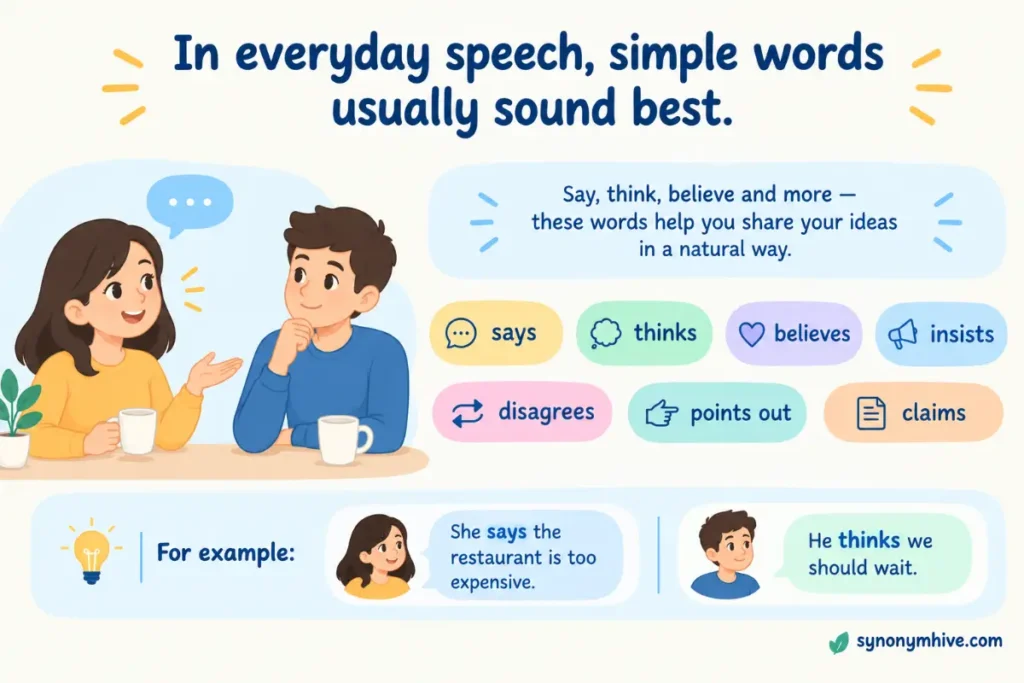
In everyday speech, simple words usually sound best. Says, thinks, believes, insists, disagrees, points out, and claims are common choices.
For example:
“She says the restaurant is too expensive.”
“He thinks we should wait.”
“She insists that she sent the email.”
“He’s arguing against the new plan.”
In spoken English, you can also use phrases such as makes the case for and makes the case against.
For example:
“She made a strong case for changing the schedule.”
That phrase sounds natural and clearly suggests persuasive reasoning.
What Are Some Examples Of Another Term for Argues
The best way to understand these alternatives is to see them in different situations.
- The author claims that the new policy will reduce costs.
- The researcher maintains that the results support the original theory.
- The professor contends that education should focus more on practical skills.
- The report suggests that remote work can improve employee satisfaction.
- The evidence demonstrates that the treatment produced measurable results.
- The organization advocates stronger protections for consumers.
- The writer asserts that the decision was based on incomplete information.
- The article questions the assumption that technology always improves productivity.
- The study challenges the traditional explanation for the trend.
- The researcher disputes the conclusion presented in the earlier report.
- The new evidence refutes the claim that the system is ineffective.
- The author proposes a different approach to solving the problem.
- The report supports the argument for additional funding.
- The speaker defends the decision with several examples.
- The editorial criticizes the proposal for ignoring long term costs.
- The committee opposes the proposed changes to the schedule.
- The paper posits that early education may influence later academic performance.
- The manager recommends a simpler process for handling customer requests.
- The article emphasizes the importance of accurate data.
- The researcher counters the criticism with evidence from a newer study.
These examples show how small changes can sharpen a sentence.
Claims Vs Argues What Is The Difference
Claims means states that something is true. It doesn’t necessarily tell readers how the person supports that position.
Argues usually suggests that the person gives reasons or evidence to support the position.
Compare these examples.
“The author claims that the policy is unfair.”
“The author argues that the policy is unfair because it creates unequal costs.”
The second sentence gives a stronger sense of reasoning.
In academic writing, claims can describe the position itself, while argues can describe the process of building and defending that position.
Contends Vs Argues What Is The Difference
Contends is one of the closest formal alternatives to argues.
Both can introduce a reasoned position. The difference is mainly tone.
Argues is common and neutral. It works across academic, professional, and general writing.
Contends sounds more formal and often suggests a position in a debate or disagreement.
Compare:
“The author argues that the policy should change.”
“The author contends that the policy should change.”
Both sentences work. The second sounds more academic and slightly more forceful.
For most general readers, argues remains clearer. Use contends when the formal tone fits your writing.
Find more synonyms in another word for demonstrates Best Choices Terms 2026.
Asserts Vs Argues What Is The Difference
Asserts usually signals confidence. It means someone states something firmly or confidently.
Argues puts more focus on reasoning.
For example:
“The writer asserts that the policy is ineffective.”
“The writer argues that the policy is ineffective because it increases costs.”
The first sentence emphasizes confidence. The second emphasizes the reasoning behind the conclusion.
If you want to highlight the author’s certainty, asserts can work well. If you want to highlight the logical case, argues may be better.
Suggests Vs Argues What Is The Difference
Suggests is weaker than argues in many academic contexts.
When a writer suggests something, the writer presents it as a possibility or conclusion supported by the available information.
When a writer argues something, the writer usually takes a more definite position and supports it with reasons.
Compare:
“The study suggests that sleep affects memory.”
“The study argues that sleep affects memory.”
The first sentence leaves more room for uncertainty. The second gives the study a stronger argumentative role.
This distinction matters when writing about research. Don’t make a study sound more certain than its evidence allows.
What Are Common Mistakes With Argues Synonyms
One common mistake is treating every synonym as interchangeable. They aren’t.
Claims doesn’t always mean argues. A claim can be presented without detailed reasoning.
Suggests shouldn’t replace argues when the writer takes a strong and direct position.
Refutes should only be used when evidence actually shows that another claim is wrong.
Demonstrates can also be too strong if the evidence merely points toward a conclusion.
Another mistake is using formal words simply to sound intelligent. Words such as posits, explicates, and contends have specific uses. If a simple word communicates the idea more clearly, use it.
Writers also sometimes use debates as a direct replacement for argues. That can change the meaning. Debate usually suggests an exchange between different positions. A single author can argue a point without taking part in a formal debate.
Finally, don’t assume argues always means disagreement. In academic writing, it often means presents and supports a position.
When Should You Not Replace Argues
Sometimes argues is already the best word.
If you’re describing a writer’s reasoning in an academic essay, argues is clear and familiar.
“The author argues that public education needs reform.”
Replacing it with a more complicated word may not improve the sentence.
For example, “The author explicates that public education needs reform” doesn’t work naturally. Explicate means explain or make the meaning of something clear. It isn’t a direct replacement for argues.
Likewise, using refutes would change the meaning. Refutes means proves a claim wrong, not simply presents a position.
The goal is accuracy, not maximum vocabulary variety.
What Are The Antonyms Of Argues
The opposite of argues depends on which meaning you have in mind.
For argumentative writing, possible contrasts include agrees, accepts, concurs, supports, and approves.
If argues means disagrees with someone, agrees, accepts, and concurs can express the opposite.
For example:
“She argues against the proposal.”
“She agrees with the proposal.”
If argues means presents a position, the opposite may involve simply accepting another position rather than challenging it.
What Are The Best Synonyms For Academic Writing
Academic writing needs accuracy more than fancy vocabulary. Some of the strongest choices include argues, contends, maintains, claims, asserts, suggests, demonstrates, supports, proposes, and challenges.
Each one signals a different relationship between the writer and the claim.
Use challenges when the writer questions an established idea.
Use refutes only when the evidence directly shows that another claim is false.
This level of precision makes academic writing stronger without making it harder to read.
What Are The Best Synonyms For Professional Writing
Professional writing usually benefits from words that describe action clearly.
Proposes, recommends, supports, advocates, questions, raises, and defends can work well.
For example:
“The team proposes a revised customer service process.”
“The report recommends reducing unnecessary approval steps.”
“The data supports the proposed budget.”
“The organization advocates better access to training.”
These sentences sound professional because they tell readers what the person or organization is doing.
What Are The Best Synonyms For Persuasive Writing
Persuasive writing often needs stronger verbs.
Advocates, defends, asserts, urges, insists, supports, and makes the case for can communicate persuasion.
For example:
“The editorial advocates stricter rules for misleading advertisements.”
“The report makes the case for expanded public transportation.”
“The campaign urges voters to support the proposal.”
These choices help readers see that the writer isn’t simply sharing information. The writer is trying to influence the audience.
What Are The Best Synonyms For Disagreement
When argues means disagrees, choose a word that clearly signals opposition.
Disputes, challenges, counters, rebuts, refutes, opposes, objects, and criticizes can work.
However, they aren’t equally strong.
Questions can suggest mild doubt.
Challenges suggests a more active disagreement.
Disputes says that someone rejects the accuracy or validity of something.
Refutes is strongest because it suggests the opposing claim has been shown to be wrong.
This range helps you avoid making a disagreement sound more intense than it actually is.
How Can You Avoid Repeating Argues
You don’t need to remove every instance of argues from an essay. Instead, use different verbs when the meaning changes.
Consider this paragraph.
“The author argues that public transportation matters. The author argues that buses reduce traffic.
The repetition makes the paragraph sound mechanical.
A better version might be:
“The author argues that public transportation matters. The evidence demonstrates that buses can reduce traffic. The final section advocates greater investment in public transit.”
Now each verb has a purpose.
Argues introduces the main position.
Demonstrates points to evidence.
Advocates expresses support for an action.
That kind of variation improves both style and precision.
How Do You Use These Words In Essay Transitions
Essay transitions work best when they show the relationship between ideas.
You might write:
“The author argues that the policy is effective. However, the opposing evidence challenges this conclusion.”
This makes the contrast clear.
You could also write:
“The first study suggests that the policy works. In contrast, a later study disputes that finding.”
Another useful pattern is:
“While the author maintains that the program is affordable, the available data suggests otherwise.”
These verbs help readers follow the argument without relying on the same transition words again and again.
How Can You Choose The Right Synonym
Start by asking what the writer or speaker is actually doing.
If the person says another claim is wrong, choose disputes or refutes depending on the evidence.
If the person introduces a possible explanation or conclusion, choose suggests.
This approach is much better than choosing a synonym from a list without checking its meaning.
Quick Reference For Choosing A Replacement
- Use claims when someone states something as true.
- Use states for a neutral presentation of information.
- Use suggests for a less certain idea.
- Use maintains for a position someone continues to defend.
- Use contends for a formal reasoned position.
- Use asserts for a confident statement.
- Use advocates for public support of an idea or cause.
- Use proposes for a suggested plan or solution.
- Use supports when evidence backs an idea.
- Use defends when someone responds to criticism.
- Use challenges when someone questions an accepted position.
- Use disputes when someone rejects a claim.
- Use counters when someone responds with an opposing point.
- Use rebuts when someone directly answers an argument.
- Use refutes when evidence shows that a claim is wrong.
- Use opposes when someone takes a position against something.
- Use criticizes when someone points out faults.
- Use urges when someone strongly encourages action.
- Use emphasizes when someone gives special importance to a point.
- Use makes the case for when you want a natural persuasive phrase.
Why Context Matters More Than A Fancy Synonym
A strong synonym isn’t simply a longer or more formal word. It should tell readers something useful about the statement.
Think of these words as different lenses. Each one changes what readers notice.
Claims puts attention on the statement.
Maintains highlights continued support.
Asserts highlights confidence.
Suggests highlights uncertainty.
Demonstrates highlights evidence.
Challenges highlights disagreement.
Advocates highlights support for a cause or action.
That difference becomes especially important in academic writing. Your word choice can affect how readers understand the strength of a source’s position.
If a researcher only suggests a possible relationship, calling it a proven fact would misrepresent the research. If strong evidence refutes an earlier claim, calling the result a simple disagreement may make the finding sound weaker than it is.
Precise verbs help you communicate those differences.
What Should You Remember About Argues Synonyms
The word argues has two major uses. It can describe reasoned support for a position, or it can describe disagreement between people.
Context tells you which meaning matters.
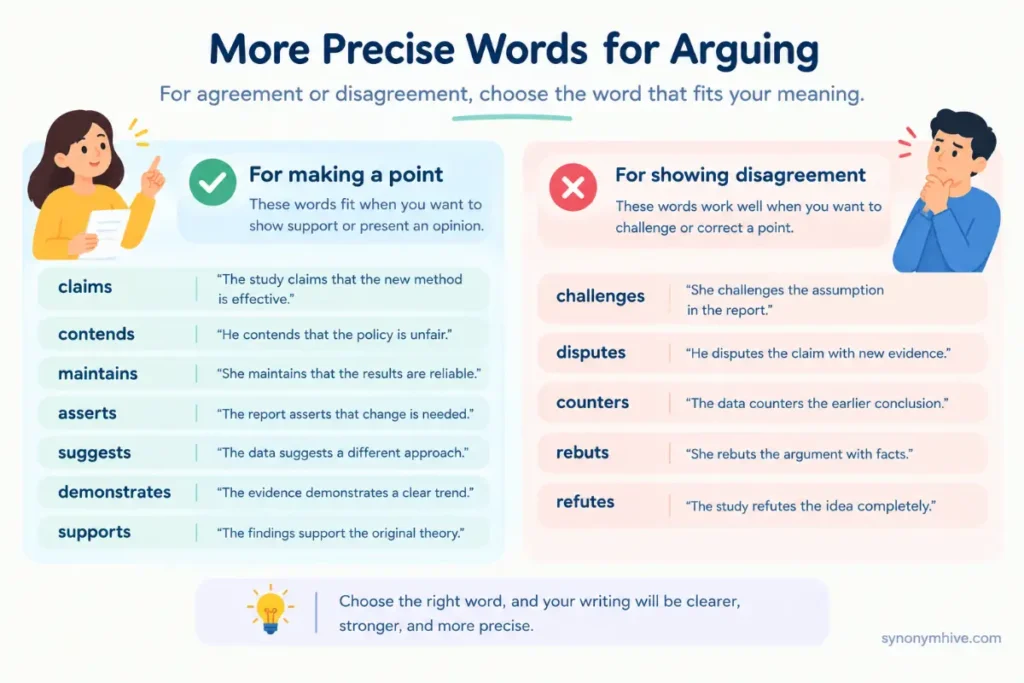
For academic writing, claims, contends, maintains, asserts, suggests, demonstrates, and supports are useful choices. For disagreement, challenges, disputes, counters, rebuts, and refutes can be more precise.
Don’t replace argues just to avoid repetition. Replace it when another verb gives the reader a clearer picture of what the writer or speaker is doing.
You may also like Another Word for Impact: Better Terms 2026.
Conclusion
Choosing another word for argues starts with the meaning you want to preserve. Claims works for a stated position, maintains shows continued support, contends adds a formal debate tone, and suggests creates more room for uncertainty. Stronger choices such as challenges, disputes, and refutes should only appear when the context supports that level of disagreement.
The best writing doesn’t use the most complicated synonym. It uses the most accurate one. Look at the evidence, consider the speaker’s purpose, and match the verb to the strength of the claim. That simple habit can make essays, reports, emails, and professional writing clearer and more precise.
Frequently Asked Questions
What is another term for argues?
Another phrase for argues is claims, contends, maintains, asserts, suggests, or supports. The right choice depends on the writer’s purpose and the strength of the position.
What is another term for argues in an essay?
In an essay, useful alternatives include contends, maintains, claims, asserts, suggests, demonstrates, and supports. Choose the word that accurately describes how the author presents the argument.
What is another term for argues in a resume?
Advocates, supports, defends, proposes, and recommends can work better than argues on a resume. They focus on useful professional actions rather than disagreement.
What is another phrase for argues in academic writing?
Contends, maintains, asserts, claims, suggests, and demonstrates are common academic alternatives. Each one signals a different level of certainty or support.
What’s another way to say argues?
You can say claims, contends, maintains, asserts, suggests, advocates, challenges, or disputes. The best option depends on the meaning of the sentence.
Is argues a formal word?
Argues is a neutral word that works in academic, professional, and everyday writing. It can describe reasoned support for an idea or a disagreement between people.
Can argues mean disagrees?
Yes. Argues can mean disagrees in everyday conversation. In academic writing, it more often means presents and supports a position with reasons or evidence.