

You’re writing an essay and reach a point where you need to connect one idea to the next. You already used therefore several times, and now you need another word for therefore that sounds natural and fits your sentence. The good news is that English gives you many choices, from simple words such as so and thus to more formal options such as consequently and accordingly.
The best alternatives to therefore include so, thus, consequently, as a result, hence, accordingly, for this reason, and because of this. The right choice depends on the level of formality and the relationship between your ideas.
Therefore is a transition word that shows a result, conclusion, or logical consequence. It tells the reader that the idea in the second part follows from the idea before it. In academic writing, it can make your reasoning easier to follow when you use it correctly.
Still, repeating the same transition can make an essay feel mechanical. A stronger approach is to choose a transition based on the exact relationship between your sentences. This guide explains the meaning and origin of therefore, more than 30 alternatives, differences in tone, sentence position, US and UK usage, and the best choices for essays, emails, texting, speaking, and other forms of writing.
Explore more word choices in Another Word for Because: Best Synonyms 2026.
What Does Therefore Mean In Plain English?
Therefore means for that reason, because of that, or as a result. It connects an earlier fact, action, or idea with a conclusion that follows from it.
For example.
The roads were flooded. Therefore, the school closed for the day.
The first sentence gives the reason. The second sentence gives the result.
You can think of therefore as a bridge between cause and effect. It tells your reader that the second statement is not random. It follows logically from what came before.
Therefore often appears in academic writing because it clearly signals reasoning.
For example.
The sample size was too small. Therefore, the findings should be interpreted carefully.
The evidence was incomplete. Therefore, the researchers requested additional data.
The company reduced its operating costs. Therefore, it was able to invest more money in new equipment.
In each example, the transition points from information to a conclusion.
Therefore can also introduce a conclusion within one sentence.
For example.
The evidence is limited. The claim is therefore difficult to support.
This position is less common in casual speech but appears frequently in formal writing.
Where Did Therefore Come From?
Therefore is an old English compound formed from there and fore. The word originally carried the idea of from that or for that reason.
Its structure helps explain its meaning. There refers to something already mentioned, while fore connects to the idea of a reason or basis. Over time, the combined word developed into the modern therefore.
The word has been used in English for centuries. Its meaning has remained closely tied to logical consequence.
That long history is one reason therefore sounds more formal than simple alternatives such as so.
For example, these sentences express a similar idea.
The weather was bad, so the event was canceled.
The weather was bad. Therefore, the event was canceled.
The first sentence sounds natural in everyday conversation. The second sounds more formal and deliberate.
This difference matters when you choose a transition. Good writing is not about using the most formal word available. It is about using the word that fits the audience, purpose, and relationship between ideas.
another word for therefore For Clear Essay Writing
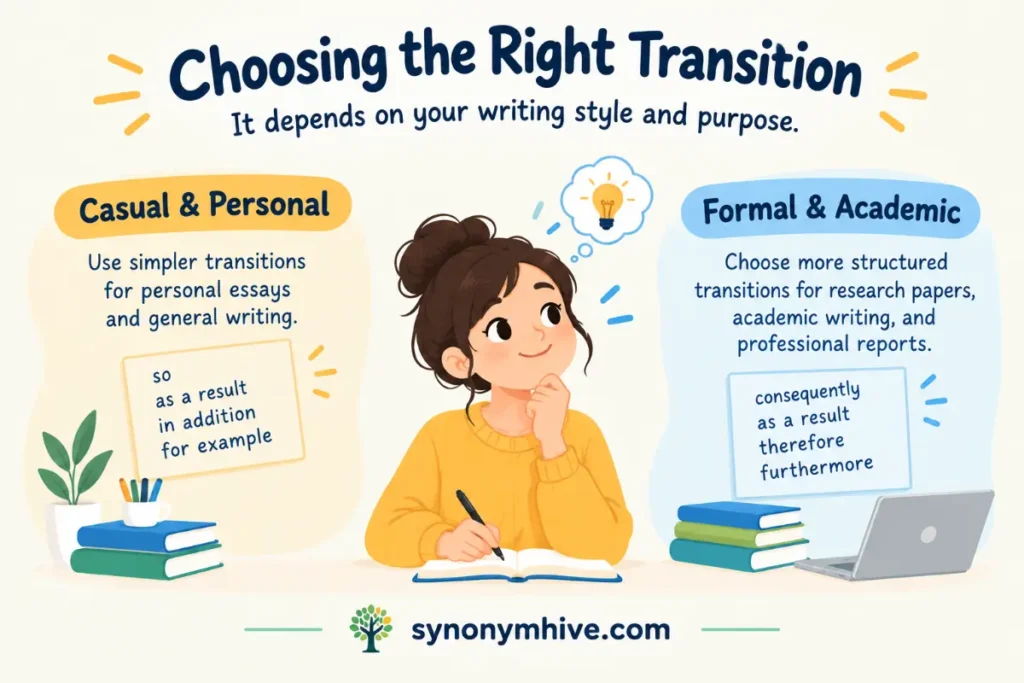
When you need another term for therefore, first decide how formal your writing should sound. Simple transitions are often best for personal essays and general writing. Formal transitions can work well in academic papers, research writing, and professional reports.
The following table gives you a broad selection.
This list gives you choices for almost every writing situation. However, these words are not perfect substitutes in every sentence. Their exact meanings can shift slightly.
another term for therefore By Intensity And Formality
Some transitions sound very natural and simple. Others create a more formal academic tone.
Mild And Simple Choices
So.
That is why.
Because of this.
For this reason.
These choices are clear and easy to understand. They work especially well in general essays, personal writing, emails, and everyday communication.
For example.
The instructions were unclear, so several students made mistakes.
The instructions were unclear. That is why several students made mistakes.
The first version is shorter. The second puts more emphasis on the reason.
Moderate Choices
As a result.
For that reason.
Given this.
With this in mind.
As such.
These options provide a polished tone without sounding overly academic.
For example.
The survey showed strong support. As a result, the organization approved the proposal.
Strong Formal Choices
Thus.
Hence.
Consequently.
Accordingly.
Thereby.
It follows that.
These words work well in formal essays, research papers, reports, and analytical writing.
For example.
The results were consistent across all groups. Consequently, the researchers accepted the hypothesis.
The treatment reduced symptoms. Thus, the researchers recommended further testing.
Use strong formal transitions when they improve clarity. Do not add them simply to make a sentence sound more sophisticated.
another phrase for therefore By Part Of Speech
Therefore is commonly classified as a conjunctive adverb or sentence adverb. It connects ideas while also expressing the relationship between them.
Several alternatives work differently.
So can function as a conjunction.
For example.
The weather was poor, so the game was canceled.
Thus and hence often function as adverbs.
For example.
The evidence was incomplete. Thus, the conclusion remained uncertain.
Consequently is also commonly used as a conjunctive adverb.
For example.
The company reduced its budget. Consequently, fewer projects were approved.
As a result is a transition phrase.
For example.
The roads flooded. As a result, several flights were delayed.
Thereby works differently because it often connects an action with the result created by that action.
For example.
The team automated the process, thereby reducing manual work.
Understanding these grammatical differences helps you avoid awkward sentences.
What Is The Best another expression for therefore For A Resume?
Resume writing rarely needs therefore because resumes focus on actions, skills, and results rather than long chains of reasoning.
Still, you may need a similar transition in a professional summary, cover letter, or achievement statement.
As a result is usually the safest choice.
For example.
Improved customer response times. As a result, customer satisfaction scores increased.
Consequently can work in a formal professional context.
For example.
Reduced processing errors and consequently improved overall reporting accuracy.
Thus can work in a professional report.
For example.
The team simplified the workflow, thus reducing unnecessary processing time.
However, resumes often become stronger when you remove the transition entirely.
Instead of writing.
Improved the ordering process. Therefore, reduced delivery delays.
Write.
Improved the ordering process and reduced delivery delays.
This version is shorter and focuses directly on the achievement.
synonyms In An Essay
Essay writing is where transition choices matter most. Your transition should show the logical relationship between your ideas without distracting the reader.
Use so for simple and conversational essays.
For example.
Many students work part time, so they have less time available for studying.
Use thus for formal academic writing.
For example.
The sample included participants from several regions. Thus, the findings may apply to a wider population.
Use consequently when the result is direct and important.
For example.
The factory released untreated waste into the river. Consequently, water quality declined.
Use as a result when you want maximum clarity.
For example.
The policy increased transportation costs. As a result, several families struggled to afford daily travel.
Use for this reason when you want to emphasize the connection between the reason and conclusion.
For example.
The study included very few participants. For this reason, the results should not be generalized.
A strong essay does not need a formal transition in every paragraph. Sometimes a simple sentence connection is clearer.

another word for therefore In An Email
Email writing depends heavily on audience and purpose. A message to a professor or manager may need a more polished transition than a quick message to a friend.
Use therefore in formal professional emails when you are drawing a clear conclusion.
For example.
The requested documents were not included. Therefore, we cannot complete the review yet.
As a result sounds slightly more natural in many business emails.
For example.
The shipment arrived late. As a result, we need to move the installation date.
That is why works well in friendly communication.
For example.
The office will be closed tomorrow. That is why I’m sending the documents today.
For this reason works well when explaining a decision.
For example.
The original meeting time conflicts with another appointment. For this reason, I’d like to suggest a different time.
Choose clarity over formality. A short email usually benefits from simple language.
another term for therefore In Texting
Text messages rarely need formal transition words. So is usually the most natural choice.
For example.
The store is closed, so I’ll go tomorrow.
You can also say that’s why.
For example.
I missed the bus. That’s why I’m running late.
Because of that is another casual option.
For example.
My phone died. Because of that, I couldn’t call you.
Using consequently or hence in a casual text can sound overly formal unless you are being playful.
For example.
I forgot my keys. Consequently, I’m locked out.
The grammar is fine, but the tone may sound humorous in a normal text.
The best transition is the one that sounds natural for the conversation.
another expression for therefore In Speaking
In everyday speech, so is by far one of the most natural choices.
For example.
I was tired, so I went home early.
That’s why is also common.
For example.
The road was blocked. That’s why we took another route.
Because of that sounds natural when you want to explain a result.
For example.
The train was delayed. Because of that, I missed the meeting.
Therefore can appear in speech, especially in formal presentations or careful explanations.
For example.
The evidence does not support the claim. Therefore, we need to reconsider the conclusion.
In casual conversation, however, therefore may sound more formal than necessary.
What Is The Difference Between Therefore And Thus?
Therefore and thus are very close. Both can introduce a logical result or conclusion.
Therefore usually sounds slightly more direct and familiar.
Thus often sounds more formal and compact.
Compare these sentences.
The evidence was incomplete. Therefore, the researchers repeated the experiment.
The evidence was incomplete. Thus, the researchers repeated the experiment.
Both are correct.
In an academic paper, either can work. In general writing, therefore may feel more natural to many readers.
Thus also has another useful function. It can describe the way an action produces a result.
For example.
The company simplified the form, thus making it easier for customers to apply.
Therefore does not normally work in the same structure.
This is an important difference. Thus can connect an action directly to its resulting effect.
Therefore Vs Consequently Which Is Better?
Therefore and consequently both show results, but they do not always carry the same emphasis.
Therefore often introduces a conclusion based on reasoning.
For example.
The evidence supports the theory. Therefore, the researchers accepted the explanation.
Consequently often emphasizes an actual result or outcome.
For example.
The company lost several major clients. Consequently, revenue declined.
A simple way to remember the difference is this.
Therefore often means this is the logical conclusion.
Consequently often means this happened because of what came before.
There is overlap, so context matters.
If you are presenting an argument, therefore may be the better choice.
If you are describing a chain of events, consequently may be more natural.
Therefore Vs Hence What Is The Difference?
Therefore and hence are close in meaning, but hence usually sounds more formal and sometimes more literary.
For example.
The evidence was weak. Therefore, the claim was rejected.
The evidence was weak. Hence, the claim was rejected.
Both sentences work.
Hence is common in formal writing, mathematics, technical writing, and academic arguments.
For example.
The two angles are equal. Hence, the triangles are congruent.
In everyday writing, therefore or so will usually sound more natural.
If your goal is simple and accessible writing, do not choose hence just because it sounds advanced.
Need another vocabulary suggestion? Read Another Word for Furthermore Best Alternatives 2026.
Therefore Vs So Which One Should You Use?
So is shorter, simpler, and more conversational. Therefore is more formal and often places greater emphasis on logical reasoning.
Compare these examples.
The weather was bad, so the event was canceled.
The weather was bad. Therefore, the event was canceled.
The first sounds natural in everyday communication.
The second sounds more formal and deliberate.
For a personal essay, so can be perfectly acceptable.
For an academic argument, therefore may fit better.
For a text message, so is usually the clear choice.
For a formal report, therefore or consequently may work better.
The audience should guide your choice.
What Are The Best Simple Another Word for Therefore?
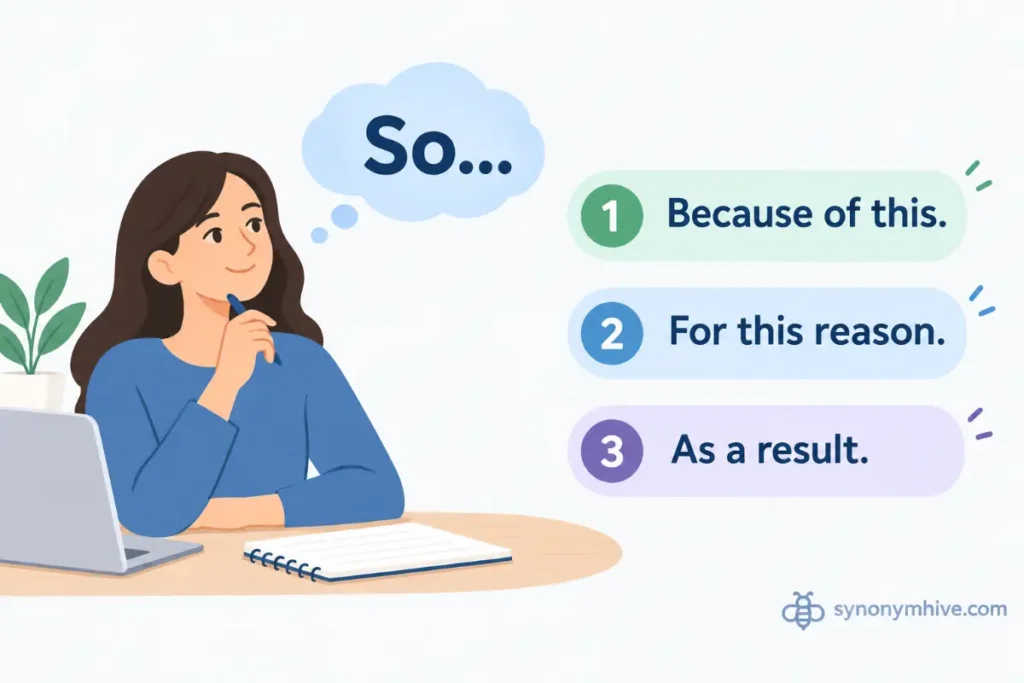
If you want plain English, use transitions that readers understand immediately.
- So.
- Because of this.
- For this reason.
- As a result.
- That is why.
- For that reason.
- Given this.
- Because of that.
These choices work well for students who want their essays to sound natural rather than overly formal.
For example.
The survey included only ten people. Because of this, the results may not represent the larger population.
Or.
The survey included only ten people. As a result, the findings may not represent the larger population.
Both versions are clear.
What Are The Most Formal Alternatives To Therefore?
Academic and professional writing may call for more formal transitions.
- Thus.
- Hence.
- Consequently.
- Accordingly.
- Thereby.
- As such.
- It follows that.
- In consequence.
- On that basis.
- In light of this.
These words can help create a formal tone, but each has a slightly different function.
For example, thereby usually connects an action to its result.
As such often refers back to the situation just described.
On that basis emphasizes that a conclusion comes from specific information.
In light of this signals that a conclusion or decision is based on new evidence.
The more precise the transition, the clearer your reasoning becomes.
How Do You Use Therefore Correctly In A Sentence?
Therefore can appear in several positions, but punctuation matters.
At the beginning of a sentence, use a comma after therefore.
For example.
The evidence was incomplete. Therefore, the researchers requested more information.
It can also appear in the middle of a sentence.
For example.
The evidence was incomplete and therefore required further review.
Another structure places therefore between two commas.
For example.
The evidence was incomplete and the conclusion was, therefore, limited.
The exact punctuation can vary with sentence structure, but the main goal is to make the transition easy to read.
Do not place therefore randomly. Make sure it clearly connects the reason with the result.
Common Mistakes With Therefore
Even experienced writers sometimes misuse therefore.
Mistake One Using Therefore When There Is No Result
Therefore should connect an idea to a consequence or conclusion.
Weak.
The study included 100 participants. Therefore, the participants completed a survey.
The second statement does not logically follow from the first.
Better.
The study included 100 participants. Therefore, the sample provided enough responses for the analysis.
Mistake Two Using Therefore Too Often
Repeating therefore in every paragraph makes an essay feel predictable.
Instead, vary your transitions naturally.
Use as a result in one section, thus in another, and for this reason somewhere else.
Mistake Three Making Every Sentence Formal
A paper can become harder to read if every transition sounds academic.
Simple words such as so and because of this can improve readability.
Mistake Four Confusing Cause And Result
Therefore introduces a result based on an earlier point. It does not simply mean because.
For example.
The roads were flooded. Therefore, traffic was delayed.
The flooding is the cause. The traffic delay is the result.
Mistake Five Using Therefore In Casual Texts
There is nothing grammatically wrong with it, but it may sound stiff.
In most casual messages, so or that’s why will sound more natural.
When Should You Not Use Therefore?
Do not use therefore simply because you need a transition. First check the relationship between your ideas.
If you are adding another point, use also, in addition, or similarly.
If you are showing contrast, use however, instead, or in contrast.
If you are giving an example, use for example or for instance.
If you are showing a reason, use because, since, or as.
If you are showing a result, use therefore, so, thus, consequently, or as a result.
If you are restating an idea, use in other words.
Choosing the wrong transition can confuse your reader even when every sentence is grammatically correct.
Examples Of Therefore And Its Alternatives
The following examples show how different transitions work in realistic situations.
- The company reduced unnecessary spending. Therefore, it had more money available for expansion.
- The company reduced unnecessary spending, so it had more money available for expansion.
- The company reduced unnecessary spending. As a result, it had more money available for expansion.
- The company reduced unnecessary spending. Consequently, its financial position improved.
- The company reduced unnecessary spending. Thus, it created more room for investment.
- The company reduced unnecessary spending. For this reason, management approved the expansion plan.
- The weather forecast predicted heavy snow. Therefore, the school canceled classes.
- The weather forecast predicted heavy snow, so the school canceled classes.
- The weather forecast predicted heavy snow. Because of this, parents were asked to make alternate arrangements.
- The research produced inconsistent results. Therefore, the researchers conducted another test.
- The research produced inconsistent results. Consequently, the team questioned the original conclusion.
- The research produced inconsistent results. For this reason, the report included a limitation statement.
- The new process reduced paperwork. Thus, employees had more time for customer service.
- The new process reduced paperwork, thereby giving employees more time for customer service.
- The store received fewer customers during the afternoon. As a result, the manager adjusted staffing levels.
- The instructions were unclear. That is why several users contacted customer support.
- The evidence supported the claim. Accordingly, the committee approved the proposal.
- The project had limited funding. Given this, the team focused on the most important features.
- The policy applies to every department. As such, all managers must follow the same procedure.
- The results were consistent across several tests. It follows that the method was reliable.
These examples show that transition words are not interchangeable in every situation.
How Can You Avoid Repeating Therefore In An Essay?
The easiest solution is to vary your transition based on the relationship between ideas.
Start with therefore when you need a direct logical conclusion.
Use as a result when you are describing an outcome.
Use consequently when the outcome is a clear consequence.
Use thus when you want a concise formal transition.
Use for this reason when you want to emphasize the reason.
Use so when the writing is simple or conversational.
Use hence when the context is highly formal or technical.
Use thereby when an action creates a specific result.
You can also remove the transition entirely when the relationship is already obvious.
For example.
The study had a small sample size. The findings should be interpreted carefully.
You do not always need therefore between the two sentences. Sometimes a direct connection is cleaner.
How Do You Choose The Right Transition?
Think about the job your transition needs to perform.
If you want to show a simple result, use so.
If you want to show a formal conclusion, use therefore or thus.
If you want to emphasize an outcome, use consequently or as a result.
If you want to explain a reason, use for this reason.
If you want to connect an action to its effect, use thereby.
If you want to point to a conclusion based on evidence, use it follows that or on that basis.
If you are writing casually, choose simple language.
If you are writing academically, choose a formal option when it improves precision.
Do not judge a transition by how impressive it sounds. Judge it by how accurately it connects your ideas.
Antonyms And Contrasting Transitions
Therefore shows a result or conclusion, so its closest contrasting transitions are words that introduce a different relationship.
However shows contrast.
Nevertheless shows that something remains true despite another point.
Instead introduces an alternative.
Otherwise introduces what would happen under a different condition.
In contrast highlights differences.
On the other hand presents another perspective.
For example.
The first method was expensive. However, it produced highly accurate results.
The first method was expensive. Therefore, the team looked for a cheaper option.
These transitions perform different jobs. Do not use a result transition when your real goal is to show contrast.
another word for therefore For Better Academic Writing
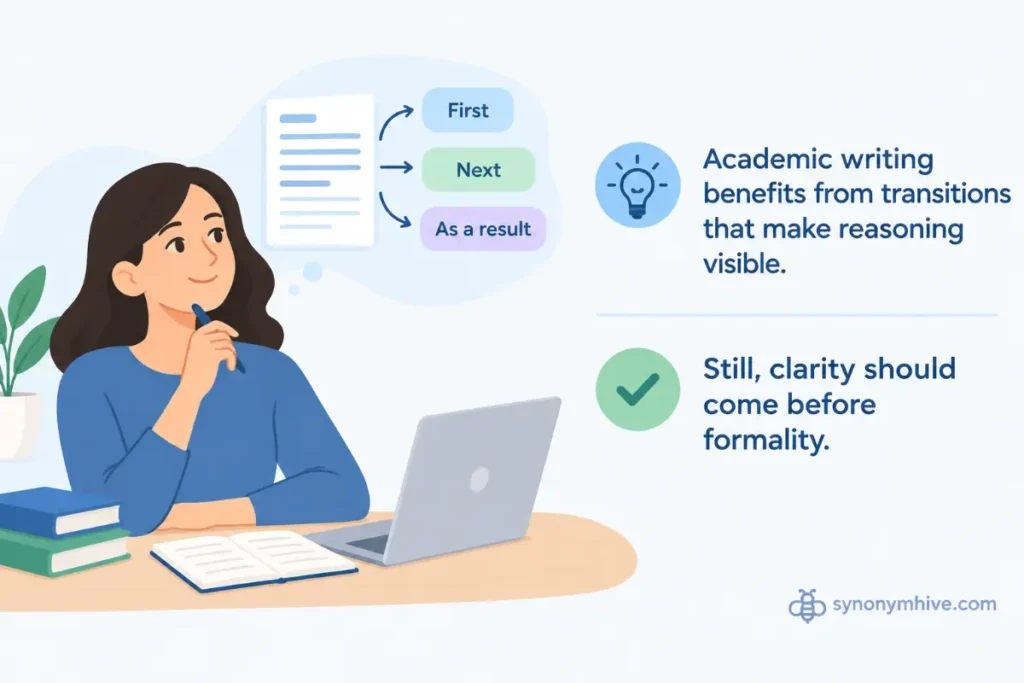
Academic writing benefits from transitions that make reasoning visible. Still, clarity should come before formality.
Therefore is useful when your conclusion directly follows from evidence.
For example.
The study found a consistent relationship between exercise and sleep quality. Therefore, the researchers recommended further investigation.
Thus is a good alternative when you want a shorter formal transition.
For example.
The results were consistent across three groups. Thus, the researchers considered the pattern significant.
Consequently works well when the focus is the outcome.
For example.
The treatment group showed fewer symptoms. Consequently, the researchers planned a larger trial.
As a result is excellent when clarity matters most.
For example.
The sample contained very few participants. As a result, the findings cannot represent the entire population.
Strong academic writing does not depend on difficult vocabulary. It depends on clear reasoning and accurate connections.
Quick Tips For Using Another Transition
- Identify the relationship between your two ideas.
- Use therefore when the second idea is a logical conclusion.
- Use as a result when you want to emphasize an outcome.
- Use consequently for a strong cause and effect relationship.
- Use thus for concise formal writing.
- Use so for simple and conversational writing.
- Use for this reason when the reason deserves emphasis.
- Use thereby when an action creates a specific result.
- Avoid repeating the same transition throughout an essay.
- Remove a transition when the connection is already obvious.
- Choose clarity instead of complicated vocabulary.
- Read the sentence aloud to check if the transition sounds natural.
A good transition should guide the reader without calling attention to itself.
What Makes A Transition Strong In An Essay?
A strong transition does three things. It connects ideas, shows the relationship between them, and helps the reader follow your reasoning.
Weak transitions simply fill space between sentences.
For example.
The policy changed. Therefore, the results changed.
This may be grammatically correct, but it does not explain how the policy caused the results to change.
A stronger version gives the reader more information.
The policy increased access to public transportation. As a result, more residents were able to reach nearby workplaces.
Now the relationship is clear.
This is an important writing lesson. A transition cannot repair weak reasoning. It can only make a clear relationship easier to follow.
Learn more useful word alternatives in Another Word for Impact: Better Terms 2026.
Conclusion
Choosing another word for therefore is mainly about matching the transition to your purpose. Use so for simple writing, as a result for clear cause and effect, thus for concise formal writing, and consequently when you want to emphasize an outcome. For this reason works well when the reason deserves attention, while thereby connects an action with its direct effect.
You do not need to replace therefore every time you use it. Sometimes it is exactly the right word. The goal is to avoid repetition while keeping your reasoning clear. Before choosing a transition, ask what relationship you are showing between your ideas. Once that relationship is clear, the right word usually becomes much easier to find.
Frequently Asked Questions
What Is another term for therefore?
Common alternatives include so, thus, hence, consequently, as a result, for this reason, accordingly, and because of this. The best choice depends on the formality and meaning of your sentence.
What Is The Best Synonym For Therefore In An Essay?
Thus, consequently, as a result, and for this reason are strong choices for essays. Therefore itself is also useful when you need to introduce a clear logical conclusion.
Is Thus More Formal Than Therefore?
Yes, thus often sounds more formal and compact than therefore. Both can introduce a logical result, but thus is especially common in academic, technical, and mathematical writing.
What’s Another Way To Say Therefore In A Casual Conversation?
So and that’s why are usually the most natural choices in casual conversation. Because of that also works when you want to explain a result clearly.
Can I Use Therefore At The Beginning Of A Sentence?
Yes, you can begin a sentence with therefore. For example, Therefore, the researchers decided to repeat the experiment.
Is Consequently The Same As Therefore?
Consequently and therefore are closely related, but consequently often puts more emphasis on the actual result of an event. Therefore often highlights a logical conclusion based on previous information.
What Is The Simplest Alternative To Therefore?
So is the simplest and most natural alternative in everyday English. It works well when the relationship between the two ideas is clear.