
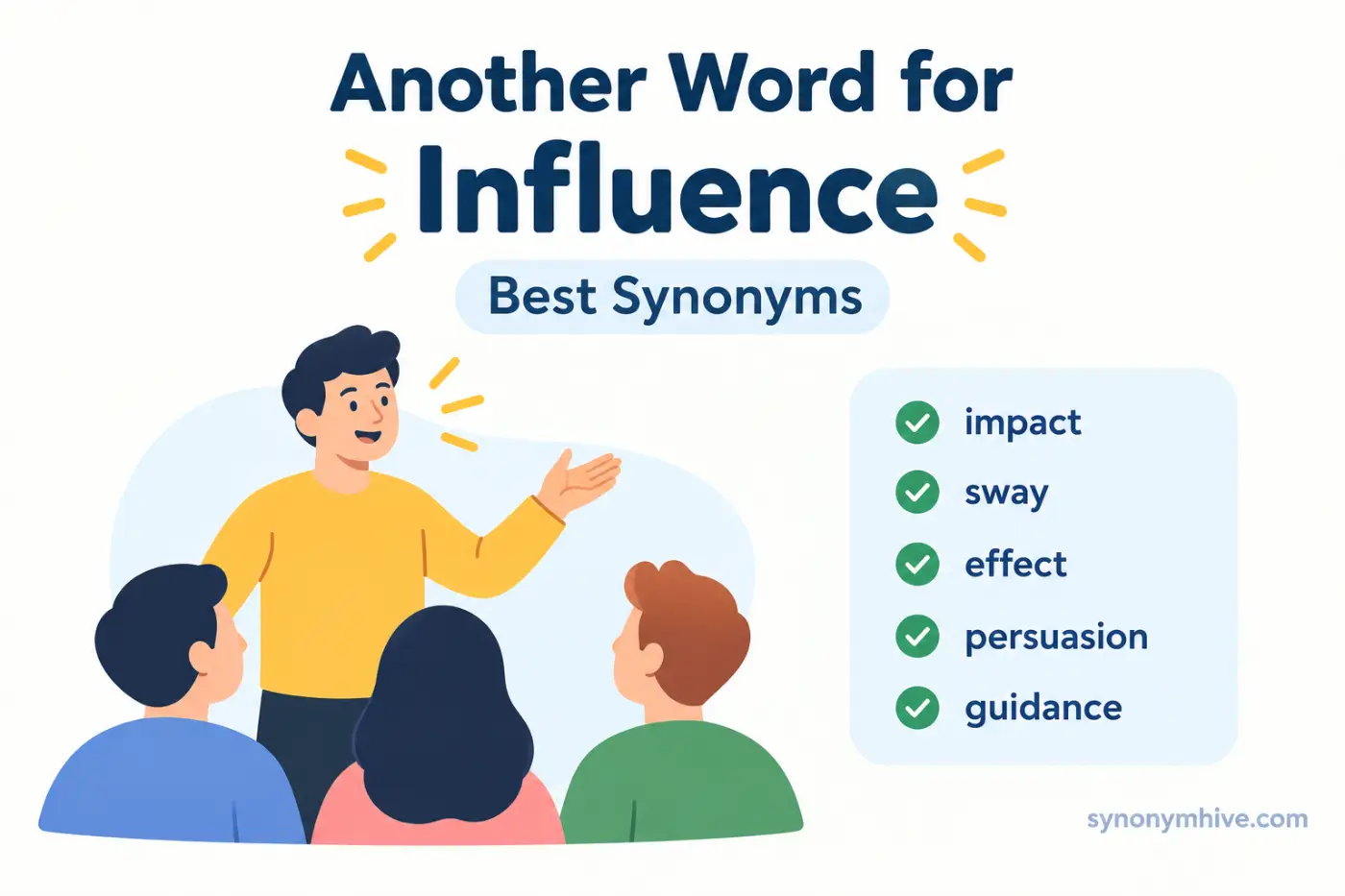
When you’re writing an essay, email, resume, or text, you may notice that you keep using the word influence. Looking for another word for influence can make your writing clearer, more precise, and less repetitive.
The best replacement depends on what you mean. You might want a simple word such as affect or shape, a stronger word such as sway or persuade, or a formal choice such as impact or determine.
Another word for influence can be affect, shape, sway, guide, impact, persuade, inspire, or motivate, depending on the meaning and strength you need.
This guide explains the meaning and origin of influence, gives you more than 20 useful alternatives, and shows how each word works in essays, resumes, emails, texts, and everyday speech. You’ll also learn how to choose a synonym that matches the exact meaning of your sentence.
Learn more useful word alternatives in Another Word for Argues Best Alternatives 2026.
What Does Influence Mean?
Influence means having an effect on a person, decision, behavior, event, or result. It can happen directly through persuasion or indirectly through ideas, actions, examples, reputation, money, status, or circumstances.
Influence can work as both a noun and a verb. As a noun, it means the power or effect someone or something has. For example, you might say that a teacher had a strong influence on a student’s career choice.
As a verb, influence means to affect how someone thinks, acts, decides, or develops. For example, good mentors can influence students in positive ways.
The word doesn’t always suggest control. A person can influence a decision without making the final decision. A friend’s advice may influence your choice of college, but you still make the final choice yourself.
That difference matters when choosing a synonym. Affect usually describes an effect. Persuade suggests an attempt to change someone’s mind. Control is much stronger and suggests direct power over the outcome.
Where Does Influence Come From?
The word influence comes from the Latin word influere, which means to flow into. The original idea described something flowing into or affecting something else.
The word later developed through Old French and Middle English. In older usage, influence could refer to a supposed invisible force from the stars that affected human events. Over time, the meaning became much broader.
Today, influence usually refers to the power to affect people, choices, opinions, actions, or results. An author’s ideas can influence readers. A parent can influence a child’s habits. A leader can influence public opinion. A new technology can influence how people work.
This history also helps explain why influence can describe both a subtle effect and a powerful one. Someone doesn’t need complete control to have influence.
What Is Another Word for Influence?
There isn’t one replacement that works in every sentence. The best synonym depends on the kind of effect you want to describe.
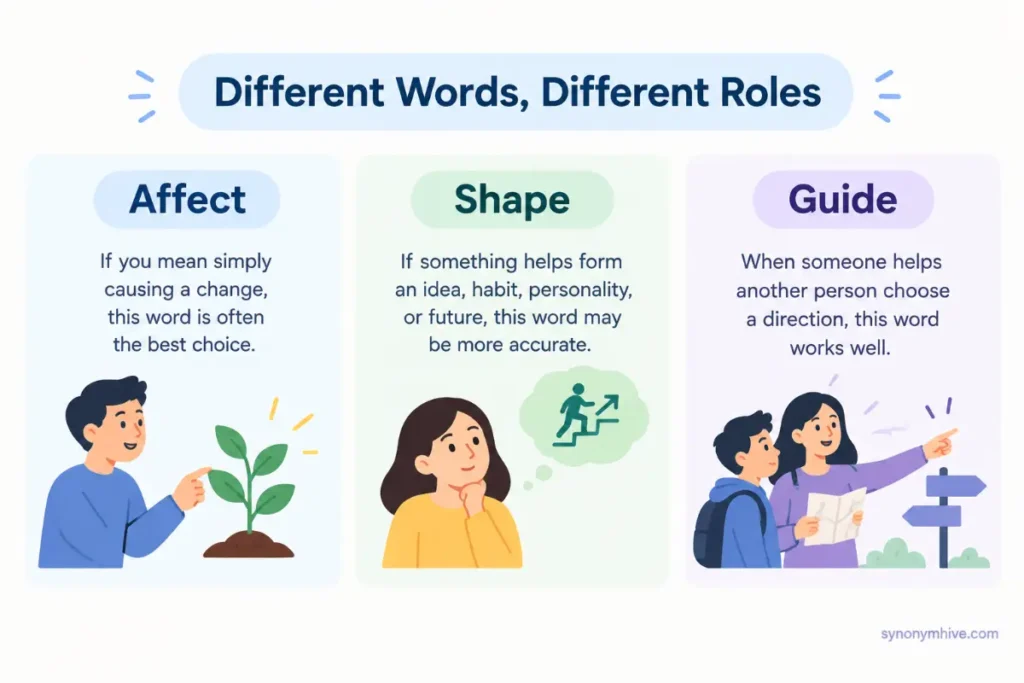
If you mean simply causing a change, affect is often the best choice. If something helps form an idea, habit, personality, or future, shape may be more accurate. When someone helps another person choose a direction, guide works well.
For a stronger effect on someone’s opinion, sway or persuade may fit. If you want to show encouragement, consider motivate, inspire, or encourage. For professional and academic writing, impact, alter, prompt, and determine can be useful.
The key is to focus on meaning first. A synonym should make your sentence more accurate, not simply make it different.
What Are the Best Synonyms for Influence?
The following words cover simple, everyday, formal, and informal situations. Each one has a slightly different meaning, so the example sentence shows how it can work naturally.
| Word | Meaning | Tone | Example |
|---|---|---|---|
| Impact | To have a noticeable effect | Formal | The policy had a major impact on sales. |
| Inspire | To encourage through ideas or example | Positive | Her work inspired young artists. |
| Encourage | To give support or confidence | Positive | His teacher encouraged him to continue. |
| Direct | To guide something toward a result | Formal | The manager directed the team’s efforts. |
| Determine | To decide or strongly affect an outcome | Strong | Several factors determine the final cost. |
| Alter | To cause something to become different | Formal | The new rule altered the process. |
| Change | To make something different | Simple | The experience changed her outlook. |
| Modify | To make a partial change | Formal | The feedback modified his approach. |
| Condition | To influence behavior through repeated experience | Academic | Training can condition a response. |
| Prompt | To cause someone to take action | Formal | The report prompted an investigation. |
| Move | To affect someone emotionally | Everyday | Her story moved the audience. |
| Convince | To cause someone to accept an idea | Everyday | The evidence convinced the jury. |
| Lead | To cause or guide toward a result | Everyday | Poor planning led to delays. |
| Pressure | To push someone toward a choice | Strong | His friends pressured him to join. |
| Drive | To strongly cause or motivate an action | Strong | Demand drives the market. |
| Pull | To attract or draw people toward something | Informal | The brand has enough pull to attract customers. |
| Clout | Social or professional power | Slang | She has considerable clout in the industry. |
| Affect | To produce an effect | Neutral | Stress can affect concentration. |
| Inspire | To encourage action or thought | Positive | The speaker inspired the students. |
| Motivate | To encourage someone to take action | Professional | The manager motivated the staff. |
| Nudge | To gently encourage a change | Informal | The reminder nudged me toward action. |
Which Synonyms Are Simple and Easy to Use?
For everyday writing, affect, change, shape, guide, and lead are some of the safest choices. Most readers understand these words immediately, and they don’t make a sentence sound overly formal.
Use affect when you simply mean that something has an effect. For example, lack of sleep can affect your mood. The sentence doesn’t say that sleep completely controls your mood. It simply says that sleep has an effect.
Use shape when something helps form a person’s ideas, character, habits, or future. You might say that childhood experiences shape a person’s worldview.
Choose guide when someone helps another person find a direction. A teacher can guide a student through a difficult subject. A mentor can guide someone during the early stages of a career.
Use lead when one thing results in another. Poor planning can lead to delays. Higher prices may lead to lower demand.
These simple alternatives work well because they communicate the idea without forcing readers to stop and interpret complicated vocabulary.
Which Synonyms Sound More Formal?
For academic, professional, or analytical writing, words such as impact, determine, alter, modify, prompt, and condition can be useful.
For example, instead of saying that social media has a big influence on buying habits, you could say that social media has a significant impact on buying habits.
You could also write that social media shapes consumer behavior. This version is slightly different because shape suggests an ongoing process rather than simply highlighting the final effect.
Academic writing doesn’t always become better when you use longer or more formal words. Precision matters more than complexity. A simple word can be the strongest choice if it communicates the idea clearly.
Which Words Describe Strong Influence?
When the effect is powerful, sway, drive, persuade, pressure, and determine can work well.
Sway suggests changing someone’s opinion or decision. You might say that the final debate swayed undecided voters.
Drive suggests that something strongly causes an action or result. Consumer demand can drive business decisions.
Persuade focuses on convincing someone. A manager might persuade an employee to accept a new responsibility.
Pressure suggests that someone is pushed toward a choice. Friends may pressure someone to join an activity.
Determine can suggest that something has a decisive effect on an outcome. Several factors may determine the final price of a product.
Strong words should be used carefully. If a teacher’s advice simply helped a student think about a career, saying the teacher determined the student’s career would probably be too strong.
Which Synonyms Describe Mild Influence?
Not every effect is strong. Sometimes something only gives a person a small push or changes their thinking slightly.
In those cases, affect, encourage, guide, prompt, and nudge can work well.
For example, an article may prompt someone to learn more about a subject. The article didn’t force the person to take action. It simply encouraged a response.
The word nudge is even softer. It suggests a small push toward a choice or action. You might say that a reminder nudged you toward finishing a project.
The word encourage also works when the influence involves support. A teacher can encourage a student to apply for a scholarship without making the student apply.
What Is Another Word for Influence as a Verb?
When influence functions as a verb, useful alternatives include affect, shape, guide, sway, persuade, motivate, inspire, encourage, prompt, drive, and alter.
Consider the sentence, Teachers influence students.
You could say that teachers guide students. This focuses on direction.
You could say that teachers inspire students. This focuses on encouragement through ideas, example, or achievement.
You could say that teachers motivate students. This focuses on giving students a reason to take action.
You could say that teachers shape students’ development. This suggests a longer process that helps form skills, beliefs, or character.
You could also say that teachers affect students’ lives. This is broader and simply describes an effect.
These examples show why choosing a synonym requires more than checking a thesaurus. You need to understand the relationship between the subject and the result.
What Is Another Term for Influence as a Noun?
As a noun, useful alternatives include impact, effect, power, sway, authority, control, pull, and clout.
Consider the sentence, Her influence in the organization is growing.
You could replace influence with impact if you want to focus on the effect she has. You could use sway if you mean that she has the ability to affect decisions.
Authority is different because it suggests official or accepted power. Control is stronger and suggests the ability to direct what happens.
Clout is more informal. It often describes social or professional power, especially when someone has enough status to affect decisions.
Because these words carry different meanings, the original sentence may sometimes be the best option.
How Do You Use Another Term for Influence on a Resume?
On a resume, strong choices include impact, led, drove, guided, shaped, motivated, and improved.
A resume becomes more effective when it shows what you did and what happened as a result. A general sentence about influence may not tell the employer enough.
Instead of writing, Influenced the sales team to improve performance, you could write, Motivated the sales team to exceed its quarterly goal.
An even stronger version might be, Led a sales initiative that increased quarterly revenue.
The last example works well because it gives the reader a clear action and result. It doesn’t make the reader guess how you influenced the team.
Use drove when you actively pushed a project or improvement forward. Use guided when you helped people move toward a goal.
Best Resume Example
Led a cross functional team to improve customer response times.
Another strong option is, Drove process improvements that increased team productivity.
Specific verbs usually make resume writing more convincing than broad claims about influence.
How Do You Use Another Word for Influence in an Essay?
For essays, affect, shape, impact, contribute to, and determine can all be useful.
Suppose you write, Technology influences modern education.
You could write, Technology shapes modern education. This suggests that technology helps form the way education develops.
You could write, Technology affects modern education. This simply says that technology has an effect.
You could also write, Technology has a significant impact on modern education. This puts more attention on the size or importance of the result.
The best choice depends on the argument you’re making. Don’t replace influence just because you’ve already used it once. Replace it when another word gives the sentence a more exact meaning.
Best Essay Example
Family income can affect a student’s access to educational resources.
This sentence is simple, specific, and appropriate for academic writing.
How Do You Use Another Word for Influence in an Email?
For emails, guide, shape, affect, impact, prompt, and encourage are usually natural choices.
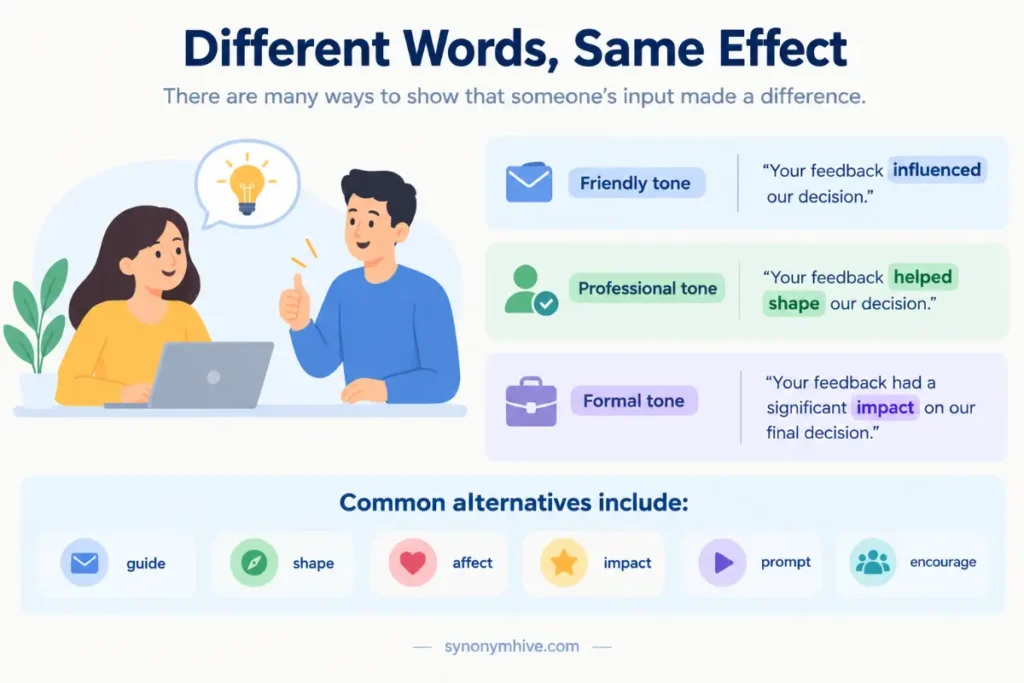
Suppose you’re thanking someone for feedback. You could write, Your feedback influenced our decision.
A smoother professional version might be, Your feedback helped shape our decision.
This wording makes the person’s contribution clear without sounding too formal.
For a more formal business email, you could write, Your feedback had a significant impact on our final decision.
For a casual workplace message, you might say, Your feedback helped us decide what to do next.
The last option is often the most natural because it communicates the point directly.
Best Email Example
Your suggestions helped shape the final proposal.
How Do You Use Another Word for Influence in Texting?
Text messages usually work best with simple and natural vocabulary. Change, sway, convince, affect, inspire, and push can all work depending on the situation.
Instead of saying, You really influenced my decision, a casual text might say, You really changed my mind.
You could also write, You convinced me to try it.
If someone changed your opinion after a discussion, you could say, You definitely swayed me.
Texting doesn’t require formal vocabulary. The goal is to communicate quickly and naturally.
Best Texting Example
You totally convinced me to give it a try.
How Do You Use Another Word for Influence in Speaking?
In conversation, common choices include affect, shape, guide, convince, sway, and inspire.
If you’re talking about advice, guide can sound natural. You might say that your parents guided you when you were choosing a career.
If you’re talking about an argument, convince may be better. You could say that her explanation convinced you to reconsider.
For long term development, shape often works well. You might say that your teachers shaped the way you think about learning.
Simple words usually work best in speech because listeners need to understand your point immediately.
Discover related words in Another Word for Example Best Choices: Smarter Synonyms 2026.
What Are Some Real Examples of Influence Synonyms?
Seeing these words in real situations can make their differences easier to understand.
Affect: Lack of sleep can affect your ability to focus at work.
Shape: Childhood experiences often shape the way people respond to challenges.
Guide: Her mentor guided her through the first year of her career.
Sway: The customer’s detailed review swayed me toward the more expensive model.
Persuade: The manager persuaded the team to test the new system.
Motivate: The coach motivated the players to keep working after a difficult first half.
Inspire: Her success inspired other students to pursue creative careers.
Prompt: The sudden change in demand prompted the company to revise its plan.
Drive: Strong customer demand drove the company to expand its services.
Impact: Rising transportation costs had a major impact on the final price.
Encourage: The scholarship encouraged more students to apply for the program.
Determine: Several factors determine how quickly the project can be completed.
Alter: New evidence altered the direction of the investigation.
Move: The speaker’s personal story moved many people in the audience.
Pressure: Social expectations can pressure young adults into making choices they don’t want.
Each sentence describes influence in a slightly different way. That’s why a long synonym list alone isn’t enough. You need to know what each word actually communicates.
What Is the Difference Between Affect and Influence?
Affect is one of the closest alternatives to influence. Both words can describe something that produces a change or effect.
For example, you can say that weather can affect travel plans. You can also say that weather can influence travel plans.
The difference often comes down to emphasis. Affect is usually direct and neutral. It simply says that something has an effect.
Influence can suggest a broader, gradual, indirect, or personal effect. It is especially common when discussing people’s choices, beliefs, behavior, or development.
| Word | Main Focus | Example |
|---|---|---|
| Affect | Cause a change or result | Stress affects concentration. |
| Influence | Help shape a decision or behavior | Friends can influence your choices. |
If you simply mean that something causes a change, affect is often the clearest choice.
What Is the Difference Between Influence and Impact?
Influence and impact overlap, but they don’t always emphasize the same thing.
Influence often describes the process of affecting someone or something. Impact often places more attention on the effect or significance of that influence.
Consider these two sentences.
Her teacher influenced her career choice.
Her teacher had a major impact on her career.
The first sentence focuses on the teacher’s role in shaping the decision. The second focuses more on how important the teacher’s effect was.
| Word | Main Focus | Example |
|---|---|---|
| Influence | The power to affect something | The mentor influenced her career choice. |
| Impact | The effect or result | The mentor had a lasting impact on her career. |
Both can be useful, but they aren’t always perfect replacements for each other.
What Is the Difference Between Influence and Persuade?
Persuade is more specific than influence.
Influence can happen without anyone deliberately trying to change a person’s mind. Persuasion normally involves an attempt to convince someone.
For example, Her confidence influenced my decision doesn’t necessarily mean she tried to change your mind.
She persuaded me to accept the offer clearly suggests that she actively tried to convince you.
Use influence for a broad effect. Use persuade when convincing someone is the main action.
What Is the Difference Between Influence and Control?
Influence and control are very different in strength.
Influence means having an effect or some power over an outcome. Control suggests much greater power and can mean having the ability to direct or determine what happens.
Parents can influence their children’s habits. Parents may control their children’s bedtime when they set and enforce the rule.
The first sentence allows room for personal choice. The second suggests direct authority.
Don’t use control simply because you’ve used influence too many times. It can change the meaning of your sentence significantly.
Which Synonyms Work Best by Intensity?
Synonyms for influence can be placed on a rough scale from mild to strong.
For mild influence, use words such as affect, encourage, guide, prompt, and nudge. These suggest that something has an effect without completely determining the result.
For moderate influence, consider shape, motivate, inspire, change, lead, and convince. These words suggest a more noticeable effect.
For strong influence, use sway, persuade, drive, pressure, or determine. These choices suggest a stronger force or a clearer connection to the final outcome.
For very strong influence, words such as control and dictate may fit. Use these carefully because they suggest direct authority or power.
For example, a manager might influence a schedule by making suggestions. The manager might determine the schedule if they make the final decision. If the manager has complete authority over it, control may be appropriate.
Which Word Is Best for Each Writing Situation?
| Situation | Strong Choices | Main Reason |
|---|---|---|
| Resume | Led, drove, guided, motivated | Shows action |
| Essay | Affect, shape, impact, determine | Sounds clear and analytical |
| Text | Change, sway, convince, affect | Sounds natural |
| Guide, shape, affect, impact | Professional and clear | |
| Speaking | Affect, shape, guide, convince | Easy to understand |
| Academic paper | Affect, shape, impact, contribute | Precise |
| Marketing | Persuade, attract, motivate, drive | Focuses on behavior |
| Leadership | Guide, motivate, inspire, direct | Highlights leadership |
| Social media | Sway, persuade, shape, affect | Fits opinions and behavior |
| Personal story | Shape, inspire, move, change | Shows personal effect |
Are There US and UK Differences?
There is no major US and UK difference in the basic meaning of influence or its most common synonyms.
American and British writers commonly use affect, impact, shape, sway, guide, persuade, and inspire.
The spelling influence is also the same in American and British English.
Some vocabulary preferences can vary between regions, but the difference is usually related to style rather than the core meaning. The alternatives in this guide work well for American school writing, professional communication, and everyday English.
What Are Common Mistakes With Influence Synonyms?
One common mistake is assuming that every synonym can replace influence in every sentence. They can’t.
For example, saying My teacher persuaded my career is incorrect because persuade normally involves convincing a person to do something. You could instead write, My teacher persuaded me to choose a career in science.
If you want to describe the broader effect of the teacher, you could say, My teacher influenced my career choice.
Another mistake is choosing a word that is too strong. If your friend simply helped you think about your options, saying that your friend controlled your decision changes the meaning.
You should also avoid using persuade when nobody actually tried to convince someone. A person’s behavior can influence you without that person intentionally persuading you.
The same principle applies to inspire, motivate, pressure, and determine. Each word carries a specific idea.
When Should You Not Replace Influence?
You don’t need to replace influence every time you see it.
Sometimes influence is the most accurate and natural word available. For example, Parents have a strong influence on children’s habits is clear and correct.
Trying to replace it with an awkward synonym can make the sentence worse. Not every synonym works naturally with every grammatical structure.
You should also keep influence when you want a broad word that doesn’t specify exactly how the effect happened. This is especially useful when the cause may include several factors.
The goal isn’t to remove influence from your writing. The goal is to avoid unnecessary repetition and choose more precise language when it helps.
What Are the Antonyms of Influence?
Antonyms express the opposite idea or a lack of influence. Common choices include ignore, resist, reject, disregard, defy, avoid, dismiss, and remain unaffected.
The best choice depends on the situation.
If someone ignores advice, you can say that they disregarded the advice. If someone actively refuses outside pressure, resist may be better.
For example, He resisted pressure from his friends shows that he actively refused to let their opinions change his decision.
She remained unaffected by the criticism shows that the criticism had little or no effect on her.
These words aren’t exact opposites in every sentence, but they can express a lack of influence or a refusal to accept it.
How Can You Avoid Repeating Influence in an Essay?
Start by deciding what kind of effect each sentence describes.
If you’re talking about a measurable effect, use affect or impact. If you’re talking about long term development, use shape.
When someone changes another person’s mind, persuade or convince may be more accurate. If someone provides encouragement, inspire or motivate can make the sentence more specific.
For example, instead of writing, Social media influences opinions. It also influences buying habits. Influencers influence trends, you could write, Social media shapes public opinion and affects buying habits. Popular creators can also drive new trends.
The revised version is stronger because every verb adds a specific idea.
How Do You Choose the Right Synonym?
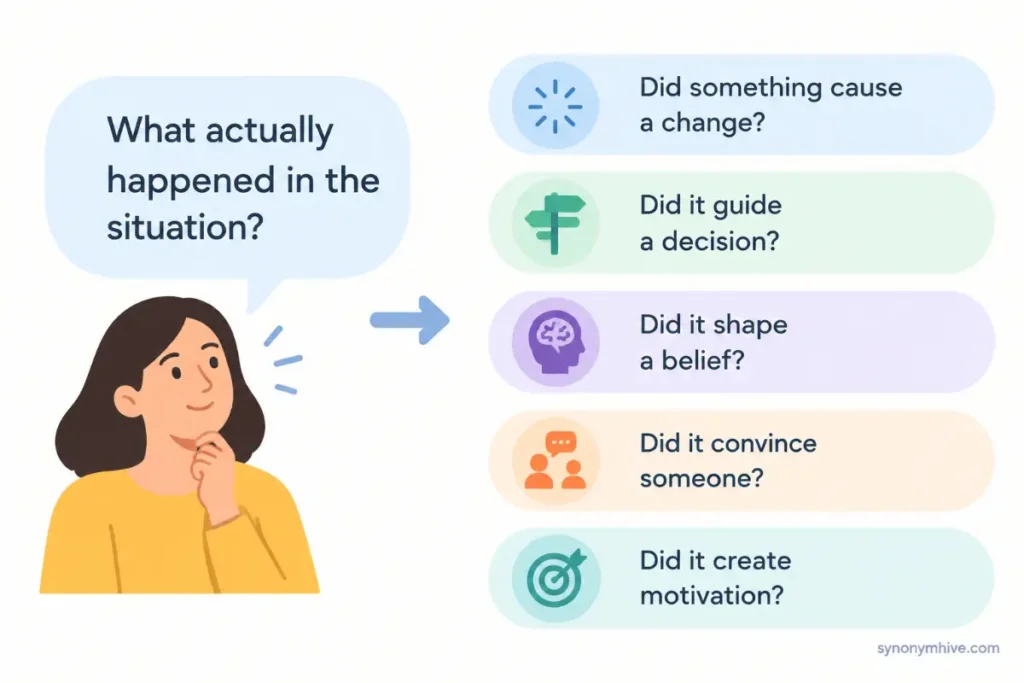
Start by asking what actually happened in the situation. Did something cause a change, guide a decision, shape a belief, convince someone, or create motivation?
Next, consider the strength of the effect. If the effect was small, a word such as prompt or encourage may work. If the effect was decisive, determine may be more accurate.
Think about your audience too. Simple words usually work best in texts and everyday conversation. Academic writing may call for more precise analytical terms, while resumes benefit from action verbs that show results.
Finally, read the complete sentence. A word may appear in a thesaurus as a synonym but still sound unnatural in your particular sentence.
The best synonym isn’t always the most impressive word. It’s the word that communicates your intended meaning with the least confusion.
What Should You Remember About Influence Synonyms?
When you need another phrase for influence, first identify the type of effect you mean.
Use affect for a general effect. Use shape for long term development.
Choose inspire when ideas or examples encourage someone. Choose motivate when you give someone a reason to act. Use impact when you want to emphasize a noticeable effect or result.
For resumes, action verbs such as led, drove, guided, and motivated often communicate more than a general statement about influence.
Most importantly, don’t replace a word just for variety. If influence is the clearest choice, keep it.
Expand your vocabulary with Another Word for Significant Best Alternatives 2026.
Conclusion
The right synonym for influence depends on what kind of effect you want to describe. Affect works well for a general effect, shape fits long term development, guide suggests direction, persuade focuses on convincing, and impact emphasizes the result.
Strong writing comes from precision rather than complicated vocabulary. A resume may benefit from action verbs such as led or drove, while an essay may need affect or shape. A text usually sounds more natural with simple words such as change or convince.
When you need another word for influence, think about what actually happened first. Once you identify the type and strength of the effect, you can choose a word that makes your sentence clearer and more accurate.
Frequently Asked Questions
What’s another way to say influence?
Another way to say influence is affect, shape, guide, sway, impact, persuade, motivate, inspire, or encourage. The best choice depends on the exact meaning and strength of the effect.
What is a simple word for influence?
Affect is one of the simplest alternatives to influence. Shape and guide are also useful when you mean helping form an idea or directing someone toward a choice.
What is a strong synonym for influence?
Sway, persuade, drive, pressure, and determine can describe strong influence. Each word has a different meaning, so choose the one that matches the situation.
What is another term for influence on a resume?
Impact, led, drove, guided, shaped, and motivated can work well on a resume. Specific action verbs can show your contribution more clearly than a general statement about influence.
Is affect the same as influence?
Affect and influence overlap, but they aren’t always identical. Affect usually means causing an effect, while influence can suggest a broader or more gradual effect on choices, ideas, or behavior.
What is another term for influence in an essay?
Affect, shape, impact, guide, and determine are useful essay choices. The best option depends on the relationship you are describing and the strength of that relationship.
What is the opposite of influence?
Common opposites include ignore, resist, reject, disregard, dismiss, and remain unaffected. The right choice depends on how the lack of influence appears in the sentence.