
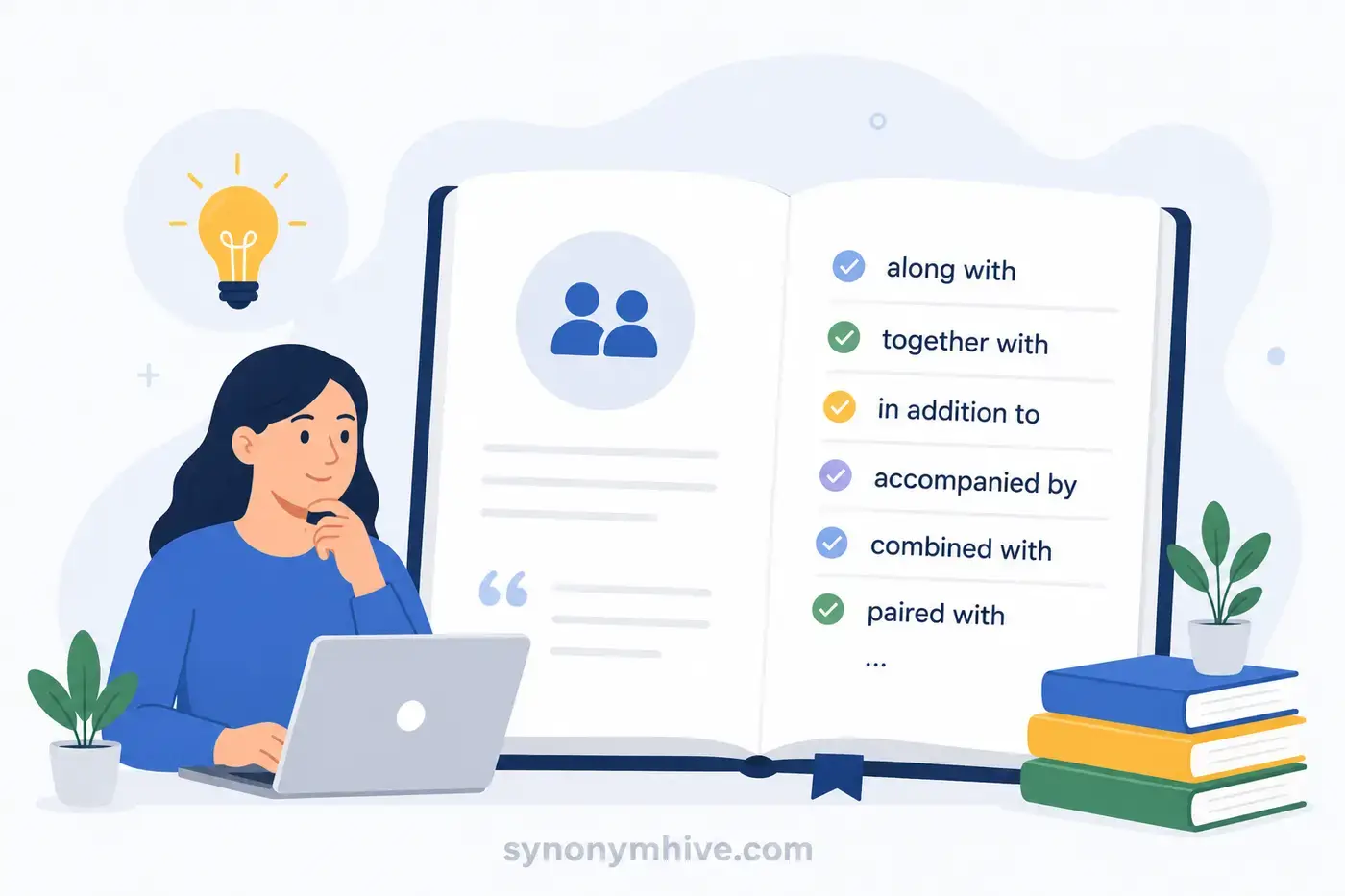
Have you ever been writing an email, essay, resume, or even a quick text and noticed you’ve used the word with again and again? It’s one of the most common words in English, so repeating it is easy. That’s why many people search for alternatives for with to make their writing sound smoother and more natural. The word with connects people, ideas, objects, and actions. It seems simple, but it has many meanings. Because of that, there isn’t one replacement that works in every sentence. The best choice depends on what you’re trying to say.
Synonyms for with include alongside, together with, accompanied by, using, by, through, including, among, beside, and plus. The right alternative depends on whether you’re showing company, method, possession, or addition.
In this guide, you’ll learn what with means, where it came from, and how to choose the best replacement for different situations. You’ll also find a large synonym list, practical examples, and tips for avoiding common mistakes.
Looking for another word? See Synonyms for Good: The Ultimate Guide Write Like a Pro (2026).
What Does “With” Mean in Plain English?
The word with is a preposition that connects one thing to another.
It can show:
- People being together
- The tool used to do something
- Something that belongs to someone
- An added item
- A relationship between ideas
Here are a few simple examples.
- I’m going with my friends.
- She cut the paper with scissors.
- A house with a garden costs more.
- Coffee with milk tastes great.
- He greeted us with a smile.
Although the same word appears in every sentence, its meaning changes slightly each time. That’s one reason many writers look for synonyms instead of using the same word repeatedly.
Where Does the Word “With” Come From?
The word with has been part of English for over a thousand years. It comes from the Old English word wið, which originally had meanings related to against, toward, and near. As English changed over time, the meaning shifted. Today, with usually expresses togetherness, connection, accompaniment, or the way something is done.
Modern English uses with in hundreds of everyday expressions.
For example:
- With care
- With confidence
- With friends
- With permission
- With respect
Because the word has several meanings, choosing the right replacement depends on the context rather than the word alone.
Why Should You Use Another Word Instead of “With”?
Using with too often can make your writing feel repetitive.
Look at this example.
Example 1
She arrived with her brother.
Alongside her teacher, she walked.
She left with a smile.
She returned with good news.
The repeated word becomes noticeable.
Example 2
She arrived alongside her brother.
Walking beside her teacher, she listened carefully.
She left smiling.
She returned carrying good news.
The second version sounds more varied because each sentence uses a more specific expression.
Using different synonyms can help you:
- Reduce repetition
- Improve sentence flow
- Sound more natural
- Match formal or casual writing
- Make descriptions more precise
- Keep readers interested
When Should You Replace “With”?
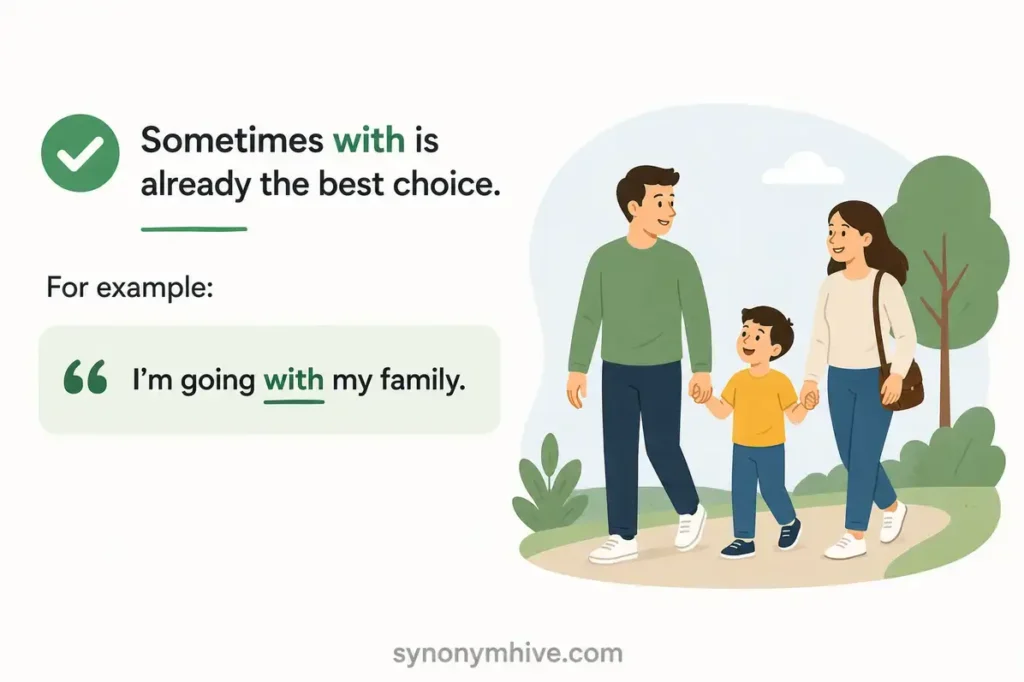
Sometimes with is already the best choice.
For example:
I’m going with my family.
This sounds completely natural.
In other situations, another expression works better.
Instead of writing:
She completed the project with great care.
You could write:
- She completed the project carefully.
- She completed the project using great care.
- She completed the project with close attention to detail.
Replacing with should make the sentence clearer, not more complicated.
What’s the Best Synonym for “With”?
There isn’t one perfect replacement.
The best choice depends on the meaning.
If you’re talking about people together, alongside or together with may fit.
When describing a tool, using or by means of often works better.
If you’re adding information, plus or including may be the right choice.
Always think about what with means in your sentence before replacing it.
Master List of Synonyms for With
Simple phrases
Alongside
- Meaning: Next to or together with
- Tone: Neutral
- Example: She worked alongside experienced engineers.
Together With
- Meaning: In the company of
- Tone: Neutral
- Example: The manager, together with the staff, attended the meeting.
Beside
- Meaning: Next to
- Tone: Everyday
- Example: He sat beside his best friend.
Using
- Meaning: By means of
- Tone: Neutral
- Example: She opened the box using a small knife.
By
- Meaning: Through a method or means
- Tone: Neutral
- Example: The message was sent by email.
Including
- Meaning: Containing as part of a group
- Tone: Neutral
- Example: The package includes free shipping, including tracking.
Plus
- Meaning: Added together with
- Tone: Casual
- Example: The meal comes with fries plus a drink.
Among
- Meaning: In the company of a group
- Tone: Neutral
- Example: She felt comfortable among friends.
These alternatives cover many common meanings of with.
Everyday Alternatives
Along
- Meaning: In someone’s company
- Tone: Casual
- Example: Can I come along?
In Company With
- Meaning: Together with
- Tone: Neutral
- Example: He arrived in company with his business partner.
Side by Side With
- Meaning: Next to or working together
- Tone: Everyday
- Example: The volunteers worked side by side with local families.
Carrying
- Meaning: Having something in your possession
- Tone: Everyday
- Example: She walked in carrying a large backpack.
Holding
- Meaning: Having something in your hands
- Tone: Everyday
- Example: He entered holding a cup of coffee.
Accompanied By
- Meaning: Together with someone or something
- Tone: Slightly formal
- Example: The singer was accompanied by a live band.
Equipped With
- Meaning: Having something available
- Tone: Neutral
- Example: The classroom is equipped with modern computers.
Complete With
- Meaning: Including every needed part
- Tone: Everyday
- Example: The cabin comes complete with a fireplace.
Formal Alternatives
By Means Of
- Meaning: Using a particular method
- Tone: Formal
- Example: The data was collected by means of an online survey.
Through
- Meaning: Using a process or method
- Tone: Formal
- Example: The issue was solved through teamwork.
In Association With
- Meaning: Working together with
- Tone: Formal
- Example: The event was organized in association with local charities.
Developed in Collaboration With
- Meaning: Cooperating with
- Tone: Professional
- Example: The company launched the project in partnership with another business.
In Collaboration With
- Meaning: Working jointly
- Tone: Professional
- Example: The report was prepared in collaboration with university researchers.
These formal expressions are useful in reports, academic writing, business documents, and professional emails.
What’s Coming in Part 2?
In the next section, you’ll discover:
- More than 30 complete alternatives for with
- variants grouped by meaning and usage
- Notes on grammar and parts of speech
- American and British English differences
- The best alternatives for resumes, essays, emails, texting, and speaking
- More than 10 original example sentences
- Side-by-side comparisons such as “with vs. alongside” and “with vs. using”
- Practical advice for choosing the right word every time
More Synonyms for With
The word with has many meanings, so there are many possible replacements. The following alternatives work in different situations depending on what you want to express.
More Everyday alternatives
Along With
- Meaning: Together with
- Tone: Everyday
- Example: She brought her sister along with her.
As Well As
- Meaning: In addition to
- Tone: Neutral
- Example: The package includes a charger as well as a carrying case.
Together
- Meaning: In each other’s company
- Tone: Casual
- Example: We studied together all afternoon.
In the Company Of
- Meaning: Together with someone
- Tone: Neutral
- Example: The actor arrived in the company of friends.
Featuring
- Meaning: Including as an important part
- Tone: Everyday
- Example: The menu features fresh local ingredients.
Loaded With
- Meaning: Full of
- Tone: Casual
- Example: The guide is loaded with useful tips.
Filled With
- Meaning: Containing a large amount of something
- Tone: Everyday
- Example: The room was filled with laughter.
Surrounded By
- Meaning: Having people or things around
- Tone: Neutral
- Example: The castle is surrounded by beautiful gardens.
More Formal Phrases
Together Alongside
- Meaning: Working or existing together
- Tone: Formal
- Example: Scientists worked together alongside international teams.
Assisted By
- Meaning: Helped by
- Tone: Professional
- Example: The surgeon was assisted by an experienced medical team.
Supported By
- Meaning: Backed or helped by
- Tone: Formal
- Example: The proposal was supported by strong evidence.
Combined With
- Meaning: Joined together
- Tone: Neutral
- Example: Experience combined with determination leads to success.
Joined By
- Meaning: Accompanied by
- Tone: Neutral
- Example: The speaker was joined by several industry experts.
Coupled With
- Meaning: Together with another factor
- Tone: Formal
- Example: Hard work coupled with patience often brings success.
Informal Alternatives
Plus
- Meaning: And also
- Tone: Casual
- Example: I’ll bring snacks, plus drinks.
Bringing
- Meaning: Carrying something
- Tone: Casual
- Example: She’s bringing homemade cookies.
Packing
- Meaning: Carrying along
- Tone: Informal
- Example: They’re packing extra blankets for the trip.
With these additions, you now have more than 30 useful alternatives that can replace with in different situations.
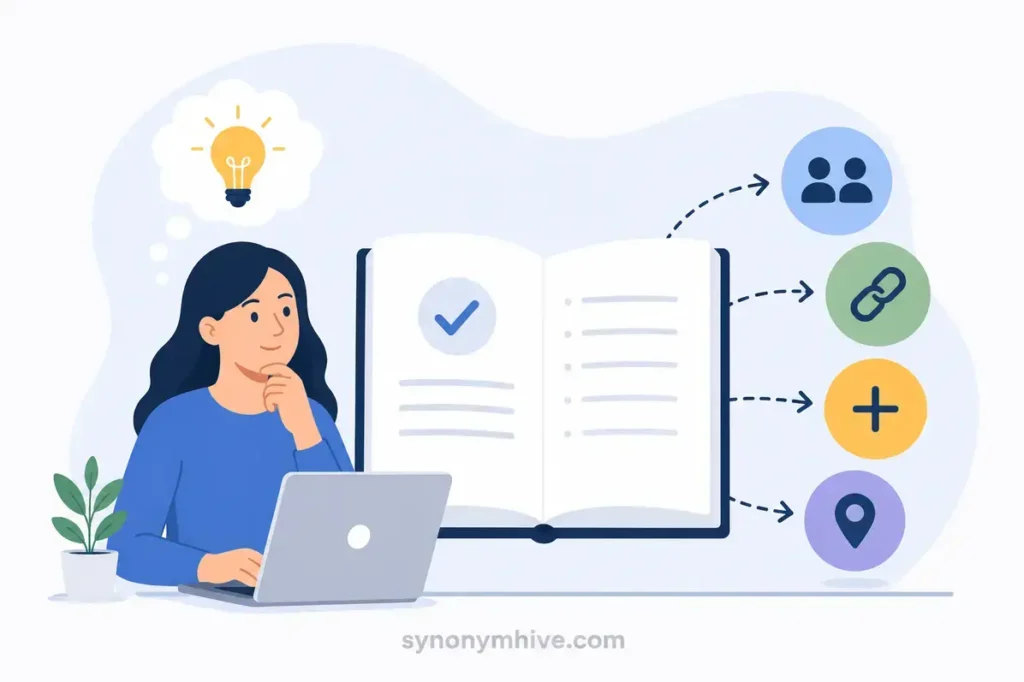
Can Synonyms for “With” Be Grouped by Meaning?
Yes. Since with has several meanings, grouping alternatives by purpose makes choosing the right one much easier.
Showing Company
Use these when people or things are together.
- Alongside
- Together with
- Along with
- Beside
- In the company of
- Accompanied by
- Joined by
Example:
She traveled alongside her classmates.
Showing a Tool or Method
These describe how something is done.
- Using
- By
- Through
- By means of
Example:
He repaired the chair using simple tools.
Showing Addition
These add extra information or items.
- Plus
- Including
- As well as
- Featuring
- Complete with
Example:
The room comes complete with free Wi-Fi.
Showing Support or Cooperation
These describe people or organizations working together.
- In collaboration with
- In partnership with
- In association with
- Supported by
- Assisted by
Example:
The project was completed in collaboration with local volunteers.
Do These Synonyms Belong to Different Parts of Speech?
Most alternatives for with are prepositions or prepositional phrases, but not all of them.
Prepositions
These connect nouns or pronouns.
Examples include:
- With
- Beside
- Among
- During
- Through
- By
Example:
She walked beside her friend.
Prepositional Phrases
These act like prepositions but contain more than one word.
Examples include:
- Together with
- Along with
- In collaboration with
- By means of
- In partnership with
Example:
The research was completed in partnership with local schools.
Participial Phrases
Some alternatives use present or past participles.
Examples include:
- Using
- Carrying
- Holding
- Accompanied by
- Supported by
Example:
He entered carrying several books.
Understanding these grammar patterns helps you choose a replacement that fits naturally.
Are There Differences Between American and British English?
Most alternatives are common in both American and British English. However, some expressions are slightly more popular in one variety.
More Common in American English
- Along with
- Plus
- Using
- Complete with
- Filled with
These are common in everyday speech and writing across the United States.
More Common in British English
- Alongside
- In association with
- Coupled with
These appear more often in British newspapers, reports, and formal writing. Even so, native speakers from both regions will understand nearly all of these expressions.
Need another vocabulary suggestion? Read Synonyms for Also Simple Guide (2026).
What’s the Best Alternative for a Resume?
A resume should sound confident and professional.
Instead of repeating with, try expressions like:
- Experienced in
- Skilled in
- Proficient in
- In collaboration with
- Supported by
Example
Less effective:
Worked with customers every day.
Better:
Collaborated with customers to solve service issues.
Or:
Provided daily support to customers.
These versions sound stronger and more specific.
What’s the Best Alternative for an Essay?
Academic writing often benefits from more precise wording.
Good choices include:
- Through
- By means of
- In collaboration with
- Combined with
- Alongside
Example
Basic:
The results improved with better planning.
Improved:
The results improved through better planning.
Or:
The results improved as a result of better planning.
These alternatives make essays sound more polished.
What’s the Best Alternative for an Email?
Professional emails should be clear and natural.
Good choices include:
- Along with
- Together with
- Including
- As well as
- Attached with (only when appropriate, though “attached” alone is often better)
Examples
Please review the report along with the attached spreadsheet.
The package includes the user guide as well as installation instructions.
I’ve included additional notes for your review.
What’s the Best Alternative for Text Messages?
Text messages usually use simple, conversational language.
People often choose:
- Along with
- Plus
- Together
- Bringing
- With
Examples
I’m bringing snacks plus drinks.
Come along with us.
We’re going together.
Simple wording usually sounds the most natural in everyday conversations.
Real-Life Example Sentences
Here are original examples showing how different alternatives work in real situations.
- She worked alongside experienced designers.
- The children played together all afternoon.
- He fixed the shelf using a screwdriver.
- The report was prepared in collaboration with two universities.
- We ordered pizza plus drinks for everyone.
- The hikers traveled carrying only small backpacks.
- The event was organized in partnership with local businesses.
- The classroom is equipped with modern technology.
- She entered the room holding a stack of books.
- The project succeeded through careful planning.
- The hotel offers breakfast as well as free parking.
- The singer performed accompanied by a full orchestra.
With vs. Alongside: What’s the Difference?
These expressions are similar but not identical.
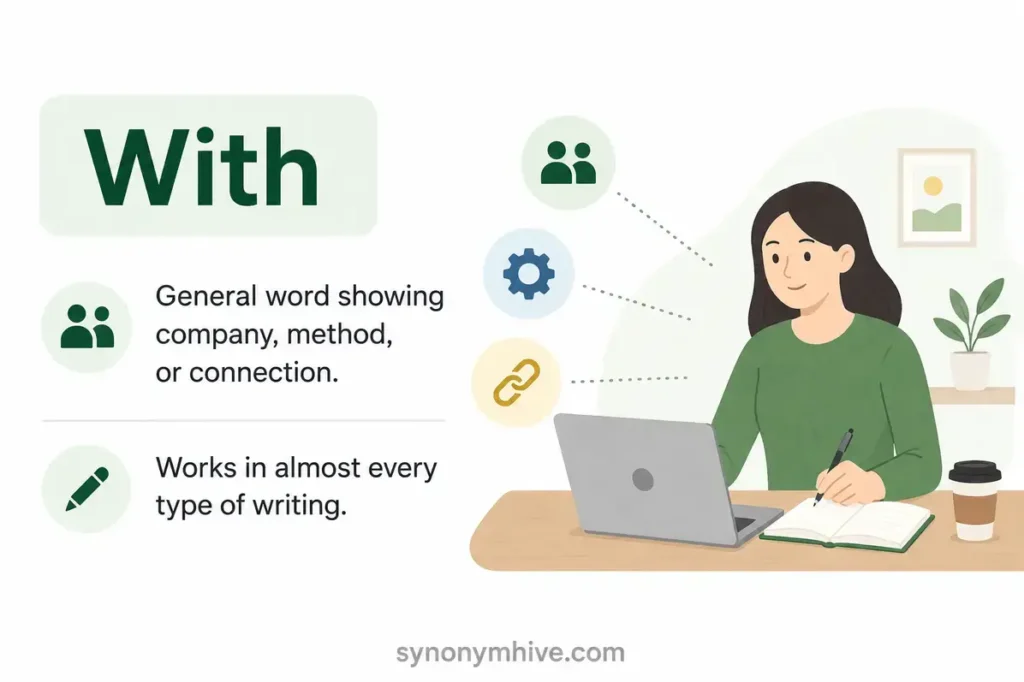
With
- General word showing company, method, or connection.
- Works in almost every type of writing.
Example:
She traveled with her family.
Alongside
- Means next to or working together.
- Often emphasizes cooperation.
Example:
She worked alongside experienced engineers.
Use alongside when you want to highlight teamwork or physical closeness.
With vs. Using: What’s the Difference?
Many people confuse these words because both can describe how something is done.
With
- Introduces the tool or object.
Example:
He cut the paper with scissors.
Using
- Focuses on the action of employing the tool.
Example:
He cut the paper using scissors.
Both are correct, but using often sounds more active in formal writing.
What’s Coming in Part 3?
The final section includes:
- Common mistakes and when not to replace with
- Brief antonyms and opposite ideas
- Quick tips for choosing the right synonym
- A practical conclusion
- Frequently Asked Questions
- An SEO-friendly Meta Description
What Are the Most Common Mistakes When Using Synonyms for “With”?
Using different words instead of with can make your writing stronger, but only if the replacement matches the meaning. Since with has many uses, it’s easy to choose the wrong alternative.
Here are the most common mistakes.
Using One Synonym for Every Situation
Many people think one replacement works everywhere.
It doesn’t.
For example:
Less accurate:
She opened the door alongside a key.
Better:
She opened the door with a key.
Or:
She opened the door using a key.
Alongside describes people or things together. It doesn’t describe a tool.
Replacing “With” When It Isn’t Necessary
Sometimes with is already the clearest word.
For example:
I went with my parents.
This sentence sounds natural. Changing it to:
I went alongside my parents.
is grammatically correct, but it sounds less natural in everyday conversation.
Use a synonym only if it improves the sentence.
Confusing “With” and “By”
These words often describe methods, but they aren’t always interchangeable.
Correct:
She traveled by train.
Correct:
She traveled with her friends.
By describes the method of travel.
With describes the people traveling together.
Using Formal Expressions in Casual Writing
Some alternatives are correct but sound too formal in daily conversations.
Examples include:
- By means of
- In association with
- In collaboration with
- Coupled with
Instead of saying:
I solved the problem by means of a calculator.
Most people would simply say:
I solved the problem with a calculator.
Match your vocabulary to your audience.
Forgetting That Some Replacements Change Sentence Structure
Some alternatives require different grammar.
For example:
Correct:
She completed the work with great care.
Also correct:
She completed the work carefully.
Notice that the second sentence changes the structure completely.
Always read your sentence again after replacing with.
Are There Antonyms of “With”?
There isn’t one perfect opposite because with has several meanings. However, these words often express opposite ideas depending on the sentence.
Without
The most direct opposite.
Example:
He left without his wallet.
Apart From
Shows separation instead of connection.
Example:
Apart from one mistake, the report was excellent.
Away From
Shows distance.
Example:
Please stay away from the wet paint.
Separate From
Shows that two things are not together.
Example:
Keep raw meat separate from vegetables.
Against
In some contexts, against expresses opposition instead of cooperation.
Example:
They voted against the proposal.
The correct opposite depends on how with is being used in the sentence.
Quick Tips for Choosing the Right Synonym
Picking the right alternative becomes much easier if you ask a few simple questions.
Ask What “With” Means
Does it show:
- Company?
- A tool?
- A method?
- An added item?
- Cooperation?
The answer points you toward the best replacement.
Choose Simple Words First
Simple words are often the best choice.
Instead of:
The report was prepared by means of advanced software.
Write:
The report was prepared using advanced software.
Simple writing is easier to understand.
Match the Tone
For formal writing, consider:
- In collaboration with
- Through
- In partnership with
- By means of
For everyday writing, use:
- With
- Along with
- Using
- Plus
- Together with
Choose words your audience expects.
Avoid Replacing Every “With”
Your goal is better writing, not constant variety.
If with is already the clearest word, keep it.
Replacing every instance can make your writing sound unnatural.
Read Your Sentence Aloud
This is one of the easiest editing tricks.
If a replacement sounds awkward when spoken, try another option.
Natural writing usually sounds natural when you read it aloud.
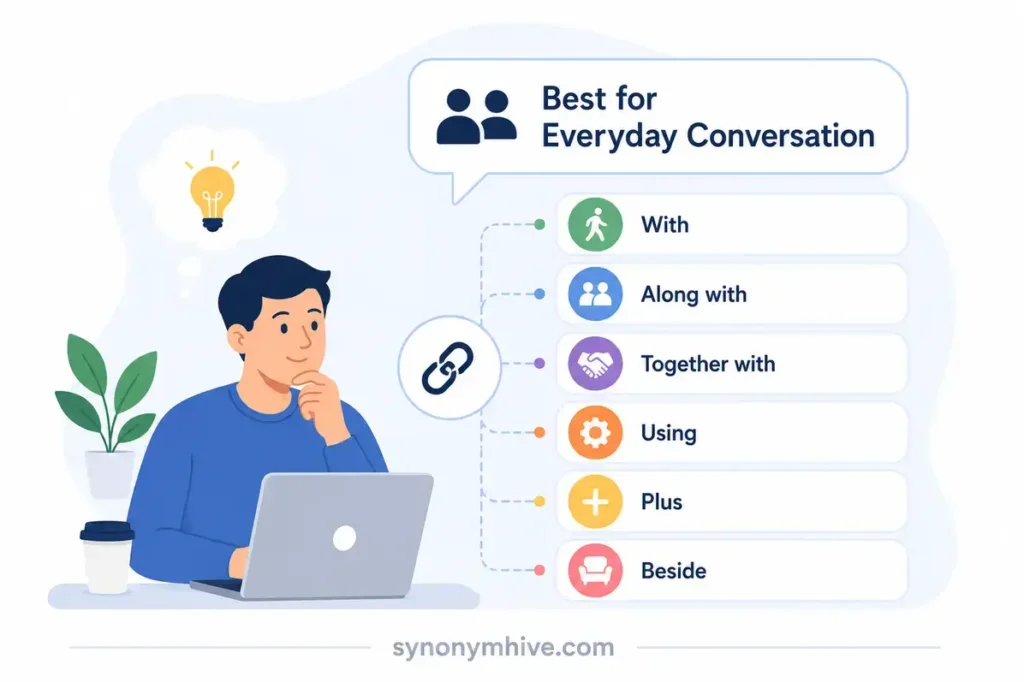
Quick Reference Guide
Best for Everyday Conversation
- With
- Along with
- Together with
- Using
- Plus
- Beside
Best for Essays
- Through
- By means of
- Alongside
- Combined with
- In collaboration with
Most Suitable for Professional Emails
- Along with
- Including
- Together with
- As well as
- Supported by
Best for Resumes
- Collaborated with
- Assisted by
- Worked alongside
- Supported by
- Partnered with
Best for Formal Writing
- In partnership with
- In association with
- By means of
- Coupled with
- Through
Keeping these groups in mind helps you choose the right expression more quickly.
Learn more useful word alternatives in Synonyms for When: The Ultimate Guide Write Like a Pro (2026).
Conclusion
Learning the best synonyms for with can make your writing more natural, varied, and precise. Although with is one of the most common words in English, it doesn’t always express exactly what you mean. Depending on the situation, words and phrases like alongside, using, together with, through, including, and plus may fit better.
The key is to understand the purpose of the word in your sentence. Is it showing company, a method, a tool, or an addition? Once you identify that meaning, choosing the right replacement becomes much easier. Keep practicing with the examples in this guide, and you’ll quickly become more confident when selecting the best alternative for any type of writing.
Frequently Asked Questions
What’s another way to say “with”?
Some of the best alternatives are alongside, together with, using, including, plus, through, and accompanied by. The right choice depends on the meaning of your sentence.
What are the best synonyms in formal writing?
For formal writing, good choices include through, by means of, in collaboration with, in partnership with, and supported by because they sound more professional.
Can I replace “with” in every sentence?
No. Since with has many meanings, no single synonym works in every situation. Choose a replacement only when it matches the context.
What are the most common alternatives for with?
The most common variant for with include along with, together with, using, including, beside, plus, and accompanied by because they work in many everyday situations.
What’s another way to say “with” in an email?
In professional emails, people often use along with, including, as well as, or together with to sound clear and polite.
Is “using” a synonym for “with”?
Sometimes. Using works when with describes the tool or method used to do something, but it doesn’t replace every meaning of with.
Can I use synonyms in essays?
Yes. Using synonyms naturally can improve sentence variety and make essays easier to read, as long as each replacement fits the meaning.