
Have you ever been writing an email, essay, resume, or even a text message and noticed you’ve used the word that over and over? You’re not alone. Many people search for synonyms for that because they want their writing to sound smoother, clearer, and less repetitive. The word that is one of the most common words in English. It can point to a person or thing, introduce a clause, or connect ideas. Because it has several jobs, there’s no single replacement that works in every sentence.
Synonyms include which, this, those, these, who, whom, so that, in order that, the one, and the fact that, depending on how that is used in the sentence.
This guide explains what that really means, where it came from, and how to choose the best replacement for different situations. You’ll also find a large list of alternatives, examples, comparisons, and practical writing tips.
Explore another synonym guide: Synonyms for Said: The Ultimate Guide Boost Your Writing (2026).
What Does “That” Mean in Plain English?
The word that is one of the most flexible words in English.
It can be used to:
- Point to a person or thing
- Connect two parts of a sentence
- Introduce extra information
- Refer to something mentioned earlier
- Show distance in time or place
Here are a few simple examples.
- That book belongs to Sarah.
- I think that you’re right.
- The movie that we watched was funny.
- Is that your backpack?
- She said that she would arrive early.
As you can see, the same word has different jobs in each sentence. That’s why finding the right replacement depends on the meaning, not just the word itself.
Where Does the Word “That” Come From?
The word that comes from the Old English word þæt (thaet). It was used to point to something specific and also to connect ideas within a sentence.
Over hundreds of years, English speakers kept using the word because it was simple and useful. Today, that appears in everyday conversations, books, news articles, business emails, and academic writing. Because it serves several grammatical purposes, many synonymst work only in certain situations. Choosing the right one means first understanding what that is doing in your sentence.
Why Look for Another Word Instead of “That”?
There’s nothing wrong with using that. The problem comes when it appears too often in the same paragraph.
For example:
She said that the report that you sent was the one that everyone liked.
The sentence is correct, but the repeated word makes it feel heavy.
Now compare it with this version:
She said the report you sent was the one everyone liked.
Or:
She said the report you sent was everyone’s favorite.
The meaning stays the same, but the sentence flows better.
Learning substitute for that and knowing when you can simply remove the word helps your writing sound more natural.
When Should You Replace “That”?
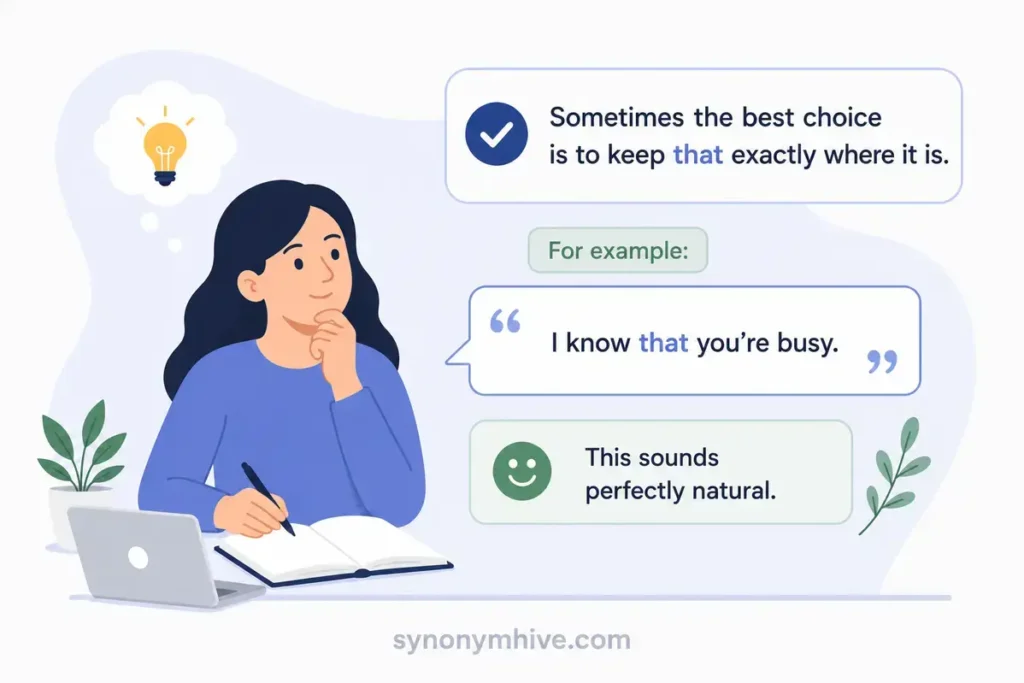
Sometimes the best choice is to keep that exactly where it is.
For example:
I know that you’re busy.
This sounds perfectly natural.
Other times, another word works better.
Instead of:
The student that won the award smiled.
You could write:
- The student who won the award smiled.
- The student who earned the award smiled.
Or instead of:
The book that is on the table is mine.
You could write:
- The book which is on the table is mine.
The right replacement depends on whether that refers to a person, thing, idea, or clause.
Is There One Best Synonym for “That”?
No.
Unlike many words, that has several different meanings and grammatical functions.
For example:
- Use who for people.
- Use which for many things.
- Use this or these for nearby objects.
- Use those for plural nouns farther away.
- Use the fact that when referring to an idea.
- Sometimes you can simply remove that without changing the meaning.
That’s why choosing the best replacement always depends on context.
Master List of Synonyms for That
Simple Variants
| Word | Meaning | Tone | Example |
|---|---|---|---|
| Which | Refers to a thing or animal | Neutral | The phone which I bought works well. |
| Who | Refers to a person | Everyday | The teacher who helped me was kind. |
| Whom | Refers to a person as an object | Formal | The guest whom we invited arrived early. |
| This | Refers to something close | Everyday | This idea makes sense. |
| These | Refers to nearby plural items | Everyday | These books are new. |
| Those | Refers to things farther away | Everyday | Those shoes look comfortable. |
| The One | Refers to a specific item | Neutral | This is the one I wanted. |
| The Fact That | Refers to an idea or statement | Formal | The fact that everyone agreed surprised us. |
Everyday Alternatives
| Word | Meaning | Tone | Example |
|---|---|---|---|
| The Person Who | Refers clearly to someone | Everyday | The person who called has arrived. |
| The Thing That | Refers to an object or idea | Everyday | The thing that matters most is honesty. |
| Such | Refers to something previously mentioned | Neutral | I’ve never seen such kindness. |
| What | Refers to the thing being discussed | Casual | What you said was true. |
| Whichever | Any one from a group | Neutral | Choose whichever color you like. |
| Whoever | Any person | Everyday | Whoever finishes first wins. |
| Whatever | Any thing | Casual | Take whatever you need. |
| The Item | Refers to one object | Neutral | The item you ordered has shipped. |
Formal Alternatives
| Word | Meaning | Tone | Example |
|---|---|---|---|
| In Order That | Shows purpose | Formal | Leave early in order that you arrive on time. |
| So That | Shows purpose or result | Neutral | Study daily so that you improve. |
| Which Said | Refers back in legal writing | Very Formal | The agreement, which said otherwise, remained valid. |
| Aforementioned | Previously mentioned | Formal | The aforementioned document is attached. |
| Said | Previously mentioned | Legal/Formal | Said property shall remain protected. |
| The Aforementioned | Earlier mentioned item | Formal | The aforementioned policy applies here. |
These are only the first group of useful alternatives. As you’ll see in the next section, many more expressions can replace that depending on whether you’re writing an essay, resume, email, or casual message.
What’s Coming in Part 2?
In the next section, you’ll learn:
- More than 30 useful alternatives for that
- variant grouped by meaning and grammar
- phrases by intensity and usage
- Parts of speech and how they affect word choice
- American vs. British English notes
- The best alternatives for resumes, essays, emails, texting, and speaking
- Original real-life example sentences
- Side-by-side comparisons such as that vs. which and that vs. who
More Synonyms for That
The word that can act as a pronoun, determiner, conjunction, or relative pronoun. Because it has several jobs, you’ll find many possible replacements depending on the sentence.
More Everyday Synonyms
| Word | Meaning | Tone | Example |
|---|---|---|---|
| Which One | Refers to a specific choice | Everyday | Which one do you prefer? |
| This One | Refers to a nearby item | Casual | This one looks better. |
| That One | Refers to a specific item farther away | Everyday | I’ll take that one. |
| These Ones | Refers to nearby plural items | Casual | These ones are cheaper. |
| Those Ones | Refers to distant plural items | Casual | Those ones belong to my brother. |
| The One Which | Refers to a specific thing | Neutral | The one which fits best is blue. |
| The One Who | Refers to a specific person | Everyday | She’s the one who helped me. |
| Whoever It Is | Refers to any person | Casual | Whoever it is can wait. |
More Formal Alternatives
| Word | Meaning | Tone | Example |
|---|---|---|---|
| Such That | Expresses a result or condition | Formal | The numbers were arranged such that every row matched. |
| Provided That | Expresses a condition | Formal | You may leave provided that your work is finished. |
| Given That | Considering the fact | Formal | Given that traffic was heavy, we left early. |
| Seeing That | Because | Neutral | Seeing that everyone agreed, we continued. |
| Considering That | Taking into account | Neutral | Considering that it’s raining, we’ll stay inside. |
| Assuming That | If something is true | Formal | Assuming that the report is correct, we can proceed. |
Informal Alternatives
| Word | Meaning | Tone | Example |
|---|---|---|---|
| Like | Used informally in conversation | Informal | It wasn’t like I expected. |
| What | Refers to the thing mentioned | Casual | That’s exactly what I wanted. |
| The Stuff | Refers to things generally | Casual | The stuff you bought looks great. |
| The Thing | Refers to an idea or object | Casual | The thing we discussed is finished. |
With these additions, you now have well over 30 useful alternatives that can replace that in different contexts.
Can Synonyms for “That” Be Grouped by Meaning?
Yes. Since that has several different functions, grouping alernatives by meaning makes them easier to understand.
Referring to People
Use these when talking about someone.
- Who
- Whom
- Whoever
- The person who
- The one who
Example:
The neighbor who helped us was very kind.
Referring to Things
Use these when talking about objects, places, or ideas.
- Which
- This
- These
- Those
- The one
- The item
Example:
The laptop which I bought works perfectly.
Showing Purpose
These connect ideas about goals or results.
- So that
- In order that
- Such that
Example:
Leave early so that you don’t miss the train.
Showing a Condition
These introduce conditions.
- Provided that
- Assuming that
- Given that
Example:
You may borrow the car provided that you return it tonight.
Referring to an Earlier Idea
These point back to something already mentioned.
- The fact that
- Such
- The aforementioned
- Said
Example:
The fact that everyone agreed surprised the manager.
Do These Synonyms Belong to Different Parts of Speech?
Yes. This is one reason replacing that isn’t always simple.
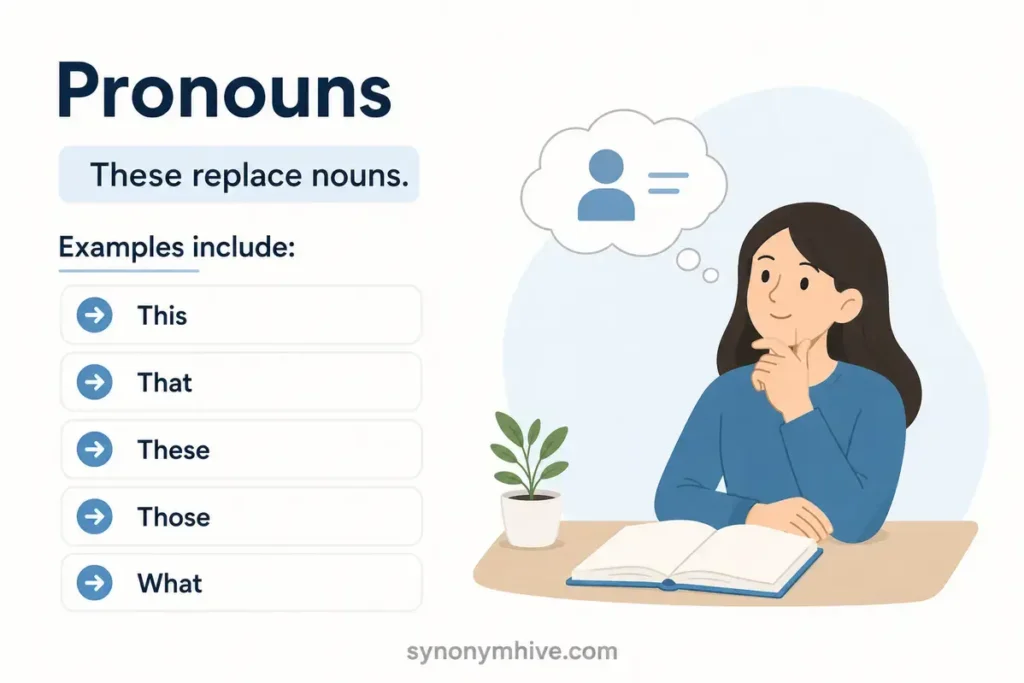
Pronouns
These replace nouns.
Examples include:
- This
- That
- These
- Those
- What
Example:
This belongs to me.
Relative Pronouns
These connect a noun with more information.
Examples include:
- That
- Which
- Who
- Whom
Example:
The student who answered first won.
Conjunctions
These connect two clauses.
Examples include:
- That
- So that
- Provided that
- Assuming that
Example:
She said that she would arrive early.
Determiners
These appear before nouns.
Examples include:
- That
- This
- These
- Those
Example:
That book is mine.
Knowing which grammatical role that plays makes choosing the right replacement much easier.
Are There Differences Between American and British English?
Most alternatives are understood in both American and British English. However, there are a few small differences.
More Common in American English
- Who
- Which
- That
- This
- Those
American English often allows that in restrictive clauses.
Example:
The movie that we watched was excellent.
More Common in British English
British English sometimes prefers which where American English commonly uses that.
Example:
British:
The car which I bought is blue.
American:
The car that I bought is blue.
Both versions are grammatically correct.
What’s the Best Alternative for a Resume?
Resume writing should be direct and concise.
Instead of:
Completed projects that improved efficiency.
You could write:
- Completed projects which improved efficiency.
- Completed projects improving efficiency.
Or simply remove that if the sentence still reads naturally.
Example
Less effective:
Created reports that helped management.
Better:
Created reports helping management make faster decisions.
Or:
Created reports that supported better decision-making.
Expand your vocabulary with Synonyms for Led: Better Words to Use (2026).
What’s the Best Alternative for an Essay?
Academic writing often benefits from more precise wording.
Good choices include:
- Which
- The fact that
- In order that
- Provided that
- Given that
Example
Basic:
The evidence suggests that climate change is affecting wildlife.
Improved:
The evidence suggests climate change is affecting wildlife.
Or:
The evidence supports the fact that climate change is affecting wildlife.
What’s the Best Alternative for an Email?
Professional emails should sound clear without being overly formal.
Good choices include:
- Which
- So that
- The fact that
- This
- Those
Examples
Please review the document so that we can finalize the project.
The report, which is attached, includes all recent updates.
Thank you for confirming the information.
What’s the Best Alternative for Text Messages?
Text messages usually use short, simple language.
People often choose:
- This
- That
- What
- The one
- Whoever
Examples
That’s exactly what I meant.
This is the one I told you about.
Whoever gets there first can save us a table.
Real-Life Example Sentences
Here are original examples showing different ways to replace that.
- The teacher who inspired me retired last year.
- The jacket which I ordered arrived today.
- Take this if you need it.
- Those books belong to the library.
- The fact that everyone arrived early surprised us.
- We left early so that we could avoid traffic.
- Whoever answers correctly wins the prize.
- The item you requested is back in stock.
- Given that the weather improved, we continued the hike.
- Assuming that everything goes as planned, we’ll finish today.
- The person who called asked for you.
- Choose whichever option fits your budget.
That vs. Which: What’s the Difference?
These words are closely related, but they aren’t always used the same way.
That
- Often introduces essential information.
- Common in everyday American English.
Example:
The book that I borrowed is excellent.
Which
- Often introduces additional information.
- Frequently used after commas.
Example:
The book, which I borrowed yesterday, is excellent.
In informal writing, many people use them interchangeably, but formal writing often follows this distinction.
That vs. Who: What’s the Difference?
These words both introduce relative clauses, but they refer to different things.
That
- Usually refers to people, animals, or things in restrictive clauses.
- Very common in American English.
Example:
The employee that solved the problem received an award.
Who
- Refers specifically to people.
- Often sounds more natural.
Example:
The employee who solved the problem received an award.
For people, who is usually the preferred choice, especially in formal writing.
What’s Coming in Part 3?
The final section includes:
- Common mistakes and when not to replace that
- Brief antonyms and opposite ideas
- Quick tips for choosing the right synonym
- A practical conclusion
- Frequently Asked Questions
- An SEO-friendly Meta Description
What Are the Most Common Mistakes When Using Synonyms for “That”?
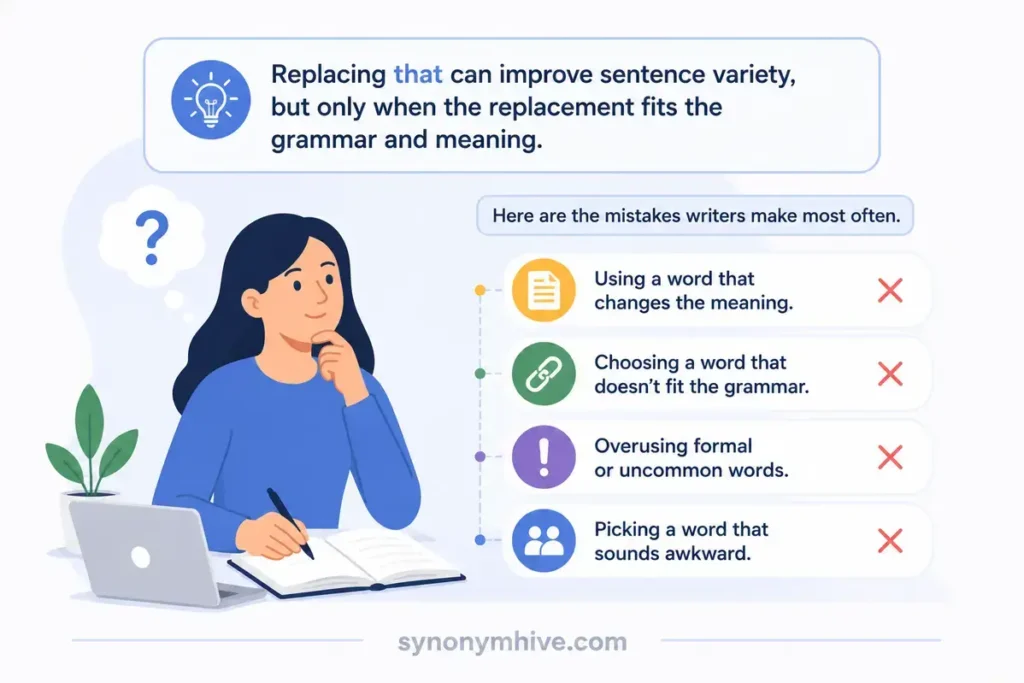
Replacing that can improve sentence variety, but only when the replacement fits the grammar and meaning. Here are the mistakes writers make most often.
Using “Which” Instead of “Who” for People
One of the most common errors is using which to refer to a person.
Less natural:
The student which won the contest received a prize.
Better:
The student who won the contest received a prize.
While some dialects may allow different usage in casual speech, who is the standard choice for people.
Replacing “That” in Every Sentence
Not every that needs to be replaced.
For example:
I think that you’re right.
This sentence is already clear and natural.
Trying to change every instance of that can make your writing sound forced.
Forgetting That “That” Can Often Be Omitted
In many sentences, you don’t need that at all.
For example:
With that:
She said that she would call later.
Without that:
She said she would call later.
Both versions are correct, but the second one is slightly shorter and more natural in everyday English.
Mixing Up “This” and “That”
These words both point to something, but they show different distances. Use this for something close.
Example:
This chair is comfortable.
Use that for something farther away.
Example:
That chair near the window is comfortable.
Choosing a Formal Alternative in Casual Writing
Some replacements sound too formal for everyday conversations.
Examples include:
- The aforementioned
- Said
- In order that
- Such that
Instead of saying:
The aforementioned package has arrived.
Most people simply say:
The package has arrived.
Choose words that match your audience and purpose.
Are There Antonyms of “That”?
Unlike many words, that doesn’t have one exact opposite because it performs several grammatical functions.
However, these words often express opposite or contrasting ideas.
This
When that refers to something farther away, this often refers to something nearby.
Example:
This book is mine.
That book is yours.
These
The plural form of this.
Example:
These apples are fresh.
Here
Shows something nearby instead of farther away.
Example:
Come here.
Now
Sometimes contrasts with then, especially when talking about time.
Example:
Let’s do it now.
These aren’t direct antonyms in every sentence, but they often express the opposite idea depending on the context.
Quick Tips for Choosing the Right Synonym
Choosing the right replacement becomes much easier when you follow a few simple rules.
Identify the Job of “That”
Ask yourself what that is doing.
Is it:
- Referring to a person?
- Pointing to a thing?
- Connecting two clauses?
- Showing purpose?
- Referring to an earlier idea?
Once you know its role, choosing the right synonym is much easier.
Use “Who” for People
Whenever possible, use who when referring to a person.
Example:
The doctor who treated me was very helpful.
This usually sounds more natural than using that.
Don’t Be Afraid to Remove “That”
Many sentences stay correct without it.
Example:
I believe you can do it.
This sounds just as natural as:
I believe that you can do it.
Match the Tone
For formal writing, consider:
- The fact that
- Provided that
- In order that
- Given that
For everyday writing, simple choices usually work best:
- Who
- Which
- This
- Those
- So that
Simple writing is easier to read.
Read Your Sentence Aloud
After replacing that, read the sentence aloud.
If it sounds awkward, try another alternative or keep the original word.
Good writing should sound natural as well as look correct.
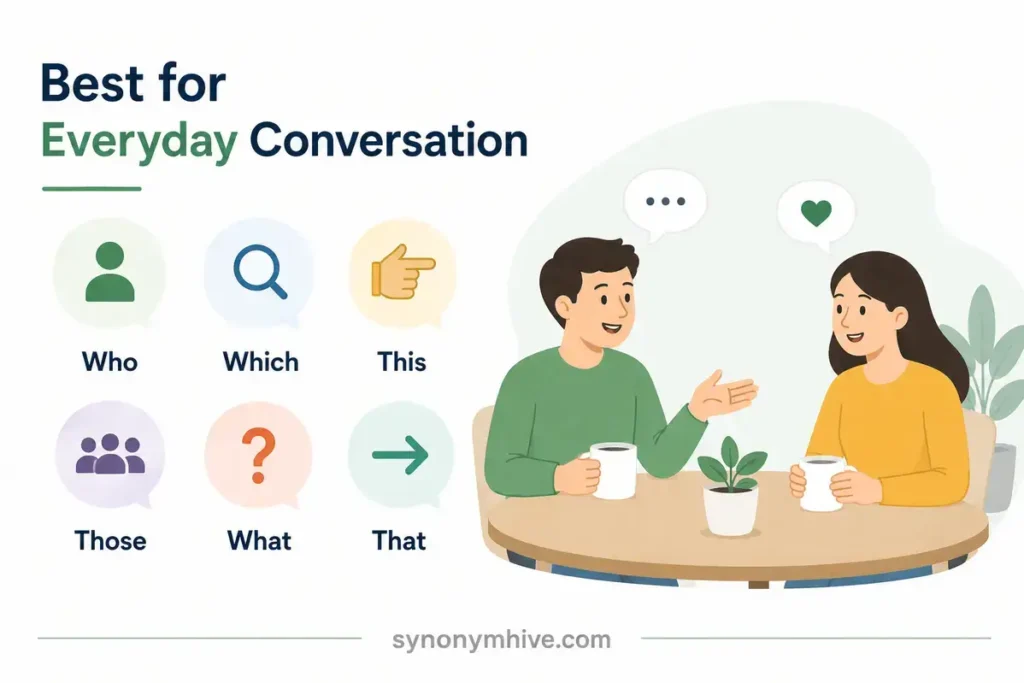
Quick Reference Guide
Best for Everyday Conversation
- Who
- Which
- This
- Those
- What
- That
Best for Essays
- Which
- The fact that
- Given that
- Provided that
- In order that
Use in Professional Emails
- Which
- So that
- The fact that
- This
- Those
Best for Resumes
- Who
- Which
- Improving
- Supporting
- Helping
Best for Formal Writing
- The aforementioned
- Said
- Provided that
- Such that
- In order that
Keeping these groups in mind makes it easier to choose the right alternative for every situation.
Explore another synonym guide: Synonyms for A Lot Simple Guide Write Like a Pro (2026).
Conclusion
Learning the best synonyms for that helps you write more naturally without repeating the same word in every sentence. Since that has several grammatical roles, there isn’t one perfect replacement. Depending on the context, words like who, which, this, those, the fact that, and so that may be better choices. In many cases, you can even remove that completely and keep the sentence clear.
The key is to focus on the meaning rather than simply replacing the word. Think about whether that refers to a person, a thing, or an idea, or whether it connects two clauses. With regular practice, you’ll find it much easier to choose the right alternative and make your writing smoother, clearer, and more engaging.
Frequently Asked Questions
What’s another way to say “that”?
Some common alternatives are which, who, this, those, the fact that, so that, and what. The best choice depends on how that is used in the sentence.
What are the best substitute in formal writing?
For formal writing, good options include the fact that, provided that, given that, such that, and in order that because they fit professional and academic styles.
Can I remove “that” from a sentence?
Yes. In many sentences, that is optional and can be removed without changing the meaning, especially after verbs like think, believe, say, and know.
What are the most common alternatives for that?
The most useful variant include which, who, this, those, what, and the fact that. Each one works in different grammatical situations.
What’s another way to say “that” in an essay?
In essays, writers often use which, the fact that, given that, or simply rewrite the sentence to avoid repeating that.
Is “which” always a synonym for “that”?
No. Which can replace that in many sentences about things, but it doesn’t work in every situation. Grammar and meaning determine the best choice.
Can I use phrases in business emails?
Yes. Using expressions where they fit naturally can reduce repetition and make professional emails easier to read without changing the meaning.