
Have you ever been writing an essay, updating your resume, replying to an email, or sending a text and stopped because you used the word learned too many times? It happens often. Looking for synonyms for learned can help your writing sound more natural, more specific, and less repetitive.The word learned can mean different things. Sometimes it means you gained knowledge through study. Other times, it means you discovered something through experience. Because it has several meanings, choosing the right replacement depends on what you’re trying to say.
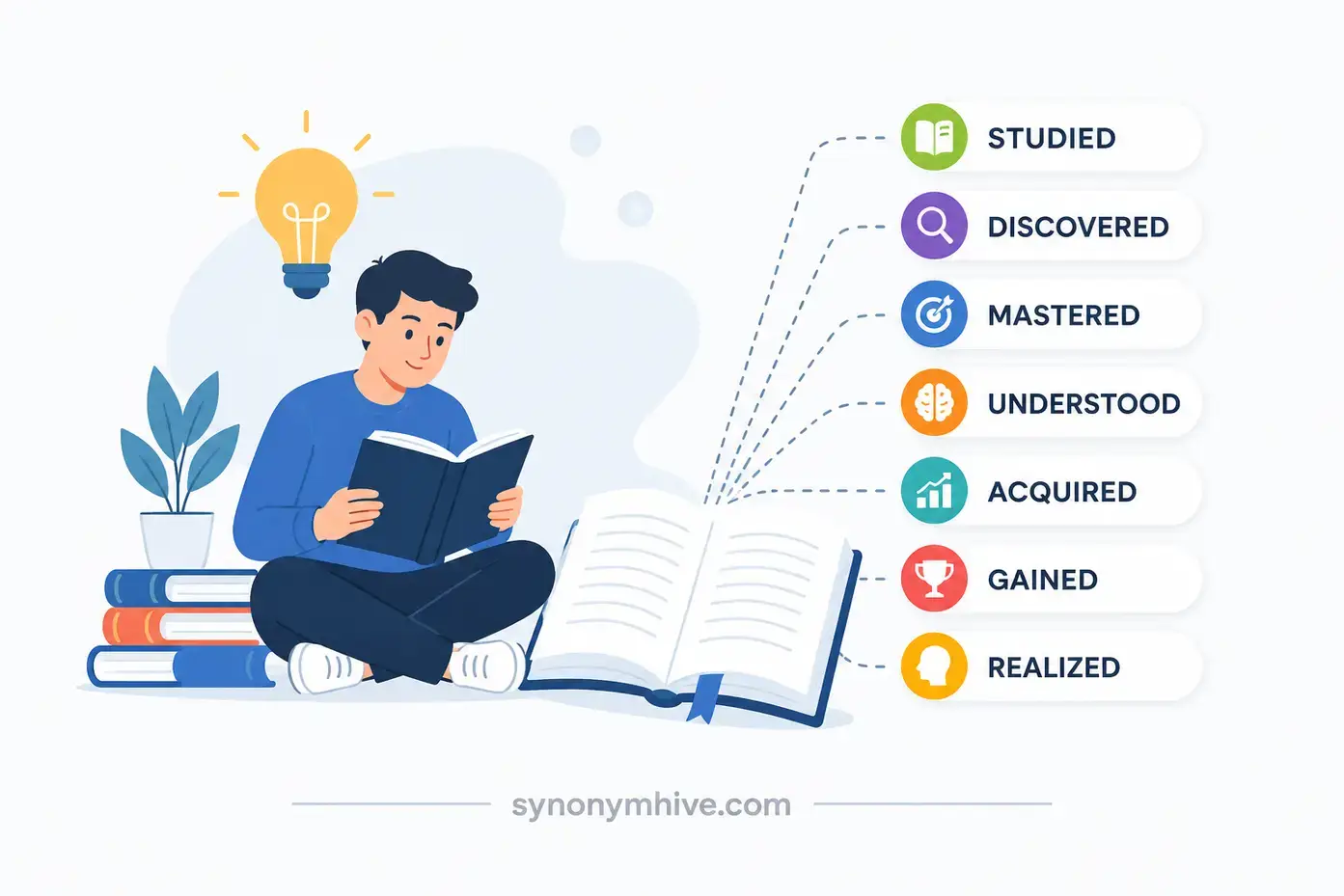
Synonyms for learned include studied, discovered, mastered, understood, acquired, gained, picked up, realized, trained, and educated. The best choice depends on the context and the type of writing.
In this guide, you’ll learn what learned really means, where the word came from, and which alternatives fit different situations. You’ll also find a large synonym list, comparison tables, practical examples, writing tips, and common mistakes to avoid.
What Does “Learned” Mean in Plain English?
The word learned is the past tense and past participle of learn. In simple English, it means:
- To gain knowledge
- To develop a new skill
- To understand something through study
- To discover something through experience
- To become familiar with new information
Here are a few examples:
- I learned Spanish in college.
- She learned how to swim last summer.
- We learned an important lesson from the mistake.
- He learned the truth yesterday.
- The children learned about space in science class.
Notice that learned doesn’t always describe school. People learn from books, work, conversations, travel, practice, and life itself. That’s one reason many writers search for synonyms for different situations call for different words.
Find similar expressions in Synonyms for Run: Smart Alternatives for Every Context (2026).
Where Does the Word “Learned” Come From?
The word learn has been part of English for hundreds of years.
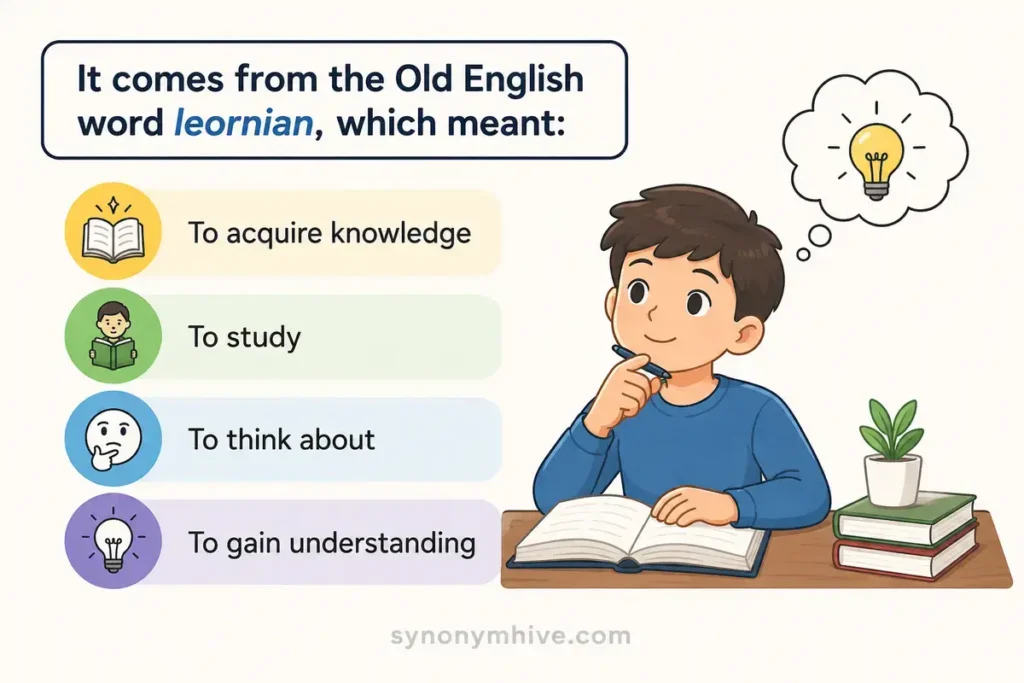
It comes from the Old English word leornian, which meant:
- To acquire knowledge
- To study
- To think about
- To gain understanding
Over time, the meaning stayed surprisingly consistent. Today, learned still describes gaining knowledge, understanding, or skill. However, modern English uses it in many more situations than before.
For example:
- Learning a language
- Learning a job
- Learning a lesson
- Learning from mistakes
- Learning about history
- Learning computer skills
- Learning through experience
This broad meaning explains why there are so many useful alternatives.
Why Look for Another Word Instead of “Learned”?
Repeating the same word over and over makes writing feel dull.
Compare these examples.
Example 1
I learned new software. New procedures became familiar through training. In addition, I developed strong customer service skills. Valuable teamwork experience was also gained.
The message is clear, but the repeated word stands out.
Example 2
I mastered new software. Company procedures became familiar through careful study. In addition, I developed strong customer service skills. Valuable teamwork experience was gained throughout the role.
The second version sounds smoother because each word adds a slightly different meaning.
Using better synonyms helps you:
- Avoid repetition
- Improve essays
- Strengthen resumes
- Write clearer emails
- Sound more natural
- Match the right tone
- Explain ideas more accurately
When Should You Replace “Learned”?
Not every sentence needs a synonym.
Sometimes learned is already the best word.
For example:
✔ I learned how to drive.
There’s no reason to change it.
But in other cases, a more specific word improves the sentence.
Instead of:
She learned leadership skills.
You might write:
- She developed leadership skills.
- She acquired leadership skills.
- She mastered leadership techniques.
Each option gives readers a slightly different impression.
What’s the Best Synonym for “Learned”?
There isn’t one perfect replacement.
The best word depends on what actually happened.
| If you mean… | Better Word |
|---|---|
| Studied something | Studied |
| Found out new information | Discovered |
| Became very skilled | Mastered |
| Understood an idea | Understood |
| Gained knowledge | Acquired |
| Improved through experience | Developed |
| Learned without much effort | Picked up |
| Finally understood | Realized |
| Received education | Educated |
| Practiced until skilled | Trained |
Thinking about the meaning first helps you choose the most accurate word.
Master List of Synonyms for Learned
Below is a detailed collection of alternatives grouped by tone and usage.
Simple Synonyms for “Learned”
These words work well in everyday writing and conversation.
| Word | Meaning | Tone | Example |
|---|---|---|---|
| Studied | Learned through reading or classes | Everyday | She studied biology in college. |
| Understood | Came to know the meaning | Everyday | I finally understood the lesson. |
| Found out | Discovered information | Casual | We found out the meeting was canceled. |
| Picked up | Learned naturally or informally | Casual | He picked up some French while traveling. |
| Knew | Became aware of | Everyday | She knew the answer after reading the article. |
| Discovered | Found something new | Neutral | Scientists discovered a new species. |
| Realized | Suddenly understood | Everyday | I realized my mistake immediately. |
| Developed | Improved through learning | Neutral | She developed strong writing skills. |
These are the words you’ll hear most often in daily conversations, classrooms, and workplaces.
Everyday Synonyms for “Learned”
These alternatives sound natural in emails, blogs, school assignments, and general writing.
| Word | Meaning | Tone | Example |
|---|---|---|---|
| Gained | Received knowledge or experience | Neutral | He gained valuable experience during the internship. |
| Acquired | Obtained knowledge or skills | Slightly formal | She acquired advanced computer skills. |
| Practiced | Improved through repetition | Everyday | We practiced speaking English every day. |
| Trained | Learned through instruction | Neutral | The staff trained on the new software. |
| Experienced | Learned by doing | Everyday | They experienced many challenges while traveling. |
| Memorized | Learned by heart | Everyday | She memorized all the state capitals. |
| Absorbed | Took in information | Neutral | Students absorbed new ideas quickly. |
| Improved | Became better through learning | Everyday | His cooking skills improved over time. |
These choices fit most everyday situations without sounding too formal.
Formal Synonyms for “Learned”
If you’re writing a resume, business report, research paper, or professional email, these words often work better than learned.
| Word | Meaning | Tone | Example |
|---|---|---|---|
| Mastered | Became highly skilled | Formal | She mastered advanced accounting software. |
| Attained | Reached a level of knowledge | Formal | He attained professional certification. |
| Comprehended | Fully understood | Academic | Students comprehended the theory after discussion. |
| Internalized | Made knowledge part of your thinking | Academic | The trainees internalized the company’s values. |
| Assimilated | Took in and understood information | Formal | She quickly assimilated new procedures. |
| Educated | Received formal instruction | Formal | They were educated in engineering. |
| Instructed | Taught or trained | Formal | New employees were instructed on safety rules. |
| Familiarized | Became comfortable with something | Professional | Staff familiarized themselves with the updated policy. |
These words are especially useful when you want your writing to sound more precise and professional.
More Formal and Specialized Synonyms for “Learned”
Some situations need words that sound more technical, academic, or professional. These alternatives are common in schools, workplaces, research papers, and business writing.
| Word | Meaning | Tone | Example |
|---|---|---|---|
| Honed | Improved a skill through practice | Formal | She honed her public speaking skills over several years. |
| Refined | Made a skill or method better | Formal | The chef refined his cooking techniques. |
| Cultivated | Developed gradually over time | Formal | They cultivated strong leadership abilities. |
| Expanded | Increased knowledge or understanding | Neutral | She expanded her knowledge of world history. |
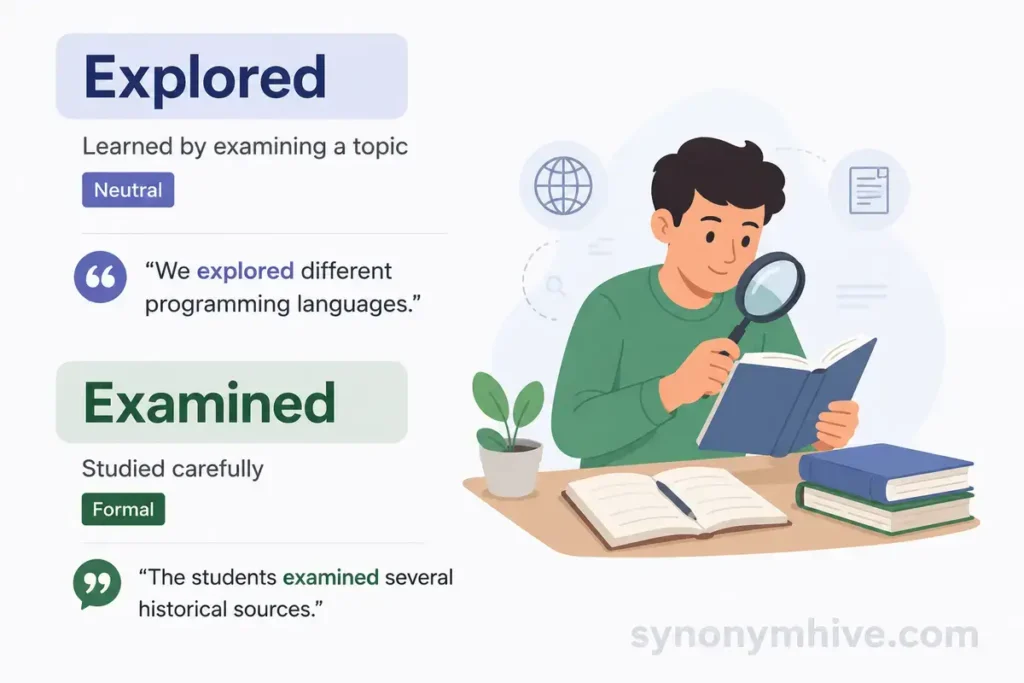
| Explored | Learned by examining a topic | Neutral | We explored different programming languages. |
| Examined | Studied carefully | Formal | The students examined several historical sources. |
| Researched | Learned through careful investigation | Academic | He researched renewable energy before writing the report. |
| Observed | Learned by watching | Neutral | The children observed how plants grow. |
These words often describe how someone learned rather than simply stating that they learned something.
Informal and Slang Alternatives
In conversations and text messages, people often choose simpler expressions instead of learned.
| Word or Phrase | Meaning | Tone | Example |
|---|---|---|---|
| Picked up | Learned naturally | Casual | I picked up a few Italian words on vacation. |
| Caught on | Began to understand | Informal | She caught on quickly during training. |
| Figured out | Solved or understood | Informal | We finally figured out the problem. |
| Got the hang of | Became comfortable with a skill | Informal | He got the hang of driving after a few lessons. |
| Came across | Found information by chance | Casual | I came across an interesting article online. |
| Took in | Absorbed information | Casual | It took me a while to take it all in. |
| Read up on | Studied independently | Informal | I read up on investing before opening an account. |
| Brushed up on | Reviewed existing knowledge | Informal | She brushed up on her Spanish before traveling. |
These expressions sound natural in everyday speech but may be too casual for formal documents.
Complete Master List of Synonyms
Here’s a quick-reference table with more than 30 useful alternatives.
| Simple | Everyday | Formal | Casual & Informal |
|---|---|---|---|
| Studied | Gained | Mastered | Picked up |
| Understood | Acquired | Attained | Caught on |
| Found out | Developed | Comprehended | Figured out |
| Knew | Improved | Internalized | Got the hang of |
| Discovered | Practiced | Assimilated | Read up on |
| Realized | Trained | Educated | Brushed up on |
| Memorized | Experienced | Familiarized | Came across |
| Absorbed | Explored | Honed | Took in |
| Learned | Expanded | Refined | |
| Observed | Researched | Cultivated |
This variety makes it easier to choose a word that fits your exact meaning instead of relying on one general verb.
Which Synonyms Show Different Levels of Learning?
Not every synonym suggests the same level of understanding or skill.
Here’s a simple progression.
| Level | Synonyms | Typical Meaning |
|---|---|---|
| Basic | Heard, found out, observed | Received new information |
| Light | Picked up, caught on | Began understanding |
| Moderate | Learned, studied, understood | Gained solid knowledge |
| Strong | Acquired, developed, trained | Built useful skills |
| Advanced | Mastered, internalized, refined | Achieved deep understanding or expertise |
For example:
- You can pick up a few phrases while traveling.
- You might study a language in school.
- After years of practice, you may master that language.
The stronger the word, the greater the level of knowledge or skill it suggests.
Are There Different Parts of Speech?
Yes. Although learned is mainly a verb form, related words appear in other parts of speech.
| Part of Speech | Word | Example |
|---|---|---|
| Verb | Learn | I learn something new every day. |
| Past tense verb | Learned | She learned to code last year. |
| Past participle | Learned | They have learned valuable lessons. |
| Noun | Learning | Learning takes time and practice. |
| Noun | Learner | Every learner improves at a different pace. |
| Adjective | Learned | He is a learned professor. |
Notice the adjective use:
She is a learned scholar.
Here, learned means well educated or highly knowledgeable, not simply “has learned something.”
Is There a Difference Between American and British English?
Most synonyms work well in both American and British English.
However, there are a few differences worth knowing.
“Learned” vs. “Learnt”
| Form | Common In |
|---|---|
| Learned | American English |
| Learnt | British English, Australian English, and some other varieties |
Both are correct.
For example:
US:
I learned a lot during college.
UK:
I learnt a lot during university.
The meaning is exactly the same.
Most of the alternatives in this guide are widely understood around the world.
Need another vocabulary suggestion? Read Synonyms for Said: The Ultimate Guide Boost Your Writing (2026).
What’s the Best Word for a Resume?
Resumes should highlight achievements, not simply state that you learned something.
Instead of writing:
Learned project management.
Consider stronger alternatives.
| Better Word | Resume Example |
|---|---|
| Mastered | Mastered advanced Excel functions for reporting. |
| Acquired | Acquired experience in customer relationship management. |
| Developed | Developed strong communication and leadership skills. |
| Trained | Trained in workplace safety procedures. |
| Honed | Honed presentation skills through weekly client meetings. |
| Familiarized | Familiarized myself with cloud-based accounting software. |
These words sound more specific and help employers understand your growth.
What’s the Best Word in an Essay?
Academic writing benefits from precise vocabulary.
Here are some better choices based on meaning.
| Instead of… | Try… |
|---|---|
| Learned a lesson | Understood |
| Learned about history | Studied |
| Learned through experience | Discovered |
| Learned a new skill | Developed |
| Learned a language | Mastered (if highly skilled) |
| Learned information | Acquired knowledge |
| Learned the facts | Researched |
Example
Basic:
Students learned about climate change.
Improved:
Students studied climate change.
Or:
Students researched climate change.
The improved versions explain how the knowledge was gained.

What’s the Best Word in an Email?
Professional emails should sound clear and natural.
These alternatives work well.
| Situation | Best Choice |
|---|---|
| Completing training | Trained |
| Understanding instructions | Understood |
| Gaining experience | Acquired |
| Researching information | Reviewed or Researched |
| Improving skills | Developed |
Examples
- I developed stronger reporting skills during the project.
- Our team acquired valuable customer feedback.
- I understood your instructions and will begin today.
- We researched several possible solutions.
- The staff trained on the updated software yesterday.
What’s the Best Word in Text Messages?
People usually choose simpler words while texting.
Examples include:
- I finally figured it out.
- I picked it up pretty quickly.
- I caught on after a few tries.
- I got the hang of it.
- I found out this morning.
These sound much more natural than using formal alternatives.
What’s the Best Word in Everyday Conversation?
In everyday speech, people often prefer shorter, familiar words.
Instead of saying:
I learned a lot at work.
You might hear:
- I picked up a lot at work.
- I figured out a lot.
- I gained plenty of experience.
- I got the hang of it.
- I found out something interesting.
These expressions make conversations feel relaxed and natural.
Real-Life Example Sentences
Here are original examples showing different ways to replace learned.
- Maya mastered graphic design after years of practice.
- We discovered a faster way to organize our files.
- Ethan picked up basic Japanese while living in Tokyo.
- The interns acquired valuable workplace experience.
- I realized I had forgotten my notebook.
- Sarah researched several colleges before applying.
- The children memorized the multiplication tables.
- He developed excellent time management skills.
- We caught on after the teacher explained it again.
- The new employee quickly familiarized herself with company policies.
- They observed how birds built their nests.
- Olivia honed her writing skills through daily practice.
Each sentence highlights a different way people gain knowledge or skill.
Learned vs. Mastered — What’s the Difference?
These words are related, but they describe different levels of ability.
| Learned | Mastered |
|---|---|
| Gained knowledge | Became highly skilled |
| Can describe beginners | Describes experts |
| General term | Stronger and more specific |
| Works in many situations | Best for advanced ability |
Example
✔ I learned Photoshop last month.
✔ After years of experience, I mastered Photoshop.
You usually learn first and master later.
Discovered vs. Realized — What’s the Difference?
People often confuse these words because both involve new understanding.
| Discovered | Realized |
|---|---|
| Found new information | Suddenly understood something |
| Often external | Often internal |
| Can involve research | Can involve personal awareness |
| May happen gradually | Often happens quickly |
Example
She discovered an error in the report.
She realized she had submitted the wrong file.
The first focuses on finding something. The second focuses on recognizing something.
What Are the Most Common Mistakes When Using Synonyms for “Learned”?
Using a synonym can improve your writing, but only if it matches the meaning of your sentence. Many words related to learned have different shades of meaning, so they aren’t always interchangeable.
Here are the mistakes people make most often.
Using “Mastered” Too Soon
Mastered means you have reached a very high level of skill. It doesn’t simply mean you learned the basics.
Less Accurate
I mastered Excel after one afternoon.
Better
I learned the basics of Excel in one afternoon.
Or:
I became familiar with Excel in one afternoon.
Use mastered only when someone has practiced enough to become highly skilled.
Confusing “Discovered” with “Learned”
These words overlap, but they aren’t identical.
Learned means you gained knowledge.
Discovered means you found something that wasn’t known to you before.
✔ I learned how to bake bread.
✔ I discovered a great bakery near my house.
One focuses on gaining a skill. The other focuses on finding information or something new.
Using “Realized” When You Mean “Studied”
Realized means you suddenly understood something.
It doesn’t mean you spent time learning it.
✔ I realized I had forgotten my keys.
✔ I studied chemistry for two years.
Those actions are very different.
Using Casual Phrases in Formal Writing
Expressions like these sound natural in conversation:
- Picked up
- Figured out
- Got the hang of
- Caught on
However, they may sound too informal in:
- Academic essays
- Business reports
- Research papers
- Professional resumes
In those cases, choose words like:
- Acquired
- Studied
- Mastered
- Developed
- Researched
Assuming Every Synonym Fits Every Situation
Not every alternative works everywhere.
For example:
✔ She studied law.
✘ She memorized law.
You can memorize facts, but you study a subject.
Another example:
✔ He acquired leadership skills.
✘ He discovered leadership skills.
The second sentence changes the meaning.
Always think about what actually happened before choosing a replacement.
What Are the Antonyms of “Learned”?
Sometimes you need the opposite meaning.
Here are some common antonyms and related opposites.
| Antonym | Meaning |
|---|---|
| Forgot | Lost knowledge from memory |
| Ignored | Chose not to pay attention |
| Misunderstood | Understood incorrectly |
| Overlooked | Failed to notice |
| Neglected | Failed to study or practice |
| Unlearned | Not educated or lacking knowledge (rare) |
| Misinterpreted | Understood the wrong meaning |
Examples
- I forgot the formula after summer break.
- He misunderstood the instructions.
- She ignored the warning signs.
These words help express the opposite of gaining knowledge or understanding.
How Do You Choose the Right Synonym?
There isn’t one perfect replacement for every sentence. The best choice depends on what you want to say.
Think About How the Knowledge Was Gained
Ask yourself questions like:
- Was it learned through school?
- Was it learned by experience?
- Was it discovered by accident?
- Was it gained through practice?
- Was it understood after thinking?
Your answer will help narrow your options.
For example:
- Through classes → Studied
- Through practice → Developed, Honed
- Through experience → Gained, Acquired
- Through research → Researched
- Through observation → Observed
Match the Level of Skill
Some words suggest basic understanding.
Others suggest expertise.
| Level | Better Choices |
|---|---|
| Beginner | Learned, studied, found out |
| Intermediate | Developed, acquired, trained |
| Advanced | Mastered, refined, internalized |
Avoid exaggerating your ability by choosing a word that’s stronger than the situation.
Match the Tone
Your audience matters.
For formal writing:
- Acquired
- Mastered
- Comprehended
- Familiarized
- Researched
For everyday conversation:
- Learned
- Picked up
- Figured out
- Found out
- Got the hang of
Choosing the right tone makes your writing sound more natural.
Avoid Repeating the Same Word
If your paragraph uses learned several times, readers may notice the repetition.
Instead of this:
I learned new software. In addition, I developed stronger communication skills. Project planning was another skill I learned.
Try this:
I mastered new software, developed communication skills, and acquired project planning experience. The revised version flows better and gives readers more detail about your progress.

Quick Reference: Which Word Should You Choose?
| Situation | Best Choice |
|---|---|
| School subject | Studied |
| Professional skill | Developed, Mastered |
| New information | Discovered, Found out |
| Workplace experience | Acquired, Gained |
| Learning by watching | Observed |
| Learning through research | Researched |
| Improving over time | Honed, Refined |
| Understanding an idea | Understood, Comprehended |
| Casual conversation | Picked up, Figured out |
| Formal writing | Acquired, Internalized |
Keep this table in mind whenever you’re unsure which word best fits your sentence.
Conclusion
Choosing the right synonyms for learned is about more than avoiding repetition. The best alternative depends on how the knowledge or skill was gained and the message you want to share. Words like studied, discovered, acquired, developed, and mastered each have their own purpose, and using them correctly makes your writing more precise and engaging.
When you’re writing a resume, an essay, a business email, or a simple text message, selecting the right word helps your ideas sound clear and confident. Save this guide as a reference, practice using the examples, and you’ll soon feel more comfortable choosing the best synonym for every situation.
Need another vocabulary suggestion? Read Synonyms for Good: The Ultimate Guide Write Like a Pro (2026).
Frequently Asked Questions
What’s another way to say “learned”?
Common alternatives include studied, discovered, understood, acquired, gained, developed, mastered, realized, and picked up. The best option depends on your context.
What are the best synonyms on a resume?
For resumes, strong choices include mastered, developed, acquired, honed, trained, and familiarized because they highlight growth and specific skills.
Is “mastered” the same as “learned”?
No. Mastered means you reached a high level of skill, while learned simply means you gained knowledge or ability. Use mastered only when advanced proficiency is accurate.
Can I use synonyms for learned in academic writing?
Yes. Using these synonyms can make academic writing more varied and reduce repetition. Just make sure the replacement matches your intended meaning.
What’s another word for learning through experience?
Words like gained, acquired, developed, observed, and experienced often fit well when knowledge comes from real-life situations instead of formal education.
What’s the easiest synonym for “learned” in everyday conversation?
People often say picked up, found out, figured out, or caught on because these expressions sound natural in casual speech.
What’s another way to say “I learned something new”?
You could say I discovered something new, I picked up something new, I gained new knowledge, or I came across something interesting, depending on the situation.