

Have you ever been writing a story, essay, email, or even a text message and noticed you’ve used the word said again and again? It happens to every writer. That’s why many people search for substitutes for said to make their writing more interesting without changing the meaning. The word said is one of the most common reporting verbs in English. It simply tells readers that someone spoke. But depending on the situation, another word may better describe the speaker’s tone, emotion, or purpose.
Synonyms for said include stated, told, explained, replied, answered, mentioned, remarked, noted, declared, and commented. The best choice depends on what the speaker is trying to communicate.
In this guide, you’ll learn what said really means, where it came from, and how to choose the best replacement for different situations. You’ll also find a large list of alternatives, practical examples, and writing tips for school, work, and everyday conversations.
Discover related words in Synonyms for Clear: Better Words to Use (2026).
What Does “Said” Mean in Plain English?
The word said is the past tense of say. It means to speak words, express an idea, or communicate something aloud or in writing.
Here are a few examples.
- She said hello.
- He said he would arrive early.
- The teacher said the test would be on Friday.
- My friend said the movie was great.
- They said they needed more time.
In each sentence, said simply reports what someone communicated. It doesn’t tell us how they spoke or what emotion they felt.
Where Does the Word “Said” Come From?
The word said comes from the Old English verb secgan, meaning to tell, speak, or relate. Over time, the language changed, but the meaning stayed almost the same. Today, said remains one of the most frequently used reporting verbs in English because it’s simple, clear, and works in almost every situation. Since it has such a broad meaning, English also offers dozens of useful alternatives for said that add more detail to your writing.
Why Look for Another Word Instead of “Said”?
There’s nothing wrong with using said. In fact, many professional writers recommend using it because readers hardly notice it. However, repeating said several times in a short paragraph can make your writing feel repetitive.
For example:
“I’m ready,” Sarah said.
“Let’s go,” Tom said.
“I’ll drive,” Emma said.
The conversation is clear, but repeating the same reporting verb may become monotonous.
You could vary it like this:
“I’m ready,” Sarah replied.
“Let’s go,” Tom suggested.
“I’ll drive,” Emma offered.
Each verb gives readers a little more information.
When Should You Replace “Said”?
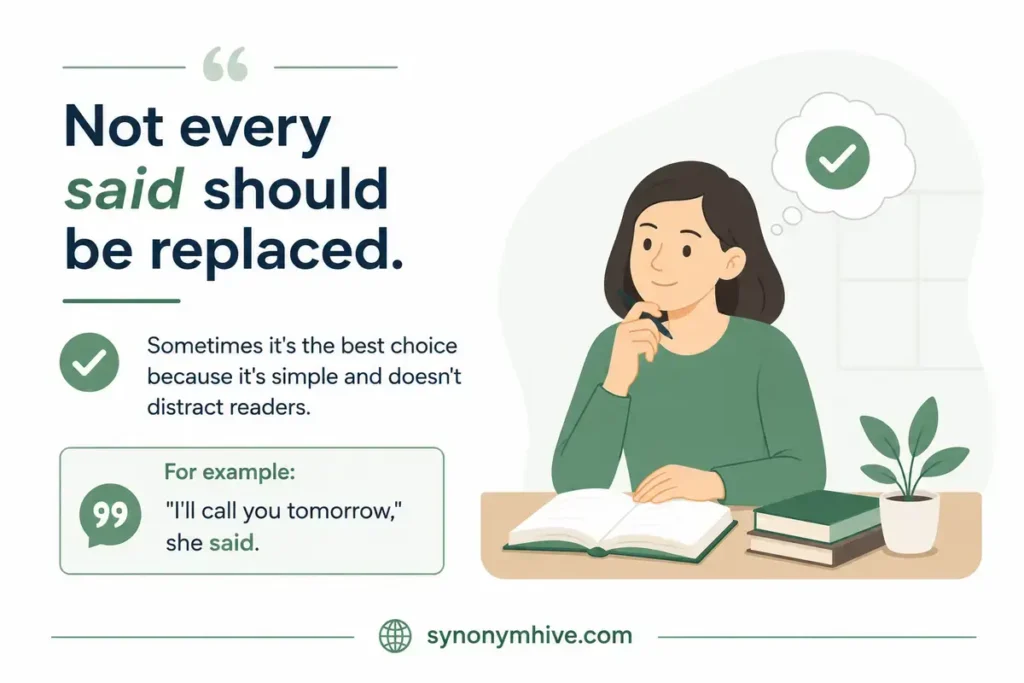
Not every said should be replaced. Sometimes it’s the best choice because it’s simple and doesn’t distract readers.
For example:
“I’ll call you tomorrow,” she said.
This sounds perfectly natural.
Replace said only when another word explains how or why someone spoke.
Instead of:
“Be careful,” Dad said.
You could write:
- Dad warned.
- Dad reminded.
- Dad advised.
These words tell readers much more than said alone.
What’s the Best Synonym for “Said”?
There isn’t one perfect replacement.
The best synonym depends on the speaker’s intention.
If someone answers a question, replied or answered fits well.
When someone explains an idea, explained works better.
If someone gives an opinion, remarked or commented may be the best choice.
Instead of searching for the fanciest word, choose the one that accurately matches the situation.
Master List of Synonyms for Said
Simple Phrases
| Word | Meaning | Tone | Example |
|---|---|---|---|
| Told | Gave information to someone | Neutral | She told me the news. |
| Spoke | Communicated by talking | Neutral | He spoke quietly. |
| Replied | Answered someone | Neutral | She replied with a smile. |
| Answered | Responded to a question | Neutral | He answered immediately. |
| Mentioned | Briefly referred to something | Neutral | She mentioned the meeting. |
| Added | Continued speaking | Neutral | He added another point. |
| Asked | Requested information | Neutral | She asked a question. |
| Explained | Made something clear | Neutral | The teacher explained the lesson. |
Everyday Expressions
| Word | Meaning | Tone | Example |
|---|---|---|---|
| Commented | Shared an opinion | Everyday | He commented on the weather. |
| Remarked | Made a short observation | Everyday | She remarked that it was cold. |
| Shared | Told others information | Friendly | She shared her experience. |
| Suggested | Offered an idea | Everyday | He suggested leaving early. |
| Admitted | Confessed something | Neutral | She admitted her mistake. |
| Agreed | Expressed the same opinion | Neutral | They agreed with the proposal. |
| Promised | Gave a commitment | Everyday | He promised to help. |
| Announced | Made something public | Neutral | The company announced the changes. |
Formal Variants
| Word | Meaning | Tone | Example |
|---|---|---|---|
| Stated | Expressed clearly | Formal | The report stated the facts. |
| Declared | Announced officially | Formal | The mayor declared an emergency. |
| Noted | Pointed something out | Professional | The author noted several concerns. |
| Reported | Shared information | Formal | Witnesses reported the incident. |
| Asserted | Expressed with confidence | Academic | The researcher asserted the claim. |
| Indicated | Suggested or pointed out | Formal | The survey indicated improvement. |
| Confirmed | Verified information | Professional | The manager confirmed the schedule. |
| Clarified | Made something easier to understand | Professional | She clarified the instructions. |
Informal and Expressive Alternatives
| Word | Meaning | Tone | Example |
|---|---|---|---|
| Whispered | Spoke very quietly | Informal | He whispered the secret. |
| Shouted | Spoke very loudly | Informal | She shouted for help. |
| Yelled | Raised the voice loudly | Informal | The coach yelled directions. |
| Murmured | Spoke softly and quietly | Informal | She murmured her thanks. |
| Mumbled | Spoke unclearly | Informal | He mumbled an apology. |
| Joked | Spoke humorously | Casual | She joked about being late. |
| Laughed | Spoke while laughing | Casual | He laughed, “That’s impossible!” |
| Cried | Spoke while crying or shouting | Emotional | She cried, “Don’t leave!” |
This collection includes more than 30 useful expressions for different types of writing. Some are perfect for fiction, while others work better in essays, business emails, reports, or everyday conversations.
What’s Coming in Part 2?
In the next section, you’ll learn:
- alternatives grouped by meaning
- phrases by intensity (neutral to emotional)
- Parts of speech and grammar notes
- US vs. UK usage differences
- The best alternatives for resumes, essays, emails, texting, and speaking
- More than 10 original example sentences
- Side-by-side comparisons like said vs. told, said vs. stated, and said vs. explained
Can Synonyms for “Said” Be Grouped by Meaning?
Yes. Since said can be used in many situations, grouping variants by purpose makes it much easier to choose the right one.
Words That Mean Giving Information
These simply report what someone communicated.
- Said
- Told
- Stated
- Mentioned
- Reported
- Shared
- Noted
- Explained
Examples:
- The manager stated the new policy.
- She mentioned her travel plans.
- The witness reported what happened.
Words That Mean Answering Someone
These work best in conversations.
- Replied
- Responded
- Answered
- Returned
- Acknowledged
Examples:
- “Yes,” she replied.
- He answered without hesitation.
- The customer responded politely.
Words That Mean Giving an Opinion
These express thoughts or observations.
- Commented
- Remarked
- Observed
- Suggested
- Added
- Pointed out
Examples:
- She commented on the weather.
- He observed that traffic was lighter than usual.
- The teacher pointed out a spelling mistake.
Words That Show Strong Emotion
These tell readers how someone spoke.
- Whispered
- Murmured
- Mumbled
- Shouted
- Yelled
- Screamed
- Cried
- Sobbed
Examples:
- “Run!” she shouted.
- He whispered the answer.
- The child cried for help.
Words That Mean Giving Orders or Advice
These describe guidance or instructions.
- Ordered
- Commanded
- Directed
- Warned
- Advised
- Reminded
- Encouraged
- Urged
Examples:
- The coach encouraged the team.
- Mom reminded me about my homework.
- The officer ordered everyone to leave.
Which Synonyms Are Stronger Than Others?
Some reporting verbs simply replace said, while others describe strong emotions.
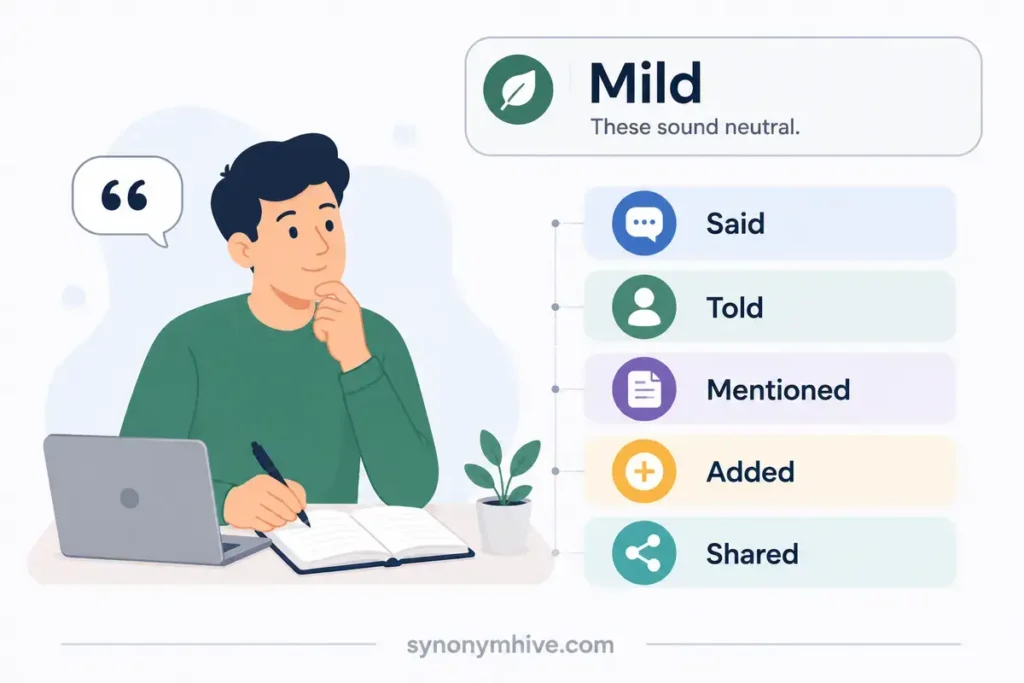
Mild
These sound neutral.
- Said
- Told
- Mentioned
- Added
- Shared
Medium
These give more detail.
- Explained
- Replied
- Commented
- Remarked
- Suggested
- Clarified
Strong
These show emotion or authority.
- Declared
- Warned
- Ordered
- Announced
- Confirmed
- Asserted
Very Strong
These describe intense feelings.
- Shouted
- Screamed
- Yelled
- Sobbed
- Demanded
- Insisted
Use stronger verbs only when they accurately describe how the speaker communicated.
Are These Synonyms Different Parts of Speech?
Almost every alternative is a verb.
Main Verbs
Examples include:
- Say
- Tell
- Explain
- Reply
- Announce
- Mention
- Declare
- Confirm
Example:
The teacher explained the answer.
Verb Phrases
Sometimes English uses short phrases instead of one verb.
Examples include:
- Pointed out
- Spoke up
- Brought up
- Went on to say
Examples:
She pointed out an important detail.
He brought up another suggestion.
These phrases often sound natural in everyday writing.
Are There US vs. UK Differences?
Most reporting verbs are common in both American and British English.
However, there are a few small differences.
More Common in American English
- Said
- Told
- Shared
- Pointed out
- Confirmed
More Common in British English
- Remarked
- Observed
- Noted
- Added
The meanings remain the same, so readers in both countries will understand them.
What’s the Best Word for a Resume?
Resumes rarely use said, but they often describe communication skills.
Strong alternatives include:
- Presented
- Explained
- Communicated
- Negotiated
- Advised
- Reported
Example
Instead of:
Said project updates during meetings.
Write:
Presented weekly project updates to senior leadership.
Or:
Communicated project milestones with cross-functional teams.
These action verbs sound more professional.
Check out more vocabulary ideas in Synonyms for Helped: 120 Powerful Alternatives (2026).
What’s the Best Word for an Essay?
Academic writing usually requires precise reporting verbs.
Good choices include:
- Stated
- Explained
- Argued
- Claimed
- Observed
- Noted
- Reported
- Asserted
Example
Basic:
The researcher said the results were important.
Better:
The researcher stated that the results were significant.
Or:
The researcher argued that the evidence supported the theory.
What’s the Best Word for an Email?
Business emails should sound polite and clear.
Useful alternatives include:
- Mentioned
- Explained
- Shared
- Confirmed
- Clarified
- Noted
Examples
As mentioned earlier, the meeting begins at 10 a.m.
I’d like to clarify yesterday’s discussion.
She confirmed the delivery date.
What’s the Best Word for Text Messages?
Text messages usually sound best with simple language.
People commonly use:
- Said
- Told
- Asked
- Shared
- Mentioned
Examples
She said she’ll be here soon.
He told me the game starts at eight.
Mom asked when we’re coming home.
What’s the Best Word for Speaking?
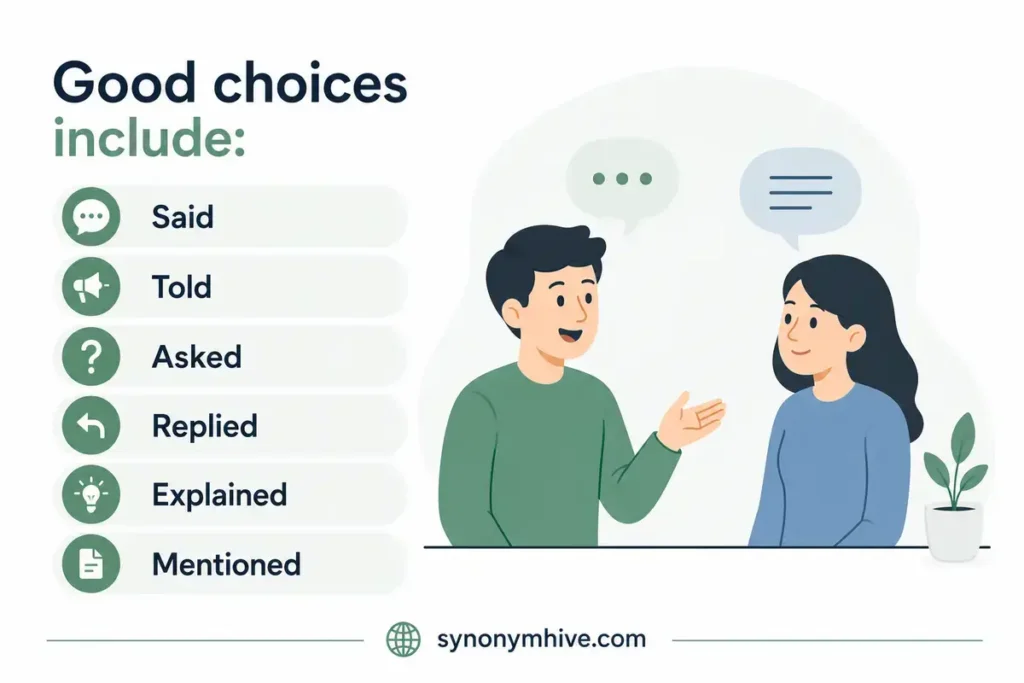
In everyday conversation, simple reporting verbs sound the most natural.
Good choices include:
- Said
- Told
- Asked
- Replied
- Explained
- Mentioned
These words are clear and easy to understand.
Real-Life Example Sentences
Here are different ways to replace said naturally.
- The teacher explained the homework carefully.
- Sarah replied with a smile.
- The doctor advised him to rest for a few days.
- The manager announced the promotion during the meeting.
- My friend suggested trying a different restaurant.
- The coach encouraged the players before the game.
- The witness confirmed the driver’s description.
- Emma whispered the answer during the movie.
- The author noted several important historical events.
- The customer complained politely about the delay.
- The scientist reported the findings to the research team.
- Dad reminded me to lock the front door.
Said vs. Told: What’s the Difference?
These two words are closely related but follow different grammar rules.
Said
Usually focuses on the words that were spoken.
Example:
She said she was tired.
Told
Usually requires a person after the verb.
Example:
She told me she was tired.
Remember:
- Said + something
- Told + someone + something
Said vs. Stated: What’s the Difference?
These words often appear in reports and articles.
Said
Neutral and common.
Example:
The CEO said profits increased.
Stated
More formal and direct.
Example:
The CEO stated that profits increased.
Choose stated for professional or academic writing.
Said vs. Explained: What’s the Difference?
These words have different purposes.
Said
Simply reports speech.
Example:
She said the meeting was canceled.
Explained
Adds detail or clarification.
Example:
She explained why the meeting was canceled.
Use explained when the speaker provides reasons or additional information.
What Are the Most Common Mistakes When Using Synonyms for “Said”?
Using different reporting verbs can make your writing more engaging, but only when the word matches the situation. Here are the mistakes writers make most often.
Replacing Every “Said”
Many new writers think they should never use said. That’s not true. Professional authors often use said because readers naturally skip over it and focus on the dialogue. Instead of replacing every instance, choose another verb only when it adds useful meaning.
Natural:
“I’ll see you tomorrow,” she said.
Also natural:
“I’ll see you tomorrow,” she replied.
Both are correct. Pick the one that best fits the conversation.
Choosing a Word That Doesn’t Match the Emotion
The reporting verb should match how the speaker actually talks.
Incorrect:
“Good morning,” he shouted.
Unless the person was yelling across a crowd, shouted doesn’t fit.
Better:
“Good morning,” he said.
Or:
“Good morning,” he greeted.
Always think about the speaker’s tone.
Using Dramatic Words Too Often
Words like screamed, demanded, declared, and sobbed are powerful. If every character screams or declares something, the writing starts to feel exaggerated. Mix simple and expressive verbs to keep dialogue natural.
Confusing “Said” and “Told”
This is one of the most common grammar mistakes.
Correct:
- She said she was busy.
- She told me she was busy.
Incorrect:
- She said me she was busy.
- She told she was busy.
Remember:
- Say usually doesn’t take a direct object.
- Tell almost always needs a person after it.
Using Formal Verbs in Casual Conversation
Some words sound too formal for everyday speech.
Instead of:
He asserted that he was hungry.
Most people would simply say:
He said he was hungry.
Choose words that match the situation and audience.
What Are the Antonyms of “Said”?
Unlike many verbs, said doesn’t have one exact opposite. However, these words express the opposite idea of speaking.
Stayed Silent
Example:
She stayed silent during the meeting.
Kept Quiet
Example:
He kept quiet about the surprise.
Withheld
Means someone intentionally did not share information.
Example:
The witness withheld important details.
Ignored
Sometimes a person chooses not to respond.
Example:
She ignored the question.
Remained Silent
A more formal expression.
Example:
The suspect remained silent.
Quick Tips for Choosing the Right Word
Choosing the best reporting verb is easier if you focus on the purpose of the sentence.
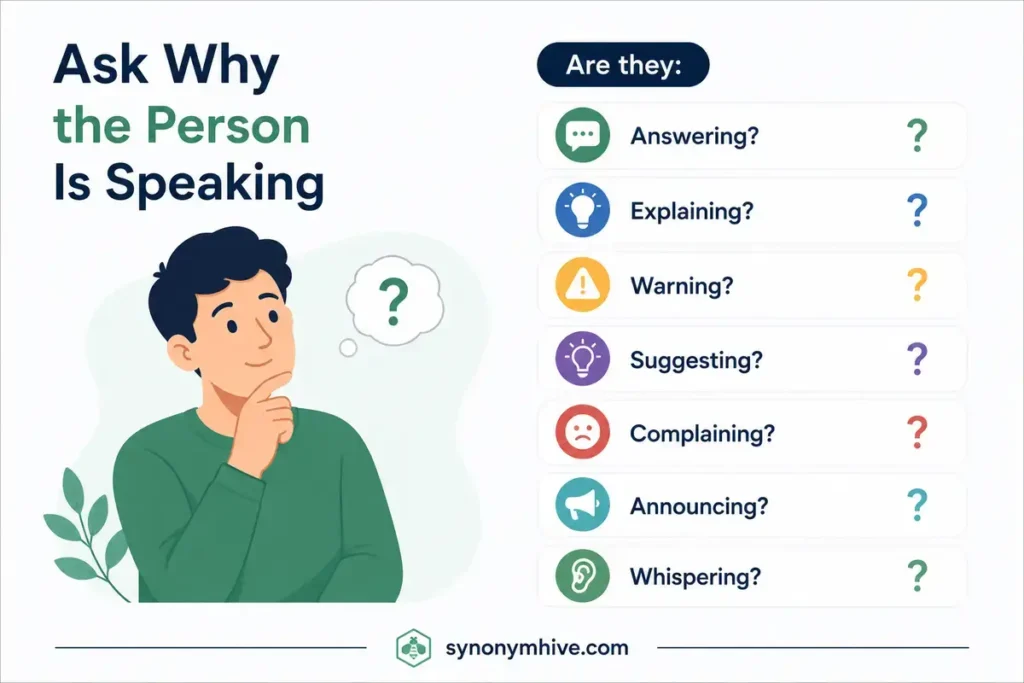
Ask Why the Person Is Speaking
Are they:
- Answering?
- Explaining?
- Warning?
- Suggesting?
- Complaining?
- Announcing?
- Whispering?
The answer helps you find the best word.
Don’t Replace “Said” Just for Variety
Sometimes said is still the strongest choice because it doesn’t distract readers. Use another verb only when it adds information.
Match the Tone
For stories:
- Whispered
- Murmured
- Shouted
- Cried
- Laughed
Recommended for Essays:
- Stated
- Reported
- Explained
- Noted
- Argued
For business writing:
- Confirmed
- Clarified
- Mentioned
- Shared
- Advised
Avoid Overusing Fancy Words
Words like asserted, proclaimed, declared, and pronounced can sound unnatural if used too often. Simple writing is usually stronger.
Read the Sentence Aloud
After changing the reporting verb, read the sentence out loud. If it sounds forced, awkward, or overly dramatic, choose another word—or keep said.
Quick Reference Guide
Best for Fiction
- Whispered
- Replied
- Murmured
- Shouted
- Cried
- Asked
Best for Essays
- Stated
- Explained
- Argued
- Reported
- Observed
- Noted
Appropriate for Business Emails
- Confirmed
- Clarified
- Mentioned
- Shared
- Explained
Best for Everyday Conversation
- Said
- Told
- Asked
- Replied
- Mentioned
Best for News and Reports
- Reported
- Announced
- Confirmed
- Declared
- Stated
Keeping these categories in mind makes it much easier to choose the right reporting verb.
Compare more word options with Synonyms for Manage: Better Words to Use (2026).
Conclusion
Learning the best synonyms for said helps you write with more variety while making your meaning clearer. Although said is one of the most useful reporting verbs in English, it doesn’t always show the speaker’s tone or purpose. Words like explained, replied, stated, commented, warned, announced, and whispered often provide extra detail that improves your writing.
The key is not to replace every use of said. Instead, choose another word only when it adds useful information or better reflects the speaker’s emotion. By matching the reporting verb to the situation, your stories, essays, emails, and conversations will sound more natural, engaging, and professional.
Frequently Asked Questions
What’s another way to say “said”?
Some of the most common alternatives are told, replied, answered, explained, mentioned, commented, stated, remarked, and noted. The best choice depends on the context.
What are the best similar words for said in formal writing?
For academic or professional writing, good choices include stated, reported, noted, explained, asserted, declared, and confirmed.
Can I replace every use of “said”?
No. Many professional writers intentionally keep said because it is simple and unobtrusive. Use substitutes for said only when they improve clarity or show tone.
What’s another way to say “said” in a story?
In fiction, you can use whispered, shouted, murmured, replied, asked, laughed, cried, or warned to show how a character speaks.
What’s the difference between “said” and “told”?
Said reports spoken words, while told usually needs a person after it. For example, She said she was tired and She told me she was tired.
Is “stated” more formal than “said”?
Yes. Stated sounds more formal and is commonly used in reports, research papers, business writing, and news articles.
Should I use variants for said in every paragraph?
No. Good writing mixes simple and descriptive reporting verbs naturally. Overusing alternatives for said can make your writing feel forced instead of smooth.