

When you’re writing an essay, story, email, or text, the word words to describe light can help you find a more exact way to explain what you see. Light can be soft, bright, warm, pale, glowing, harsh, or almost invisible. The best word depends on its strength, color, source, and effect.
Words to describe light are terms that show how light looks, feels, spreads, or affects a place. Common choices include bright, dim, soft, radiant, glowing, brilliant, warm, pale, gentle, and dazzling.
A single word rarely captures every kind of light. Morning sunlight can be golden and gentle, while a flashlight can be sharp and focused. A candle can give off a warm glow, while a hospital lamp may seem cold and harsh. Choosing the right adjective makes your writing clearer and more vivid.
This guide covers the meaning and origin of key light related words, a large synonym list, intensity levels, useful examples, context based choices, common mistakes, close word comparisons, and frequently asked questions.
Find similar expressions in words to describe chaos: Best Guide.
What Do Words to Describe Light Mean?
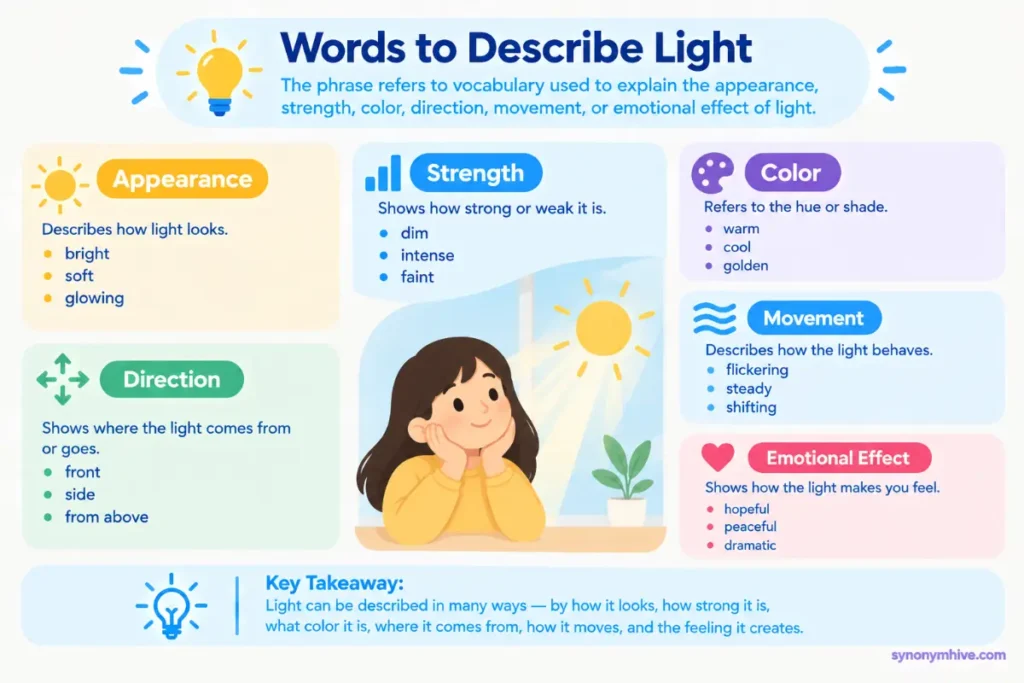
The phrase words to describe light refers to vocabulary used to explain the appearance, strength, color, direction, movement, or emotional effect of light.
Some words describe physical brightness. For example, bright, dim, and brilliant tell readers how much light there seems to be. Other words describe its quality. Soft, gentle, and diffused suggest light that spreads smoothly rather than hitting one spot with force.
Color also matters. Words such as golden, amber, white, blue, and pale can tell readers what the light looks like. Writers can also describe its movement with words such as flickering, shimmering, dancing, or sparkling.
The right choice depends on what you want your reader to picture.
Where Does the Word Light Come From?
The English word light has very old roots. It comes from Old English leoht, which referred to brightness or the visible natural phenomenon that allows people to see. Related forms appear in several older Germanic languages.
The word has kept its basic meaning for centuries. It can refer to sunlight, fire, electricity, a lamp, or another source of illumination.
English also uses light in several figurative ways. Someone can bring light to a difficult situation by offering hope or understanding. A person can have a light expression, meaning their face looks cheerful or relaxed.
That is why light related vocabulary can describe more than what the eye sees. It can also describe mood, atmosphere, beauty, warmth, and emotion.
What Are the Best Words to Describe Light?
The best word depends on the type of light and the effect you want to create. Here is a broad list organized by tone and common use.
| Word | Meaning | Tone | Example |
|---|---|---|---|
| Bright | Giving off or reflecting a lot of light | Simple | The room was bright. |
| Dim | Giving off little light | Simple | A dim lamp stood beside the bed. |
| Soft | Gentle and not harsh | Everyday | Soft light entered through the curtains. |
| Shining | Producing or reflecting light | Everyday | The moon was shining above us. |
| Flickering | Turning brighter and darker repeatedly | Descriptive | Flickering candlelight filled the room. |
| Glistening | Shining because of moisture | Descriptive | Glistening drops caught the morning light. |
| Golden | Having a warm yellow color | Descriptive | Golden light covered the fields. |
| Amber | Having a warm orange or yellow brown color | Descriptive | Amber light came through the window. |
| Harsh | Strong and unpleasant to look at | Negative | Harsh light made the room uncomfortable. |
| Blinding | So strong that vision is affected | Very strong | The headlights were blinding. |
| Subtle | Gentle and not easy to notice | Gentle | A subtle glow appeared behind the clouds. |
| Gentle | Soft and pleasant | Gentle | Gentle light filled the nursery. |
| Clear | Bright and easy to see through | Neutral | Clear sunlight entered the room. |
| Brilliant | Very bright or impressive | Strong | Brilliant sunlight reflected off the snow. |
| Softened | Made less strong or sharp | Neutral | Curtains softened the afternoon light. |
| Diffused | Spread across a wider area | Technical | Diffused light created fewer hard shadows. |
| Focused | Concentrated in one area | Technical | A focused beam illuminated the doorway. |
| Moody | Creating a dark or emotional atmosphere | Creative | Moody light gave the room a quiet feeling. |
| Ethereal | Very delicate and almost unreal | Literary | Ethereal light floated through the mist. |
| Heavenly | Beautiful and peaceful | Literary | Heavenly light appeared through the clouds. |
| Brilliantly lit | Filled with strong light | Descriptive | The hall was brilliantly lit. |
This list gives you choices for ordinary writing, school assignments, professional communication, creative work, and fiction.
Which Words Describe Mild Light?
Mild light is gentle, low, or easy on the eyes. It does not dominate the scene.
Good choices include:
- Soft.
- Gentle.
- Subtle.
- Dim.
- Pale.
- Faint.
- Muted.
- Low.
- Diffused.
- Delicate.
For example, soft works well when light feels pleasant.
Soft light came through the bedroom window.
Faint suggests that the light is weak or barely visible.
A faint light appeared beyond the trees.
Subtle suggests that the light is noticeable but not strong.
A subtle glow surrounded the candle.
These words work well in descriptions of bedrooms, sunsets, cloudy mornings, candles, moonlight, and quiet indoor spaces.
Which Words Describe Medium Light?
Medium strength light is neither weak nor overwhelming. It is strong enough to make things clear without creating discomfort.
Useful words include:
- Clear.
- Natural.
- Warm.
- Steady.
- Pleasant.
- Balanced.
- Even.
- Gentle.
- Glowing.
- Shining.
For example:
Warm light filled the dining room.
Here, warm describes the color and mood rather than simply the strength.
Another example is:
Steady light from the lamp made it easy to read.
The word steady tells the reader that the light does not flicker or change.
Which Words Describe Very Bright Light?
When light is extremely strong, choose words that show intensity.
Useful choices include:
- Brilliant.
- Radiant.
- Dazzling.
- Blazing.
- Intense.
- Vivid.
- Blinding.
- Glaring.
- Glorious.
- Fiery.
These words do not all mean exactly the same thing.
Brilliant usually suggests very strong or impressive brightness.
Brilliant sunlight reflected off the lake.
Dazzling suggests light that is so strong it can make it difficult to see.
The dazzling headlights forced him to look away.
Blinding is stronger. It suggests that the light seriously interferes with vision.
The blinding flash lasted only a second.
Which Words Describe Beautiful Light?
When the goal is beauty rather than simple brightness, choose words that create a pleasant image.
Good options include:
Radiant, glowing, golden, shimmering, sparkling, luminous, ethereal, heavenly, brilliant, and gleaming.
For example:
Golden light spread across the valley.
The word golden gives the reader both color and mood.
Shimmering light danced across the surface of the water.
Here, shimmering suggests movement and changing reflections.
An ethereal glow surrounded the mountains.
This choice creates a dreamy or almost unreal impression.
Which Words Describe Unpleasant Light?
Not all light is pleasant. Sometimes it is too strong, cold, direct, or uncomfortable.
Useful words include:
- Harsh.
- Glaring.
- Blinding.
- Stark.
- Cold.
- Clinical.
- Overhead.
- Intense.
- Piercing.
- Aggressive.
Consider these examples:
Harsh fluorescent light made the office feel cold.
The glaring headlights filled the windshield.
A piercing beam cut through the darkness.
Harsh is one of the most useful choices because it can describe light that looks uncomfortable or creates sharp shadows.
How Do You Describe Light by Its Movement?
Light can stay still, but it can also move, change, flicker, or reflect.
Use flickering for light that repeatedly becomes brighter and darker.
Flickering candlelight covered the walls.
Use shimmering for light that appears to move in small, soft flashes.
These verbs can make descriptions more active.
How Do You Describe Light by Color?
Color can completely change the mood of a scene.
Golden Light
Golden suggests a warm yellow light.
Golden sunlight covered the field.
This word works especially well for sunrise and sunset.
White Light
White describes neutral or very pale light.
White light poured through the open door.
It can suggest cleanliness, simplicity, or a clinical setting.
Blue Light
Blue often creates a cool or calm mood.
Blue light filled the room as evening arrived.
It can also describe electronic screens or artificial lighting.
Amber Light
Amber suggests warm yellow or orange light.
Amber light glowed from the old lamp.
It is useful for candles, lamps, sunsets, and decorative lights.
Red Light
Red can suggest warning, danger, heat, or strong emotion.
A red light flashed above the doorway.
Silver Light
Silver is often used for moonlight or pale reflections.
Silver light spread across the quiet lake.
What Are the Best Words to Describe Light in an Essay?
For an essay, choose clear words that add meaning without sounding too dramatic.
Strong choices include bright, soft, natural, intense, warm, pale, radiant, diffused, and clear.
For example:
The soft morning light created a calm atmosphere in the classroom.
That sentence is clearer than simply saying:
The light was nice.
For academic writing, avoid adding dramatic words when they do not support your point. Ethereal may work in literary analysis, but it could sound out of place in a scientific report.
The best academic description is specific.
Instead of:
The light was very strong.
Try:
The direct sunlight created sharp shadows across the pavement.
The second sentence gives the reader useful information.
What Are the Best Words to Describe Light in a Story?
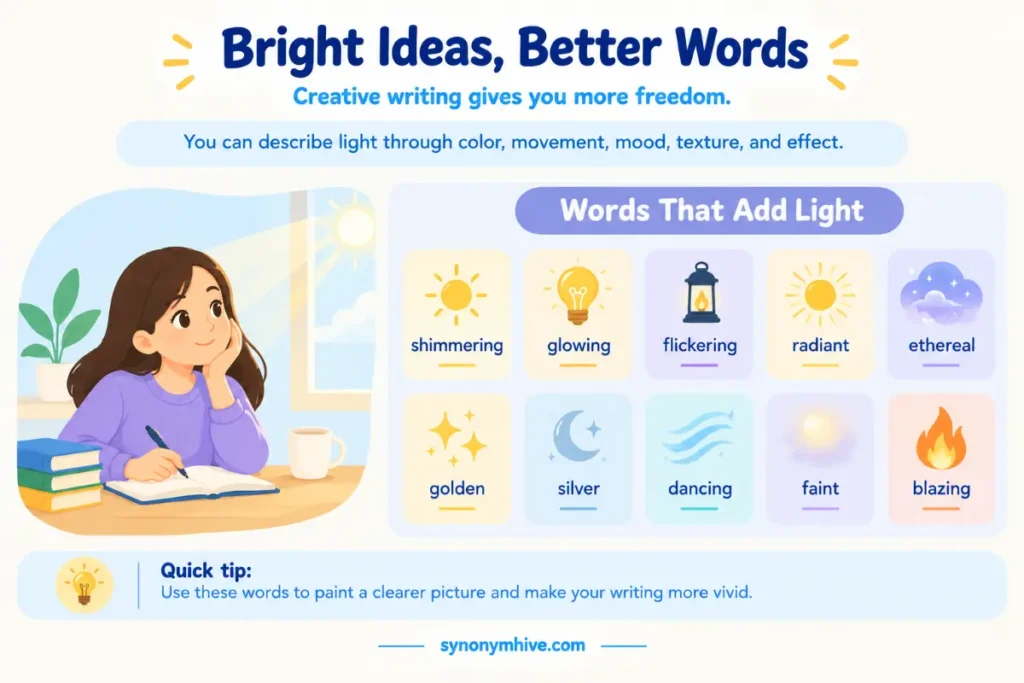
Creative writing gives you more freedom. You can describe light through color, movement, mood, texture, and effect.
Words such as shimmering, glowing, flickering, radiant, ethereal, golden, silver, dancing, faint, and blazing can create strong images.
Compare these sentences:
The sun came up.
Golden sunlight spilled over the rooftops.
The second sentence gives the reader a clearer picture.
You can also describe how light affects other objects.
Sunlight caught the glass and sent bright patterns across the wall.
This approach often works better than using several fancy adjectives.
What Is the Best Word to Describe Light on a Resume?
Light itself is rarely a major resume topic, so simple language usually works best. If you are describing photography, design, video, theater, architecture, or another visual field, use professional terms such as controlled, focused, balanced, diffused, natural, and precise.
For example:
Created balanced lighting setups for studio photography.
Or:
Used focused lighting to highlight key products during commercial shoots.
These examples show a skill instead of simply saying that the light looked good.
What Is the Best Word to Describe Light in an Email?
Professional emails should use simple and direct words.
Good choices include bright, natural, soft, clear, and strong.
For example:
The room has bright natural light throughout the morning.
If you are discussing an office, event space, photography location, or design project, specific descriptions help the reader understand the space quickly.
Avoid overly poetic choices such as heavenly or ethereal unless the situation is creative.
What Is the Best Word to Describe Light in a Text?
Text messages usually work best with natural everyday words.
You might say:
The light is really bright in here.
Or:
The sunset light looks amazing.
Or:
I love the soft light in this room.
Words such as bright, soft, warm, dark, and glowing sound natural in casual conversation.
Explore more word choices in Words to Describe Fear Best Guide In 2026.
What Is the Best Word to Describe Light When Speaking?
In everyday speech, simple words usually sound the most natural.
Try:
Bright, dark, soft, strong, warm, dim, glare, sunny, and shiny.
For example:
The room is too bright.
I like the warm light in this café.
Can you turn down that light?
You do not need an unusual adjective to describe something well. The right common word is often stronger because the listener understands it instantly.
What Is the Difference Between Bright and Brilliant?
Bright is the basic word for strong or noticeable light. Brilliant usually suggests a much higher level of brightness and can also suggest beauty or impressive quality.
| Bright | Brilliant |
|---|---|
| Common and simple | Stronger and more expressive |
| Describes strong light | Describes very strong or impressive light |
| Works in everyday speech | Often sounds more descriptive |
| The room was bright | Brilliant sunlight filled the valley |
You can say:
The kitchen was bright.
You can also say:
Brilliant sunlight poured through the windows.
The second sentence creates a stronger image.
What Is the Difference Between Dim and Faint?
Dim usually describes light that is weak because there is not much illumination. Faint suggests something weak, barely visible, or difficult to notice.
The hallway was dim.
The whole hallway has low light.
A faint glow appeared in the distance.
The glow is barely visible.
Both words describe weak light, but faint often suggests something smaller or less noticeable.
What Is the Difference Between Glow and Shine?
Glow usually suggests a soft, steady light that seems to come from within an object or surface.
The fireplace glowed in the corner.
Shine is broader. It can describe light coming from a source or reflecting from a surface.
The sun shone through the window.
Her shoes were shining after they were polished.
A glow often feels softer. A shine can be stronger, clearer, or more reflective.
What Is the Difference Between Shimmering and Sparkling?
Shimmering suggests a soft and changing reflection. Sparkling suggests small, bright flashes.
Shimmering light moved across the water.
The reflection changes gently.
Sparkling lights decorated the tree.
The lights appear as many bright points.
Both words can create beautiful descriptions, but they create different visual effects.
What Is the Difference Between Radiant and Luminous?
Radiant often suggests strong, beautiful light that seems to spread outward.
The radiant sun warmed the garden.
Luminous means giving off or reflecting light. It can sound more scientific or literary.
The luminous moon appeared above the trees.
Radiant often carries a stronger sense of beauty. Luminous focuses more directly on the quality of producing or reflecting light.
How Does Context Change the Best Word?
Context can change the best choice. The same light can be described in several ways, but each word highlights something different.
Imagine sunlight entering a bedroom.
You could write:
Bright sunlight entered the room.
This focuses on strength.
Warm sunlight entered the room.
This focuses on color and comfort.
Golden sunlight entered the room.
That is one of the most useful ideas when choosing words to describe light. Do not ask only, “What does the light look like?” Ask what part of the light you want the reader to notice.
What Are Common Mistakes When Describing Light?
One common mistake is using bright for every situation. Bright is useful, but it does not tell the reader much about color, movement, texture, or mood.
Another mistake is using shiny when you mean bright. Shiny usually describes a surface that reflects light.
For example:
The shiny floor reflected the lamps.
The floor itself is not producing light.
Another common mistake is confusing glowing with shining. A candle can glow. The sun can shine. Both can produce visible light, but the words create different images.
Writers also sometimes use blinding simply to mean bright. That can be too strong. Blinding suggests that the light makes it difficult to see.
Avoid saying:
The soft sunlight was blinding.
The two descriptions conflict unless you have a special reason for that contrast.
When Should You Not Use Fancy Words for Light?
Fancy vocabulary is not always better.
If you are writing a school report, a business email, or a simple explanation, bright, dim, soft, and warm may be better than ethereal, luminous, or radiant.
Clear writing depends on purpose.
A reader should understand your meaning without stopping to think about the vocabulary.
For example:
The bright light made the room easier to see.
This is plain and useful.
A more literary sentence might be:
An ethereal glow drifted through the mist.
That works in a story or poem because the goal is different.
Use the word that matches the job.
What Are the Antonyms of Light Related Words?
Many light related words have useful opposites.
| Light Word | Opposite |
|---|---|
| Bright | Dim |
| Radiant | Dull |
| Glowing | Dark |
| Shining | Dull |
| Brilliant | Faint |
| Warm | Cold |
| Clear | Murky |
| Strong | Weak |
| Visible | Hidden |
| Illuminated | Darkened |
These pairs can help you make comparisons.
For example:
The bright kitchen stood in sharp contrast to the dim hallway.
Or:
Warm golden light filled the room while cold shadows gathered near the door.
Contrast can make descriptions stronger without requiring many adjectives.
How Can You Choose the Right Word for Light?
Start by asking what you actually want to describe.
If You Mean Strength
Choose bright, dim, faint, brilliant, dazzling, or blinding.
If You Mean Color
Choose golden, amber, blue, white, silver, or pale.
If You Mean Movement
Choose flickering, shimmering, sparkling, flashing, or pulsing.
If You Mean Mood
Choose warm, gentle, soft, moody, peaceful, or cold.
If You Mean Beauty
Choose radiant, glowing, luminous, golden, sparkling, or ethereal.
If You Mean Discomfort
Choose harsh, glaring, piercing, intense, or blinding.
This simple method can prevent vague descriptions.
What Are 15 Strong Example Sentences?
Here are original examples showing how different choices change the image.
- Soft morning light entered through the curtains.
- Brilliant sunlight reflected from the glass windows.
- A faint glow appeared behind the distant hills.
- Golden light covered the field at sunset.
- Flickering candlelight moved across the walls.
- The harsh ceiling light made the room look cold.
- Shimmering light danced across the surface of the lake.
- A pale moon cast silver light over the road.
- The dazzling snow forced us to shade our eyes.
- Warm light made the small café feel welcoming.
- A focused beam illuminated the old doorway.
- Dim light filled the hallway after midnight.
- Sparkling lights decorated the garden.
- The radiant morning sun warmed the empty street.
- A faint blue light came from the screen.
Notice how each sentence gives a different impression. That difference is what makes precise description useful.
How Can You Make Light Descriptions More Vivid?
One strong method is to describe what the light does instead of only naming its appearance.
Instead of:
The light was bright.
Try:
Bright sunlight spilled across the kitchen floor.
Instead of:
The light was soft.
Try:
Soft light settled over the quiet room.
Instead of:
The sunset was beautiful.
Try:
Golden light spread across the clouds as the sun disappeared.
These sentences give the reader an image rather than a basic label.
You can also describe the effect on nearby objects.
Moonlight turned the wet pavement silver.
That sentence does not simply tell the reader that moonlight exists. It shows what the light does.
How Can Writers Describe Light Without Repeating the Same Word?
Avoid repeating bright in every paragraph.
Change the focus instead.
Use radiant when the light is powerful and beautiful.
Use glowing when it appears warm and steady.
This gives your writing more variety while keeping the meaning clear.
What Should You Remember About Words to Describe Light?
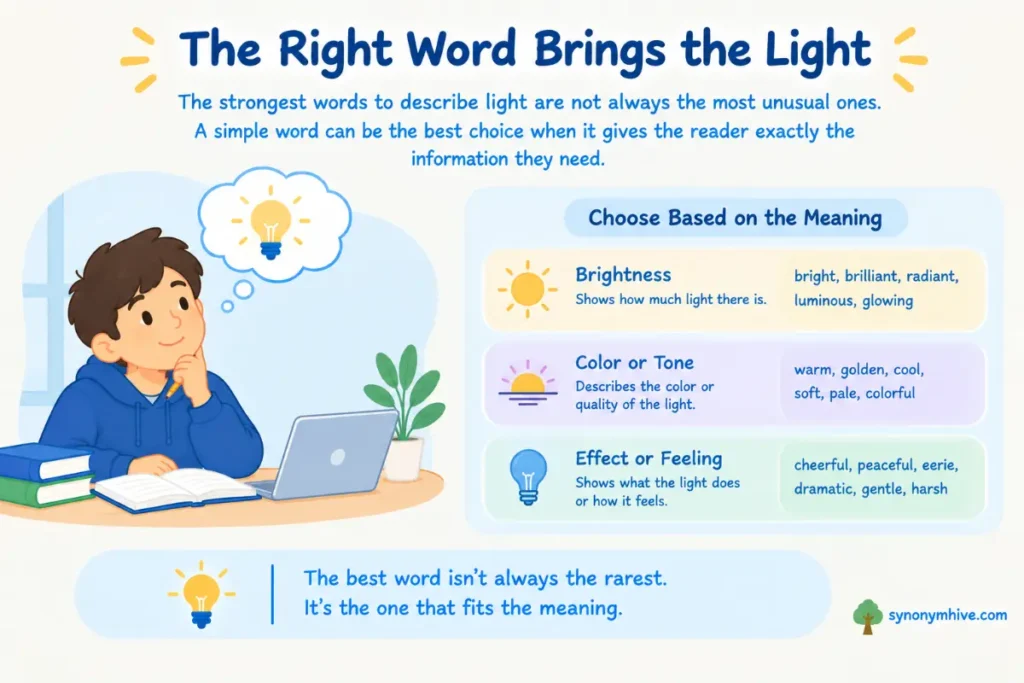
The strongest words to describe light are not always the most unusual ones. A simple word can be the best choice when it gives the reader exactly the information they need.
Use bright for strong light, dim for weak light, soft for gentle light, golden for warm yellow light, shimmering for changing reflections, and flickering for unstable light.
Think about strength, color, movement, source, and mood before choosing an adjective. That small step can turn a plain sentence into a clear picture.
Good description does not depend on using the biggest vocabulary. It depends on choosing the most accurate word.
Explore another synonym guide: words to describe silence Best Guide in 2026.
Conclusion
The best words to describe light depend on the exact quality you want your reader to notice. Bright and brilliant describe strength, while soft and gentle describe a calmer quality. Golden and amber describe warm colors. Shimmering and sparkling show changing reflections, while flickering describes unstable light.
For simple writing, choose familiar words that communicate the idea quickly. For stories, poems, and descriptive essays, you can use more expressive choices such as radiant, luminous, ethereal, or glowing.
Before choosing a word, ask yourself one simple question: What do I want the reader to see? If you can answer that, the right description becomes much easier to find.
Frequently Asked Questions
What are the best words to describe light?
The best choices include bright, dim, soft, glowing, radiant, brilliant, warm, golden, shimmering, sparkling, and luminous. The right word depends on the strength, color, movement, and mood of the light.
What is another way to say bright light?
You can say brilliant light, radiant light, intense light, dazzling light, or strong light. Use dazzling or blinding only when the brightness is extreme.
What words describe soft light?
Soft, gentle, subtle, faint, diffused, muted, and delicate can describe soft light. These words work well for candlelight, moonlight, morning light, and cloudy sunlight.
What word describes light that flickers?
Flickering is the most direct choice. It describes light that repeatedly becomes brighter and darker, such as candlelight or firelight.
What words describe beautiful sunlight?
Golden, radiant, glowing, warm, brilliant, shimmering, and luminous are strong choices for beautiful sunlight. Golden and warm work especially well for sunrise and sunset.
What is the difference between glowing and shining?
Glowing usually suggests soft or steady light coming from something. Shining is broader and can describe light produced by a source or reflected from a surface.
How do I describe light in creative writing?
Focus on what the light looks like and what it does. Instead of only saying that light is bright, describe its color, movement, shadows, reflections, or effect on the setting.