
Writing about a forest, beach, mountain, garden, or quiet trail can be harder than it looks. You may know exactly what you see, but words such as beautiful or peaceful can sound too plain. That is where the right descriptive language helps. This guide to words to describe nature gives you stronger choices for essays, emails, captions, stories, speeches, and everyday writing.
Words to describe nature can show more than appearance. They can tell readers how a place sounds, moves, feels, smells, and affects the people around it. A forest might be lush and peaceful, while a stormy coastline might be wild and dramatic. The best word depends on the scene and the feeling you want to create.
The most useful nature words range from simple choices such as green, calm, fresh, and quiet to richer terms such as majestic, serene, rugged, vibrant, untamed, and breathtaking. Some words describe physical features, while others describe mood, movement, color, or atmosphere.
Below, you’ll find a detailed list grouped by meaning and tone. You’ll also learn how to choose the right word for an essay, text, caption, email, speech, or creative piece. Real examples and close word comparisons will help you use each term naturally.
Need another vocabulary suggestion? Read Words to Describe Summer Ultimate Word List.
What do words to describe nature mean?
Terms to describe nature are adjectives and descriptive phrases that explain the appearance, mood, sounds, textures, movement, or overall character of the natural world. They can describe forests, oceans, mountains, rivers, flowers, weather, wildlife, landscapes, and outdoor spaces.
For example, a forest can be lush, dense, quiet, shady, or mysterious. A lake can be calm, clear, still, sparkling, or peaceful. These choices give readers a more specific picture than simply calling nature beautiful.
What is the best way to describe nature?
The best way to describe nature is to choose specific words that match what you can see, hear, smell, touch, or experience. Use words such as lush, tranquil, rugged, vibrant, majestic, wild, peaceful, or breathtaking when they fit the scene.
Avoid using the same general word for every setting. A quiet meadow and a powerful waterfall may both be beautiful, but they create very different impressions.
A master list of words to describe nature
The table below gives you more than 30 useful choices. Each word has a slightly different meaning, so you can choose one that matches your exact scene.
| Word | Meaning | Tone | Example |
|---|---|---|---|
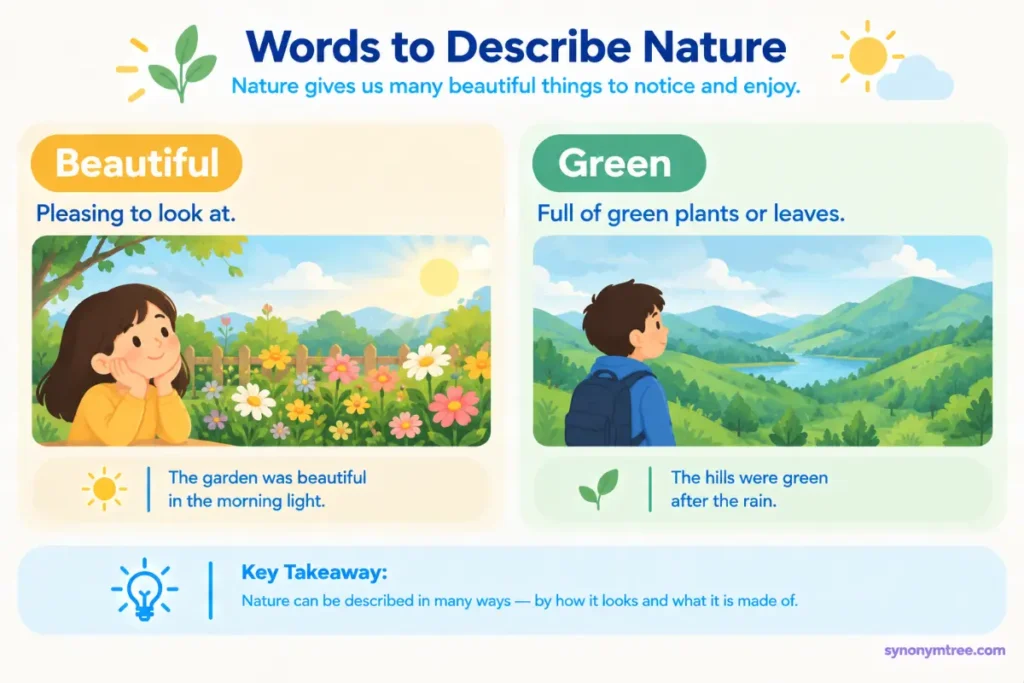
| Beautiful | Pleasing to look at | Simple | The garden was beautiful in the morning light. |
| Green | Full of green plants or leaves | Simple | The hills were green after the rain. |
| Calm | Quiet and without much movement | Simple | The lake looked calm at sunrise. |
| Quiet | Having little or no noise | Simple | The quiet woods helped me relax. |
| Fresh | Clean, cool, or new | Simple | Fresh mountain air filled the valley. |
| Bright | Full of strong light or color | Simple | Bright flowers covered the field. |
| Lush | Rich with healthy plants | Everyday | The valley was lush and green. |
| Peaceful | Calm and free from disturbance | Everyday | We found a peaceful spot beside the river. |
| Scenic | Having attractive natural views | Everyday | The road offered a scenic view of the mountains. |
| Colorful | Full of different or vivid colors | Everyday | The forest was colorful in autumn. |
| Majestic | Grand, impressive, and powerful | Formal | The majestic mountain stood above the town. |
| Untamed | Not controlled or changed much by people | Formal | The island has an untamed beauty. |
| Breezy | Having a gentle or pleasant wind | Everyday | It was a breezy afternoon by the coast. |
| Blooming | Covered with flowers | Everyday | The blooming garden attracted visitors. |
| Lush | Thick, healthy, and green | Everyday | Lush vegetation covered the hillside. |
| Magical | Seeming special or almost unreal | Creative | The snowy forest looked magical at dusk. |
| Dreamlike | Similar to something from a dream | Creative | The fog created a dreamlike scene. |
| Enchanting | Extremely charming or appealing | Creative | The enchanting woods seemed full of mystery. |
| Raw | Powerful and untouched | Creative | The coastline had a raw beauty. |
| Otherworldly | Strange and unlike ordinary places | Creative | The blue caves looked otherworldly. |
Which words describe nature in a simple way?
Simple descriptive words work well when you want clear writing. They are easy to understand and fit school assignments, everyday messages, and basic descriptions.
Good simple choices include:
- Green.
- Fresh.
- Calm.
- Quiet.
- Bright.
- Sunny.
- Shady.
- Warm.
- Cool.
- Wild.
- Clean.
- Pretty.
- Beautiful.
- Peaceful.
- Colorful.
These words are not weak. They become useful when they accurately match the scene.
For example, saying a lake is clear gives the reader a useful detail. Saying a field is green after several days of rain creates a specific picture. Simple language can often make writing easier to understand.
Which words describe nature in everyday writing?
Everyday writing gives you more room to add personality. Words such as lush, scenic, misty, rugged, vibrant, lively, and peaceful can make a description more interesting without making it difficult to read.
Consider these examples.
The hills were lush after the spring rain.
The coastal road was scenic from beginning to end.
A misty layer covered the trees before sunrise.
The trail led through a rugged mountain landscape.
Vibrant flowers grew beside the old stone wall.
These words work well because they add information. Lush tells us that the plants are thick and healthy. Rugged tells us that the land is rough. Misty tells us that the air contains a thin layer of moisture.
Which words describe nature in a formal way?
Formal writing often needs more precise vocabulary. This is useful for essays, reports, academic writing, travel articles, and speeches.
Strong formal choices include:
- Serene.
- Tranquil.
- Majestic.
- Pristine.
- Picturesque.
- Rugged.
- Vibrant.
- Vast.
- Untamed.
- Breathtaking.
- Lush.
- Dramatic.
- Spectacular.
- Remarkable.
- Abundant.
Use these words when they add real meaning. Do not choose a fancy word simply because it sounds impressive.
For example, serene works well for a quiet lake. Majestic suits a huge mountain or waterfall. Pristine works best when something is exceptionally clean and appears largely untouched.
Which words describe wild nature?
Nature does not always look soft or peaceful. Some places are powerful, rough, dangerous, or difficult to control.
Useful words for wild landscapes include rugged, untamed, fierce, raw, powerful, remote, harsh, dramatic, stormy, and wild.
A rugged landscape may contain steep rocks and rough ground. An untamed forest has not been heavily changed by people. A harsh desert may have extreme heat and little water.
Try these examples.
The rugged coastline was covered with dark rocks.
A fierce wind swept across the open plain.
The remote valley was surrounded by high peaks.
The untamed forest stretched far beyond the hiking trail.
The raw beauty of the desert made the journey unforgettable.
How can you describe peaceful nature?
Peaceful nature often includes quiet sounds, gentle movement, soft colors, and open space. Words such as calm, tranquil, serene, still, restful, soothing, quiet, gentle, and peaceful work well.
A calm lake has little movement. A still lake may appear almost motionless. A serene setting creates a strong sense of peace. A soothing landscape can make people feel relaxed.
For example:
The garden was quiet and peaceful after the rain.
A gentle breeze moved through the tall grass.
The serene lake reflected the pale morning sky.
The still water made the valley seem even quieter.
The soft sound of the stream created a soothing atmosphere.
How can you describe beautiful nature without saying beautiful?
If you use beautiful too often, your writing may start to sound repetitive. You can replace it with a more exact word based on the scene.
Use spectacular for something especially impressive.
Use pristine for a clean and untouched setting.
For example, instead of writing, The mountain was beautiful, try The mountain looked majestic against the clear blue sky.
That sentence gives the reader more information. It tells us the mountain was not simply attractive. It was large, impressive, and powerful.
How do nature words change from mild to strong?
Descriptive words can have different levels of intensity. Choosing the right level keeps your writing accurate.
| Mild | Medium | Strong |
|---|---|---|
| Nice | Beautiful | Breathtaking |
| Pretty | Scenic | Spectacular |
| Calm | Serene | Tranquil |
| Large | Vast | Immense |
| Green | Lush | Abundant |
| Wild | Rugged | Untamed |
| Colorful | Vibrant | Brilliant |
| Interesting | Striking | Astonishing |
| Quiet | Peaceful | Silent |
| Good | Remarkable | Extraordinary |
Mild words are useful when you want a natural tone. Strong words work better when the scene truly deserves them.
Calling every sunset breathtaking weakens the word. Save powerful descriptions for moments that genuinely stand out.
What are the different parts of speech used to describe nature?
Most direct nature descriptions use adjectives, but other parts of speech can help create a stronger image.
Adjectives
Adjectives describe nouns.
Examples include lush, green, peaceful, rugged, bright, vast, and wild.
The lush forest covered the hillside.
The rugged trail climbed toward the mountain.
Nouns
Nouns can name features of nature.
Examples include forest, meadow, river, valley, mountain, waterfall, coastline, sunset, breeze, storm, and wilderness.
The waterfall echoed through the valley.
The meadow was covered in wildflowers.
Verbs
Strong verbs show what nature is doing.
Examples include flow, sway, bloom, shimmer, roar, drift, ripple, sparkle, grow, crash, and rustle.
The leaves rustled in the wind.
The river rushed through the narrow canyon.
The sunlight shimmered across the water.
Adverbs
Adverbs can explain how something happens.
The leaves moved gently.
The waves crashed loudly against the rocks.
The clouds drifted slowly across the sky.
Using strong verbs can make nature writing much more active.
Which words describe nature by the five senses?
Good descriptions often appeal to the senses. This helps readers picture the scene instead of simply being told that it is beautiful.
Words for sight
Use words such as bright, colorful, green, golden, pale, vivid, sparkling, shadowy, misty, and clear.
The golden sunlight spread across the field.
Words for sound
Use words such as quiet, silent, peaceful, rustling, roaring, crashing, gentle, loud, and soothing.
The quiet forest was broken by the distant sound of a waterfall.
Words for smell
Use words such as fresh, earthy, fragrant, floral, sweet, pine scented, damp, and smoky.
The earthy smell of wet soil filled the garden.
Words for touch
Use words such as cool, warm, soft, rough, smooth, damp, dry, breezy, and crisp.
A cool breeze moved across the open field.
Words for taste
Nature descriptions sometimes include food or plants. Words such as sweet, bitter, fresh, sour, juicy, and ripe can work here.
The ripe berries tasted sweet after the long hike.
How should you describe nature in an essay?
For an essay, choose words that are clear, specific, and connected to your main point. Avoid filling every sentence with dramatic adjectives.
If your essay discusses the value of spending time outdoors, you might write:
The quiet forest provided a peaceful place away from the noise of the city. Tall trees blocked much of the sunlight, while a cool breeze moved through the leaves. The natural setting gave visitors a chance to slow down and enjoy a calmer environment.
This approach works better than using many strong adjectives in every sentence. The details support the idea instead of distracting from it.
What words work best for nature in a resume?
A resume rarely needs direct descriptions of nature unless your work involves parks, conservation, tourism, landscaping, agriculture, outdoor education, or environmental work.
For a resume, use practical words such as natural, outdoor, environmental, sustainable, scenic, protected, agricultural, and ecological.
For example:
Managed visitor activities in a scenic national park.
Supported environmental projects across protected natural areas.
Maintained outdoor spaces and native plant gardens.
These examples focus on work and results instead of poetic language.
What words work best for nature in a text message?
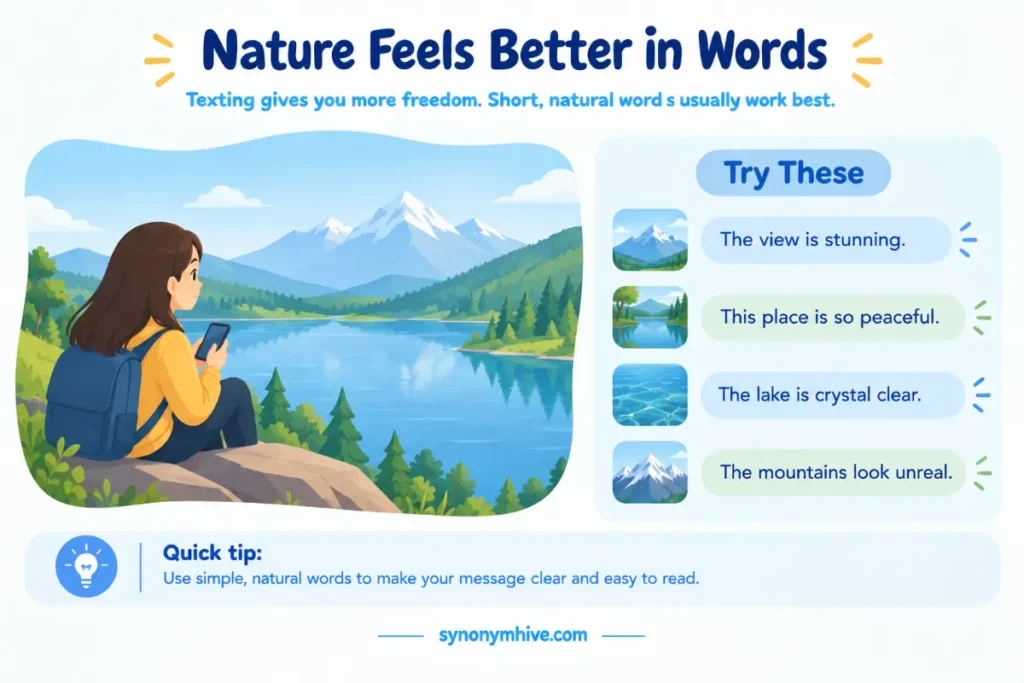
Texting gives you more freedom. Short, natural words usually work best.
Try:
The view is stunning.
This place is so peaceful.
The lake is crystal clear.
The mountains look unreal.
The sunset is gorgeous.
This trail is wild.
The whole place feels magical.
For casual messages, you do not need formal words such as picturesque or tranquil unless they match your normal style.
What words work best for nature in an email?
Professional emails should sound clear and natural. Words such as scenic, beautiful, peaceful, remote, natural, and impressive are usually safe choices.
For example:
The conference location offers a scenic view of the surrounding hills.
The property has a peaceful setting with several mature trees.
The area provides a beautiful natural backdrop for outdoor events.
Keep the description connected to the reason for the email.
Looking for a better alternative? Visit Words to Describe Eyes: Words for Eye Colors 2026.
What words work best for nature in a speech?
A speech benefits from words that are easy to say and easy for listeners to understand. Strong choices include beautiful, powerful, peaceful, wild, vast, remarkable, and breathtaking.
For example:
When we stand beside a quiet river or look across a vast mountain range, we are reminded how much natural beauty surrounds us.
Speech writing also benefits from rhythm. Pair a few descriptive words with clear images instead of creating a long list.
What are some original examples of nature descriptions?
The following examples show how different descriptive words work in real situations.
- The peaceful lake reflected the pink colors of the early morning sky.
- Tall pine trees filled the fresh mountain air with a clean, earthy scent.
- The rugged trail led us across rocks, roots, and narrow streams.
- Vibrant wildflowers covered the meadow beside the hiking path.
- A gentle breeze moved through the golden grass.
- The vast desert looked endless beneath the afternoon sun.
- Dark clouds gave the coastline a dramatic and powerful appearance.
- The pristine beach had clear water and soft white sand.
- Misty hills appeared and disappeared as the morning fog moved through the valley.
- The lush forest was alive with birds, insects, and small animals.
- The waterfall roared as it dropped into the deep pool below.
- The quiet garden offered a peaceful place to read.
- Golden leaves covered the ground beneath the old oak trees.
- The rugged cliffs rose sharply above the cold ocean.
- The sunset painted the sky in soft shades of orange, pink, and purple.
- A cool breeze swept across the field just before the rain began.
- The untouched valley looked remote and almost otherworldly.
- The lively river rushed over smooth stones after the storm.
- The fragrant garden attracted butterflies throughout the afternoon.
- The snow covered the mountain peaks and gave the landscape a clean, bright appearance.
Lush vs. green: what is the difference?
Lush and green are related, but they do not mean exactly the same thing.
| Word | Main idea | Example |
|---|---|---|
| Green | The color of plants or grass | The hills were green after the rain. |
| Lush | Thick, healthy, and rich with plant life | The valley was lush after weeks of rain. |
Green focuses mainly on color. Lush tells the reader more about the amount and health of vegetation.
A field can be green without being lush. A lush forest is usually green, but the word also suggests dense and healthy growth.
Peaceful vs. serene: what is the difference?
Both words describe calm settings, but serene usually sounds more refined and deeply peaceful.
Peaceful is common in everyday writing.
The beach was peaceful in the early morning.
Serene often suggests a deeper sense of stillness and calm.
The serene lake reflected the mountains without a ripple.
For a school essay, either word can work. In casual writing, peaceful often sounds more natural. In descriptive or formal writing, serene can add a softer tone.
Wild vs. untamed: what is the difference?
Wild means natural, uncontrolled, or not domesticated. Untamed adds a stronger idea that people have not controlled or changed the area.
The wild forest was home to many animals.
The untamed wilderness stretched for miles.
Wild is broader and more common. Untamed often creates a stronger image of freedom and natural power.
Beautiful vs. breathtaking: what is the difference?
Beautiful means pleasing or attractive. Breathtaking is much stronger.
A beautiful garden may have colorful flowers and careful landscaping.
A breathtaking mountain view may be so impressive that it immediately grabs your attention.
Do not use breathtaking for every attractive scene. Its stronger meaning makes it more effective when the view is truly exceptional.
How do US and UK English differ when describing nature?
Most common nature vocabulary works the same way in US and UK English. Words such as beautiful, peaceful, lush, rugged, scenic, serene, and majestic are widely understood in both varieties.
Some related outdoor terms can differ. For example, Americans commonly use hiking trail, while British English may also use footpath for a walking route. Americans often say fall, while British English usually uses autumn.
The main descriptive adjectives do not usually need to change. Focus on the setting and audience instead.
What common mistakes should you avoid when describing nature?
Strong descriptive writing depends on accuracy. Several common mistakes can make nature descriptions weaker.
Using beautiful too many times
Beautiful is useful, but repeating it makes your writing predictable.
Instead of writing:
The beautiful lake was surrounded by beautiful trees and beautiful flowers.
Try:
The clear lake was surrounded by tall pine trees and vibrant wildflowers.
The second version gives the reader specific details.
Using words that do not match the scene
Do not call a storm peaceful. Do not call a rocky cliff gentle. Choose words that fit what is happening.
A stormy sky might be dark, fierce, dramatic, or threatening.
A quiet pond might be calm, still, serene, or peaceful.
Adding too many adjectives
A sentence such as The breathtaking, majestic, beautiful, stunning, vibrant, peaceful, magical forest can sound forced.
Pick one or two strong words and add concrete details.
The misty forest was quiet except for the soft sound of birds.
That sentence creates a clearer picture.
Using formal words in casual situations
Words such as pristine, picturesque, and majestic are useful, but they may sound too formal in a quick text.
For a friend, The view is amazing may sound more natural than The view is exceptionally picturesque.
Confusing appearance with mood
Some words describe how nature looks. Others describe how it makes you feel.
Green describes color.
Rugged describes physical shape.
Peaceful describes atmosphere.
Refreshing can describe the effect a setting has on you.
Knowing this difference helps you choose more precise language.
What are the antonyms of common nature words?
Understanding opposites can help you find the exact word you need.
| Word | Antonym |
|---|---|
| Calm | Stormy |
| Peaceful | Chaotic |
| Quiet | Noisy |
| Bright | Dark |
| Lush | Barren |
| Green | Dry |
| Fresh | Stale |
| Clean | Polluted |
| Smooth | Rough |
| Gentle | Fierce |
| Wild | Tame |
| Warm | Cold |
| Vast | Small |
| Clear | Cloudy |
| Vibrant | Dull |
These opposites can also help you create contrast in writing.
For example:
The quiet lake stood in sharp contrast to the noisy city nearby.
The lush forest ended where the dry, barren land began.
How do you choose the right word for nature?
Start by asking what you are actually trying to describe. Do not begin with a list of fancy adjectives.
If you are describing beauty, consider beautiful, stunning, breathtaking, picturesque, majestic, or enchanting.
If you are describing movement, consider flowing, rushing, swaying, drifting, rippling, or crashing.
This method makes your writing more precise because you are choosing a word based on meaning rather than sound.
How can you make nature writing more vivid?
Use a combination of specific adjectives, strong verbs, and sensory details.
Instead of:
The forest was beautiful.
Try:
Tall pine trees filled the quiet forest, and cool air carried the fresh smell of rain.
The second sentence gives the reader several details. We can see the trees, hear the quiet, and imagine the cool air and smell of rain.
You can also describe movement.
Leaves rustled in the breeze.
Water rushed over the rocks.
Clouds drifted above the valley.
Waves crashed against the shore.
Flowers swayed in the wind.
Strong verbs often create a clearer image than long adjective lists.
How can you describe nature in creative writing?
Creative writing gives you more freedom to use emotional and imaginative language. Words such as magical, mysterious, dreamlike, enchanting, haunting, otherworldly, and timeless can work well.
For example:
The mist settled over the forest, turning the familiar trail into a dreamlike path.
Another option is to compare nature with something familiar.
The lake was as still as glass.
The clouds spread across the sky like soft gray blankets.
The golden grass moved like waves in the wind.
Use comparisons carefully. A few strong images can make a passage memorable without making it hard to understand.
How can you describe nature in a travel article?
Travel writing should help readers imagine the place while still giving useful information. Combine descriptive language with specific details about the location.
For example:
The trail winds through a lush forest before reaching a rocky overlook. From the top, visitors can see the vast valley below and the blue mountains in the distance.
This approach is more useful than simply calling the place beautiful. Readers learn what the landscape looks like and what they can expect to see.
Useful travel words include scenic, peaceful, remote, rugged, picturesque, vibrant, natural, breathtaking, and accessible.
How can you avoid repetitive nature descriptions?
The easiest way is to describe different parts of the scene instead of using a new adjective for the same thing.
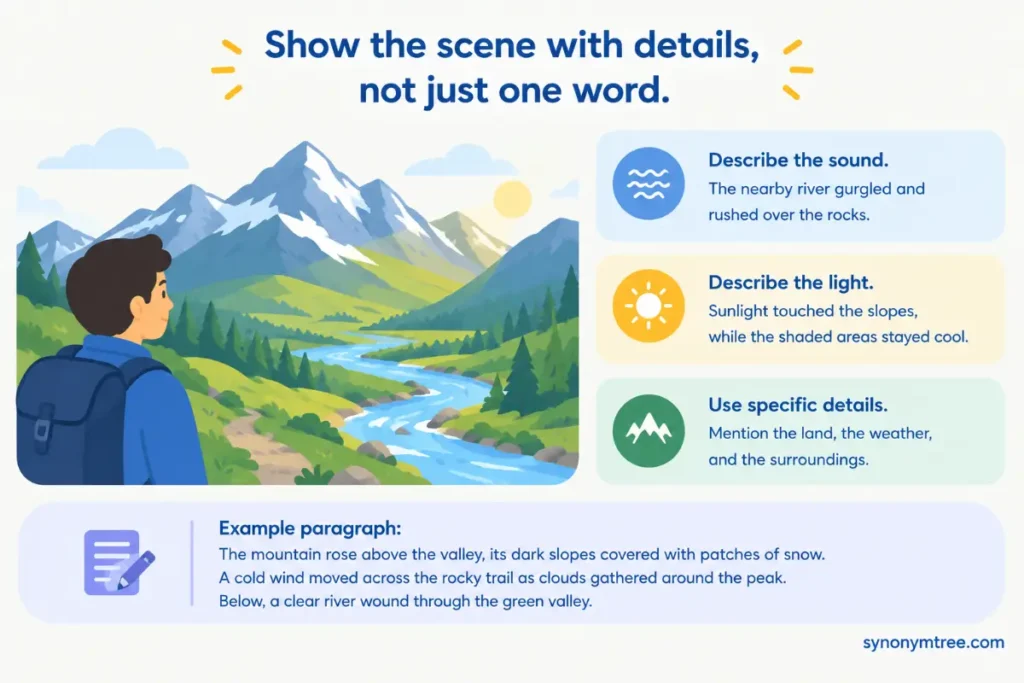
Describe the sound of the nearby river.
Describe how the light changes across the slopes.
A stronger paragraph might look like this:
The mountain rose above the valley, its dark slopes covered with patches of snow. A cold wind moved across the rocky trail as clouds gathered around the peak. Below, a clear river wound through the green valley.
This paragraph uses several details instead of repeating beautiful.
Quick tips for choosing nature words
Keep these simple rules in mind when you write.
- Choose specific words instead of general ones when you can.
- Match the word to the actual scene.
- Use strong words only when they fit the intensity of the scene.
- Add sensory details to help readers picture the setting.
- Use strong verbs such as rush, shimmer, sway, drift, bloom, and roar.
- Avoid repeating beautiful, nice, amazing, and pretty.
- Keep formal vocabulary for formal writing.
- Use simple vocabulary when writing for a broad audience.
- Describe what nature looks like and how it sounds or moves.
- Read the sentence aloud. If a word sounds forced, replace it with a simpler choice.
- Use two precise words instead of five weak adjectives.
- Let the details create the mood instead of explaining every emotion.
Discover another helpful synonym list in Words to Describe a Smile: Words for Stories and Poems 2026.
Conclusion
Choosing the right words to describe nature is less about using complicated vocabulary and more about being precise. A calm lake, rugged mountain, lush forest, and dramatic coastline each need different language. When the word matches the scene, the description becomes clearer and more memorable.
Start with the detail you want to show. Think about color, size, sound, movement, texture, weather, or mood. Then choose a word that gives the reader that exact idea. Simple words can work just as well as formal ones when they are accurate.
You can also strengthen nature writing with sensory details and active verbs. Instead of saying a river is beautiful, explain how it rushes over smooth stones or reflects the morning light. Those details give readers something they can picture.
The next time you describe a natural setting, pause before using beautiful or nice. Ask what makes the place special. Then choose the word that tells your reader exactly what you mean.
Frequently Asked Questions
What are good words to describe nature?
Good choices include lush, peaceful, serene, vibrant, rugged, majestic, wild, pristine, scenic, tranquil, and breathtaking. The best choice depends on the type of landscape and the mood you want to create.
What’s another way to say nature is beautiful?
You can say nature is breathtaking, stunning, majestic, picturesque, enchanting, vibrant, or spectacular. Choose the word that explains why the scene is attractive instead of simply replacing beautiful.
What are positive words for nature?
Positive words include peaceful, fresh, vibrant, lush, beautiful, serene, refreshing, lively, majestic, and breathtaking. These words can describe both the appearance of nature and the way a natural setting affects people.
What are words to describe nature in an essay?
Useful choices include lush, serene, scenic, vibrant, rugged, majestic, pristine, peaceful, vast, and natural. For essays, choose words that add specific meaning and support your main idea.
What words describe a peaceful natural place?
Calm, serene, tranquil, quiet, still, restful, soothing, gentle, and peaceful all work well. Serene and tranquil usually sound more formal than peaceful and calm.
What words describe wild nature?
Wild, untamed, rugged, raw, remote, fierce, powerful, dramatic, and harsh can describe wild natural settings. The best word depends on the land, weather, and level of human influence.
What are strong words to describe nature?
Strong choices include breathtaking, majestic, spectacular, extraordinary, immense, untamed, dramatic, and awe inspiring. Save the strongest terms for scenes that truly deserve them.