
You’re writing an essay and notice that you’ve used because in almost every paragraph. The sentence is correct, but the repeated wording makes your writing feel flat. You start looking for another word for because that keeps the same meaning while making your sentence sound more natural.
The good news is that you have plenty of choices. Words and phrases such as since, as, because of, due to, owing to, given that, and considering that can all express a reason. The best choice depends on the sentence, the level of formality, and the relationship between your ideas.
Another term for because can be since, as, given that, due to, owing to, or because of. Choose the option that fits the grammar and tone of your sentence.
This guide explains the meaning and origin of because, gives you more than 30 useful alternatives, and shows how to use them in essays, resumes, emails, texts, conversations, and professional writing. You’ll also see clear comparisons, examples, common mistakes, and quick tips for choosing the right expression.
Compare more word options with Another Word for In Conclusion Best Essay Choices 2026.
What Does Another Word for Because Mean
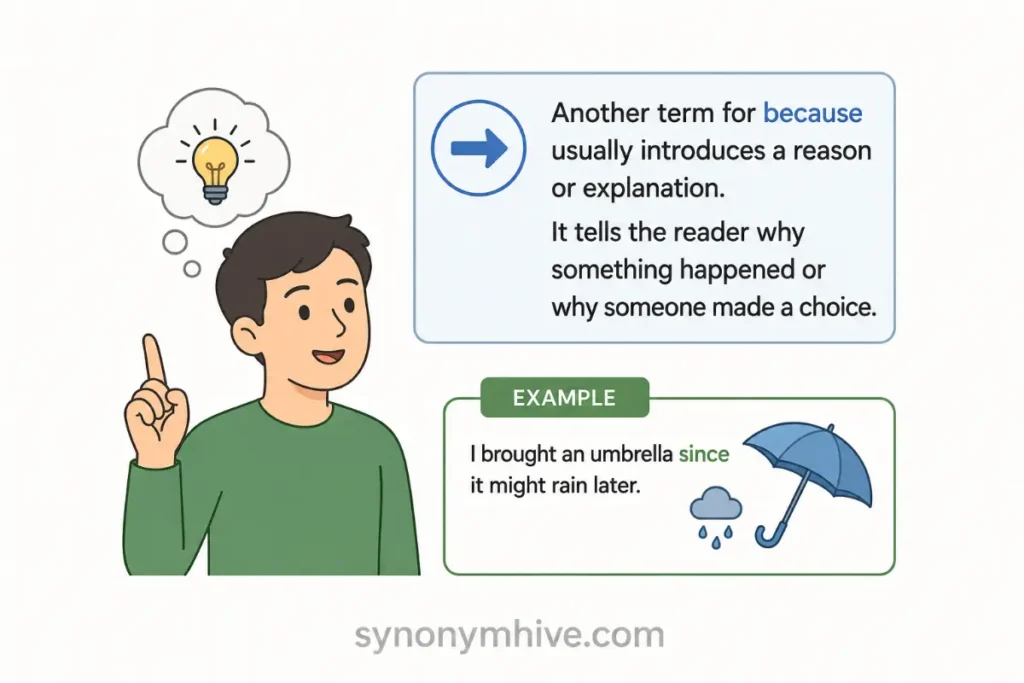
Another term for because usually introduces a reason or explanation. It tells the reader why something happened or why someone made a choice.
For example.
The team stayed inside because it was raining.
The phrase because it was raining explains the reason the team stayed inside. You could also write.
The team stayed inside since it was raining.
The team stayed inside as it was raining.
The team stayed inside because of the rain.
The meaning stays close, but the grammar changes slightly. That difference matters.
Because normally connects a main clause with a dependent clause.
I left early because I felt tired.
Because of normally comes before a noun or noun phrase.
I left early because of my tiredness.
A simple way to remember this is to look at what comes after the expression. If you need a full clause, because, since, as, or given that may work. If you need a noun, because of, due to, or owing to may work better.
Where Did Because Come From
The word because has a long history in English. It developed from the phrase by cause. Over time, the expression changed in pronunciation and spelling until it became the single word because.
The original idea was simple. Something happened by cause of something else. Modern English shortened that relationship into because.
Today, because is one of the most common ways to explain a reason. It works in casual speech, school writing, business communication, and everyday conversation.
Its long history also explains why English has so many similar expressions. Language gives writers several ways to show cause and reason. Some sound casual. Others sound formal or academic.
What Are The Best Synonyms For Because
The best synonym depends on your sentence. Some alternatives can replace because directly. Others need a different sentence structure.
| Word | Meaning | Tone | Example |
|---|---|---|---|
| Since | For the reason that. | Everyday | Since you are here, we can begin. |
| As | For the reason that. | Neutral | As it was late, we went home. |
| Because of | For the reason of something. | Everyday | The game ended because of rain. |
| Due to | Caused by something. | Formal | The flight was delayed due to weather. |
| Owing to | Caused by something. | Formal | The event changed owing to heavy rain. |
| Given that | Considering the fact that. | Formal | Given that time is limited, we should start now. |
| Considering that | Taking a fact into account. | Neutral | Considering that you worked late, you deserve a break. |
| Seeing that | Since a particular fact is true. | Conversational | Seeing that everyone agreed, we moved ahead. |
| As a result of | Caused by something. | Formal | The road closed as a result of flooding. |
| On account of | Because of something. | Formal | The match was canceled on account of rain. |
| Thanks to | Because of something positive. | Everyday | Thanks to your help, we finished early. |
| Due | Caused by something. | Formal | The delay was due to traffic. |
| For | Because or since. | Literary | I stayed home, for I was sick. |
| Now that | Because a new situation exists. | Everyday | Now that you are ready, we can leave. |
| In view of | Considering a particular fact. | Formal | In view of the evidence, the decision changed. |
| In light of | Considering new information. | Formal | In light of the results, we changed the plan. |
| By reason of | Because of. | Very formal | The claim was rejected by reason of missing evidence. |
| As a consequence of | Caused by something. | Formal | Costs rose as a consequence of the shortage. |
| As a result | Because of what happened before. | Neutral | The store closed early. As a result, we returned home. |
| Consequently | Because of something that came before. | Formal | The road was closed. Consequently, traffic increased. |
| Therefore | For that reason. | Formal | The data was incomplete. Therefore, we repeated the test. |
| Thus | For that reason. | Formal | The evidence was weak. Thus, the claim was rejected. |
| Hence | For that reason. | Formal | The sample was too small. Hence, the result was limited. |
| So | For that reason. | Casual | I was tired, so I went home. |
| That is why | Explains the reason. | Everyday | I missed the bus. That is why I was late. |
| This is why | Explains the reason. | Everyday | The road was closed. This is why we turned back. |
| For this reason | Explains a cause. | Formal | The results were unclear. For this reason, more research was needed. |
| Given | Taking something into account. | Formal | Given the circumstances, we decided to wait. |
| With | Caused or accompanied by something. | Everyday | With so little time, we had to hurry. |
| Out of | Because of a feeling or motive. | Casual | She helped him out of kindness. |
| Through | As a result of an action or condition. | Neutral | Through careful planning, the group avoided delays. |
The table shows an important point. Not every alternative works in exactly the same grammatical position. A strong writer chooses based on both meaning and sentence structure.
How Strong Are These Alternatives
Not every reason expression carries the same level of force. Some simply explain a cause. Others highlight a strong connection between an event and its result.
Mild Reason Expressions
Since and as often feel lighter than because. They work well when the reason is already clear or not the main focus.
Since you have finished, you can leave.
As the store was closed, we came back later.
These choices can make writing feel smoother without adding extra emphasis.
Moderate Reason Expressions
Because of, given that, considering that, and seeing that give the reason a little more attention.
Given that the deadline is tomorrow, we need to act now.
Considering that the project took six months, the final cost was reasonable.
These expressions work well in essays and professional communication.
Stronger Cause Expressions
Due to, owing to, as a result of, and as a consequence of clearly connect one condition to an outcome.
The event was postponed due to severe weather.
Sales increased as a result of the new campaign.
These expressions can sound more formal and are useful when the cause and result are important to the point you are making.
Can Another Term for Because Be A Different Part Of Speech
Yes. This is one of the most important grammar points to understand.
Because is a conjunction. It normally introduces a clause.
We stayed home because it rained.
Because of is a preposition. It normally comes before a noun or noun phrase.
We stayed home because of the rain.
Due to and owing to work in a similar way.
The flight was canceled due to bad weather.
The flight was canceled owing to bad weather.
Words such as therefore, thus, hence, and consequently work differently again. They usually connect an earlier idea with a result.
The weather was severe. Therefore, the flight was canceled.
You cannot always replace because with therefore inside the same sentence. The grammar and punctuation need to change.

What Is Another Word for Because In An Essay
Academic writing gives you more freedom than casual conversation. Still, the best alternative should make the connection between ideas clear.
Since and as work well when the reason is straightforward.
Since the sample was small, the results should be interpreted carefully.
Given that works well when you want to highlight an important fact.
Given that the study involved only 50 participants, the findings need further testing.
Due to and owing to can work when they introduce a noun phrase.
The decline occurred due to lower consumer demand.
For a stronger cause and effect relationship, use as a result of.
The company reduced production as a result of falling demand.
You can also move the reason to a separate sentence.
Consumer demand fell sharply. As a result, the company reduced production.
This approach can make longer essays easier to read because it prevents every sentence from following the same pattern.
What Is Another Phrase for Because On A Resume
Resume writing needs a slightly different approach. Most resume bullets should focus on action and results instead of explaining simple reasons.
Instead of writing.
I improved the process because I noticed several delays.
You could write.
Improved the process after identifying several delays.
Or.
Improved workflow to reduce delays.
In many cases, the best solution is not a synonym at all. Strong resume writing often removes unnecessary reason phrases and puts the action first.
If you need to explain a result, phrases such as due to or as a result of can work.
Reduced processing time by 25 percent as a result of workflow changes.
Increased customer satisfaction due to faster response times.
Keep the sentence focused on what you did and what changed.
What Is Another Expression for Because In An Email
Email writing depends on your relationship with the reader.
For a casual email, since, as, or so can sound natural.
Since you are already meeting with the client, could you bring up the new schedule.
For a professional email, given that or due to may fit better.
Given that the deadline has moved forward, we need to review the schedule today.
The meeting has been moved due to a scheduling conflict.
You can also use that is why when the tone is friendly.
The office will close early today. That is why I wanted to let you know before the afternoon meeting.
Avoid making every professional email sound overly formal. Clear and natural writing usually works better than fancy wording.
What Is Another Synonym for Because In Texting
Text messages usually favor short and familiar words.
Since, so, as, and that is why can all work well.
I left early since I wasn’t feeling great.
I missed your call, so I texted you back.
I couldn’t come as I had another plan.
The store was closed. That is why I went somewhere else.
In casual texting, because itself is also perfectly fine. You don’t need to replace it every time. The goal is to avoid awkward repetition, not to make a text sound formal.
What Is Another Term for Because In Speaking
In everyday speech, since, as, so, and because of are common choices.
I stayed home since I wasn’t feeling well.
We left early because of the traffic.
It was getting late, so we called it a night.
People often use so when they want to show a quick cause and result.
I was hungry, so I made a sandwich.
This sounds natural because spoken English tends to favor simple structures. Formal expressions such as owing to and by reason of can sound unnatural in casual conversation.
Is Another Term for Because Different In US And UK English
Most common alternatives work in both American and British English.
Since, as, because of, due to, owing to, given that, and so are widely understood in both varieties.
The main difference is usually style rather than grammar. Some expressions may appear more often in formal British writing, but they aren’t restricted to the UK.
American writers often prefer direct wording in everyday communication.
The event was canceled because of rain.
A formal report might use.
The event was canceled due to severe weather.
Both versions are understandable to readers in the United States and the United Kingdom.
Regional differences become more noticeable with very formal or old fashioned expressions. For general writing, stick with familiar choices unless your audience or subject calls for a more formal tone.
You may also like Another Word for Influence Best Synonyms 2026.
What Are Ten Natural Examples Of Because Alternatives
The easiest way to learn these expressions is to see them in realistic sentences.
- Since the store was closed, we went to another location.
- As the weather was getting worse, the coach ended practice early.
- The flight was delayed because of heavy rain.
- The meeting was moved due to a scheduling conflict.
- Owing to a power outage, the building closed for the afternoon.
- Given that the deadline is close, we should finish the first draft today.
- Considering that she had only one day to prepare, her presentation was impressive.
- Thanks to your help, we finished the project ahead of schedule.
- The road was blocked as a result of an accident.
- The first test produced unclear results. Therefore, the team repeated it.
- The evidence was incomplete. Consequently, the researchers collected more data.
- I wasn’t feeling well, so I stayed home.
- Now that everyone has arrived, we can begin the meeting.
- Seeing that nobody objected, the manager approved the plan.
- In light of the new information, the company changed its decision.
These examples show why simply memorizing a synonym list isn’t enough. The expression must fit the sentence around it.
Because Vs Since What Is The Difference
Because and since can often express the same reason, but they do not always place the same amount of emphasis on that reason.
| Because | Since |
|---|---|
| Usually gives a clear direct reason. | Often gives a background reason. |
| Can strongly answer why. | Can sound smoother when the reason is already known. |
| Common in speech and writing. | Common in speech and writing. |
| Usually has less risk of confusion. | Can sometimes mean from a past time. |
Compare these examples.
I stayed home because I was sick.
I stayed home since I was sick.
Both can mean the same thing. However, because makes the reason especially clear.
Since can also mean from a particular time.
I have lived here since 2020.
That meaning has nothing to do with cause. Because cannot replace since in that sentence.
When clarity matters most, because is often the safest choice.
Because Of Vs Due To What Is The Difference
Because of and due to both introduce a noun or noun phrase and can explain a cause.
The game was canceled because of rain.
The game was canceled due to rain.
The first sentence sounds more natural in everyday English. The second sounds more formal.
Because of works well in conversations, emails, school writing, and general communication.
Due to is common in formal notices, reports, announcements, and professional writing.
The office is closed because of a maintenance issue.
The office is closed due to scheduled maintenance.
Both are correct, but the second has a more official tone.
Because Vs As What Is The Difference
We stayed inside because it was raining.
We stayed inside as it was raining.
Because gives a more direct answer to the question why. As can make the reason feel more like background information.
There is another reason to be careful with as. The word has several meanings.
She worked as a teacher.
As I walked home, I called my friend.
As it was late, we left.
In these sentences, as has three different functions. Because has a narrower meaning, which can make it clearer.
Common Mistakes With Another Word for Because
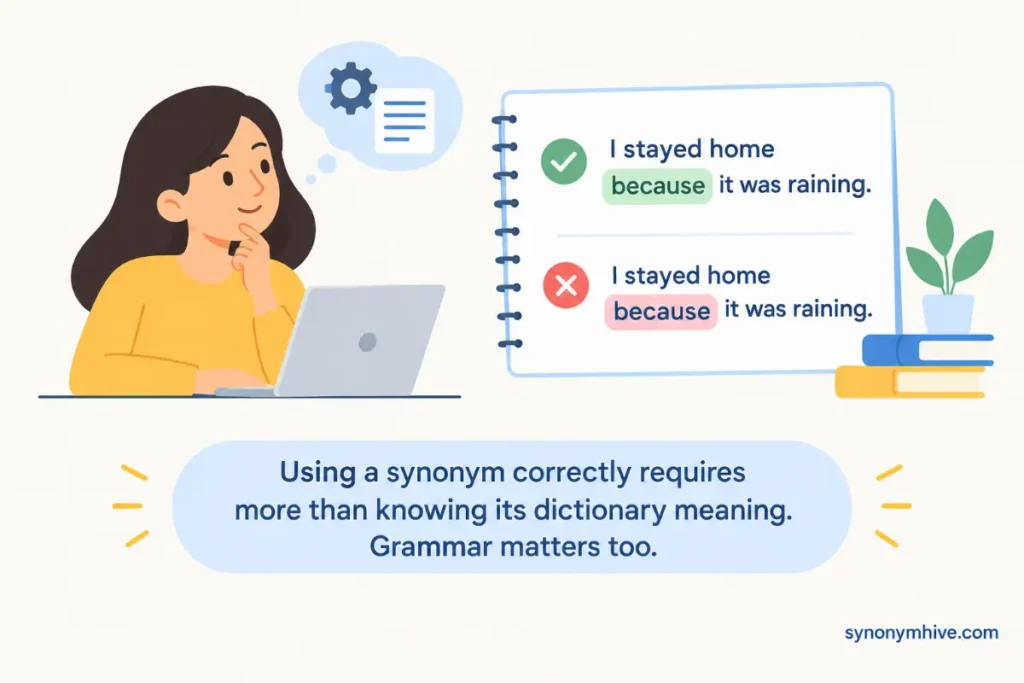
Using a synonym correctly requires more than knowing its dictionary meaning. Grammar matters too.
Using Because Of Before A Full Clause
This is a common mistake.
Incorrect.
We stayed home because of it was raining.
Correct.
We stayed home because it was raining.
Or.
We stayed home because of the rain.
Because takes a clause. Because of takes a noun phrase.
Using Due To In Every Situation
Due to is not wrong simply because it sounds formal. The problem comes when writers use it everywhere.
I missed the bus due to traffic.
This is understandable, but because of may sound more natural.
I missed the bus because of traffic.
Save formal expressions for places where they actually improve the sentence.
Confusing Cause With Result
Because introduces a reason.
The road closed because of flooding.
Therefore introduces a result.
The road was flooded. Therefore, it closed.
You cannot treat these words as interchangeable.
Overusing Formal Expressions
A sentence can become harder to read when every reason is written in formal language.
Owing to the fact that the weather conditions were unfavorable, we postponed the event.
A clearer version is.
Because the weather was bad, we postponed the event.
Good writing isn’t about choosing the most complicated phrase. It’s about choosing the clearest phrase.
Using Since When The Meaning Is Unclear
Since can describe time or cause.
I have known her since 2019.
Since you are here, let’s start.
Readers usually understand the meaning from context. Still, because can be clearer when the sentence could create confusion.
When Should You Not Replace Because
Sometimes because is the best word.
If the sentence needs a direct and clear reason, there is nothing wrong with using because.
I left because I was tired.
Trying to make this sentence sound more advanced can actually make it worse.
I left owing to the fact that I was tired.
The second version is longer and less natural.
Strong writing isn’t about avoiding common words. It is about using the right word at the right time.
Because is especially useful in personal writing, explanations, instructions, conversations, and simple academic sentences.
What Are The Antonyms Of Because
Because does not have a perfect opposite in the same way that hot has cold. Still, some words and phrases can express ideas that move away from cause or explain the absence of a reason.
Common options include.
- Without a reason.
- For no reason.
- Despite.
- Regardless of.
- Independently of.
Despite and regardless of do not mean the direct opposite of because. They show that something happened even though another condition existed.
Despite the rain, we went outside.
This differs from.
We stayed inside because of the rain.
The first sentence highlights contrast. The second highlights cause.
How Do You Choose The Right Reason Word
Start with the grammar. Then think about tone.
If you need a full clause, try because, since, as, given that, or considering that.
If you need a noun phrase, try because of, due to, owing to, or as a result of.
The best alternative is the one that makes your meaning easier to understand.
Quick Tips For Better Essay Transitions
Essay transitions work best when they show a clear relationship between ideas. A reason expression should tell the reader exactly why the next point matters.
Use because when you need a direct explanation.
Use since when the reason works more like background information.
Don’t replace every because with a different expression. Variety should improve the writing, not distract from it.
A useful editing trick is to read the paragraph aloud. If you hear the same connector several times, check the sentence structure. You may find a natural opportunity to use another transition or combine two ideas.
How Can You Make Your Writing Sound More Natural for Another Word for Because
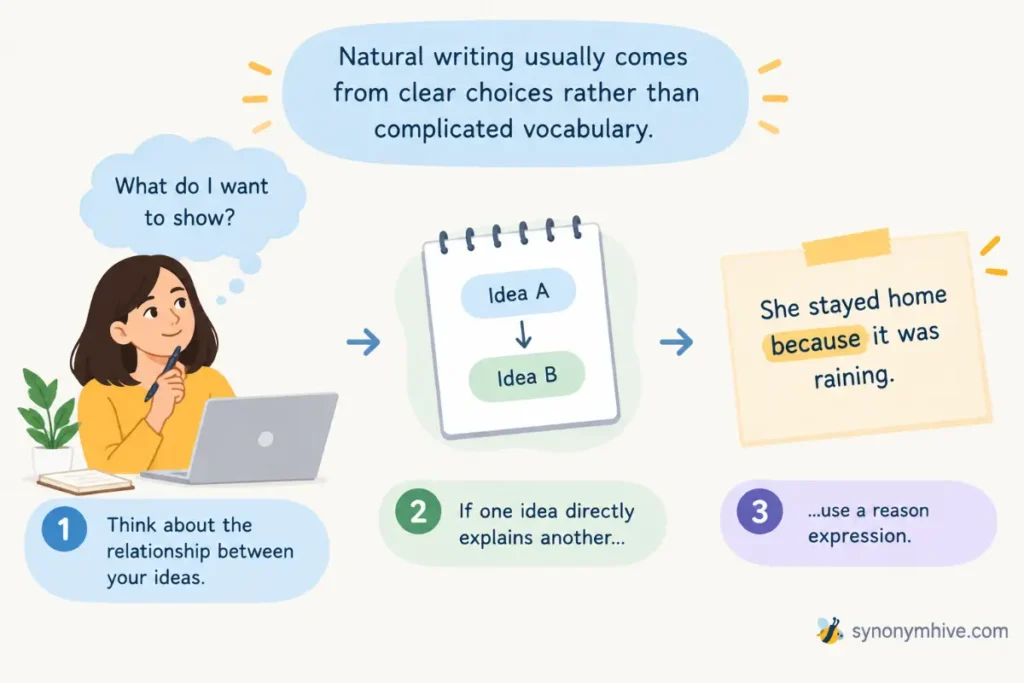
Natural writing usually comes from clear choices rather than complicated vocabulary.
Start by asking what relationship you want to show.
If one idea directly explains another, use a reason expression.
If the first idea causes a later result, use a result transition.
For example.
The company changed its schedule because customer demand had fallen.
This clearly shows cause.
You could also write.
Customer demand had fallen. As a result, the company changed its schedule.
Now the cause and result receive separate attention.
This kind of variation makes an essay easier to follow. It also prevents every paragraph from sounding like it follows the same formula.
A Simple Guide To The Best Choices
Here is a quick reference you can use while editing.
| Your Goal | Best Choice | Example |
|---|---|---|
| Give a direct reason | Because | I stayed home because I was sick. |
| Give a background reason | Since | Since it was late, we left. |
| Give a smooth reason | As | As the store was closed, we left. |
| Follow with a noun | Because of | We left because of the rain. |
| Sound formal | Due to | The event changed due to weather. |
| Sound formal and traditional | Owing to | The delay occurred owing to traffic. |
| Highlight a known fact | Given that | Given that time is short, we should begin. |
| Show a positive cause | Thanks to | Thanks to your help, we finished early. |
| Show a result | Therefore | The data was weak. Therefore, we repeated the test. |
| Show a consequence | Consequently | The road closed. Consequently, traffic increased. |
| Use casual speech | So | I was tired, so I went home. |
| Explain a result directly | That is why | I missed the bus. That is why I was late. |
Need another vocabulary suggestion? Read Another Word for Furthermore Best Alternatives 2026.
Conclusion
Finding another word for because is less about replacing a common word and more about making the relationship between your ideas clear. Since and as can create a smooth connection. Because of works before a noun. Due to and owing to can add a formal tone. Given that can highlight an important fact. Therefore and consequently can shift the focus from cause to result.
The best choice depends on your sentence, audience, and purpose. Don’t change because just to sound smarter. Change it when the new expression makes the sentence clearer, smoother, or more precise.
Good writing doesn’t need complicated vocabulary. It needs the right words in the right places. Once you understand how these reason expressions work, you can vary your essays, emails, resumes, texts, and everyday writing without losing clarity.
Frequently Asked Questions
What Is Another Phrase for Because?
Another term for because is since, as, given that, due to, or owing to. The right choice depends on the grammar and tone of your sentence.
What Is Another Term for Because In An Essay?
Another term for because in an essay can be since, as, given that, due to, or as a result of. Use the expression that creates the clearest connection between your ideas.
Can I Use Since Instead Of Because?
Yes, you can often use since instead of because when since clearly shows a reason. Be careful because since can also refer to time.
Is Because Of The Same As Due To?
Because of and due to can both introduce a cause before a noun phrase. Because of usually sounds more natural in everyday writing, while due to often sounds more formal.
What’s Another Way To Say Because In A Text?
In a text, you can use since, as, so, or that is why. Simple choices usually sound best in casual messages.
Can Therefore Replace Because?
Therefore can replace a cause structure only after you change the sentence structure. Because introduces a reason, while therefore normally introduces a result.
Is Because Too Informal For An Essay?
No, because is completely acceptable in essays. It is clear, standard English and often works better than a more complicated alternative.