
Writing about a teacher can be harder than it sounds. You may need the right words for a school essay, a thank you note, a recommendation, a resume, or a simple message. Searching for words to describe a teacher often brings up long lists, but a list alone does not tell you which word fits the person or situation.
A great teacher can be patient, caring, knowledgeable, encouraging, fair, creative, or inspiring. Some teachers are calm and gentle. Others are energetic, funny, strict, or highly organized. The best word depends on the quality you want to highlight.
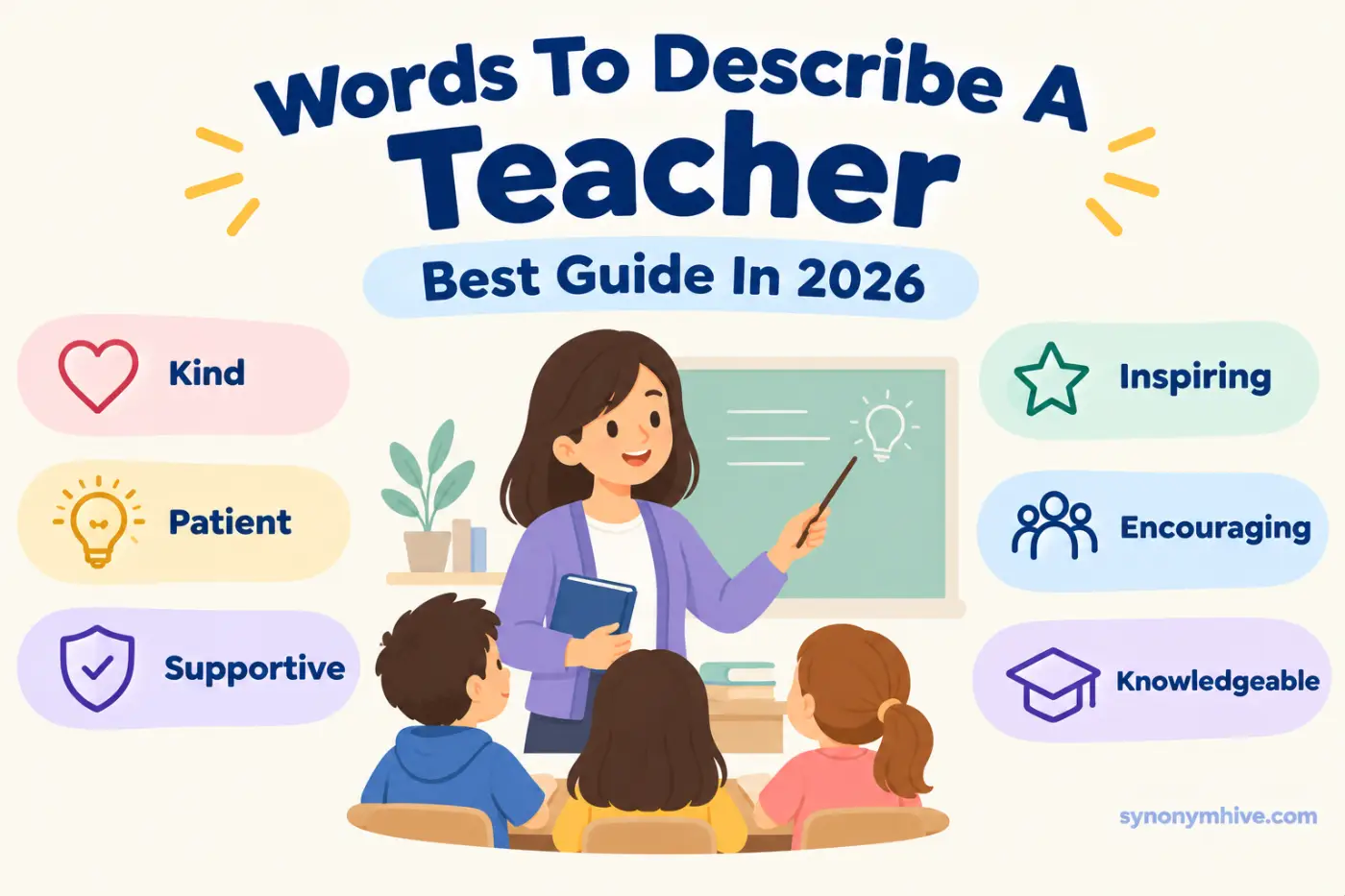
The best words to describe a teacher are words that show a clear quality, such as patient, supportive, knowledgeable, inspiring, fair, caring, or dedicated. Choose a word that matches what the teacher actually does.
This guide explains the meaning and tone of more than 30 useful words, shows how strong or gentle each word sounds, compares close synonyms, and gives examples for essays, emails, texts, resumes, and everyday speech.
Discover related words in Words to Describe a Mother Best Guide In 2026.
What Do Words to Describe a Teacher Mean?
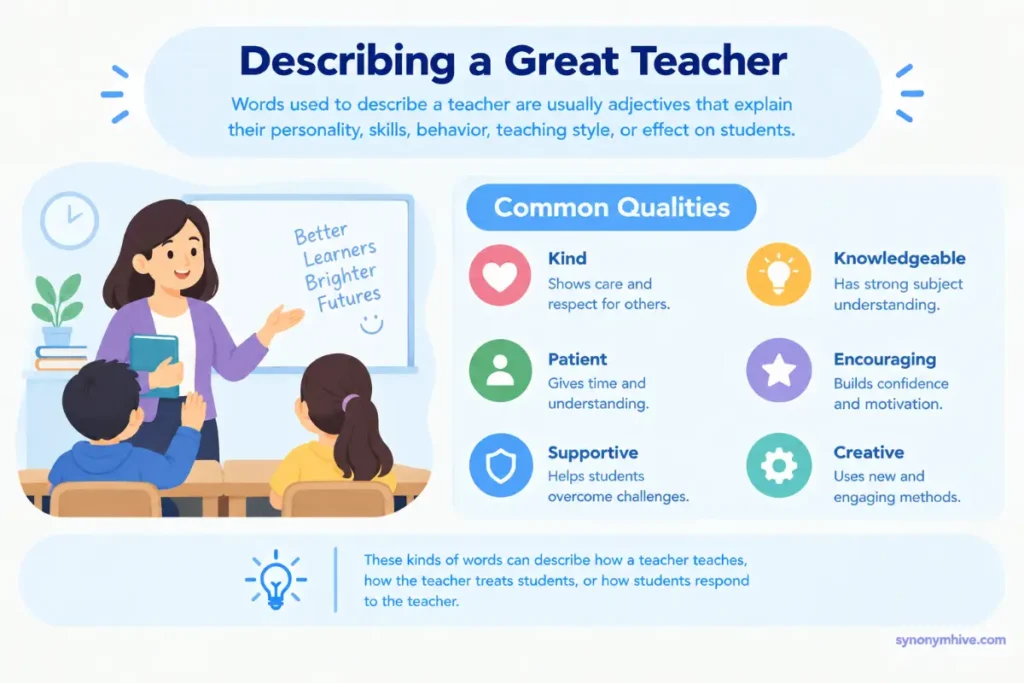
Words used to describe a teacher are usually adjectives that explain the teacher’s personality, skills, behavior, teaching style, or effect on students. They can describe how a teacher teaches, how the teacher treats students, or how students respond to the teacher.
For example, patient describes someone who stays calm while students learn. Knowledgeable describes someone who understands a subject well. Inspiring describes someone who encourages students to learn, grow, or try harder.
The phrase itself does not point to one specific type of word. It can include positive adjectives, neutral descriptions, and even critical words when the situation calls for an honest description.
Where Does the Word Teacher Come From?
The word teacher comes from the verb teach. The English word teach has Old English roots and has been used for centuries to describe the act of helping someone gain knowledge or skills.
A teacher is therefore more than someone who gives information. The word can describe a person who helps others understand, practice, improve, and develop.
That meaning explains why many strong descriptions focus on qualities such as patience, clarity, guidance, encouragement, knowledge, and care.
What Makes a Good Description of a Teacher?
A useful description gives the reader a reason to understand the teacher in a certain way. Instead of saying that someone is a good teacher, explain the quality behind that judgment.
Compare these two sentences.
My teacher is good.
My teacher is patient and encouraging because she gives every student time to understand difficult ideas.
The second sentence gives the reader something concrete. It shows what makes the teacher good.
A strong description usually does one of four things.
- It describes personality.
- It explains teaching ability.
- It shows how the teacher treats students.
- It explains the teacher’s effect on the class.
30 Plus Words to Describe a Teacher
The table below gives a broad set of useful choices. The tone column helps you pick a word that fits your purpose instead of choosing a word only because it sounds positive.
| Word | Meaning | Tone | Example |
|---|---|---|---|
| Patient | Stays calm while others learn | Positive | My teacher is patient with every student. |
| Kind | Treats people with care | Warm | She is a kind teacher who listens closely. |
| Caring | Shows concern for students | Warm | Our caring teacher checks on students who struggle. |
| Helpful | Gives useful support | Positive | He is always helpful when we have questions. |
| Supportive | Encourages and assists others | Positive | She is supportive when students make mistakes. |
| Friendly | Easy and pleasant to talk to | Casual | Our friendly teacher makes students comfortable. |
| Enthusiastic | Shows strong interest and excitement | Positive | He is enthusiastic about history. |
| Encouraging | Helps others believe they can succeed | Positive | Her encouraging attitude gives students confidence. |
| Approachable | Easy to talk to or ask for help | Professional | Our teacher is approachable after class. |
| Adaptable | Changes methods when needed | Professional | She is adaptable when students need extra help. |
| Patient | Gives learners time without becoming upset | Positive | A patient teacher lets students learn at their own pace. |
| Wise | Shows good judgment and experience | Strong positive | His wise advice helped me make a better choice. |
| Influential | Has a strong effect on others | Formal | She was an influential teacher in my life. |
| Empowering | Helps people gain confidence and independence | Strong positive | His empowering lessons encouraged us to speak up. |
Which Words Describe a Teacher in a Simple Way?
Simple words are often the best choice for a school assignment, personal message, or everyday conversation. You do not need a fancy adjective to write a strong description.
Good simple choices include:
- Kind.
- Nice.
- Helpful.
- Friendly.
- Calm.
- Fair.
- Funny.
- Patient.
- Caring.
- Smart.
- Helpful.
- Honest.
For example, a student might write, My teacher is kind because she always listens when I have a problem.
Another simple sentence could be, Mr. Lee is patient and explains hard lessons more than once.
These words work because readers understand them right away.
Which Words Sound More Formal?
Formal words are useful for essays, recommendation letters, school awards, and professional writing. They sound more polished without becoming difficult to understand.
Useful formal choices include:
- Knowledgeable.
- Dedicated.
- Professional.
- Compassionate.
- Responsible.
- Reliable.
- Adaptable.
- Influential.
- Thoughtful.
- Encouraging.
- Skilled.
- Inspiring.
For example, a recommendation letter could say, She is a dedicated educator who creates a respectful and focused classroom.
An essay could say, His knowledgeable approach helped students understand complex scientific ideas.
How Strong Are Different Words for a Teacher?
Not every positive adjective has the same strength. Some words simply describe a useful quality. Others suggest that the teacher has a powerful effect on students.
Mild Descriptions
These words give a basic positive impression.
Friendly, helpful, nice, calm, organized, and pleasant are mild descriptions. They are useful when you want to sound natural without making a very strong claim.
Example:
My teacher is friendly and easy to talk to.
Strong Positive Descriptions
These words show deeper qualities.
Dedicated, compassionate, encouraging, knowledgeable, supportive, and motivating are stronger. They suggest that the teacher does more than simply complete the basic duties of teaching.
Example:
She is a dedicated teacher who spends extra time helping students understand difficult lessons.
Very Strong Descriptions
These words suggest a lasting or powerful effect.
Inspiring, influential, empowering, exceptional, outstanding, and remarkable can make a much stronger statement.
Example:
Mr. Davis was an inspiring teacher who made me want to study science.
Use very strong words when your example supports them. Calling every teacher exceptional can make the description sound less believable.
Which Words Describe a Teacher’s Personality?
A teacher’s personality affects the mood of a classroom. You can describe that personality with words such as patient, calm, friendly, cheerful, funny, confident, thoughtful, kind, caring, energetic, or understanding.
Consider the difference between calm and energetic.
A calm teacher may create a quiet classroom where students can focus. An energetic teacher may make lessons lively and active.
Neither quality is automatically better. The right word depends on what you want to say.
For example:
My teacher has a calm personality that makes students feel safe asking questions.
Or:
Our energetic teacher keeps everyone involved during group activities.
Which Words Describe a Teacher’s Teaching Skills?
When you want to focus on teaching ability, choose words that show knowledge, clarity, planning, and skill.
Useful choices include:
- Knowledgeable.
- Skilled.
- Clear.
- Organized.
- Prepared.
- Creative.
- Adaptable.
- Effective.
- Thorough.
- Resourceful.
A knowledgeable teacher understands the subject. A clear teacher explains ideas in a way students can follow. An organized teacher plans lessons carefully.
These qualities can appear together.
Our teacher is knowledgeable, organized, and clear, so even difficult lessons are easy to follow.
Which Words Describe a Teacher Who Helps Students?
Some teachers stand out because they make students feel supported. Words such as caring, helpful, patient, understanding, supportive, compassionate, and approachable work well here.
Supportive vs Helpful
A helpful teacher gives assistance when students need it. A supportive teacher does more than solve a problem. The teacher also gives encouragement and confidence.
My teacher is helpful because she answers questions after class.
My teacher is supportive because she encourages me when I doubt my ability.
Both are positive, but supportive often describes a deeper relationship.
Caring vs Compassionate
Caring is common and easy to use. It shows that someone pays attention to other people’s needs.
Compassionate is stronger and more formal. It suggests a deep concern for someone who is struggling.
Our caring teacher notices when students are having a hard day.
Our compassionate teacher gave extra support to a student going through a difficult time.
Which Words Describe a Teacher Who Inspires Students?
If a teacher makes students want to learn, improve, or try something new, inspiring is one of the strongest choices.
Other useful words include motivating, encouraging, influential, empowering, passionate, enthusiastic, and dedicated.
Inspiring vs Motivating
These two words are close, but they are not identical.
| Word | Main idea | Example |
|---|---|---|
| Inspiring | Creates a lasting desire to learn or improve | Her story was inspiring. |
| Motivating | Encourages someone to take action | His feedback was motivating. |
A teacher can be motivating before a test by encouraging students to study. An inspiring teacher may change how a student thinks about learning for years.
Which Words Describe a Teacher Who Is Strict?
Strict does not always mean bad. It can describe a teacher who sets firm rules and expects students to follow them.
Useful related words include disciplined, firm, demanding, serious, structured, and consistent.
The tone changes depending on the word.
Strict can sound negative or neutral. Firm often sounds more balanced. Demanding suggests that the teacher expects a high level of effort.
Compare these examples.
My teacher is strict about homework.
My teacher is firm about deadlines.
My teacher is demanding but fair.
The third sentence gives a more complete picture because it shows that high expectations are balanced with fairness.
Which Words Describe a Teacher Who Is Funny?
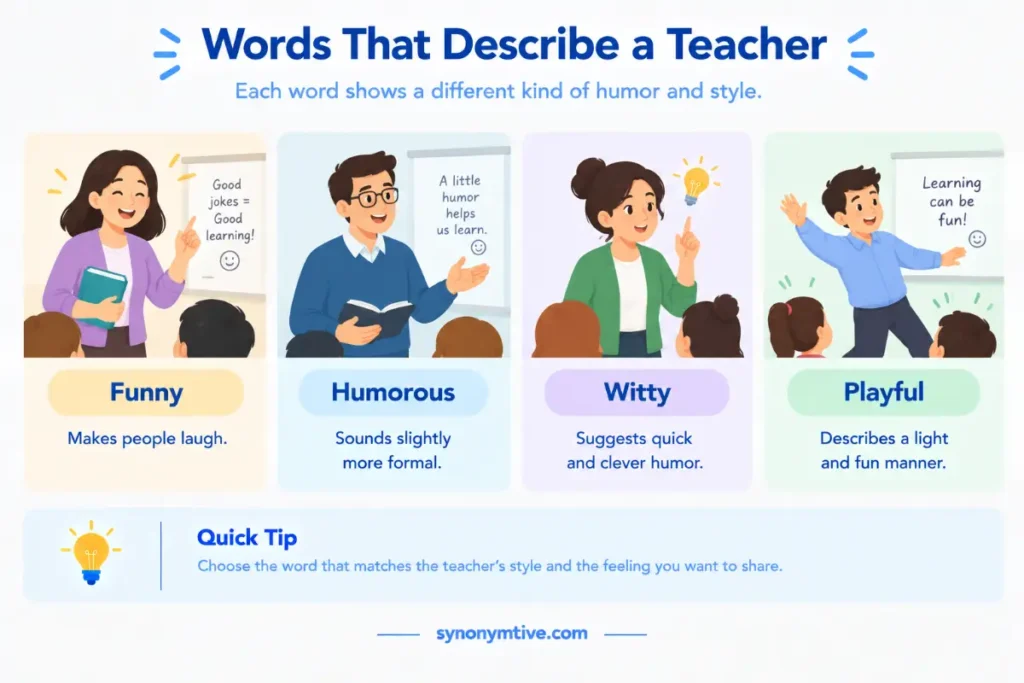
Funny is the most natural everyday word. Other options include humorous, playful, lively, cheerful, witty, and entertaining.
These words are not exact matches.
Funny means the teacher makes people laugh. Humorous sounds slightly more formal. Witty often suggests quick and clever humor. Playful describes a light and fun manner.
For a school essay, you might write:
My teacher has a humorous way of explaining difficult ideas.
For a text message, you could simply say:
Mr. Brown is really funny.
Which Words Work Best for a Teacher Resume?
A resume needs professional language. Choose words that describe useful workplace qualities rather than personal traits that are hard to prove.
Strong choices include knowledgeable, organized, adaptable, reliable, skilled, dedicated, creative, collaborative, patient, and effective.
Example:
Dedicated educator with strong classroom management and clear communication skills.
Another example:
Organized and adaptable teacher who creates engaging lessons for students with different learning needs.
On a resume, avoid filling the page with adjectives alone. Pair each quality with evidence.
Instead of:
Creative, dedicated, hardworking teacher.
Try:
Dedicated teacher who developed interactive lessons that increased student participation.
The second version gives the reader something to believe.
Which Words Work Best in a School Essay?
An essay often needs words that are clear but descriptive. Strong choices include patient, knowledgeable, caring, inspiring, dedicated, fair, supportive, creative, and influential.
A sentence could say:
My teacher is patient because she never makes students feel embarrassed for asking questions.
You can also combine personality and teaching skill.
Mrs. Green is a caring and knowledgeable teacher who makes difficult subjects easier to understand.
The key is to explain the quality instead of stacking several adjectives together.
Which Words Work Best in a Text Message?
Text messages usually sound better with simple, natural language. Words such as amazing, kind, funny, helpful, caring, patient, smart, supportive, and awesome can work well.
For example:
My teacher is so patient.
She is honestly one of the kindest teachers I’ve had.
Mr. Ali is funny but still keeps the class focused.
Texting does not require formal vocabulary. Choose the word you would actually use when talking to a friend.
Expand your vocabulary with Words to Describe a Friend Best Guide In 2026.
Which Words Work Best in an Email?
Emails need a balance between warmth and professionalism. Good choices include helpful, supportive, knowledgeable, professional, thoughtful, patient, dedicated, and respectful.
For example:
I am grateful for your patient and thoughtful guidance throughout the semester.
Or:
Thank you for being such a supportive teacher and for always taking the time to answer my questions.
A professional email should sound sincere. One specific compliment is often stronger than a long list.
Which Words Work Best When Speaking?
When speaking, simple words usually sound the most natural. You might say that a teacher is kind, patient, funny, smart, helpful, fair, caring, or inspiring.
For a short speech, you can combine a quality with an example.
Mrs. Wilson is one of the most patient teachers I’ve ever had. She always gives us another way to understand a difficult idea.
That sounds more genuine than saying:
Mrs. Wilson is patient, caring, intelligent, organized, dedicated, inspiring, creative, and exceptional.
The second sentence has too many labels and not enough proof.
What Are Some Real Examples of Describing a Teacher?
Here are original examples for different situations.
- My teacher is patient because she gives every student enough time to understand the lesson.
- Mr. Carter is knowledgeable and explains difficult ideas in simple language.
- Our teacher is encouraging, so students are not afraid to make mistakes.
- She is organized and always has a clear plan for each class.
- My science teacher is creative and uses experiments to make lessons easier to remember.
- He is fair and listens to both sides when students have a disagreement.
- Our English teacher is approachable, so I feel comfortable asking for help.
- She is dedicated and often stays after class to help students who are struggling.
- My history teacher is energetic and makes every lesson interesting.
- He is thoughtful because he remembers what each student needs to succeed.
- Mrs. Taylor is compassionate toward students who are dealing with personal problems.
- My teacher is motivating because she reminds us that improvement takes time.
- He is firm about classroom rules but always treats students with respect.
- She is inspiring because she helped me discover an interest in writing.
- Our teacher is adaptable and changes her approach when students need another explanation.
These examples show why specific details matter. The adjective tells the reader the quality. The rest of the sentence shows why the word fits.
What Is the Difference Between Kind and Caring?
Kind and caring are closely related, but they focus on different things.
Kind usually describes how someone treats other people. A kind teacher may speak gently, help students, or show respect.
Caring focuses more on concern for another person’s needs or well being.
| Kind | Caring |
|---|---|
| Focuses on good treatment | Focuses on concern |
| Common in everyday speech | Slightly more personal |
| Describes actions and behavior | Describes concern and attention |
| Example: She is kind to every student. | Example: She is caring and notices when students need help. |
You can use both when both qualities are true.
My teacher is kind and caring toward every student.
What Is the Difference Between Smart and Knowledgeable?
Smart is a broad and casual word. It can describe someone’s ability to think, solve problems, or learn.
Knowledgeable is more specific. It means the person has a strong understanding of a subject or topic.
For a school essay, knowledgeable is often more precise.
My teacher is smart.
This tells the reader very little about the teacher’s teaching ability.
My teacher is knowledgeable about biology and explains complex topics clearly.
The second sentence gives useful information.
What Is the Difference Between Strict and Firm?
Strict and firm both describe someone who expects rules to be followed, but they can create different impressions.
Strict can suggest that rules are tough and closely enforced. Firm often suggests that someone has clear standards without being unfair.
For example:
My teacher is strict about late assignments.
This may sound somewhat negative.
My teacher is firm about deadlines but always explains the reason for the rules.
This sounds more balanced.
If you want a professional or positive tone, firm may be a better choice when it accurately describes the teacher.
How Should You Choose the Right Word?
The best description depends on the quality you want the reader to notice. Start with the teacher’s behavior instead of searching for the fanciest adjective.
Ask yourself these questions.
- How does the teacher treat students?
- How does the teacher explain lessons?
- How does the teacher respond to mistakes?
- How does the teacher handle problems?
- What does the teacher do that stands out?
- How do students respond to the teacher?
- Is the tone casual, academic, or professional?
- Can you give an example that proves the description?
If the teacher stays calm while students struggle, choose patient.
If the teacher gives confidence to students, choose encouraging.
What Are Common Mistakes When Describing a Teacher?
A few mistakes can make a description sound weak or unnatural.
Using Too Many Positive Words
A sentence packed with adjectives can sound forced.
My teacher is amazing, wonderful, perfect, incredible, brilliant, kind, caring, patient, funny, inspiring, and fantastic.
That is too much. The reader learns almost nothing specific.
A better sentence is:
My teacher is patient and encouraging. She gives us extra explanations when a topic is difficult.
Using a Word That Does Not Match the Example
Do not call someone patient if your example shows that the person gets frustrated quickly.
The adjective and evidence should agree.
Choosing Formal Words for Casual Writing
Words such as compassionate, influential, and exceptional may sound strange in a casual text.
A friend would probably say:
My teacher is really kind.
Instead of:
My teacher demonstrates exceptional compassion.
Match the vocabulary to the situation.
Using Strong Words Without Evidence
Words such as inspiring, outstanding, and exceptional make big claims. Use them when you can explain why they fit.
Instead of saying:
She is an inspiring teacher.
You can write:
She is an inspiring teacher because she encouraged me to enter my first writing contest.
The second sentence gives the claim a reason.
What Are the Antonyms of Common Teacher Descriptions?
Antonyms are words with opposite or contrasting meanings. They can help you understand the meaning of a positive description more clearly.
| Positive word | Possible opposite |
|---|---|
| Patient | Impatient |
| Kind | Unkind |
| Caring | Uncaring |
| Helpful | Unhelpful |
| Fair | Unfair |
| Organized | Disorganized |
| Friendly | Unfriendly |
| Calm | Nervous or tense |
| Supportive | Unsupportive |
| Encouraging | Discouraging |
| Knowledgeable | Uninformed |
| Prepared | Unprepared |
| Reliable | Unreliable |
| Respectful | Disrespectful |
| Flexible | Rigid |
| Creative | Uncreative |
| Energetic | Tired or inactive |
| Understanding | Unreasonable |
Use negative descriptions carefully. If you are writing a recommendation letter or thank you note, positive and accurate language is usually more appropriate.
What Are the Best Words to Describe a Teacher Positively?
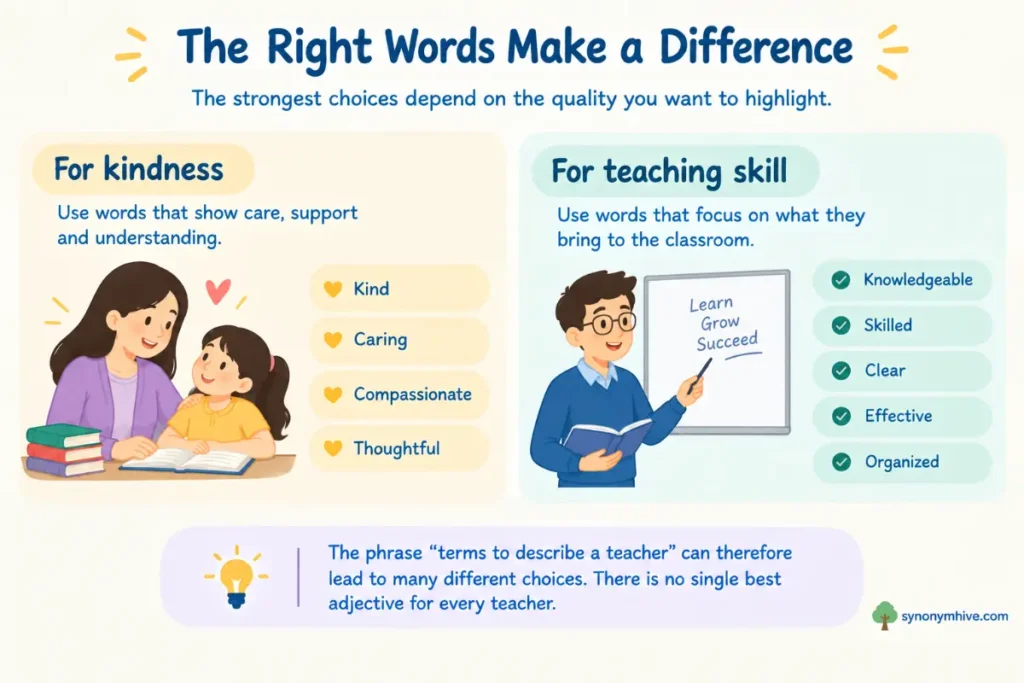
The strongest choices depend on the quality you want to highlight.
For kindness, use kind, caring, compassionate, or thoughtful.
For teaching skill, use knowledgeable, skilled, clear, effective, or organized.
The phrase terms to describe a teacher can therefore lead to many different choices. There is no single best adjective for every teacher.
How Do US and UK English Differ Here?
There is very little difference in the basic vocabulary used to describe teachers in American and British English. Words such as patient, kind, knowledgeable, supportive, dedicated, and inspiring work in both forms of English.
Some education terms can vary by region. In the United States, teacher is the standard everyday word for someone who teaches in a school. In the United Kingdom, teacher is also standard, though terms such as tutor can have different uses depending on the educational setting.
Spelling differences can appear in related words. For example, American English often uses organized, while British English commonly uses organised. Both forms are correct within their own spelling systems.
For US readers, use American spellings consistently throughout your writing.
How Can You Make a Teacher Description Sound More Natural?
Start with one clear quality. Then explain it with a real action.
Instead of:
My teacher is very caring.
Try:
My teacher is caring because she notices when students are having trouble and offers help.
Instead of:
My teacher is intelligent.
Try:
My teacher is knowledgeable and can explain difficult ideas in a way everyone understands.
Instead of:
My teacher is inspiring.
Try:
My teacher is inspiring because she helped me believe I could succeed in a subject I once disliked.
This simple pattern works well:
Quality + action + result.
For example:
She is patient + she explains the lesson again + students feel comfortable asking questions.
That structure creates a description with real meaning.
Quick Tips for Choosing the Best Description
Keep these tips in mind when you need the right adjective quickly.
- Think about behavior first.
- Choose a word that matches a real example.
- Use simple words for casual writing.
- Use precise words for essays and professional writing.
- Avoid stacking too many adjectives.
- Use strong words only when the evidence supports them.
- Pair a description with an action.
- Consider the reader and purpose.
- Pick words that show the teacher’s effect on students.
- Read the sentence aloud to check if it sounds natural.
The goal is not to find the most impressive word. The goal is to find the most accurate one.
You may also like Words to Describe a Hero Best Guide In 2026.
Conclusion
Choosing the right description is easier when you focus on what the teacher actually does. A patient teacher gives students time to learn. A supportive teacher builds confidence. A knowledgeable teacher explains ideas clearly. An inspiring teacher can change how students think about learning.
The strongest words to describe a teacher are not always the biggest or most formal ones. A simple word can be powerful when it matches a real example. Kind, caring, patient, fair, helpful, dedicated, and knowledgeable are useful in many situations.
For essays and professional writing, choose precise words and support them with evidence. For texts and casual messages, keep the language natural. When you are unsure, describe the teacher’s action first, then choose the adjective that best explains it.
Frequently Asked Questions
What are good words to describe a teacher?
Good words include patient, kind, caring, supportive, knowledgeable, dedicated, fair, creative, encouraging, organized, and inspiring. The best choice depends on the teacher’s specific qualities.
What is another way to say a good teacher?
You can say an excellent teacher, effective teacher, dedicated educator, inspiring educator, skilled teacher, or supportive teacher. Choose the phrase that explains why the teacher is good.
What are the best phrases to describe a teacher in an essay?
Knowledgeable, patient, dedicated, supportive, creative, inspiring, fair, and compassionate work well in essays. Add a specific example so the description does not sound like an empty compliment.
How do I describe a teacher in one word?
Choose one word based on the strongest quality you want to show. Patient, inspiring, caring, knowledgeable, dedicated, and supportive are strong choices.
What are some positive terms to describe a teacher?
Positive words to describe a teacher include kind, patient, caring, helpful, fair, respectful, encouraging, motivating, creative, knowledgeable, dedicated, and inspiring.
What words describe a teacher who helps students?
Supportive, helpful, patient, caring, understanding, compassionate, approachable, and encouraging are useful choices. Each word highlights a slightly different kind of support.
What’s another way to describe an inspiring teacher?
You can call an inspiring teacher motivating, influential, empowering, encouraging, exceptional, or memorable. Inspiring is often the best choice when the teacher has a lasting effect on students.