

Writing about a hero can be harder than it sounds. You may know exactly what the person did, but finding the right words to describe a hero can take time. A school essay, character description, speech, tribute, or social post all need different kinds of language.
A hero is not simply someone who wins or has special powers. A hero can be an ordinary person who acts with courage, helps others, stands up for what is right, or keeps going during a difficult time. The best description shows what makes that person admirable instead of just calling them good.
The strongest words also depend on the quality you want to highlight. Brave works well for someone who faces danger. Compassionate suits someone who cares deeply about others. Selfless fits a person who puts other people’s needs before their own. Some words describe actions, while others describe character, attitude, or moral strength.
This guide explains the meaning and use of these words in simple English. You will find a large synonym list, words grouped by tone and strength, examples for essays and everyday writing, close word comparisons, common mistakes, antonyms, and practical tips for choosing the best description.
Find similar expressions in words to describe love Best Guide in 2026.
What Do Words to Describe a Hero Mean?
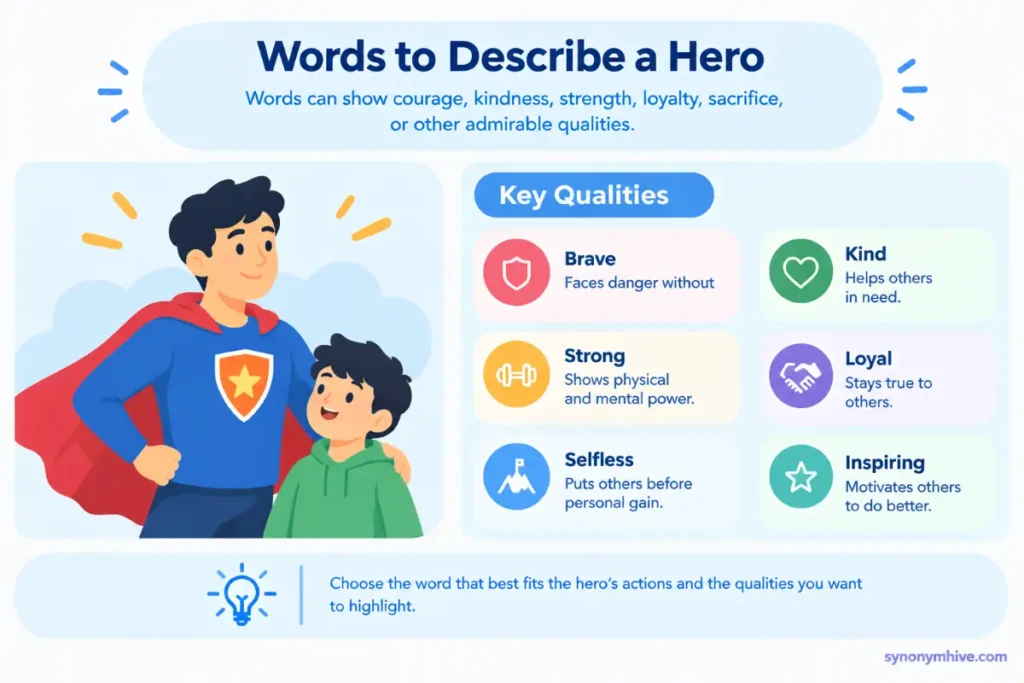
Words to describe a hero are adjectives and related expressions that show a person’s courage, kindness, strength, loyalty, sacrifice, or other admirable qualities. The best choice depends on what the hero does and which part of their character you want to emphasize.
A useful description gives readers a reason to admire the person. Instead of writing that someone is a great hero, you can say the person is courageous, selfless, compassionate, determined, or fearless.
What Is the Best Way to Describe a Hero?
The best way to describe a hero is to connect a strong character word to a specific quality or action. Words such as courageous, selfless, compassionate, brave, noble, determined, and heroic work well because they explain why the person deserves respect.
For example, instead of saying, “She was a good hero,” write, “She was a courageous leader who risked her safety to protect others.”
A Master List of Heroic Words
The table below gives you a broad set of choices. The words are grouped by tone so you can choose language that fits your situation.
| Word | Meaning | Tone | Example |
|---|---|---|---|
| Brave | Willing to face fear or danger | Simple | He was brave when the storm hit. |
| Courageous | Showing strong courage | Everyday | She made a courageous choice. |
| Fearless | Not easily frightened | Strong | The fearless firefighter entered the building. |
| Bold | Willing to take risks | Everyday | He made a bold move to save the team. |
| Daring | Ready to take great risks | Strong | The daring rescue amazed everyone. |
| Selfless | Putting others first | Warm | Her selfless actions helped the whole town. |
| Kind | Caring and helpful | Simple | He was kind to people who needed help. |
| Compassionate | Deeply caring about suffering | Formal | She was a compassionate doctor. |
| Caring | Showing concern for others | Everyday | His caring nature made people trust him. |
| Generous | Willing to give or help | Everyday | The generous man donated his savings. |
| Loyal | Staying faithful to people or a cause | Everyday | She remained loyal to her friends. |
| Honest | Truthful and sincere | Simple | He was honest even when the truth was hard. |
| Noble | Morally good and honorable | Formal | Her noble actions inspired others. |
| Honorable | Deserving respect for good conduct | Formal | He was known as an honorable leader. |
| Humble | Not acting as if you are better than others | Warm | Despite his success, he remained humble. |
| Wise | Showing good judgment | Everyday | The wise leader listened before acting. |
| Resourceful | Good at solving problems | Formal | She was resourceful during the emergency. |
| Steadfast | Firm and loyal over time | Formal | His steadfast support never changed. |
| Fearless | Showing little or no fear | Strong | The fearless rescuer kept moving forward. |
| Heroic | Showing qualities linked with a hero | Strong | His heroic actions saved several lives. |
Which Words Describe a Hero’s Courage?
Courage is one of the clearest qualities linked with heroism. A courageous person does not need to be free from fear. In many cases, courage means acting despite fear.
Brave
Brave is the simplest choice. It works in almost any type of writing.
“She was brave enough to speak up when everyone else stayed silent.”
Courageous
Courageous sounds a little more formal than brave. It works especially well in essays, speeches, biographies, and formal descriptions.
“The courageous nurse stayed behind to help injured patients.”
Fearless
Fearless suggests that a person does not seem afraid. It is stronger than brave, but it can sometimes sound dramatic.
“The fearless climber continued despite the dangerous conditions.”
Bold
Bold describes someone willing to make a risky or unusual choice. It does not always mean physical courage.
“He made a bold decision to challenge the unfair rule.”
Daring
Daring suggests that someone takes serious risks.
“The daring pilot landed the damaged plane safely.”
Which Words Describe a Hero’s Kindness?
Not every hero faces physical danger. Many people become heroes because they care for others, offer help, or make sacrifices.
Compassionate
Compassionate means showing deep concern for people who are suffering.
“The compassionate teacher stayed after school to help a struggling student.”
Caring
Caring is simple and warm. It works well for family members, teachers, friends, nurses, and community helpers.
“She was a caring woman who always checked on elderly neighbors.”
Generous
Generous describes someone willing to give time, money, attention, or support.
“The generous volunteer spent every weekend helping families in need.”
Selfless
Selfless is one of the strongest choices when someone gives up personal comfort or benefit for another person.
“His selfless decision allowed his teammates to escape safely.”
Altruistic
Altruistic is more formal. It describes a strong concern for the welfare of other people.
“Her altruistic work improved access to education in rural communities.”
Which Words Describe a Hero’s Strength?
Strength does not always mean physical power. A hero may show emotional strength, mental strength, or the ability to remain calm under pressure.
Strong
Strong is broad and easy to understand. It can describe physical, emotional, or moral strength.
“She remained strong after facing years of hardship.”
Resilient
Resilient describes someone who recovers after a setback.
“The resilient community leader rebuilt the town after the disaster.”
Determined
Determined describes someone who has a clear goal and refuses to give up.
“He was determined to find every missing person.”
Persistent
Persistent means continuing to work toward something despite difficulty.
“Her persistent efforts eventually changed the law.”
Steadfast
Steadfast describes someone who stays firm and loyal.
“His steadfast commitment to the cause earned everyone’s respect.”
Which Words Describe a Hero’s Morals?
Some heroes stand out because they choose to do what is right even when doing so costs them something.
Honest
Honest means truthful and sincere.
“The honest officer admitted his mistake and corrected it.”
Noble
Noble describes actions or motives that are morally good and admirable.
“She made a noble sacrifice for her community.”
Honorable
Honorable describes someone who acts in a way that deserves respect.
“He was an honorable leader who refused to misuse his power.”
Principled
Principled describes someone who follows strong moral beliefs.
“She was a principled judge who treated everyone fairly.”
Just
Just can describe someone who cares about fairness and right treatment.
“The just leader refused to punish innocent people.”
What Are the Strongest Words for a Hero?
The strength of a word depends on the quality you want to emphasize. Some words sound mild and natural, while others carry a much stronger sense of admiration.
Mild heroic words
These choices are useful when you want a natural description.
- Kind.
- Helpful.
- Caring.
- Honest.
- Strong.
- Loyal.
- Reliable.
- Friendly.
These words do not automatically suggest extraordinary bravery. They work well when describing everyday heroes.
Moderate heroic words
These words show a clearer level of admiration.
- Brave.
- Courageous.
- Determined.
- Generous.
- Protective.
- Inspiring.
- Resilient.
- Dependable.
They are useful for school essays, personal writing, biographies, and speeches.
Strong heroic words
These choices create a stronger sense of admiration.
- Fearless.
- Selfless.
- Noble.
- Heroic.
- Daring.
- Altruistic.
- Gallant.
- Unshakable.
Use strong words when the person’s actions truly support them. Calling every helpful person fearless can make your writing sound exaggerated.
How Do Hero Words Change by Part of Speech?
Most descriptions of a person use adjectives. However, related nouns and adverbs can help you build stronger sentences.
| Adjective | Noun | Adverb |
|---|---|---|
| Brave | Courage | Courageously |
| Kind | Kindness | Kindly |
| Compassionate | Compassion | Compassionately |
| Generous | Generosity | Generously |
| Loyal | Loyalty | Loyally |
| Honest | Honesty | Honestly |
| Determined | Determination | Determinedly |
| Strong | Strength | Strongly |
| Noble | Nobility | Nobly |
| Selfless | Selflessness | Selflessly |
| Resilient | Resilience | Resiliently |
| Heroic | Heroism | Heroically |
The adjective usually describes the person.
“She was courageous.”
The noun describes the quality.
“Her courage inspired the team.”
The adverb describes how someone acts.
“She courageously entered the burning building.”
This difference matters in essays because changing the part of speech can help you avoid repeating the same sentence pattern.
Are Hero Words Different in American and British English?
Most common words used to describe heroes have the same meaning in American and British English. Brave, courageous, kind, selfless, loyal, noble, heroic, and determined are understood in both varieties.
Some words may have slightly different levels of popularity. Gallant, for example, can sound more old fashioned or literary in modern American writing. In British writing, it may still appear in formal or historical descriptions.
Spelling can also change in related words. American English usually uses words such as honorable and valor, while British English commonly uses honourable and valour.
The core meanings remain the same. For US readers, the most natural choices are usually brave, courageous, selfless, caring, determined, inspiring, and heroic.
What Words Work Best for a Hero in a Resume?
A resume should focus on qualities that connect to real actions. Avoid calling yourself a hero unless the context clearly supports it.
Good choices include:
- Determined.
- Reliable.
- Resilient.
- Responsible.
- Resourceful.
- Courageous.
- Compassionate.
- Dependable.
- Selfless.
- Decisive.
For example, instead of writing, “I am a heroic employee,” write:
“I remained determined during a major project delay and helped the team meet its deadline.”
That sentence proves the quality instead of simply claiming it.
What Words Work Best for a Hero in an Essay?
An essay gives you more room to explain character. Strong choices include courageous, selfless, compassionate, resilient, noble, determined, and honorable.
Try to connect each adjective to evidence.
Weak:
“Abraham Lincoln was a great and heroic person.”
Stronger:
“Abraham Lincoln showed determination and moral courage during one of the most difficult periods in American history.”
The second sentence gives readers a clearer idea of what kind of hero the person was.
What Words Work Best for a Hero in a Text?
Text messages usually need shorter, more natural language.
You could say:
“You’re seriously brave.”
“You’re such a kind person.”
“You always put other people first.”
“You’re one of the most loyal people I know.”
“You handled that like a champ.”
The best wording depends on your relationship with the person. A casual message does not need formal words such as altruistic or steadfast.
What Words Work Best for a Hero in an Email?
Email language should match the relationship and purpose.
For a formal email, use words such as courageous, dedicated, compassionate, generous, admirable, or inspiring.
For example:
“Your courageous work during the emergency made a real difference to our community.”
For a friendly email, simpler language sounds more natural:
“You were incredibly brave, and I don’t think I’ll ever forget what you did.”
What Words Work Best When Speaking About a Hero?
Speaking usually works best with words that are easy to say and understand. Brave, kind, strong, loyal, selfless, courageous, and inspiring are good choices.
If you’re giving a speech, combine a quality with a short example.
“She was courageous, but what impressed me most was her kindness toward everyone she met.”
That approach sounds more natural than listing several adjectives in a row.
What Are Good Words to Describe a Hero’s Personality?
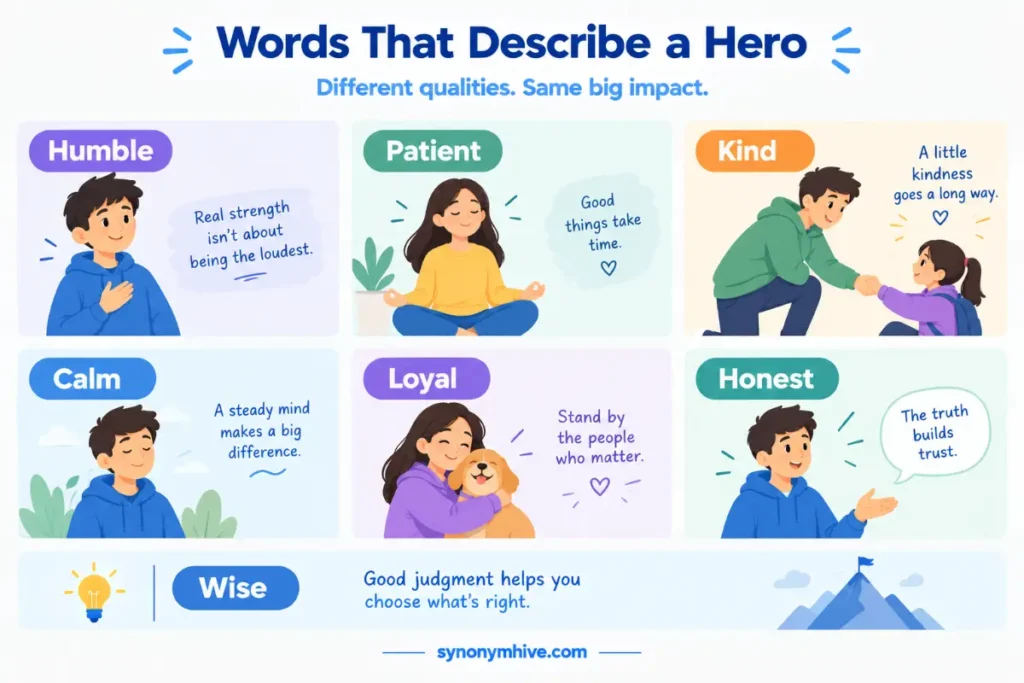
A hero’s personality can include many traits that are not directly connected to danger.
Consider these choices:
- Humble.
- Patient.
- Kind.
- Calm.
- Loyal.
- Honest.
- Wise.
- Generous.
- Compassionate.
- Responsible.
- Determined.
- Confident.
- Thoughtful.
- Dependable.
- Respectful.
A humble hero does not seek attention for every good deed. A patient hero stays calm when progress is slow. A wise hero makes careful choices instead of acting on impulse.
These details make character descriptions more believable.
What Are Good Words to Describe a Hero’s Actions?
Sometimes the action matters more than the person’s personality.
Useful words include:
- Courageous.
- Selfless.
- Heroic.
- Daring.
- Generous.
- Protective.
- Sacrificial.
- Brave.
- Noble.
- Compassionate.
- Inspiring.
- Admirable.
For example:
“Her selfless action saved the child.”
“His courageous decision protected the workers.”
“The firefighter made a heroic rescue.”
“The volunteer offered generous support to families who had lost their homes.”
Check out more vocabulary ideas in Words to Describe a Father Best Guide In 2026.
Ten Natural Examples of Hero Descriptions
Good writing shows how a word works in a real sentence. Here are examples across different situations.
Example 1
The courageous firefighter entered the building to rescue two trapped children.
Example 2
My grandfather was a humble hero who spent years helping people in his neighborhood.
Example 3
She showed remarkable resilience after losing her home in the storm.
Example 4
The nurse was compassionate toward every patient, even during the busiest shifts.
Example 5
His selfless choice protected his friends from serious danger.
Example 6
The young athlete became an inspiring example of determination after recovering from a major injury.
Example 7
Our teacher was patient, caring, and generous with her time.
Example 8
The rescue worker remained calm and resourceful when the first plan failed.
Example 9
He was a loyal friend who never abandoned people during difficult times.
Example 10
Her noble actions encouraged others to volunteer in the community.
Example 11
The honest leader admitted the mistake instead of blaming someone else.
Example 12
His fearless response gave the frightened children hope.
Example 13
The resilient doctor continued serving patients despite years of hardship.
Example 14
She was a dependable volunteer who arrived early and stayed until the work was done.
Example 15
The wise mentor taught his students to solve problems instead of simply giving them answers.
Brave vs Courageous
Brave and courageous are very close, but they are not always interchangeable in tone.
| Brave | Courageous |
|---|---|
| More common in everyday speech | Slightly more formal |
| Simple and direct | More polished |
| Works well in casual writing | Works well in essays and speeches |
| Can describe a quick act | Often suggests strong moral or personal courage |
Compare these sentences:
“He was brave enough to enter the water.”
“She made a courageous decision to speak against the unfair policy.”
Both words show courage. The second sentence has a more formal tone and focuses on a difficult moral choice.
Selfless vs Generous
Selfless and generous both describe people who give to others, but they highlight different things.
| Selfless | Generous |
|---|---|
| Focuses on putting others first | Focuses on giving freely |
| Often involves sacrifice | Does not always involve sacrifice |
| Stronger moral meaning | Broader everyday meaning |
| Often used for major acts | Works for small or large acts |
A person who gives someone a gift is generous.
A person who gives up a valuable opportunity so another person can benefit may be described as selfless.
Fearless vs Brave
Fearless suggests little or no fear. Brave does not.
A brave person may be very afraid but still choose to act.
A fearless person is described as someone who seems not to be afraid.
That difference matters in realistic writing. If you want to show that a character feels fear but overcomes it, brave or courageous is usually the better choice.
Heroic vs Hero
Hero is usually a noun.
“She became a hero.”
Heroic is an adjective.
“She made a heroic sacrifice.”
You can call someone a hero because of what they did. You can call an action heroic because it shows qualities associated with heroism.
The two words are related, but they do different jobs in a sentence.
What Are Common Mistakes When Describing Heroes?
Strong descriptions can lose their impact when every sentence uses an extreme adjective. If someone is called fearless, noble, heroic, brilliant, extraordinary, and perfect in every paragraph, the reader has little reason to believe the description.
Mistake 1: Using too many adjectives
Weak:
“He was brave, courageous, fearless, heroic, noble, strong, selfless, kind, generous, loyal, and amazing.”
This sounds like a list.
Better:
“He was courageous and selfless. He risked his safety to protect people he barely knew.”
The second version gives evidence.
Mistake 2: Using a word without checking its meaning
Do not use fearless when you simply mean brave.
Do not use selfless when someone merely helped once.
Choose the word that matches the exact behavior.
Mistake 3: Calling someone heroic without explaining why
The word heroic tells readers that an action was admirable. It does not tell them what happened.
Instead of:
“She was heroic.”
Try:
“She was heroic because she stayed behind to guide the children to safety.”
Mistake 4: Using formal words in casual writing
Words such as altruistic, steadfast, and gallant can sound unnatural in a text message.
A friend would probably say:
“You were incredibly brave.”
A formal tribute might say:
“Her steadfast dedication to public service earned widespread respect.”
Both are correct. The context decides the better choice.
Mistake 5: Making a hero sound perfect
Real people have flaws. A believable hero can be afraid, tired, uncertain, or upset.
A stronger character description might say:
“He was not fearless. He was afraid, but he chose to help anyway.”
That gives the hero more depth.
What Are the Antonyms of Heroic Words?
Antonyms are words with opposite or contrasting meanings.
| Heroic Quality | Possible Antonym |
|---|---|
| Brave | Cowardly |
| Courageous | Fearful |
| Selfless | Selfish |
| Kind | Cruel |
| Generous | Stingy |
| Honest | Dishonest |
| Loyal | Disloyal |
| Humble | Arrogant |
| Determined | Unmotivated |
| Compassionate | Uncaring |
| Dependable | Unreliable |
| Strong | Weak |
| Noble | Dishonorable |
| Responsible | Irresponsible |
| Patient | Impatient |
Be careful with antonyms. A person who is not brave is not always cowardly. A person can simply be cautious.
How Can You Choose the Right Hero Word?
Start by asking what the person actually did. Then choose the word that best explains that behavior.
If the person faced danger, try brave, courageous, fearless, or daring.
If the person helped others at personal cost, consider selfless or sacrificial.
How Can You Make a Hero Description More Specific?
A useful trick is to replace a general adjective with a quality plus evidence.
Instead of:
“He was brave.”
Write:
“He was brave enough to enter the flooded house and help the family escape.”
Instead of:
“She was kind.”
Write:
“She was kind to the injured animals and spent her weekends caring for them.”
Instead of:
“He was determined.”
Write:
“He was determined to finish the project even after the first three plans failed.”
This method works because the reader can see the quality in action.
How Many Hero Words Should You Use?
There is no fixed number, but two or three strong words are often better than a long list.
For example:
“She was courageous, compassionate, and determined.”
That gives three clear qualities.
You can then explain each one with evidence.
“She was courageous when she spoke up. She was compassionate toward people who were struggling. Most of all, she was determined to make the situation better.”
The description now has depth instead of simply repeating praise.
What Is the Difference Between a Hero and a Role Model?
A hero is often admired because of brave, selfless, or extraordinary actions. A role model is someone whose behavior provides an example that others want to follow.
A firefighter who rescues people from a burning building can be called a hero.
A teacher who shows patience, honesty, and dedication every day can be a role model.
One person can be both.
Can an Ordinary Person Be a Hero?
Yes. Heroism does not require fame, wealth, special powers, or public recognition.
A person can show heroism through a single courageous action or through years of service. Parents, teachers, nurses, neighbors, volunteers, emergency workers, and friends can all show heroic qualities.
This is why words such as caring, dependable, compassionate, loyal, and selfless can be just as useful as brave or fearless.
How Do You Describe a Hero Without Sounding Repetitive?
Change both your vocabulary and sentence structure.
Instead of writing:
He was brave. He was brave when he helped the child.
Try:
“He showed remarkable courage during the rescue. Even when the situation became dangerous, he stayed focused on helping the child. His calm determination gave everyone else confidence.”
The meaning stays clear, but the writing sounds more natural.
How Do You Describe a Fictional Hero?
A fictional hero often needs a mix of strengths and weaknesses.
You might describe the character as courageous but uncertain, loyal but stubborn, compassionate but impatient, or determined but afraid.
For example:
“Lena was a determined young hero who refused to abandon her village. She was not fearless. Her fear made her more believable, and her decision to act despite it showed real courage.”
This approach gives readers a stronger picture of the character.
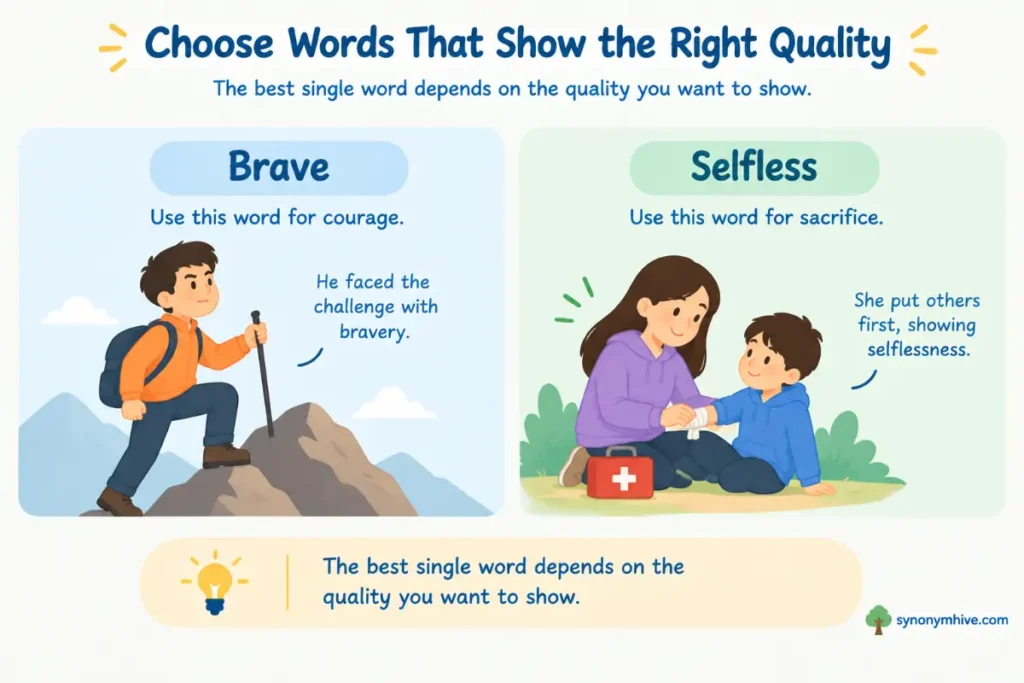
How Do You Describe a Hero in One Word?
The best single word depends on the quality you want to show.
Use brave for courage.
Use selfless for sacrifice.
Quick Tips for Choosing the Right Word
- Think about the person’s main quality before choosing an adjective.
- Use brave for everyday descriptions of courage.
- Choose courageous when you want a slightly more formal tone.
- Use selfless when the person sacrifices something for others.
- Choose compassionate when the focus is care for people who are suffering.
- Use determined when someone refuses to give up.
- Choose resilient when someone recovers after hardship.
- Use humble when the person avoids showing off.
- Choose noble when the action has a strong moral quality.
- Use inspiring when the person’s behavior motivates others.
- Avoid using extreme words without evidence.
- Match your vocabulary to the audience.
- Use simple words in texts and casual conversations.
- Use more formal words in essays, speeches, and tributes.
- Show the quality through an action whenever possible.
Conclusion
The right words to describe a hero should tell readers what makes that person admirable. Instead of stacking several positive adjectives together, choose a few precise words and connect them to real actions.
Brave and courageous work well for people who face fear. Selfless describes sacrifice. Compassionate highlights care. Determined and persistent show that someone refuses to quit. Resilient focuses on recovery, while noble and honorable highlight strong moral choices.
The strongest description is not always the most dramatic one. A simple word can have more power when the example supports it. Before you finish your essay, speech, tribute, or character description, ask one question: what did this person do that proves the quality I am describing?
Need another vocabulary suggestion? Read Words to Describe a Mother Best Guide In 2026.
Frequently Asked Questions
What are the best words to describe a hero?
The best words depend on the hero’s strongest qualities. Brave, courageous, selfless, compassionate, determined, resilient, noble, loyal, and inspiring are strong choices for many situations.
What’s another way to say a person is heroic?
You can call someone courageous, brave, selfless, noble, admirable, fearless, or inspiring. The best option depends on the specific action or quality you want to highlight.
What are good words to describe a hero in an essay?
Courageous, selfless, determined, compassionate, resilient, noble, honorable, and inspiring work well in essays. Choose words that you can support with examples from the person’s actions.
What are good words to describe a fictional hero?
Use words such as brave, determined, loyal, resourceful, compassionate, fearless, resilient, and selfless. You can create a stronger character by pairing positive traits with realistic flaws.
What are words to describe a hero who helps others?
Selfless, compassionate, caring, generous, helpful, protective, and altruistic are useful choices. Selfless is especially strong when the person gives up something important to help another person.
What is the difference between brave and courageous?
Brave and courageous have almost the same basic meaning. Brave is more common in everyday speech, while courageous can sound slightly more formal and often works well in essays and speeches.
What is a strong word for someone who never gives up?
Determined, persistent, resilient, and steadfast are strong choices. Determined is the simplest everyday option, while resilient focuses more on recovering from setbacks.