
Art can be easy to admire but harder to describe. Imagine writing an essay about a painting, sharing your thoughts in an email, or posting a photo of a sculpture. You know the artwork looks beautiful, but you want better words than nice or pretty. That is where terms to describe art can help you express what you see and how it makes you feel.
The best art descriptions do more than name colors or praise an artist. They explain the mood, style, texture, message, and effect of an artwork. For example, vibrant describes strong colors, while haunting suggests a feeling that stays with you long after you look away.
Words to describe art are adjectives and descriptive expressions that explain an artwork’s appearance, style, mood, technique, and meaning. The right choice helps readers picture the artwork and understand your reaction to it.
Below, you will find useful vocabulary for paintings, drawings, sculptures, photographs, and other creative works. You will also learn how to choose precise words for essays, emails, conversations, and social media without making your writing sound forced.
Discover related words in words to describe light Best Guide in 2026.
What Do Words to Describe Art Mean?
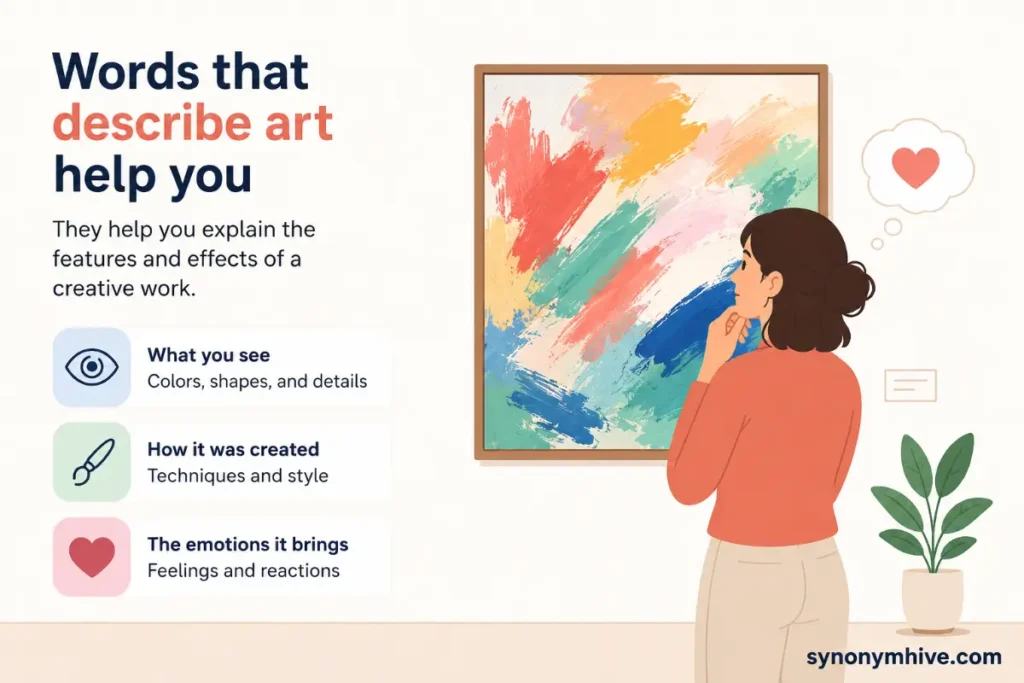
Words that describe art help you explain the features and effects of a creative work. They can describe what you see, how the artist created it, or the emotions it brings out in you.
For example, you might call a painting colorful because it uses many bright colors. However, vibrant gives a stronger sense of energy. Similarly, dark describes a visual quality, while somber explains a serious or sad mood.
A good description often combines several types of words.
- Appearance words explain visible features such as color, shape, size, and texture.
- Mood words describe the feelings an artwork creates, such as peaceful, tense, joyful, or mysterious.
- Style words identify qualities such as abstract, realistic, minimalist, or traditional.
- Technique words describe how the artist works, such as layered, detailed, expressive, or textured.
- Meaning words help explain the ideas or themes behind the work, such as symbolic, thought provoking, or emotional.
For instance, instead of writing, “The painting is nice,” you could say, “The vibrant colors and flowing brushstrokes give the painting a joyful mood.”
The second sentence tells readers more. It identifies specific features and explains their effect.
Where Does the Word Art Come From?
The English word art comes through Old French art from Latin ars, meaning skill, craft, or practical ability. The Latin word is connected with the idea of doing something skillfully.
Over time, art developed a broad meaning. Today, it can refer to painting, drawing, sculpture, photography, music, design, and many other forms of creative expression.
The word describe has roots in Latin through Old French. It means to represent something in words or give an account of its features.
Put these ideas together, and describing art means using language to explain the qualities of a creative work. You might focus on its physical appearance, the artist’s methods, the emotions it creates, or the message it communicates.
This distinction matters because art is more than an object. A painting has colors and shapes, but it can also express grief, hope, conflict, humor, or cultural identity. Strong descriptive language helps you discuss both the visible work and the ideas behind it.
For example, rough might describe the physical surface of a sculpture. In another context, it might describe the artist’s loose and unfinished technique. The surrounding sentence helps readers understand the intended meaning.
What Are the Best Expressions to Describe Art?
The best choice depends on the artwork and the point you want to make. Some words are simple and familiar, while others are more specific or formal.
Here is a practical list of phrases to describe art, grouped by tone. The examples show how each word works in a natural sentence.
Simple Words for Describing Art
These familiar words work well in everyday conversations, school assignments, and basic descriptions.
| Word | Meaning | Tone | Example |
|---|---|---|---|
| Beautiful | Pleasing to look at | Positive | The garden painting is beautiful. |
| Colorful | Full of different colors | Neutral | The colorful mural brightens the hallway. |
| Bright | Full of light or strong color | Neutral | Bright flowers stand out against the dark background. |
| Dark | Having little light or deep colors | Neutral | The dark painting creates a serious mood. |
| Pretty | Attractive in a delicate or pleasing way | Casual | The pretty illustration shows a small cottage. |
| Simple | Made with few details or elements | Neutral | The simple design draws attention to the main shape. |
| Detailed | Showing many small features | Neutral | The detailed drawing includes every leaf on the tree. |
| Strange | Unusual or unexpected | Casual | The strange sculpture looks like a creature from a dream. |
These words provide a useful starting point. Still, a more specific term can make your description clearer. For example, intricate often works better than detailed when a design contains many small parts arranged in a complex pattern.
Everyday Words for Describing Art
Everyday descriptive words help you express your personal reaction without sounding too formal.
| Word | Meaning | Tone | Example |
|---|---|---|---|
| Vibrant | Full of energy and strong color | Positive | The vibrant mural brings life to the street. |
| Peaceful | Calm and free from tension | Positive | The peaceful landscape shows a quiet lake. |
| Playful | Lighthearted and full of fun | Positive | The playful figures make the sculpture feel lively. |
| Dramatic | Full of contrast, tension, or strong emotion | Expressive | Dramatic shadows make the portrait stand out. |
| Dreamy | Soft, imaginative, or unreal | Expressive | The dreamy scene looks like a memory. |
| Bold | Strong, confident, or striking | Positive | Bold shapes give the poster a modern look. |
| Delicate | Fine, light, or easily damaged in appearance | Positive | Delicate lines form the butterfly’s wings. |
| Mysterious | Difficult to explain or understand | Expressive | The mysterious figure draws the viewer closer. |
These words are especially helpful when you want to explain the feeling of an artwork. For a stronger description, connect the word to a visible detail. Instead of saying, “The artwork is dramatic,” explain how the sharp shadows and strong contrasts create that effect.
Formal Words for Describing Art
| Word | Meaning | Tone | Example |
|---|---|---|---|
| Impressive | Causing admiration because of quality or scale | Formal | The impressive sculpture fills the entire room. |
| Thought provoking | Encouraging careful thought or discussion | Formal | The thought provoking installation raises questions about waste. |
Formal language is most effective when it fits the subject. For example, evocative is useful when a work brings a memory or feeling to mind. However, colorful may be enough when you only need to describe the range of colors.
Slang and Casual Words for Describing Art
Casual expressions are useful in texts, comments, and conversations with friends. They can make your reaction sound natural, but they may not fit a formal review or school essay.
| Word or Expression | Meaning | Tone | Example |
|---|---|---|---|
| Cool | Interesting or appealing | Casual | That street art looks cool. |
| Awesome | Extremely good or impressive | Casual | The huge mural is awesome. |
| Eye catching | Quickly attracting attention | Casual | The eye catching poster uses neon colors. |
| Stunning | Extremely beautiful or impressive | Casual to formal | The sunset painting is stunning. |
| Trippy | Strange, surreal, or visually disorienting | Slang | The trippy design uses swirling patterns. |
| Artsy | Having a strong artistic style | Casual | The cafe has an artsy wall display. |
| Mind blowing | Extremely surprising or impressive | Casual | The optical illusion is mind blowing. |
| Offbeat | Unusual in an interesting way | Casual | The offbeat sculpture uses recycled toys. |
Use casual expressions when they suit your audience. In a formal review, visually striking may sound more precise than cool. In a text to a friend, though, “That sculpture is so cool” may be exactly right.
Which Words Describe Art From Mild to Strong?
Descriptive words have different levels of intensity. Some express a gentle reaction, while others suggest a powerful emotional or visual effect. Choosing the right level helps you avoid exaggeration.
Mild Words
Use these words when an artwork is pleasant, simple, or quietly appealing.
- Pleasant describes something enjoyable to look at.
- Gentle suggests soft colors, smooth lines, or a calm mood.
- Subtle describes a quality that is present but not obvious.
- Charming suggests a pleasing and attractive quality.
- Understated describes art that makes an impression without demanding attention.
Example: “The understated painting uses pale colors and simple shapes to create a gentle mood.”
Moderate Words
These words express a clearer reaction without suggesting that the artwork is extraordinary.
- Striking means noticeable and memorable.
- Expressive means full of feeling or meaning.
- Captivating means able to hold your attention.
- Imaginative means showing creativity and original ideas.
- Atmospheric means creating a particular feeling or sense of place.
Example: “The atmospheric photograph captures the stillness of an empty train station.”
Strong Words
Choose these when the artwork creates a powerful visual or emotional effect.
- Breathtaking describes something extremely beautiful or impressive.
- Mesmerizing means so interesting that it holds your attention.
- Powerful suggests a strong emotional or intellectual effect.
- Provocative describes art that challenges ideas or encourages debate.
- Monumental suggests great size, importance, or impact.
- Unforgettable describes something that stays in your memory.
Example: “The monumental sculpture creates a powerful impression through its size and rough surface.”
Strong words should match the artwork. Calling every painting breathtaking can make your writing sound exaggerated. Instead, explain what makes a particular work stand out.
Which Words to Describe Art Fit Different Parts of Speech?
Most art descriptions use adjectives, but nouns and verbs can make your writing more precise. Using different parts of speech also helps you avoid repeating the same descriptive word.
Adjectives That Describe Art
Adjectives describe the qualities of an artwork, its style, or its effect.
| Adjective | Example |
|---|---|
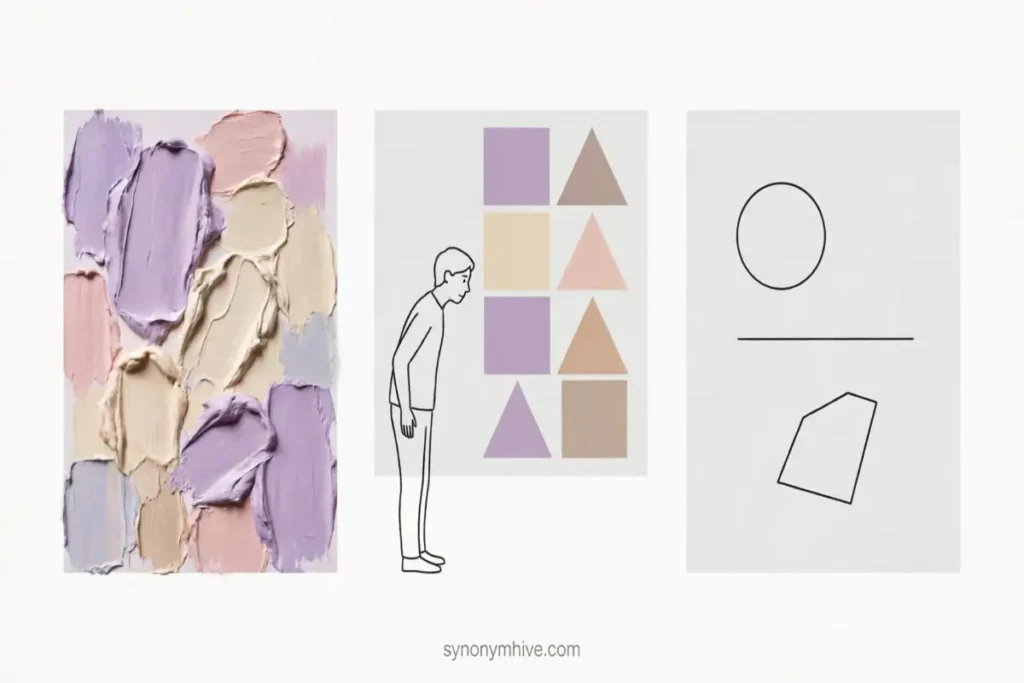
| Textured | The textured surface gives the painting a sense of depth. |
| Geometric | The geometric design uses squares and triangles. |
| Minimalist | The minimalist artwork contains only a few shapes. |
| Realistic | The realistic portrait captures the subject’s expression. |
| Surreal | The surreal scene combines familiar objects in strange ways. |
| Luminous | The luminous colors make the water seem to glow. |
| Muted | The muted palette creates a quiet mood. |
| Asymmetrical | The asymmetrical composition feels modern and energetic. |
Nouns That Help You Discuss Art
Nouns name the features you notice or the ideas you want to explain.
| Noun | Meaning | Example |
|---|---|---|
| Composition | How the elements are arranged | The composition guides the eye toward the central figure. |
| Palette | The colors used in an artwork | The warm palette gives the scene a welcoming feel. |
| Texture | The actual or visual surface quality | The texture makes the wall look rough and aged. |
| Contrast | A noticeable difference between elements | The contrast between light and shadow adds tension. |
| Symbolism | The use of images to represent ideas | The symbolism points to the theme of freedom. |
| Perspective | The way depth and spatial relationships are shown | The perspective makes the narrow street appear longer. |
Verbs That Make Art Descriptions Stronger
Verbs explain what an artwork does or how its elements affect the viewer.
| Verb | Example |
|---|---|
| Evokes | The painting evokes memories of childhood. |
| Suggests | The empty chair suggests absence or loss. |
| Emphasizes | The bright circle emphasizes the central figure. |
| Contrasts | The artist contrasts warm colors with cool shades. |
| Captures | The photograph captures a fleeting moment. |
| Conveys | The sculpture conveys a sense of movement. |
| Symbolizes | The open window symbolizes possibility. |
| Challenges | The installation challenges traditional ideas about beauty. |
For example, instead of writing, “The painting is sad,” you could write, “The painting evokes sadness through its muted colors and lonely setting.” The second version explains how the artwork creates its emotional effect.
Are Art Descriptions Different in the US and UK?
Most common art vocabulary works in both American and British English. Words such as beautiful, vibrant, abstract, intricate, and expressive have similar meanings in both varieties.
A few differences in spelling and everyday usage are worth knowing.
| American English | British English | Meaning |
|---|---|---|
| Colorful | Colourful | Full of color |
| Gray | Grey | A color between black and white |
| Center | Centre | The middle point |
| Analyze | Analyse | Examine something carefully |
| Favorite | Favourite | Preferred above others |
These spelling differences matter in essays, museum descriptions, and published reviews. Follow the spelling style required by your school, workplace, or publication.
Regional preferences can also affect tone. In both countries, brilliant can mean very good or impressive, but its everyday use may vary by speaker and situation. Similarly, artsy is common in casual American English, while arty is also used in British English.
Neither term is automatically better. Choose language that fits your audience and keep your spelling consistent throughout the piece.
Looking for another word? See Another Word For Mood Best Synonyms And Slang.
Which Terms to Describe Art Work Best in Different Situations?
The best word depends on your purpose. A school essay needs clear explanations, while a text to a friend can be relaxed and personal. A professional review should focus on specific features rather than praise alone.
What Words Should You Use to Describe Art on a Resume?
If you are describing your own creative work on a resume, focus on skills, methods, and results. Avoid vague claims such as amazing artist or very talented. Instead, choose words that show what you can do.
Useful words include detail oriented, innovative, versatile, conceptual, technical, and collaborative.
Example: “Created detailed illustrations for educational materials using a consistent visual style.”
You could also write, “Developed innovative concepts for digital artwork and promotional designs.”
These sentences describe your work more clearly than a list of personal compliments. If you are applying for an art related role, include specific software, materials, or techniques when they are relevant to the position.
What Words Should You Use to Describe Art in an Essay?
An essay benefits from precise language and evidence. Choose terms that support your main point, then connect them to visible details.
Useful words include symbolic, expressive, contrasting, historical, abstract, and evocative.
Example: “The muted colors and empty landscape create a somber atmosphere that supports the painting’s theme of isolation.”
For a stronger argument, explain how the artwork creates that effect. You might discuss the use of light, the arrangement of figures, or the relationship between colors and shapes.
Avoid adding formal words just to make your essay sound academic. A clear explanation is more useful than a complicated sentence with several terms you cannot support.
What Words Should You Use to Describe Art in a Text?
Texts and social media comments usually call for short, natural expressions. You can be enthusiastic without making every comment sound the same.
Useful choices include stunning, cool, creative, dreamy, bold, gorgeous, and eye catching.
For example: “The colors in this piece are so vibrant. I love how the shapes seem to move.”
Or try, “This sculpture is strange in the best way. I keep noticing new details.”
A short comment becomes more personal when you mention one feature you genuinely like. Instead of writing only “Amazing art,” try “The tiny details around the frame are amazing.”
What Words Should You Use to Describe Art in an Email?
An email about an artwork may need a polite, professional tone. This is especially useful when contacting an artist, teacher, gallery, or client.
Helpful words include thoughtful, well composed, expressive, balanced, distinctive, and carefully crafted.
Example: “I especially appreciated the balanced composition and the thoughtful use of color in your painting.”
For a request or review, explain your reaction clearly and respectfully. For instance, “The design is visually striking, although a little more contrast could make the central text easier to read.”
This approach combines appreciation with useful feedback.
What Words Should You Use When Speaking About Art?
When talking about art in person, choose words that come naturally. You do not need technical vocabulary for every observation.
Useful terms include bright, rough, smooth, peaceful, dramatic, lifelike, and unusual.
For example: “I like how the rough texture makes the sculpture feel old and weathered.”
You can also ask a question to keep the conversation going. “Do you think the dark colors are meant to create a sad mood?” invites discussion without assuming you know the artist’s intention.
When you are unsure about a work’s meaning, describe what you notice first. Then explain your interpretation as a personal response rather than a proven fact.
How Can You Use Words to Describe Art in Real Life?
The easiest way to describe an artwork is to connect a specific detail with your reaction. This makes your writing more useful than a string of unrelated adjectives.
Here are original examples from everyday situations.
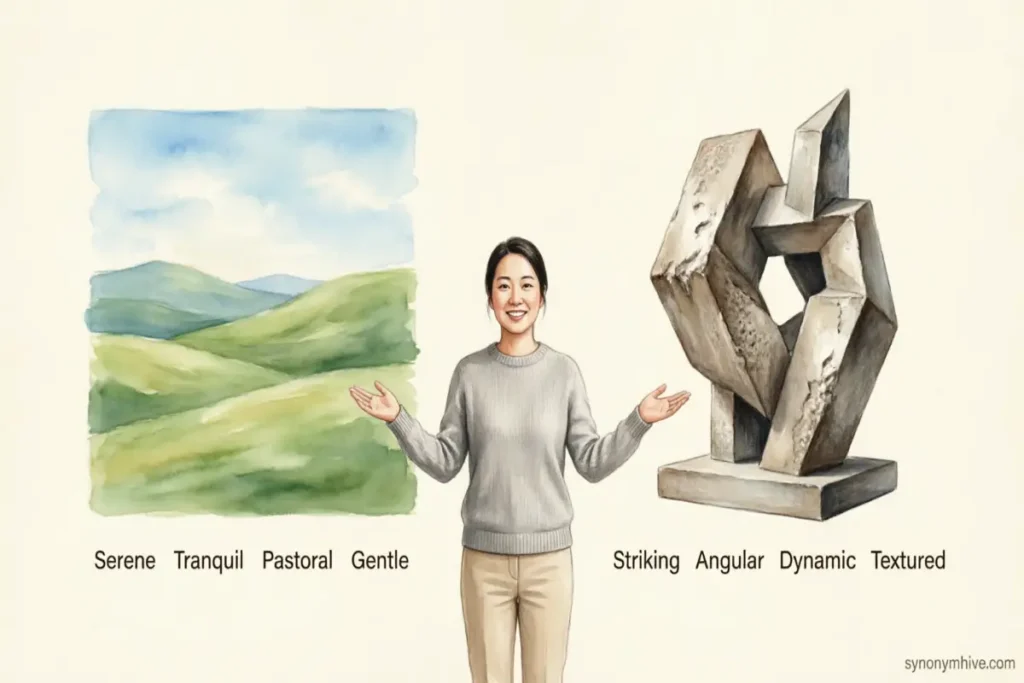
1. A landscape painting. The soft green hills and pale blue sky create a peaceful scene that feels far removed from city life.
2. A modern sculpture. Its sharp edges and uneven surfaces give the sculpture a bold appearance.
3. A family portrait. The warm colors and relaxed expressions make the portrait feel personal and welcoming.
4. A street mural. The vibrant colors and oversized figures turn an ordinary wall into an eye catching display.
5. An abstract painting. The swirling shapes and clashing colors create a restless mood that suggests confusion.
6. A black and white photograph. The strong contrast between light and shadow gives the image a dramatic quality.
7. A pencil drawing. The delicate lines and careful shading make the flowers appear almost lifelike.
8. A children’s illustration. The playful characters and bright colors make the picture feel cheerful and inviting.
9. A historical painting. The detailed clothing and carefully arranged figures offer clues about the period being represented.
10. A ceramic bowl. Its smooth surface and curved shape give the simple object an elegant appearance.
Notice the pattern in these examples. Each sentence identifies one or two features and explains their effect. You can use the same method when writing your own description.
What Is the Difference Between Similar Art Describing Words?
Some words appear interchangeable, but they often describe different qualities. Understanding these differences helps you select the right term.
Beautiful vs. Stunning
Both words express admiration, but beautiful is a broad term for something pleasing to look at. Stunning suggests a stronger reaction, often because the artwork is especially striking or impressive.
| Beautiful | Stunning |
|---|---|
| The painting has beautiful flowers and soft colors. | The huge floral mural is stunning because of its scale and vivid colors. |
| Works for many kinds of visual appeal. | Works when the effect feels especially powerful. |
Use beautiful for general appreciation. Choose stunning when the work strongly catches your attention.
Detailed vs. Intricate
Detailed means an artwork includes many visible features. Intricate suggests that those details are arranged in a complex or carefully connected way.
| Detailed | Intricate |
|---|---|
| The drawing shows detailed feathers on the bird. | The intricate design combines tiny feathers with repeating patterns. |
| Focuses on the amount of detail. | Focuses on complexity and arrangement. |
A picture can be detailed without being intricate. An intricate artwork often has a complex structure that rewards close attention.
Colorful vs. Vibrant
Colorful means an artwork contains many colors or noticeable color variation. Vibrant suggests strong energy, brightness, or liveliness.
For example, “The colorful quilt includes red, blue, and yellow squares” simply describes its range of colors. By contrast, “The vibrant mural fills the street with energy” describes both its appearance and its effect.
Strange vs. Surreal
Strange is a general word for something unusual or unfamiliar. Surreal describes imagery that feels dreamlike, impossible, or disconnected from ordinary reality.
For instance, an oddly shaped chair might look strange. A painting showing a chair floating above a sea of clouds may look surreal.
Use surreal when the artwork creates an unreal or dreamlike scene. Otherwise, strange or unusual may be more accurate.
What Common Mistakes Should You Avoid When Describing Art?
Good descriptions depend on accuracy as much as vocabulary. Even an impressive word can weaken your writing if it does not fit the artwork.
1. Using the same adjective repeatedly. Calling every artwork beautiful, amazing, or stunning gives readers little information. Try naming the colors, shapes, mood, or technique instead.
2. Confusing appearance with emotion. A dark painting does not always feel sad. It might be mysterious, peaceful, dramatic, or even playful. Explain the details that create the mood.
3. Calling every complex work abstract. Abstract art moves away from direct representation of recognizable subjects. A detailed realistic portrait can be complex without being abstract.
4. Guessing the artist’s intention. You can explain how an artwork makes you feel, but avoid claiming that the artist definitely intended a particular message unless you have supporting evidence. Phrases such as “The image may suggest” allow room for interpretation.
5. Using formal vocabulary without a clear reason. Words such as evocative and aesthetic can be useful, but simple language often communicates an idea more clearly.
6. Giving praise without evidence. Instead of writing “This is a powerful painting,” explain that its large figures, sharp contrast, and tense expressions make it powerful.
7. Ignoring the audience. A casual social media caption can use relaxed language. An academic essay usually needs more precise terms and a clear explanation.
The goal is not to make every description sound sophisticated. It is to help another person understand what you see and why it matters to you.
What Are the Opposite Words for Art Descriptions?
Antonyms help you describe qualities that are missing, reversed, or less noticeable. However, a word’s opposite depends on the feature you want to discuss.
| Descriptive Word | Possible Opposite | Example |
|---|---|---|
| Bright | Dim | The dim lighting makes the artwork difficult to see. |
| Colorful | Monochromatic | The monochromatic print uses several shades of gray. |
| Detailed | Simple | The simple drawing uses only a few lines. |
| Balanced | Unbalanced | The unbalanced composition makes the image feel tense. |
| Smooth | Rough | The rough surface creates a rugged appearance. |
| Realistic | Abstract | The abstract forms do not represent recognizable objects. |
| Cheerful | Gloomy | The gloomy scene creates a feeling of sadness. |
| Harmonious | Clashing | The clashing colors create visual tension. |
| Delicate | Heavy | The heavy shapes make the design feel solid and imposing. |
| Calm | Chaotic | The chaotic arrangement makes the viewer’s eye move in several directions. |
These pairs are useful for comparisons and critical reviews. Still, an opposite word does not automatically mean a work is bad. A chaotic composition can be intentional, just as a simple design can be highly effective.
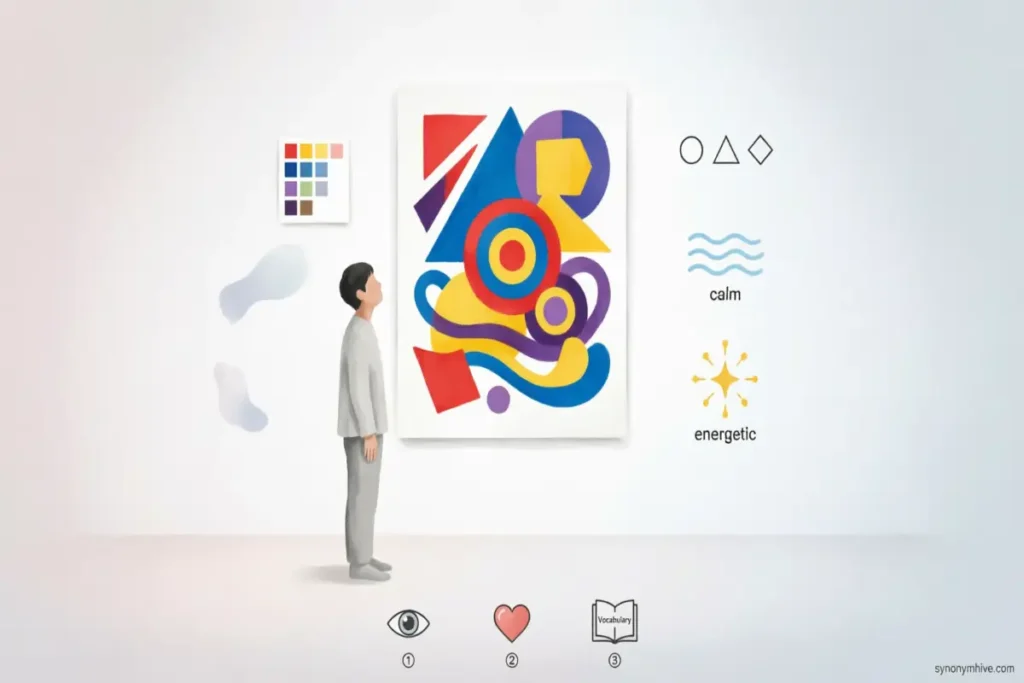
How Do You Choose the Right Words to Describe Art?
Use these practical tips to make your description clearer and more personal.
1. Start with what you can see. Notice the colors, shapes, lines, materials, size, and arrangement before interpreting the meaning.
2. Identify the mood. Ask yourself if the work feels peaceful, joyful, tense, lonely, mysterious, or energetic.
3. Choose precise language. If the colors are strong and full of energy, vibrant may be more useful than nice.
4. Think about the medium. A sculpture may have a rough surface, while a photograph may have sharp focus and strong contrast. Select words that suit the form of art.
5. Match the tone to the situation. Use conversational terms in a text, precise vocabulary in an essay, and professional language in a review.
6. Support your opinion with evidence. Explain what makes the artwork striking, peaceful, or unsettling. Mention a visible feature instead of relying on praise alone.
7. Avoid unnecessary exaggeration. One well chosen adjective often works better than a string of superlatives.
8. Read your sentence aloud. If it sounds unnatural, replace complicated language with a simpler phrase.
A useful formula is to name the feature, describe its quality, and explain its effect. For example, “The muted colors create a quiet mood that makes the empty street feel lonely.”
This approach works for paintings, drawings, photographs, sculptures, and digital designs. It also gives your readers a reason to trust your interpretation.
Looking for a better alternative? Visit Synonyms for Good: The Ultimate Guide Write Like a Pro (2026).
Conclusion
Finding the right words can turn a vague reaction into a clear and memorable description. Instead of relying on general praise, focus on what makes the artwork distinctive. Notice its colors, texture, composition, technique, and mood. Then explain how those features affect the viewer.
The best words to describe art are the ones that fit the work and support your point. You do not need complicated vocabulary to sound thoughtful. A simple word such as rough can be more useful than a formal term if it accurately describes the surface. Likewise, vibrant can communicate more than colorful when the artwork feels full of energy.
Keep a few descriptive words nearby when you write an essay, review a painting, or share a photo. With practice, you will find it easier to explain not just what an artwork looks like, but also why it catches your attention.
Frequently Asked Questions
What Are Some Good Words to Describe Art?
Good words include vibrant, expressive, intricate, abstract, peaceful, dramatic, symbolic, and captivating. Choose terms that match the artwork’s visible features or emotional effect.
What’s Another Way to Say Art Is Beautiful?
You can say the artwork is stunning, striking, elegant, captivating, or visually appealing. For a more specific description, explain the colors, composition, or details that make it attractive.
How Do You Describe Art in One Sentence?
Name a noticeable feature and explain its effect. For example, “The bold colors and sweeping brushstrokes give the painting an energetic mood.”
What Are the Best Words to Describe Art in an Essay?
Words such as symbolic, evocative, balanced, expressive, and contrasting work well in essays. Support each word with evidence from the artwork so your description feels clear and thoughtful.
How Can I Describe Abstract Art?
Describe its colors, shapes, lines, texture, and composition. You can also explain the mood or ideas it suggests, but make it clear when you are sharing a personal interpretation.
What Words Describe the Mood of an Artwork?
Peaceful, cheerful, somber, tense, mysterious, dreamy, unsettling, and dramatic can describe an artwork’s mood. The right choice depends on the feelings created by its visual elements.
How Do I Avoid Repeating the Same Art Describing Words?
Use a mix of appearance, mood, style, and technique words. For example, combine muted, somber, and minimalist when they accurately describe different aspects of the same artwork.