
You may need another word for mood when you’re writing a text, essay, email, resume, or social media post. Mood is a useful word, but it can mean different things. Sometimes you mean a person’s emotional state. Other times you mean the atmosphere of a place, the tone of a message, or the feeling created by a song or movie.
The best replacement depends on the exact meaning. Words such as feeling, attitude, atmosphere, tone, emotion, state of mind, and disposition can all work in different situations. Gen Z slang adds casual choices such as vibe, energy, aura, and mood itself as a reaction phrase.
The best synonym for mood depends on context. Feeling, emotion, atmosphere, tone, attitude, and state of mind are strong choices, while vibe, energy, and aura work better in casual or Gen Z speech.
This guide covers the meaning and origin of mood, more than 30 useful alternatives, Gen Z slang, formal choices, intensity levels, common mistakes, and examples for real situations. You’ll also see how close synonyms differ so you can choose the word that says exactly what you mean.
What Does Mood Mean In Plain English
Mood is a noun that usually describes an emotional state or the general feeling created by a person, place, event, piece of writing, song, or situation.
When you say someone is in a good mood, you’re describing their current emotional state. They may be happy, relaxed, excited, or cheerful.
Mood can also describe the emotional quality of a place or creative work. A dark movie may create a tense mood. A quiet café may have a peaceful mood.
The word is broad because it can describe both a person’s inner state and the emotional atmosphere around them.
That makes mood useful in everyday English. It also explains why one synonym won’t work in every sentence.
Where Did The Word Mood Come From
The word mood has a long history in English.
It comes from an Old English word related to mind, spirit, or frame of mind. Over time, the meaning became connected with a person’s emotional state and general disposition.
The word later developed another important use in grammar. In English, mood can describe the form of a verb that shows things such as statements, commands, wishes, or possibilities.
For example, the indicative mood is commonly used for statements.
The imperative mood is used for commands.
The subjunctive mood can express wishes, suggestions, or situations that are not presented as ordinary facts.
Most everyday questions about mood are about emotions rather than grammar. Still, the grammatical meaning is worth knowing because it shows how broad the word has become.
Today, mood is common in casual conversation, psychology, literature, music reviews, social media, and everyday descriptions of people and places.
What Is Another Word For Mood
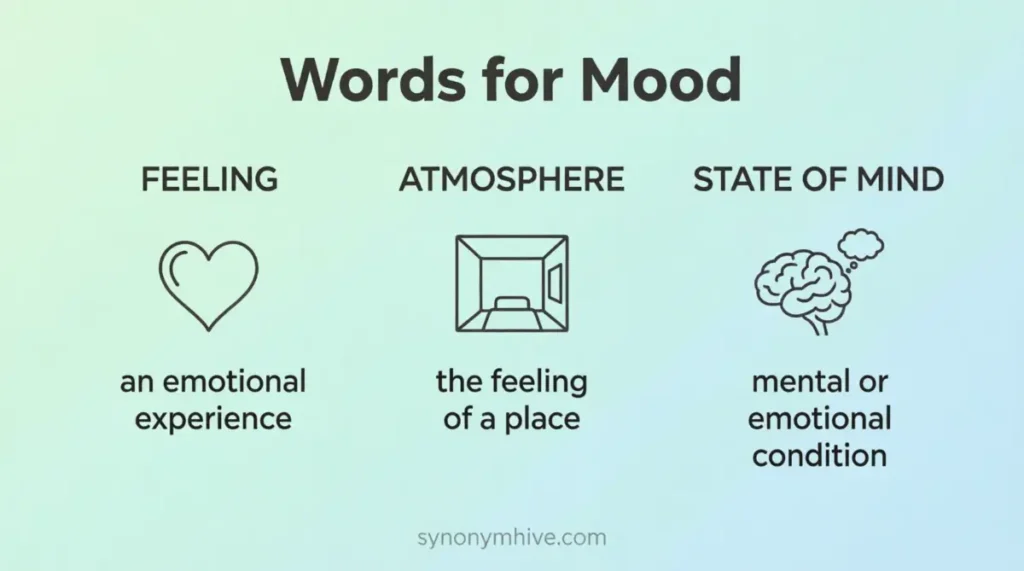
There isn’t one perfect replacement for mood because the word can describe several related ideas.
Here are useful choices grouped by how they are normally used.
| Word | Meaning | Tone | Example |
|---|---|---|---|
| Feeling | An emotional experience or impression | Simple | I had a strange feeling about the meeting. |
| Emotion | A specific emotional response | Neutral | Anger was the strongest emotion in the scene. |
| Atmosphere | The general feeling of a place or situation | Neutral | The room had a relaxed atmosphere. |
| Tone | The emotional quality or attitude of communication | Neutral | Her email had a friendly tone. |
| Attitude | A person’s way of thinking or behaving | Neutral | He has a positive attitude. |
| State of mind | A person’s current mental or emotional condition | Neutral | She was in a calm state of mind. |
| Disposition | A person’s usual emotional nature | Formal | He has a cheerful disposition. |
| Temper | A person’s emotional state or tendency | Neutral | His calm temper helped during the crisis. |
| Calm | A peaceful emotional state | Simple | He answered with complete calm. |
| Tension | A feeling of stress or pressure | Neutral | There was tension in the room. |
| Sentimentality | Strong emotional attachment | Formal | The film avoids excessive sentimentality. |
| Feeling tone | The emotional quality of an experience | Formal | The feeling tone of the poem is gentle. |
| Demeanor | The way a person appears and behaves | Formal | Her professional demeanor impressed the clients. |
| Psyche | A person’s mind and emotional life | Formal | The novel explores the character’s psyche. |
| Social energy | The emotional quality of group interaction | Casual | The party had great social energy. |
Not all of these words are interchangeable.
That distinction matters. Feeling and emotion are close, but atmosphere usually describes a place or situation. Tone often describes communication. Disposition describes a person’s general nature rather than a temporary emotional state.
A strong writer doesn’t just swap one word for another. The writer chooses the word that matches the intended meaning.
Which Synonyms Are Best For Different Meanings
The fastest way to choose a replacement is to identify what kind of mood you mean.
If you mean a person’s current emotion, use feeling, emotion, or state of mind.
If you mean the emotional quality of a place, use atmosphere or ambiance.
The small difference between these words can make a sentence much clearer.
What Are Mild Words For Mood
Mild alternatives describe a general emotional quality without suggesting a strong reaction.
Feeling is one of the safest choices.
For example, I had a good feeling about the interview.
State of mind is another useful option.
For example, she was in a peaceful state of mind.
Atmosphere works when describing a place.
For example, the library had a quiet atmosphere.
Tone works for communication.
For example, his message had a friendly tone.
These choices are useful when you want to sound clear without making the sentence overly emotional.
What Are Stronger Words For Mood
Some situations call for a stronger word.
Emotion works when a specific feeling is important.
For example, fear was the strongest emotion in the scene.
Passion suggests powerful interest or enthusiasm.
For example, her passion for teaching was obvious.
Tension suggests stress, conflict, or unease.
For example, tension filled the room after the argument.
Excitement suggests strong enthusiasm.
For example, excitement spread through the crowd when the singer appeared.
Resonance suggests a deep emotional effect that continues after an experience.
For example, the story has emotional resonance because many readers can relate to its message.
The stronger word should match the strength of the feeling.
What Is A Good Gen Z Word For Mood
Gen Z slang gives the word mood several casual alternatives.
Vibe is probably the broadest choice. It can describe the feeling someone or something gives off.
For example, This café has such a chill vibe.
Energy focuses more on what a person or situation seems to give off.
For example, She brings good energy wherever she goes.
Aura is often used online to describe someone’s presence, confidence, or cool factor.
For example, He has serious aura.
Aesthetic is more specific. It usually describes a visual style or recognizable look.
For example, Her room has a soft minimalist aesthetic.
Mood itself can also work as slang. Someone might post a photo of a tired cat and simply write mood. This means the person relates strongly to the image or situation.
Gen Z language changes quickly. A word that sounds natural online today may become less common later. Use slang when the audience and setting fit it.
What Is Another Word For Mood In A Resume
A resume needs more specific language than casual conversation.
You normally shouldn’t write that you have a good mood at work. That doesn’t tell an employer much.
Instead, use words such as attitude, demeanor, presence, mindset, or outlook.
Use Attitude For Your Approach To Work
For example:
I maintain a positive attitude when handling difficult customer requests.
This tells the employer how you behave during challenging situations.
Use Mindset For Your Way Of Thinking
For example:
I bring a problem solving mindset to complex projects.
Mindset works well when you want to describe how you approach work.
Use Demeanor For Professional Behavior
For example:
I maintain a calm and professional demeanor during high pressure situations.
Demeanor is more formal than mood and focuses on how you appear to others.
Use Presence For Leadership
For example:
I bring a calm and confident presence to client meetings.
Presence can work well for managers, sales professionals, teachers, speakers, and other people facing groups.
What Is Another Word For Mood In An Essay
Essays require precision.
If you’re analyzing a novel, poem, or film, mood and atmosphere are often the strongest terms.
If you’re discussing how an author communicates an attitude, use tone.
For example:
The author creates a tense atmosphere through short sentences and dark imagery.
Another example is:
The poem has a melancholy tone that reflects the speaker’s loneliness.
These choices tell the reader exactly what you are analyzing.
Avoid replacing mood with slang such as vibe or aura in formal academic writing unless the subject itself is slang, youth culture, or social media language.
What Is Another Word For Mood In Texting
Texting gives you much more freedom.
You can use vibe, energy, feeling, aura, or mood depending on the situation.
For example:
This song is such a vibe.
That photo is a whole mood.
She has such good energy.
This place has a peaceful vibe.
His calm aura makes everyone feel comfortable.
These phrases sound natural in casual conversation.
The phrase whole mood is especially common online. It means something strongly represents or matches the speaker’s current feelings.
For example, a picture of someone sleeping after a long day might receive the comment, This is a whole mood.
What Is Another Word For Mood In An Email
In professional emails, tone is often the strongest replacement.
For example:
The tone of your message sounds friendly and helpful.
If you are describing a meeting, use atmosphere.
For example:
The meeting had a positive atmosphere despite the difficult topic.
If you are describing a person’s approach, use attitude.
For example:
Her positive attitude helped keep the discussion productive.
If you are writing to a friend, you have more freedom. Feeling, vibe, energy, and mood can all work naturally.
The relationship between the writer and reader should guide your choice.
What Is Another Word For Mood When Speaking
In everyday speech, simple words usually work best.
Feeling is easy and natural.
For example:
I have a weird feeling about this.
Vibe works for a general impression.
For example:
I like the vibe of this place.
Energy works for people and social situations.
For example:
She has really positive energy.
Atmosphere works well for places.
For example:
The restaurant has a relaxed atmosphere.
You don’t need a fancy synonym just because one exists. A simple word that fits the situation is usually stronger.
What Are The Best Synonyms By Part Of Speech
Mood is mainly a noun, so most direct replacements are also nouns.
Here are the most useful noun choices.
- Feeling.
- Emotion.
- Atmosphere.
- Tone.
- Attitude.
- Disposition.
- Temperament.
- Mindset.
- Outlook.
- Vibe.
- Energy.
- Aura.
- Spirit.
- Sentiment.
- Demeanor.
Some related alternatives can also work as adjectives.
For example, moody describes someone or something that shows changing or strong emotions.
Emotional describes something connected with feelings.
Cheerful describes a happy or positive emotional state.
Gloomy describes a dark or sad emotional state.
Tense describes a stressful or uneasy state.
These adjectives can sometimes communicate the idea more directly than a noun.
Instead of saying the mood was positive, you might say the room was cheerful.
Instead of saying the mood was tense, you might say the atmosphere was tense.
Direct description often makes writing stronger.
Mood Vs Feeling What Is The Difference
Mood and feeling are closely related, but they aren’t always identical.
A feeling is often a specific emotional experience.
For example, I felt nervous before the interview.
A mood is usually a broader emotional state that can last for a while.
For example, I was in a nervous mood before the interview.
The second sentence sounds less natural than the first in many situations because nervous is more naturally described as a feeling in that context.
Mood can also describe an atmosphere.
For example:
The movie has a dark mood.
You could not always replace mood with feeling without changing the sentence.
| Mood | Feeling |
|---|---|
| Usually broader | Often more specific |
| Can describe atmosphere | Usually describes an emotional experience |
| Can last for a period | Can happen quickly |
| Common in art and literature | Common in personal experiences |
Think of feeling as a particular emotional experience and mood as a wider emotional state or atmosphere.
Mood Vs Tone What Is The Difference
Mood describes the feeling created in the reader or audience.
Tone describes the attitude expressed by the writer, speaker, or creator.
For example, a writer may use a sarcastic tone to create an uncomfortable mood.
The tone belongs to the speaker or writer.
The mood is the emotional effect experienced by the audience.
| Mood | Tone |
|---|---|
| Focuses on emotional effect | Focuses on attitude |
| Often describes the reader’s experience | Often describes the writer’s approach |
| Can describe a place or scene | Commonly describes communication |
| Example: tense mood | Example: serious tone |
This difference is especially useful in literary analysis.
Mood Vs Atmosphere What Is The Difference
Mood and atmosphere overlap heavily.
Atmosphere often focuses on the overall feeling created by a place, scene, or situation.
For example:
The story creates a sad mood.
The old house has a mysterious atmosphere.
Both words can describe emotional qualities, but atmosphere is especially useful when talking about surroundings.
Atmosphere is also a strong choice for professional writing.
For example:
The restaurant has a warm atmosphere.
That sounds more polished than saying the restaurant has a warm vibe.
Mood Vs Attitude What Is The Difference
Attitude describes a person’s way of thinking or behaving toward something.
Mood usually describes a temporary emotional state.
For example:
She was in a bad mood.
She has a negative attitude toward change.
The first sentence describes her current emotional condition.
The second suggests a more general way of thinking.
A person’s attitude can influence their mood, but the two words are not interchangeable.
Mood Vs Vibe What Is The Difference
Mood and vibe are close, especially in casual speech.
Vibe is broader and can include emotion, appearance, social energy, atmosphere, and general impression.
For example:
The movie has a sad mood.
The movie has a strange vibe.
The first sentence clearly describes emotion.
The second suggests that something about the movie feels unusual, but it doesn’t tell us exactly what.
That flexibility is one reason vibe is so common in casual speech.
15 Examples Of Another word for Mood In Real Situations
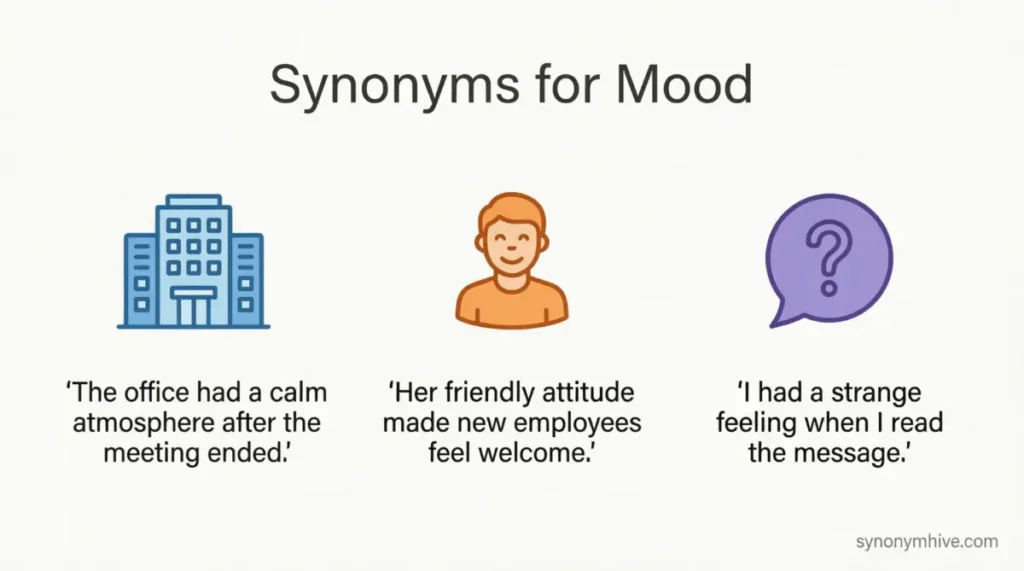
- The office had a calm atmosphere after the meeting ended.
- Her friendly attitude made new employees feel welcome.
- I had a strange feeling when I read the message.
- The speaker used a serious tone during the presentation.
- His cheerful disposition made him easy to work with.
- She was in a peaceful state of mind after the walk.
- The song creates a nostalgic feeling for many listeners.
- The party had great energy once the music started.
- The café has a warm vibe that keeps people coming back.
- His confident presence changed the mood of the room.
- The movie creates a sense of tension from the first scene.
- She has an optimistic outlook on difficult situations.
- The character’s calm demeanor helped everyone relax.
- The story has emotional resonance because its message is relatable.
- The room had an air of mystery that made everyone curious.
Each sentence uses a word that gives more specific information than mood alone.
How Strong Are Different Mood Words
The intensity of your word can change the entire sentence.
| Intensity | Word | Example |
|---|---|---|
| Very mild | Feel | The room has a nice feel. |
| Mild | Atmosphere | The room has a calm atmosphere. |
| Mild | Attitude | She has a positive attitude. |
| Medium | Emotion | Fear was clear in his voice. |
| Medium | Energy | The group had positive energy. |
| Medium | Tension | Tension filled the room. |
| Strong | Passion | Her passion for art was obvious. |
| Strong | Excitement | Excitement spread through the crowd. |
| Strong | Resonance | The story has emotional resonance. |
Use mild words for simple observations.
Use stronger words when the emotional effect is clear and important.
Common Mistakes When Using Mood Synonyms
One common mistake is treating every synonym as an exact replacement.
They aren’t.
For example, atmosphere usually describes a setting, while attitude usually describes a person’s approach.
Another mistake is using disposition to describe a temporary feeling.
Disposition usually suggests a person’s general nature.
Someone can be in a bad mood for an hour without having a bad disposition.
A third mistake is using aesthetic as a synonym for every kind of mood.
Aesthetic is mainly about visual or artistic style.
A fourth mistake is using slang in a formal setting.
Vibe and aura may sound natural in a text but can make an academic essay or business report sound too casual.
Another mistake is choosing an unnecessarily complicated word.
If feeling communicates your idea clearly, you don’t need to replace it with emotional state or sentiment.
Good word choice isn’t about using the biggest word.
It’s about choosing the most accurate word.
When Should You Not Use A Synonym For Mood
Sometimes mood is already the best word.
Don’t replace it simply because you think repetition is always bad.
If you’re discussing a novel’s mood, the word is precise and widely understood.
If you’re describing your current emotional state, mood can also be clearer than a more formal alternative.
For example:
I’m in a good mood today.
This sounds completely natural.
Replacing it with I’m in a positive emotional state today would sound stiff.
The goal is not to avoid mood.
The goal is to avoid using it when another word communicates your meaning better.
What Are The Opposites Of Mood
Mood has no single opposite because it can describe many different emotional states.
Depending on the sentence, useful opposites include calm and tension, happiness and sadness, optimism and pessimism, comfort and discomfort, and positivity and negativity.
If you mean the absence of emotion, words such as neutrality, indifference, or detachment may work.
For example:
The room had a warm atmosphere.
The opposite could be:
The room had a cold atmosphere.
The best antonym depends on the specific mood you’re describing.
How To Choose The Right another word for mood Quickly
Start with the subject.
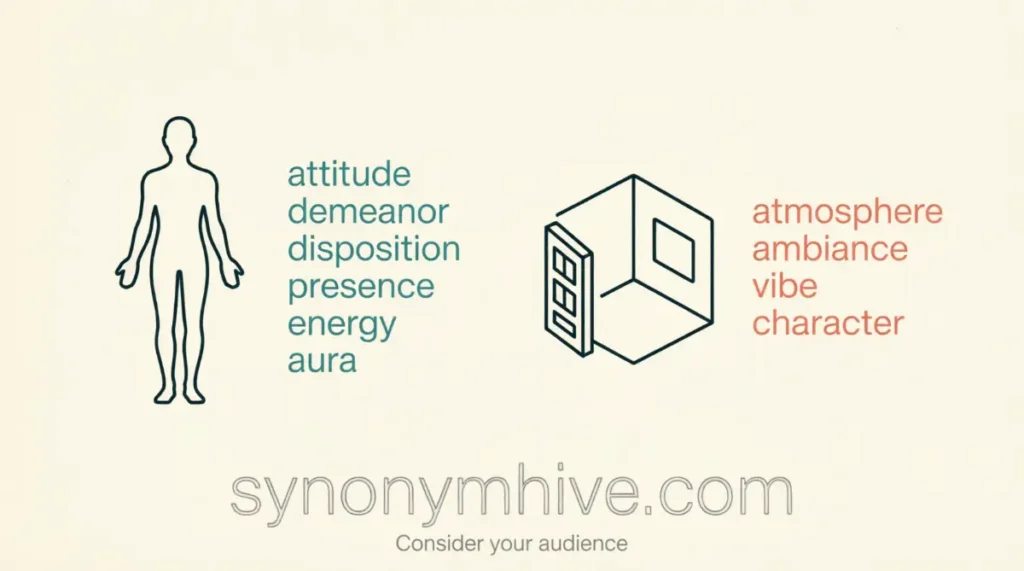
If you’re describing a person, consider attitude, demeanor, disposition, presence, energy, or aura.
If you’re describing a place, consider atmosphere, ambiance, vibe, or character.
Then think about your audience.
A text message can use slang.
A school essay needs clearer academic language.
A resume needs professional language.
A business email needs a tone that matches the relationship.
Finally, choose the simplest word that gives the reader the right meaning.
That rule will usually lead you to the strongest choice.
Which Word Is Best For Each Situation
| Situation | Best Word | Reason |
|---|---|---|
| Personal emotion | Feeling | Simple and direct |
| Strong emotion | Emotion | More specific |
| Place | Atmosphere | Describes the overall setting |
| Restaurant | Ambiance | Fits a designed environment |
| Tone | Describes communication style | |
| Resume | Attitude | Describes work approach |
| Leadership | Presence | Describes how someone comes across |
| Essay | Mood | Useful for emotional analysis |
| Literature | Tone | Useful for the author’s attitude |
| Gen Z slang | Vibe | Casual and flexible |
| Online slang | Aura | Describes presence or cool factor |
| Visual style | Aesthetic | Focuses on appearance |
| General thinking | Mindset | Describes thought patterns |
| Life perspective | Outlook | Describes a broader view |
| Personality | Disposition | Describes general emotional nature |
How To Make Your Word Choice Sound Natural
Good word choice starts with the situation rather than the thesaurus.
If you’re talking to a friend, mood and vibe are both natural.
If you’re writing an essay, mood, tone, and atmosphere are usually stronger.
The same basic idea can require different words in different settings.
That isn’t inconsistency.
It’s good communication.
Conclusion
Choosing another word for mood becomes much easier once you identify the exact meaning you want. Feeling and emotion work well for personal reactions. Atmosphere fits places and situations. Tone is useful for writing and speech. Attitude describes someone’s approach, while mindset and outlook describe broader ways of thinking.
For casual conversations and Gen Z slang, vibe, energy, and aura can sound natural. Aesthetic is better for visual style. In professional writing, more precise words such as presence, demeanor, atmosphere, and attitude usually communicate the idea more clearly.
The simplest rule is to choose the word that gives your reader the clearest picture. You don’t need the fanciest synonym. You need the right one.
Frequently Asked Questions
What’s another way to say mood?
Another way to say mood is feeling, emotion, atmosphere, tone, attitude, state of mind, or vibe. The best choice depends on the person, place, situation, or type of writing you are describing.
What is another word for mood in Gen Z slang?
Vibe, energy, aura, and aesthetic are common casual alternatives connected with mood. Mood itself is also widely used as slang when someone strongly relates to a picture, comment, or situation.
What is a professional word for mood?
Professional alternatives include attitude, atmosphere, tone, disposition, demeanor, state of mind, and outlook. Choose the word that matches the exact meaning rather than using a formal word simply to sound professional.
What is another word for mood when describing a person?
Feeling, attitude, demeanor, disposition, temperament, energy, and presence can describe a person’s emotional state or general character. Feeling works well for a temporary state, while disposition suggests a more lasting trait.
What is another word for mood in an essay?
Mood, atmosphere, tone, feeling, and emotional quality are strong choices in essays. Tone is especially useful when discussing the writer’s attitude, while mood often describes the emotional effect on the reader.
What is another word for a bad mood?
You can say irritation, frustration, sadness, anger, tension, gloom, or negativity depending on the exact emotion. The best word should identify the specific feeling instead of using a broad term.
Is vibe the same as mood?
Vibe and mood overlap, but vibe is broader and more casual. Mood usually points more directly to an emotional state, while vibe can include atmosphere, appearance, personality, social energy, and general impression.