
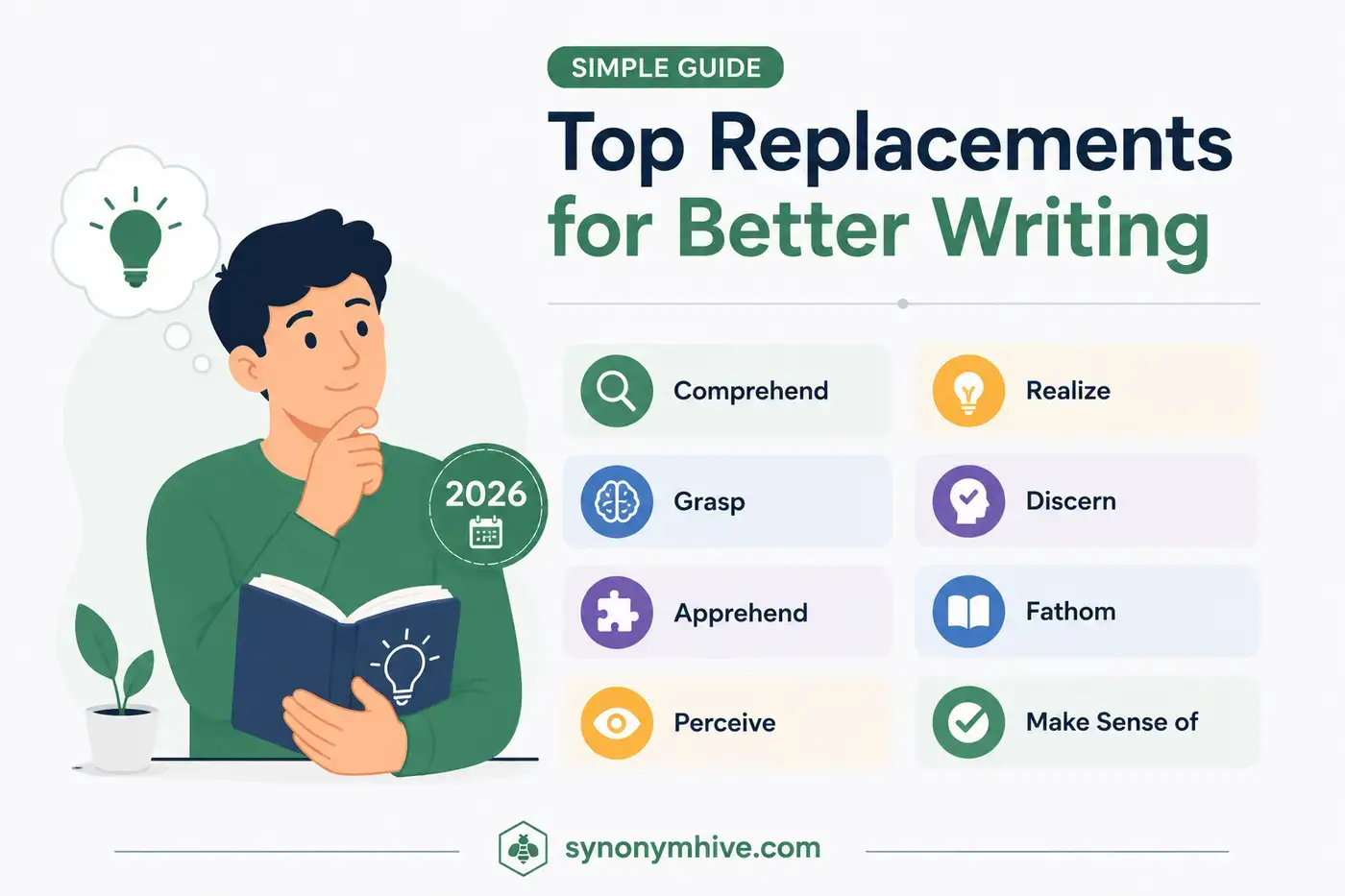
Have you ever written an email or school essay and noticed you used the word understand several times? It happens to almost everyone. Learning synonyms for understand helps your writing sound smoother and more natural without changing your message.
Synonyms for understand are words and phrases that mean to know the meaning of something to grasp an idea or to recognize a situation. The best synonym depends on your purpose and the level of understanding you want to express. Some alternatives fit casual conversations while others work better in business writing academic papers or presentations. Choosing the right word makes your message clearer and more engaging.
This guide covers the meaning and history of understand a complete list of useful alternatives real examples common mistakes comparisons and practical tips for choosing the best word every time.
Explore another synonym guide: Synonyms for Helped: 120 Powerful Alternatives (2026).
What Does Understand Mean
The word understand means to know the meaning of something to grasp an idea or to recognize how a situation works. People use it when they follow instructions learn new information or show empathy toward another person.
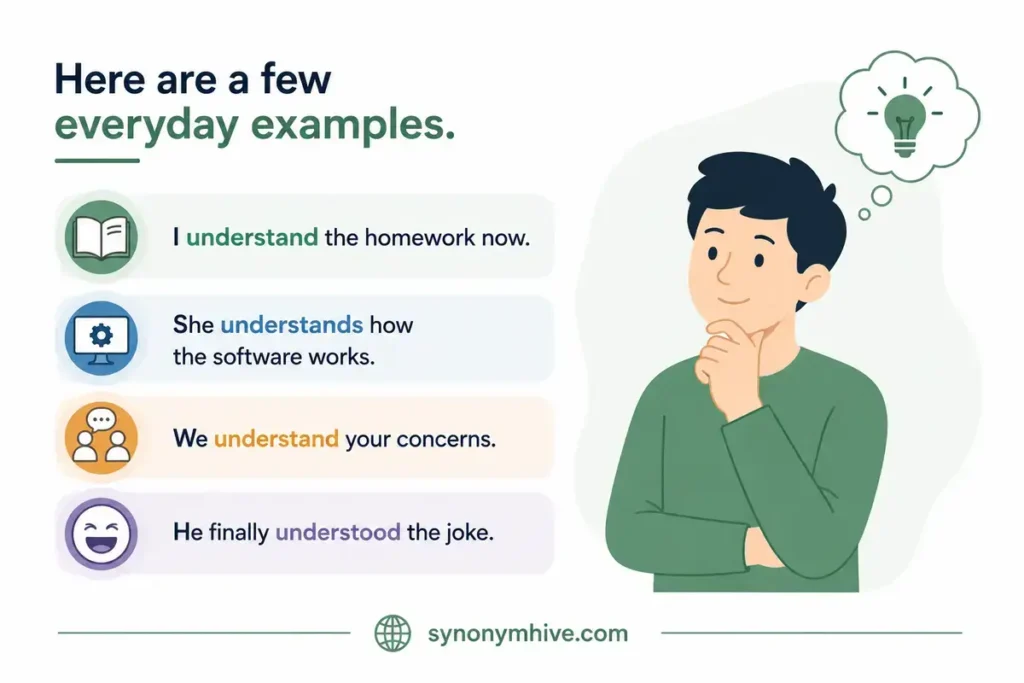
Here are a few everyday examples.
- I understand the homework now.
- She understands how the software works.
- We understand your concerns.
- He finally understood the joke.
The word can describe both knowledge and emotional awareness. That is one reason English speakers use it so often.
Where Did The Word Understand Come From
The word understand comes from Old English. It originally meant to stand among or stand in the middle of something. Over time the meaning shifted toward grasping the meaning of ideas facts and situations. Today it is one of the most common verbs in English because people constantly explain learn discuss and solve problems.
What Are The Best Synonyms For Understand
The table below includes many useful alternative for understand grouped by tone and everyday use.
| Word | Meaning | Tone | Example |
|---|---|---|---|
| Know | Have knowledge | Simple | I know the answer. |
| Get | Understand quickly | Everyday | I get what you mean. |
| Grasp | Understand clearly | Everyday | She grasped the idea fast. |
| Follow | Understand what is being explained | Everyday | Can you follow the instructions? |
| Recognize | Identify or realize | Everyday | I recognize the problem. |
| See | Understand a point | Everyday | I see your concern. |
| Realize | Become aware | Everyday | He realized his mistake. |
| Comprehend | Fully understand | Formal | Students must comprehend the text. |
| Appreciate | Understand the value or importance | Formal | I appreciate your effort. |
| Discern | Notice and understand | Formal | She discerned a pattern. |
| Perceive | Become aware through thought | Formal | We perceived a change. |
| Interpret | Explain the meaning | Formal | Lawyers interpret laws carefully. |
| Decode | Figure out a meaning | Neutral | He decoded the message. |
| Learn | Gain understanding | Neutral | Children learn through practice. |
| Catch on | Begin to understand | Casual | She caught on quickly. |
| Figure out | Solve or understand | Casual | I figured out the problem. |
| Read | Understand a situation | Casual | He read the room well. |
| Take in | Absorb information | Casual | I need time to take this in. |
| Make sense of | Understand something confusing | Everyday | We made sense of the data. |
| Be aware of | Know about something | Neutral | I am aware of the issue. |
| Be familiar with | Know something well | Neutral | She is familiar with the process. |
| Get the picture | Understand the situation | Casual | I get the picture now. |
| Catch the meaning | Understand the message | Casual | Did you catch the meaning? |
| See the point | Understand the reason | Everyday | I see the point now. |
| Take on board | Accept and understand | UK leaning | He took the advice on board. |
| Clock | Notice and understand | UK slang | I clocked what happened. |
Which Synonyms Show Different Levels Of Understanding
Not every synonym means the same degree of understanding.
| Level | Words |
|---|---|
| Slight awareness | Notice Realize Be aware of |
| Basic understanding | Know Get Follow |
| Clear understanding | Grasp See Make sense of |
| Strong understanding | Comprehend Discern Interpret |
| Deep understanding | Read between the lines Piece together Dig |
Choosing the right level helps your writing sound more precise.
Which Synonyms Work As Verbs And Phrases
Most alternatives are verbs but some are verb phrases.
Single verbs
- Know.
- Get.
- Grasp.
- Follow.
- Recognize.
- Comprehend.
- Interpret.
- Discern.
Verb phrases
- Make sense of.
- Figure out.
- Catch on.
- Read between the lines.
- Piece together.
- Get the picture.
These phrases often sound more natural in conversation than a single formal verb.
Are There Any US And UK Differences
Yes. Most words work in both countries but a few are more common in one place.
| More Common In The US | More Common In The UK |
|---|---|
| Dig | Cotton on |
| Figure out | Clock |
| Get the picture | Take on board |
If you write for an American audience figure out get the picture and dig usually sound the most natural.
What Is The Best Word For A Resume
A resume should sound professional and confident.
Better choices include.
- Comprehend.
- Interpret.
- Analyze.
- Understand.
Example sentence.
I comprehend complex technical documents and explain them clearly to clients.
What Is The Best Word For An Essay
Academic writing usually needs a neutral formal tone.
Good options include.
- Comprehend.
- Interpret.
- Analyze.
- Discern.
Example sentence.
Readers must comprehend the author’s main argument before evaluating it.
What Is The Best Word For Text Messages
Friends usually prefer shorter and simpler words.
Natural choices include.
- Get.
- See.
- Follow.
- Catch on.
Example sentence.
I get what you’re saying now.
What Is The Best Word For Emails
Professional emails should sound clear but friendly.
Good choices include.
- Understand.
- Recognize.
- Appreciate.
- Follow.
Example sentence.
I understand your concern and will review the issue today.
What Is The Best Word For Speaking
When speaking people often choose quick familiar words.
The most natural options include.
- Get.
- See.
- Follow.
- Grasp.
Example sentence.
I see what you mean.
Real Life Examples Using Different Synonyms
Learning new words becomes much easier when you see them in real situations.
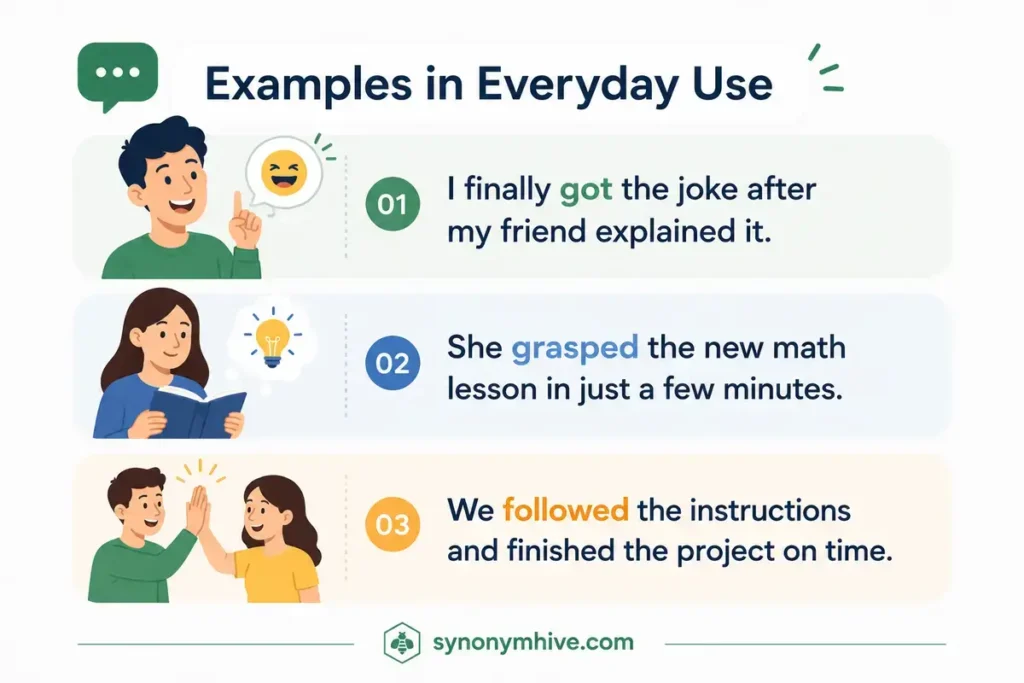
- I finally got the joke after my friend explained it.
- She grasped the new math lesson in just a few minutes.
- We followed the instructions and finished the project on time.
- The manager recognized the problem before it became serious.
- I see your point and agree with your suggestion.
- The students comprehended the article after discussing it in class.
- He figured out the answer without asking for help.
- It took me a while to make sense of the directions.
- The detective pieced together the story from several clues.
- My little brother finally caught on to the game.
- She interpreted the poem in a creative way.
- We appreciate how difficult this decision has been for you.
Get Vs Understand
These words often replace each other in conversation but they are not always identical.
| Get | Understand |
|---|---|
| Very common in casual speech. | Works in both casual and formal situations. |
| Sounds relaxed and friendly. | Sounds slightly more polished. |
| Best for conversations and texting. | Fits writing speaking and professional settings. |
Examples.
I get what you mean.
I understand your concern.
Grasp Vs Understand
Grasp usually suggests that someone understands something completely after thinking about it.
| Grasp | Understand |
|---|---|
| Shows clear or complete understanding. | Can describe any level of understanding. |
| Often used after learning something difficult. | Used in almost every situation. |
Examples.
She quickly grasped the new concept.
She understands the lesson now.
Realize Vs Understand
These words have different meanings even though people sometimes confuse them.
| Realize | Understand |
|---|---|
| Means to become aware of something. | Means to know the meaning or idea. |
| Often describes a sudden discovery. | Describes knowledge or comprehension. |
Examples.
I realized I left my keys at home.
I understand why the meeting was delayed.
Common Mistakes To Avoid
Using the wrong synonym can make your writing sound unnatural or change your meaning.
Using Get In Formal Writing
Get is perfect for conversations but may sound too casual in reports research papers or business documents. Instead use words like understand comprehend recognize or interpret.
Using Comprehend In Everyday Chats
Comprehend is correct but many native speakers rarely use it in daily conversation. Understand or get usually sounds more natural.
Confusing Realize And Understand
Realize means becoming aware of something.
Understand means knowing or comprehending something.
Choose the one that matches your sentence.
Using Figure Out Before You Know The Answer
Figure out describes the process of finding an answer.
Understand describes the result after learning it.
What Are The Opposite Words Of Understand
These antonyms express confusion or lack of knowledge.
| Antonym | Meaning |
|---|---|
| Misunderstand | Understand incorrectly. |
| Misinterpret | Explain something the wrong way. |
| Ignore | Pay no attention to something. |
| Overlook | Fail to notice something. |
| Miss | Fail to notice or understand. |
| Confuse | Make something unclear. |
Quick Tips For Choosing The Right Word
- Use get when talking with friends.
- Use understand in most situations because it works almost everywhere.
- Use grasp after learning something difficult.
- Use comprehend in academic or professional writing.
- Use figure out when solving a problem.
- Use recognize when noticing something familiar.
- Use interpret when explaining the meaning of information.
- Match your word to your audience and purpose.
How Do Native English Speakers Use Understand Every Day
Native speakers often replace understand with simpler expressions. This keeps conversations natural and avoids repeating the same word.
Common alternatives include get see follow and figure out.
Examples.
I get what you’re saying.
Now I see why you made that choice.
Did you follow everything the teacher explained.
I finally figured out how this app works.
These expressions appear in conversations much more often than formal words like comprehend.
Which Synonyms Should You Avoid In Casual Conversations
Some words are correct but sound too formal for everyday speech.
Examples include.
- Comprehend.
- Discern.
- Perceive.
- Interpret.
- Decode.
Friends are much more likely to say get see or catch on. Saving formal words for essays reports and presentations makes your writing sound more natural.
How Can You Stop Repeating Understand In Your Writing
Repeating the same word can make your writing feel dull. Try replacing understand based on your meaning.
- Use get for conversations.
- Use recognize when noticing something.
- Use grasp after learning a difficult idea.
- Use figure out while solving a problem.
- Use interpret when explaining meaning.
Reading your work aloud is a simple way to spot repeated words. If understand appears several times in one paragraph choose a synonym that fits the sentence instead of replacing every single one.
How Can Reading More Improve Your Understanding Of New Words
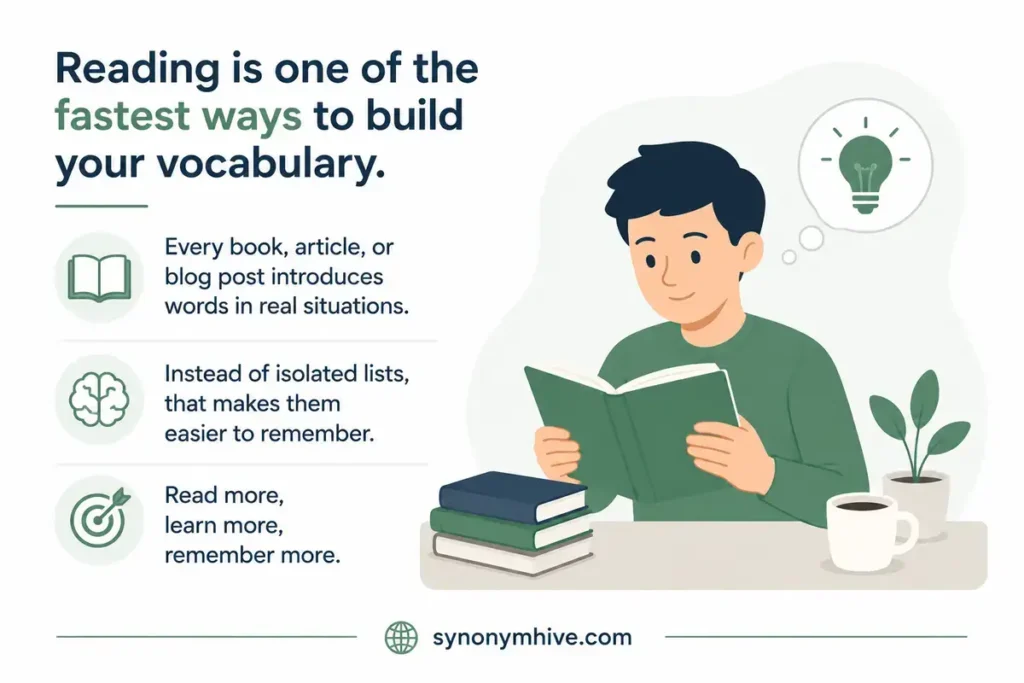
Reading is one of the fastest ways to build your vocabulary. Every book article or blog post introduces words in real situations instead of isolated lists. That makes them easier to remember.
When you come across an unfamiliar word do not skip it. Look at the surrounding sentence first and try to guess the meaning. Then check a dictionary to confirm your idea. The more you read the easier it becomes to understand new words without stopping every few minutes.
Which Synonyms Help You Sound More Confident
Some words naturally sound stronger than others. Picking the right one can make your message more convincing without making it sound exaggerated.
| Synonym | Confidence Level | Example |
|---|---|---|
| Get | Low | I get the idea now. |
| Understand | Medium | I understand the process. |
| Grasp | High | I grasp the main concept. |
| Comprehend | Very High | She comprehends advanced topics with ease. |
| Interpret | High | He interpreted the results correctly. |
Using a stronger synonym only makes sense if it accurately reflects your level of understanding.
Discover another helpful synonym list in Synonyms for With: The Ultimate Guide Write Like a Pro (2026).
How Do Teachers And Students Use Understand Differently
Teachers often use understand when checking learning. Students use it when explaining what they have learned or asking for help.
Examples from the classroom include.
- Do you understand today’s lesson.
- I understand the first chapter but not the second.
- The teacher helped us grasp the difficult concept.
- It took several examples before everyone caught on.
- We finally figured out the science experiment.
These examples show that different synonyms fit different stages of learning.
Which Expressions Show You Understand Someone’s Feelings
Sometimes understand is not about facts. It is about showing empathy and respect.
Instead of repeating understand you can use expressions like these.
- I see your point.
- I know how you feel.
- I appreciate your concern.
- I can relate to that.
- That makes sense to me.
These expressions help conversations feel warmer and more personal because they acknowledge another person’s experience instead of simply agreeing.
Why Does Choosing The Right Synonym Matter
Words shape how people receive your message. A small change in wording can make you sound more confident more thoughtful or more approachable. For example saying I get it feels relaxed and conversational. Saying I comprehend the issue sounds formal and academic. Saying I see your point shows respect for another person’s opinion.
Expanding your vocabulary also helps you avoid repeating the same word throughout an email essay presentation or conversation. Your writing becomes smoother easier to read and more enjoyable for your audience.
Which Synonyms Fit Different Workplace Situations
Choosing the right word at work helps you sound clear and professional. A simple change can make an email or meeting sound more polished.
| Situation | Best Synonym | Example |
|---|---|---|
| Team meeting | Understand | I understand the project goals. |
| Client email | Appreciate | We appreciate your concerns and will respond soon. |
| Training session | Grasp | Everyone grasped the new process quickly. |
| Report | Interpret | We interpreted the survey results carefully. |
| Problem solving | Figure out | The team figured out a better solution. |
Using words that match the situation makes your communication more effective.
Which Synonyms Work Best For Customer Service
Customer service often requires empathy along with clear communication. Instead of repeating understand use words and phrases that reassure the customer.
Examples include.
- We appreciate your patience.
- I see your concern.
- We recognize the issue.
- I follow what you’re describing.
- We acknowledge your feedback.
These expressions help customers feel heard while keeping the conversation professional and respectful.
How Can Parents Teach Children To Understand New Words
Children learn new vocabulary faster when words are connected to everyday life. Parents can help by reading together asking simple questions and encouraging children to explain ideas in their own words.
For example.
- Ask your child to explain a story after reading it.
- Encourage them to describe what they learned at school.
- Replace difficult words with easy ones before introducing more advanced vocabulary.
- Praise effort when they correctly use a new word.
Small daily conversations often teach more than long vocabulary lists.
Which Synonyms Are Common In Books And Movies
Writers and filmmakers use different words to make dialogue feel natural. You may notice these alternatives often.
- Get.
- See.
- Figure out.
- Catch on.
- Recognize.
- Realize.
- Read between the lines.
Characters usually avoid repeating understand because varied language makes conversations sound more realistic.
What Questions Can Help You Understand Something Better
Asking good questions is one of the easiest ways to improve understanding. Helpful questions include.
- Can you explain that another way.
- Could you give me an example.
- What does this word mean.
- Why does this happen.
- How does this work.
- Can you show me step by step.
These questions encourage better learning and reduce confusion.
Which Synonyms Should English Learners Learn First
If you are building your vocabulary start with the words you will use every day.
- Understand.
- Get.
- Know.
- See.
- Follow.
- Figure out.
- Grasp.
After you become comfortable with these words move on to more advanced choices like comprehend interpret and discern.
How Does Context Change The Meaning Of Understand
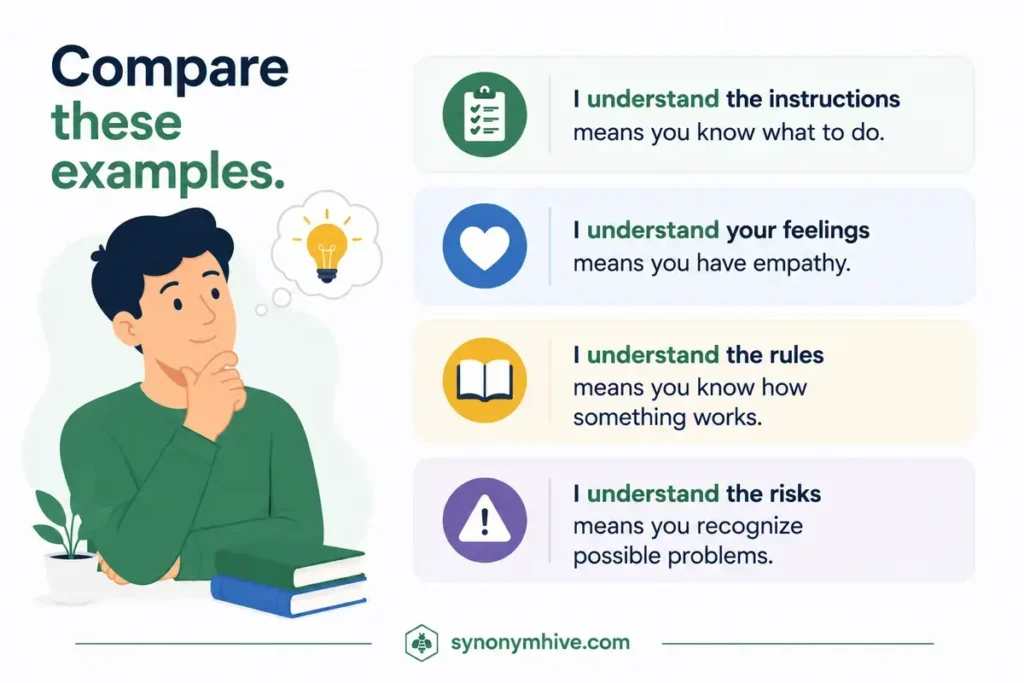
The same word can express different ideas depending on the sentence. Compare these examples.
- I understand the instructions means you know what to do.
- I understand your feelings means you have empathy.
- I understand the rules means you know how something works.
- I understand the risks means you recognize possible problems.
Context is the key to choosing the best synonym.
Why Do Strong Writers Avoid Repeating The Same Word
Repeating the same word again and again can make writing feel predictable. Experienced writers mix simple and advanced vocabulary to keep readers interested. For example one paragraph might include understand grasp recognize figure out and appreciate. Each word adds a slightly different meaning while keeping the writing smooth and engaging. This simple habit makes articles essays and emails feel more polished without making them difficult to read.
Practice Exercise To Build Your Vocabulary
Try replacing understand with a better synonym in these sentences.
- I understand your idea.
Possible answer. I see your point.
- She understands the lesson.
Possible answer. She grasped the lesson.
- We understand the instructions.
Possible answer. We followed the instructions.
- He understands the problem.
Possible answer. He recognized the problem.
- They understand the situation now.
Possible answer. They finally got the picture.
Practicing with real sentences helps new vocabulary become part of your everyday English.
Discover another helpful synonym list in Synonyms for Said: The Ultimate Guide Boost Your Writing (2026).
Conclusion
Learning synonyms for understand gives you more ways to express yourself without repeating the same word. Some alternatives fit casual conversations while others sound better in essays emails or professional writing. Small changes in word choice can make your writing clearer stronger and more enjoyable to read.
The best synonym always depends on your purpose and audience. Get works well with friends. Grasp shows a deeper level of understanding. Comprehend fits formal writing. Practice using these words in real situations and they will soon become a natural part of your vocabulary.
Frequently Asked Questions
What’s Another Way To Say Understand.
Some of the best synonyms for understand include get grasp follow recognize see comprehend and figure out. Pick the one that matches your sentence and audience.
Is Get A Good Replacement For Understand.
Yes. Get is one of the most common everyday alternatives. It sounds natural in conversations and text messages.
What Is The Most Formal Synonym For Understand.
Comprehend is one of the most formal choices. Interpret and discern also work well in academic and professional writing.
Can I Use Grasp Instead Of Understand.
Yes. Grasp usually shows a stronger and clearer level of understanding especially after learning something challenging.
What Is The Difference Between Understand And Realize.
Understand means knowing the meaning of something. Realize means suddenly becoming aware of something that you did not notice before.
Which Synonym Sounds Best In Professional Writing.
Understand recognize interpret and comprehend are excellent choices for business documents reports and workplace communication.
What Are The Most Common alternatives For Understand.
The most common variant for understand are get know grasp follow see recognize and figure out. These words appear frequently in everyday English.