
You might search for slang for tired when the simple phrase I am tired doesn’t capture how exhausted you actually are. Maybe you stayed up all night studying. Perhaps work drained your energy. You may also want a casual phrase to text a friend after a long day.
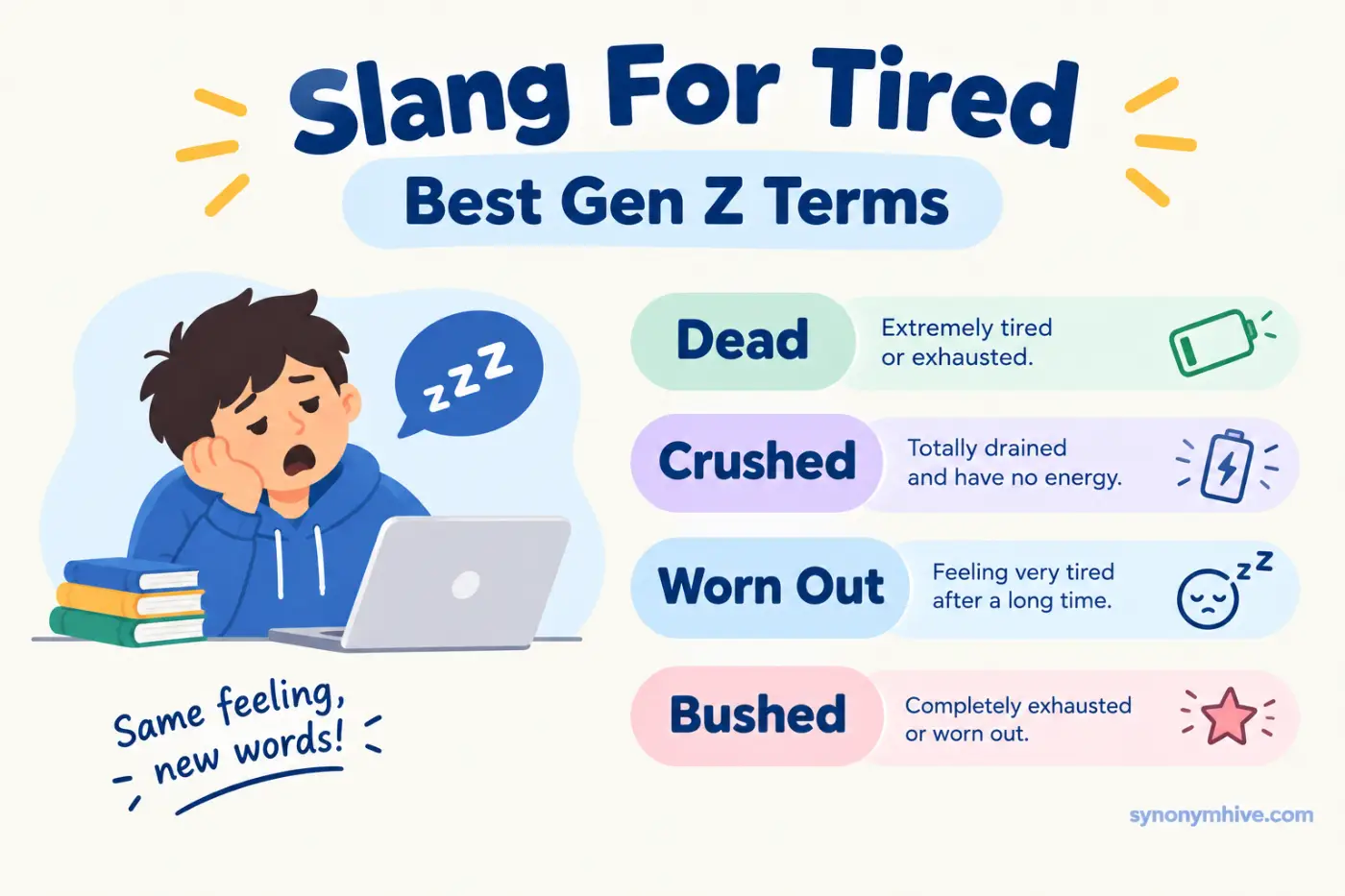
Common slang for tired includes cooked, dead, wiped, drained, beat, spent, fried, and running on fumes. The right choice depends on your energy level and the situation.
Some expressions sound funny and dramatic. Others describe mental fatigue or long term stress. When someone says I’m cooked, they may mean they have almost no energy left. A person who says I’m sleepy may simply need some rest.
This guide covers common expressions for tiredness and explains the small differences between them. You’ll also see which terms work best in texts, conversations, essays, resumes, emails, and social posts.
Check out more vocabulary ideas in Another Word For Vibe Best Synonyms And Uses In 2026.
What Does Slang For Tired Mean
Slang for tired includes casual words and phrases that describe low energy, sleepiness, physical exhaustion, or mental fatigue. These expressions usually sound more relaxed than the standard word tired.
You might tell a friend I’m beat after a long shift. After studying all night, you could say I’m cooked. Both sentences describe exhaustion, but each one creates a different tone.
Many slang expressions use exaggeration. When someone says I’m dead, the person isn’t talking about actual death. The speaker uses the word to emphasize extreme tiredness.
Context can also change the meaning. Cooked can describe exhaustion, but it can also mean someone is in trouble. Fried often points to mental fatigue, while sleepy usually means someone wants to sleep.
Choosing the right expression makes your sentence sound natural. It also helps you communicate the exact kind of tiredness you mean.
Where Did Tired Slang Come From
Tired slang doesn’t have one single source. English speakers have used casual expressions for exhaustion for many years. Younger speakers have also created and spread newer terms through music, gaming, memes, and social media.
The word exhausted belongs to standard English rather than slang. People have used casual terms such as beat, spent, and worn out for a long time.
Cooked offers a good example of how slang changes. The traditional meaning describes food prepared with heat. Online speakers later started using the word to describe someone who had reached the end of their energy or ability to continue.
Dead has an even longer history as an exaggerated expression. People use it to emphasize tiredness and many other strong reactions.
Burnt out carries a more serious meaning. People use it to describe deep exhaustion that follows long periods of stress or demanding work.
Social media now spreads new expressions quickly. A phrase can start in one online group and soon appear in texts, comments, videos, and everyday conversations.
Slang also changes over time. A word that sounds fresh today may sound old later. Speakers should always consider their audience before using newer expressions.
What Are The Best Slang Words For Tired
No single expression works for every kind of tiredness. Your best choice depends on how exhausted you are, what caused the tiredness, and how casual you want to sound.
Cooked works well in casual online speech. It suggests that you’ve reached your limit or have almost no energy left.
Dead sounds short and dramatic. People often use it to describe extreme tiredness.
Wiped works especially well after physical effort. It tells someone that an activity used up most of your energy.
Drained can describe both physical and mental exhaustion. The word suggests that something used up your energy.
Beat sounds relaxed and natural in everyday American English.
Spent means that you have very little energy left. You can use it for physical or mental tiredness.
Fried usually describes mental exhaustion. People often use it after studying, working, or processing too much information.
Running on fumes creates a clear image of someone with almost no energy left.
Burnt out describes deeper exhaustion that often follows ongoing pressure or stress.
Sleepy has a much milder meaning. It usually means you feel ready to sleep.
Master List Of Tired Slang
The table below gives you a wider range of casual expressions. Some qualify as slang, while others are simply informal terms that English speakers use often.
| Word or Phrase | Meaning | Tone | Example |
|---|---|---|---|
| Cooked | Completely exhausted or finished | Casual internet slang | I’m cooked after that exam. |
| Dead | Extremely tired | Casual and dramatic | I’m dead after work. |
| Wiped | Very tired after effort | Casual | I’m wiped after the gym. |
| Drained | Low on physical or mental energy | Everyday | That meeting left me drained. |
| Beat | Tired or worn out | Casual | I’m beat after work. |
| Spent | Almost out of energy | Casual | I’m completely spent. |
| Done | Too tired to continue | Casual | I’m done for today. |
| Exhausted | Extremely tired | Standard | I’m exhausted after the trip. |
| Burnt out | Deeply exhausted from long stress | Casual and serious | I’m burnt out from work. |
| Running on fumes | Almost no energy remains | Figurative | I’m running on fumes today. |
| Sleepy | Ready to sleep | Mild | I’m getting sleepy. |
| Drowsy | Very sleepy | Neutral | The medicine made me drowsy. |
| Worn out | Very tired from effort | Everyday | I’m worn out after moving. |
| Weary | Tired after long effort | Slightly formal | She was weary after the journey. |
| Pooped | Very tired | Playful | I’m pooped after cleaning. |
| Knackered | Extremely tired | British casual | I’m completely knackered. |
| Shattered | Extremely tired | British casual | I’m shattered after the flight. |
| Zonked | Very tired or sleepy | Playful | I’m totally zonked. |
| Spaced out | Mentally unfocused | Casual | I’m too tired and spaced out. |
| Out of gas | Low on energy | Figurative | I’m out of gas today. |
| Running low | Losing energy | Casual | I’m running low on energy. |
| Fried | Mentally exhausted | Casual slang | My brain is fried. |
| Toast | Finished or unable to continue | Internet slang | After that exam, I’m toast. |
| Done for | Too tired or overwhelmed | Casual | I’m done for after this week. |
| Crashed | Fell asleep or became exhausted | Casual | I crashed when I got home. |
| Dragging | Moving slowly from tiredness | Casual | I’m dragging this morning. |
| Low battery | Very low energy | Internet style | My social battery is low. |
| Running empty | Almost no energy left | Figurative | I’m running empty after finals. |
| Fried out | Extremely mentally tired | Casual | I’m fried out after studying. |
What Is Mild Slang For Tired
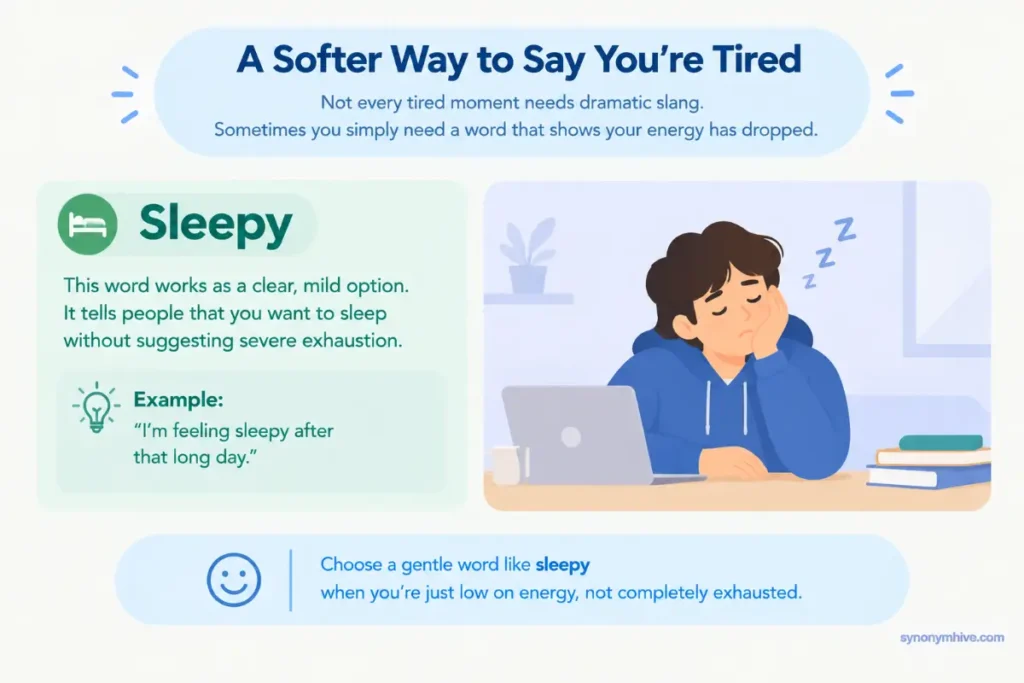
Not every tired moment needs dramatic slang. Sometimes you simply need a word that shows your energy has dropped.
Sleepy works as the clearest mild option. It tells people that you want to sleep without suggesting severe exhaustion.
You might say:
I’m getting sleepy.
Running low gives the idea that your energy is starting to disappear.
I’m running low on energy.
Dragging works when tiredness makes you move or work more slowly.
I’m dragging this morning.
Beat can also describe ordinary tiredness without sounding dramatic.
I’m a little beat after class.
These expressions fit situations such as a short night of sleep, a busy morning, or a normal day that left you low on energy.
What Is Strong Slang For Tired
Stronger expressions work better when you have almost no energy left.
Dead adds drama and sounds very casual.
I’m dead after that shift.
Cooked has a modern internet style.
I’m completely cooked.
Wiped works especially well after exercise or physical work.
I’m wiped after that workout.
Fried fits mental exhaustion.
My brain is fried after that test.
Running on fumes creates a strong image of someone who has nearly used up all their energy.
I’ve had four hours of sleep and worked all day. I’m running on fumes.
These expressions give tiredness more personality. They tell the reader that the ordinary word tired doesn’t fully describe your condition.
What Slang Means Extremely Tired
Several expressions can communicate extreme exhaustion.
American speakers commonly use dead, cooked, wiped, and exhausted. British speakers may use knackered or shattered.
Consider these examples:
I worked a double shift and now I’m dead.
I studied all night. I’m cooked.
I just finished moving apartments. I’m wiped.
I’ve had four hours of sleep. I’m running on fumes.
I’m absolutely shattered after that flight.
The speaker and situation can influence the best choice. A teenager texting a friend may choose cooked. Someone describing a hard workout may naturally choose wiped.
What Tired Slang Works Best For Physical Exhaustion
Physical exhaustion often follows exercise, sports, travel, cleaning, moving, or long work shifts.
Wiped gives you a strong and natural choice.
I’m wiped after that workout.
Beat also works well.
I’m beat after carrying those boxes upstairs.
Spent suggests that you have used almost all your energy.
I’m completely spent after the hike.
Pooped adds a playful tone.
I’m pooped after chasing the kids around all afternoon.
Worn out works when physical effort leaves you tired for a longer period.
I’m worn out after moving all weekend.
Each expression connects naturally with the effort that caused the tiredness.
What Tired Slang Works Best For Mental Exhaustion
Mental fatigue differs from physical tiredness. You might still have enough energy to walk around while struggling to think, focus, or make decisions.
Fried works especially well for mental exhaustion.
My brain is fried after studying all day.
Drained can also describe this kind of fatigue.
That meeting left me mentally drained.
Cooked can describe mental exhaustion too.
I’m cooked after that exam.
Spaced out suggests trouble focusing.
I’ve been working for six hours and I’m completely spaced out.
Burnt out can describe deeper exhaustion caused by ongoing pressure.
I’ve been working nonstop for months and I’m burnt out.
That final example carries more weight than I’m tired. It suggests a longer period of stress along with low energy.
What Is The Difference Between Tired And Burnt Out
Tired usually describes temporary low energy. You might feel tired after staying up late, working out, traveling, or having a busy day.
Burnt out suggests deeper exhaustion. Long periods of stress, heavy workloads, or constant pressure often cause this state.
Compare these sentences:
I’m tired after studying for three hours.
I’m burnt out after weeks of nonstop studying.
The first sentence describes a short term condition. The second sentence suggests that pressure has continued for a much longer period.
Burnt out therefore carries more weight than tired. Use it when you want to describe ongoing exhaustion rather than one rough day.
What Is The Difference Between Tired And Cooked
Cooked sounds more dramatic and playful than tired.
The sentence I’m tired simply tells someone about your condition.
The sentence I’m cooked suggests that you’ve reached your limit or have almost no ability to continue.
For example:
I’m tired after work.
I’m cooked after work.
The second sentence sounds more casual and expressive.
Cooked can also describe someone who has landed in trouble.
We’re cooked if the teacher finds out.
In that example, cooked doesn’t mean tired. It means the speakers believe they are in a bad situation.
Context determines the meaning.
What Is The Difference Between Dead And Wiped
Dead sounds broader and more dramatic. Wiped often connects more directly with physical effort.
Compare these examples:
I’m dead after that week.
I’m wiped after the workout.
The first sentence can describe many forms of exhaustion. The second naturally connects the tiredness with physical activity.
Both words can still overlap.
I’m dead after that workout.
That sentence sounds natural in casual speech. Dead simply adds more drama.
Wiped works well when you want a clear description of physical exhaustion without adding too much exaggeration.
How Strong Is Each Tired Expression
You can use the following scale as a rough guide. Slang doesn’t follow strict rules, so speakers may use the same word differently.
| Level | Useful Terms | Example |
|---|---|---|
| Mild | Sleepy, running low, dragging | I’m getting sleepy. |
| Moderate | Beat, spent, worn out | I’m beat after work. |
| Strong | Wiped, drained, fried | My brain is fried. |
| Very strong | Dead, cooked, exhausted | I’m completely cooked. |
| Ongoing | Burnt out, worn out | I’m burnt out from work. |
Someone might say I’m dead after a mildly tiring day for humor. Another speaker might use the same phrase only after serious exhaustion.
Tone changes how strong the expression sounds.
How Does Tired Slang Work As Different Parts Of Speech
Many tired expressions follow a form of the verb be.
I’m beat.
I’m drained.
Other expressions work differently.
I’m running on fumes.
I’m running low on energy.
My brain is fried.
I crashed after work.
Grammar determines how you place each expression in a sentence.
Cooked works like an adjective in I’m cooked. Crash works as a verb in I crashed.
That difference matters when you write a complete sentence instead of sending a short text.
Is Tired Slang Different In The US And UK
Yes. Speakers in different English speaking regions favor different expressions.
American speakers commonly use dead, wiped, beat, drained, spent, cooked, exhausted, and running on fumes.
British speakers may use knackered and shattered more often.
For example:
I’m knackered.
I’m shattered.
Many American readers understand these expressions through context. Still, the words may sound distinctly British.
The phrase I’m beat sounds very natural in American English.
If you write for a US audience, wiped, beat, drained, cooked, dead, and exhausted provide familiar choices.
Regional slang can add personality. However, unfamiliar terms may confuse readers who haven’t heard them before.
What Is The Best Slang For Tired In A Text
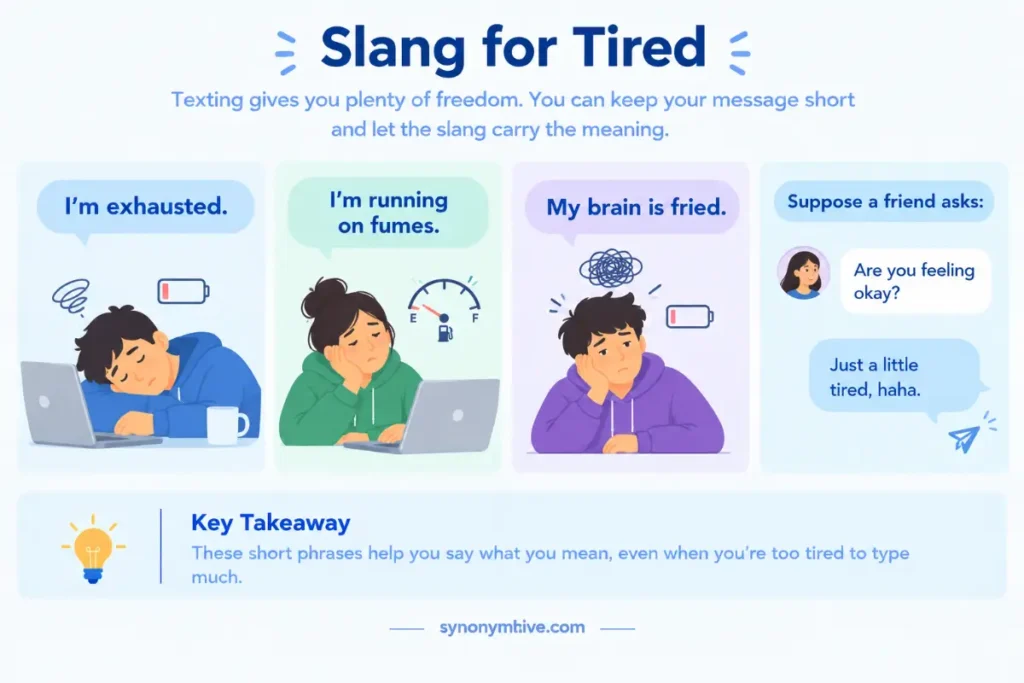
Texting gives you plenty of freedom. You can keep your message short and let the slang carry the meaning.
I’m exhausted.
I’m running on fumes.
My brain is fried.
Suppose a friend asks:
How was work?
You could reply:
I’m cooked.
That short answer tells your friend that work used up most of your energy.
You can also create playful expressions that don’t count as fixed slang.
My battery is at one percent.
My brain has left the chat.
I’m physically here but mentally asleep.
These lines work because they use familiar ideas to make tiredness sound funny and relatable.
Expand your vocabulary with Another Word for Cool Best Synonyms In 2026.
What Is The Best Word For Tired In A Resume
A resume should almost never use casual tired slang.
Instead, describe demanding situations with clear professional language.
Don’t write:
I was cooked after handling a huge workload.
Write:
I managed a demanding workload while meeting key deadlines.
Instead of this:
I was dead after working long hours.
Use this:
I maintained strong performance during extended work periods.
A resume should highlight skills, results, and professional experience. Casual slang can make your writing sound less professional.
Choose precise standard English when your reader expects a formal tone.
What Is The Best Word For Tired In An Essay
Academic writing usually requires standard English.
Don’t write:
The character was totally cooked.
Write:
The character was physically exhausted.
Don’t write:
She was dead after the journey.
Write:
She was extremely tired after the journey.
Words such as exhausted, fatigued, weary, drained, and worn out work better in formal essays.
One exception exists. You can use slang when your essay discusses Gen Z language, internet culture, or informal speech.
In that case, explain the expression so readers understand its meaning.
What Is The Best Tired Slang For An Email
A casual email to a friend can use expressions such as:
I’m so tired.
I’m running on fumes.
Professional emails need a different tone.
You could write:
I’ve had a demanding week and I’m feeling exhausted.
You could also write:
I’m feeling low on energy after a busy week.
The goal should always be clear communication. Slang can work perfectly in a message to a close friend but sound out of place in a message to a manager or client.
What Is The Best Tired Slang For Speaking
Everyday conversation gives you the most freedom.
I’m spent.
I’m running on fumes.
Each expression creates a slightly different tone.
I’m dead sounds dramatic.
I’m running on fumes sounds descriptive.
Your normal speaking style also matters. If you rarely use internet slang, suddenly saying I’m cooked may sound forced.
The best slang should sound natural coming from you.
What Are Some Real Examples Of Tired Slang
Here are natural examples from common situations.
- I’m dead after that eight hour shift.
- I studied all night and now I’m cooked.
- I’m wiped after that workout.
- That meeting completely drained me.
- I’m beat after moving all those boxes.
- My brain is fried after three exams.
- I’m running on fumes today.
- I barely slept last night, so I’m dragging.
- I’m totally spent after the hike.
- I got home and crashed on the couch.
- I’m getting sleepy, so I’m heading to bed.
- I’m burnt out after weeks of overtime.
- I feel worn out after traveling all day.
- I’m done for tonight.
- I’m so drained that I can’t focus.
- After cleaning the whole house, I was pooped.
- I stayed up until three and now I’m barely functioning.
- I’m running low on energy after that long class.
- My social battery is completely gone.
- I need sleep because my brain is fried.
- I’m shattered after that long flight.
- I’m knackered after working all weekend.
- I crashed as soon as I got home.
- I’m dragging so badly this morning.
- That exam left me completely wiped.
- I feel like I have zero battery left.
- I’m too tired to make another decision today.
- After that road trip, everyone was exhausted.
- I have no energy left for another meeting.
- My brain checked out hours ago.
These examples show how people can express the same basic idea in many ways. Some expressions focus on physical effort. Others describe mental fatigue, sleepiness, or stress.
What Does Cooked Mean In Gen Z Slang
Cooked can mean exhausted, finished, overwhelmed, or in trouble.
When someone says I’m cooked after studying all night, the speaker means that they feel exhausted.
When someone says We’re cooked before a difficult test, the speaker may mean that the group expects trouble.
Online communities, gaming spaces, memes, and social media have helped spread this use.
Context determines the meaning.
I’m cooked after work means tired.
We’re cooked if the teacher sees this means we’re probably in trouble.
That player is cooked can mean the player is struggling or unlikely to recover.
The common idea involves reaching a point where continuing or succeeding becomes difficult.
What Does Dead Mean In Tired Slang
Dead works as an exaggerated way to show extreme tiredness.
I’m dead after that shift.
The speaker doesn’t mean actual death. The word simply emphasizes the level of exhaustion.
People also use dead for other strong reactions.
I’m dead from laughing.
I’m dead after hearing that story.
Context separates these meanings. The first example describes exhaustion. The other examples describe amusement.
One slang word can therefore carry several meanings depending on the conversation.
What Does Fried Mean When Talking About Tiredness
Fried usually describes mental exhaustion.
When someone says my brain is fried, the speaker means they struggle to think, focus, or process information after too much mental work.
For example:
I’ve been studying for six hours. My brain is fried.
The expression works especially well after studying, testing, working, or handling large amounts of information.
Fried can describe physical exhaustion too, but mental fatigue remains its clearest use.
If your body hurts after a workout, wiped or beat may sound more natural.
If your brain stops cooperating after hours of studying, fried fits better.
What Does Running On Fumes Mean
Running on fumes describes a person who has very little energy left.
The expression compares a person’s energy to a vehicle with almost no fuel. The vehicle may still move, but it cannot keep going for long.
The same idea applies to people.
I’ve slept four hours and worked all day. I’m running on fumes.
You can use the phrase for physical or mental energy.
I’m running on fumes after finals.
I’m running on fumes after three days of travel.
Compared with cooked, the phrase sounds less like internet slang. English speakers have used it as a casual metaphor for a long time.
That makes it useful when you want a vivid expression that most readers will understand.
What Does Burnt Out Mean
Burnt out describes deep exhaustion caused by long periods of stress, pressure, or demanding work.
For example:
I’ve been working seven days a week and I’m burnt out.
The term carries more weight than tired.
If you stayed up late one night, you’re tired.
If you have worked under heavy pressure for months and now have little energy or motivation, burnt out may fit better.
The expression can describe mental, emotional, and physical exhaustion.
Don’t use burnt out simply because you feel sleepy. Save it for situations where ongoing pressure has taken a serious toll.
Common Mistakes With Tired Slang
One common mistake involves treating every slang term as an exact synonym.
They aren’t.
Cooked can mean exhausted, but it can also mean someone is in trouble.
Dead can describe tiredness, laughter, shock, or embarrassment.
Fried often suggests mental exhaustion.
Burnt out can suggest long term stress.
Another mistake involves regional slang. Knackered is common British English, but many American readers may find it unusual.
A third mistake involves casual slang in formal writing. A resume or business report usually needs clear standard English.
Some writers also stack too many slang words together.
For example:
I’m cooked, dead, fried, and absolutely bussin.
That sentence doesn’t communicate one clear idea. Bussin doesn’t even mean tired.
Natural writing usually works better when you choose one strong expression instead of piling several trendy terms together.
When Should You Not Use Tired Slang
Avoid casual tired slang in formal documents unless the slang itself forms part of your topic.
This includes most resumes, academic papers, business reports, official applications, and professional messages.
You should also avoid unfamiliar slang when you write for a broad audience.
A friend may understand this:
I’m cooked.
A professional reader may prefer:
I’m experiencing significant fatigue.
Neither sentence is automatically better. The audience determines which one fits.
Good communication means choosing words that your reader can understand quickly.
What Are The Opposites Of Tired Slang
Common opposites include energetic, alert, awake, refreshed, rested, lively, and energized.
Casual English gives you more playful choices.
I’m fully charged.
I’m wide awake.
My battery is full.
I’m ready to go.
These phrases can describe physical energy or mental focus.
For example:
I slept for nine hours and now I’m fully charged.
I’m fresh and ready to work.
I had coffee and I’m locked in.
People often use battery and fuel images to describe their energy. That gives casual speech a playful way to express the opposite of exhaustion.
How Can You Choose The Right Slang For Tired
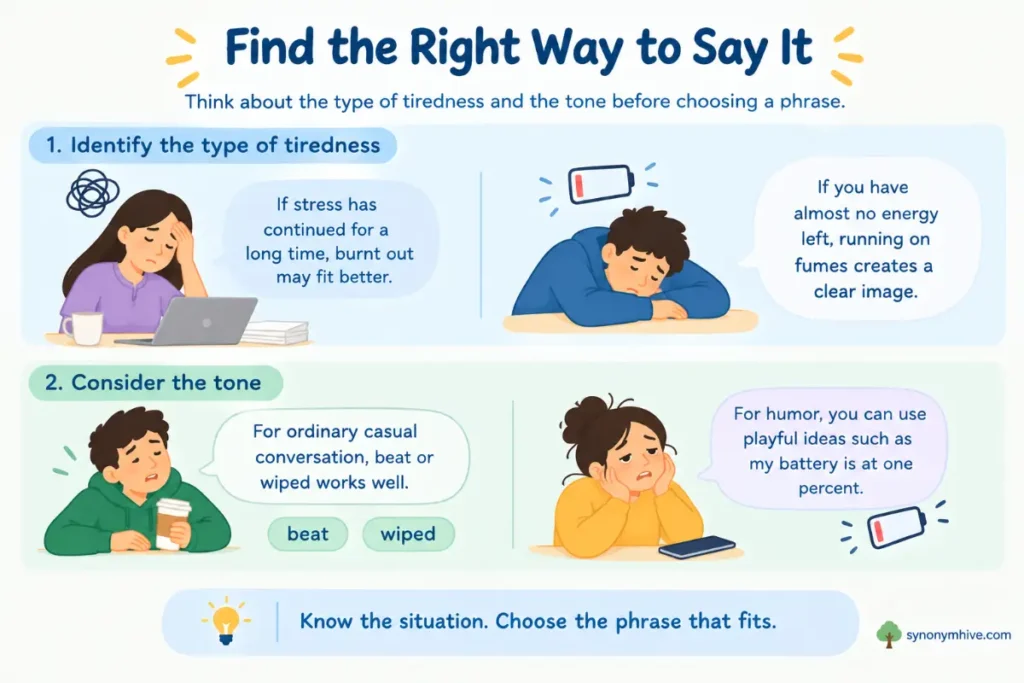
Start by identifying the type of tiredness.
If stress has continued for a long time, burnt out may fit better.
If you have almost no energy left, running on fumes creates a clear image.
Next, consider the tone.
For ordinary casual conversation, beat or wiped works well.
For humor, you can use playful ideas such as my battery is at one percent.
Finally, think about your audience. Friends usually understand casual slang. Professional readers may prefer standard English.
Quick Tips For Using Tired Slang
- Use sleepy when you mainly want to sleep.
- Use beat for everyday casual tiredness.
- Use wiped after physical effort.
- Use drained when your energy feels completely used up.
- Use fried for mental exhaustion.
- Use cooked for strong casual or internet style tiredness.
- Use dead when you want dramatic emphasis.
- Use burnt out for deeper exhaustion linked to long periods of stress.
- Use running on fumes when you have almost no energy left.
- Use knackered or shattered for British casual speech.
- Use standard English in professional writing.
- Don’t force slang into every sentence.
- Match the word to the type of tiredness you mean.
- Consider your audience before using unfamiliar expressions.
- Remember that slang meanings can change over time.
Discover related words in Gen Z Word For Good Best Slang Terms.
Conclusion
The best slang for tired depends on the kind of exhaustion you want to describe. Use beat or sleepy for everyday tiredness. Choose wiped or spent after physical effort. Fried works well for mental fatigue, while cooked and dead add a stronger casual tone. Running on fumes suggests that you have almost no energy remaining.
Burnt out has a deeper meaning. It can describe exhaustion linked to long periods of stress or pressure, so it isn’t simply another funny way to say tired.
For texts, social posts, and casual conversations, these expressions can make your message more natural and personal. Professional writing calls for clearer standard words. Pick the term that matches your meaning, your audience, and the tone you want. That simple habit will make your writing sound more natural without forcing slang where it doesn’t belong.
Frequently Asked Questions
What is slang for tired?
Common slang includes cooked, dead, wiped, beat, drained, spent, fried, and running on fumes. Each expression has a slightly different tone or meaning.
What’s another way to say tired in Gen Z slang?
You can say I’m cooked, I’m dead, I’m wiped, I’m fried, or I’m running on fumes. The best choice depends on how exhausted you are and how casual you want to sound.
What is the best slang for extremely tired?
Dead, cooked, wiped, exhausted, and running on fumes are strong choices. Burnt out works better for deeper exhaustion caused by long periods of stress.
What does cooked mean when someone says they are tired?
Cooked means extremely tired, finished, or unable to keep going. It can also mean someone is in trouble, so the surrounding context matters.
Is dead a slang word for tired?
Yes. Dead is commonly used as an exaggerated way to say you’re extremely tired. The same word can also describe amusement, shock, or embarrassment in other situations.
What does fried mean when talking about tiredness?
Fried usually means mentally exhausted or unable to focus. Someone might say their brain is fried after studying or working for many hours.
What is a British slang word for tired?
Knackered and shattered are common British casual terms for being very tired. American speakers more often use words such as wiped, beat, exhausted, or drained.