
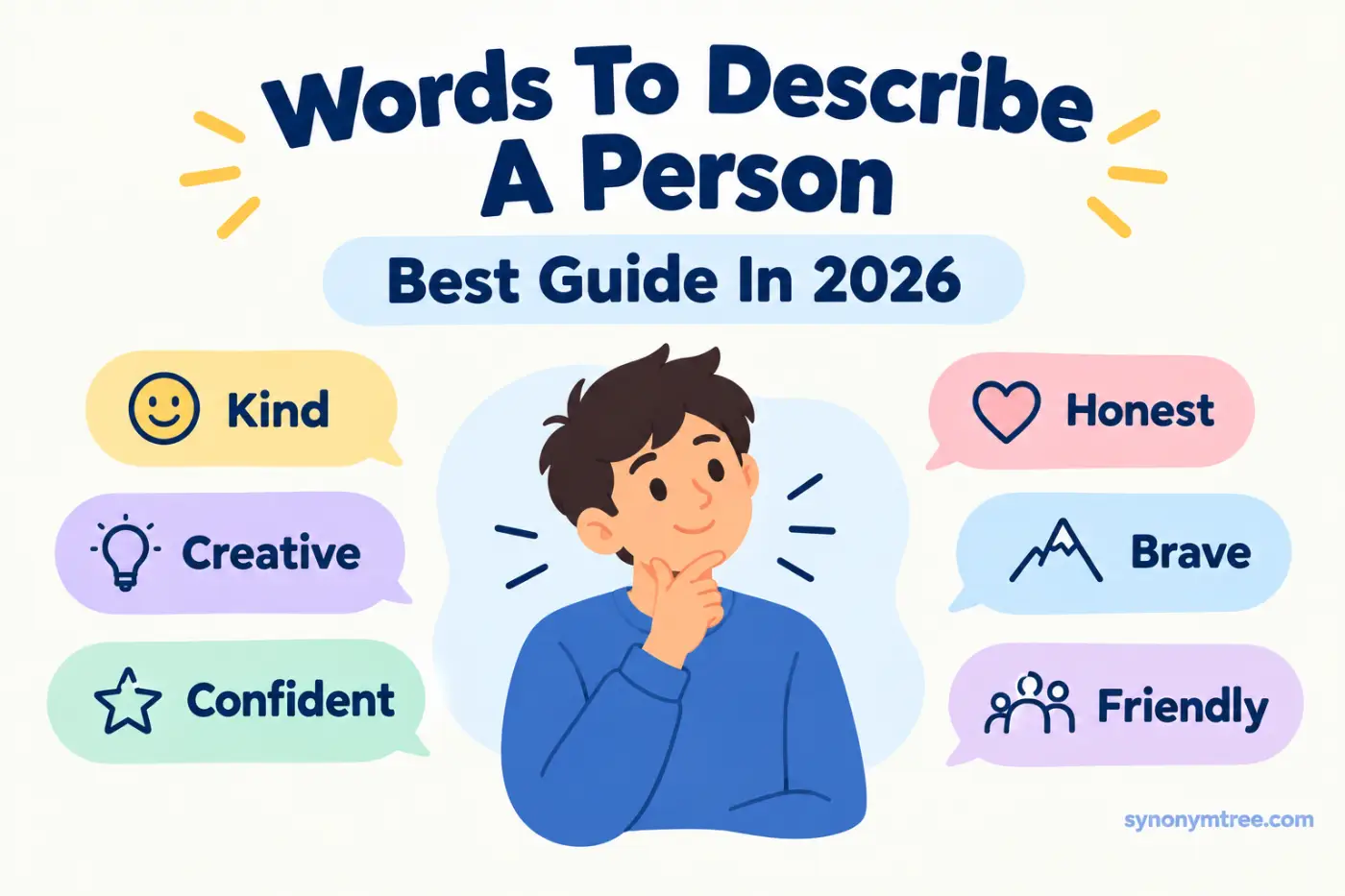
Writing an email, essay, resume, or text often leaves you searching for the right way to talk about someone. You may know exactly what the person is like, but the usual words such as nice, smart, or friendly don’t quite say enough. That’s when finding the right words to describe a person can make your writing much clearer.
The best word depends on the person’s behavior, personality, skills, attitude, or appearance. Someone who helps others might be generous. A person who stays calm under pressure could be patient or composed. Someone who keeps working after a setback may be determined or resilient.
The best words to describe a person are specific adjectives that show a person’s personality, behavior, skills, appearance, or character. The right word depends on the situation and the quality you want to highlight.
This guide gives you a large collection of useful descriptions with simple meanings and natural examples. You’ll also learn how to choose the right word for a resume, essay, email, text, or everyday conversation. The goal isn’t to collect impressive words just for the sake of it. The goal is to help you describe people accurately and naturally.
Expand your vocabulary with Words to Describe Friendship Best Guide.
What Do Words To Describe A Person Mean
Terms to describe a person are usually adjectives that tell readers or listeners something about someone’s character, behavior, personality, skills, emotions, appearance, or attitude. These words help turn a basic description into something more specific.
For example, saying someone is nice gives only a general idea. Calling that person thoughtful tells the reader more about how they treat others. Calling them dependable tells the reader that people can count on them.
Good descriptions also depend on evidence. If you call someone hardworking, you should be able to point to actions that support that description. A strong description connects the word with something the person actually does.
The same person can also need different descriptions in different settings. Your friend might be funny and easygoing. On a resume, you might describe that same person as collaborative and dependable. In an essay, you might call them thoughtful, confident, or ambitious.
Where Do Descriptive Words Come From
English has a huge range of words for describing people because human behavior has many layers. A single adjective often captures one part of someone’s character.
Words such as kind, honest, brave, and patient have been used in English for centuries. Other terms have developed from changes in culture, work, technology, and everyday speech.
Many descriptive words also come from older languages. English borrowed thousands of words from French, Latin, Greek, and other languages. That history explains why English has several words that seem similar but carry different levels of meaning.
Consider confident, bold, and fearless. All three can suggest courage. Yet confident usually means someone trusts their own ability. Bold can suggest a willingness to take risks. Fearless suggests that fear does not easily stop the person.
Knowing these small differences helps you choose a word that actually fits.
What Are The Best Words To Describe A Person
There isn’t one perfect list because people have many different traits. Still, some words work in a wide range of situations.
| Word | Meaning | Tone | Example |
|---|---|---|---|
| Reliable | Can be trusted to do what is expected | Professional | Maria is reliable and always meets deadlines. |
| Confident | Believes in their own abilities | Positive | James is confident when speaking to clients. |
| Patient | Able to stay calm while waiting or dealing with problems | Positive | She is patient with new employees. |
| Thoughtful | Shows care and consideration | Warm | He gave a thoughtful response. |
| Friendly | Pleasant and easy to talk to | Casual | Our new neighbor is very friendly. |
| Ambitious | Strongly wants to succeed | Positive | She is ambitious and works toward clear goals. |
| Creative | Good at producing new ideas | Positive | He has a creative approach to design. |
| Curious | Eager to learn or discover things | Positive | The student is curious about science. |
| Generous | Willing to give time, money, or help | Warm | She is generous with her time. |
| Calm | Not easily upset or worried | Positive | He stays calm during stressful moments. |
| Determined | Keeps working toward a goal | Strong | She is determined to finish the project. |
| Dependable | Can be trusted to help or perform well | Professional | He is dependable under pressure. |
| Humble | Does not act as if they are better than others | Positive | Despite his success, he remains humble. |
| Energetic | Has a lot of energy | Positive | The coach is energetic and motivating. |
| Practical | Focuses on useful and realistic solutions | Neutral | She takes a practical approach to problems. |
| Compassionate | Shows concern for people who are struggling | Warm | He is compassionate toward people in need. |
| Observant | Notices details quickly | Positive | He is observant and catches small errors. |
| Polite | Shows good manners | Positive | He is polite even during disagreements. |
| Cheerful | Usually happy and positive | Warm | She has a cheerful personality. |
| Witty | Clever and funny with words | Casual | He is witty and quick with a joke. |
| Resilient | Recovers after difficulty or failure | Strong | She is resilient after facing several setbacks. |
Which Words Describe A Person In A Positive Way
Positive descriptions highlight qualities that people often value in friendships, workplaces, schools, and families. The best choice depends on the exact quality you want to show.
Kind describes someone who treats others with care. Compassionate goes a little deeper and suggests concern for people who are suffering.
Reliable and dependable both suggest that someone can be trusted. Reliable often works well when talking about work or performance. Dependable can describe both personal and professional relationships.
Thoughtful describes someone who considers other people’s needs. Generous focuses more on giving time, help, money, attention, or other resources.
Confident describes someone who trusts their ability. Assertive describes someone who expresses opinions or needs clearly. The two can overlap, but confidence is about self belief while assertiveness is more about communication and action.
Creative describes someone who produces fresh ideas. Innovative can sound more professional and often works well in business or technical settings.
Resilient describes someone who recovers after problems. Determined describes someone who keeps pursuing a goal. A person can be both.
Which Words Describe A Person In A Negative Way
Negative descriptions should be used carefully because they can sound judgmental. When you need to point out a weakness, choose a word that accurately describes the behavior.
Rude describes someone who treats others without proper respect. Arrogant suggests that someone thinks they are better or more important than others.
Selfish describes someone who focuses mainly on their own needs. Impatient describes someone who struggles to wait or stay calm.
Careless suggests that someone does not pay enough attention. Unreliable describes someone who cannot consistently be trusted to do what they promise.
Stubborn describes someone who refuses to change their position. That word can sound negative, but the same quality may sometimes appear as determination.
Bossy suggests that someone tries to control others. Assertive, by contrast, can describe clear and confident communication without the negative meaning.
The difference matters. A good description should tell the truth without adding an unfair judgment.
What Words Describe A Person By Intensity
Some qualities have mild, moderate, and strong forms. Choosing the right level keeps your writing accurate.
For example, quiet can describe someone who doesn’t talk much. Reserved suggests that the person usually keeps thoughts private. Withdrawn can suggest a stronger tendency to avoid social interaction.
The same idea appears with confidence.
A person can be confident, bold, fearless, or daring. These words aren’t identical.
Confident suggests self belief. Bold suggests a willingness to act in a noticeable or risky way. Fearless suggests very little fear. Daring suggests a willingness to take risks.
The best words to describe a person should match the strength of the trait rather than exaggerate it.
Which Words Describe A Person By Personality
Personality words describe how someone usually thinks, behaves, communicates, or interacts with others.
Friendly, outgoing, cheerful, patient, calm, curious, thoughtful, humorous, confident, and independent are common positive choices.
Someone who enjoys meeting people may be outgoing or sociable. Someone who prefers quiet settings may be reserved or introverted.
A person who enjoys learning may be curious or open minded. Someone who thinks carefully before making decisions may be thoughtful or cautious.
Personality words work best when you connect them with behavior.
Instead of writing that someone is thoughtful, you could write that she remembers small details about her friends and checks on them when they need support.
That extra detail gives the adjective more power.
Which Words Describe A Person At Work
Professional descriptions should focus on qualities that affect performance, teamwork, communication, leadership, and results.
Reliable is useful for someone who consistently completes tasks. Organized describes someone who manages information, schedules, or responsibilities well.
Adaptable works for someone who handles changing plans. Resourceful describes someone who finds practical solutions when the usual approach doesn’t work.
Analytical describes a person who studies information carefully before making decisions. Detail oriented describes someone who pays close attention to small parts of a task.
Collaborative describes someone who works well with others. Diplomatic describes someone who handles sensitive conversations with care.
Proactive describes someone who takes action without waiting for someone else to tell them what to do.
These words work best when examples support them.
Instead of saying:
She is organized.
You could write:
She keeps project files organized and helps the team meet deadlines.
The second version gives the reader something concrete to understand.

Which Words Work Best On A Resume
A resume needs precise language. The best words to describe a person on a resume are those that connect to real skills and results.
Reliable For A Resume
Reliable works well when you can show consistent performance.
Example:
I am a reliable team member who consistently meets deadlines and follows through on assigned tasks.
Adaptable For A Resume
Adaptable describes someone who can adjust to new tools, roles, systems, or work conditions.
Example:
I am adaptable and quickly learn new software and work processes.
Resourceful For A Resume
Resourceful works well when someone solves problems with limited time or resources.
Example:
I am resourceful and find practical solutions when projects face unexpected problems.
Detail Oriented For A Resume
Detail oriented works when accuracy matters.
Example:
I am detail oriented and carefully review reports before submission.
Collaborative For A Resume
Collaborative describes a person who works well with coworkers.
Example:
I am a collaborative team member who shares ideas and supports group goals.
Which Words Work Best In An Essay
Essays often need more precise descriptions than everyday conversation.
Instead of calling a character nice, you might describe them as compassionate, generous, patient, or considerate.
Instead of calling someone mean, you might use cruel, hostile, selfish, dismissive, or insensitive depending on the character’s behavior.
For a character analysis, choose words that help explain motivation.
A character who keeps helping others despite personal problems could be described as selfless or compassionate.
A character who carefully plans every action might be strategic or calculating. Calculating can carry a negative tone because it may suggest that the person is using others for personal gain.
Strong essays don’t simply label people. They explain why the description fits.
Which Words Work Best In A Text
Texting allows more casual language.
You can call a friend chill, funny, sweet, caring, hilarious, bold, wild, laid back, or real.
For example:
You’re honestly such a thoughtful person.
That sounds natural in a text.
You could also say:
She’s super chill and easy to talk to.
Slang can work too, but use it only when it matches your normal voice and your audience. Forced slang often sounds less natural than simple English.
Which Words Work Best In An Email
Email requires more care because the right word depends on the person you’re writing to.
A casual email might describe someone as friendly, helpful, thoughtful, or easygoing.
A professional email might use dependable, knowledgeable, professional, organized, responsive, or collaborative.
For example:
Alex has been incredibly helpful throughout the project.
Or:
Jordan is reliable and communicates clearly with the entire team.
These descriptions are simple, specific, and appropriate for professional communication.
Which Words Work Best When Speaking
Everyday speech usually favors familiar words.
Kind, funny, smart, friendly, calm, honest, helpful, confident, and hardworking are easy for most people to understand.
You don’t need a rare word to sound intelligent. In fact, a simple accurate word often works better.
For example:
She’s really thoughtful.
sounds more natural in casual speech than:
She possesses exceptional consideration for others.
Clear language usually wins.
What Are Some Natural Examples Of Describing People
Real examples make it easier to see how descriptive words work.
- Maya is patient with new students and always gives them time to ask questions.
- Daniel is reliable, so I know he’ll finish the work on time.
- Sarah is curious and always asks smart questions during class.
- Marcus is confident when he speaks but still listens carefully to other people.
- Nina is generous with her time and often helps coworkers who need support.
- James is calm during stressful situations and rarely lets pressure affect his decisions.
- Olivia is creative and finds unusual solutions to difficult problems.
- Ethan is observant and notices small details that other people miss.
- Grace is ambitious but stays humble after reaching her goals.
- Liam is witty and can make people laugh without putting anyone down.
- Emma is resilient and keeps moving forward after setbacks.
- Noah is adaptable and handles sudden changes without much trouble.
- Sophia is compassionate toward people who are having a hard time.
- Henry is assertive and explains his ideas clearly during meetings.
- Ava is genuine, so people usually trust what she says.
- Lucas is practical and focuses on solutions instead of complaints.
- Mia is cheerful and brings a positive attitude to the group.
- Ethan is independent and enjoys solving problems on his own.
- Chloe is diplomatic and knows how to discuss difficult topics respectfully.
- Jack is resourceful and usually finds a way to finish the job with what he has.
These examples show why context matters. The adjective becomes more useful when the sentence gives readers a reason to believe it.
How Do You Describe A Person By Character
Character describes the deeper qualities that influence how someone acts.
Honest, loyal, brave, responsible, compassionate, patient, humble, generous, and trustworthy are strong character words.
For example, an honest person tells the truth even when doing so may be uncomfortable.
A loyal person continues to support people they care about during difficult times.
A responsible person takes ownership of duties and mistakes.
A brave person acts despite fear.
Character words often work best when supported by an example.
Instead of saying:
He is brave.
You could write:
He stayed calm and helped others during the emergency.
The action gives the reader evidence of bravery.
How Do You Describe A Person By Appearance
Appearance words describe physical features or visible presentation. Use them respectfully and only when appearance matters to the context.
Common neutral descriptions include tall, short, athletic, slim, muscular, youthful, mature, neat, stylish, casual, elegant, and well dressed.
You can also describe visible details such as curly hair, glasses, a bright smile, or a calm expression.
For example:
She has curly brown hair and a warm smile.
He usually dresses in a neat and professional style.
Avoid turning appearance into a judgment about someone’s worth. A description should provide useful information rather than insult or stereotype the person.
Explore another synonym guide: Words to Describe a Hero Best Guide In 2026.
How Do You Describe A Person By Behavior
Behavior words explain what someone does rather than simply labeling their personality.
Helpful, respectful, generous, attentive, considerate, careless, rude, impatient, supportive, and responsible can all describe behavior.
For example:
He listens carefully when other people speak.
That sentence shows respectful and attentive behavior without directly using either adjective.
Behavior based descriptions can be stronger because they give readers something they can picture.
If you want to describe someone as considerate, explain what they do that shows consideration.
She checks on her coworkers after difficult meetings.
That sentence tells the reader much more than simply saying she is considerate.
What Is The Difference Between Kind And Nice
Kind and nice are close but not identical.
Nice is a broad word for someone who behaves pleasantly. Kind usually suggests genuine care or a willingness to help.
Consider these examples.
She was nice to everyone at the party.
She was kind enough to help an elderly neighbor carry groceries.
The second example gives a stronger sense of care and action.
Nice is useful in casual conversation. Kind is often better when you want to highlight someone’s character.
What Is The Difference Between Smart And Intelligent
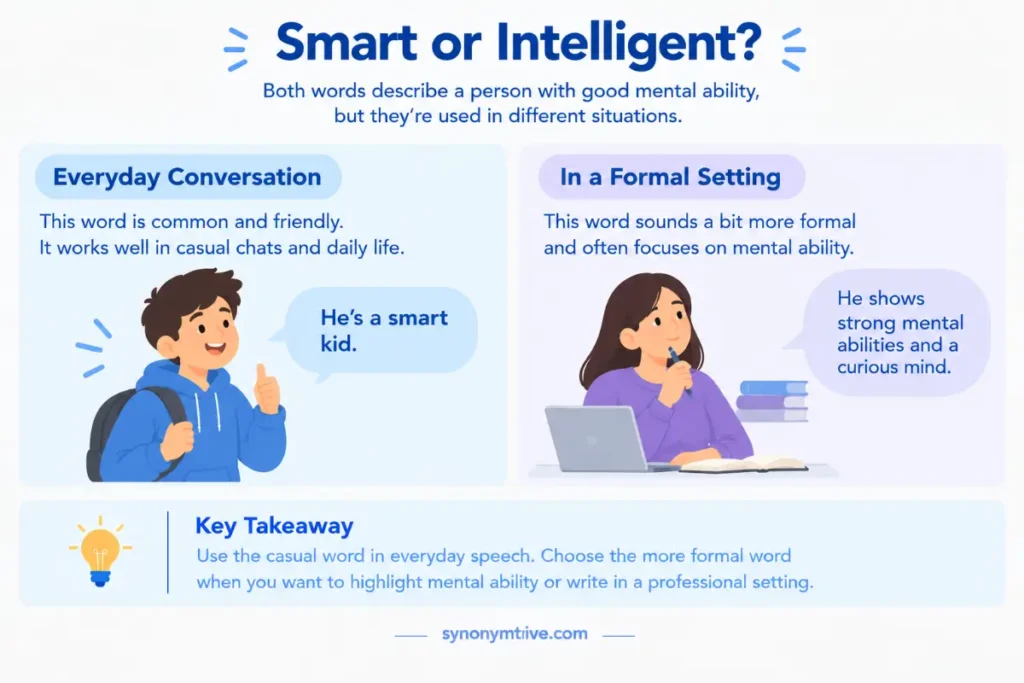
Smart is common and conversational. Intelligent sounds slightly more formal and often focuses on mental ability.
You might say:
He’s a smart kid.
That sounds natural in everyday speech.
In a formal essay, you might write:
The character is highly intelligent and understands complex ideas quickly.
Smart can also describe practical judgment. Someone can be smart because they make good decisions even if the sentence isn’t about academic ability.
Intelligent more strongly points to mental ability or understanding.
What Is The Difference Between Confident And Arrogant
Confident is usually positive. Arrogant is negative.
A confident person trusts their abilities while still respecting others.
An arrogant person may believe they are better or more important than everyone else.
For example:
She is confident enough to share her ideas.
She is arrogant and refuses to listen to anyone else.
The key difference is how the person treats others. Confidence doesn’t require looking down on people.
What Is The Difference Between Quiet And Shy
Quiet describes how much someone talks or how much attention they seek. Shy suggests discomfort or nervousness in social situations.
A quiet person may be completely comfortable around others.
A shy person may want to participate but feel nervous about speaking.
For example:
He is quiet but very confident during presentations.
She is shy around new people but becomes talkative once she gets comfortable.
These words shouldn’t be treated as exact substitutes.
What Is The Difference Between Hardworking And Ambitious
Hardworking describes effort. Ambitious describes strong goals or a desire to achieve something.
A hardworking person may spend many hours practicing or completing tasks.
An ambitious person may set large goals and actively pursue success.
Someone can be both.
She is hardworking and ambitious. She studies every night because she wants to become a doctor.
That sentence shows the difference clearly. Hard work describes the effort. Ambition describes the goal.
What Are Common Mistakes When Describing People
One common mistake is choosing a word because it sounds impressive rather than because it fits.
Calling someone charismatic when they are simply friendly can make your description less accurate.
Another mistake is using a strong negative word without enough evidence. Calling someone selfish is much stronger than saying they were inconsiderate in one situation.
A third mistake is relying on vague words such as nice, good, bad, or interesting when a more specific word would explain the idea better.
For example:
She is good.
doesn’t tell the reader much.
She is dependable and thoughtful.
gives the reader two clear qualities.
Another mistake is repeating the same adjective throughout an essay. Use related words only when they carry the same meaning in the context. Don’t replace a word with a synonym just to avoid repetition if the new word changes the meaning.
When Should You Avoid Certain Descriptive Words
Avoid labels that make broad claims about someone without evidence.
Words such as lazy, selfish, dishonest, crazy, or difficult can sound harsh and may oversimplify a person.
Instead of saying:
He’s lazy.
you could describe the behavior:
He often misses deadlines and leaves tasks unfinished.
That version is more specific and easier to support.
The same approach works in professional writing. Describe actions, results, and patterns rather than making personal attacks.
Specific writing builds trust because the reader can see where the description comes from.
What Are The Opposites Of Common Personality Words
Every descriptive quality has possible contrasts.
Kind can contrast with cruel or unkind.
Patient can contrast with impatient.
Confident can contrast with insecure.
Generous can contrast with selfish.
Honest can contrast with dishonest.
Calm can contrast with anxious or agitated.
Friendly can contrast with unfriendly or distant.
Hardworking can contrast with careless or unmotivated.
Brave can contrast with fearful.
Flexible can contrast with rigid.
These opposites are useful when you need to compare two characters or explain how someone’s behavior changes.
How Do You Choose The Right Descriptive Word
Start with the behavior you want to describe. Don’t begin by searching for the fanciest adjective.
Ask what the person actually does.
Do they help others? Try kind, generous, helpful, or compassionate.
Do they keep promises? Try reliable, dependable, or trustworthy.
Do they recover from setbacks? Try resilient.
Do they speak clearly and stand up for their ideas? Try confident or assertive.
Do they come up with fresh ideas? Try creative or inventive.
Next, consider the tone. A resume needs professional language. A text can sound relaxed. An academic essay usually needs precise standard English.
Finally, check the strength of the word. Don’t call someone fearless when you only mean they are confident.
How Can You Make Descriptions More Specific
The easiest way to improve a description is to connect the adjective with an action.
Instead of:
She is helpful.
write:
She stays late to help new employees learn the reporting system.
Instead of:
He is confident.
write:
He confidently presents his ideas during team meetings and answers questions clearly.
Instead of:
They are creative.
write:
They create fresh campaign ideas and test different approaches when the first plan doesn’t work.
Specific details make descriptions stronger because they give the reader evidence.
This is especially useful for resumes, recommendation letters, essays, and professional profiles.
How Do You Avoid Repeating The Same Descriptive Words
If you use the same word several times, first ask if you can explain the quality in another way.
For kind, you might use compassionate, considerate, caring, generous, or thoughtful when the meaning fits.
For hardworking, you might use diligent, dedicated, committed, disciplined, or persistent.
Still, don’t replace every repeated word automatically. Sometimes repetition improves clarity. A precise word is better than an awkward synonym.
Good writing isn’t about avoiding every repeated word. It’s about choosing the clearest word each time.
How Do You Describe Someone Without Sounding Fake
Use words that you can support with real examples.
If you call someone amazing, explain why.
Instead of:
She is an amazing leader.
try:
She listens to her team, gives clear direction, and stays calm when projects go off track.
The second version sounds more believable because it shows the qualities behind the claim.
You can also use natural language instead of stacking adjectives.
Rather than:
He is incredibly smart, extremely talented, highly motivated, and exceptionally hardworking.
write:
He learns quickly and keeps working until he solves difficult problems.
One strong example often says more than four big adjectives.
How Can You Use Words To Describe A Person In A Sentence
Adjectives can appear before a noun or after linking verbs.
Before a noun:
She is a thoughtful friend.
He is a reliable employee.
After a linking verb:
She is thoughtful.
He seems reliable.
You can also combine adjectives when each one adds a different idea.
She is calm, patient, and dependable.
He is creative, curious, and ambitious.
Try not to overload the sentence with too many descriptions. Two or three well chosen words often create a clearer picture than a long string of adjectives.
How Do Different Contexts Change The Best Word
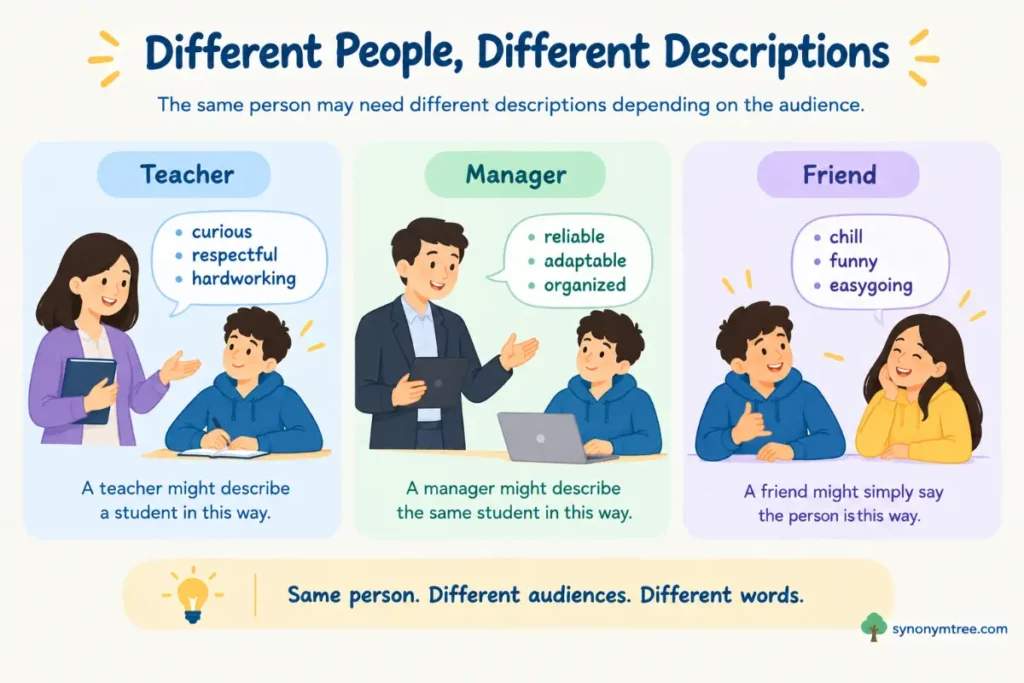
The same person may need different descriptions depending on the audience.
A teacher might describe a student as curious, respectful, and hardworking.
A manager might describe the same student as reliable, adaptable, and organized.
A friend might simply say the person is chill, funny, and easygoing.
None of these descriptions has to be wrong. Each one focuses on a different part of the person’s character.
That is why words to describe a person should always connect to purpose. Ask what the reader needs to understand.
If you’re writing a character analysis, focus on motives and behavior.
If you’re writing a personal message, focus on qualities that make the relationship meaningful.
How Can You Pick A Word Quickly
Use a simple four step check.
- Identify the trait. Decide if you’re describing personality, behavior, skill, appearance, attitude, or character.
- Think about the evidence. Ask what the person does that shows this quality.
- Match the tone. Choose casual language for friends and precise language for school or work.
- Check the strength. Make sure the adjective isn’t stronger or weaker than the evidence supports.
This method helps you choose words to describe a person without spending too much time searching through long synonym lists.
Explore another synonym guide: Words to Describe a Father Best Guide In 2026.
Conclusion
The strongest words to describe a person are not always the biggest or most unusual ones. A simple word such as kind, reliable, patient, or confident can work better than a fancy adjective when it matches the person clearly.
Start with the quality you want to show. Then think about the behavior that supports it. From there, choose a word that fits the audience and the setting. A resume may need professional terms such as adaptable or dependable, while a text to a friend can use relaxed words such as funny or laid back.
Specific details make any description stronger. Instead of simply saying someone is thoughtful, show what they do that proves it. That small change can turn a basic sentence into a clear and believable description.
The next time you need to describe someone, don’t reach for the first general word that comes to mind. Think about the exact quality you want your reader to see. The right word will usually make the whole sentence easier to write.
Frequently Asked Questions
What are good words to describe a person?
Good words include kind, honest, reliable, thoughtful, confident, patient, creative, generous, dependable, curious, and resilient. The best word depends on the quality you want to show.
What’s another way to describe a person?
You can describe someone by personality, character, behavior, skills, appearance, or attitude. Words such as thoughtful, dependable, confident, observant, and compassionate can give a more specific description than simply saying nice.
What are positive words to describe someone?
Positive choices include kind, caring, honest, loyal, generous, patient, confident, creative, humble, reliable, and hardworking. Choose the word that matches the person’s actual behavior.
What are strong words to describe a person?
Strong descriptions include resilient, resourceful, compassionate, courageous, determined, dependable, insightful, adaptable, and trustworthy. These words work best when you can support them with examples.
What are good words to describe a person on a resume?
Professional choices include reliable, adaptable, organized, resourceful, collaborative, analytical, proactive, dependable, and detail oriented. Connect each word to a skill or result whenever possible.
How do I describe someone’s personality?
Focus on how the person usually behaves and interacts with others. Words such as outgoing, reserved, patient, confident, curious, thoughtful, cheerful, and independent can describe personality clearly.
What are the best words to describe a person?
The best words to describe a person are specific words that match the person’s real qualities. Choose terms such as kind, reliable, confident, creative, resilient, or thoughtful based on the behavior you want to highlight.