
You might need another word for vibe when you’re writing a text, polishing an essay, describing a person, or trying to make a sentence sound less casual. Vibe is useful, but it can be too broad for some situations. The right replacement can tell your reader exactly what you mean.
The best synonym depends on the idea behind the word. If you mean a person’s mood, try mood or attitude. If you mean the atmosphere of a place, ambiance or atmosphere may work better. For Gen Z slang, words such as energy, aura, and aesthetic can sound more natural.
The best synonym for vibe depends on context. Mood, atmosphere, energy, aura, feeling, tone, ambiance, and aesthetic are strong choices, but each one carries a slightly different meaning.
This guide covers simple and formal alternatives, Gen Z slang, differences in tone, regional usage, examples, and the best word for texts, essays, resumes, emails, and everyday speech. You’ll also see which choices can sound awkward or too informal.
Explore more word choices in another word for crazy Best Choices For Every Context.
What Does Vibe Mean In Plain English
Vibe is a casual noun that describes the feeling, mood, atmosphere, or general impression that a person, place, situation, or piece of media gives you.
For example, you might say, This coffee shop has a cozy vibe. You’re not talking about one specific object. You’re describing the overall impression you get from the place.
You can also use vibe for people. Someone might have a friendly vibe, a serious vibe, or a strange vibe. In that case, the word describes the impression that person gives you.
Vibe can also describe music, clothing, social events, online content, or even a short conversation. The meaning changes slightly based on context, which explains why there are so many useful alternatives.
The word is flexible because it can cover several ideas at once. That flexibility makes it popular in casual American English, but it can also make your writing less precise.
Where Did The Word Vibe Come From
Vibe comes from the word vibration.
The modern slang use developed from the idea that people or places can give off a certain feeling or energy. The word became popular in American English during the twentieth century and became strongly linked with music and youth culture.
Over time, vibe moved beyond music. People began using it to describe restaurants, clothing, personalities, relationships, parties, social media posts, and everyday experiences.
Today, vibe is common in casual conversation. It also appears frequently in online slang.
The original connection to vibration helps explain phrases such as good vibes. The idea is that something gives off a particular emotional or social impression.
That meaning is still present today, even though most people don’t think about physical vibrations when they use the word.
What Is Another Word For Vibe
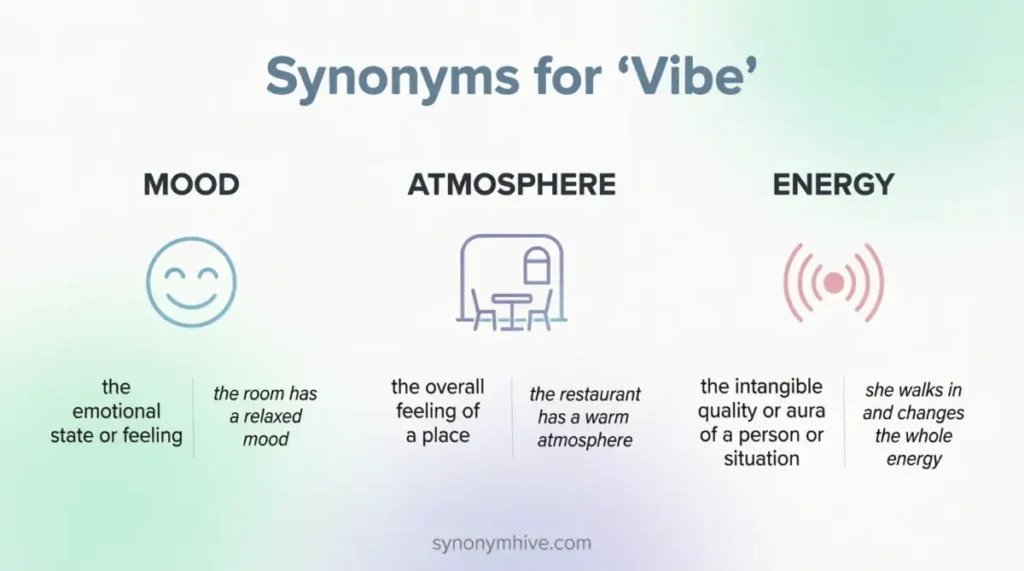
There isn’t one perfect replacement for vibe because the word can mean several things.
Here are some of the strongest choices.
| Word | Meaning | Tone | Example |
|---|---|---|---|
| Mood | The emotional state or feeling of a person or place | Everyday | The room has a relaxed mood. |
| Atmosphere | The overall feeling of a place or situation | Neutral | The restaurant has a warm atmosphere. |
| Ambiance | The mood created by a place’s setting and style | Formal | The hotel has a peaceful ambiance. |
| Energy | The emotional or social quality someone gives off | Casual | She brings positive energy. |
| Aura | A quality that seems to surround a person or place | Casual | He has a calm aura. |
| Feeling | A general emotional impression | Simple | I got a good feeling from the team. |
| Tone | The attitude or emotional quality of communication | Neutral | Her message had a friendly tone. |
| Character | The qualities that make something distinctive | Neutral | The neighborhood has a unique character. |
| Spirit | The emotional quality or attitude of a group | Neutral | The team has a strong spirit. |
| Air | A noticeable quality or impression | Literary | The room had an air of mystery. |
| Impression | The idea or feeling something creates in your mind | Formal | He made a positive impression. |
| Style | A distinctive way something looks or behaves | Everyday | The café has a modern style. |
| Aesthetic | A particular visual or artistic style | Casual | I like the beach aesthetic. |
| Presence | The noticeable quality a person has | Neutral | She has a confident presence. |
| Attitude | A person’s way of thinking or behaving | Neutral | His attitude was positive. |
| Outlook | A person’s general way of viewing life or events | Formal | She has an optimistic outlook. |
| Temper | A person’s emotional state or mood | Neutral | The meeting had a tense temper. |
| Ambience | The overall character or atmosphere of a place | Formal | The restaurant has a romantic ambience. |
| Feel | The overall impression of something | Casual | The room has a cozy feel. |
| Flavor | A distinctive quality or character | Casual | The neighborhood has an artistic flavor. |
| Moodiness | A changing or emotional quality | Casual | The song has a touch of moodiness. |
| Characteristic | A quality that helps define something | Formal | Patience is a key characteristic of the team. |
| Atmospherics | Elements that create a certain mood | Formal | The film uses dark atmospherics. |
| Social energy | The quality created by people interacting | Casual | The party had great social energy. |
| Charisma | A strong personal appeal | Neutral | Her charisma filled the room. |
| Spirit | The mood or attitude shown by people | Neutral | The school has a welcoming spirit. |
| Intent | The purpose or attitude behind an action | Formal | His words had a serious intent. |
Not every word in this table can replace vibe in every sentence. That’s the key point.
For example, atmosphere works well for a restaurant. Charisma works better for a person. Aesthetic usually describes a visual style. Tone works especially well for writing and speech.
The best replacement should match the exact meaning you want to communicate.
Which Synonyms Work Best By Intensity
Some alternatives are soft and general. Others suggest a much stronger emotional effect.
Choosing based on intensity can make your writing more precise.
Mild Alternatives
Use feel, mood, atmosphere, or character when you want a light description.
For example, the café has a relaxed feel.
This does not suggest a powerful emotional response. It simply describes the general impression.
You could also say that the room has a calm atmosphere. That sounds natural and neutral.
Medium Strength Alternatives
Use energy, aura, presence, or appeal when the impression feels more noticeable.
For example, she has a confident presence.
This tells the reader that her personality is easy to notice.
You could also say that the event had positive energy. That sounds more expressive than saying the event had a good mood.
Strong Alternatives
Use charisma, resonance, intensity, or impact when something creates a powerful impression.
For example, the singer has incredible charisma.
That means the person has a strong ability to attract attention and connect with others.
Similarly, you might say that the speech had a strong emotional impact. That is much stronger and more specific than saying it had a good vibe.
What Is A Good Gen Z Word For Vibe
Gen Z slang gives you several casual alternatives, but the best choice depends on what you mean.
Aura is one of the closest modern slang choices. It often describes a person’s presence, confidence, or overall cool factor.
For example, That guy has serious aura.
Energy is another common choice. It describes what someone or something seems to give off.
For example, She brings such good energy to the group.
Aesthetic is common when talking about a visual style or carefully created look.
For example, Her room has a cozy aesthetic.
Mood can also work as casual slang. It can describe something that matches how you’re feeling.
For example, That photo is such a mood.
Core has become popular in online language when describing a specific style or identity. Words such as cottagecore, normcore, and balletcore describe particular visual or cultural styles.
These words can overlap with vibe, but they aren’t exact substitutes.
If you’re looking for another word for vibe in Gen Z slang, aura and energy are often the closest choices for people. Aesthetic works better for visual style.
How To Choose A Word For A Resume
A resume usually needs more precise language than vibe.
You generally shouldn’t write that you bring a positive vibe to the workplace. That sounds too casual and doesn’t tell an employer much.
Instead, choose a word that describes the actual quality you want to show.
Use Energy For A Positive Presence
You can say:
I bring positive energy to team projects and customer interactions.
This works in some modern workplace settings, especially creative or people-focused roles.
Still, you can make the sentence stronger by describing an action or result.
For example:
I create a positive team environment by supporting coworkers and communicating clearly.
That sentence gives the reader something concrete.
Use Attitude For Work Behavior
Attitude works well when you want to describe someone’s approach to work.
For example:
I maintain a positive attitude when handling challenging customer requests.
This sounds more professional than saying you have a good vibe.
Use Presence For Leadership
Presence can describe the way someone comes across in a professional setting.
For example:
I bring a calm and confident presence to client meetings.
This works especially well for leadership, sales, customer service, and public speaking roles.
Use Atmosphere For Workplace Settings
If you are describing a workplace or event rather than yourself, atmosphere may be the right choice.
For example:
I helped create a welcoming atmosphere for new employees.
That sounds more professional and specific than saying you created a good vibe.
What Is A Good another word For Vibe In An Essay
Academic writing usually benefits from precise nouns such as atmosphere, tone, mood, character, or impression.
The best option depends on your subject.
If you’re analyzing a novel, mood and atmosphere are often strong choices.
For example:
The author creates a tense atmosphere through short sentences and dark imagery.
If you’re discussing the writer’s attitude, tone is usually better.
For example:
The writer uses a serious tone when discussing the effects of social media.
If you’re describing how a character affects others, impression may work.
For example:
The character creates a strong impression of confidence during the interview.
Avoid using slang such as aura, energy, or aesthetic in formal academic writing unless your subject is specifically about modern slang or popular culture.
What Is A Good Alternative For Vibe In A Text
Text messages give you more freedom.
You can use mood, energy, aura, feeling, aesthetic, or energy depending on what you mean.
For example:
This place has such a good energy.
That outfit has a whole different aesthetic.
I like the mood of this song.
He gives off a calm aura.
This café has a cozy feel.
These sound natural in casual conversation.
If you want a more playful Gen Z style, aura and energy are strong choices.
If you’re describing a visual style, aesthetic is usually more precise.
What Is A Good Alternative For Vibe In An Email
Email language depends heavily on who you’re writing to.
For a friend, mood, feeling, energy, or atmosphere can work.
For example, instead of writing:
I like the vibe of the proposal.
You could write:
I like the overall tone of the proposal.
That sounds clearer and more professional.
Instead of:
The event had a great vibe.
You could write:
The event had a warm and welcoming atmosphere.
That version gives the reader a clearer picture.
What Is A Good Alternative For Vibe In Speaking
Everyday speech is where vibe works best.
Still, switching to a more specific word can make your point clearer.
You might say that a person has a calm energy.
You might describe a movie as having a dark tone.
The best spoken alternative depends on what you noticed.
If you can name the specific quality, use that word instead of the broad term vibe.
20 Real Examples Of Better Word Choices
The following examples show how the meaning changes when you replace vibe with a more precise word.
- The café has a cozy atmosphere that makes people want to stay.
- She brings positive energy to every group project.
- His calm presence made the interview less stressful.
- The movie has a dark tone from the opening scene.
- The song creates a nostalgic mood.
- The restaurant has a romantic ambiance.
- Her outfit has a strong streetwear aesthetic.
- The neighborhood has a unique character.
- He left a positive impression on the hiring manager.
- The team has a strong competitive spirit.
- She has a natural charisma that draws people into the conversation.
- The room has a peaceful feel.
- The speech had a serious tone.
- The brand has a youthful appeal.
- The new manager brings a calm attitude to difficult meetings.
- The film has emotional resonance that stays with viewers.
- The event had great social energy.
- His confident aura was easy to notice.
- The company has a creative culture.
- The story has a mysterious atmosphere.
Each replacement gives the reader more information than the broad word vibe.
Mood Vs Vibe
Mood usually refers to an emotional state or emotional quality.
Vibe is broader. It can include mood, atmosphere, appearance, social energy, or general impression.
For example, you might say:
The movie has a sad mood.
That points directly to the emotional quality.
You could say:
The movie has a strange vibe.
That might include the music, visuals, acting, story, and overall feeling.
Mood is usually more specific when you’re talking about emotions.
Vibe is more flexible and casual.
Atmosphere Vs Vibe
Atmosphere is one of the strongest formal alternatives.
It usually describes the feeling or character of a place or situation.
For example:
The restaurant has a relaxed atmosphere.
That sounds natural and clear.
You could say:
The restaurant has a relaxed vibe.
That also works, but it sounds more casual.
Atmosphere is better for essays, reports, reviews, and professional writing.
Vibe is more common in casual speech and social media.
If you are describing a physical space, atmosphere is often the safest replacement.
Energy Vs Vibe
Energy is especially useful when describing people.
For example:
She brings positive energy to the team.
This suggests that her attitude or behavior affects other people.
You could say:
She has a positive vibe.
That is broader and less specific.
Energy can suggest enthusiasm, confidence, excitement, calmness, or warmth.
The meaning depends on the word used before it.
Positive energy suggests friendliness and optimism.
Calm energy suggests a relaxed presence.
High energy suggests enthusiasm or excitement.
Because of this flexibility, energy is one of the most useful casual alternatives.
You may also like Slang For Tired Best Gen Z Terms.
Aura Vs Vibe
Aura is more personal and expressive.
It often describes a quality that seems to surround someone.
For example:
She has a confident aura.
That suggests her confidence is noticeable even without her saying much.
Vibe can mean something similar, but it is broader.
You might say:
She gives off a confident vibe.
Aura can sound more stylish, poetic, or slang-heavy.
It is common in social media language and Gen Z conversations.
However, aura may sound strange in formal writing.
A sentence such as the CEO has an impressive aura may sound less professional than the CEO has a confident presence.
Aesthetic Vs Vibe
Aesthetic is often confused with vibe because both words appear frequently in social media posts.
They are not exact synonyms.
Aesthetic usually refers to a visual style or artistic look.
For example:
The room has a minimalist aesthetic.
That tells us about the room’s design.
Vibe can include the design but also the mood and experience.
For example:
The room has a peaceful vibe.
That tells us more about how the room feels.
If you’re talking about clothing, photography, interior design, colors, or visual branding, aesthetic may be the better word.
What Are The Most Formal another words for vibe
If you need a professional alternative, choose words such as atmosphere, tone, impression, character, attitude, presence, ambiance, or outlook.
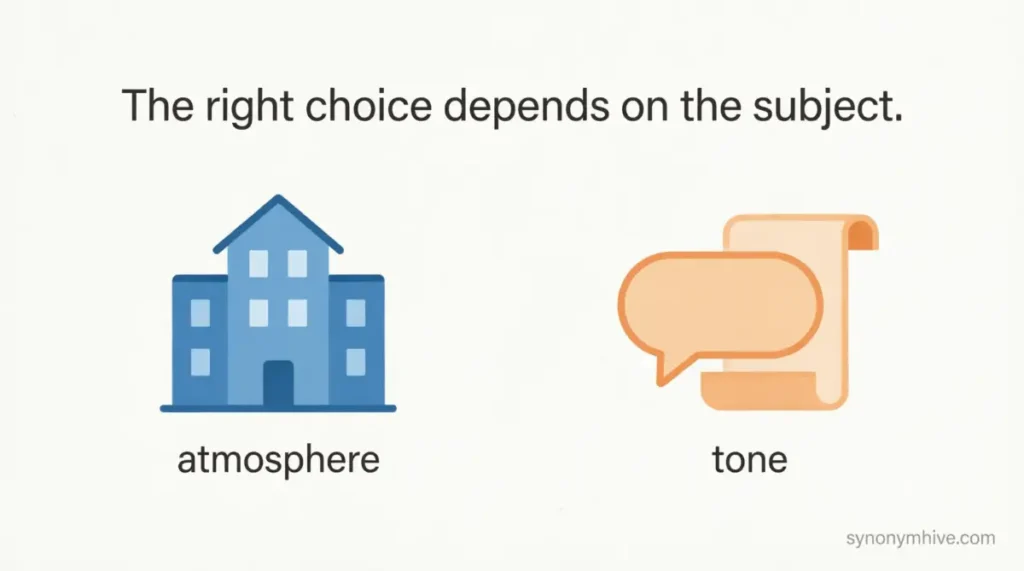
The right choice depends on the subject.
For example, atmosphere works for places.
Tone works for speech and writing.
Attitude works for behavior.
Impression works for the effect someone or something has on you.
Presence works for the noticeable quality of a person.
Outlook works for a person’s general view of life or a situation.
Ambiance works especially well for restaurants, hotels, events, and designed spaces.
These words make your writing more exact without sounding overly complicated.
What Words Should You Avoid As Direct Replacements
Some words may seem similar but can change the meaning too much.
Personality is not always the same as vibe. Personality describes stable traits of a person, while vibe can describe the temporary impression they give.
Emotion is also narrower. A vibe can include emotion, but it can also include style, atmosphere, and social behavior.
Character can work for the quality of a place or person, but it often sounds broader and more established than vibe.
Energy can work well, but it can also suggest enthusiasm or activity rather than general atmosphere.
Aesthetic should usually be reserved for visual or artistic style.
Choosing the closest word is better than choosing a synonym simply because it appears in a list.
Common Mistakes When Replacing Vibe
The biggest mistake is choosing a word that changes the meaning.
For example, replacing vibe with personality can make a sentence about a temporary impression sound like a statement about someone’s lasting traits.
Another mistake is using slang in formal writing.
Words such as aura and aesthetic can work perfectly in a text message but may sound out of place in a formal report.
A third mistake is using atmosphere for a person.
You can describe the atmosphere around a person in some contexts, but you normally wouldn’t say that a person has an atmosphere.
Energy or presence would usually work better.
Another mistake is using ambiance for everything.
Ambiance is mainly connected with places, settings, and designed environments. It can sound awkward when describing a person’s attitude.
The final mistake is choosing the longest word instead of the clearest one.
You don’t need a formal synonym just to sound smart.
Simple words often communicate the idea better.
When Should You Not Use Vibe
Vibe is not wrong. It simply isn’t the best choice for every situation.
Avoid it when your writing needs a precise explanation.
For example, a research paper should explain the exact emotional response or atmosphere rather than saying something had a certain vibe.
Avoid it in a resume when a more specific word can describe your skill or behavior.
Avoid it in formal business writing if the reader needs to know exactly what you mean.
You can also avoid it when the word feels repetitive.
If you use vibe several times in one paragraph, replacing some instances with mood, tone, atmosphere, energy, or impression can make the writing more interesting.
What Are The Opposite Words Of Vibe
The right antonym depends on the meaning of vibe.
If vibe means a positive atmosphere, possible opposites include tension, discomfort, hostility, coldness, and unease.
If it describes a welcoming atmosphere, an opposite might be an unwelcoming atmosphere.
There isn’t one universal antonym because vibe is a broad word.
The best opposite should describe the exact quality you want to contrast.
How To Pick The Right Synonym Quickly
Start by asking what you mean by vibe.
If you mean how someone feels, choose mood.
If you mean a restaurant’s design and setting, choose ambiance.
This simple check can help you find a better word without reaching for a thesaurus every time.
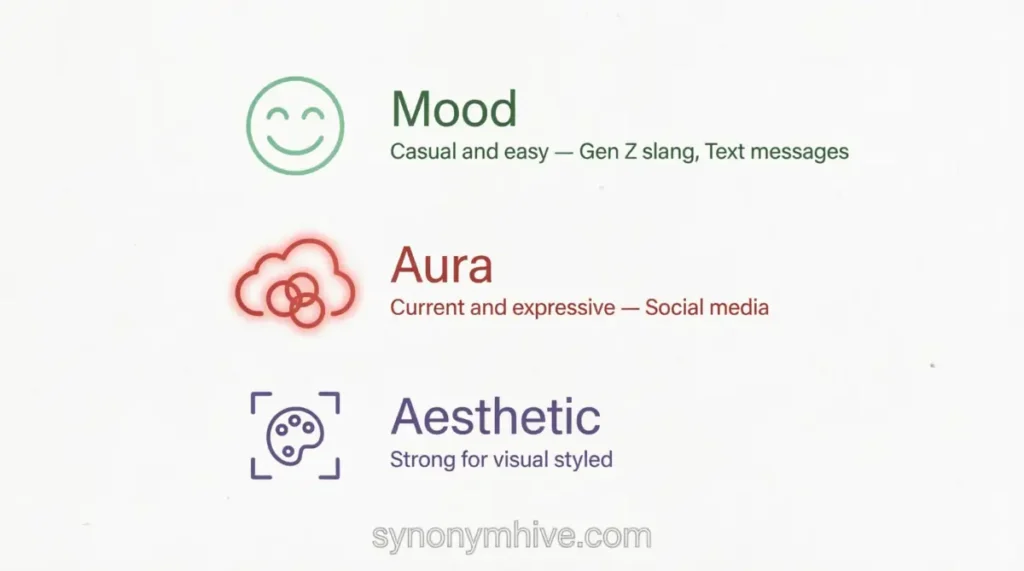
Which another word for vibe Word Is Best For Different Situations
| Situation | Best Choice | Why It Works |
|---|---|---|
| Text message | Mood | Casual and easy |
| Gen Z slang | Aura | Current and expressive |
| Social media | Aesthetic | Strong for visual style |
| Restaurant review | Atmosphere | Clear and descriptive |
| Hotel review | Ambiance | Fits the setting |
| Resume | Presence | Professional and specific |
| Essay | Mood | Useful for emotional analysis |
| Literary analysis | Tone | Describes attitude in communication |
| Business email | Tone | Clear and professional |
| Speaking | Energy | Natural in conversation |
| Workplace culture | Environment | Describes the wider setting |
| Personality description | Presence | Focuses on how someone comes across |
| Music review | Mood | Describes emotional effect |
| Film review | Tone | Describes the emotional and artistic direction |
| Fashion | Aesthetic | Focuses on visual style |
The table shows why there isn’t one replacement that works everywhere.
Good word choice starts with meaning.
How To Sound More Natural
Don’t replace vibe every time you see it.
Vibe is a perfectly normal word in casual American English. The goal isn’t to eliminate it. The goal is to know when another word gives your reader a clearer picture.
Compare these two sentences.
The restaurant has a great vibe.
The restaurant has a warm atmosphere with soft lighting and quiet music.
The second sentence gives the reader more information.
Now consider a casual text.
This place has such a good vibe.
That sentence is perfectly natural. Replacing vibe with atmosphere might make the message sound unnecessarily formal.
Good writing is not about using the most advanced word.
It’s about using the word that fits.
A Quick Guide To Gen Z Slang
Gen Z language changes quickly, especially online. Still, several words connected to vibe have become common.
Aura often describes someone’s presence or cool factor.
Energy describes what a person or situation seems to give off.
Aesthetic describes a visual style.
Mood can describe something that matches an emotional state.
Core describes a recognizable style or cultural category.
Giving is often used to say that someone or something strongly presents a certain quality.
For example:
That outfit is giving old Hollywood.
The phrase doesn’t mean the outfit literally gives something away. It means the outfit strongly creates an old Hollywood impression.
These expressions are useful in casual online writing, but they can date quickly.
Slang changes much faster than standard vocabulary.
If you’re writing for a professional audience, choose a more stable word.
Is Vibe Professional
Vibe can be professional in some casual workplace conversations, but it isn’t always the best choice in formal writing.
For example, coworkers might say that the team has a good vibe.
That sounds natural in conversation.
A formal report might instead say that the team has a positive work environment.
The second phrase tells the reader more clearly what you mean.
This difference matters in resumes, cover letters, reports, proposals, and academic work.
Casual language isn’t automatically bad.
It just needs to fit the situation.
How To Replace Vibe Without Losing Personality
Sometimes writers replace casual words with formal words and make their writing sound stiff.
You don’t need to do that.
Instead, choose a natural word that matches the setting.
For example, don’t automatically replace vibe with ambiance just because ambiance sounds more sophisticated.
When texting a friend, you can say mood or energy.
For a review, atmosphere is the more natural choice.
In an essay, consider using tone or mood.
On a resume, describe the specific qualities you bring to a team rather than using a general word like “vibe.”
Strong writing isn’t about sounding fancy.
It’s about making the meaning easy to understand.
Three Questions To Ask Before Choosing A Synonym
First, ask what kind of feeling or quality you mean.
Are you talking about emotion, atmosphere, style, attitude, or social energy?
Second, ask who will read your writing.
A word that sounds natural in a text may sound too casual in an academic paper.
Third, ask if the replacement adds precision.
If the new word gives the reader a clearer picture, use it.
If it only makes the sentence sound more complicated, keep the original word.
That approach will help you make better word choices without overthinking every sentence.
Looking for a better alternative? Visit another word for annoying Best Choices In 2026.
Conclusion
Finding another word for vibe starts with identifying the exact idea you want to express. Mood works for emotion. Atmosphere fits places and situations. Energy and aura work well for people and casual speech. Tone is strong for writing and communication. Aesthetic is best for visual style.
For Gen Z slang, aura, energy, mood, and aesthetic are common choices, but each carries its own meaning. In professional writing, clearer words such as atmosphere, presence, attitude, or impression usually work better.
The easiest rule is simple. Don’t search for a synonym just to sound smarter. Choose the word that tells your reader exactly what you mean. That small change can make a sentence sharper, more natural, and much easier to understand.
Frequently Asked Questions
What’s another way to say vibe?
Good alternatives include mood, atmosphere, energy, aura, tone, feeling, ambiance, presence, character, and aesthetic. The best choice depends on what you mean by vibe in the sentence.
What is another word for vibe in Gen Z slang?
Aura and energy are two of the closest modern slang alternatives. Aesthetic also works when you’re talking about someone’s visual style or the look of a place.
What is a professional word for vibe?
Atmosphere, tone, impression, presence, attitude, and environment can sound more professional than vibe. Choose the word that matches the exact meaning.
What is another word for vibe when describing a person?
Energy, aura, presence, attitude, and charisma can describe a person’s vibe. Energy is useful for someone’s social quality, while presence often sounds more professional.
What is another word for vibe in an essay?
Mood, atmosphere, tone, character, and impression are strong choices for essays. Mood works well for emotional qualities, while tone is often better for the writer’s attitude or style.
Can I use vibe in formal writing?
You can, but a more precise word is often better. In formal writing, atmosphere, tone, impression, attitude, or environment can communicate the idea more clearly.
Is aesthetic the same as vibe?
No. Aesthetic usually refers to visual or artistic style, while vibe has a broader meaning that can include mood, atmosphere, personality, and social energy.