

Writing a resume can make you stop at simple words. You may want to say that you always arrive on time, meet deadlines, and respect schedules. But repeating punctual can make your resume sound plain. Finding another word for punctual can help you describe this strength in a more specific and natural way.
The best replacement depends on what you want to show. You may want to highlight reliability, timeliness, consistency, discipline, or strong time management. These ideas are related, but they aren’t exactly the same.
Another word for punctual can be reliable, timely, prompt, dependable, or on time. The best choice depends on the specific behavior you want to describe.
This guide explains what punctual means, where the word comes from, and how its alternatives differ. You’ll also find more than 30 synonyms, examples for resumes and everyday writing, close word comparisons, common mistakes, and practical tips for choosing the right word.
Need another vocabulary suggestion? Read Adaptable Best Resume Guide: Land Jobs Faster 2026.
What Does Punctual Mean?
Punctual means arriving, starting, or finishing at the expected time. A punctual person respects schedules and usually avoids being late.
For example, a punctual employee arrives for a shift on time. A punctual student gets to class when it begins. A punctual professional joins meetings as scheduled and submits work before or on the required deadline.
The word usually has a positive meaning. Employers often connect punctuality with reliability, responsibility, discipline, and good time management.
However, punctual doesn’t always mean exactly the same thing as reliable. A person can arrive at work on time but still fail to complete tasks properly. Reliable is broader because it describes someone others can trust to do what they promise.
This difference matters when you’re choosing a replacement word.
If your main strength is arriving on time, use punctual, timely, prompt, or on time. If your strength is consistently meeting commitments, reliable or dependable may be stronger.
Where Does Punctual Come From?
Punctual comes from the Latin word punctum, meaning a point. The idea developed through words connected with something precise or exact.
Over time, punctual became connected with being exact about time. In modern English, it describes someone who arrives or acts at the expected time.
The word has a long history, but its everyday meaning is simple. A punctual person pays attention to time and follows agreed schedules.
The noun form is punctuality. The adverb is punctually.
You might say:
She is punctual.
Her punctuality is appreciated.
He arrived punctually.
The adjective punctual works especially well when describing a person. The noun punctuality works better when discussing the general quality.
What Is Another Word for Punctual?
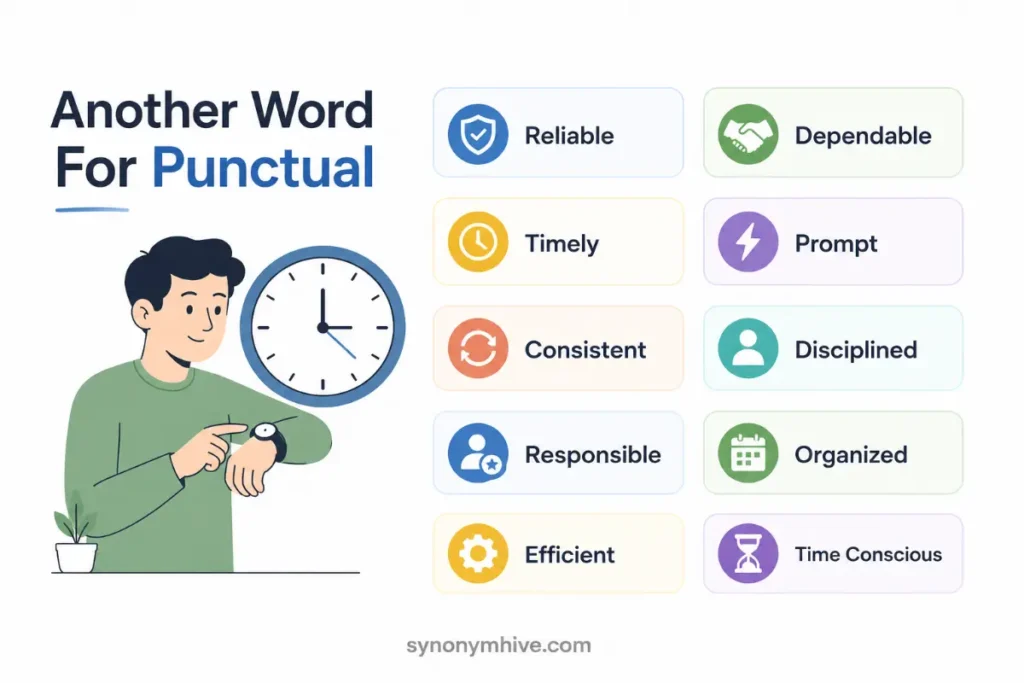
The most useful alternatives include reliable, dependable, timely, prompt, consistent, disciplined, responsible, organized, efficient, and time conscious.
Each word highlights a slightly different quality.
Reliable suggests that people can count on you. Dependable carries a similar meaning and often sounds natural in professional writing. Timely focuses on doing something at the right time. Prompt suggests quick and immediate action.
For resumes, reliable and dependable are often useful because they describe more than simply arriving on time. Timely works well when discussing deadlines or responses. Organized and disciplined can work when punctuality comes from strong work habits.
The best another word for punctual is the one that accurately matches your experience.
Master Synonym List for Punctual
The table below groups useful alternatives by style and meaning. Some words are direct synonyms. Others describe a closely related quality that may work better in a particular context.
| Word | Meaning | Tone | Example |
|---|---|---|---|
| On time | Arriving at the expected time | Simple | He is always on time for work. |
| Methodical | Works in an orderly way | Formal | She uses a methodical schedule to manage projects. |
| Punctilious | Very strict about rules and schedules | Formal | He is punctilious about meeting appointment times. |
| Diligent | Works carefully and consistently | Professional | She is diligent about completing tasks on schedule. |
| Self disciplined | Controls habits and actions effectively | Professional | He is self disciplined with his daily schedule. |
| Deadline focused | Concentrates on completing work on time | Professional | She is deadline focused and organized. |
| Schedule focused | Pays close attention to schedules | Professional | He is schedule focused during large projects. |
| Time efficient | Uses available time effectively | Professional | She takes a time efficient approach to planning. |
| Responsive | Acts quickly after receiving information | Professional | He is highly responsive to client requests. |
| Immediate | Happening without delay | Strong | She provides immediate support when needed. |
| Fast acting | Responds quickly | Everyday | He is fast acting when urgent issues arise. |
| Quick | Happens without much delay | Everyday | She gives quick responses to customers. |
| Promptly | In a timely or quick manner | Professional | He responds promptly to emails. |
| Regular | Occurring consistently | Everyday | She keeps regular work hours. |
| Timely | Arriving or happening at the right moment | Professional | He submits timely reports every month. |
| Dependable | Consistently trustworthy | Professional | She is dependable when deadlines are tight. |
Not every word above should replace punctual in every sentence. The goal is to choose the word that communicates the exact strength you want the reader to notice.
Which Synonyms Are Simple and Easy to Use?
Simple words often work best when your audience needs an immediate answer.
On time, reliable, early, ready, prompt, and dependable are easy to understand.
For example:
He is always on time for work.
She is reliable and meets every deadline.
He gives prompt responses.
These sentences don’t need complicated vocabulary.
Simple wording can also make a resume easier for recruiters and hiring software to understand. Clear language helps your main point stand out.
Which Synonyms Sound More Professional?
Reliable, dependable, timely, consistent, responsible, disciplined, conscientious, and organized work well in professional writing.
These words can describe more than arrival times.
For example, reliable suggests that an employer can trust you to follow through. Disciplined suggests that you maintain strong habits. Organized suggests that you manage your schedule and tasks effectively.
This makes them useful for resumes, cover letters, performance reviews, and professional profiles.
Which Synonyms Sound Formal?
Punctilious, conscientious, methodical, and exact can sound more formal.
Punctilious is especially strong. It describes someone who pays strict attention to rules, details, and proper procedures. It can apply to time, but it isn’t a simple replacement for punctual in every situation.
Conscientious is more broadly useful. It suggests that someone takes duties seriously and tries to do things correctly.
Formal words can add precision, but don’t use them simply to sound impressive.

Which Another Word for Punctual Work in Everyday English?
For everyday conversations, on time, early, reliable, prompt, and ready usually sound natural.
You might say:
She’s always on time.
He’s usually early.
You can count on her to be there.
He’s really reliable.
These phrases sound more conversational than highly formal alternatives.
Which Synonyms Are Strongest?
Synonyms for punctual don’t all have the same intensity.
A mild phrase such as on time simply states that someone arrives at the expected time. Reliable and dependable are stronger because they suggest consistent behavior.
Punctilious is stronger in another way. It suggests strict attention to rules and schedules.
Here is a useful scale.
| Intensity | Word | Main Idea |
|---|---|---|
| Mild | On time | Arrives at the expected time |
| Mild | Ready | Prepared when needed |
| Mild | Early | Arrives before the expected time |
| Moderate | Prompt | Acts without unnecessary delay |
| Moderate | Timely | Happens at the appropriate time |
| Moderate | Consistent | Repeats the behavior reliably |
| Strong | Reliable | Can be trusted to follow through |
| Strong | Dependable | Can be counted on consistently |
| Strong | Disciplined | Maintains strong time habits |
| Strong | Conscientious | Takes responsibilities seriously |
| Very strong | Punctilious | Strict about rules and schedules |
Choose an intensity that your experience supports. A simple word can be more convincing than an extreme word.
Which Parts of Speech Can You Use?
Punctual is an adjective. Several related words can change the structure of your sentence.
| Part of Speech | Word | Example |
|---|---|---|
| Adjective | Punctual | She is punctual at work. |
| Adjective | Reliable | He is reliable with deadlines. |
| Adjective | Dependable | She is a dependable employee. |
| Adjective | Timely | He provides timely reports. |
| Adjective | Prompt | She gives prompt responses. |
| Noun | Punctuality | His punctuality is excellent. |
| Noun | Reliability | Her reliability makes her a strong team member. |
| Noun | Dependability | His dependability is valuable to the team. |
| Noun | Timeliness | The project requires strong timeliness. |
| Adverb | Promptly | She responds promptly. |
| Adverb | Punctually | He arrives punctually. |
| Adverb | Consistently | She consistently meets deadlines. |
You don’t always need another adjective. Sometimes changing the sentence structure makes the writing more natural.
Instead of saying that you are punctual, you could say that you consistently meet deadlines.
Instead of saying that you are punctual at meetings, you could say that you arrive early and prepare before each meeting.
The second version gives the reader more information.
Is Punctual Used Differently in the US and UK?
Punctual is widely understood in both American and British English.
The meaning stays the same. A punctual person arrives or acts at the expected time.
American professional writing often favors direct wording such as reliable, on time, timely, and dependable. British writing also uses punctual and punctuality naturally.
There is no major regional difference that requires you to replace the word.
The bigger difference comes from context. A resume may favor reliable or dependable, while casual conversation may favor on time.
What Is Another Word for Punctual on a Resume?
A strong another word for punctual on a resume is reliable, dependable, timely, consistent, or disciplined.
The best option depends on your work.
When you want to show that employers can count on you, use reliable.
To emphasize consistent follow through, use dependable.
When your work involves deadlines, reports, payments, or responses, use timely.
If your punctuality comes from strong personal habits, use disciplined.
When you manage schedules, appointments, and competing tasks, use organized.
Instead of writing:
Punctual employee.
Try:
Reliable employee who consistently meets deadlines and arrives prepared for scheduled shifts.
The second version gives the employer a clearer picture.
What Is the Best Word for a Resume Summary?
Reliable is often one of the safest choices for a resume summary.
For example:
Reliable administrative assistant with strong time management and scheduling skills.
You can also use dependable:
Dependable customer service professional with a consistent record of meeting deadlines.
If deadlines are central to the job, timely may work better:
Timely and organized professional experienced in managing deadline driven projects.
The best word should connect to the job requirements.
What Is the Best Word for an Essay?
For essays, timely, prompt, consistent, disciplined, and punctuality can work depending on the topic.
For example:
The manager valued timely communication during the project.
The student developed disciplined study habits.
The organization needed prompt action.
Academic writing often benefits from precise descriptions. Don’t use punctual simply because it sounds formal.
What Is the Best Word for Texting?
For texting, on time, early, reliable, and prompt are usually natural.
You might write:
I’ll be there on time.
She’s always early.
He’s really reliable.
That wording feels normal in a text message.
Formal words such as punctilious can sound strange in casual communication.
What Is the Best Word for an Email?
For professional emails, timely, prompt, reliable, and responsive often work well.
For example:
Thank you for your prompt response.
We appreciate your timely update.
She has been reliable throughout the project.
These choices sound professional without making the email overly formal.
What Is the Best Word for Speaking?
In everyday speech, on time, early, reliable, and dependable are easy choices.
You might say:
She’s always on time.
He’s really dependable.
I can count on him to show up on time.
These phrases sound natural and clear.
How Do You Show Punctuality on a Resume?
The strongest way to show punctuality is to connect it with a measurable behavior.
Don’t simply say:
I am punctual.
Instead, show what you did.
- Maintained perfect attendance throughout the year.
- Consistently arrived early for scheduled shifts.
- Met weekly deadlines across multiple projects.
- Managed appointment schedules without missed meetings.
- Submitted reports ahead of required deadlines.
- Coordinated team meetings and kept projects on schedule.
- Responded to customer requests within required time frames.
These examples prove the quality instead of simply naming it.
What Are Real Examples of Punctuality at Work?
Punctuality can appear in many different situations.
- She arrives 10 minutes early for every scheduled shift.
- He consistently submits weekly reports before the deadline.
- She responds promptly to client requests.
- He keeps meetings on schedule and respects agreed start times.
- She manages appointments accurately and avoids scheduling conflicts.
- He completes assigned tasks within the required time frame.
- She arrives prepared before each team meeting begins.
- He coordinates deliveries according to strict schedules.
- She consistently meets project milestones.
- He keeps customers informed with timely updates.
- She maintains reliable attendance during busy periods.
- He organizes his daily workload to prevent missed deadlines.
- She completes administrative tasks before the required submission time.
- He responds quickly when urgent scheduling changes occur.
- She keeps projects moving by completing each task on schedule.
These examples are stronger than simply calling yourself punctual because they show what punctuality looks like in real work.

What Is Another Word for Punctual in Professional Writing?
Professional writing gives you several strong options.
Reliable works when trust matters.
Dependable works when consistent follow through matters.
Timely works when deadlines matter.
Prompt works when fast responses matter.
Disciplined works when strong habits matter.
Organized works when scheduling matters.
Conscientious works when responsibility matters.
Responsive works when quick communication matters.
Choose based on the action behind the word.
Find more synonyms in Another Word for Worked Best Resume Choices 2026.
Reliable vs Punctual What Is the Difference?
Reliable and punctual are related, but they aren’t identical.
Punctual specifically focuses on time.
Reliable focuses on trust and consistency.
A punctual employee arrives at 9:00 every morning.
A reliable employee arrives on time, completes assigned tasks, follows instructions, and meets commitments.
Use punctual when time is the main point.
Use reliable when you want to describe a broader pattern of dependable behavior.
On a resume, reliable may often be more useful because it can cover several positive workplace behaviors.
Dependable vs Punctual What Is the Difference?
Dependable means that people can count on someone.
Punctual means that someone arrives or acts at the expected time.
A dependable employee might always arrive on time, finish work as promised, and help the team when needed.
A punctual employee may simply have a strong record of arriving on time.
If you want to highlight attendance, punctual fits well.
If you want to highlight overall trust, dependable is stronger.
Timely vs Punctual What Is the Difference?
Timely means something happens at an appropriate or useful time.
Punctual usually describes a person or their arrival at an expected time.
For example:
She is punctual for every meeting.
She provides timely updates.
The first sentence focuses on her arrival. The second focuses on the timing of her communication.
Timely works especially well with words such as response, update, report, payment, action, and decision.
Prompt vs Punctual What Is the Difference?
Prompt usually suggests quick action or response.
Punctual focuses on the expected time.
For example:
He gave a prompt response.
She arrived punctually for the meeting.
Prompt can sometimes describe arriving on time, but it often emphasizes speed.
Use prompt for responses and actions. Use punctual for scheduled arrival or timing.
Consistent vs Punctual What Is the Difference?
Consistent means something happens reliably over time.
Punctual describes being on time.
A consistent employee may be punctual every day, but consistency can also describe quality, performance, communication, or habits.
For example:
She consistently meets deadlines.
That sentence tells the reader more than simply saying she is punctual.
Use consistent when you want to show a repeated pattern.
How Can You Show Punctuality Without Using the Word?
You can show punctuality through actions.
Instead of:
I am punctual and reliable.
Write:
Consistently arrived early for scheduled shifts and maintained excellent attendance.
Instead of:
I am punctual with deadlines.
Write:
Completed weekly reports ahead of schedule and maintained a consistent record of on time submissions.
Instead of:
I am good at time management.
Write:
Managed competing deadlines while keeping all client deliverables on schedule.
These statements sound stronger because they give evidence.
What Are Common Mistakes With Punctual Synonyms?
One common mistake is treating every related word as a perfect synonym.
Reliable and punctual aren’t identical. Timely and prompt aren’t identical either.
Another mistake is using a word that sounds too formal.
Punctilious is correct, but it may sound stiff on a modern resume.
A third mistake is making an unsupported claim.
Saying you are extremely punctual doesn’t prove anything. A specific attendance record or deadline result gives the reader useful evidence.
Another mistake is using punctual when you really mean organized.
Someone can be punctual without having strong organizational skills. Someone can also be organized without always arriving early.
Choose the word that matches the actual behavior.
When Should You Not Use Punctual?
Don’t use punctual when the main quality is something else.
When someone completes work correctly, use accurate.
When someone can be trusted, use reliable.
For independent work, use self directed.
When someone manages tasks well, use organized.
For quick responses, use responsive or prompt.
When someone consistently meets deadlines, use timely or consistent.
Using the wrong synonym can make your writing less precise.
What Are the Antonyms of Punctual?
Common opposites include late, tardy, delayed, unreliable, inconsistent, and unpunctual.
Late and tardy focus directly on time.
Unreliable describes someone who cannot consistently be counted on.
Delayed usually describes something that happens later than planned.
These words can be useful when discussing problems, but they usually don’t belong in a positive resume statement.
How Do You Choose the Right Word?
Start with the behavior you want to describe.
- Choose punctual for arriving at the expected time.
- Choose reliable for broad trust and consistency.
- Choose dependable for strong follow through.
- Choose timely for appropriate timing and deadlines.
- Choose prompt for quick action or responses.
- Choose consistent for repeated behavior over time.
- Choose disciplined for strong time habits.
- Choose organized for schedule management.
- Choose responsible for taking duties seriously.
- Choose responsive for quick communication.
- Choose efficient for using time well.
- Choose conscientious for careful responsibility.
This approach helps you avoid using synonyms simply for variety. Every word should add the right meaning.
How Can You Make Your Resume Sound More Natural?
Avoid filling your resume with adjectives.
Instead of writing:
Punctual, reliable, responsible, organized, and hardworking employee.
Show those qualities through your experience.
Try:
Managed daily schedules, met all reporting deadlines, and maintained reliable attendance during a high volume work period.
This sentence gives the reader evidence.
You can still use one strong adjective in a summary or skills section. Just make sure the rest of your resume supports it.
What Should You Use Instead of Punctuality on a Resume?
You can use reliability, timeliness, time management, dependability, or schedule management depending on the skill.
For example:
Strong time management and consistent deadline performance.
Excellent reliability and attendance.
Dependable scheduling and administrative support.
Consistent record of timely project completion.
These phrases can sound more specific than simply writing punctuality.
How Can You Use Punctual in a Resume Bullet?
Use punctual when arrival time is important to the job.
For example:
Maintained punctual attendance across rotating shifts.
You can make it stronger with a result:
Maintained punctual attendance across rotating shifts while supporting daily customer operations.
Still, you don’t always need the word.
A stronger bullet may be:
Maintained excellent attendance across rotating shifts and consistently arrived before scheduled start times.
That version gives the reader more information.
What Is Another Word for Punctual in a Cover Letter?
Reliable, dependable, timely, and disciplined are useful choices for cover letters.
For example:
My reliable work habits help me meet deadlines and maintain consistent schedules.
Or:
I have developed disciplined time management habits that help me complete assignments on schedule.
These examples connect the quality to work performance.
What Is Another Word for Punctual in a Job Interview?
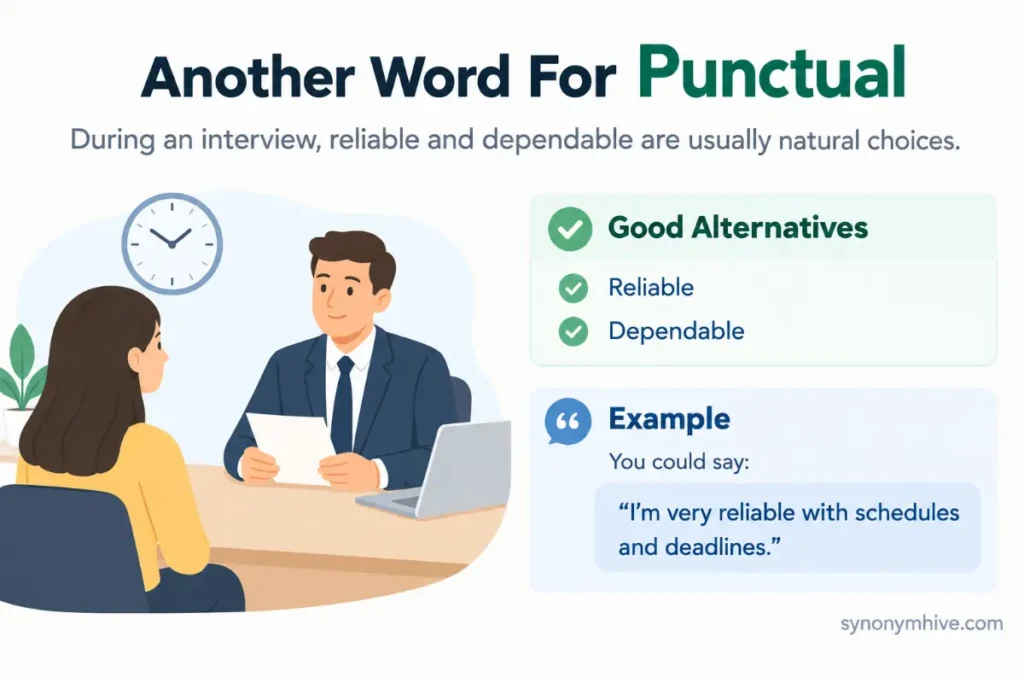
During an interview, reliable and dependable are usually natural choices.
You could say:
I’m very reliable with schedules and deadlines.
Or:
My team can depend on me to arrive prepared and complete work on time.
This sounds stronger than simply saying that you’re punctual because it gives context.
How Does Punctuality Help at Work?
Punctuality helps teams coordinate their work.
When employees arrive on time, meetings can start as planned. Shifts can change smoothly. Customers can receive service without unnecessary delays. Projects can stay on schedule.
Punctuality also signals respect for other people’s time.
However, being on time is only one part of professional reliability. Good employees also communicate clearly, complete tasks, follow through, and meet expectations.
That’s why words such as reliable and dependable can sometimes communicate more value than punctual alone.
How Can You Prove Punctuality?
Use measurable evidence when possible.
Attendance records can show consistency.
Deadline records can show timely performance.
Project schedules can show that you completed work as planned.
Customer response times can show prompt communication.
Meeting records can show consistent attendance.
The more specific the evidence, the more believable the claim becomes.
For example:
Maintained a 98 percent on time delivery rate across 12 months.
Only use numbers that are accurate and that you can support.
What Are the Best Resume Phrases for Punctuality?
Here are useful phrases you can adapt.
- Consistently met project deadlines.
- Maintained reliable attendance.
- Arrived prepared for scheduled shifts.
- Completed assignments on schedule.
- Responded promptly to customer requests.
- Delivered timely project updates.
- Managed multiple deadlines effectively.
- Kept appointments and schedules organized.
- Maintained consistent work hours.
- Completed reports ahead of required deadlines.
- Coordinated daily schedules efficiently.
- Kept team projects on track.
These phrases focus on evidence rather than empty claims.
Final Teacher Explanation
Punctual means being on time or acting at the expected time. It is a useful word, but you don’t always need to use it on a resume.
To show that people can count on you, reliable or dependable may be stronger. When deadlines are the main point, timely or consistent may fit better. For strong habits, disciplined works well. To describe fast responses, prompt or responsive is more accurate.
The key is to match the word with the behavior.
Don’t choose a synonym just because it sounds more professional. Choose the word that tells the reader exactly what you do well.
Then support it with evidence. A statement about consistent attendance, early arrival, deadline performance, or timely communication will usually make a stronger impression than a simple adjective.
Final Answer Quick Recap
The best another word for punctual depends on the exact meaning you want.
When people can count on you, use reliable.
To show consistent follow through, use dependable.
When deadlines and appropriate timing matter, use timely.
To show quick action or responses, use prompt.
When the behavior happens regularly, use consistent.
If strong time habits are the reason for your punctuality, use disciplined.
When scheduling and planning are central to the skill, use organized.
To show that you take duties seriously, use responsible.
For the simplest and most natural phrase, use on time.
On a resume, the strongest choice is often the word you can support with evidence. Show how you met deadlines, maintained attendance, arrived early, or kept projects on schedule.
Explore another synonym guide: Another Word For Achieved: Winning Resume Words 2026.
Conclusion
Choosing another word for punctual should start with the exact quality you want to communicate. Punctual focuses on being on time. Reliable and dependable show that others can count on you. Timely works well for deadlines and updates. Prompt fits quick responses. Disciplined highlights strong habits, while organized points to effective scheduling.
For a resume, don’t stop at the adjective. Show the behavior behind it. A statement about maintaining reliable attendance or consistently meeting deadlines gives employers something concrete to understand. You can also use numbers when they are accurate and relevant.
The best word is the one that matches your real experience and sounds natural in context. Keep your wording clear, support your claims with evidence, and let your work history prove the quality.
Frequently Asked Questions
What’s another way to say punctual?
Another way to say punctual is reliable, dependable, timely, prompt, consistent, or on time. Choose the word that best matches the behavior you want to describe.
What is a professional word for punctual?
Reliable, dependable, timely, and disciplined are strong professional alternatives. Each one highlights a slightly different quality.
What is another word for punctual on a resume?
Another word for punctual on a resume can be reliable, dependable, timely, or consistent. Reliable is especially useful when you want to show broader workplace dependability.
Is reliable the same as punctual?
No, reliable has a broader meaning than punctual. Punctual focuses on time, while reliable means people can generally count on you to follow through.
What is a better word than punctual for meeting deadlines?
Timely, consistent, dependable, or deadline focused can work well for meeting deadlines. Timely directly emphasizes completing something at the right time.
What is the difference between punctual and prompt?
Punctual usually focuses on arriving at an expected time, while prompt often emphasizes quick action or response. Both can relate to good time management.
How can I show punctuality on my resume?
Show punctuality through evidence such as consistent attendance, early arrival, on time submissions, or a strong record of meeting deadlines. Specific results are stronger than a general claim.