
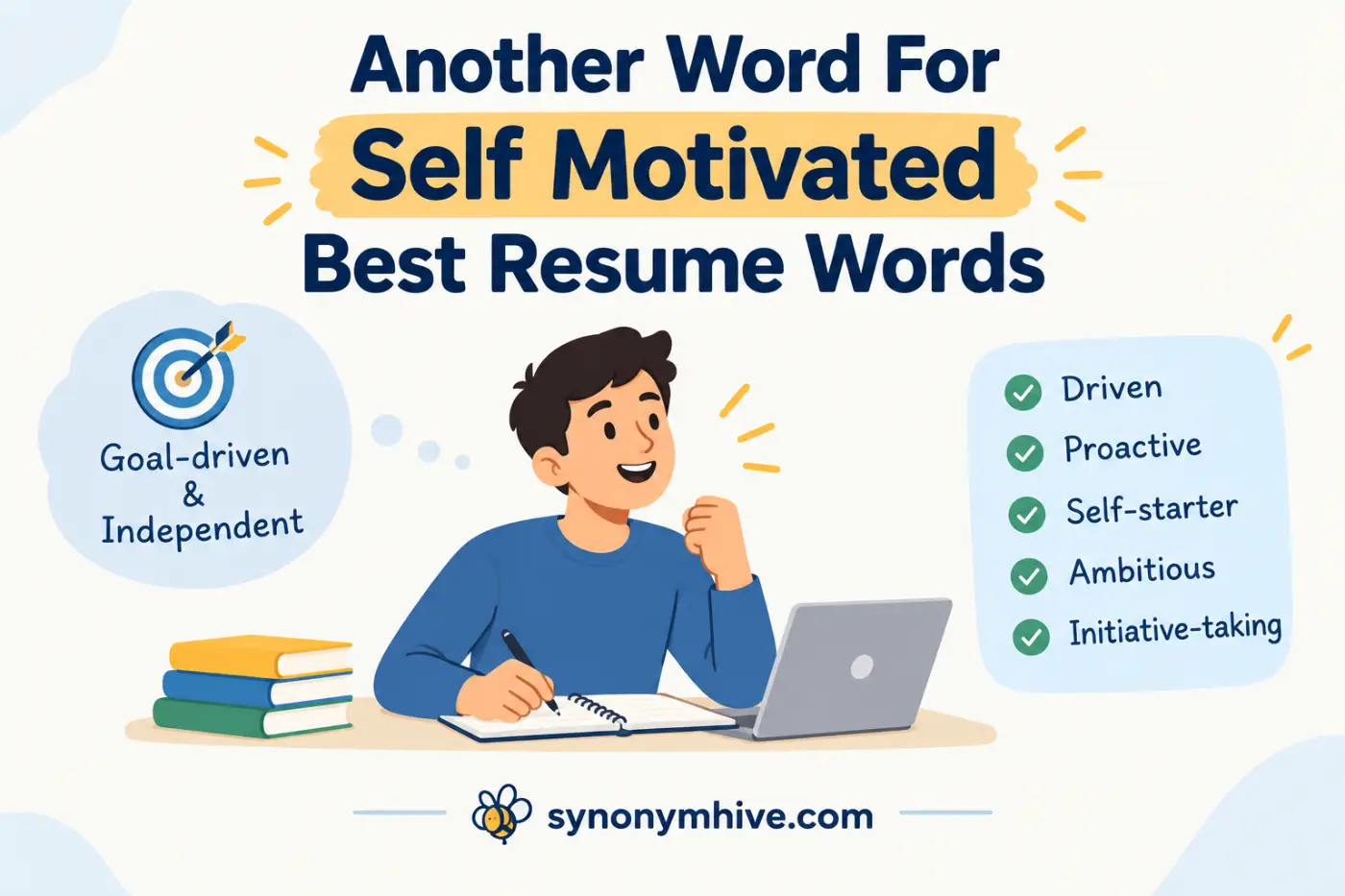
When you’re writing a resume and want to show that you take action without waiting for someone to push you, finding another word for self-motivated can make your writing much stronger. The right word can show initiative, drive, independence, ambition, or determination.
Self motivation matters because employers want people who can move work forward. Still, simply calling yourself self motivated doesn’t tell the reader much. A stronger word can explain exactly how you work and what you bring to a team.
Another word for self-motivated is proactive when you want to show that you take action before someone asks you to.
The best choice depends on your situation. This guide covers the meaning and origin of self motivated plus more than 30 alternatives. You’ll also learn which words work best on resumes, in essays, emails, texts, and conversations. Real examples and simple comparisons will help you choose a word that sounds natural and credible.
You may also like Another Word For Achieved: Winning Resume Words 2026.
What does self motivated mean in simple English
Self motivated means you can push yourself to start tasks and keep working toward a goal without needing constant reminders or supervision.
A self motivated person doesn’t always wait for instructions. They can recognize what needs to be done and take action.
For example, imagine an employee who notices that a monthly report takes too long to prepare. Instead of waiting for a manager to suggest a solution, the employee looks for a faster process and learns how to use a new tool.
That behavior shows self motivation.
The phrase can describe several related qualities.
- Initiative.
- Drive.
- Independence.
- Determination.
- Ambition.
- Discipline.
- Persistence.
- Proactivity.
- Energy.
- Commitment.
These qualities overlap but don’t mean exactly the same thing. That difference matters when you’re choosing a resume word.
Where does self motivated come from
The phrase self motivated combines the word self with motivated.
Self points to something that comes from within the person. Motivated relates to having a reason or desire to act.
The broader word motivate comes from the Latin motivus which relates to movement. Over time the word developed into the modern idea of causing or encouraging someone to take action.
Self motivated therefore describes motivation that comes from the person rather than from outside pressure.
This distinction explains why the phrase appears so often in resumes and job descriptions. Employers use it to describe someone who can manage responsibilities and maintain progress without constant supervision.
Still, the phrase has become common enough that it can lose impact on a resume.
That’s where a more specific alternative helps.
What is another word for self motivated
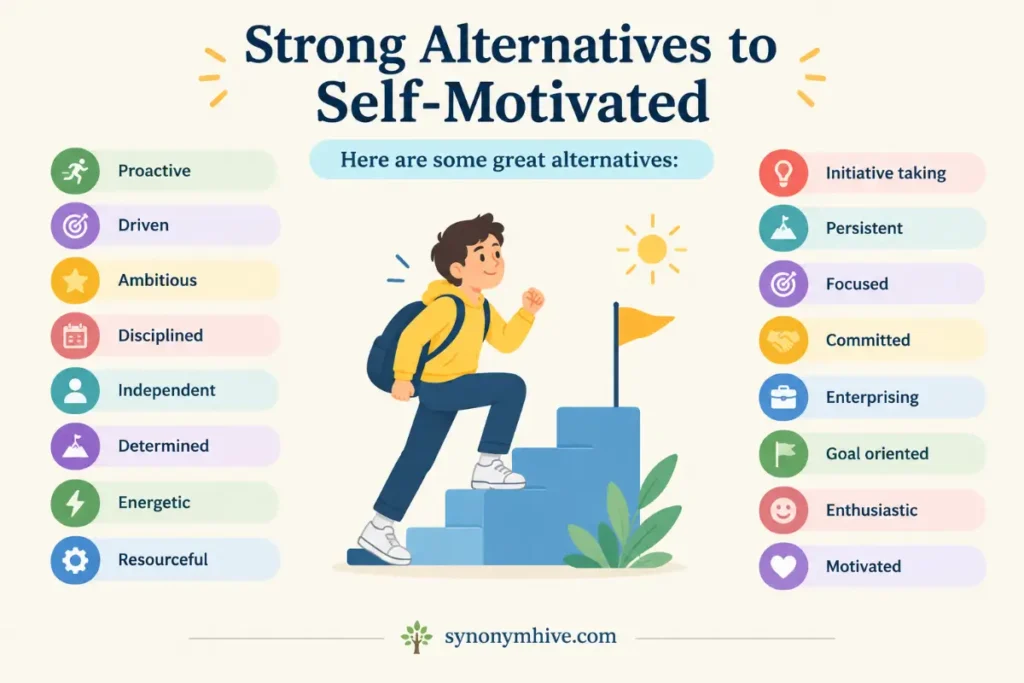
Strong alternatives include proactive, driven, ambitious, disciplined, independent, determined, energetic, resourceful, initiative taking, persistent, focused, committed, enterprising, goal oriented, enthusiastic, and motivated.
Each word highlights a different part of the idea.
Proactive emphasizes action before being asked. Driven emphasizes strong internal ambition. Disciplined emphasizes consistent effort. Independent emphasizes the ability to work without close supervision.
For professional writing, precision matters more than using the fanciest word available.
What are the best synonyms for self motivated
Here is a broad list of useful alternatives grouped by tone. The examples show how each word can work in a real sentence.
| Word | Meaning | Tone | Example |
|---|---|---|---|
| Proactive | Takes action before being asked | Professional | She takes a proactive approach to solving customer issues. |
| Enterprising | Takes action and finds opportunities | Formal | Her enterprising approach led to a new client solution. |
| Self directed | Able to guide your own work | Professional | He’s a self directed learner who develops new technical skills. |
| Purposeful | Acts with a clear goal | Formal | She takes a purposeful approach to professional development. |
| Tenacious | Keeps going despite obstacles | Strong | His tenacious approach helped the team finish the project. |
| Go ahead attitude | Willing to take action | Casual | She has a go ahead attitude when new opportunities appear. |
| Go getter | Person who actively pursues goals | Casual | He’s a natural go getter who looks for ways to contribute. |
| Hard charging | Highly energetic and determined | Casual | She has a hard charging approach to competitive sales. |
| Hustling | Working actively toward a goal | Casual | He’s always hustling to build new skills and connections. |
| Aspiring | Seeking future achievement | Formal | She’s an aspiring leader focused on developing her management skills. |
| Purpose driven | Motivated by a clear purpose | Professional | He brings a purpose driven approach to community projects. |
| Action oriented | Focused on taking practical steps | Professional | She has an action oriented approach to problem solving. |
| Achievement focused | Concentrated on reaching results | Professional | He’s achievement focused and tracks progress against clear goals. |
| Self reliant | Able to handle tasks independently | Professional | She’s self reliant and comfortable managing complex assignments. |
| Conscientious | Careful and responsible about work | Formal | He’s a conscientious employee who follows through on commitments. |
| Industrious | Consistently hardworking | Formal | Her industrious nature helped her master the new process. |
| Zealous | Extremely enthusiastic about a cause or goal | Formal | He showed a zealous commitment to improving the program. |
| Vigorous | Showing strong energy and effort | Formal | She took a vigorous approach to the research project. |
Which alternatives are simple and everyday
Some words sound natural because people use them regularly.
Good everyday choices include:
- Driven.
- Focused.
- Determined.
- Motivated.
- Persistent.
- Ambitious.
- Energetic.
- Independent.
- Curious.
- Hardworking.
These words work well in conversations and informal writing.
For example:
I’m pretty driven when I have a goal.
Or:
She’s determined to finish the course.
These sentences sound natural because they use familiar words.
Which alternatives sound professional
Professional writing needs words that communicate value without sounding inflated.
Strong choices include:
- Proactive.
- Self directed.
- Resourceful.
- Disciplined.
- Goal oriented.
- Initiative taking.
- Purpose driven.
- Action oriented.
- Achievement focused.
- Self reliant.
These terms work especially well when they connect to a measurable action.
For example:
Proactively identified reporting errors and created a review process that reduced repeated mistakes.
That sentence gives the word proactive real meaning.
What words show mild self motivation
Sometimes you want to communicate that someone takes responsibility without making an extreme claim.
Try:
- Motivated.
- Focused.
- Responsible.
- Willing.
- Committed.
- Interested.
- Reliable.
- Engaged.
These words suggest steady effort.
For example:
She’s committed to learning new skills and improving her work.
That sounds positive without making the person sound overly aggressive.
What words show strong self motivation
For a stronger impression choose words that suggest determination and action.
Good options include:
- Driven.
- Determined.
- Tenacious.
- Ambitious.
- Persistent.
- Enterprising.
- Proactive.
- Industrious.
- Purpose driven.
- Achievement focused.
These words work best when you can support them with evidence.
For example:
Her tenacious approach helped her complete a difficult certification while working full time.
The example shows the quality instead of simply naming it.
What are the parts of speech for these alternatives
Most alternatives appear as adjectives. Some also work as nouns or phrases.
Adjectives
Common adjective choices include:
- Proactive.
- Driven.
- Ambitious.
- Disciplined.
- Independent.
- Determined.
- Persistent.
- Resourceful.
- Focused.
- Committed.
Example:
She’s a proactive employee who looks for solutions before problems grow.
Nouns
Noun forms can describe the quality itself.
- Initiative.
- Ambition.
- Discipline.
- Determination.
- Persistence.
- Drive.
- Commitment.
- Independence.
Example:
Her initiative helped the team improve its customer support process.
Phrases
Some alternatives work best as short descriptive phrases.
- Goal oriented.
- Action oriented.
- Self directed.
- Purpose driven.
- Achievement focused.
- Eager to learn.
- Willing to take initiative.
Example:
He’s a self directed learner who quickly develops new technical skills.
What is the difference between self motivated and proactive
Self motivated describes the source of motivation.
Proactive describes the timing and nature of action.
A self motivated person can push themselves to complete a task without constant supervision.
A proactive person often acts before a problem appears or before someone asks them to act.
| Self Motivated | Proactive |
|---|---|
| Shows internal drive | Shows early action |
| Keeps working toward goals | Anticipates needs |
| Doesn’t need constant reminders | Looks for solutions ahead of time |
| Focuses on personal motivation | Focuses on practical action |
These qualities often appear together.
For example:
She’s highly self motivated and proactive when managing customer concerns.
Still, proactive is usually stronger on a resume because it can point to observable behavior.
What is the difference between driven and ambitious
Driven and ambitious both suggest strong motivation. Their tone differs slightly.
Driven often suggests intense effort and determination.
Ambitious focuses more on wanting to achieve something significant.
| Driven | Ambitious |
|---|---|
| Emphasizes effort | Emphasizes goals |
| Suggests strong determination | Suggests desire for achievement |
| Can describe daily work habits | Often describes future plans |
| Strong professional tone | Can sound career focused |
For example:
He’s driven and works hard to improve his skills.
She’s ambitious and wants to move into a leadership role.
Choose driven when effort matters most. Choose ambitious when the desired achievement matters most.
What is the difference between independent and self motivated
Independent means you can work without constant help or supervision.
Self motivated means you have the internal drive to keep moving toward a goal.
A person can be independent without being highly motivated. Someone may work alone but only complete exactly what they’re told.
A self motivated person usually shows more internal drive.
For a resume:
Independent worker who manages daily responsibilities with minimal supervision.
That sentence focuses on autonomy.
A stronger example might be:
Self directed professional who identifies priorities and takes action without constant supervision.
The second sentence combines independence with initiative.
What is the difference between disciplined and self motivated
Motivation gets you moving.
Discipline helps you keep going.
You might feel motivated to start a new course. Discipline helps you study every week even after the excitement fades.
That makes disciplined a useful alternative when your example involves consistency.
For example:
She uses a disciplined approach to complete long term projects on schedule.
This says something more specific than simply calling her self motivated.
What is another word for self motivated on a resume
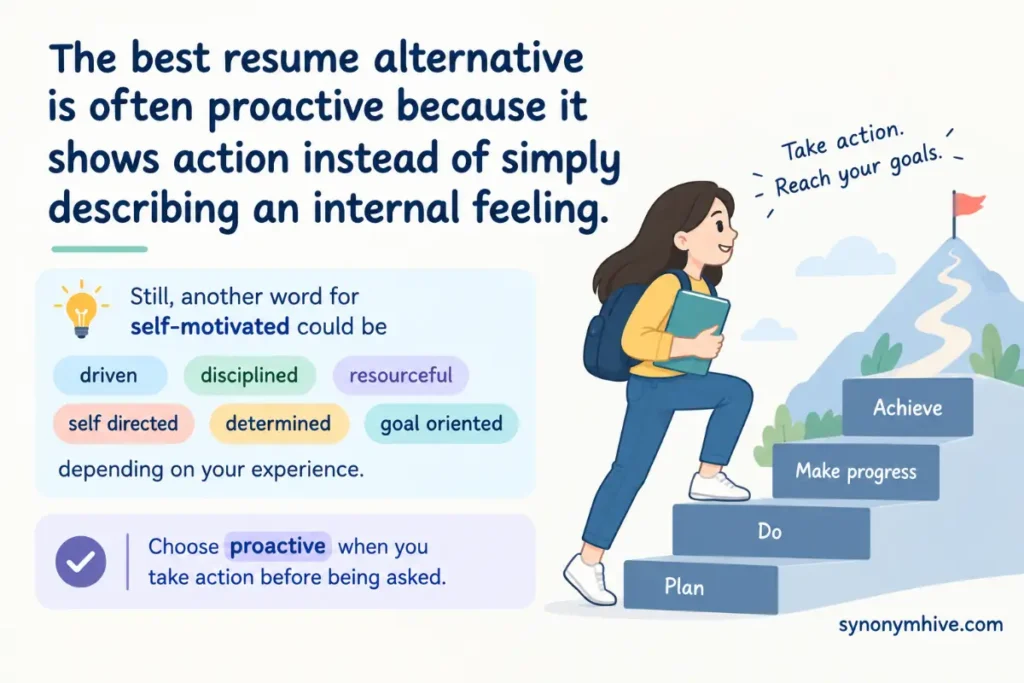
The best resume alternative is often proactive because it shows action instead of simply describing an internal feeling.
Still, another word for self-motivated could be driven, disciplined, resourceful, self directed, determined, or goal oriented depending on your experience.
Choose proactive when you take action before being asked.
Select driven when you consistently push toward ambitious goals.
Consider disciplined when you maintain strong work habits.
Pick resourceful when you solve problems independently.
Highlight self directed when you manage your own learning or work.
Choose determined when you continue despite challenges.
Mention goal oriented when your work centers on clear results.
The best resume word should connect directly to something you’ve done.
What is another word for self motivated in an essay
In an essay you have more freedom to use words such as determined, ambitious, disciplined, persistent, purposeful, or internally motivated.
The best choice depends on your subject.
For example:
The student showed determination by continuing to practice after several failed attempts.
Or:
Her curiosity and ambition encouraged her to explore subjects beyond the classroom.
Academic writing often benefits from precise language. Instead of repeating self motivated several times, explain the behavior behind the motivation.
What is another word for self motivated in an email
For professional emails, proactive, motivated, committed, and eager to learn usually sound natural.
For example:
I’m eager to take ownership of the project and keep it moving forward.
Another option is:
I’m happy to take the initiative and handle the next steps.
These sentences sound more conversational than simply saying:
I’m self motivated.
They also tell the reader what you intend to do.
What is another word for self motivated in a text
Text messages usually call for simple language.
Try:
- Driven.
- Focused.
- Determined.
- Ambitious.
- Motivated.
- Ready to work.
- Always pushing forward.
For example:
I’m pretty driven when I care about a goal.
Or:
She’s determined and doesn’t give up easily.
You don’t need formal vocabulary in a text.
Explore more word choices in Another Word for Coordinated Best Resume Choices 2026.
What is another word for self motivated when speaking
In everyday speech, driven, motivated, determined, independent, and ambitious are easy choices.
You could say:
I’m pretty driven when I have something I want to accomplish.
Or:
I’m the type of person who likes to get started without waiting for someone to tell me what to do.
The second version is especially natural because it describes behavior instead of using a label.
What are real examples of self motivation
Real examples make the meaning easier to understand.
- An employee learns a new software program before the company requires everyone to use it.
- A student creates a weekly study schedule without being asked.
- A manager notices a repeated customer complaint and develops a better process.
- A job seeker takes an online course to improve a skill required for a target role.
- A salesperson researches new prospects instead of waiting for assigned leads.
- A team member volunteers to solve a problem after finishing their main task.
- A writer revises an article after noticing that the explanation could be clearer.
- A new employee asks for feedback and uses it to improve future work.
- A freelancer sets personal deadlines and consistently meets them.
- A student continues practicing a difficult skill after making several mistakes.
- A worker identifies a useful certification and completes it independently.
- A project leader creates a plan before the team receives detailed instructions.
- An employee develops a shortcut that saves coworkers time.
- A professional reads industry material regularly to keep building knowledge.
- A manager sets measurable goals and checks progress without needing reminders.
Each example demonstrates action. That’s the key.
How can you show self motivation on a resume
The strongest approach is to replace vague claims with evidence.
Instead of:
Self motivated employee with excellent work habits.
Try:
Proactively identified workflow problems and created a simpler process that improved team efficiency.
Instead of:
Highly motivated professional.
Try:
Completed advanced training while managing a full workload and applied the new skills to daily projects.
Instead of:
Self motivated team member.
Try:
Took initiative to create a team resource that reduced repeated questions from new employees.
These examples give employers something they can evaluate.
That’s much stronger than relying on an adjective.
What words should you use for leadership
Leadership roles often benefit from proactive, decisive, driven, resourceful, enterprising, and goal oriented.
For example:
Proactive team leader who identifies obstacles early and keeps projects moving toward clear goals.
Another option is:
Resourceful manager who takes initiative and develops practical solutions to team challenges.
These descriptions show action and responsibility.
What words should you use for students
Students can use motivated, disciplined, curious, determined, independent, proactive, and eager to learn.
For example:
Disciplined student who balances coursework with independent research and professional development.
Or:
Curious learner who actively develops technical skills through coursework and personal projects.
Students should avoid making their resumes sound like they have decades of professional experience. Honest and specific language works better.
What words should you use for managers
Managers often need to demonstrate initiative, leadership, discipline, accountability, drive, and strategic thinking.
Useful choices include:
- Proactive.
- Decisive.
- Driven.
- Accountable.
- Resourceful.
- Goal oriented.
- Results focused.
- Purpose driven.
For example:
Proactive manager who identifies operational issues early and develops practical solutions.
That sentence communicates action and leadership at the same time.
What words should you use for entry level jobs
For entry level roles, simple words often work best.
Try:
- Eager to learn.
- Reliable.
- Motivated.
- Adaptable.
- Curious.
- Proactive.
- Teachable.
- Hardworking.
- Responsible.
- Determined.
For example:
Proactive entry level professional who learns new systems quickly and welcomes feedback.
This gives an employer a clear reason to take notice.
How can you avoid sounding like a resume template
Avoid stacking several similar adjectives together.
For example:
I’m a highly motivated proactive driven ambitious hardworking and goal oriented professional.
That sentence sounds crowded and generic.
Choose one strong quality and support it.
For example:
Proactively learned a new reporting system and created a simple guide for coworkers.
The action does the heavy lifting.
You can also use numbers when they’re accurate.
For example:
Completed a six week certification program while working full time.
Or:
Created a new tracking process that helped the team monitor 50 plus weekly requests.
Specific details create credibility.
What are common mistakes with self motivated synonyms
One mistake is choosing a word that sounds stronger than your evidence.
Calling yourself tenacious makes sense if you can show persistence through a serious challenge. It may sound excessive for a simple routine task.
Another mistake is using ambitious when you actually mean curious.
Ambition focuses on achievement. Curiosity focuses on learning.
Another common mistake is using independent when you really mean proactive.
Independent tells the reader that you can work alone. Proactive tells the reader that you take action.
You should also avoid forcing slang into formal documents.
Words such as go getter and hustling can work in casual speech. They usually don’t belong in a traditional resume.
When should you not use a synonym
Don’t change the word simply because you want variety.
If self motivated accurately describes the quality and fits your audience then the phrase can work.
Also avoid alternatives that change your intended meaning.
For example, disciplined doesn’t automatically mean ambitious. Independent doesn’t automatically mean proactive. Energetic doesn’t automatically mean determined.
Choose the word based on the behavior you can support.
A precise word is better than an impressive sounding word.
What are the antonyms of self motivated
Common opposites include:
- Unmotivated.
- Passive.
- Apathetic.
- Dependent.
- Indifferent.
- Unfocused.
- Disengaged.
- Inactive.
- Reluctant.
- Complacent.
The exact opposite depends on the situation.
Passive describes someone who waits for others to act.
Unmotivated describes a lack of desire or energy to pursue a goal.
Dependent can describe someone who needs frequent assistance or direction.
These distinctions matter in professional writing.
How do you choose the right word
Start by asking what you actually want to communicate.
Before someone asks you to act, choose proactive.
For challenging goals, choose driven.
Despite setbacks, choose persistent or determined.
With consistent habits, choose disciplined.
When solving unfamiliar problems, choose resourceful.
Without close supervision, choose independent or self directed.
For a specific goal, choose ambitious.
For measurable results, choose goal oriented.
With responsibility for your own work, choose initiative or self reliant.
This method keeps your writing honest and precise.
How can you make your resume stronger
Use a simple formula.
Strong word + action + result.
For example:
Proactively identified customer service delays and created a tracking system that improved response times.
Another example:
Disciplined learner who completed advanced training and applied new technical skills to daily projects.
Another:
Resourceful team member who developed a simpler process for handling recurring customer requests.
These sentences work because they connect the personal quality to something observable.
If you have a measurable result then include it.
If you don’t have a number then describe the action clearly.
What is another word for self motivated in professional writing
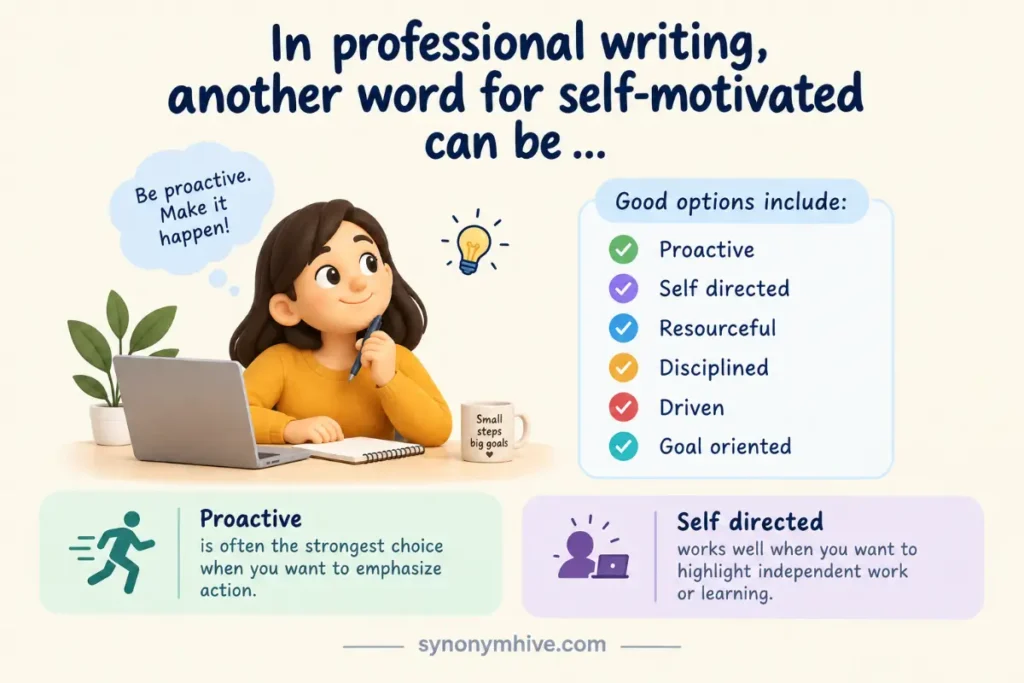
In professional writing another word for self-motivated can be proactive, self directed, resourceful, disciplined, driven, or goal oriented.
Proactive is often the strongest choice when you want to emphasize action.
Self directed works well when you want to highlight independent work or learning.
Resourceful is useful for problem solving.
Disciplined fits consistent performance.
Driven suits ambitious goals.
Goal oriented works when your work has clear targets.
Don’t choose based on which word sounds most impressive. Choose based on what you can prove.
How can you use self motivation without saying self motivated
You can describe the behavior directly.
Instead of:
I’m self motivated.
Write:
I take initiative and look for ways to improve my work.
Instead of:
She’s self motivated.
Write:
She independently identified the issue and developed a solution.
Instead of:
He’s highly self motivated.
Write:
He consistently sets goals and follows through without constant supervision.
These versions sound more human because they show the reader how the person behaves.
Quick tips for choosing the right word
Use these simple rules when choosing your final word.
- Choose proactive for early action.
- Choose driven for strong ambition.
- Choose disciplined for consistency.
- Choose determined for strong commitment.
- Choose persistent for continued effort.
- Choose resourceful for problem solving.
- Choose independent for working without close supervision.
- Choose self directed for independent learning.
- Choose ambitious for career or achievement goals.
- Choose goal oriented for measurable targets.
- Choose committed for dedication.
- Choose enterprising for initiative and opportunity seeking.
- Choose focused for strong attention.
- Choose energetic for enthusiasm and activity.
- Choose curious for learning and exploration.
The right choice should make your sentence clearer rather than simply more impressive.
Learn more useful word alternatives in Another Word for Developed Best Resume Choices 2026.
Conclusion
Choosing another word for self-motivated becomes easier when you focus on the behavior behind the phrase. Use proactive when you take action before being asked. Choose disciplined when consistency is your strength. Use driven or ambitious when strong goals push you forward. Pick resourceful when you solve problems independently and self directed when you manage your own work or learning.
For a resume the strongest choice is rarely the most complicated word. It’s the word you can support with real evidence. Show what you started what you learned what you improved and what results you achieved.
That approach makes your writing clearer and more convincing. It also helps employers understand how you work rather than simply giving them another personality label.
Frequently Asked Questions
What’s another way to say self motivated?
Proactive is one of the strongest alternatives when you want to show that you take action without waiting for instructions. Other useful choices include driven, disciplined, determined, resourceful, and self directed.
What is another word for self motivated on a resume?
Another word for self-motivated on a resume can be proactive, driven, self directed, disciplined, or goal oriented. Choose the term that matches your actual work behavior.
What is a professional way to say self motivated?
A professional way to express the idea is proactive or self directed. You can also show the quality through a specific accomplishment instead of naming it directly.
What word describes someone who works without being told?
Proactive is a strong word for someone who takes action without waiting for instructions. Self directed and independent can also fit depending on the situation.
Is proactive the same as self motivated?
No. Self motivated focuses on internal drive while proactive focuses on taking action ahead of a request or problem. The two qualities often appear together.
What is the opposite of self motivated?
The opposite can be unmotivated or passive. The best choice depends on the behavior you want to describe.
How can I show that I am self motivated on my resume?
Show independent action and results instead of simply making the claim. Mention projects you started yourself skills you learned independently problems you solved or improvements you introduced.